Q1821.‘T + U’ means ‘T is the mother of U’.
‘T – U’ means ‘T is the father of U’.
‘T $ U’ means ‘T is the husband of U’.
‘T # U’ means ‘T is the daughter of U’.
If A # C $ V + X, then how is A related to X?
‘T + U’ का अर्थ है ‘T, U की माता है’।
‘T – U’ का अर्थ है ‘T, U का पिता है’।
‘T $ U’ का अर्थ है ‘T, U का पति है’।
‘T # U’ का अर्थ है ‘T, U की पुत्री है’।
यदि A # C $ V + X है, तो A का X से क्या संबंध है?
- ABrotherभाई
- BSisterबहन
- CFatherपिता
- DDaughterपुत्री
Show answer
Concept: Decode the symbols one by one and draw the family tree.
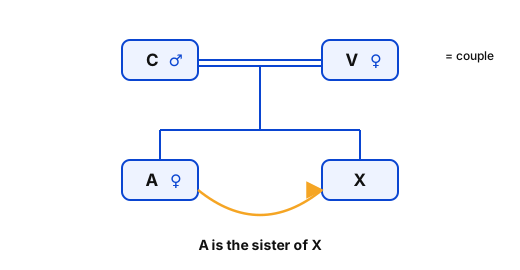
- A # C: A is the daughter of C (A is female).
- C $ V: C is the husband of V.
- V + X: V is the mother of X.
- A and X are both children of the couple C–V; A is female, so A is X's sister.
Trick: A 'daughter' at the start of the chain always ends as sister of the other child.
Answer: (B) Sister
अवधारणा: चिह्नों को एक-एक कर डिकोड करें और वंश-वृक्ष बनाएँ।
- A # C: A, C की बेटी है (A स्त्री)।
- C $ V: C, V का पति है।
- V + X: V, X की माँ है।
- A और X दोनों दंपति C–V की संतान हैं; A स्त्री है, अतः X की बहन (Sister)।
ट्रिक: श्रृंखला की शुरुआत में 'बेटी' हो तो वह दूसरी संतान की बहन होती है।
उत्तर: (B) बहन (Sister)
SSC CPO Paper IGeneral Intelligence and ReasoningBlood Relation (Coded)SSC CPO Paper I 2023 · 5 Oct Shift 3
Q1822.A paper is folded and cut as shown below. How will it appear when unfolded?
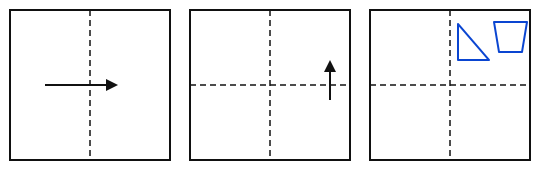
एक कागज़ को नीचे दर्शाए गए अनुसार मोड़ा और काटा जाता है। खोलने पर यह कैसा दिखाई देगा?
- A
- B
- C
- D
Show answer
Concept: Unfolding reflects every cut across each fold line, giving four mirror-image copies for two folds.
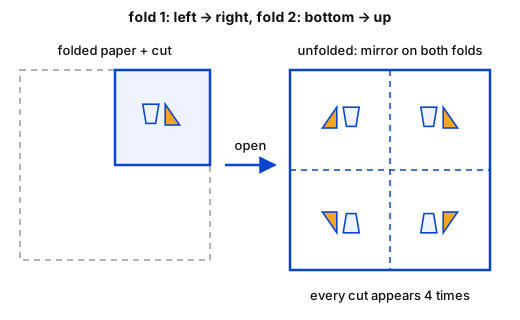
- Fold 1: left half onto right (vertical line); fold 2: bottom half up (horizontal line). Cuts – a right triangle and a trapezium – lie in the top-right quarter.
- Opening fold 2 reflects them into the bottom-right quarter, upside down.
- Opening fold 1 reflects the right half into the left half, left–right reversed.
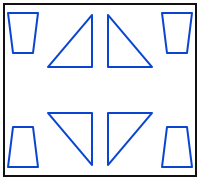
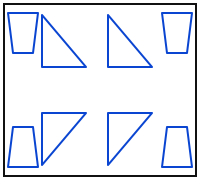
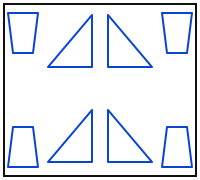
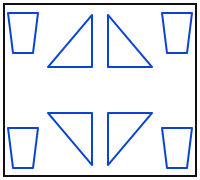
- Result: trapeziums at the four outer corners, triangles next to the centre line, top row and bottom row mirror images – option (A).
Trick: Compare the top row with the bottom row: they must be upside-down copies of each other.
Answer: (A) the first figure
अवधारणा: खोलने पर हर कट प्रत्येक मोड़-रेखा के सापेक्ष परावर्तित होता है; दो मोड़ों से चार दर्पण-प्रतियाँ बनती हैं।
- मोड़ 1: बायाँ आधा दाईं ओर (ऊर्ध्व रेखा); मोड़ 2: नीचे का आधा ऊपर (क्षैतिज रेखा)। कट – समकोण त्रिभुज व समलंब (trapezium) – ऊपर-दाएँ भाग में हैं।
- मोड़ 2 खोलने पर वे नीचे-दाएँ भाग में उलटे दिखते हैं।
- मोड़ 1 खोलने पर दायाँ आधा बाएँ में बाएँ–दाएँ उलटा परावर्तित होता है।
- परिणाम: चारों बाहरी कोनों पर trapezium, केंद्र-रेखा के पास त्रिभुज, ऊपरी व निचली पंक्ति एक-दूसरे के दर्पण – विकल्प (A)।
ट्रिक: ऊपरी और निचली पंक्ति की तुलना करें: वे एक-दूसरे की उलटी प्रतियाँ होनी चाहिए।
उत्तर: (A) पहली आकृति
SSC CPO Paper IGeneral Intelligence and ReasoningPaper Folding and CuttingSSC CPO Paper I 2023 · 5 Oct Shift 3
Q1823.Select the set in which the numbers are related in the same way as are the numbers of the following sets.
(NOTE : Operations should be performed on the whole numbers, without breaking
down the numbers into its constituent digits. E.g. 13 – Operations on 13 such as
adding /subtracting /multiplying etc. to 13 can be performed. Breaking down 13 into 1 and 3 and then performing mathematical operations on 1 and 3 is not allowed)
(112, 327, 215), (98, 254, 156)
उस समुच्चय का चयन कीजिए जिसकी संख्याएँ आपस में उसी प्रकार संबंधित हैं, जिस प्रकार निम्नलिखित समुच्चयों की संख्याएँ आपस में संबंधित हैं।
(ध्यान दें: संक्रियाएँ संख्याओं को उनके घटक अंकों में विभाजित किए बिना, पूर्ण संख्याओं पर की जानी चाहिए। उदाहरण के लिए, 13 – 13 पर की जाने वाली संक्रियाएँ, जैसे 13 में जोड़ना/घटाना/गुणा करना आदि की जा सकती हैं। 13 को 1 और 3 में विभाजित करना और फिर 1 और 3 पर गणितीय संक्रियाएँ करना वर्जित है।)
(112, 327, 215), (98, 254, 156)
- A(108, 209, 184)
- B(105, 347, 322)
- C(126, 268, 142)
- D(281, 490,309)
Show answer
Concept: Find how the middle number is formed from the other two.
- (112, 327, 215): .
- (98, 254, 156): .
- Rule: first third second.
- (126, 268, 142): ✓. Check others: , , .
Trick: Middle number = sum of the outer two – test units digits first ( ✓).
Answer: (C) (126, 268, 142)
अवधारणा: बीच की संख्या बाकी दो से कैसे बनती है, यह खोजें।
- (112, 327, 215): ।
- (98, 254, 156): ।
- नियम: पहली तीसरी दूसरी।
- (126, 268, 142): ✓। अन्य: , , ।
ट्रिक: बीच वाली = बाहरी दोनों का योग – पहले इकाई अंक जाँचें ( ✓)।
उत्तर: (C) (126, 268, 142)
SSC CPO Paper IGeneral Intelligence and ReasoningNumber Set AnalogySSC CPO Paper I 2023 · 5 Oct Shift 3
Q1824.Select the set in which the numbers are related in the same way as are the numbers of the following set.
(NOTE : Operations should be performed on the whole numbers, without breaking
down the numbers into its constituent digits. E.g. 13 – Operations on 13 such as
adding/ subtracting/ multiplying etc. to 13 can be performed. Breaking down 13 into 1 and 3 and then performing mathematical operations on 1 and 3 is NOT allowed)
(5, 4, 2)
(9, 9, 3)
उस समुच्चय का चयन कीजिए जिसकी संख्याएँ आपस में उसी प्रकार संबंधित हैं, जिस प्रकार निम्नलिखित समुच्चय की संख्याएँ आपस में संबंधित हैं।
(ध्यान दें: संक्रियाएँ संख्याओं को उनके घटक अंकों में विभाजित किए बिना, पूर्ण संख्याओं पर की जानी चाहिए। उदाहरण के लिए, 13 – 13 पर की जाने वाली संक्रियाएँ, जैसे 13 में जोड़ना/घटाना/गुणा करना आदि की जा सकती हैं। 13 को 1 और 3 में विभाजित करना और फिर 1 और 3 पर गणितीय संक्रियाएँ करना वर्जित है।)
(5, 4, 2)
(9, 9, 3)
- A(21,39,1)
- B(5,2,6)
- C(24,43,34)
- D(17,6,5)
Show answer
Concept: Find one operation on the whole numbers that links the three numbers of each given set, then test every option with the same rule.
- Rule: . For (5, 4, 2): .
- For (9, 9, 3): . The rule holds for both sets.
- (A) (21, 39, 1): . It fits.
- (B) ; (C) ; (D) . None of these fits.
Trick: Once a rule fits both given sets, check it on all four options; only one option should pass.
Answer: (A) (21, 39, 1)
अवधारणा: दिए गए हर set की तीनों संख्याओं को पूरी संख्या पर एक ही operation से जोड़ने वाला नियम ढूँढें, फिर वही नियम हर option पर लगाएँ।
- नियम: । (5, 4, 2) के लिए: ।
- (9, 9, 3) के लिए: । नियम दोनों sets पर लागू होता है।
- (A) (21, 39, 1): । यह सही बैठता है।
- (B) ; (C) ; (D) । इनमें से कोई नहीं बैठता।
ट्रिक: जब कोई नियम दोनों दिए गए sets पर सही बैठ जाए, तो उसे चारों options पर जाँचें; केवल एक option ही पास होना चाहिए।
उत्तर: (A) (21, 39, 1)
SSC CPO Paper IGeneral Intelligence and ReasoningNumber Set RelationshipSSC CPO Paper I 2023 · 5 Oct Shift 3
Q1825.Seven people, A, B, C, D, E, F and G, are sitting in a straight row, facing north. Only 2 people sit to the right of D. G is an immediate neighbour of D. Only 3 people sit
between A and G. Only 2 people sit between B and C. E is not an immediate neighbour of C. F sits to the immediate right of G.
Who sits to the immediate left of A?
सात व्यक्ति A, B, C, D, E, F और G, उत्तर की ओर मुख करके एक सीधी पंक्ति में बैठे हैं। D के दाईं ओर केवल 2 व्यक्ति बैठे हैं। G, D का निकटतम पड़ोसी है। A और G के बीच केवल 3 व्यक्ति बैठे हैं।
B और C के बीच केवल 2 व्यक्ति बैठे हैं। E, C का निकटतम पड़ोसी नहीं है। F, G के ठीक दाईं ओर बैठा है।
A के ठीक बाईं ओर कौन बैठा है?
- AE
- BC
- CD
- DB
Show answer
Concept: Fix definite positions first (positions 1–7 from left, all facing north).
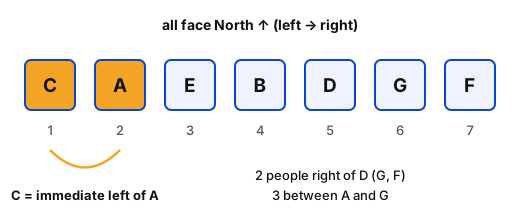
- Only 2 people to the right of D ⇒ D = 5.
- G is next to D and F is immediately right of G: G = 4 would make F = 5 (D's seat), so G = 6, F = 7.
- 3 people between A and G ⇒ A = 2.
- Free seats 1, 3, 4: B and C with 2 between ⇒ seats 1 and 4; E = 3. E not next to C ⇒ C = 1, B = 4.
- Row: C A E B D G F ⇒ immediate left of A is C.
Trick: Start with the statement that fixes a seat directly ('only 2 to the right').
Answer: (B) C
अवधारणा: पहले निश्चित स्थान तय करें (बाएँ से 1–7, सभी उत्तर की ओर मुख)।
- D के दाईं ओर केवल 2 लोग ⇒ D = 5।
- G, D के पास और F, G के ठीक दाएँ: G = 4 हो तो F = 5 (D का स्थान), अतः G = 6, F = 7।
- A और G के बीच 3 लोग ⇒ A = 2।
- खाली स्थान 1, 3, 4: B और C के बीच 2 ⇒ स्थान 1 और 4; E = 3। E, C के पास नहीं ⇒ C = 1, B = 4।
- पंक्ति: C A E B D G F ⇒ A के ठीक बाएँ C।
ट्रिक: उस कथन से शुरू करें जो सीधे स्थान तय करता है ('केवल 2 दाईं ओर')।
उत्तर: (B) C
SSC CPO Paper IGeneral Intelligence and ReasoningSeating Arrangement (Linear)SSC CPO Paper I 2023 · 5 Oct Shift 3
Q1826.Select the option that represents the correct order of the given words as they would appear in an English dictionary?
1.Brochure
2.Brine
3.Bright
4.Brief
5.Brocade
उस विकल्प का चयन कीजिए जो दिए गए शब्दों का वह सही क्रम दर्शाता है जिसमें वे अंग्रेज़ी शब्दकोश में आते हैं?
1.Brochure
2.Brine
3.Bright
4.Brief
5.Brocade
- A1, 2, 3, 4, 5
- B1, 2, 3, 5, 4
- C4, 3, 2, 5, 1
- D3, 2, 5, 4, 1
Show answer
Concept: All words begin with 'Br'; compare from the 3rd letter onward.
- 3rd letters: Bri-ef, Bri-ght, Bri-ne (i) come before Bro-cade, Bro-chure (o).
- Among Bri-: e (Brief) < g (Bright) < n (Brine).
- Among Broc-: a (Brocade) < h (Brochure).
- Order: Brief, Bright, Brine, Brocade, Brochure = 4, 3, 2, 5, 1.
Trick: Group by the first differing letter (i before o), then sort inside each group.
Answer: (C) 4, 3, 2, 5, 1
अवधारणा: सभी शब्द 'Br' से शुरू होते हैं; तीसरे अक्षर से तुलना करें।
- तीसरा अक्षर: Bri-ef, Bri-ght, Bri-ne (i), Bro-cade, Bro-chure (o) से पहले।
- Bri- में: e (Brief) < g (Bright) < n (Brine)।
- Broc- में: a (Brocade) < h (Brochure)।
- क्रम: Brief, Bright, Brine, Brocade, Brochure = 4, 3, 2, 5, 1।
ट्रिक: पहले भिन्न अक्षर से समूह बनाएँ (i, o से पहले), फिर समूह के भीतर क्रम।
उत्तर: (C) 4, 3, 2, 5, 1
SSC CPO Paper IGeneral Intelligence and ReasoningDictionary OrderSSC CPO Paper I 2023 · 5 Oct Shift 3
Q1827.If ‘+’ means ‘−’, ‘−’ means ‘×’, ‘×’ means ‘÷’ and ‘÷’ means ‘+’, what will come in place of ‘?’ in the following equation?
79 ÷ 64 × 8 − 7 + 12 = ?
यदि ‘+’ का अर्थ ‘−’, ‘−’ का अर्थ ‘×’, ‘×’ का अर्थ ‘÷’ और ‘÷’ का अर्थ ‘+’ है, तो निम्नलिखित समीकरण में ‘?’ के स्थान पर क्या आएगा?
79 ÷ 64 × 8 − 7 + 12 = ?
- A123
- B117
- C138
- D147
Show answer
Concept: Replace each sign by its meaning, then apply BODMAS.
- ÷ → +, × → ÷, − → ×, + → −.
- becomes .
- , .
- .
Trick: Rewrite the whole expression first, then calculate – never mix old and new signs.
Answer: (A) 123
अवधारणा: हर चिह्न को उसके अर्थ से बदलें, फिर BODMAS लगाएँ।
- ÷ → +, × → ÷, − → ×, + → −।
- बनता है ।
- , ।
- ।
ट्रिक: पहले पूरा व्यंजक दोबारा लिखें, फिर गणना करें – पुराने व नए चिह्न न मिलाएँ।
उत्तर: (A) 123
SSC CPO Paper IGeneral Intelligence and ReasoningMathematical Operations (Sign Interchange)SSC CPO Paper I 2023 · 5 Oct Shift 3
Q1828.Two statements are given followed by three conclusions numbered I, II and III.
Assuming the statements to be true, even if they seem to be at variance with
commonly known facts, decide which of the conclusions logically follow(s) from the statements.
Statements:
All keys are locks.
No door is a lock.
Conclusions:
I. Some locks are doors.
II. Some locks are keys.
III. No key is a door.
दो कथन दिए गए हैं, जिनके बाद I, II और III क्रमांकित तीन निष्कर्ष दिए गए हैं।
कथनों को सत्य मानते हुए, भले ही वे सामान्य रूप से ज्ञात तथ्यों से भिन्न प्रतीत होते हों,
निर्णय लीजिए कि कौन-सा/कौन-से निष्कर्ष तार्किक रूप से कथनों का अनुसरण करता है/करते हैं।
कथन:
सभी चाबियाँ, ताले हैं।
कोई दरवाज़ा, ताला नहीं है।
निष्कर्ष:
I. कुछ ताले, दरवाज़े हैं।
II. कुछ ताले, चाबियाँ हैं।
III. कोई चाबी, दरवाज़ा नहीं है।
- ABoth conclusions I and II follow.निष्कर्ष I और II दोनों अनुसरण करते हैं।
- BConclusions I, II and III follow.निष्कर्ष I, II और III अनुसरण करते हैं।
- CBoth conclusions II and III follow.निष्कर्ष II और III दोनों अनुसरण करते हैं।
- DBoth conclusions I and III follow.निष्कर्ष I और III दोनों अनुसरण करते हैं।
Show answer
Concept: Draw the least-overlap Venn diagram consistent with the statements.
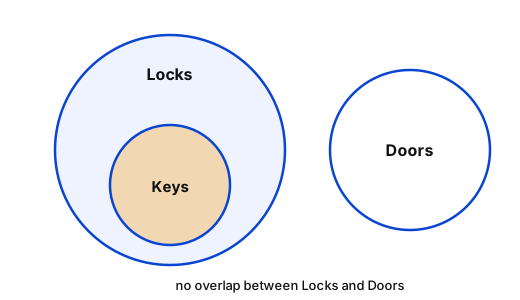
- All keys are locks → Keys circle inside Locks.
- No door is a lock → Doors completely outside Locks, hence outside Keys too.
- I: Some locks are doors – false (no overlap). II: Some locks are keys – true (conversion of 'All keys are locks'). III: No key is a door – true.
Trick: 'All A are B' always gives 'Some B are A'; anything inside B shares the 'No' relation of B.
Answer: (C) Both conclusions II and III follow.
अवधारणा: कथनों के अनुरूप वेन आरेख बनाएँ।
- सभी keys, locks हैं → Keys का वृत्त Locks के अंदर।
- कोई door, lock नहीं है → Doors, Locks से पूरी तरह बाहर, अतः Keys से भी बाहर।
- I: कुछ locks, doors हैं – गलत। II: कुछ locks, keys हैं – सही ('All keys are locks' का रूपांतरण)। III: कोई key, door नहीं – सही।
ट्रिक: 'सभी A, B हैं' से सदा 'कुछ B, A हैं'; B के अंदर की हर चीज़ पर B का 'No' संबंध लागू।
उत्तर: (C) Both conclusions II and III follow.
SSC CPO Paper IGeneral Intelligence and ReasoningSyllogismSSC CPO Paper I 2023 · 5 Oct Shift 3
Q1829.In a certain code language, 'Live long' is coded as 'mu ae', 'Road is long' is coded as 'ae si du' and 'Game is live' is coded as 'si mu zt'. What is the code for the word
'Game'?
एक निश्चित कूट भाषा में, ‘Live long’ को ‘mu ae’ के रूप में कूटबद्ध किया जाता है, ‘Road is long’ को ‘ae si du’ के रूप में कूटबद्ध किया जाता है और ‘Game is live’ को ‘si mu zt’ के रूप में कूटबद्ध किया जाता है। शब्द
‘Game’ का कूट क्या है?
- Asi
- Bmu
- Czt
- Dae
Show answer
Concept: Find common words between sentences and match them with common codes.
- 'Live long' = mu ae and 'Road is long' = ae si du ⇒ long = ae, so live = mu.
- 'Road is long' and 'Game is live': common word 'is' = common code si.
- 'Game is live' = si mu zt; removing is (si) and live (mu) ⇒ Game = zt.
Trick: Common word ↔ common code; eliminate known codes to get the rest.
Answer: (C) zt
अवधारणा: वाक्यों में समान शब्द और समान कोड मिलाएँ।
- 'Live long' = mu ae तथा 'Road is long' = ae si du ⇒ long = ae, अतः live = mu।
- 'Road is long' व 'Game is live' में समान शब्द 'is' = समान कोड si।
- 'Game is live' = si mu zt; is (si) व live (mu) हटाने पर Game = zt।
ट्रिक: समान शब्द ↔ समान कोड; ज्ञात कोड हटाकर बाकी निकालें।
उत्तर: (C) zt
SSC CPO Paper IGeneral Intelligence and ReasoningCoding–Decoding (Word Codes)SSC CPO Paper I 2023 · 5 Oct Shift 3
Q1830.Which two signs should be interchanged to make the given equation correct?
42 ÷ 7 + 11 × 87 – 12 = 141
दिए गए समीकरण को सही बनाने के लिए किन दो चिह्नों को आपस में बदला जाना चाहिए?
42 ÷ 7 + 11 × 87 – 12 = 141
- A÷ and –÷ और –
- B÷ and +÷ और +
- Cx and +x और +
- D– and ×– और ×
Show answer
Concept: Interchange the signs in each option and check with BODMAS.
- Interchange × and +: .
- , .
- ✓.
Trick: The target 141 is near , which hints that 87 should be added – so + must move next to 87.
Answer: (C) × and +
अवधारणा: हर विकल्प के चिह्न बदलकर BODMAS से जाँचें।
- × और + बदलें: ।
- , ।
- ✓।
ट्रिक: लक्ष्य 141, के पास है – अतः 87 के साथ + आना चाहिए।
उत्तर: (C) × और +
SSC CPO Paper IGeneral Intelligence and ReasoningSign InterchangeSSC CPO Paper I 2023 · 5 Oct Shift 3
Q1831.Select the option that is related to the third word in the same way as the second word is related to the first word.
(The words must be considered as meaningful words and must not be related to each other based on the number of letters/number of consonants/vowels in the word.)
Pressure : Barometer :: Electricity : ?
उस विकल्प का चयन कीजिए जो तीसरे शब्द से उसी प्रकार संबंधित है, जिस प्रकार दूसरा शब्द पहले शब्द से संबंधित है।
(शब्दों को अर्थपूर्ण शब्दों के रूप में माना जाना चाहिए और उन्हें शब्द में अक्षरों की संख्या/व्यंजनों/स्वरों की संख्या के आधार पर एक-दूसरे से संबंधित नहीं किया जाना चाहिए।)
दाब : बैरोमीटर :: विद्युत : ?
- ACyclotronसाइक्लोट्रॉन
- BBolometerबोलोमीटर
- CAudiometerऑडियोमीटर
- DMultimeterमल्टीमीटर
Show answer
Concept: The pair is 'physical quantity : instrument that measures it'.
- A barometer measures atmospheric pressure.
- A multimeter measures electrical quantities – current, voltage and resistance.
- Bolometer measures radiant heat, audiometer measures hearing, a cyclotron is a particle accelerator (not a measuring device).
Trick: Baro- = pressure; Multi-meter = many electrical readings.
Answer: (D) Multimeter
अवधारणा: युग्म 'भौतिक राशि : उसे मापने वाला उपकरण' है।
- बैरोमीटर (Barometer) वायुमंडलीय दाब मापता है।
- मल्टीमीटर (Multimeter) विद्युत राशियाँ – धारा, वोल्टेज व प्रतिरोध – मापता है।
- Bolometer विकिरण ऊष्मा, Audiometer श्रवण-क्षमता मापता है; Cyclotron कण-त्वरक है, मापक नहीं।
ट्रिक: Baro- = दाब; Multi-meter = कई विद्युत माप।
उत्तर: (D) Multimeter
SSC CPO Paper IGeneral Intelligence and ReasoningWord Analogy (Quantity : Instrument)SSC CPO Paper I 2023 · 5 Oct Shift 3
Q1832.Which of the following numbers will replace the question mark (?) in the given series? 270, 241, 212, ?, 154, 125
दी गई श्रृंखला में निम्नलिखित में से कौन-सी संख्या प्रश्न चिह्न (?) के स्थान पर आएगी? 270, 241, 212, ?, 154, 125
- A198
- B186
- C183
- D192
Show answer
Concept: Check the common difference.
- , .
- Next: .
- Check: , ✓.
Trick: Constant difference series – subtract 29 each time.
Answer: (C) 183
अवधारणा: सार्व अंतर जाँचें।
- , ।
- अगला: ।
- जाँच: , ✓।
ट्रिक: स्थिर अंतर वाली श्रृंखला – हर बार 29 घटाएँ।
उत्तर: (C) 183
SSC CPO Paper IGeneral Intelligence and ReasoningNumber SeriesSSC CPO Paper I 2023 · 5 Oct Shift 3
Q1833.Select the option that is related to the third term in the same way as the second term is related to the first term and the sixth term is related to the fifth term.
25 : 18 :: 37 : ? :: 49 : 36
उस विकल्प का चयन कीजिए जो तीसरे पद से उसी प्रकार संबंधित है, जिस प्रकार दूसरा पद पहले पद से संबंधित है और छठा पद पाँचवें पद से संबंधित है।
25 : 18 :: 37 : ? :: 49 : 36
- A29
- B32
- C30
- D27
Show answer
Concept: The first terms 25, 37, 49 rise by 12; find how the second term is obtained from each.
- and .
- Subtracted numbers 7, ?, 13 form a series with step 3, so the middle one is 10.
- . Also 18, 27, 36 rise by 9, matching the pattern.
Trick: Terms in arithmetic progression on both sides: 25, 37, 49 (+12) and 18, 27, 36 (+9).
Answer: (D) 27
अवधारणा: पहले पद 25, 37, 49 में 12 की वृद्धि है; प्रत्येक से दूसरा पद कैसे बनता है, देखें।
- तथा ।
- घटाई गई संख्याएँ 7, ?, 13 में अंतर 3 है, अतः बीच वाली 10।
- । साथ ही 18, 27, 36 में 9 की वृद्धि भी मेल खाती है।
ट्रिक: दोनों ओर समांतर श्रेणी: 25, 37, 49 (+12) और 18, 27, 36 (+9)।
उत्तर: (D) 27
SSC CPO Paper IGeneral Intelligence and ReasoningNumber AnalogySSC CPO Paper I 2023 · 5 Oct Shift 3
Q1834.Six students Meera, Jigyasa, Tarun, Naina, Shambhavi and Avni are sitting around a circular table facing the centre (not necessarily in the same order). Shambhavi is an immediate neighbour of both Jigyasa and Avni. Tarun is sitting third to the left of
Jigyasa. Meera is sitting second to the right of Avni.
Who is sitting second to the left of Jigyasa?
छह विद्यार्थी मीरा, जिज्ञासा, तरुण, नैना, शांभवी और अवनि एक वृत्ताकार मेज़ के चारों ओर केंद्र की ओर मुख करके बैठे हैं (आवश्यक नहीं कि इसी क्रम में हों)। शांभवी, जिज्ञासा और अवनि दोनों की निकटतम पड़ोसी है। तरुण,
जिज्ञासा के बाईं ओर तीसरे स्थान पर बैठा है। मीरा, अवनि के दाईं ओर दूसरे स्थान पर बैठी है।
जिज्ञासा के बाईं ओर दूसरे स्थान पर कौन बैठा है?
- AMeeraमीरा
- BNainaनैना
- CAvniअवनि
- DTarunतरुण
Show answer
Concept: For people facing the centre, left = clockwise and right = anticlockwise.
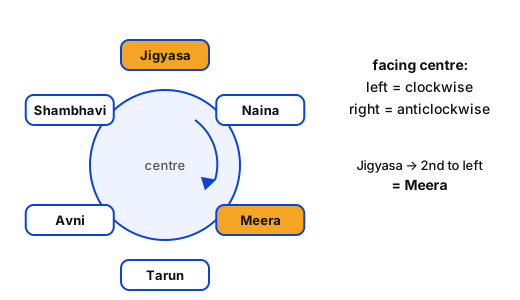
- Tarun is third to the left of Jigyasa ⇒ directly opposite her (6 seats).
- Shambhavi sits next to Jigyasa with Avni on her other side.
- Meera is second to the right of Avni. If Shambhavi were on Jigyasa's left, Meera would land on Jigyasa's seat – impossible. So Shambhavi is on Jigyasa's right and Avni next to her; Meera is then two seats anticlockwise from Avni, and Naina takes the last seat.
- Going clockwise from Jigyasa: Naina, then Meera ⇒ Meera is second to the left of Jigyasa.
Trick: In a 6-seat circle 'third to the left/right' always means directly opposite.
Answer: (A) Meera
अवधारणा: केंद्र की ओर मुख होने पर बायाँ = दक्षिणावर्त (clockwise), दायाँ = वामावर्त (anticlockwise)।
- Tarun, Jigyasa के बाएँ तीसरा ⇒ ठीक सामने (6 सीटें)।
- Shambhavi, Jigyasa के पास और उसकी दूसरी ओर Avni।
- Meera, Avni के दाएँ दूसरी। यदि Shambhavi, Jigyasa के बाएँ हो तो Meera, Jigyasa की सीट पर आती – असंभव। अतः Shambhavi दाएँ, उसके बाद Avni; Meera, Avni से दो सीट वामावर्त, और बची सीट Naina की।
- Jigyasa से दक्षिणावर्त: Naina, फिर Meera ⇒ Meera, Jigyasa के बाएँ दूसरी।
ट्रिक: 6 सीटों के वृत्त में 'तीसरा बाएँ/दाएँ' = ठीक सामने।
उत्तर: (A) Meera
SSC CPO Paper IGeneral Intelligence and ReasoningSeating Arrangement (Circular)SSC CPO Paper I 2023 · 5 Oct Shift 3
Q1835.Which letter-cluster will replace the question mark (?) to complete the given series? BRCQ, EPFO, ?, KLLK, NJOI
दी गई श्रृंखला को पूरा करने के लिए कौन-सा अक्षर-समूह प्रश्न चिह्न (?) के स्थान पर आएगा? BRCQ, EPFO, ?, KLLK, NJOI
- AHINO
- BGNMI
- CHNIM
- DGINO
Show answer
Concept: Follow each letter position separately.
- 1st letters: B, E, ?, K, N → : H.
- 2nd letters: R, P, ?, L, J → : N.
- 3rd letters: C, F, ?, L, O → : I.
- 4th letters: Q, O, ?, K, I → : M.
Trick: Positions 1 & 3 go +3, positions 2 & 4 go −2.
Answer: (C) HNIM
अवधारणा: हर स्थान के अक्षर को अलग से देखें।
- पहला अक्षर: B, E, ?, K, N → : H।
- दूसरा अक्षर: R, P, ?, L, J → : N।
- तीसरा अक्षर: C, F, ?, L, O → : I।
- चौथा अक्षर: Q, O, ?, K, I → : M।
ट्रिक: स्थान 1 व 3 में +3, स्थान 2 व 4 में −2।
उत्तर: (C) HNIM
SSC CPO Paper IGeneral Intelligence and ReasoningLetter Cluster SeriesSSC CPO Paper I 2023 · 5 Oct Shift 3
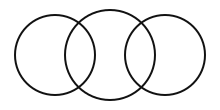
Q1836.Select the Venn diagram that best illustrates the relationship between the following classes.
Animal, Jungle, Wild Animal
उस वेन आरेख का चयन कीजिए जो निम्नलिखित वर्गों के बीच संबंध को सर्वोत्तम रूप से दर्शाता है।
पशु, जंगल, जंगली पशु
- A
- B
- C
- D

Show answer
Concept: Identify subsets and unrelated classes.
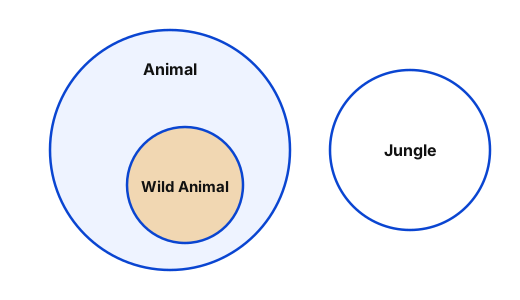
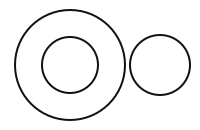
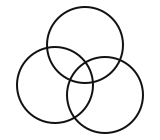
- Every wild animal is an animal → Wild Animal circle inside Animal.
- A jungle is a place, not an animal → a separate circle.
- Figure: a circle inside a bigger circle, and a separate circle.
Trick: Living thing vs place: a place (Jungle) never overlaps a class of animals.
Answer: (A) the first figure
अवधारणा: उपसमुच्चय और असंबंधित वर्ग पहचानें।
- हर जंगली जानवर (Wild Animal) एक जानवर (Animal) है → Wild Animal वृत्त, Animal के अंदर।
- जंगल (Jungle) एक स्थान है, जानवर नहीं → अलग वृत्त।
- आकृति: बड़े वृत्त के अंदर एक वृत्त, और एक अलग वृत्त।
ट्रिक: जीव बनाम स्थान: स्थान (Jungle) जानवरों के वर्ग से कभी नहीं मिलता।
उत्तर: (A) पहली आकृति
SSC CPO Paper IGeneral Intelligence and ReasoningVenn DiagramSSC CPO Paper I 2023 · 5 Oct Shift 3
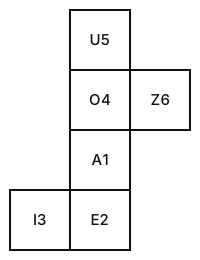
Q1837.When the following figure is folded to form a cube, which letter-number will be on the face opposite to the face showing the letter-number ‘A1’?
(The elements are shown to indicate the sides only.)
जब निम्नलिखित आकृति को मोड़कर घन बनाया जाता है, तो अक्षर-संख्या ‘A1’ वाले फलक के विपरीत फलक पर कौन-सी अक्षर-संख्या होगी?
(तत्व केवल फलकों को इंगित करने के लिए दर्शाए गए हैं।)
- AU5
- BO4
- CI3
- DE2
Show answer
Concept: In a net, two faces in the same straight line with exactly one face between them become opposite faces.
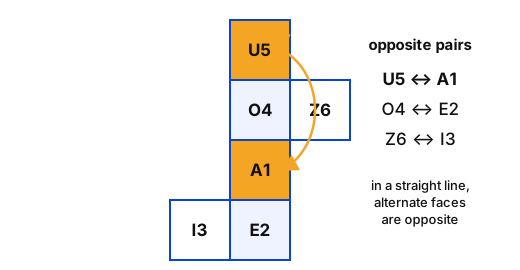
- Vertical column: U5, O4, A1, E2.
- U5 and A1 have one face (O4) between them ⇒ opposite.
- Similarly O4 ↔ E2, and the side faces Z6 ↔ I3.
Trick: Skip one face in a straight line → opposite face.
Answer: (A) U5
अवधारणा: जाल (net) में एक सीधी रेखा में, बीच में ठीक एक फलक छोड़कर वाले दो फलक विपरीत होते हैं।
- ऊर्ध्व स्तंभ: U5, O4, A1, E2।
- U5 और A1 के बीच एक फलक (O4) ⇒ विपरीत।
- इसी प्रकार O4 ↔ E2, और किनारे के फलक Z6 ↔ I3।
ट्रिक: सीधी रेखा में एक फलक छोड़ें → विपरीत फलक।
उत्तर: (A) U5
SSC CPO Paper IGeneral Intelligence and ReasoningCube Net – Opposite FacesSSC CPO Paper I 2023 · 5 Oct Shift 3
Q1838.Which of the given figures when placed in the 5
th position would continue the series that is established by the first four figures?
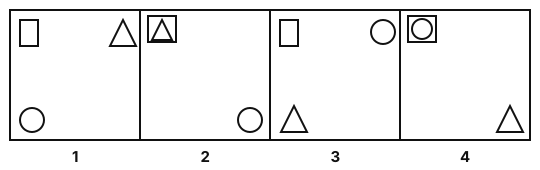
दी गई आकृतियों में से कौन-सी आकृति 5
वें स्थान पर रखे जाने पर पहली चार आकृतियों द्वारा स्थापित श्रृंखला को जारी रखेगी?
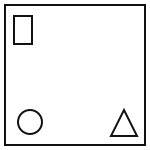
- A
- B
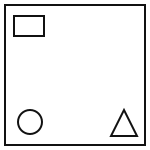
- C
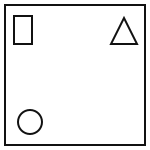
- D
Show answer
Concept: Compare alternate figures – odd and even positions follow separate patterns.
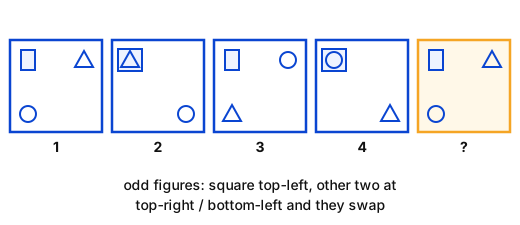
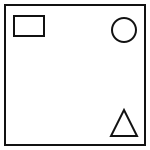
- Figures 1 and 3: an upright rectangle at the top-left and the other two shapes at the top-right and bottom-left corners.
- Triangle and circle swap places each time: Fig 1 – triangle top-right, circle bottom-left; Fig 3 – circle top-right, triangle bottom-left.
- Fig 5 swaps again: triangle top-right, circle bottom-left, rectangle top-left (upright).
- Figures 2 and 4 (shape inside a wide box) belong to the even pattern and do not decide figure 5.
Trick: Position 5 follows positions 1 and 3; with a two-way swap, figure 5 looks like figure 1.
Answer: (C) the third figure
अवधारणा: एक छोड़कर वाली आकृतियों की तुलना करें – विषम व सम स्थान अलग पैटर्न पर चलते हैं।
- आकृति 1 और 3: ऊपर-बाएँ खड़ा आयत, बाकी दो आकृतियाँ ऊपर-दाएँ और नीचे-बाएँ कोनों पर।
- त्रिभुज और वृत्त हर बार स्थान बदलते हैं: आकृति 1 – त्रिभुज ऊपर-दाएँ, वृत्त नीचे-बाएँ; आकृति 3 – वृत्त ऊपर-दाएँ, त्रिभुज नीचे-बाएँ।
- आकृति 5 में फिर बदलाव: त्रिभुज ऊपर-दाएँ, वृत्त नीचे-बाएँ, आयत ऊपर-बाएँ (खड़ा)।
- आकृति 2 और 4 सम पैटर्न की हैं, आकृति 5 तय नहीं करतीं।
ट्रिक: स्थान 5, स्थान 1 व 3 का अनुसरण करता है; अदला-बदली से आकृति 5 = आकृति 1 जैसी।
उत्तर: (C) तीसरी आकृति
SSC CPO Paper IGeneral Intelligence and ReasoningFigure SeriesSSC CPO Paper I 2023 · 5 Oct Shift 3
Q1839.Select the option that is related to the third word in the same way as the second word is related to the first word.
(The words must be considered as meaningful words and must not be related to each other based on the number of letters/number of consonants/vowels in the word.)
Centre : Focus :: Vicar : ?
उस विकल्प का चयन कीजिए जो तीसरे शब्द से उसी प्रकार संबंधित है, जिस प्रकार दूसरा शब्द पहले शब्द से संबंधित है।
(शब्दों को अर्थपूर्ण शब्दों के रूप में माना जाना चाहिए और उन्हें शब्द में अक्षरों की संख्या/व्यंजनों/स्वरों की संख्या के आधार पर एक-दूसरे से संबंधित नहीं किया जाना चाहिए।)
केंद्र (Centre) : फोकस (Focus) :: विकर (Vicar) : ?
- ALifeजीवन
- BPriestपुरोहित
- CBuildingइमारत
- DRiddleपहेली
Show answer
Concept: The words in the first pair are synonyms.
- Centre and Focus both mean the central point of attention.
- A vicar is a member of the clergy in charge of a parish, i.e. a priest.
- Life, Building and Riddle have no such meaning.
Trick: Vicar → church → priest.
Answer: (B) Priest
अवधारणा: पहले युग्म के शब्द समानार्थी (synonym) हैं।
- Centre और Focus दोनों का अर्थ केंद्र/ध्यान का बिंदु है।
- Vicar चर्च का पादरी होता है, यानी Priest।
- Life, Building, Riddle का ऐसा अर्थ नहीं।
ट्रिक: Vicar → चर्च → Priest (पुरोहित)।
उत्तर: (B) Priest
SSC CPO Paper IGeneral Intelligence and ReasoningWord Analogy (Synonym)SSC CPO Paper I 2023 · 5 Oct Shift 3
Q1840.Three of the following four letter-clusters are alike in a certain way and one is different. Pick the odd one out.
निम्नलिखित चार अक्षर-समूहों में से तीन किसी निश्चित प्रकार से एकसमान हैं और एक असंगत है। असंगत का चयन कीजिए।
- AMOKN
- BSQUH
- CGIET
- DCEAX
Show answer
Concept: Compare each letter with the first letter of the cluster (positions A = 1 … Z = 26).
- MOKN: M=O, M=K, N = opposite of M ().
- GIET: G=I, G=E, T opposite of G (). CEAX: C=E, C=A, X opposite of C ().
- SQUH: S=Q, S=U – the +2 and −2 letters are interchanged, though H is the opposite of S ().
Trick: Opposite letters add up to 27; here the order of the 2nd and 3rd letters gives the odd one.
Answer: (B) SQUH
अवधारणा: हर अक्षर की तुलना समूह के पहले अक्षर से करें (A = 1 … Z = 26)।
- MOKN: M=O, M=K, N, M का विपरीत ()।
- GIET: G=I, G=E, T विपरीत ()। CEAX: C=E, C=A, X विपरीत ()।
- SQUH: S=Q, S=U – +2 व −2 वाले अक्षर उलटे क्रम में हैं, यद्यपि H, S का विपरीत है ()।
ट्रिक: विपरीत अक्षरों का योग 27; यहाँ दूसरे व तीसरे अक्षर का क्रम विषम पहचानता है।
उत्तर: (B) SQUH
SSC CPO Paper IGeneral Intelligence and ReasoningOdd One Out (Letter Clusters)SSC CPO Paper I 2023 · 5 Oct Shift 3

