RRB NTPC Undergraduate CBT 1 2024 · Shift 1

RRB NTPC Undergraduate CBT 1 8 Sept 2025 Shift 1 – Question Paper

100 questions · 100 marks · 90 minutes · +1 for a correct answer, −1/3 for a wrong one. With answer key and detailed solutions in Hindi and English.

Test Series – airGurukul

Paper pattern

SectionQuestionsMarks
General Awareness4040
Mathematics3030
General Intelligence and Reasoning3030

Sample questions from this paper

Q1.
What was India's rank in the 2025 Human Development Index (HDI) released by the United Nations Development Programme (UNDP)?
संयुक्त राष्ट्र विकास कार्यक्रम (UNDP) द्वारा जारी 2025 के मानव विकास सूचकांक (HDI) में भारत का स्थान क्या था?
  1. A135
  2. B130
  3. C140
  4. D125
Show answer

Concept: UNDP's Human Development Report 2025 (released May 2025) ranks countries on the HDI, which combines health, education and income.

  1. India ranked 130th of 193 countries in HDR 2025 (HDI value 0.685).
  2. It improved from 133rd in the previous report and stays in the 'medium human development' group.

Yaad rakhein: HDR 2025 → India 130 (up from 133).

Answer: (B) 130

अवधारणा: UNDP की मानव विकास रिपोर्ट 2025 (मई 2025) देशों को HDI पर रैंक करती है — स्वास्थ्य, शिक्षा और आय मिलाकर।

  1. HDR 2025 में भारत 193 में 130वें स्थान पर रहा (HDI मान 0.685)।
  2. पिछली रिपोर्ट के 133वें स्थान से सुधार; भारत 'मध्यम मानव विकास' समूह में है।

याद रखें: HDR 2025 → भारत 130 (133 से ऊपर)।

उत्तर: (B) 130
RRB NTPC Undergraduate CBT 1General AwarenessHuman Development Index 2025
Q41.
The product of two consecutive natural numbers is 650. The greater of the two numbers is:
दो क्रमागत प्राकृत संख्याओं का गुणनफल 650 है। दोनों संख्याओं में से बड़ी संख्या है:
  1. A29
  2. B31
  3. C43
  4. D26
Show answer

Concept: For consecutive numbers n(n+1)=650, n is close to 650.

  1. 650≈25.5, so try 25 and 26.
  2. 25×26=650 ✓
  3. Greater number =26.

Trick: Product ending in 0 with numbers near N: 25×26 (5 × even → ends in 0).

Answer: (D) 26

अवधारणा: क्रमागत संख्याओं के लिए n(n+1)=650, n लगभग 650 के बराबर होगा।

  1. 650≈25.5, अतः 25 और 26 लें।
  2. 25×26=650 ✓
  3. बड़ी संख्या =26।

ट्रिक: N के आसपास की दो संख्याएँ जाँचें: 25×26=650।

उत्तर: (D) 26

RRB NTPC Undergraduate CBT 1MathematicsNumber system – consecutive numbers
Q71.
Read the given statements and conclusions carefully. Assuming that the information given in the statements is true, even if it appears to be at variance with commonly known facts, decide which of the given conclusions logically follow(s) from the statements.
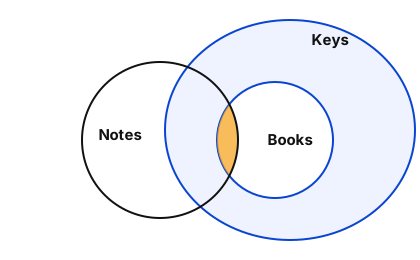
Statements: Some notes are books. All books are keys.
Conclusions (I): Some notes are keys.
Conclusions (II): All keys are books.
दिए गए कथनों और निष्कर्षों को ध्यानपूर्वक पढ़िए। कथनों में दी गई जानकारी को सत्य मानते हुए, भले ही वह सामान्यतः ज्ञात तथ्यों से भिन्न प्रतीत होती हो, निर्णय लीजिए कि दिए गए निष्कर्षों में से कौन-सा/से निष्कर्ष कथनों का तार्किक रूप से अनुसरण करता है/करते हैं।
कथन: कुछ नोट, पुस्तकें हैं। सभी पुस्तकें, चाबियाँ हैं।
निष्कर्ष (I): कुछ नोट, चाबियाँ हैं।
निष्कर्ष (II): सभी चाबियाँ, पुस्तकें हैं।
  1. AOnly conclusion (II) follows.केवल निष्कर्ष (II) अनुसरण करता है।
  2. BOnly conclusion (I) follows.केवल निष्कर्ष (I) अनुसरण करता है।
  3. CNeither conclusion (I) nor (II) follows.न तो निष्कर्ष (I) और न ही (II) अनुसरण करता है।
  4. DBoth conclusions (I) and (II) follow.निष्कर्ष (I) और (II) दोनों अनुसरण करते हैं।
Show answer

Concept: Draw the Venn diagram with the minimum possible overlap.

  1. Some notes are books, and all books lie inside keys.
  2. So the notes that are books are also keys ⇒ Some notes are keys: (I) follows.
  3. Keys may contain things that are not books ⇒ (II) does not follow.

Trick: Some A are B + All B are C ⇒ Some A are C. 'All B are C' never gives 'All C are B'.

Answer: (B) Only conclusion (I) follows.

अवधारणा: न्यूनतम संभव ओवरलैप के साथ वेन आरेख बनाएँ।

  1. कुछ notes, books हैं और सभी books, keys के अंदर हैं।
  2. जो notes, books हैं वे keys भी हैं ⇒ कुछ notes, keys हैं: (I) सही।
  3. keys में books के अलावा भी चीज़ें हो सकती हैं ⇒ (II) सही नहीं।

ट्रिक: कुछ A, B हैं + सभी B, C हैं ⇒ कुछ A, C हैं। 'सभी B, C' से 'सभी C, B' नहीं निकलता।

उत्तर: (B) केवल निष्कर्ष (I) अनुसरण करता है।

RRB NTPC Undergraduate CBT 1General Intelligence and ReasoningSyllogism

See all 100 solutions

More RRB NTPC Undergraduate CBT 1 papers

Download our app

Study smarter with the airGurukul App

Your complete exam-prep companion - classes, practice, and progress tracking.

Learn anytime, anywhere - live classes, tests, notes, and updates in one place.

GET IT ONGoogle Play

Have a query? We’re here to help

Fill out the form and our team will get back to you as soon as possible.

  • Ask your questions related to admission, courses, fees, or facilities
  • Share your details so our team can contact you easily
  • Get accurate information from our support team
  • Quick and simple form submission process

All fields marked * are required.