RRB NTPC Undergraduate CBT 1 2024 · Shift 3

RRB NTPC Undergraduate CBT 1 13 Aug 2025 Shift 3 – Question Paper

100 questions · 100 marks · 90 minutes · +1 for a correct answer, −1/3 for a wrong one. With answer key and detailed solutions in Hindi and English.

Test Series – airGurukul

Paper pattern

SectionQuestionsMarks
General Awareness4040
Mathematics3030
General Intelligence and Reasoning3030

Sample questions from this paper

Q1.
The Stockholm Convention on Persistent Organic Pollutants was adopted at a Conference of Plenipotentiaries in which year?
स्थायी कार्बनिक प्रदूषकों (Persistent Organic Pollutants) पर स्टॉकहोम कन्वेंशन को पूर्णाधिकारियों के सम्मेलन (Conference of Plenipotentiaries) में किस वर्ष अपनाया गया था?
  1. A2000
  2. B2002
  3. C2001
  4. D2003
Show answer

Concept: The Stockholm Convention is a global treaty to eliminate or restrict Persistent Organic Pollutants (POPs) – toxic chemicals that persist and bio-accumulate.

  1. It was adopted at a Conference of Plenipotentiaries in Stockholm on 22 May 2001.
  2. It entered into force on 17 May 2004; it initially targeted the 'dirty dozen' POPs such as DDT, aldrin and dioxins.
  3. 2004 is the entry-into-force year, not the adoption year – a common trap.

Yaad rakhein: Stockholm = POPs, adopted 2001, in force 2004; Rotterdam = PIC (1998); Basel = hazardous waste (1989).

Answer: (C) 2001

अवधारणा: स्टॉकहोम अभिसमय (Stockholm Convention) एक वैश्विक संधि है जो स्थायी कार्बनिक प्रदूषकों (Persistent Organic Pollutants – POPs) को समाप्त/सीमित करती है।

  1. इसे 22 मई 2001 को स्टॉकहोम में पूर्णाधिकारियों के सम्मेलन (Conference of Plenipotentiaries) में अपनाया गया।
  2. यह 17 मई 2004 से लागू हुआ; शुरुआत में DDT, एल्ड्रिन, डाइऑक्सिन जैसे 'dirty dozen' POPs शामिल थे।
  3. 2004 लागू होने का वर्ष है, अपनाने का नहीं – यही आम भ्रम है।

याद रखें: स्टॉकहोम = POPs, अपनाया 2001, लागू 2004; रॉटरडैम = PIC (1998); बेसल = खतरनाक अपशिष्ट (1989)।

उत्तर: (C) 2001
RRB NTPC Undergraduate CBT 1General AwarenessEnvironmental conventions
Q41.
In △ABC, BD ⟂ AC at D and ∠DBC = 39°. E is a point on BC such that ∠CAE = 16°. What is the measure of ∠AEB?
△ABC में, BD ⟂ AC, D पर है और ∠DBC = 39° है। E, BC पर एक ऐसा बिंदु है कि ∠CAE = 16° है। ∠AEB की माप क्या है?
  1. A82°
  2. B66°
  3. C67°
  4. D74°
Show answer

Concept: Angle sum of a triangle is 180∘, and an exterior angle equals the sum of the two interior opposite angles.

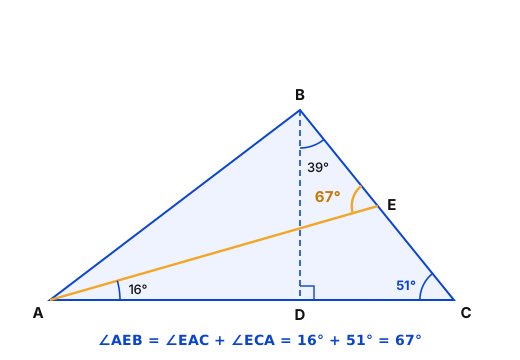
  1. In right △BDC: ∠BDC=90∘, ∠DBC=39∘, so ∠C=180∘−90∘−39∘=51∘.
  2. In △AEC: ∠EAC=16∘ and ∠ECA=51∘.
  3. ∠AEB is the exterior angle of △AEC at E: ∠AEB=16∘+51∘=67∘.

Trick: ∠AEB=∠CAE+(90∘−∠DBC)=16∘+90∘−39∘=67∘.

Answer: (C) 67∘

अवधारणा: त्रिभुज के कोणों का योग 180∘ होता है और बहिष्कोण दोनों अभिमुख अंतःकोणों के योग के बराबर होता है।

  1. समकोण △BDC में: ∠BDC=90∘, ∠DBC=39∘, अतः ∠C=180∘−90∘−39∘=51∘।
  2. △AEC में: ∠EAC=16∘ और ∠ECA=51∘।
  3. ∠AEB, △AEC का E पर बहिष्कोण है: ∠AEB=16∘+51∘=67∘।

ट्रिक: ∠AEB=∠CAE+(90∘−∠DBC)=16∘+90∘−39∘=67∘।

उत्तर: (C) 67∘

RRB NTPC Undergraduate CBT 1MathematicsGeometry – triangles (angles)
Q71.
Read the given statement(s) and conclusions carefully. Assuming that the information given in the statement(s) is true, even if it appears to be at variance with commonly known facts, decide which of the given conclusions logically follow(s) from the statement(s).
Statements:
Some trucks are cars.
Some cars are bottles.
Conclusions:
(I) Some trucks are bottles.
(II) All bottles are cars.
दिए गए कथन/कथनों और निष्कर्षों को ध्यानपूर्वक पढ़िए। यह मानते हुए कि कथन/कथनों में दी गई जानकारी सत्य है, भले ही वह सामान्य रूप से ज्ञात तथ्यों से भिन्न प्रतीत होती हो, निर्णय कीजिए कि दिए गए निष्कर्षों में से कौन-सा/से निष्कर्ष तार्किक रूप से कथन/कथनों का अनुसरण करता है/करते हैं।
कथन:
कुछ ट्रक, कार हैं।
कुछ कार, बोतलें हैं।
निष्कर्ष:
(I) कुछ ट्रक, बोतलें हैं।
(II) सभी बोतलें, कार हैं।
  1. ABoth conclusions (I) and (II) follow.निष्कर्ष (I) और (II) दोनों अनुसरण करते हैं।
  2. BOnly conclusion (I) follows.केवल निष्कर्ष (I) अनुसरण करता है।
  3. CNeither conclusion (I) nor (II) follows.न तो निष्कर्ष (I) और न ही (II) अनुसरण करता है।
  4. DOnly conclusion (II) follows.केवल निष्कर्ष (II) अनुसरण करता है।
Show answer

Concept: From two 'Some' statements no definite conclusion links the end terms; draw the least-overlap Venn diagram.

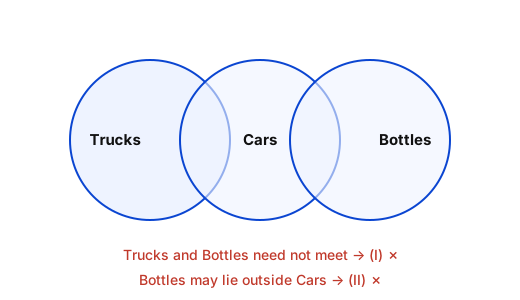
  1. Trucks overlap Cars; Cars overlap Bottles – Trucks and Bottles may not meet, so (I) does not follow.
  2. 'Some cars are bottles' never gives 'All bottles are cars' – (II) does not follow.
  3. Hence neither follows.

Trick: Some + Some = No definite conclusion.

Answer: (C) Neither conclusion (I) nor (II) follows.

अवधारणा: दो 'कुछ' कथनों से अंतिम पदों के बीच कोई निश्चित निष्कर्ष नहीं निकलता; न्यूनतम ओवरलैप वाला वेन आरेख बनाएँ।

  1. ट्रक–कार और कार–बोतल ओवरलैप; ट्रक और बोतल का मिलना ज़रूरी नहीं, अतः (I) अनुसरण नहीं करता।
  2. 'कुछ कार बोतल हैं' से 'सभी बोतल कार हैं' नहीं निकलता – (II) भी नहीं।
  3. अतः कोई भी अनुसरण नहीं करता।

ट्रिक: कुछ + कुछ = कोई निश्चित निष्कर्ष नहीं।

उत्तर: (C) न तो (I) और न ही (II) अनुसरण करता है।

RRB NTPC Undergraduate CBT 1General Intelligence and ReasoningSyllogism

See all 100 solutions

More RRB NTPC Undergraduate CBT 1 papers

Download our app

Study smarter with the airGurukul App

Your complete exam-prep companion - classes, practice, and progress tracking.

Learn anytime, anywhere - live classes, tests, notes, and updates in one place.

GET IT ONGoogle Play

Have a query? We’re here to help

Fill out the form and our team will get back to you as soon as possible.

  • Ask your questions related to admission, courses, fees, or facilities
  • Share your details so our team can contact you easily
  • Get accurate information from our support team
  • Quick and simple form submission process

All fields marked * are required.