RRB NTPC Undergraduate CBT 1 2024 · Shift 1

RRB NTPC Undergraduate CBT 1 22 Aug 2025 Shift 1 – Question Paper

100 questions · 100 marks · 90 minutes · +1 for a correct answer, −1/3 for a wrong one. With answer key and detailed solutions in Hindi and English.

Test Series – airGurukul

Paper pattern

SectionQuestionsMarks
General Awareness4040
Mathematics3030
General Intelligence and Reasoning3030

Sample questions from this paper

Q1.
What is the condition for total internal reflection to occur?
पूर्ण आंतरिक परावर्तन (total internal reflection) होने की शर्त क्या है?
  1. ALight must travel from a rarer medium to a denser medium at an angle of 90°.प्रकाश को 90° के कोण पर विरल माध्यम से सघन माध्यम में जाना चाहिए।
  2. BLight must travel from a denser to a rarer medium at an angle greater than the critical angle.प्रकाश को क्रांतिक कोण (critical angle) से अधिक कोण पर सघन माध्यम से विरल माध्यम में जाना चाहिए।
  3. CLight must strike the boundary at 90° to the normal separating any two mediums of different refractive indices.प्रकाश को भिन्न अपवर्तनांक वाले किन्हीं दो माध्यमों को अलग करने वाले अभिलंब से 90° पर सीमा से टकराना चाहिए।
  4. DThe refractive indices of both media must be equal.दोनों माध्यमों के अपवर्तनांक (refractive indices) बराबर होने चाहिए।
Show answer

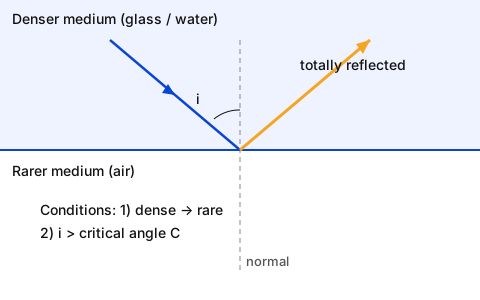
Concept: Total internal reflection (TIR) happens when light, going from an optically denser to a rarer medium, meets the boundary at an angle of incidence larger than the critical angle C, where sinC=1μ.

  1. Light must travel from denser (glass, water) to rarer (air) medium; from rarer to denser it always bends towards the normal, so no TIR.
  2. Angle of incidence i>C; then no refracted ray exists and all light reflects back.
  3. At i=0∘ (along the normal) light passes straight; equal refractive indices mean no bending at all.

Yaad rakhein: Two conditions: Dense → Rare and i>C. Examples: optical fibre, sparkling diamond, mirage.

Answer: (B) Light must travel from a denser to a rarer medium at an angle greater than the critical angle.

अवधारणा: पूर्ण आंतरिक परावर्तन (TIR) तब होता है जब प्रकाश सघन माध्यम से विरल माध्यम में जाते समय सीमा पर क्रांतिक कोण (critical angle) C से बड़े कोण पर पड़ता है, जहाँ sinC=1μ।

  1. प्रकाश सघन (कांच, पानी) से विरल (हवा) माध्यम में जाना चाहिए; विरल से सघन में जाने पर किरण अभिलंब की ओर मुड़ती है, TIR नहीं होता।
  2. आपतन कोण i>C होना चाहिए; तब कोई अपवर्तित किरण नहीं बनती, पूरा प्रकाश वापस परावर्तित होता है।
  3. अभिलंब के अनुदिश (i=0∘) प्रकाश सीधा निकल जाता है; समान अपवर्तनांक पर मुड़ना ही नहीं होता।

याद रखें: दो शर्तें: सघन → विरल और i>C। उदाहरण: ऑप्टिकल फाइबर, हीरे की चमक, मरीचिका।

उत्तर: (B) प्रकाश सघन से विरल माध्यम में क्रांतिक कोण से अधिक कोण पर जाए।

RRB NTPC Undergraduate CBT 1General AwarenessTotal internal reflection
Q41.
A number, when decreased by 7%, gives 3720. The number is:
एक संख्या में 7% की कमी करने पर 3720 प्राप्त होता है। वह संख्या है:
  1. A12000
  2. B8000
  3. C4000
  4. D2000
Show answer

Concept: If a number is decreased by r%, the result is (100−r)% of the number.

  1. After a 7% decrease, 93% of the number =3720.
  2. Number =3720×10093.
  3. 372093=40, so number =40×100=4000.

Trick: Check options: 7% of 4000=280 and 4000−280=3720 ✔.

Answer: (C) 4000

अवधारणा: यदि किसी संख्या को r% घटाया जाए, तो परिणाम संख्या का (100−r)% होता है।

  1. 7% घटाने पर संख्या का 93%=3720।
  2. संख्या =3720×10093।
  3. 372093=40, अतः संख्या =40×100=4000।

ट्रिक: विकल्प जाँचें: 4000 का 7%=280 और 4000−280=3720 ✔।

उत्तर: (C) 4000

RRB NTPC Undergraduate CBT 1MathematicsPercentage
Q71.
Based on the English alphabetical order, three of the following four letter-cluster pairs are alike in a certain way and thus form a group. Which letter-cluster pair DOES NOT belong to that group?
(Note: The odd one out is not based on the number of consonants/vowels or their position in the letter-cluster.)
अंग्रेज़ी वर्णमाला क्रम के आधार पर, निम्नलिखित चार अक्षर-समूह युग्मों में से तीन किसी निश्चित प्रकार से एकसमान हैं और इस प्रकार एक समूह बनाते हैं। कौन-सा अक्षर-समूह युग्म उस समूह से संबंधित नहीं है?
(ध्यान दें: असंगत अक्षर-समूह, उस अक्षर-समूह में व्यंजनों/स्वरों की संख्या या उनके स्थान पर आधारित नहीं है।)
  1. AGI-LE
  2. BJL-OH
  3. CMO-RK
  4. DDF-IC
Show answer

Concept: Check the letter gaps inside each pair: 1st→2nd, 2nd→3rd, 3rd→4th letter.

  1. GI-LE: G +2 I, I +3 L, L −7 E.
  2. JL-OH: J +2 L, L +3 O, O −7 H; MO-RK: M +2 O, O +3 R, R −7 K.
  3. DF-IC: D +2 F, F +3 I, but I −6 C → breaks the pattern.

Trick: Write positions (G7, I9, L12, E5) and compare differences; the last gap is the giveaway.

Answer: (D) DF-IC

अवधारणा: हर जोड़ी में अक्षरों का अंतर देखें: पहला→दूसरा, दूसरा→तीसरा, तीसरा→चौथा।

  1. GI-LE: G +2 I, I +3 L, L −7 E।
  2. JL-OH: +2, +3, −7; MO-RK: +2, +3, −7।
  3. DF-IC: +2, +3, पर I −6 C → अलग।

ट्रिक: स्थानांक लिखें (G7, I9, L12, E5) और अंतर मिलाएँ; अंतिम अंतर से ही विषम पकड़ में आता है।

उत्तर: (D) DF-IC

RRB NTPC Undergraduate CBT 1General Intelligence and ReasoningLetter-cluster odd one out

See all 100 solutions

More RRB NTPC Undergraduate CBT 1 papers

Download our app

Study smarter with the airGurukul App

Your complete exam-prep companion - classes, practice, and progress tracking.

Learn anytime, anywhere - live classes, tests, notes, and updates in one place.

GET IT ONGoogle Play

Have a query? We’re here to help

Fill out the form and our team will get back to you as soon as possible.

  • Ask your questions related to admission, courses, fees, or facilities
  • Share your details so our team can contact you easily
  • Get accurate information from our support team
  • Quick and simple form submission process

All fields marked * are required.