RRB NTPC Undergraduate CBT 1 2024 · Shift 1

RRB NTPC Undergraduate CBT 1 28 Aug 2025 Shift 1 – Question Paper

100 questions · 100 marks · 90 minutes · +1 for a correct answer, −1/3 for a wrong one. With answer key and detailed solutions in Hindi and English.

Test Series – airGurukul

Paper pattern

SectionQuestionsMarks
General Awareness4040
Mathematics3030
General Intelligence and Reasoning3030

Sample questions from this paper

Q1.
Which of the following Constitutional provisions can be amended by an ordinary Act of Parliament (simple majority), rather than through the special procedure under Article 368?
निम्नलिखित में से किस संवैधानिक प्रावधान को अनुच्छेद 368 के अंतर्गत विशेष प्रक्रिया के बजाय संसद के साधारण अधिनियम (साधारण बहुमत) द्वारा संशोधित किया जा सकता है?
  1. AArticle 2 (Parliament may by law admit new states)अनुच्छेद 2 (संसद विधि द्वारा नए राज्यों को प्रवेश दे सकती है)
  2. BArticle 356 (President’s Rule in states)अनुच्छेद 356 (राज्यों में राष्ट्रपति शासन)
  3. CArticle 368 (the Amendment procedure itself)अनुच्छेद 368 (स्वयं संशोधन प्रक्रिया)
  4. DArticle 14 (equality before law)अनुच्छेद 14 (विधि के समक्ष समता)
Show answer

Concept: Some provisions can be changed by a simple majority law of Parliament; such laws are expressly NOT treated as amendments under Article 368.

  1. Article 4 says laws made under Articles 2 and 3 (admission/formation of states) are not amendments for Article 368.
  2. So Article 2 can be acted on by an ordinary Act (simple majority).
  3. Article 368 itself and Article 356 need the special majority; Article 14 is a Fundamental Right – special majority (and Basic Structure limits).

Yaad rakhein: Articles 2, 3, 4, 169, 239A, 5th & 6th Schedule matters – simple majority.

Answer: (A) Article 2 (Parliament may by law admit new states)

अवधारणा: कुछ प्रावधान संसद के साधारण बहुमत वाले कानून से बदले जा सकते हैं; ऐसे कानून अनुच्छेद 368 के अंतर्गत संशोधन नहीं माने जाते।

  1. अनुच्छेद 4 कहता है कि अनुच्छेद 2 व 3 (नए राज्यों का प्रवेश/गठन) के तहत बने कानून अनुच्छेद 368 का संशोधन नहीं हैं।
  2. इसलिए अनुच्छेद 2 पर साधारण कानून (simple majority) से कार्य हो सकता है।
  3. अनुच्छेद 368, 356 और 14 के लिए विशेष बहुमत चाहिए।

याद रखें: अनुच्छेद 2, 3, 4, 169, 239A, 5वीं व 6ठी अनुसूची – साधारण बहुमत।

उत्तर: (A) अनुच्छेद 2 (संसद कानून द्वारा नए राज्य शामिल कर सकती है)
RRB NTPC Undergraduate CBT 1General AwarenessAmendment of Constitution
Q41.
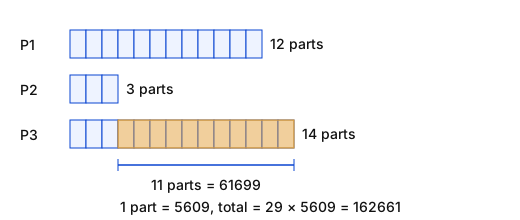
A company earns a profit (in ₹) that is distributed among the company's three partners in the ratio of 12 : 3 : 14. If the difference between the smallest and the largest shares is ₹61,699, the total profit (in ₹) of the company is:
एक कंपनी लाभ (₹ में) अर्जित करती है जिसे कंपनी के तीन साझेदारों में 12 : 3 : 14 के अनुपात में वितरित किया जाता है। यदि सबसे छोटे और सबसे बड़े हिस्से के बीच का अंतर ₹61,699 है, तो कंपनी का कुल लाभ (₹ में) कितना है?
  1. A1,62,661
  2. B1,62,566
  3. C1,62,581
  4. D1,62,673
Show answer

Concept: Shares in a ratio are equal 'parts'; find the value of one part from the given difference.

  1. Ratio 12:3:14; smallest =3 parts, largest =14 parts.
  2. Difference =14−3=11 parts =61699 ⇒ 1 part =6169911=5609.
  3. Total =(12+3+14)×5609=29×5609=162661.

Trick: Total must be a multiple of 29: only 162661=29×5609 works.

Answer: (A) ₹1,62,661

अवधारणा: अनुपात में हिस्से बराबर 'भाग' होते हैं; दिए गए अंतर से एक भाग का मान निकालें।

  1. अनुपात 12:3:14; सबसे छोटा =3 भाग, सबसे बड़ा =14 भाग।
  2. अंतर =14−3=11 भाग =61699 ⇒ 1 भाग =6169911=5609।
  3. कुल =(12+3+14)×5609=29×5609=162661।

ट्रिक: कुल लाभ 29 का गुणज होना चाहिए: केवल 162661=29×5609।

उत्तर: (A) ₹1,62,661

RRB NTPC Undergraduate CBT 1MathematicsRatio and proportion
Q71.
What should come in place of the question mark (?) in the given series?
21 23 33 51 77 ?
दी गई श्रृंखला में प्रश्न चिह्न (?) के स्थान पर क्या आना चाहिए?
21 23 33 51 77 ?
  1. A131
  2. B111
  3. C112
  4. D140
Show answer

Concept: Look at the differences; they form an arithmetic pattern.

  1. Differences: 2,10,18,26 (each +8).
  2. Next difference =34.
  3. 77+34=111.

Trick: Second-level difference constant (8) → AP of differences.

Answer: (B) 111

अवधारणा: अंतर देखें; वे समांतर श्रेणी में हैं।

  1. अंतर: 2,10,18,26 (हर बार +8)।
  2. अगला अंतर =34।
  3. 77+34=111।

ट्रिक: अंतरों का अंतर स्थिर (8) है।

उत्तर: (B) 111

RRB NTPC Undergraduate CBT 1General Intelligence and ReasoningNumber Series

See all 100 solutions

More RRB NTPC Undergraduate CBT 1 papers

Download our app

Study smarter with the airGurukul App

Your complete exam-prep companion - classes, practice, and progress tracking.

Learn anytime, anywhere - live classes, tests, notes, and updates in one place.

GET IT ONGoogle Play

Have a query? We’re here to help

Fill out the form and our team will get back to you as soon as possible.

  • Ask your questions related to admission, courses, fees, or facilities
  • Share your details so our team can contact you easily
  • Get accurate information from our support team
  • Quick and simple form submission process

All fields marked * are required.