RRB NTPC Undergraduate CBT 1 2024 · Shift 2

RRB NTPC Undergraduate CBT 1 29 Aug 2025 Shift 2 – Question Paper

100 questions · 100 marks · 90 minutes · +1 for a correct answer, −1/3 for a wrong one. With answer key and detailed solutions in Hindi and English.

Test Series – airGurukul

Paper pattern

SectionQuestionsMarks
General Awareness4040
Mathematics3030
General Intelligence and Reasoning3030

Sample questions from this paper

Q1.
Which of the following subjects was NOT a part of the Transferred Subjects under the Government of India Act of 1919?
निम्नलिखित में से कौन-सा विषय भारत सरकार अधिनियम, 1919 के अंतर्गत हस्तांतरित विषयों (Transferred Subjects) का भाग नहीं था?
  1. ALocal self-governmentस्थानीय स्वशासन
  2. BPoliceपुलिस
  3. CHealthस्वास्थ्य
  4. DEducationशिक्षा
Show answer

Concept: The Government of India Act, 1919 (Montagu–Chelmsford Reforms) introduced dyarchy in the provinces, dividing provincial subjects into Transferred and Reserved.

  1. Transferred subjects were run by ministers responsible to the legislature: local self-government, education, health, agriculture, public works.
  2. Reserved subjects stayed with the Governor and his Executive Council: police, justice, land revenue, irrigation, finance.
  3. So Police was a Reserved subject, not a Transferred one.

Yaad rakhein: Law-and-order and money (police, justice, finance, land revenue) were 'reserved' by the British; welfare subjects were 'transferred'.

Answer: (B) Police

अवधारणा: भारत शासन अधिनियम, 1919 (मॉण्टेग्यू–चेम्सफोर्ड सुधार) ने प्रांतों में द्वैध शासन (Dyarchy) लागू किया और प्रांतीय विषयों को हस्तांतरित (Transferred) और आरक्षित (Reserved) में बाँटा।

  1. हस्तांतरित विषय विधानमंडल के प्रति उत्तरदायी मंत्रियों के पास थे: स्थानीय स्वशासन, शिक्षा, स्वास्थ्य, कृषि, लोक निर्माण।
  2. आरक्षित विषय गवर्नर और उसकी कार्यकारी परिषद के पास थे: पुलिस, न्याय, भू-राजस्व, सिंचाई, वित्त।
  3. अतः पुलिस आरक्षित विषय था, हस्तांतरित नहीं।

याद रखें: कानून-व्यवस्था और पैसा (पुलिस, न्याय, वित्त) अंग्रेज़ों ने 'आरक्षित' रखे; कल्याण के विषय 'हस्तांतरित' किए।

उत्तर: (B) पुलिस
RRB NTPC Undergraduate CBT 1General AwarenessGoI Act 1919 – Dyarchy
Q41.
A can do a work in 12 days and B can do the same work in 25 days. If they work on it together for 6 days, then what fraction of the work is left?
A किसी कार्य को 12 दिनों में और B उसी कार्य को 25 दिनों में कर सकता है। यदि वे 6 दिनों तक एक साथ कार्य करते हैं, तो कार्य का कितना भाग शेष रह जाता है?
  1. A950
  2. B1750
  3. C1350
  4. D2150
Show answer

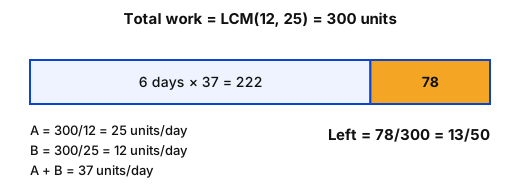
Concept: Take total work = LCM of the days; one-day work = total ÷ days.

  1. Total work =LCM(12,25)=300 units; A =25, B =12 units/day.
  2. Together =37 units/day; in 6 days =6×37=222 units.
  3. Left =300−222=78 units =78300=1350.

Trick: Fraction done =6(112+125)=6×37300=3750, so left =1350.

Answer: (C) 1350

अवधारणा: कुल कार्य = दिनों का LCM लें; एक दिन का कार्य = कुल ÷ दिन।

  1. कुल कार्य =LCM(12,25)=300 इकाई; A =25, B =12 इकाई/दिन।
  2. दोनों मिलकर =37 इकाई/दिन; 6 दिन में =6×37=222 इकाई।
  3. शेष =300−222=78 इकाई =78300=1350।

ट्रिक: किया गया भाग =6(112+125)=3750, शेष =1350।

उत्तर: (C) 1350

RRB NTPC Undergraduate CBT 1MathematicsTime and work
Q71.
Read the given statements and conclusions carefully. Assuming that the information given in the statements is true, even if it appears to be at variance with commonly known facts, decide which of the given conclusions logically follow(s) from the statements.
Statements: All bricks are spoons. No brick is a game.
Conclusions (I): Some games are spoons.
Conclusions (II): All spoons are games.
दिए गए कथनों और निष्कर्षों को ध्यानपूर्वक पढ़िए। कथनों में दी गई जानकारी को सत्य मानते हुए, भले ही वह सामान्य रूप से ज्ञात तथ्यों से भिन्न प्रतीत होती हो, निर्णय कीजिए कि दिए गए निष्कर्षों में से कौन-सा/से निष्कर्ष तार्किक रूप से कथनों का अनुसरण करता है/करते हैं।
कथन: सभी ईंटें, चम्मच हैं। कोई ईंट, खेल नहीं है।
निष्कर्ष (I): कुछ खेल, चम्मच हैं।
निष्कर्ष (II): सभी चम्मच, खेल हैं।
  1. AOnly conclusion (II) follows.केवल निष्कर्ष (II) अनुसरण करता है।
  2. BBoth conclusions (I) and (II) follow.निष्कर्ष (I) और (II) दोनों अनुसरण करते हैं।
  3. CNeither conclusion (I) nor (II) follows.न तो निष्कर्ष (I) और न ही (II) अनुसरण करता है।
  4. DOnly conclusion (I) follows.केवल निष्कर्ष (I) अनुसरण करता है।
Show answer

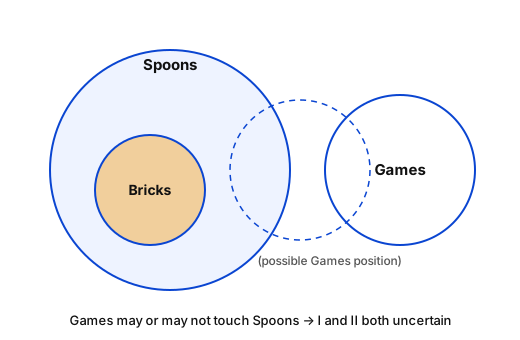
Concept: Draw the least-overlap Venn diagram; a conclusion follows only if it is true in every possible diagram.

  1. Bricks lie inside Spoons; Games lie fully outside Bricks.
  2. I: Games may lie completely outside Spoons too ⇒ "Some games are spoons" is not certain.
  3. II: "All spoons are games" is impossible to prove (bricks are spoons but not games) ⇒ false.

Trick: "All A are B" + "No A is C" gives only "Some B are not C" – nothing positive about B and C.

Answer: (C) Neither conclusion (I) nor (II) follows.

अवधारणा: न्यूनतम ओवरलैप वाला वेन आरेख बनाएँ; निष्कर्ष तभी अनुसरण करता है जब वह हर संभव आरेख में सत्य हो।

  1. Bricks, Spoons के भीतर; Games, Bricks से पूर्णतः बाहर।
  2. I: Games, Spoons से भी पूरी तरह बाहर हो सकता है ⇒ निश्चित नहीं।
  3. II: Bricks spoons हैं पर games नहीं ⇒ "सभी spoons games हैं" गलत।

ट्रिक: "सभी A, B हैं" + "कोई A, C नहीं" से केवल "कुछ B, C नहीं हैं" निकलता है।

उत्तर: (C) न तो निष्कर्ष (I) और न ही (II) अनुसरण करता है।

RRB NTPC Undergraduate CBT 1General Intelligence and ReasoningSyllogism

See all 100 solutions

More RRB NTPC Undergraduate CBT 1 papers

Download our app

Study smarter with the airGurukul App

Your complete exam-prep companion - classes, practice, and progress tracking.

Learn anytime, anywhere - live classes, tests, notes, and updates in one place.

GET IT ONGoogle Play

Have a query? We’re here to help

Fill out the form and our team will get back to you as soon as possible.

  • Ask your questions related to admission, courses, fees, or facilities
  • Share your details so our team can contact you easily
  • Get accurate information from our support team
  • Quick and simple form submission process

All fields marked * are required.