Question bank

Q&A: practice questions with answers

Search questions on any topic. Filter by exam category, exam, subject and topic, try the question, then open the answer and explanation.

Courses – airGurukul

20,719 questions found.

Q301.
A car travels 120 km at 60 km/h, then 200 km at 80 km/h, but during the second segment, it experiences a total stoppage time of 20 minutes due to traffic. After that, it covers the final 150 km at 100 km/h. What is the average speed (in km/h, rounded off to one decimal place) of the car for the entire journey including stoppage times?
एक कार 120 km की दूरी 60 km/h की चाल से, फिर 200 km की दूरी 80 km/h की चाल से तय करती है, लेकिन दूसरे खंड के दौरान यातायात के कारण उसे कुल 20 मिनट रुकना पड़ता है। उसके बाद, वह अंतिम 150 km की दूरी 100 km/h की चाल से तय करती है। रुकने के समय सहित पूरी यात्रा में कार की औसत चाल (km/h में, एक दशमलव स्थान तक पूर्णांकित) क्या है?
  1. A74.2
  2. B75.3
  3. C73.5
  4. D72.4
Show answer

Concept: Average speed = total distance ÷ total time (stoppage time is added to time).

  1. Times: 12060=2 h, 20080=2.5 h, stoppage 2060=13 h, 150100=1.5 h
  2. Total time =2+2.5+13+1.5=193 h; total distance =470 km
  3. Average speed =470×319=141019≈74.2 km/h

Short trick: Total time = 6 h 20 min = 193 h; 470×3=1410 and 19×74=1406, so the answer is just above 74 → 74.2.

Answer: (A) 74.2

अवधारणा: औसत चाल = कुल दूरी ÷ कुल समय (रुकने का समय भी कुल समय में जुड़ता है)।

  1. समय: 12060=2 घंटे, 20080=2.5 घंटे, ठहराव 2060=13 घंटा, 150100=1.5 घंटे
  2. कुल समय =193 घंटे; कुल दूरी =470 km
  3. औसत चाल =470×319=141019≈74.2 km/h

शॉर्ट ट्रिक: कुल समय = 6 घंटे 20 मिनट = 193 घंटे; 470×3=1410 और 19×74=1406, अतः उत्तर 74 से थोड़ा अधिक → 74.2।

उत्तर: (A) 74.2
RRB ALP CBT 1MathematicsSpeed, time and distance – average speedRRB ALP CBT 1 2025 · 17 Feb Shift 2 →
Q302.
If m : f = 16 : 3, then what is the value of 3m−16f3m+16f?
यदि m : f = 16 : 3 है, तो 3m−16f3m+16f का मान क्या है?
  1. A0
  2. B233249
  3. C253247
  4. D253249
Show answer

Concept: Put m = 16k and f = 3k.

  1. 3m=48k and 16f=48k
  2. Numerator =48k−48k=0
  3. Value =096k=0

Short trick: m : f = 16 : 3 means 3m=16f directly (cross-multiply) → numerator is zero.

Answer: (A) 0

अवधारणा: m = 16k और f = 3k रखें।

  1. 3m=48k और 16f=48k
  2. अंश =48k−48k=0
  3. मान =096k=0

शॉर्ट ट्रिक: m : f = 16 : 3 का अर्थ है 3m=16f (तिर्यक गुणा) → अंश शून्य।

उत्तर: (A) 0

RRB ALP CBT 1MathematicsRatio and proportion – value of expressionRRB ALP CBT 1 2025 · 17 Feb Shift 2 →
Q303.
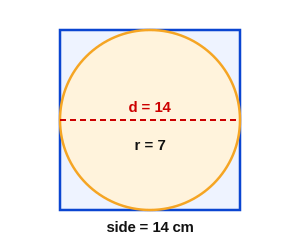
The length of a side of a square is equal to the diameter of a circle. If the area of the square is equal to 196 cm2, then find the area of the circle (in cm2). (Use π=227)
एक वर्ग की भुजा की लंबाई एक वृत्त के व्यास के बराबर है। यदि वर्ग का क्षेत्रफल 196 cm2 के बराबर है, तो वृत्त का क्षेत्रफल (cm2 में) ज्ञात कीजिए। (π=227 का प्रयोग करें)
  1. A154
  2. B148
  3. C616
  4. D145
Show answer

Concept: Side of square = diameter of circle.

  1. Side =196=14 cm ⇒ diameter = 14 cm, r=7 cm
  2. Area of circle =227×7×7=154 cm2

Short trick: Circle inscribed in a square has area =π4× square area =1114×196=154.

Answer: (A) 154

अवधारणा: वर्ग की भुजा = वृत्त का व्यास।

  1. भुजा =196=14 cm ⇒ व्यास = 14 cm, r=7 cm
  2. वृत्त का क्षेत्रफल =227×7×7=154 cm2

शॉर्ट ट्रिक: वर्ग में बने वृत्त का क्षेत्रफल =π4× वर्ग का क्षेत्रफल =1114×196=154।

उत्तर: (A) 154

RRB ALP CBT 1MathematicsMensuration – square and circleRRB ALP CBT 1 2025 · 17 Feb Shift 2 →
Q304.
A shopkeeper sells an item for ₹430.5 after giving two successive discounts of 70% and 75% on its marked price. Had he not given any discount, he would have earned a profit of 40%. What is the cost price (in ₹) of the item?
एक दुकानदार किसी वस्तु के अंकित मूल्य पर 70% और 75% की दो क्रमिक छूट देने के बाद उसे ₹430.5 में बेचता है। यदि उसने कोई छूट नहीं दी होती, तो उसे 40% का लाभ होता। वस्तु का क्रय मूल्य (₹ में) क्या है?
  1. A4,121
  2. B4,145
  3. C4,100
  4. D4,081
Show answer

Concept: After discounts a% and b%, SP = MP × (1 − a%) × (1 − b%).

  1. SP=MP×0.30×0.25=0.075MP=430.5
  2. MP=430.50.075=5740
  3. Without discount, SP = MP = 140% of CP ⇒ CP=57401.4=4100

Short trick: CP=430.50.3×0.25×1.4=430.50.105=4100 in one step.

Answer: (C) 4,100

अवधारणा: a% और b% छूट के बाद, विक्रय मूल्य = अंकित मूल्य × (1 − a%) × (1 − b%)।

  1. SP=MP×0.30×0.25=0.075MP=430.5
  2. MP=430.50.075=5740
  3. बिना छूट, SP = MP = CP का 140% ⇒ CP=57401.4=4100

शॉर्ट ट्रिक: एक कदम में: CP=430.50.3×0.25×1.4=430.50.105=4100।

उत्तर: (C) 4,100

RRB ALP CBT 1MathematicsDiscount – successive discounts with profitRRB ALP CBT 1 2025 · 17 Feb Shift 2 →
Q305.
A product's price after successive discounts of 20% and 10% is ₹7,200. What was the original price of the product before any discounts were applied?
क्रमिक 20% और 10% की छूट के बाद एक उत्पाद का मूल्य ₹7,200 है। किसी भी छूट के लागू होने से पहले उत्पाद का मूल मूल्य क्या था?
  1. A₹9,000
  2. B₹12,000
  3. C₹10,000
  4. D₹11,000
Show answer

Concept: Price after discounts = original × 0.8 × 0.9.

  1. 0.8×0.9=0.72
  2. Original =72000.72=10000

Short trick: Successive 20% and 10% = single discount of 20+10−20×10100=28%; 72% of price = 7200 → price = ₹10,000.

Answer: (C) ₹10,000

अवधारणा: छूट के बाद मूल्य = मूल मूल्य × 0.8 × 0.9।

  1. 0.8×0.9=0.72
  2. मूल मूल्य =72000.72=10000

शॉर्ट ट्रिक: 20% और 10% की क्रमिक छूट = 20+10−20×10100=28% एकल छूट; मूल्य का 72% = 7200 → ₹10,000।

उत्तर: (C) ₹10,000

RRB ALP CBT 1MathematicsDiscount – successive discountsRRB ALP CBT 1 2025 · 17 Feb Shift 2 →
Q306.
What is the mode of the following data?
77, 85, 87, 75, 78, 62, 68, 61, 90, 63, 61, 71, 69, 77, 75, 82, 75, 69, 74, 75, 70, 81, 65, 66, 61
निम्नलिखित आँकड़ों का बहुलक क्या है?
77, 85, 87, 75, 78, 62, 68, 61, 90, 63, 61, 71, 69, 77, 75, 82, 75, 69, 74, 75, 70, 81, 65, 66, 61
  1. A75
  2. B77
  3. C61
  4. D69
Show answer

Concept: Mode = the value that occurs most often.

  1. 75 occurs 4 times
  2. 61 occurs 3 times; 77 and 69 occur 2 times each
  3. Mode = 75

Short trick: Tally only the options: 75 (4), 61 (3), 77 (2), 69 (2) – no need to sort all 25 values.

Answer: (A) 75

अवधारणा: बहुलक = सबसे अधिक बार आने वाला मान।

  1. 75 चार बार आता है
  2. 61 तीन बार; 77 और 69 दो-दो बार
  3. बहुलक = 75

शॉर्ट ट्रिक: केवल विकल्पों की गिनती करें: 75 (4), 61 (3), 77 (2), 69 (2) – सभी 25 मानों को क्रम में लगाने की ज़रूरत नहीं।

उत्तर: (A) 75

RRB ALP CBT 1MathematicsStatistics – modeRRB ALP CBT 1 2025 · 17 Feb Shift 2 →
Q307.
4% of a number is what percentage of 20% of the same number?
किसी संख्या का 4%, उसी संख्या के 20% का कितना प्रतिशत है?
  1. A500%
  2. B16.67%
  3. C8.33%
  4. D20%
Show answer

Concept: Required % = (first quantity ÷ second quantity) × 100.

  1. Let number = 100: 4% = 4, 20% = 20
  2. 420×100=20%

Short trick: The number cancels: just divide the percentages, 420=15=20%.

Answer: (D) 20%

अवधारणा: अभीष्ट % = (पहली राशि ÷ दूसरी राशि) × 100।

  1. संख्या = 100 मानें: 4% = 4, 20% = 20
  2. 420×100=20%

शॉर्ट ट्रिक: संख्या कट जाती है: केवल प्रतिशतों को भाग दें, 420=15=20%।

उत्तर: (D) 20%

RRB ALP CBT 1MathematicsPercentage – comparisonRRB ALP CBT 1 2025 · 17 Feb Shift 2 →
Q308.
If a2+b2+c2+189=6(a+4b+2c), then ab+bc+ca is equal to:
यदि a2+b2+c2+189=6(a+4b+2c) है, तो ab+bc+ca किसके बराबर है?
  1. A214
  2. B211
  3. C311
  4. D314
Show answer

Concept: If a sum of squares is 0, each square is 0.

  1. a2−6a+b2−24b+c2−12c+189=0
  2. (a−3)2+(b−12)2+(c−6)2=9+144+36−189=0
  3. a=3, b=12, c=6
  4. ab+bc+ca=36+72+18=126, 126=314

Short trick: Halve the coefficients on the right: 6a,24b,12c → a=3,b=12,c=6; check 32+122+62=189 ✓.

Answer: (D) 314

अवधारणा: यदि वर्गों का योग 0 है, तो प्रत्येक वर्ग 0 होगा।

  1. a2−6a+b2−24b+c2−12c+189=0
  2. (a−3)2+(b−12)2+(c−6)2=9+144+36−189=0
  3. a=3, b=12, c=6
  4. ab+bc+ca=36+72+18=126, 126=314

शॉर्ट ट्रिक: दाईं ओर के गुणांक आधे करें: 6a,24b,12c → a=3,b=12,c=6; जाँच 32+122+62=189 ✓।

उत्तर: (D) 314

RRB ALP CBT 1MathematicsAlgebra – sum of squares equal to zeroRRB ALP CBT 1 2025 · 17 Feb Shift 2 →
Q309.
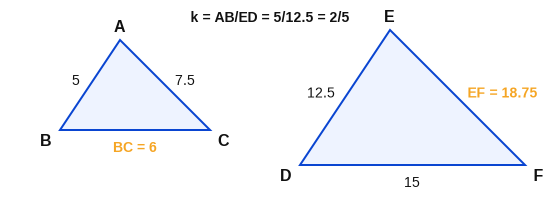
It is given that, △ABC∼△EDF such that AB = 5 cm, AC = 7.5 cm, DF = 15 cm and ED = 12.5 cm. The sum of the remaining sides of the triangles is:
दिया गया है कि △ABC∼△EDF इस प्रकार है कि AB = 5 cm, AC = 7.5 cm, DF = 15 cm और ED = 12.5 cm है। त्रिभुजों की शेष भुजाओं का योग है:
  1. A24.75 cm
  2. B22.25 cm
  3. C20.25 cm
  4. D23.25 cm
Show answer

Concept: In △ABC∼△EDF, A↔E, B↔D, C↔F, so ABED=BCDF=ACEF.

  1. ABED=512.5=25
  2. BC=25×15=6 cm
  3. EF=7.5×52=18.75 cm
  4. Sum =6+18.75=24.75 cm

Short trick: Match letters by position (ABC ↔ EDF), never by alphabet. Ratio 2 : 5 → small side ×2/5, big side ×5/2.

Answer: (A) 24.75 cm

अवधारणा: △ABC∼△EDF में A↔E, B↔D, C↔F, अतः ABED=BCDF=ACEF।

  1. ABED=512.5=25
  2. BC=25×15=6 cm
  3. EF=7.5×52=18.75 cm
  4. योग =6+18.75=24.75 cm

शॉर्ट ट्रिक: अक्षरों का मिलान स्थान से करें (ABC ↔ EDF), वर्णमाला से नहीं। अनुपात 2 : 5।

उत्तर: (A) 24.75 cm

RRB ALP CBT 1MathematicsGeometry – similar trianglesRRB ALP CBT 1 2025 · 17 Feb Shift 2 →
Q310.
Anand purchased an item and spent ₹63 on its repair. He then sold it to Bharath at a profit of 25%. Later, Bharath sold the item for ₹8415, incurring a loss of 15%. What was Anand’s cost (in ₹) of the item just before selling it to Bharath?
आनंद ने एक वस्तु खरीदी और उसकी मरम्मत पर ₹63 खर्च किए। फिर उसने उसे 25% के लाभ पर भरत को बेच दिया। बाद में, भरत ने वह वस्तु 15% की हानि उठाकर ₹8415 में बेची। भरत को बेचने से ठीक पहले आनंद की उस वस्तु पर लागत (₹ में) क्या थी?
  1. A7917
  2. B7918
  3. C7920
  4. D7919
Show answer

Concept: Work backwards from the last selling price.

  1. Bharath's CP =84150.85=9900
  2. This is Anand's SP at 25% profit ⇒ Anand's total cost =99001.25=7920
  3. (Purchase price = 7920 − 63 = 7857; the cost just before selling includes repair = 7920.)

Short trick: 8415×2017×45=8415×1617=495×16=7920.

Answer: (C) 7920

अवधारणा: अंतिम विक्रय मूल्य से पीछे की ओर चलें।

  1. भरत का क्रय मूल्य =84150.85=9900
  2. यह आनंद का 25% लाभ पर विक्रय मूल्य ⇒ आनंद की कुल लागत =99001.25=7920
  3. (खरीद मूल्य = 7920 − 63 = 7857; बेचने से ठीक पहले की लागत में मरम्मत शामिल = 7920।)

शॉर्ट ट्रिक: 8415×2017×45=8415×1617=495×16=7920।

उत्तर: (C) 7920

RRB ALP CBT 1MathematicsProfit and loss – chain of salesRRB ALP CBT 1 2025 · 17 Feb Shift 2 →
Q311.
Bharat, Jyoti, and Vishal invest ₹70,000, ₹32,000, and ₹46,000, respectively, to start a business. At the end of the year, the total profit earned is ₹52,540. 60% of the total profit earned is given to charity and the rest is divided among them in the ratio of their profit. What will be the share of Vishal (in ₹)?
भरत, ज्योति और विशाल एक व्यवसाय शुरू करने के लिए क्रमशः ₹70,000, ₹32,000 और ₹46,000 का निवेश करते हैं। वर्ष के अंत में, अर्जित कुल लाभ ₹52,540 है। अर्जित कुल लाभ का 60% दान में दे दिया जाता है और शेष राशि उनके बीच उनके लाभ के अनुपात में बाँट दी जाती है। विशाल का हिस्सा (₹ में) क्या होगा?
  1. A6,380
  2. B6,532
  3. C6,520
  4. D6,453
Show answer

Concept: Profit is shared in the ratio of investments (same time period).

  1. Ratio 70000:32000:46000=35:16:23 (sum 74)
  2. Amount to share =40% of 52540 =21016
  3. Vishal =2374×21016=23×284=6532

Short trick: 21016 ÷ 74 = 284 exactly; so the answer must be a multiple of 23 → 6532 = 23 × 284 (6532 is the only option divisible by 23).

Answer: (B) 6,532

अवधारणा: समान अवधि में लाभ निवेश के अनुपात में बँटता है।

  1. अनुपात 70000:32000:46000=35:16:23 (योग 74)
  2. बाँटी जाने वाली राशि =52540 का 40%=21016
  3. विशाल =2374×21016=23×284=6532

शॉर्ट ट्रिक: 21016 ÷ 74 = 284; उत्तर 23 का गुणज होना चाहिए → 6532 = 23 × 284।

उत्तर: (B) 6,532

RRB ALP CBT 1MathematicsPartnership – share of profitRRB ALP CBT 1 2025 · 17 Feb Shift 2 →
Q312.
If the cost price of 12 identical books is ₹960 and the cost price of 8 identical pens is ₹320, find the total cost price (in ₹) of 15 books and 10 pens of the same kind.
यदि 12 एक जैसी पुस्तकों का क्रय मूल्य ₹960 है और 8 एक जैसे पेनों का क्रय मूल्य ₹320 है, तो उसी प्रकार की 15 पुस्तकों और 10 पेनों का कुल क्रय मूल्य (₹ में) ज्ञात कीजिए।
  1. A1800
  2. B1600
  3. C1200
  4. D1500
Show answer

Concept: Find the cost of one item, then multiply.

  1. 1 book =96012=80; 1 pen =3208=40
  2. 15 books =1200; 10 pens =400
  3. Total =1600

Short trick: 15 books = 960×1512=1200, 10 pens = 320×108=400 → 1600.

Answer: (B) 1600

अवधारणा: एक वस्तु का मूल्य निकालें, फिर गुणा करें।

  1. 1 पुस्तक =96012=80; 1 पेन =3208=40
  2. 15 पुस्तकें =1200; 10 पेन =400
  3. कुल =1600

शॉर्ट ट्रिक: 15 पुस्तकें = 960×1512=1200, 10 पेन = 320×108=400 → 1600।

उत्तर: (B) 1600

RRB ALP CBT 1MathematicsUnitary method – cost priceRRB ALP CBT 1 2025 · 17 Feb Shift 2 →
Q313.
The mean of a data is four times of its mode. If the median of the data is 63, find its mean.
किसी आँकड़े का माध्य उसके बहुलक का चार गुना है। यदि आँकड़े की माध्यिका 63 है, तो उसका माध्य ज्ञात कीजिए।
  1. A63
  2. B72
  3. C93
  4. D84
Show answer

Concept: Empirical relation: Mode = 3 Median − 2 Mean.

  1. Let mode = x, mean = 4x
  2. x=3(63)−2(4x)=189−8x
  3. 9x=189⇒x=21; mean =84

Short trick: Use 3Median=Mode+2Mean: 189=x+8x=9x → mean =4×21=84.

Answer: (D) 84

अवधारणा: आनुभविक संबंध: बहुलक = 3 माध्यिका − 2 माध्य।

  1. बहुलक = x, माध्य = 4x
  2. x=3(63)−2(4x)=189−8x
  3. 9x=189⇒x=21; माध्य =84

शॉर्ट ट्रिक: 3माध्यिका=बहुलक+2माध्य: 189=x+8x=9x → माध्य =84।

उत्तर: (D) 84

RRB ALP CBT 1MathematicsStatistics – mean, median, mode relationRRB ALP CBT 1 2025 · 17 Feb Shift 2 →
Q314.
A student's marks were incorrectly entered as 44 instead of 92. Due to this, the average marks of the class got decreased by 43. What is the number of students in the class?
एक विद्यार्थी के अंक गलती से 92 के स्थान पर 44 दर्ज कर दिए गए। इसके कारण, कक्षा के औसत अंक 43 कम हो गए। कक्षा में विद्यार्थियों की संख्या कितनी है?
  1. A43
  2. B32
  3. C36
  4. D41
Show answer

Concept: Change in average = change in total ÷ number of students.

  1. Change in total =92−44=48
  2. 48n=43
  3. n=48×34=36

Short trick: n=48÷43=48×34=36 in one line.

Answer: (C) 36

अवधारणा: औसत में परिवर्तन = योग में परिवर्तन ÷ विद्यार्थियों की संख्या।

  1. योग में परिवर्तन =92−44=48
  2. 48n=43
  3. n=48×34=36

शॉर्ट ट्रिक: n=48÷43=36 – एक पंक्ति में।

उत्तर: (C) 36

RRB ALP CBT 1MathematicsAverage – wrong entryRRB ALP CBT 1 2025 · 17 Feb Shift 2 →
Q315.
Three pipes of diameters 2 cm, 3 cm and 4 cm are running together to fill a cistern. The smallest pipe alone can fill the cistern in 232 minutes. The amount of water flowing in each pipe is proportional to the square of its diameter. The time (in minutes) taken by all pipes running together to completely fill the cistern is:
2 cm, 3 cm और 4 cm व्यास वाले तीन पाइप एक टंकी को भरने के लिए एक साथ चल रहे हैं। सबसे छोटा पाइप अकेले टंकी को 232 मिनट में भर सकता है। प्रत्येक पाइप में बहने वाले पानी की मात्रा उसके व्यास के वर्ग के समानुपाती है। सभी पाइपों द्वारा एक साथ चलकर टंकी को पूरी तरह भरने में लिया गया समय (मिनट में) है:
  1. A40
  2. B42
  3. C32
  4. D36
Show answer

Concept: Rate ∝ (diameter)2.

  1. Rates ∝ 22:32:42=4:9:16, total 29
  2. Smallest pipe (4 units) takes 232 min ⇒ capacity =4×232=928 units
  3. All together: 92829=32 min

Short trick: Time ∝ 1/rate: 232×429=8×4=32 (232 = 29 × 8).

Answer: (C) 32

अवधारणा: दर ∝ (व्यास)2।

  1. दरें ∝ 22:32:42=4:9:16, कुल 29
  2. सबसे छोटा पाइप (4 इकाई) 232 मिनट ⇒ क्षमता =4×232=928 इकाई
  3. सभी साथ: 92829=32 मिनट

शॉर्ट ट्रिक: समय ∝ 1/दर: 232×429=8×4=32 (232 = 29 × 8)।

उत्तर: (C) 32

RRB ALP CBT 1MathematicsPipes and cistern – flow ∝ diameter²RRB ALP CBT 1 2025 · 17 Feb Shift 2 →
Q316.
The cost of 7 kg of sugar of quality A is ₹245, and the cost of 5 kg of sugar of quality B is ₹300. In what ratio should quality A sugar and quality B sugar be mixed so that the cost of 1 kg of the mixture is ₹50?
गुणवत्ता A की 7 kg चीनी का मूल्य ₹245 है और गुणवत्ता B की 5 kg चीनी का मूल्य ₹300 है। गुणवत्ता A और गुणवत्ता B की चीनी को किस अनुपात में मिलाया जाए कि मिश्रण के 1 kg का मूल्य ₹50 हो?
  1. A3 : 4
  2. B2 : 3
  3. C3 : 2
  4. D4 : 3
Show answer

Concept: Alligation: cheaper : dearer = (dearer − mean) : (mean − cheaper).

  1. A = ₹245/7 = ₹35 per kg; B = ₹300/5 = ₹60 per kg
  2. A : B = (60 − 50) : (50 − 35) = 10 : 15
  3. = 2 : 3

Short trick: Distances from ₹50: A is 15 below, B is 10 above; quantities go inversely → A : B = 10 : 15 = 2 : 3.

Answer: (B) 2 : 3

अवधारणा: एलिगेशन: सस्ता : महँगा = (महँगा − औसत) : (औसत − सस्ता)।

  1. A = ₹245/7 = ₹35 प्रति kg; B = ₹300/5 = ₹60 प्रति kg
  2. A : B = (60 − 50) : (50 − 35) = 10 : 15
  3. = 2 : 3

शॉर्ट ट्रिक: ₹50 से दूरी: A 15 नीचे, B 10 ऊपर; मात्राएँ व्युत्क्रम में → A : B = 10 : 15 = 2 : 3।

उत्तर: (B) 2 : 3

RRB ALP CBT 1MathematicsMixture and alligationRRB ALP CBT 1 2025 · 17 Feb Shift 2 →
Q317.
A person drove at 59 kmph for 3.5 hours, then increased his speed by 9 kmph, and reached the destination in another hour. Find the average speed (in kmph) of the person during the entire journey.
एक व्यक्ति ने 3.5 घंटे तक 59 km/h की चाल से गाड़ी चलाई, फिर अपनी चाल 9 km/h बढ़ा दी और अगले एक घंटे में गंतव्य पर पहुँच गया। पूरी यात्रा के दौरान व्यक्ति की औसत चाल (km/h में) ज्ञात कीजिए।
  1. A61
  2. B57
  3. C59
  4. D66
Show answer

Concept: Average speed = total distance ÷ total time.

  1. Distance =59×3.5+68×1=206.5+68=274.5 km
  2. Time =4.5 h
  3. Average =274.54.5=61 km/h

Short trick: Time-weighted: 59+9×14.5=59+2=61.

Answer: (A) 61

अवधारणा: औसत चाल = कुल दूरी ÷ कुल समय।

  1. दूरी =59×3.5+68×1=206.5+68=274.5 km
  2. समय =4.5 घंटे
  3. औसत =274.54.5=61 km/h

शॉर्ट ट्रिक: समय-भारित: 59+9×14.5=59+2=61।

उत्तर: (A) 61

RRB ALP CBT 1MathematicsSpeed, time and distance – average speedRRB ALP CBT 1 2025 · 17 Feb Shift 2 →
Q318.
In a division sum, the divisor is 2 times the quotient and 4 times the remainder. If the remainder is 22, what is the dividend?
एक भाग के प्रश्न में, भाजक भागफल का 2 गुना और शेषफल का 4 गुना है। यदि शेषफल 22 है, तो भाज्य क्या है?
  1. A3894
  2. B3892
  3. C3899
  4. D3889
Show answer

Concept: Dividend = Divisor × Quotient + Remainder.

  1. Divisor =4×22=88
  2. Quotient =882=44
  3. Dividend =88×44+22=3872+22=3894

Short trick: Dividend − remainder must be divisible by the divisor: only 3894−22=3872=88×44 ✓.

Answer: (A) 3894

अवधारणा: भाज्य = भाजक × भागफल + शेषफल।

  1. भाजक =4×22=88
  2. भागफल =882=44
  3. भाज्य =88×44+22=3872+22=3894

शॉर्ट ट्रिक: भाज्य − शेषफल, भाजक से विभाज्य होना चाहिए: 3894−22=3872=88×44 ✓।

उत्तर: (A) 3894

RRB ALP CBT 1MathematicsNumber system – division algorithmRRB ALP CBT 1 2025 · 17 Feb Shift 2 →
Q319.
The price of an article was ₹1600, It increased by 10% in the first year and by 20% in the second year. What is the price (in ₹) of the article after two years?
एक वस्तु का मूल्य ₹1600 था। पहले वर्ष में इसमें 10% और दूसरे वर्ष में 20% की वृद्धि हुई। दो वर्ष बाद वस्तु का मूल्य (₹ में) क्या है?
  1. A2000
  2. B2144
  3. C1840
  4. D2112
Show answer

Concept: Successive increases multiply: new = old × (1 + a%) × (1 + b%).

  1. 1600×1.1=1760
  2. 1760×1.2=2112

Short trick: Net increase =10+20+10×20100=32%; 1600×1.32=2112.

Answer: (D) 2112

अवधारणा: क्रमिक वृद्धि गुणा होती है: नया = पुराना × (1 + a%) × (1 + b%)।

  1. 1600×1.1=1760
  2. 1760×1.2=2112

शॉर्ट ट्रिक: कुल वृद्धि =10+20+10×20100=32%; 1600×1.32=2112।

उत्तर: (D) 2112

RRB ALP CBT 1MathematicsPercentage – successive increaseRRB ALP CBT 1 2025 · 17 Feb Shift 2 →
Q320.
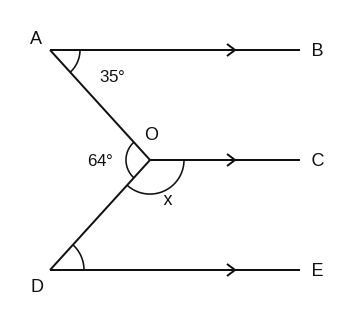
In the given figure, find the value of x.
दी गई आकृति में, x का मान ज्ञात कीजिए।
  1. A105∘
  2. B145∘
  3. C209∘
  4. D151∘
Show answer

Concept: AB ∥ OC ∥ DE (arrows). Co-interior angles add up to 180∘; angles round a point add up to 360∘.

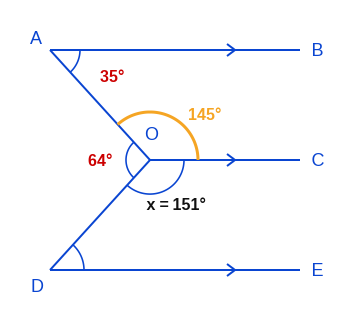
  1. AB ∥ OC with transversal AO: ∠BAO+∠AOC=180∘ ⇒ ∠AOC=145∘
  2. Around O: ∠AOC+∠AOD+x=360∘
  3. x=360∘−145∘−64∘=151∘

Short trick: x=180∘+35∘−64∘=151∘ (the "180 + top angle − middle angle" shortcut for this Z-shape).

Answer: (D) 151∘

अवधारणा: AB ∥ OC ∥ DE (तीर)। सह-आंतरिक कोणों का योग 180∘; एक बिंदु के चारों ओर कोणों का योग 360∘।

  1. AB ∥ OC, तिर्यक रेखा AO: ∠BAO+∠AOC=180∘ ⇒ ∠AOC=145∘
  2. O के चारों ओर: ∠AOC+∠AOD+x=360∘
  3. x=360∘−145∘−64∘=151∘

शॉर्ट ट्रिक: x=180∘+35∘−64∘=151∘।

उत्तर: (D) 151∘

RRB ALP CBT 1MathematicsGeometry – parallel lines and anglesRRB ALP CBT 1 2025 · 17 Feb Shift 2 →