Question bank

Q&A: practice questions with answers

Search questions on any topic. Filter by exam category, exam, subject and topic, try the question, then open the answer and explanation.

Courses – airGurukul

20,719 questions found.

Q321.
A cistern can be filled by a tap in 5 hours and emptied by an outlet pipe in 9 hours. How long will it take to fill the cistern if both the tap and the pipe are opened together?
एक टंकी को एक नल 5 घंटे में भर सकता है और एक निकास पाइप 9 घंटे में खाली कर सकता है। यदि नल और पाइप दोनों को एक साथ खोल दिया जाए, तो टंकी को भरने में कितना समय लगेगा?
  1. A11 hours 25 minutes11 घंटे 25 मिनट
  2. B11 hours 15 minutes11 घंटे 15 मिनट
  3. C12 hours 15 minutes12 घंटे 15 मिनट
  4. D12 hours 25 minutes12 घंटे 25 मिनट
Show answer

Concept: Net rate = filling rate − emptying rate.

  1. Net part per hour =15−19=445
  2. Time =454=11.25 h
  3. 0.25 h =15 min ⇒ 11 h 15 min

Short trick: Time =abb−a=5×99−5=454 h = 11 h 15 min.

Answer: (B) 11 hours 15 minutes

अवधारणा: शुद्ध दर = भरने की दर − खाली करने की दर।

  1. प्रति घंटा शुद्ध भाग =15−19=445
  2. समय =454=11.25 घंटे
  3. 0.25 घंटा =15 मिनट ⇒ 11 घंटे 15 मिनट

शॉर्ट ट्रिक: समय =abb−a=5×99−5=454 घंटे।

उत्तर: (B) 11 घंटे 15 मिनट

RRB ALP CBT 1MathematicsPipes and cistern – filling and emptyingRRB ALP CBT 1 2025 · 17 Feb Shift 2 →
Q322.
During a sale 50% of the goods are sold at 40% profit, 30% of the remaining goods are sold at 46% profit and the still remaining goods are sold at a loss of 24%. If there is an overall profit of x%, then what is the value of x?
एक सेल के दौरान 50% सामान 40% लाभ पर बेचा जाता है, शेष सामान का 30% 46% लाभ पर बेचा जाता है और बचा हुआ सामान 24% हानि पर बेचा जाता है। यदि कुल लाभ x% है, तो x का मान क्या है?
  1. A18.5
  2. B17.5
  3. C19
  4. D20
Show answer

Concept: Overall profit % = weighted average of the parts.

  1. Parts: 50%, then 30% of remaining 50% = 15%, rest = 35%
  2. x=0.50(40)+0.15(46)−0.35(24)
  3. =20+6.9−8.4=18.5

Short trick: Take 100 items of CP ₹1: profit =20+6.9−8.4=18.5 on ₹100 → 18.5%.

Answer: (A) 18.5

अवधारणा: कुल लाभ % = भागों का भारित औसत।

  1. भाग: 50%, फिर शेष 50% का 30% = 15%, बाकी = 35%
  2. x=0.50(40)+0.15(46)−0.35(24)
  3. =20+6.9−8.4=18.5

शॉर्ट ट्रिक: ₹1 क्रय मूल्य की 100 वस्तुएँ लें: लाभ =20+6.9−8.4=18.5 → 18.5%।

उत्तर: (A) 18.5

RRB ALP CBT 1MathematicsProfit and loss – weighted profitRRB ALP CBT 1 2025 · 17 Feb Shift 2 →
Q323.
A solid metal sphere is melted and smaller spheres of equal radii are formed. 5% of the volume of the sphere is lost during the process. The smaller sphere has a radius that is one-tenth of the large sphere. If 14 liters of paint was needed to paint the larger sphere, how many liters is needed to paint all the smaller spheres?
एक ठोस धातु के गोले को पिघलाकर समान त्रिज्या वाले छोटे गोले बनाए जाते हैं। इस प्रक्रिया में गोले का 5% आयतन नष्ट हो जाता है। छोटे गोले की त्रिज्या बड़े गोले की त्रिज्या का दसवाँ भाग है। यदि बड़े गोले को रंगने के लिए 14 लीटर पेंट की आवश्यकता थी, तो सभी छोटे गोलों को रंगने के लिए कितने लीटर पेंट की आवश्यकता होगी?
  1. A154 liters154 लीटर
  2. B102 liters102 लीटर
  3. C133 liters133 लीटर
  4. D44 liters44 लीटर
Show answer

Concept: Volume ∝ r3, surface area ∝ r2; paint ∝ surface area.

  1. Each small sphere has volume (110)3=11000 of the big one.
  2. Usable volume =95% ⇒ number of small spheres =0.95×1000=950
  3. Each small sphere has area 1100 of the big one ⇒ total area =950100=9.5 times
  4. Paint =9.5×14=133 litres

Short trick: Total area factor =0.95×k where k=10 (radius ratio): 14×0.95×10=133.

Answer: (C) 133 liters

अवधारणा: आयतन ∝ r3, पृष्ठीय क्षेत्रफल ∝ r2; पेंट ∝ पृष्ठीय क्षेत्रफल।

  1. प्रत्येक छोटे गोले का आयतन बड़े का 11000।
  2. उपयोगी आयतन =95% ⇒ छोटे गोलों की संख्या =950
  3. प्रत्येक छोटे गोले का क्षेत्रफल बड़े का 1100 ⇒ कुल क्षेत्रफल =9.5 गुना
  4. पेंट =9.5×14=133 लीटर

शॉर्ट ट्रिक: कुल क्षेत्रफल गुणक =0.95×10 (त्रिज्या अनुपात): 14×9.5=133।

उत्तर: (C) 133 लीटर

RRB ALP CBT 1MathematicsMensuration – sphere recasting and surface areaRRB ALP CBT 1 2025 · 17 Feb Shift 2 →
Q324.
Atul distributed ₹24700 between his two grandsons 12-year-old Baban and 13-year-old Rakesh such that they get equal money when they turn 23 years old. Till then the money is in a bank getting compound interest at 8% per annum, compounded annually. How much (in ₹) Atul deposited in the name of Rakesh?
अतुल ने ₹24700 अपने दो पोतों, 12 वर्षीय बबन और 13 वर्षीय राकेश, के बीच इस प्रकार बाँटे कि 23 वर्ष के होने पर उन्हें बराबर धन मिले। तब तक धन बैंक में 8% वार्षिक चक्रवृद्धि ब्याज (वार्षिक संयोजित) पर रहता है। अतुल ने राकेश के नाम पर कितनी राशि (₹ में) जमा की?
  1. A12825
  2. B11625
  3. C13175
  4. D11875
Show answer

Concept: Equal final amounts: R(1.08)10=B(1.08)11.

  1. Rakesh: 10 years to 23; Baban: 11 years
  2. R=1.08B⇒R:B=108:100=27:25
  3. R=2752×24700=27×475=12825

Short trick: The older child needs more money: ratio = (1+8100)1 for the 1-year gap = 27 : 25 → 24700÷52=475; Rakesh =27×475.

Answer: (A) 12825

अवधारणा: अंतिम राशियाँ बराबर: R(1.08)10=B(1.08)11।

  1. राकेश: 23 तक 10 वर्ष; बबन: 11 वर्ष
  2. R=1.08B⇒R:B=108:100=27:25
  3. R=2752×24700=27×475=12825

शॉर्ट ट्रिक: बड़े बच्चे को अधिक राशि: 1 वर्ष के अंतर का अनुपात 27 : 25 → 24700÷52=475; राकेश =27×475।

उत्तर: (A) 12825

RRB ALP CBT 1MathematicsCompound interest – equal amounts at different timesRRB ALP CBT 1 2025 · 17 Feb Shift 2 →
Q325.
What sum (in ₹) will earn an interest of ₹480 in 2 years at 12% simple interest per year?
12% वार्षिक साधारण ब्याज की दर से 2 वर्ष में कितनी राशि (₹ में) पर ₹480 का ब्याज प्राप्त होगा?
  1. A2200
  2. B1800
  3. C2000
  4. D2150
Show answer

Concept: SI=P×R×T100.

  1. 480=P×12×2100
  2. P=4800024=2000

Short trick: Total rate =12×2=24%; 24% of P = 480 → P = 2000.

Answer: (C) 2000

अवधारणा: SI=P×R×T100।

  1. 480=P×12×2100
  2. P=4800024=2000

शॉर्ट ट्रिक: कुल दर =12×2=24%; P का 24% = 480 → P = 2000।

उत्तर: (C) 2000

RRB ALP CBT 1MathematicsSimple interest – principalRRB ALP CBT 1 2025 · 17 Feb Shift 2 →
Q326.
A question is followed by two statements numbered (I) and (II). You have to decide whether the data provided in the statements are sufficient to answer the question. Read both the statements and decide the appropriate answer.
Q. Four bags – Atlas, Bolt, Cargo, and Drift – have different weights.
Which bag is heavier: Bolt or Cargo?
(I) Atlas is heavier than Bolt but lighter than Drift.
(II) Cargo is lighter than Drift but heavier than Atlas.
एक प्रश्न के बाद दो कथन (I) और (II) दिए गए हैं। आपको यह तय करना है कि कथनों में दिए गए आँकड़े प्रश्न का उत्तर देने के लिए पर्याप्त हैं या नहीं। दोनों कथनों को पढ़ें और उपयुक्त उत्तर चुनें।
प्रश्न: चार बैग – Atlas, Bolt, Cargo और Drift – के भार अलग-अलग हैं।
कौन-सा बैग भारी है: Bolt या Cargo?
(I) Atlas, Bolt से भारी है लेकिन Drift से हल्का है।
(II) Cargo, Drift से हल्का है लेकिन Atlas से भारी है।
  1. AData in Statement II alone is sufficient to answer the question while data in Statement I is notकेवल कथन II के आँकड़े प्रश्न का उत्तर देने के लिए पर्याप्त हैं, जबकि कथन I के आँकड़े पर्याप्त नहीं हैं
  2. BData in both statements I and II together are NOT sufficient to answer the questionकथन I और II दोनों के आँकड़े एक साथ भी प्रश्न का उत्तर देने के लिए पर्याप्त नहीं हैं
  3. CData in both statements I and II together (and not statement I alone or statement II alone) are sufficient to answer the questionकथन I और II दोनों के आँकड़े एक साथ (न कि केवल कथन I या केवल कथन II) प्रश्न का उत्तर देने के लिए पर्याप्त हैं
  4. DData in Statement I alone is sufficient to answer the question while data in Statement II is notकेवल कथन I के आँकड़े प्रश्न का उत्तर देने के लिए पर्याप्त हैं, जबकि कथन II के आँकड़े पर्याप्त नहीं हैं
Show answer

Concept: Check each statement alone, then both together.

  1. (I): Bolt < Atlas < Drift – nothing about Cargo. Not sufficient.
  2. (II): Atlas < Cargo < Drift – nothing about Bolt. Not sufficient.
  3. Together: Bolt < Atlas < Cargo < Drift ⇒ Cargo is heavier than Bolt.

Short trick: The question links Bolt and Cargo; Bolt is only in (I) and Cargo only in (II), with Atlas as the common bridge – so both are needed.

Answer: (C) Both statements together are sufficient

अवधारणा: पहले प्रत्येक कथन अलग से, फिर दोनों को साथ जाँचें।

  1. (I): Bolt < Atlas < Drift – Cargo के बारे में कुछ नहीं। अपर्याप्त।
  2. (II): Atlas < Cargo < Drift – Bolt के बारे में कुछ नहीं। अपर्याप्त।
  3. दोनों साथ: Bolt < Atlas < Cargo < Drift ⇒ Cargo, Bolt से भारी है।

शॉर्ट ट्रिक: Bolt केवल (I) में और Cargo केवल (II) में है; Atlas दोनों को जोड़ने वाला पुल है – इसलिए दोनों कथन चाहिए।

उत्तर: (C) दोनों कथन एक साथ पर्याप्त हैं

RRB ALP CBT 1General Intelligence and ReasoningData sufficiency – rankingRRB ALP CBT 1 2025 · 17 Feb Shift 2 →
Q327.
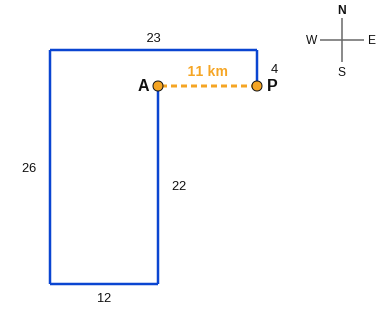
Paritosh starts from Point A and drives 22 km towards South. He then takes a right turn, drives 12 km, turns right and drives 26 km. He then takes a right turn and drives 23 km. He takes a final right turn, drives 4 km and stops at Point P. How far (shortest distance) and towards which direction should he drive in order to reach Point A again? (All turns are 90-degree turns only, unless specified.)
परितोष बिंदु A से चलना शुरू करता है और दक्षिण की ओर 22 km गाड़ी चलाता है। फिर वह दाएँ मुड़ता है, 12 km चलाता है, दाएँ मुड़ता है और 26 km चलाता है। फिर वह दाएँ मुड़ता है और 23 km चलाता है। वह अंतिम बार दाएँ मुड़ता है, 4 km चलाता है और बिंदु P पर रुक जाता है। बिंदु A पर फिर से पहुँचने के लिए उसे कितनी दूरी (न्यूनतम दूरी) और किस दिशा में गाड़ी चलानी चाहिए? (जब तक निर्दिष्ट न हो, सभी मोड़ केवल 90 डिग्री के हैं।)
  1. A11 km to the eastपूर्व की ओर 11 km
  2. B10 km to the westपश्चिम की ओर 10 km
  3. C11 km to the westपश्चिम की ओर 11 km
  4. D10 km to the eastपूर्व की ओर 10 km
Show answer

Concept: Take A = (0, 0); East = +x, North = +y.

  1. South 22 → (0, −22); right (West) 12 → (−12, −22)
  2. Right (North) 26 → (−12, 4); right (East) 23 → (11, 4)
  3. Right (South) 4 → P = (11, 0)
  4. P is 11 km East of A, so he must drive 11 km towards the West.

Short trick: Net East–West: 23−12=11 (East); net North–South: 26−22−4=0. So P is 11 km east of A → go 11 km west.

Answer: (C) 11 km to the west

अवधारणा: A = (0, 0) मानें; पूर्व = +x, उत्तर = +y।

  1. दक्षिण 22 → (0, −22); दाएँ (पश्चिम) 12 → (−12, −22)
  2. दाएँ (उत्तर) 26 → (−12, 4); दाएँ (पूर्व) 23 → (11, 4)
  3. दाएँ (दक्षिण) 4 → P = (11, 0)
  4. P, A से 11 km पूर्व में है, अतः उसे 11 km पश्चिम की ओर जाना होगा।

शॉर्ट ट्रिक: शुद्ध पूर्व–पश्चिम: 23−12=11 (पूर्व); शुद्ध उत्तर–दक्षिण: 26−22−4=0। अतः P, A के 11 km पूर्व में → 11 km पश्चिम जाएँ।

उत्तर: (C) पश्चिम की ओर 11 km

RRB ALP CBT 1General Intelligence and ReasoningDirection sense – distance and directionRRB ALP CBT 1 2025 · 17 Feb Shift 2 →
Q328.
What should come in place of ? in the given series?
91 97 106 118 133 ?
दी गई श्रृंखला में ? के स्थान पर क्या आना चाहिए?
91 97 106 118 133 ?
  1. A150
  2. B152
  3. C151
  4. D153
Show answer

Concept: Look at the differences between consecutive terms.

  1. Differences: 6, 9, 12, 15 – they increase by 3 (multiples of 3).
  2. Next difference = 18
  3. ? = 133 + 18 = 151

Short trick: Differences are the 3-table: 3×2, 3×3, 3×4, 3×5 → next 3×6 = 18.

Answer: (C) 151

अवधारणा: क्रमागत पदों के अंतर देखें।

  1. अंतर: 6, 9, 12, 15 – हर बार 3 बढ़ता है।
  2. अगला अंतर = 18
  3. ? = 133 + 18 = 151

शॉर्ट ट्रिक: अंतर 3 का पहाड़ा हैं: 3×2, 3×3, 3×4, 3×5 → अगला 3×6 = 18।

उत्तर: (C) 151

RRB ALP CBT 1General Intelligence and ReasoningNumber series – increasing differencesRRB ALP CBT 1 2025 · 17 Feb Shift 2 →
Q329.
Select the set in which the numbers are related in the same way as are the numbers of the following sets.
(NOTE : Operations should be performed on the whole numbers, without breaking down the numbers into its constituent digits. E.g. 13 – Operations on 13 such as adding / subtracting /multiplying etc. to 13 can be performed. Breaking down 13 into 1 and 3 and then performing mathematical operations on 1 and 3 is not allowed)
(8,168,7)
(9,243,9)
उस समुच्चय का चयन करें जिसमें संख्याएँ उसी प्रकार संबंधित हैं जिस प्रकार निम्नलिखित समुच्चयों की संख्याएँ संबंधित हैं।
(नोट: संख्याओं को उसके घटक अंकों में तोड़े बिना, पूर्ण संख्याओं पर संक्रियाएँ की जानी चाहिए। उदाहरण के लिए 13 – 13 पर संक्रियाएँ जैसे 13 में जोड़ना/घटाना/गुणा करना आदि किया जा सकता है। 13 को 1 और 3 में तोड़कर फिर 1 और 3 पर गणितीय संक्रियाएँ करने की अनुमति नहीं है।)
(8,168,7)
(9,243,9)
  1. A(12,252,7)
  2. B(16,324,8)
  3. C(15,330,8)
  4. D(13,325,9)
Show answer

Concept: Find a rule linking the 1st and 3rd numbers to the middle one.

  1. (8, 168, 7): 8×7×3=168 ✓
  2. (9, 243, 9): 9×9×3=243 ✓
  3. (A) (12, 252, 7): 12×7×3=252 ✓
  4. (B) 16×8×3=384≠324, (C) 15×8×3=360≠330, (D) 13×9×3=351≠325

Short trick: Middle ÷ 3 must equal product of the ends: 168/3 = 56 = 8×7. Check only 252/3 = 84 = 12×7 ✓.

Answer: (A) (12,252,7)

अवधारणा: पहली और तीसरी संख्या से बीच वाली संख्या का नियम खोजें।

  1. (8, 168, 7): 8×7×3=168 ✓
  2. (9, 243, 9): 9×9×3=243 ✓
  3. (A) (12, 252, 7): 12×7×3=252 ✓
  4. (B) 16×8×3=384≠324, (C) 15×8×3=360≠330, (D) 13×9×3=351≠325

शॉर्ट ट्रिक: बीच की संख्या ÷ 3 = दोनों सिरों का गुणनफल: 252/3 = 84 = 12×7 ✓।

उत्तर: (A) (12,252,7)

RRB ALP CBT 1General Intelligence and ReasoningNumber analogy – number setsRRB ALP CBT 1 2025 · 17 Feb Shift 2 →
Q330.
Refer to the following letter series and answer the question that follows. Counting to be done from left to right only.
(Left) F U V G Q R T N E S C T E U S R R S Q Q Y (Right)
How many such vowels are there, each of which is immediately preceded by a consonant and also immediately followed by a consonant?
निम्नलिखित अक्षर श्रृंखला को देखें और उसके बाद दिए गए प्रश्न का उत्तर दें। गिनती केवल बाएँ से दाएँ की जानी है।
(बाएँ) F U V G Q R T N E S C T E U S R R S Q Q Y (दाएँ)
ऐसे कितने स्वर हैं, जिनमें से प्रत्येक के ठीक पहले एक व्यंजन है और ठीक बाद भी एक व्यंजन है?
  1. AOneएक
  2. BMore than threeतीन से अधिक
  3. CTwoदो
  4. DNoneकोई नहीं
Show answer

Concept: Check only the vowels and their two neighbours.

  1. F U V → consonant–U–consonant ✓
  2. N E S → ✓
  3. T E U → followed by vowel ✗
  4. E U S → preceded by vowel ✗
  5. Count = 2

Short trick: Scan for the pattern "consonant-vowel-consonant" only around the 4 vowels (U, E, E, U) – the two vowels sitting together (E U) cancel each other.

Answer: (C) Two

अवधारणा: केवल स्वरों और उनके दोनों पड़ोसियों को जाँचें।

  1. F U V → व्यंजन–U–व्यंजन ✓
  2. N E S → ✓
  3. T E U → बाद में स्वर ✗
  4. E U S → पहले स्वर ✗
  5. संख्या = 2

शॉर्ट ट्रिक: केवल 4 स्वरों (U, E, E, U) के आसपास "व्यंजन-स्वर-व्यंजन" देखें – साथ-साथ बैठे E U एक-दूसरे को रद्द कर देते हैं।

उत्तर: (C) दो

RRB ALP CBT 1General Intelligence and ReasoningLetter series – position countingRRB ALP CBT 1 2025 · 17 Feb Shift 2 →
Q331.
This question is based on the five, three-digit numbers given below.
(Left) 567 254 395 486 671 (Right)
(Example- 697 – First digit = 6, second digit = 9 and third digit = 7)
What will be the resultant if the third digit of the highest number is added to the third digit of the lowest number?
यह प्रश्न नीचे दी गई पाँच, तीन अंकों वाली संख्याओं पर आधारित है।
(बाएँ) 567 254 395 486 671 (दाएँ)
(उदाहरण- 697 – पहला अंक = 6, दूसरा अंक = 9 और तीसरा अंक = 7)
यदि सबसे बड़ी संख्या के तीसरे अंक को सबसे छोटी संख्या के तीसरे अंक में जोड़ा जाए, तो परिणाम क्या होगा?
  1. A4
  2. B3
  3. C5
  4. D2
Show answer

Concept: Identify the highest and lowest numbers first.

  1. Highest = 671 → third digit 1
  2. Lowest = 254 → third digit 4
  3. Sum = 1 + 4 = 5

Short trick: Compare hundreds digits only: 2 (254) is the smallest; of the two numbers starting with 6, 671 > 567.

Answer: (C) 5

अवधारणा: पहले सबसे बड़ी और सबसे छोटी संख्या पहचानें।

  1. सबसे बड़ी = 671 → तीसरा अंक 1
  2. सबसे छोटी = 254 → तीसरा अंक 4
  3. योग = 1 + 4 = 5

शॉर्ट ट्रिक: केवल पहले अंक देखें: सबसे छोटा 2 (254); 6 वाली दो संख्याओं में 671 > 567।

उत्तर: (C) 5

RRB ALP CBT 1General Intelligence and ReasoningThree-digit number puzzleRRB ALP CBT 1 2025 · 17 Feb Shift 2 →
Q332.
What should come in place of the question mark (?) in the given series based on the English alphabetical order?
MCZ RHE WMJ BRO ?
अंग्रेज़ी वर्णमाला क्रम के आधार पर दी गई श्रृंखला में प्रश्न चिह्न (?) के स्थान पर क्या आना चाहिए?
MCZ RHE WMJ BRO ?
  1. AGTW
  2. BGRD
  3. CGWT
  4. DGER
Show answer

Concept: Check each letter position separately.

PositionLettersChange
1stM → R → W → B → G+5
2ndC → H → M → R → W+5
3rdZ → E → J → O → T+5

Short trick: Every letter moves +5 (Z+5 wraps to E). From BRO: B+5 = G, R+5 = W, O+5 = T → GWT.

Answer: (C) GWT

अवधारणा: प्रत्येक स्थान के अक्षर अलग-अलग देखें।

स्थानअक्षरपरिवर्तन
पहलाM → R → W → B → G+5
दूसराC → H → M → R → W+5
तीसराZ → E → J → O → T+5

शॉर्ट ट्रिक: हर अक्षर +5 (Z+5 = E)। BRO से: B+5 = G, R+5 = W, O+5 = T → GWT।

उत्तर: (C) GWT

RRB ALP CBT 1General Intelligence and ReasoningLetter series – +5 patternRRB ALP CBT 1 2025 · 17 Feb Shift 2 →
Q333.
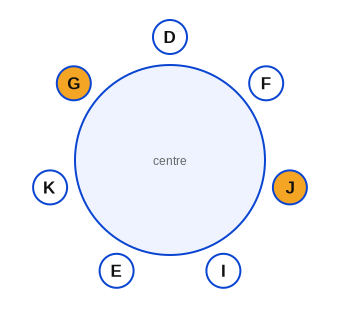
D, E, F, G, I, J and K are sitting around a circular table, facing the centre of the table. E sits to the immediate left of I. F sits to the immediate left of D. D sits second to the left of K. G sits third to the left of I.
Who sits third to the right of J?
D, E, F, G, I, J और K एक वृत्ताकार मेज़ के चारों ओर केंद्र की ओर मुख करके बैठे हैं। E, I के ठीक बाएँ बैठा है। F, D के ठीक बाएँ बैठा है। D, K के बाएँ से दूसरे स्थान पर बैठा है। G, I के बाएँ से तीसरे स्थान पर बैठा है।
J के दाएँ से तीसरे स्थान पर कौन बैठा है?
  1. AG
  2. BK
  3. CD
  4. DF
Show answer

Concept: Facing the centre: left = clockwise, right = anticlockwise.

  1. E is immediate left of I; G is 3rd to the left of I ⇒ clockwise: I, E, _, G.
  2. D is 2nd to the left of K and F is immediate left of D ⇒ K, _, D, F (clockwise). Place K right after E: I, E, K, G, D, F.
  3. The remaining seat (between F and I) goes to J. Clockwise: D, F, J, I, E, K, G.
  4. 3rd to the right of J (anticlockwise): F → D → G.

Short trick: Once the order is clockwise D-F-J-I-E-K-G, "3rd right of J" = 3 steps back in this list (wrapping round): F, D, G.

Answer: (A) G

अवधारणा: केंद्र की ओर मुख होने पर: बायाँ = दक्षिणावर्त, दायाँ = वामावर्त।

  1. E, I के ठीक बाएँ; G, I के बाएँ से तीसरा ⇒ दक्षिणावर्त: I, E, _, G।
  2. D, K के बाएँ से दूसरा और F, D के ठीक बाएँ ⇒ K, _, D, F। K को E के बाद रखें: I, E, K, G, D, F।
  3. शेष स्थान (F और I के बीच) J का। दक्षिणावर्त: D, F, J, I, E, K, G।
  4. J के दाएँ से तीसरा (वामावर्त): F → D → G।

शॉर्ट ट्रिक: दक्षिणावर्त क्रम D-F-J-I-E-K-G बनने के बाद "J के दाएँ तीसरा" = सूची में 3 कदम पीछे: F, D, G।

उत्तर: (A) G

RRB ALP CBT 1General Intelligence and ReasoningSeating arrangement – circular (facing centre)RRB ALP CBT 1 2025 · 17 Feb Shift 2 →
Q334.
Refer to the following letter, symbol series and answer the question that follows. Counting to be done from left to right only.
(Left) # P & T £ @ G $ G V M & X M @ # & L L @ K Y (Right)
How many such letter are there, each of which is immediately preceded by a symbol and also immediately followed by a symbol?
निम्नलिखित अक्षर, प्रतीक श्रृंखला को देखें और उसके बाद दिए गए प्रश्न का उत्तर दें। गिनती केवल बाएँ से दाएँ की जानी है।
(बाएँ) # P & T £ @ G $ G V M & X M @ # & L L @ K Y (दाएँ)
ऐसे कितने अक्षर हैं, जिनमें से प्रत्येक के ठीक पहले एक प्रतीक है और ठीक बाद भी एक प्रतीक है?
  1. A3
  2. B4
  3. C5
  4. D2
Show answer

Concept: Look for the pattern symbol–letter–symbol.

  1. # P & ✓
  2. & T £ ✓
  3. @ G $ ✓
  4. All other letters have a letter on at least one side (G V M, & X M, L L, K Y).
  5. Count = 3

Short trick: Mark every letter standing alone between two symbols – only the first three single letters (P, T, G) qualify.

Answer: (A) 3

अवधारणा: प्रतीक–अक्षर–प्रतीक पैटर्न खोजें।

  1. # P & ✓
  2. & T £ ✓
  3. @ G $ ✓
  4. बाकी सभी अक्षरों के कम से कम एक ओर अक्षर है (G V M, & X M, L L, K Y)।
  5. संख्या = 3

शॉर्ट ट्रिक: दो प्रतीकों के बीच अकेले खड़े अक्षर गिनें – केवल P, T, G।

उत्तर: (A) 3

RRB ALP CBT 1General Intelligence and ReasoningLetter-symbol series – position countingRRB ALP CBT 1 2025 · 17 Feb Shift 2 →
Q335.
Select the pair which follows the same pattern as that followed by the two set of pairs given below. Both pairs follow the same pattern.
NLGT : SPJV
DQCL : IUFN
उस युग्म का चयन करें जो उसी पैटर्न का अनुसरण करता है जिसका अनुसरण नीचे दिए गए दो युग्म करते हैं। दोनों युग्म एक ही पैटर्न का अनुसरण करते हैं।
NLGT : SPJV
DQCL : IUFN
  1. AJPZS : OTCU
  2. BWXYZ : BBBC
  3. CKNMS : PRPV
  4. DRMEF : WRHH
Show answer

Concept: Compare letter-by-letter.

Pair1st2nd3rd4th
NLGT → SPJV+5+4+3+2
DQCL → IUFN+5+4+3+2
JPZS → OTCU+5+4+3 (Z→C)+2

Short trick: The shifts fall +5, +4, +3, +2. The 1st letter (+5) fits every option, so test the last letter (+2): Z+2 = B ≠ C and S+2 = U ≠ V knock out (B) and (C); in (D) M+4 = Q ≠ R. Only (A) survives.

Answer: (A) JPZS : OTCU

अवधारणा: अक्षर-दर-अक्षर तुलना करें।

युग्मपहलादूसरातीसराचौथा
NLGT → SPJV+5+4+3+2
DQCL → IUFN+5+4+3+2
JPZS → OTCU+5+4+3 (Z→C)+2

शॉर्ट ट्रिक: परिवर्तन +5, +4, +3, +2 हैं। पहला अक्षर (+5) सभी विकल्पों में ठीक है, अतः अंतिम अक्षर (+2) जाँचें: Z+2 = B ≠ C और S+2 = U ≠ V से (B) व (C) बाहर; (D) में M+4 = Q ≠ R। केवल (A) बचता है।

उत्तर: (A) JPZS : OTCU

RRB ALP CBT 1General Intelligence and ReasoningLetter analogy – position shiftsRRB ALP CBT 1 2025 · 17 Feb Shift 2 →
Q336.
Each vowel in the word JOURNAL is changed to the letter immediately following it in the English alphabetical order and each consonant is changed to the letter immediately preceding it in the English alphabetical order. How many vowels are there in the new group of letters thus formed?
शब्द JOURNAL में प्रत्येक स्वर को अंग्रेज़ी वर्णमाला क्रम में उसके ठीक बाद वाले अक्षर से बदल दिया जाता है और प्रत्येक व्यंजन को अंग्रेज़ी वर्णमाला क्रम में उसके ठीक पहले वाले अक्षर से बदल दिया जाता है। इस प्रकार बने अक्षरों के नए समूह में कितने स्वर हैं?
  1. A1
  2. B0
  3. C3
  4. D2
Show answer

Concept: Vowel → next letter; consonant → previous letter.

JOURNAL
IPVQMBK

Short trick: Vowels move forward and always become consonants (A→B, O→P, U→V). A new vowel can come only from a consonant just after a vowel: J→I ✓ (also F→E, P→O, V→U, B→A would). JOURNAL has only J → 1 vowel.

Answer: (A) 1

अवधारणा: स्वर → अगला अक्षर; व्यंजन → पिछला अक्षर।

JOURNAL
IPVQMBK

शॉर्ट ट्रिक: स्वर आगे बढ़कर हमेशा व्यंजन बन जाते हैं (A→B, O→P, U→V)। नया स्वर केवल ऐसे व्यंजन से बनेगा जो स्वर के ठीक बाद आता है: J→I ✓। अतः 1 स्वर।

उत्तर: (A) 1

RRB ALP CBT 1General Intelligence and ReasoningLetter coding – vowel/consonant changeRRB ALP CBT 1 2025 · 17 Feb Shift 2 →
Q337.
In the following number-pairs, the second number is obtained by applying certain mathematical operation(s) to the first number. Which numbers should replace X and Y, so that the pattern followed by the two numbers on the left side of :: is the same as that on the right side of ::?
(NOTE: Operations should be performed on the whole numbers, without breaking down the numbers into their constituent digits. E.g. 13 – Operations on 13 such as adding to/subtracting from/multiplying with 13 can be performed. Breaking down 13 into 1 and 3 and then performing mathematical operations on 1 and 3 is not allowed.)
X : 98 : : 196 : Y
निम्नलिखित संख्या-युग्मों में, दूसरी संख्या पहली संख्या पर कुछ गणितीय संक्रिया/संक्रियाएँ करके प्राप्त की जाती है। X और Y को किन संख्याओं से प्रतिस्थापित किया जाना चाहिए, ताकि :: के बाईं ओर की दोनों संख्याओं द्वारा अनुसरित पैटर्न वही हो जो :: के दाईं ओर की संख्याओं का है?
(नोट: संख्याओं को उसके घटक अंकों में तोड़े बिना, पूर्ण संख्याओं पर संक्रियाएँ की जानी चाहिए। उदाहरण के लिए 13 – 13 पर संक्रियाएँ जैसे 13 में जोड़ना/घटाना/गुणा करना आदि किया जा सकता है। 13 को 1 और 3 में तोड़कर फिर 1 और 3 पर गणितीय संक्रियाएँ करने की अनुमति नहीं है।)
X : 98 : : 196 : Y
  1. AX = 116, Y = 178
  2. BX = 104, Y = 185
  3. CX = 47, Y = 101
  4. DX = 98, Y = 96
Show answer

Concept: The same operation must turn X into 98 and 196 into Y.

  1. (A) 116 − 18 = 98 and 196 − 18 = 178 ✓ (same rule: subtract 18)
  2. (B) 104 − 6 = 98 but 196 − 11 = 185 ✗
  3. (C) 47 → 98 is ×2 + 4, but 196 → 101 ✗
  4. (D) 98 → 98 (no change) but 196 → 96 ✗

Short trick: Compute X − 98 and 196 − Y for each option; they must be equal: (A) 18 and 18 ✓.

Answer: (A) X = 116, Y = 178

अवधारणा: एक ही संक्रिया से X को 98 और 196 को Y बनना चाहिए।

  1. (A) 116 − 18 = 98 और 196 − 18 = 178 ✓ (नियम: 18 घटाएँ)
  2. (B) 104 − 6 = 98 लेकिन 196 − 11 = 185 ✗
  3. (C) 47 → 98 (×2 + 4) लेकिन 196 → 101 ✗
  4. (D) 98 → 98 लेकिन 196 → 96 ✗

शॉर्ट ट्रिक: प्रत्येक विकल्प में X − 98 और 196 − Y निकालें; दोनों बराबर हों: (A) 18 और 18 ✓।

उत्तर: (A) X = 116, Y = 178

RRB ALP CBT 1General Intelligence and ReasoningNumber analogy – find X and YRRB ALP CBT 1 2025 · 17 Feb Shift 2 →
Q338.
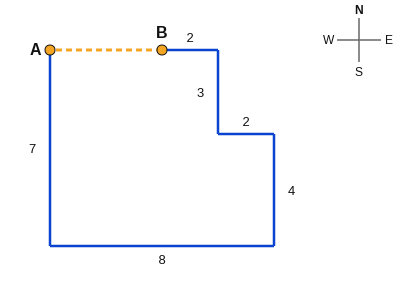
Vinay starts to walk from point A towards the south for 7 m. Then he takes a left turn and walks for 8 m. Then he takes a left turn and walks for 4 m. Then he takes a left turn and walks for 2 m. Then he takes a right turn and walks for 3 m. At last, he takes left turn and walks for 2 m and stops at point B. Towards which direction should he walk in order to reach point A again? (All turns are 90-degree turns only unless specified.)
विनय बिंदु A से दक्षिण की ओर 7 m चलना शुरू करता है। फिर वह बाएँ मुड़ता है और 8 m चलता है। फिर वह बाएँ मुड़ता है और 4 m चलता है। फिर वह बाएँ मुड़ता है और 2 m चलता है। फिर वह दाएँ मुड़ता है और 3 m चलता है। अंत में, वह बाएँ मुड़ता है और 2 m चलकर बिंदु B पर रुक जाता है। बिंदु A पर फिर से पहुँचने के लिए उसे किस दिशा में चलना चाहिए? (जब तक निर्दिष्ट न हो, सभी मोड़ केवल 90 डिग्री के हैं।)
  1. ANorthउत्तर
  2. BSouthदक्षिण
  3. CEastपूर्व
  4. DWestपश्चिम
Show answer

Concept: Take A = (0, 0); East = +x, North = +y.

  1. South 7 → (0, −7); left (East) 8 → (8, −7)
  2. Left (North) 4 → (8, −3); left (West) 2 → (6, −3)
  3. Right (North) 3 → (6, 0); left (West) 2 → B = (4, 0)
  4. B is 4 m East of A ⇒ walk towards the West.

Short trick: Net N–S: −7+4+3=0; net E–W: 8−2−2=4 East. B is due east of A → go West.

Answer: (D) West

अवधारणा: A = (0, 0) मानें; पूर्व = +x, उत्तर = +y।

  1. दक्षिण 7 → (0, −7); बाएँ (पूर्व) 8 → (8, −7)
  2. बाएँ (उत्तर) 4 → (8, −3); बाएँ (पश्चिम) 2 → (6, −3)
  3. दाएँ (उत्तर) 3 → (6, 0); बाएँ (पश्चिम) 2 → B = (4, 0)
  4. B, A के 4 m पूर्व में ⇒ पश्चिम की ओर चलें।

शॉर्ट ट्रिक: शुद्ध उ–द: −7+4+3=0; शुद्ध पू–प: 8−2−2=4 पूर्व। B, A के ठीक पूर्व में → पश्चिम जाएँ।

उत्तर: (D) पश्चिम

RRB ALP CBT 1General Intelligence and ReasoningDirection sense – final directionRRB ALP CBT 1 2025 · 17 Feb Shift 2 →
Q339.
What should come in place of the question mark (?) in the given series based on the English alphabetical order?
ZHW UCR PXM KSH ?
अंग्रेज़ी वर्णमाला क्रम के आधार पर दी गई श्रृंखला में प्रश्न चिह्न (?) के स्थान पर क्या आना चाहिए?
ZHW UCR PXM KSH ?
  1. AFCD
  2. BFNC
  3. CFCN
  4. DFDR
Show answer

Concept: Check each position separately.

PositionLettersChange
1stZ → U → P → K → F−5
2ndH → C → X → S → N−5
3rdW → R → M → H → C−5

Short trick: All letters go back 5: K−5 = F, S−5 = N, H−5 = C → FNC (only option with N in the middle).

Answer: (B) FNC

अवधारणा: प्रत्येक स्थान अलग देखें।

स्थानअक्षरपरिवर्तन
पहलाZ → U → P → K → F−5
दूसराH → C → X → S → N−5
तीसराW → R → M → H → C−5

शॉर्ट ट्रिक: सभी अक्षर 5 पीछे: K−5 = F, S−5 = N, H−5 = C → FNC (बीच में N वाला एकमात्र विकल्प)।

उत्तर: (B) FNC

RRB ALP CBT 1General Intelligence and ReasoningLetter series – −5 patternRRB ALP CBT 1 2025 · 17 Feb Shift 2 →
Q340.
Based on the English alphabetical order, three of the following four letter-cluster pairs are alike in a certain way and thus form a group. Which letter-cluster pair DOES NOT belong to that group? (Note: The odd one out is not based on the number of consonants/vowels or their position in the letter-cluster.)
अंग्रेज़ी वर्णमाला क्रम के आधार पर, निम्नलिखित चार अक्षर-समूह युग्मों में से तीन किसी निश्चित तरीके से एकसमान हैं और इस प्रकार एक समूह बनाते हैं। कौन-सा अक्षर-समूह युग्म उस समूह से संबंधित नहीं है?
(नोट: असंगत का चयन व्यंजनों/स्वरों की संख्या या अक्षर-समूह में उनके स्थान पर आधारित नहीं है।)
  1. AJI-LK
  2. BBA-DC
  3. CGH-PQ
  4. DXW-ZY
Show answer

Concept: Find the relation inside each cluster and between the two clusters.

  1. JI-LK: J→I (−1); J+2 = L, I+2 = K ✓
  2. BA-DC: B→A (−1); +2 → D, C ✓
  3. XW-ZY: X→W (−1); +2 → Z, Y ✓
  4. GH-PQ: G→H is +1 and G→P is +9 ✗

Short trick: In three pairs the letters are in reverse order (JI, BA, XW) and the second cluster is just +2. GH is in forward order – odd.

Answer: (C) GH-PQ

अवधारणा: प्रत्येक समूह के भीतर और दोनों समूहों के बीच संबंध देखें।

  1. JI-LK: J→I (−1); J+2 = L, I+2 = K ✓
  2. BA-DC: B→A (−1); +2 → D, C ✓
  3. XW-ZY: X→W (−1); +2 → Z, Y ✓
  4. GH-PQ: G→H (+1) और G→P (+9) ✗

शॉर्ट ट्रिक: तीन युग्मों में अक्षर उल्टे क्रम में (JI, BA, XW) और दूसरा समूह +2 है। GH सीधे क्रम में – विषम।

उत्तर: (C) GH-PQ

RRB ALP CBT 1General Intelligence and ReasoningOdd one out – letter-cluster pairsRRB ALP CBT 1 2025 · 17 Feb Shift 2 →