Question bank

Q&A: practice questions with answers

Search questions on any topic. Filter by exam category, exam, subject and topic, try the question, then open the answer and explanation.

Courses – airGurukul

20,719 questions found.

Q481.
AL8 is related to EQ40 in a certain way. In the same way, MF13 is related to QK65. To which of the given options is UO5 related, following the same logic?
AL8 एक निश्चित प्रकार से EQ40 से संबंधित है। उसी प्रकार, MF13, QK65 से संबंधित है। समान तर्क का अनुसरण करते हुए, UO5 दिए गए विकल्पों में से किससे संबंधित है?
  1. AXT20
  2. BMT25
  3. CZT20
  4. DYT25
Show answer

Concept: First letter +4, second letter +5, number ×5.

  1. A(1)+4 = E, L(12)+5 = Q, 8×5 = 40 → EQ40.
  2. M+4 = Q, F+5 = K, 13×5 = 65 → QK65.
  3. U(21)+4 = Y, O(15)+5 = T, 5×5 = 25 → YT25.

Short trick: Number part first: 5×5 = 25 → only MT25 or YT25; U+4 = Y → YT25.

Answer: (D) YT25

अवधारणा: पहला अक्षर +4, दूसरा अक्षर +5, संख्या ×5.

  1. A(1)+4 = E, L(12)+5 = Q, 8×5 = 40 → EQ40.
  2. M+4 = Q, F+5 = K, 13×5 = 65 → QK65.
  3. U(21)+4 = Y, O(15)+5 = T, 5×5 = 25 → YT25.

शॉर्ट ट्रिक: पहले संख्या: 5×5 = 25 → MT25 या YT25; U+4 = Y → YT25.

उत्तर: (D) YT25
RRB ALP CBT 1General Intelligence and ReasoningAlpha-numeric analogyRRB ALP CBT 1 2025 · 16 Feb Shift 3 →
Q482.
Based on the English alphabetical order, three of the following four letter-clusters are alike in a certain way and thus form a group. Which letter-cluster DOES NOT belong to that group?
(Note: The odd one out is not based on the number of consonants/vowels or their position in the letter-cluster.)
अंग्रेजी वर्णमाला क्रम के आधार पर, निम्नलिखित चार अक्षर-समूहों में से तीन किसी निश्चित प्रकार से एकसमान हैं और इस प्रकार एक समूह बनाते हैं। कौन-सा अक्षर-समूह उस समूह से संबंधित नहीं है?
(नोट: असंगत का निर्धारण व्यंजनों/स्वरों की संख्या या अक्षर-समूह में उनके स्थान के आधार पर नहीं है।)
  1. APUZ
  2. BCHN
  3. CLQW
  4. DINT
Show answer

Concept: Find the gaps between consecutive letters.

  1. PUZP→U +5U→Z +5
    CHN+5+6
    LQW+5+6
    INT+5+6

Short trick: Three clusters follow +5, +6; PUZ follows +5, +5.

Answer: (A) PUZ

अवधारणा: क्रमागत अक्षरों के बीच का अंतर ज्ञात करें।

  1. PUZP→U +5U→Z +5
    CHN+5+6
    LQW+5+6
    INT+5+6

शॉर्ट ट्रिक: तीन समूहों में +5, +6; PUZ में +5, +5.

उत्तर: (A) PUZ

RRB ALP CBT 1General Intelligence and ReasoningOdd one out – letter gapsRRB ALP CBT 1 2025 · 16 Feb Shift 3 →
Q483.
What will come in place of the question mark (?) in the following equation, if '+' and '÷' are interchanged and '−' and '×' are interchanged?
368 + 46 × 7 − 23 ÷ 183 = ?
यदि '+' और '÷' को आपस में बदल दिया जाए तथा '−' और '×' को आपस में बदल दिया जाए, तो निम्नलिखित समीकरण में प्रश्न चिह्न (?) के स्थान पर क्या आएगा?
368 + 46 × 7 − 23 ÷ 183 = ?
  1. A30
  2. B39
  3. C33
  4. D38
Show answer

Concept: Swap the signs, then apply BODMAS.

  1. New expression: 368÷46−7×23+183.
  2. =8−161+183.
  3. =30.

Short trick: 368÷46=8 (since 46×8=368); 8+183=191, 191−161=30.

Answer: (A) 30

अवधारणा: चिह्न बदलें, फिर BODMAS लगाएँ।

  1. नया व्यंजक: 368÷46−7×23+183.
  2. =8−161+183.
  3. =30.

शॉर्ट ट्रिक: 368÷46=8; 8+183=191, 191−161=30.

उत्तर: (A) 30

RRB ALP CBT 1General Intelligence and ReasoningMathematical operations – interchangeRRB ALP CBT 1 2025 · 16 Feb Shift 3 →
Q484.
Refer to the following letter series and answer the question that follows. Counting to be done from left to right only.
(Left) W U G E K L T Q J W U J V E S C V K J T C (Right)
How many such vowels are there, each of which is immediately preceded by a vowel and also immediately followed by a consonant?
निम्नलिखित अक्षर श्रृंखला को देखें और नीचे दिए गए प्रश्न का उत्तर दें। गिनती केवल बाएँ से दाएँ की जानी है।
(बाएँ) W U G E K L T Q J W U J V E S C V K J T C (दाएँ)
ऐसे कितने स्वर हैं जिनमें से प्रत्येक के ठीक पहले एक स्वर है और ठीक बाद एक व्यंजन है?
  1. ANoneकोई नहीं
  2. BMore than threeतीन से अधिक
  3. COneएक
  4. DTwoदो
Show answer

Concept: Look only at vowels and check the letter before each.

  1. Vowels: U (2nd), E (4th), U (11th), E (14th).
  2. Before them: W, G, W, V – all consonants.
  3. No vowel is preceded by a vowel.

Short trick: Find vowel-vowel pairs first: there is none (no two vowels side by side) → answer 'None'.

Answer: (A) None

अवधारणा: केवल स्वरों को देखें और उनके ठीक पहले का अक्षर जाँचें।

  1. स्वर: U (दूसरा), E (चौथा), U (11वाँ), E (14वाँ)।
  2. इनके ठीक पहले: W, G, W, V – सभी व्यंजन।
  3. किसी स्वर के ठीक पहले स्वर नहीं है।

शॉर्ट ट्रिक: पहले स्वर-स्वर जोड़ी खोजें: कोई नहीं → उत्तर 'कोई नहीं'।

उत्तर: (A) कोई नहीं

RRB ALP CBT 1General Intelligence and ReasoningLetter series – position conditionsRRB ALP CBT 1 2025 · 16 Feb Shift 3 →
Q485.
Based on the English alphabetical order, three of the following four letter-clusters are alike in a certain way and thus form a group. Which letter-cluster DOES NOT belong to that group? (Note: The odd one out is not based on the number of consonants/vowels or their position in the letter-cluster.)
अंग्रेजी वर्णमाला क्रम के आधार पर, निम्नलिखित चार अक्षर-समूहों में से तीन किसी निश्चित प्रकार से एकसमान हैं और इस प्रकार एक समूह बनाते हैं। कौन-सा अक्षर-समूह उस समूह से संबंधित नहीं है?
(नोट: असंगत का निर्धारण व्यंजनों/स्वरों की संख्या या अक्षर-समूह में उनके स्थान के आधार पर नहीं है।)
  1. ADUP
  2. BJAV
  3. CXPJ
  4. DQHC
Show answer

Concept: Move forward cyclically (after Z comes A) and measure the gaps.

  1. DUPD→U +17U→P +21
    JAVJ→A +17A→V +21
    QHCQ→H +17H→C +21
    XPJX→P +18P→J +20

Short trick: Count the second gap backwards: U→P −5, A→V −5, H→C −5, but P→J −6 → XPJ is odd.

Answer: (C) XPJ

अवधारणा: चक्रीय रूप से आगे गिनें (Z के बाद A) और अंतर मापें।

  1. DUPD→U +17U→P +21
    JAVJ→A +17A→V +21
    QHCQ→H +17H→C +21
    XPJX→P +18P→J +20

शॉर्ट ट्रिक: +21 आगे = −5 पीछे: U→P, A→V, H→C में −5, परंतु P→J में −6 → XPJ असंगत।

उत्तर: (C) XPJ

RRB ALP CBT 1General Intelligence and ReasoningOdd one out – letter gaps (cyclic)RRB ALP CBT 1 2025 · 16 Feb Shift 3 →
Q486.
18 is related to 54 following certain logic. Following the same logic, 33 is related to 99. To which of the following is 27 related, following the same logic?
(NOTE: Operations should be performed on the whole numbers, without breaking down the numbers into its constituent digits. E.g. 13 – Operations on 13 such as adding / subtracting / multiplying etc. to 13 can be performed. Breaking down 13 into 1 and 3 and then performing mathematical operations on 1 and 3 is not allowed.)
18 एक निश्चित तर्क के अनुसार 54 से संबंधित है। उसी तर्क का अनुसरण करते हुए, 33, 99 से संबंधित है। उसी तर्क का अनुसरण करते हुए, 27 निम्नलिखित में से किससे संबंधित है?
(नोट: संक्रियाएँ संख्याओं को उनके घटक अंकों में तोड़े बिना, पूर्ण संख्याओं पर की जानी चाहिए। उदाहरण: 13 – 13 पर संक्रियाएँ जैसे 13 में जोड़ना/घटाना/गुणा करना आदि की जा सकती हैं। 13 को 1 और 3 में तोड़कर फिर 1 और 3 पर गणितीय संक्रियाएँ करने की अनुमति नहीं है।)
  1. A79
  2. B85
  3. C81
  4. D84
Show answer

Concept: Second number = first number × 3.

  1. 18×3=54, 33×3=99.
  2. 27×3=81.

Short trick: Answer must be a multiple of 3 (and of 27): digit sum of 81 = 9 ✓; 79, 85, 84 → only 81 is divisible by 27.

Answer: (C) 81

अवधारणा: दूसरी संख्या = पहली संख्या × 3.

  1. 18×3=54, 33×3=99.
  2. 27×3=81.

शॉर्ट ट्रिक: उत्तर 27 का गुणज होना चाहिए → केवल 81.

उत्तर: (C) 81

RRB ALP CBT 1General Intelligence and ReasoningNumber analogyRRB ALP CBT 1 2025 · 16 Feb Shift 3 →
Q487.
Each of G, J, M, O, R, S, and T has an exam on a different day of a week, starting from Monday and ending on Sunday of the same week.
Only three people have exams between O and S. S has an exam on the last day of the week. Only one person has an exam between G and J. T has an exam immediately the day before M. R doesn't have an exam on Friday. J has an exam before G.
Who has an exam on Tuesday?
G, J, M, O, R, S और T में से प्रत्येक की परीक्षा एक ही सप्ताह के अलग-अलग दिन है, जो सोमवार से शुरू होकर रविवार को समाप्त होता है।
O और S के बीच केवल तीन लोगों की परीक्षा है। S की परीक्षा सप्ताह के अंतिम दिन है। G और J के बीच केवल एक व्यक्ति की परीक्षा है। T की परीक्षा M से ठीक एक दिन पहले है। R की परीक्षा शुक्रवार को नहीं है। J की परीक्षा G से पहले है।
मंगलवार को किसकी परीक्षा है?
  1. AO
  2. BT
  3. CG
  4. DJ
Show answer

Concept: Start with the fixed day (S = Sunday) and the gap clues.

  1. S on Sunday; three between O and S → O on Wednesday.
  2. T immediately before M: possible pairs (Mon-Tue), (Thu-Fri), (Fri-Sat).
  3. One between G and J with J before G: if T-M = Fri-Sat then J-G = Tue-Thu, R = Mon (not Friday ✓).
  4. Other T-M placements leave R on Friday or break the G-J gap.
  5. MonTueWedThuFriSatSun
    RJOGTMS

Short trick: Fix S and O first (Sun, Wed) – only 5 days remain; place the 2-block T-M, then G _ J falls into place.

Answer: (D) J

अवधारणा: निश्चित दिन (S = रविवार) और अंतराल वाले संकेतों से शुरू करें।

  1. S रविवार; O और S के बीच तीन → O बुधवार।
  2. T, M से ठीक पहले: संभव जोड़े (सोम-मंगल), (गुरु-शुक्र), (शुक्र-शनि)।
  3. G और J के बीच एक, J पहले: T-M = शुक्र-शनि हो तो J-G = मंगल-गुरु, R = सोमवार (शुक्रवार नहीं ✓)।
  4. अन्य स्थितियों में R शुक्रवार पर आता है या G-J का अंतर टूटता है।
  5. सोममंगलबुधगुरुशुक्रशनिरवि
    RJOGTMS

शॉर्ट ट्रिक: पहले S और O (रवि, बुध) तय करें – 5 दिन बचते हैं; T-M ब्लॉक रखें, फिर G _ J अपने आप बैठ जाता है।

उत्तर: (D) J

RRB ALP CBT 1General Intelligence and ReasoningScheduling – days of a weekRRB ALP CBT 1 2025 · 16 Feb Shift 3 →
Q488.
Read the given statements and conclusions carefully. Assuming that the information given in the statements is true, even if it appears to be at variance with commonly known facts, decide which of the given conclusions logically follow(s) from the statements.
Statements:
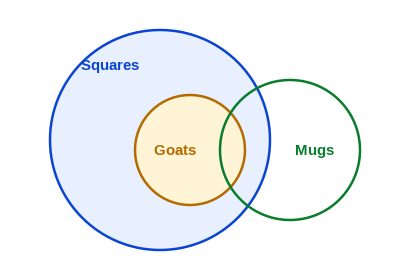
Some mugs are goats.
All goats are squares.
Conclusions:
(I) Some mugs are squares.
(II) Some squares are goats.
दिए गए कथनों और निष्कर्षों को ध्यानपूर्वक पढ़ें। यह मानते हुए कि कथनों में दी गई जानकारी सत्य है, भले ही वह सामान्य रूप से ज्ञात तथ्यों से भिन्न प्रतीत होती हो, निर्णय लें कि दिए गए निष्कर्षों में से कौन-सा/से निष्कर्ष कथनों का तार्किक रूप से अनुसरण करता/करते है/हैं।
कथन:
कुछ मग, बकरियाँ हैं।
सभी बकरियाँ, वर्ग हैं।
निष्कर्ष:
(I) कुछ मग, वर्ग हैं।
(II) कुछ वर्ग, बकरियाँ हैं।
  1. ANeither conclusion (I) nor (II) follows.न तो निष्कर्ष (I) और न ही (II) अनुसरण करता है।
  2. BBoth conclusions (I) and (II) follow.निष्कर्ष (I) और (II) दोनों अनुसरण करते हैं।
  3. COnly conclusion (I) follows.केवल निष्कर्ष (I) अनुसरण करता है।
  4. DOnly conclusion (II) follows.केवल निष्कर्ष (II) अनुसरण करता है।
Show answer

Concept: Some + All → Some (I-type conclusion); 'All A are B' gives 'Some B are A'.

  1. Some mugs are goats + All goats are squares → Some mugs are squares → (I) follows.
  2. All goats are squares → converse: Some squares are goats → (II) follows.

Short trick: Rule: 'Some A are B' + 'All B are C' ⇒ 'Some A are C'. Conversion of 'All' always gives 'Some'.

Answer: (B) Both conclusions (I) and (II) follow.

अवधारणा: कुछ + सभी → कुछ; 'सभी A, B हैं' से 'कुछ B, A हैं'।

  1. कुछ मग बकरियाँ हैं + सभी बकरियाँ वर्ग हैं → कुछ मग वर्ग हैं → (I) अनुसरण करता है।
  2. सभी बकरियाँ वर्ग हैं → विलोम: कुछ वर्ग बकरियाँ हैं → (II) अनुसरण करता है।

शॉर्ट ट्रिक: नियम: 'कुछ A, B हैं' + 'सभी B, C हैं' ⇒ 'कुछ A, C हैं'। 'सभी' का विलोम सदैव 'कुछ' होता है।

उत्तर: (B) निष्कर्ष (I) और (II) दोनों अनुसरण करते हैं।

RRB ALP CBT 1General Intelligence and ReasoningSyllogismRRB ALP CBT 1 2025 · 16 Feb Shift 3 →
Q489.
Seven boxes, T, U, V, W, X, Y and Z are kept one over the other but not necessarily in the same order. Only one box is kept above X. T is kept immediately above Y. U is placed immediately below Y. V is kept fifth from the bottom. W is kept on one of the positions below Z. What box is kept at the top?
सात बक्से T, U, V, W, X, Y और Z एक के ऊपर एक रखे गए हैं, लेकिन जरूरी नहीं कि इसी क्रम में हों। X के ऊपर केवल एक बक्सा रखा है। T, Y के ठीक ऊपर रखा है। U, Y के ठीक नीचे रखा है। V नीचे से पाँचवें स्थान पर रखा है। W, Z से नीचे के किसी एक स्थान पर रखा है। सबसे ऊपर कौन-सा बक्सा रखा है?
  1. AV
  2. BU
  3. CT
  4. DZ
Show answer

Concept: Positions 1 (bottom) to 7 (top). Place fixed boxes first.

  1. Only one box above X → X at 6. V 5th from bottom → V at 5.
  2. Block T-Y-U (top to bottom) must fit in 1–4: either 4-3-2 or 3-2-1.
  3. W below Z; the only places left are 7 and one low slot → Z must be at 7 (top), W at the low slot.
  4. PositionCase 1Case 2
    7ZZ
    6XX
    5VV
    4TW
    3YT
    2UY
    1WU

Short trick: Top position is free and W must be below Z → Z is always on top, whichever case.

Answer: (D) Z

अवधारणा: स्थान 1 (नीचे) से 7 (ऊपर)। पहले निश्चित बक्से रखें।

  1. X के ऊपर केवल एक बक्सा → X स्थान 6 पर। V नीचे से पाँचवाँ → V स्थान 5.
  2. T-Y-U ब्लॉक (ऊपर से नीचे) 1–4 में: 4-3-2 या 3-2-1.
  3. W, Z से नीचे; बचे स्थान 7 और एक नीचे का → Z स्थान 7 (सबसे ऊपर), W नीचे।
  4. स्थानस्थिति 1स्थिति 2
    7ZZ
    6XX
    5VV
    4TW
    3YT
    2UY
    1WU

शॉर्ट ट्रिक: दोनों स्थितियों में सबसे ऊपर Z ही है।

उत्तर: (D) Z

RRB ALP CBT 1General Intelligence and ReasoningBox arrangement – stackingRRB ALP CBT 1 2025 · 16 Feb Shift 3 →
Q490.
YEVA is related to KQHM in a certain way based on the English alphabetical order. In the same way, UARW is related to GMDI. To which of the given options is EKBG related, following the same logic?
अंग्रेजी वर्णमाला क्रम के आधार पर YEVA एक निश्चित प्रकार से KQHM से संबंधित है। उसी प्रकार, UARW, GMDI से संबंधित है। समान तर्क का अनुसरण करते हुए, EKBG दिए गए विकल्पों में से किससे संबंधित है?
  1. AQWCG
  2. BQNJU
  3. CQWNS
  4. DAQWE
Show answer

Concept: Each letter moves +12 (cyclic).

  1. Y+12 = K, E+12 = Q, V+12 = H, A+12 = M → KQHM.
  2. U+12 = G, A+12 = M, R+12 = D, W+12 = I → GMDI.
  3. E+12 = Q, K+12 = W, B+12 = N, G+12 = S → QWNS.

Short trick: +12 forward = −14 backward; check only 2nd letter: K+12 = W → QWCG or QWNS; B+12 = N → QWNS.

Answer: (C) QWNS

अवधारणा: प्रत्येक अक्षर +12 (चक्रीय) आगे बढ़ता है।

  1. Y+12 = K, E+12 = Q, V+12 = H, A+12 = M → KQHM.
  2. U+12 = G, A+12 = M, R+12 = D, W+12 = I → GMDI.
  3. E+12 = Q, K+12 = W, B+12 = N, G+12 = S → QWNS.

शॉर्ट ट्रिक: दूसरा अक्षर जाँचें: K+12 = W → QWCG या QWNS; B+12 = N → QWNS.

उत्तर: (C) QWNS

RRB ALP CBT 1General Intelligence and ReasoningLetter analogy – shiftRRB ALP CBT 1 2025 · 16 Feb Shift 3 →
Q491.
Seven boxes, T, W, Z, K, R, U and H are kept one over the other but not necessarily in the same order. Only two boxes are kept below W. T is kept immediately below K. Only one box is kept between H and W. H is kept immediately below T. U is kept immediately above Z. Which box is placed immediately above W?
सात बक्से T, W, Z, K, R, U और H एक के ऊपर एक रखे गए हैं, लेकिन जरूरी नहीं कि इसी क्रम में हों। W के नीचे केवल दो बक्से रखे हैं। T, K के ठीक नीचे रखा है। H और W के बीच केवल एक बक्सा रखा है। H, T के ठीक नीचे रखा है। U, Z के ठीक ऊपर रखा है। W के ठीक ऊपर कौन-सा बक्सा रखा है?
  1. AR
  2. BZ
  3. CK
  4. DT
Show answer

Concept: Positions 1 (bottom) to 7 (top). Two below W → W at 3.

  1. K-T-H is a block (K above T, H just below T).
  2. One box between H and W → H at 5 (H at 1 is impossible as T, K would need 2, 3).
  3. So H 5, T 6, K 7. U just above Z → Z 1, U 2. R takes 4.
  4. 7654321
    KTHRWUZ

Short trick: Place the 3-box block K-T-H above W first; R automatically fills the gap just above W.

Answer: (A) R

अवधारणा: स्थान 1 (नीचे) से 7 (ऊपर)। W के नीचे दो → W स्थान 3 पर।

  1. K-T-H एक ब्लॉक है (K, T के ऊपर; H, T के ठीक नीचे)।
  2. H और W के बीच एक बक्सा → H स्थान 5 पर।
  3. अतः H 5, T 6, K 7. U, Z के ठीक ऊपर → Z 1, U 2. R स्थान 4 पर।
  4. 7654321
    KTHRWUZ

शॉर्ट ट्रिक: पहले K-T-H ब्लॉक को W के ऊपर रखें; W के ठीक ऊपर का खाली स्थान R भरता है।

उत्तर: (A) R

RRB ALP CBT 1General Intelligence and ReasoningBox arrangement – stackingRRB ALP CBT 1 2025 · 16 Feb Shift 3 →
Q492.
QT 3 is related to SS -16 in a certain way. In the same way, HK 7 is related to JJ -12. To which of the given options is NO 11 related, following the same logic?
QT 3 एक निश्चित प्रकार से SS -16 से संबंधित है। उसी प्रकार, HK 7, JJ -12 से संबंधित है। समान तर्क का अनुसरण करते हुए, NO 11 दिए गए विकल्पों में से किससे संबंधित है?
  1. AOM -8
  2. BPO -6
  3. COO -6
  4. DPN -8
Show answer

Concept: First letter +2, second letter −1, number −19.

  1. Q+2 = S, T−1 = S, 3−19 = −16 → SS −16.
  2. H+2 = J, K−1 = J, 7−19 = −12 → JJ −12.
  3. N+2 = P, O−1 = N, 11−19 = −8 → PN −8.

Short trick: Number first: 11−19 = −8 → OM or PN; N+2 = P → PN −8.

Answer: (D) PN -8

अवधारणा: पहला अक्षर +2, दूसरा अक्षर −1, संख्या −19.

  1. Q+2 = S, T−1 = S, 3−19 = −16 → SS −16.
  2. H+2 = J, K−1 = J, 7−19 = −12 → JJ −12.
  3. N+2 = P, O−1 = N, 11−19 = −8 → PN −8.

शॉर्ट ट्रिक: पहले संख्या: 11−19 = −8 → OM या PN; N+2 = P → PN −8.

उत्तर: (D) PN -8

RRB ALP CBT 1General Intelligence and ReasoningAlpha-numeric analogyRRB ALP CBT 1 2025 · 16 Feb Shift 3 →
Q493.
Each of A, C, I, M, O, Q and W has an exam on a different day of a week starting from Monday and ending on Sunday of the same week.
M has an exam on Thursday. Exactly 4 people have their exams between O and A, neither of whom has an exam on Sunday. Q has an exam immediately before C. I does not have an exam on Friday. O does not have an exam after C.
How many people have exams after A?
A, C, I, M, O, Q और W में से प्रत्येक की परीक्षा एक ही सप्ताह के अलग-अलग दिन है, जो सोमवार से शुरू होकर रविवार को समाप्त होता है।
M की परीक्षा गुरुवार को है। O और A के बीच ठीक 4 लोगों की परीक्षा है, और इन दोनों में से किसी की परीक्षा रविवार को नहीं है। Q की परीक्षा C से ठीक पहले है। I की परीक्षा शुक्रवार को नहीं है। O की परीक्षा C के बाद नहीं है।
A के बाद कितने लोगों की परीक्षा है?
  1. A3
  2. B1
  3. C4
  4. D2
Show answer

Concept: Exactly 4 between O and A means they are 5 days apart.

  1. Pairs 5 apart: (Mon, Sat) or (Tue, Sun); Sunday not allowed → O, A on Mon and Sat.
  2. O not after C → O cannot be Saturday → O Mon, A Sat.
  3. Q-C together, with M on Thu: Q Tue, C Wed. I not Fri → I Sun, W Fri.
  4. MonTueWedThuFriSatSun
    OQCMWAI

Short trick: A is on Saturday → only Sunday is after it → 1.

Answer: (B) 1

अवधारणा: O और A के बीच ठीक 4 → दोनों में 5 दिन का अंतर।

  1. 5 दिन के अंतर वाले जोड़े: (सोम, शनि) या (मंगल, रवि); रविवार वर्जित → O, A सोम और शनि पर।
  2. O, C के बाद नहीं → O शनिवार नहीं → O सोम, A शनि।
  3. Q-C साथ, M गुरुवार: Q मंगल, C बुध। I शुक्र नहीं → I रवि, W शुक्र।
  4. सोममंगलबुधगुरुशुक्रशनिरवि
    OQCMWAI

शॉर्ट ट्रिक: A शनिवार → उसके बाद केवल रविवार → 1.

उत्तर: (B) 1

RRB ALP CBT 1General Intelligence and ReasoningScheduling – days of a weekRRB ALP CBT 1 2025 · 16 Feb Shift 3 →
Q494.
What should come in place of the question mark (?) in the given series based on the English alphabetical order?
ZWM URK PMI KHG ?
अंग्रेजी वर्णमाला क्रम के आधार पर दी गई श्रृंखला में प्रश्न चिह्न (?) के स्थान पर क्या आना चाहिए?
ZWM URK PMI KHG ?
  1. AFCL
  2. BFCE
  3. CKCE
  4. DFDF
Show answer

Concept: Treat 1st, 2nd and 3rd letters as three separate series.

  1. 1st letters: Z, U, P, K → −5 each → F.
  2. 2nd letters: W, R, M, H → −5 each → C.
  3. 3rd letters: M, K, I, G → −2 each → E.

Short trick: Last letter alone decides: G−2 = E → only FCE / KCE end in E; first letter K−5 = F → FCE.

Answer: (B) FCE

अवधारणा: पहले, दूसरे और तीसरे अक्षर को तीन अलग श्रृंखलाएँ मानें।

  1. पहले अक्षर: Z, U, P, K → हर बार −5 → F.
  2. दूसरे अक्षर: W, R, M, H → हर बार −5 → C.
  3. तीसरे अक्षर: M, K, I, G → हर बार −2 → E.

शॉर्ट ट्रिक: अंतिम अक्षर: G−2 = E → FCE या KCE; पहला अक्षर K−5 = F → FCE.

उत्तर: (B) FCE

RRB ALP CBT 1General Intelligence and ReasoningLetter seriesRRB ALP CBT 1 2025 · 16 Feb Shift 3 →
Q495.
If 2 is subtracted from each even digit and 1 is added to each odd digit in the number 6785234, then how many digits will appear more than once in the new number?
यदि संख्या 6785234 में प्रत्येक सम अंक में से 2 घटाया जाए और प्रत्येक विषम अंक में 1 जोड़ा जाए, तो नई संख्या में कितने अंक एक से अधिक बार आएँगे?
  1. ATwoदो
  2. BFourचार
  3. CThreeतीन
  4. DOneएक
Show answer

Concept: Change each digit as per the rule and count repeats.

  1. 6785234
    4866042
  2. New number 4866042: 4 appears twice, 6 appears twice; 8, 0, 2 once.
  3. Digits appearing more than once: 4 and 6 → two.

Short trick: Even digits fall by 2, odd rise by 1 – write the new digits directly under the old ones and tick repeats.

Answer: (A) Two

अवधारणा: नियम के अनुसार प्रत्येक अंक बदलें और दोहराव गिनें।

  1. 6785234
    4866042
  2. नई संख्या 4866042: 4 दो बार, 6 दो बार; 8, 0, 2 एक बार।
  3. एक से अधिक बार आने वाले अंक: 4 और 6 → दो।

शॉर्ट ट्रिक: सम अंक 2 घटते, विषम 1 बढ़ते – नए अंक पुराने के नीचे लिखकर दोहराव चिह्नित करें।

उत्तर: (A) दो

RRB ALP CBT 1General Intelligence and ReasoningDigit operationsRRB ALP CBT 1 2025 · 16 Feb Shift 3 →
Q496.
Among five people named V, W, X, Y and Z, each have a certain age. Y is four times the age of X. V is two times the age of X. Y is five times the age of W. The age of W is 12. If Z is thrice the age of V, what is the age of Z?
V, W, X, Y और Z नाम के पाँच व्यक्तियों में से प्रत्येक की एक निश्चित आयु है। Y की आयु X की आयु की चार गुनी है। V की आयु X की आयु की दोगुनी है। Y की आयु W की आयु की पाँच गुनी है। W की आयु 12 है। यदि Z की आयु V की आयु की तीन गुनी है, तो Z की आयु क्या है?
  1. A90
  2. B75
  3. C89
  4. D85
Show answer

Concept: Start from the known age and move along the chain.

  1. W = 12 → Y = 5 × 12 = 60.
  2. Y = 4X → X = 15.
  3. V = 2X = 30 → Z = 3V = 90.

Short trick: Z = 3 × 2 × X = 6X = 6 × (5 × 12 ÷ 4) = 6 × 15 = 90.

Answer: (A) 90

अवधारणा: ज्ञात आयु से शुरू करके शृंखला में आगे बढ़ें।

  1. W = 12 → Y = 5 × 12 = 60.
  2. Y = 4X → X = 15.
  3. V = 2X = 30 → Z = 3V = 90.

शॉर्ट ट्रिक: Z = 6X = 6 × 15 = 90.

उत्तर: (A) 90

RRB ALP CBT 1General Intelligence and ReasoningAge chainRRB ALP CBT 1 2025 · 16 Feb Shift 3 →
Q497.
Refer to the following letter series and answer the question that follows. Counting to be done from left to right only.
(Left) K N C G I N F Z X I J X M N W T K K S V V (Right)
How many such consonants are there, each of which is immediately preceded by a vowel and also immediately followed by a consonant?
निम्नलिखित अक्षर श्रृंखला को देखें और नीचे दिए गए प्रश्न का उत्तर दें। गिनती केवल बाएँ से दाएँ की जानी है।
(बाएँ) K N C G I N F Z X I J X M N W T K K S V V (दाएँ)
ऐसे कितने व्यंजन हैं जिनमें से प्रत्येक के ठीक पहले एक स्वर है और ठीक बाद एक व्यंजन है?
  1. AThreeतीन
  2. BTwoदो
  3. CNoneकोई नहीं
  4. DOneएक
Show answer

Concept: Start from each vowel and look at the next two letters.

  1. Vowels: I (5th) and I (10th).
  2. I N F → N is a consonant preceded by vowel I and followed by consonant F ✓.
  3. I J X → J preceded by I and followed by X ✓.

Short trick: Only letters right after a vowel can qualify – there are only 2 vowels, so the answer is at most 2; both work.

Answer: (B) Two

अवधारणा: प्रत्येक स्वर से शुरू करके अगले दो अक्षर देखें।

  1. स्वर: I (5वाँ) और I (10वाँ)।
  2. I N F → N व्यंजन, पहले स्वर I, बाद में व्यंजन F ✓.
  3. I J X → J, पहले I और बाद में X ✓.

शॉर्ट ट्रिक: केवल स्वर के ठीक बाद वाले अक्षर योग्य हो सकते हैं – स्वर केवल 2 हैं, दोनों मान्य।

उत्तर: (B) दो

RRB ALP CBT 1General Intelligence and ReasoningLetter series – position conditionsRRB ALP CBT 1 2025 · 16 Feb Shift 3 →
Q498.
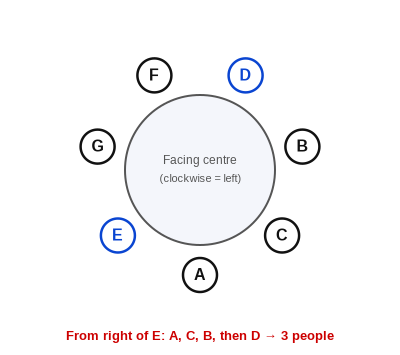
A, B, C, D, E, F and G are sitting around a circular table, facing the centre.
F sits third to the left of A. C sits second to the left of D. Only A sits between E and C. B is not an immediate neighbour of F.
How many people sit between D and E when counted from the right of E?
A, B, C, D, E, F और G एक वृत्ताकार मेज के चारों ओर केंद्र की ओर मुख करके बैठे हैं।
F, A के बाएँ से तीसरे स्थान पर बैठा है। C, D के बाएँ से दूसरे स्थान पर बैठा है। E और C के बीच केवल A बैठा है। B, F का निकटतम पड़ोसी नहीं है।
E के दाएँ से गिनने पर D और E के बीच कितने व्यक्ति बैठे हैं?
  1. A2
  2. B3
  3. C1
  4. D4
Show answer

Concept: Facing the centre, left = clockwise and right = anticlockwise.

  1. Only A between E and C → E, A, C consecutive.
  2. C is 2nd to the left of D and F is 3rd to the left of A – this fixes clockwise order A, E, G, F, D, B, C (B not next to F ✓).
  3. Counting to the right (anticlockwise) of E: A, C, B and then D.

Short trick: Between D and E from E's right = A, C, B → 3; the other way would be G, F → 2 (not asked).

Answer: (B) 3

अवधारणा: केंद्र की ओर मुख: बाएँ = दक्षिणावर्त, दाएँ = वामावर्त।

  1. E और C के बीच केवल A → E, A, C लगातार।
  2. C, D के बाएँ से दूसरा और F, A के बाएँ से तीसरा → दक्षिणावर्त क्रम A, E, G, F, D, B, C (B, F के पास नहीं ✓)।
  3. E के दाएँ (वामावर्त) गिनें: A, C, B, फिर D.

शॉर्ट ट्रिक: E के दाएँ से D और E के बीच = A, C, B → 3; दूसरी ओर G, F → 2 (यह नहीं पूछा)।

उत्तर: (B) 3

RRB ALP CBT 1General Intelligence and ReasoningCircular seating arrangementRRB ALP CBT 1 2025 · 16 Feb Shift 3 →
Q499.
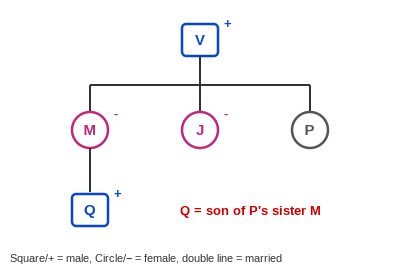
In a certain code language,
'A + B' means 'A is the daughter of B',
'A – B' means 'A is the father of B',
'A × B' means 'A is the son of B' and
'A ÷ B' means 'A is the sister of B'.
Based on the above, how is Q related to P if 'Q × M + V – J ÷ P'?
एक निश्चित कूट भाषा में,
'A + B' का अर्थ है 'A, B की पुत्री है',
'A – B' का अर्थ है 'A, B का पिता है',
'A × B' का अर्थ है 'A, B का पुत्र है' और
'A ÷ B' का अर्थ है 'A, B की बहन है'।
उपरोक्त के आधार पर, यदि 'Q × M + V – J ÷ P' है, तो Q का P से क्या संबंध है?
  1. ASister's husbandबहन का पति
  2. BFatherपिता
  3. CBrotherभाई
  4. DSister's sonबहन का पुत्र
Show answer

Concept: Decode each symbol pair from left to right and build the tree.

  1. Q × M: Q is the son of M.
  2. M + V: M is the daughter of V.
  3. V – J: V is the father of J; J ÷ P: J is the sister of P.
  4. So M, J, P are children of V → M is P's sister; Q is M's son → Q is P's sister's son.

Short trick: Since M and P share the father V, M (a daughter) is P's sister – her son is P's sister's son (nephew).

Answer: (D) Sister's son

अवधारणा: बाएँ से दाएँ प्रत्येक चिह्न-युग्म को डिकोड करें और वंश-वृक्ष बनाएँ।

  1. Q × M: Q, M का पुत्र है।
  2. M + V: M, V की पुत्री है।
  3. V – J: V, J का पिता है; J ÷ P: J, P की बहन है।
  4. अतः M, J, P तीनों V की संतान → M, P की बहन; Q, M का पुत्र → Q, P की बहन का पुत्र।

शॉर्ट ट्रिक: M और P का पिता एक ही (V), M पुत्री है → P की बहन; उसका पुत्र = P की बहन का पुत्र (भांजा)।

उत्तर: (D) बहन का पुत्र

RRB ALP CBT 1General Intelligence and ReasoningCoded blood relationRRB ALP CBT 1 2025 · 16 Feb Shift 3 →
Q500.
In this question, a question is followed by two statements numbered (I) and (II). You have to decide whether the data provided in the statements are sufficient to answer the question. Read both the statements and decide the appropriate answer.
Among the five poles—I, N, C, H, and L—each having a different height, which pole is the shortest?
(I) L is shorter than N. H is shorter than I.
(II) H is taller than L.
इस प्रश्न में, एक प्रश्न के बाद दो कथन (I) और (II) दिए गए हैं। आपको यह तय करना है कि कथनों में दिए गए आँकड़े प्रश्न का उत्तर देने के लिए पर्याप्त हैं या नहीं। दोनों कथनों को पढ़ें और उपयुक्त उत्तर चुनें।
पाँच खंभों—I, N, C, H और L—में से प्रत्येक की ऊँचाई अलग-अलग है, सबसे छोटा खंभा कौन-सा है?
(I) L, N से छोटा है। H, I से छोटा है।
(II) H, L से ऊँचा है।
  1. AData in statement I alone is sufficient to answer the question while data in statement II is notकेवल कथन I के आँकड़े प्रश्न का उत्तर देने के लिए पर्याप्त हैं, जबकि कथन II के आँकड़े पर्याप्त नहीं हैं
  2. BBoth statements I and II together (and not statement I alone or statement II alone) are sufficient to answer the questionकथन I और II दोनों मिलकर (न कि अकेला कथन I या अकेला कथन II) प्रश्न का उत्तर देने के लिए पर्याप्त हैं
  3. CData in statement II alone is sufficient to answer the question while data in statement I is notकेवल कथन II के आँकड़े प्रश्न का उत्तर देने के लिए पर्याप्त हैं, जबकि कथन I के आँकड़े पर्याप्त नहीं हैं
  4. DBoth statements I and II together are NOT sufficient to answer the questionकथन I और II दोनों मिलकर भी प्रश्न का उत्तर देने के लिए पर्याप्त नहीं हैं
Show answer

Concept: Every pole must be placed relative to the candidate for the shortest.

  1. (I): L < N, H < I – two separate pairs; shortest unknown.
  2. (II): L < H – alone not enough.
  3. Together: L < H < I and L < N, so L is shorter than N, H, I – but C is never compared.

Short trick: Scan for a pole never mentioned: C is missing → 'not sufficient' even together.

Answer: (D) Both statements I and II together are NOT sufficient

अवधारणा: सबसे छोटे के उम्मीदवार की तुलना हर खंभे से होनी चाहिए।

  1. (I): L < N, H < I – दो अलग युग्म; सबसे छोटा अज्ञात।
  2. (II): L < H – अकेला पर्याप्त नहीं।
  3. दोनों: L < H < I और L < N, अतः L, N, H, I से छोटा – पर C की कोई तुलना नहीं।

शॉर्ट ट्रिक: देखें कौन-सा खंभा कहीं नहीं आया: C → दोनों मिलकर भी पर्याप्त नहीं।

उत्तर: (D) कथन I और II दोनों मिलकर भी पर्याप्त नहीं

RRB ALP CBT 1General Intelligence and ReasoningData sufficiency – shortest poleRRB ALP CBT 1 2025 · 16 Feb Shift 3 →