Question bank

Q&A: practice questions with answers

Search questions on any topic. Filter by exam category, exam, subject and topic, try the question, then open the answer and explanation.

Courses – airGurukul

20,719 questions found.

Q501.
In a code language, 'AGENT' is coded as GAHTN and 'ADOPT' is coded as DARTP. How will 'DRINK' be coded in the same language?
एक कूट भाषा में, 'AGENT' को GAHTN और 'ADOPT' को DARTP के रूप में कूटबद्ध किया जाता है। उसी भाषा में 'DRINK' को कैसे कूटबद्ध किया जाएगा?
  1. ASEKNM
  2. BSDLKM
  3. CREKNL
  4. DRDLKN
Show answer

Concept: Swap letters 1-2, middle letter +3, swap letters 4-5.

  1. AGENT: AG → GA, E+3 = H, NT → TN → GAHTN.
  2. ADOPT: AD → DA, O+3 = R, PT → TP → DARTP.
  3. DRINK: DR → RD, I+3 = L, NK → KN → RDLKN.

Short trick: Only the first two letters: DR → RD leaves options C, D; middle I+3 = L → RDLKN.

Answer: (D) RDLKN

अवधारणा: अक्षर 1-2 की अदला-बदली, बीच का अक्षर +3, अक्षर 4-5 की अदला-बदली।

  1. AGENT: AG → GA, E+3 = H, NT → TN → GAHTN.
  2. ADOPT: AD → DA, O+3 = R, PT → TP → DARTP.
  3. DRINK: DR → RD, I+3 = L, NK → KN → RDLKN.

शॉर्ट ट्रिक: पहले दो अक्षर: DR → RD → विकल्प C, D; बीच का I+3 = L → RDLKN.

उत्तर: (D) RDLKN
RRB ALP CBT 1General Intelligence and ReasoningCoding – swap and shiftRRB ALP CBT 1 2025 · 16 Feb Shift 3 →
Q502.
Refer to the following letter series and answer the question that follows. Counting to be done from left to right only.
(Left) O Q K K M I W K M F A F Y U T U B H T X S (Right)
How many such consonants are there, each of which is immediately preceded by a vowel and also immediately followed by a vowel?
निम्नलिखित अक्षर श्रृंखला को देखें और नीचे दिए गए प्रश्न का उत्तर दें। गिनती केवल बाएँ से दाएँ की जानी है।
(बाएँ) O Q K K M I W K M F A F Y U T U B H T X S (दाएँ)
ऐसे कितने व्यंजन हैं जिनमें से प्रत्येक के ठीक पहले एक स्वर है और ठीक बाद भी एक स्वर है?
  1. ANoneकोई नहीं
  2. BThreeतीन
  3. COneएक
  4. DTwoदो
Show answer

Concept: Look for the pattern vowel – consonant – vowel.

  1. Vowels: O, I, A, U, U.
  2. Check neighbours: …F A F Y… (Y is not a vowel), …Y U T U B… → T has U on both sides ✓.
  3. Only one such consonant (T).

Short trick: Find two vowels with exactly one letter between them: only U _ U → 1.

Answer: (C) One

अवधारणा: स्वर – व्यंजन – स्वर का क्रम खोजें।

  1. स्वर: O, I, A, U, U.
  2. पड़ोसी जाँचें: …F A F Y… (Y स्वर नहीं), …Y U T U B… → T के दोनों ओर U ✓.
  3. ऐसा केवल एक व्यंजन (T)।

शॉर्ट ट्रिक: ऐसे दो स्वर खोजें जिनके बीच ठीक एक अक्षर हो: केवल U _ U → 1.

उत्तर: (C) एक

RRB ALP CBT 1General Intelligence and ReasoningLetter series – position conditionsRRB ALP CBT 1 2025 · 16 Feb Shift 3 →
Q503.
What should come in place of ? in the given series?
98 110 123 137 152 ?
दी गई श्रृंखला में ? के स्थान पर क्या आना चाहिए?
98 110 123 137 152 ?
  1. A168
  2. B169
  3. C167
  4. D170
Show answer

Concept: Differences increase by 1.

  1. Differences: +12, +13, +14, +15.
  2. Next difference +16 → 152 + 16 = 168.

Short trick: Write the gaps under the series – consecutive numbers 12, 13, 14, 15 → next 16.

Answer: (A) 168

अवधारणा: अंतर 1-1 बढ़ते हैं।

  1. अंतर: +12, +13, +14, +15.
  2. अगला अंतर +16 → 152 + 16 = 168.

शॉर्ट ट्रिक: अंतर 12, 13, 14, 15 लगातार हैं → अगला 16.

उत्तर: (A) 168

RRB ALP CBT 1General Intelligence and ReasoningNumber series – increasing differenceRRB ALP CBT 1 2025 · 16 Feb Shift 3 →
Q504.
Refer to the following letter, symbol series and answer the question that follows. Counting to be done from left to right only.
(Left) N % Q E A L & M @ B & F > £ N H * # < L % P (Right)
How many such symbols are there, each of which are immediately preceded by a letter and immediately followed by a symbol?
निम्नलिखित अक्षर, प्रतीक श्रृंखला को देखें और नीचे दिए गए प्रश्न का उत्तर दें। गिनती केवल बाएँ से दाएँ की जानी है।
(बाएँ) N % Q E A L & M @ B & F > £ N H * # < L % P (दाएँ)
ऐसे कितने प्रतीक हैं जिनमें से प्रत्येक के ठीक पहले एक अक्षर है और ठीक बाद एक प्रतीक है?
  1. AThreeतीन
  2. BOneएक
  3. CTwoदो
  4. DNoneकोई नहीं
Show answer

Concept: Look for the pattern letter – symbol – symbol.

  1. Symbols with a letter before them: %(after N), &(after L), @(after M), &(after B), >(after F), *(after H), %(after L).
  2. Of these, followed by a symbol: F > £ ✓ and H * # ✓.
  3. Count = 2.

Short trick: Find two symbols side by side, then check whether a letter stands just before the first: >£ (F ✓), *# (H ✓), #< (* ✗).

Answer: (C) Two

अवधारणा: अक्षर – प्रतीक – प्रतीक का क्रम खोजें।

  1. जिन प्रतीकों के ठीक पहले अक्षर है: %(N के बाद), &(L), @(M), &(B), >(F), *(H), %(L).
  2. इनमें से जिनके बाद प्रतीक है: F > £ ✓ और H * # ✓.
  3. संख्या = 2.

शॉर्ट ट्रिक: साथ-साथ आए दो प्रतीक खोजें, फिर पहले प्रतीक से ठीक पहले अक्षर देखें: >£ (F ✓), *# (H ✓), #< (* ✗).

उत्तर: (C) दो

RRB ALP CBT 1General Intelligence and ReasoningLetter-symbol seriesRRB ALP CBT 1 2025 · 16 Feb Shift 3 →
Q505.
What should come in place of the question mark (?) in the given series?
17 28 39 50 61 72 ?
दी गई श्रृंखला में प्रश्न चिह्न (?) के स्थान पर क्या आना चाहिए?
17 28 39 50 61 72 ?
  1. A81
  2. B87
  3. C85
  4. D83
Show answer

Concept: Each term is 11 more than the previous one.

  1. 28 − 17 = 11, 39 − 28 = 11, … , 72 − 61 = 11.
  2. Next: 72 + 11 = 83.

Short trick: Unit digits go 7, 8, 9, 0, 1, 2 → next ends in 3 → only 83.

Answer: (D) 83

अवधारणा: प्रत्येक पद पिछले से 11 अधिक है।

  1. 28 − 17 = 11, 39 − 28 = 11, … , 72 − 61 = 11.
  2. अगला: 72 + 11 = 83.

शॉर्ट ट्रिक: इकाई अंक 7, 8, 9, 0, 1, 2 → अगला 3 पर समाप्त → केवल 83.

उत्तर: (D) 83

RRB ALP CBT 1General Intelligence and ReasoningNumber series – constant differenceRRB ALP CBT 1 2025 · 16 Feb Shift 3 →
Q506.
This question is based on the five, three-digit numbers given below.
(Left) 627 458 347 491 567 (Right)
(Example- 697 – First digit = 6, second digit = 9 and third digit = 7)
What will be the resultant if the second digit of the second highest number is added to the third digit of the lowest number?
यह प्रश्न नीचे दी गई पाँच, तीन-अंकीय संख्याओं पर आधारित है।
(बाएँ) 627 458 347 491 567 (दाएँ)
(उदाहरण- 697 – पहला अंक = 6, दूसरा अंक = 9 और तीसरा अंक = 7)
यदि दूसरी सबसे बड़ी संख्या के दूसरे अंक को सबसे छोटी संख्या के तीसरे अंक में जोड़ा जाए, तो परिणाम क्या होगा?
  1. A11
  2. B13
  3. C12
  4. D14
Show answer

Concept: Arrange the numbers in order, then pick the required digits.

  1. Descending: 627 > 567 > 491 > 458 > 347.
  2. Second highest = 567 → second digit 6.
  3. Lowest = 347 → third digit 7. Sum = 6 + 7 = 13.

Short trick: Compare only first digits: 6, 5, 4, 4, 3 → 2nd highest 567, lowest 347.

Answer: (B) 13

अवधारणा: संख्याओं को क्रम में रखें, फिर आवश्यक अंक चुनें।

  1. घटते क्रम में: 627 > 567 > 491 > 458 > 347.
  2. दूसरी सबसे बड़ी = 567 → दूसरा अंक 6.
  3. सबसे छोटी = 347 → तीसरा अंक 7. योग = 6 + 7 = 13.

शॉर्ट ट्रिक: केवल पहले अंक देखें: 6, 5, 4, 4, 3 → दूसरी बड़ी 567, सबसे छोटी 347.

उत्तर: (B) 13

RRB ALP CBT 1General Intelligence and ReasoningNumber arrangement – digitsRRB ALP CBT 1 2025 · 16 Feb Shift 3 →
Q507.
Refer to the following number, symbol series and answer the question that follows. Counting to be done from left to right only. All numbers are single-digit numbers.
(Left) ? + > * 1 + 7 & ^ 1 ^ 7 2 8 ? & > # ? 4 @ (Right)
How many such numbers are there, each of which is immediately preceded by another number and also immediately followed by a symbol?
निम्नलिखित संख्या, प्रतीक श्रृंखला को देखें और नीचे दिए गए प्रश्न का उत्तर दें। गिनती केवल बाएँ से दाएँ की जानी है। सभी संख्याएँ एक-अंकीय हैं।
(बाएँ) ? + > * 1 + 7 & ^ 1 ^ 7 2 8 ? & > # ? 4 @ (दाएँ)
ऐसी कितनी संख्याएँ हैं जिनमें से प्रत्येक के ठीक पहले एक अन्य संख्या है और ठीक बाद एक प्रतीक है?
  1. AThreeतीन
  2. BFourचार
  3. COneएक
  4. DTwoदो
Show answer

Concept: Look for the pattern number – number – symbol.

  1. Pairs of adjacent numbers: 7 2, 2 8.
  2. 7 2 8: 2 is followed by 8 (a number) ✗; 2 8 ?: 8 is followed by ? (a symbol) ✓.
  3. Count = 1.

Short trick: Only a run of digits can give 'number before number' – the single run 7 2 8 gives exactly its last digit → 1.

Answer: (C) One

अवधारणा: संख्या – संख्या – प्रतीक का क्रम खोजें।

  1. लगातार संख्याओं के जोड़े: 7 2, 2 8.
  2. 7 2 8: 2 के बाद 8 (संख्या) ✗; 2 8 ?: 8 के बाद ? (प्रतीक) ✓.
  3. संख्या = 1.

शॉर्ट ट्रिक: केवल अंकों की लगातार कड़ी (7 2 8) ही योग्य – उसका अंतिम अंक → 1.

उत्तर: (C) एक

RRB ALP CBT 1General Intelligence and ReasoningNumber-symbol seriesRRB ALP CBT 1 2025 · 16 Feb Shift 3 →
Q508.
Based on the English alphabetical order, three of the following four letter-clusters are alike in a certain way and thus form a group. Which letter-cluster DOES NOT belong to that group? (Note: The odd one out is not based on the number of consonants/vowels or their position in the letter-cluster.)
अंग्रेजी वर्णमाला क्रम के आधार पर, निम्नलिखित चार अक्षर-समूहों में से तीन किसी निश्चित प्रकार से एकसमान हैं और इस प्रकार एक समूह बनाते हैं। कौन-सा अक्षर-समूह उस समूह से संबंधित नहीं है?
(नोट: असंगत का निर्धारण व्यंजनों/स्वरों की संख्या या अक्षर-समूह में उनके स्थान के आधार पर नहीं है।)
  1. AOSV
  2. BGKN
  3. CLOS
  4. DTXA
Show answer

Concept: Find the gaps between consecutive letters.

  1. OSV+4+3
    GKN+4+3
    TXA+4+3 (X→Y→Z→A)
    LOS+3+4

Short trick: Three follow +4, +3; LOS reverses it (+3, +4).

Answer: (C) LOS

अवधारणा: क्रमागत अक्षरों के बीच का अंतर ज्ञात करें।

  1. OSV+4+3
    GKN+4+3
    TXA+4+3 (X→Y→Z→A)
    LOS+3+4

शॉर्ट ट्रिक: तीन में +4, +3; LOS में उल्टा (+3, +4).

उत्तर: (C) LOS

RRB ALP CBT 1General Intelligence and ReasoningOdd one out – letter gapsRRB ALP CBT 1 2025 · 16 Feb Shift 3 →
Q509.
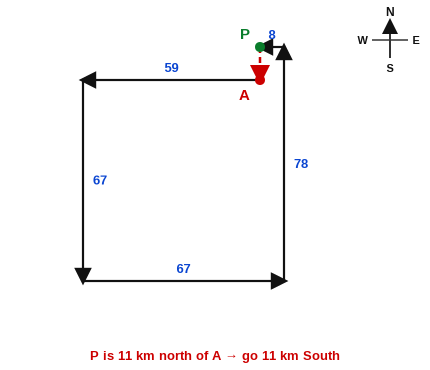
Soham starts from Point A and drives 59 km towards west. He then takes a left turn, drives 67 km, turns left and drives 67 km. He then takes a left turn and drives 78 km. He takes a final left turn, drives 8 km and stops at Point P. How far (shortest distance) and towards which direction should he drive in order to reach Point A again? (All turns are 90 degrees turns only unless specified)
सोहम बिंदु A से शुरू करता है और पश्चिम की ओर 59 km गाड़ी चलाता है। फिर वह बाएँ मुड़ता है, 67 km चलाता है, बाएँ मुड़ता है और 67 km चलाता है। फिर वह बाएँ मुड़ता है और 78 km चलाता है। वह अंतिम बार बाएँ मुड़ता है, 8 km चलाता है और बिंदु P पर रुक जाता है। बिंदु A पर फिर से पहुँचने के लिए उसे कितनी दूर (न्यूनतम दूरी) और किस दिशा में गाड़ी चलानी चाहिए? (जब तक निर्दिष्ट न हो, सभी मोड़ केवल 90 डिग्री के हैं)
  1. A10 km to the south10 km दक्षिण की ओर
  2. B13 km to the south13 km दक्षिण की ओर
  3. C11 km to the south11 km दक्षिण की ओर
  4. D12 km to the north12 km उत्तर की ओर
Show answer

Concept: Take A as origin; add east-west and north-south moves separately.

  1. West 59; left → South 67; left → East 67; left → North 78; left → West 8.
  2. East-west: −59 + 67 − 8 = 0.
  3. North-south: −67 + 78 = +11 → P is 11 km north of A.
  4. To return: 11 km towards the South.

Short trick: Net E-W cancels (59 + 8 = 67), so only N-S matters: 78 − 67 = 11 north → go south.

Answer: (C) 11 km to the south

अवधारणा: A को मूल बिंदु मानें; पूर्व-पश्चिम और उत्तर-दक्षिण गतियाँ अलग-अलग जोड़ें।

  1. पश्चिम 59; बाएँ → दक्षिण 67; बाएँ → पूर्व 67; बाएँ → उत्तर 78; बाएँ → पश्चिम 8.
  2. पूर्व-पश्चिम: −59 + 67 − 8 = 0.
  3. उत्तर-दक्षिण: −67 + 78 = +11 → P, A से 11 km उत्तर में।
  4. वापस जाने के लिए: 11 km दक्षिण की ओर।

शॉर्ट ट्रिक: पूर्व-पश्चिम कट जाता है (59 + 8 = 67), केवल उत्तर-दक्षिण: 78 − 67 = 11 उत्तर → दक्षिण जाएँ।

उत्तर: (C) 11 km दक्षिण की ओर

RRB ALP CBT 1General Intelligence and ReasoningDirection senseRRB ALP CBT 1 2025 · 16 Feb Shift 3 →
Q510.
Refer to the following series and answer the question (All numbers are single digit numbers only. Counting to be done from left to right.)
(Left) 3 7 2 6 2 7 3 8 7 3 7 6 4 2 4 5 4 9 5 7 7 2 4 (Right)
How many such even digits are there each of which is immediately preceded by an odd digit and also immediately followed by an even digit?
निम्नलिखित श्रृंखला को देखें और प्रश्न का उत्तर दें (सभी संख्याएँ केवल एक-अंकीय हैं। गिनती बाएँ से दाएँ की जानी है।)
(बाएँ) 3 7 2 6 2 7 3 8 7 3 7 6 4 2 4 5 4 9 5 7 7 2 4 (दाएँ)
ऐसे कितने सम अंक हैं जिनमें से प्रत्येक के ठीक पहले एक विषम अंक है और ठीक बाद एक सम अंक है?
  1. AThreeतीन
  2. BNoneकोई नहीं
  3. CTwoदो
  4. DOneएक
Show answer

Concept: Look for the pattern odd – even – even.

  1. 7 2 6 ✓ (2 after 7, before 6).
  2. 7 6 4 ✓ (6 after 7, before 4).
  3. 7 2 4 ✓ (last three digits). Others like 3 8 7, 5 4 9 fail.
  4. Count = 3.

Short trick: Scan for every even digit right after an odd digit, then just look one step ahead.

Answer: (A) Three

अवधारणा: विषम – सम – सम का क्रम खोजें।

  1. 7 2 6 ✓ (2 के पहले 7, बाद में 6)।
  2. 7 6 4 ✓ (6 के पहले 7, बाद में 4)।
  3. 7 2 4 ✓ (अंतिम तीन अंक)। 3 8 7, 5 4 9 आदि नहीं।
  4. संख्या = 3.

शॉर्ट ट्रिक: विषम के ठीक बाद आने वाला हर सम अंक खोजें, फिर केवल अगला अंक देखें।

उत्तर: (A) तीन

RRB ALP CBT 1General Intelligence and ReasoningNumber series – position conditionsRRB ALP CBT 1 2025 · 16 Feb Shift 3 →
Q511.
In a certain code language, ‘HATS’ is coded as ‘2743’ and ‘AHUS’ is coded as ‘7483’. What is the code for ‘U’ in the given code language?
एक निश्चित कूट भाषा में, 'HATS' को '2743' और 'AHUS' को '7483' लिखा जाता है। दी गई कूट भाषा में 'U' का कूट क्या है?
  1. A4
  2. B7
  3. C8
  4. D3
Show answer

Concept: Letters common to both words share the common digits.

  1. HATS = 2743, AHUS = 7483.
  2. Common letters H, A, S ↔ common digits 7, 4, 3.
  3. Remaining: T = 2 and U = 8.

Short trick: Remove common digits from AHUS's code (7, 4, 3) → leftover 8 is U.

Answer: (C) 8

अवधारणा: दोनों शब्दों के उभयनिष्ठ अक्षरों के कूट भी उभयनिष्ठ होते हैं।

  1. HATS = 2743, AHUS = 7483.
  2. उभयनिष्ठ अक्षर H, A, S ↔ उभयनिष्ठ अंक 7, 4, 3.
  3. शेष: T = 2 और U = 8.

शॉर्ट ट्रिक: AHUS के कूट से उभयनिष्ठ अंक (7, 4, 3) हटाएँ → बचा 8 = U.

उत्तर: (C) 8

RRB ALP CBT 1General Intelligence and ReasoningCoding – common lettersRRB ALP CBT 1 2025 · 16 Feb Shift 3 →
Q512.
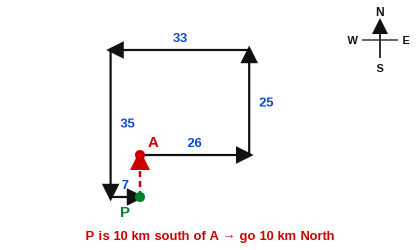
Namit starts from Point A and drives 26 km towards the east. He then takes a left turn, drives 25 km, turns left and drives 33 km. He then takes a left turn and drives 35 km. He takes a final left turn, drives 7 km and stops at Point P. How far (shortest distance) and towards which direction should he drive in order to reach Point A again? (All turns are 90-degree turns only unless specified.)
नमित बिंदु A से शुरू करता है और पूर्व की ओर 26 km गाड़ी चलाता है। फिर वह बाएँ मुड़ता है, 25 km चलाता है, बाएँ मुड़ता है और 33 km चलाता है। फिर वह बाएँ मुड़ता है और 35 km चलाता है। वह अंतिम बार बाएँ मुड़ता है, 7 km चलाता है और बिंदु P पर रुक जाता है। बिंदु A पर फिर से पहुँचने के लिए उसे कितनी दूर (न्यूनतम दूरी) और किस दिशा में गाड़ी चलानी चाहिए? (जब तक निर्दिष्ट न हो, सभी मोड़ केवल 90 डिग्री के हैं।)
  1. A11 km to the North11 km उत्तर की ओर
  2. B10 km to the North10 km उत्तर की ओर
  3. C12 km to the South12 km दक्षिण की ओर
  4. D13 km to the South13 km दक्षिण की ओर
Show answer

Concept: Take A as origin; add east-west and north-south moves separately.

  1. East 26; left → North 25; left → West 33; left → South 35; left → East 7.
  2. East-west: 26 − 33 + 7 = 0.
  3. North-south: 25 − 35 = −10 → P is 10 km south of A.
  4. To return: 10 km towards the North.

Short trick: E-W: 26 + 7 = 33 cancels; N-S: 35 − 25 = 10 south → go north.

Answer: (B) 10 km to the North

अवधारणा: A को मूल बिंदु मानें; पूर्व-पश्चिम और उत्तर-दक्षिण गतियाँ अलग-अलग जोड़ें।

  1. पूर्व 26; बाएँ → उत्तर 25; बाएँ → पश्चिम 33; बाएँ → दक्षिण 35; बाएँ → पूर्व 7.
  2. पूर्व-पश्चिम: 26 − 33 + 7 = 0.
  3. उत्तर-दक्षिण: 25 − 35 = −10 → P, A से 10 km दक्षिण में।
  4. वापस जाने के लिए: 10 km उत्तर की ओर।

शॉर्ट ट्रिक: पूर्व-पश्चिम: 26 + 7 = 33 कट जाता है; उत्तर-दक्षिण: 35 − 25 = 10 दक्षिण → उत्तर जाएँ।

उत्तर: (B) 10 km उत्तर की ओर

RRB ALP CBT 1General Intelligence and ReasoningDirection senseRRB ALP CBT 1 2025 · 16 Feb Shift 3 →
Q513.
Select the set in which the numbers are related in the same way as are the numbers of the given sets.
(NOTE: Operations should be performed on the whole numbers, without breaking down the numbers into their constituent digits. E.g. 13 – Operations on 13 such as adding to/subtracting from/multiplying with 13 can be performed. Breaking down 13 into 1 and 3 and then performing mathematical operations on 1 and 3 is not allowed.)
(29, 116, 348)
(22, 88, 264)
उस समुच्चय का चयन कीजिए जिसमें संख्याएँ उसी प्रकार संबंधित हैं जिस प्रकार दिए गए समुच्चयों की संख्याएँ संबंधित हैं।
(नोट: संक्रियाएँ संख्याओं को उनके घटक अंकों में तोड़े बिना, पूर्ण संख्याओं पर की जानी चाहिए। उदाहरण: 13 – 13 पर संक्रियाएँ जैसे 13 में जोड़ना/घटाना/गुणा करना आदि की जा सकती हैं। 13 को 1 और 3 में तोड़कर फिर 1 और 3 पर गणितीय संक्रियाएँ करने की अनुमति नहीं है।)
(29, 116, 348)
(22, 88, 264)
  1. A(26, 104, 332)
  2. B(17, 68, 204)
  3. C(15, 60, 120)
  4. D(21, 94, 252)
Show answer

Concept: Second = first × 4; third = second × 3.

  1. 29×4=116, 116×3=348; 22×4=88, 88×3=264.
  2. (B) 17×4=68, 68×3=204 ✓. (A) 104×3=312≠332; (C) 60×3=180≠120; (D) 21×4=84≠94.

Short trick: Third = first × 12: 17 × 12 = 204 ✓ in one step.

Answer: (B) (17, 68, 204)

अवधारणा: दूसरी = पहली × 4; तीसरी = दूसरी × 3.

  1. 29×4=116, 116×3=348; 22×4=88, 88×3=264.
  2. (B) 17×4=68, 68×3=204 ✓. (A) 104×3=312≠332; (C) 60×3=180≠120; (D) 21×4=84≠94.

शॉर्ट ट्रिक: तीसरी = पहली × 12: 17 × 12 = 204 ✓.

उत्तर: (B) (17, 68, 204)

RRB ALP CBT 1General Intelligence and ReasoningNumber analogy – setsRRB ALP CBT 1 2025 · 16 Feb Shift 3 →
Q514.
If ‘A’ stands for ‘÷’, ‘B’ stands for ‘×’, ‘C’ stands for ‘+’ and ‘D’ stands for ‘−’, then what will come in place of the question mark (?) in the following equation?
75 A 3 D 14 C 9 B 4 = ?
यदि 'A' का अर्थ '÷', 'B' का अर्थ '×', 'C' का अर्थ '+' और 'D' का अर्थ '−' है, तो निम्नलिखित समीकरण में प्रश्न चिह्न (?) के स्थान पर क्या आएगा?
75 A 3 D 14 C 9 B 4 = ?
  1. A47
  2. B59
  3. C63
  4. D31
Show answer

Concept: Replace letters by signs, then apply BODMAS.

  1. 75÷3−14+9×4.
  2. =25−14+36=47.

Short trick: Do ÷ and × first: 25 and 36; then 25 + 36 − 14 = 47.

Answer: (A) 47

अवधारणा: अक्षरों के स्थान पर चिह्न रखें, फिर BODMAS लगाएँ।

  1. 75÷3−14+9×4.
  2. =25−14+36=47.

शॉर्ट ट्रिक: पहले ÷ और ×: 25 और 36; फिर 25 + 36 − 14 = 47.

उत्तर: (A) 47

RRB ALP CBT 1General Intelligence and ReasoningMathematical operations – symbol substitutionRRB ALP CBT 1 2025 · 16 Feb Shift 3 →
Q515.
What should come in place of the question mark (?) in the given series based on the English alphabetical order?
HBU NHA TNG ZTM ?
अंग्रेजी वर्णमाला क्रम के आधार पर दी गई श्रृंखला में प्रश्न चिह्न (?) के स्थान पर क्या आना चाहिए?
HBU NHA TNG ZTM ?
  1. AFXS
  2. BFDR
  3. CFSE
  4. DFZS
Show answer

Concept: Each letter of a term moves +6 to give the next term.

  1. 1st letters: H, N, T, Z → +6 → F (cyclic).
  2. 2nd letters: B, H, N, T → +6 → Z.
  3. 3rd letters: U, A, G, M → +6 → S.

Short trick: Middle letter T + 6 = Z decides at once → FZS.

Answer: (D) FZS

अवधारणा: प्रत्येक पद का हर अक्षर +6 बढ़कर अगला पद देता है।

  1. पहले अक्षर: H, N, T, Z → +6 → F (चक्रीय)।
  2. दूसरे अक्षर: B, H, N, T → +6 → Z.
  3. तीसरे अक्षर: U, A, G, M → +6 → S.

शॉर्ट ट्रिक: बीच का अक्षर T + 6 = Z → सीधे FZS.

उत्तर: (D) FZS

RRB ALP CBT 1General Intelligence and ReasoningLetter seriesRRB ALP CBT 1 2025 · 16 Feb Shift 3 →
Q516.
If an object is placed between infinity and the pole (P) in front of a convex mirror, what type of image will be formed?
यदि किसी वस्तु को उत्तल दर्पण के सामने अनंत और ध्रुव (P) के बीच रखा जाए, तो किस प्रकार का प्रतिबिंब बनेगा?
  1. AReal, inverted, and enlargedवास्तविक, उल्टा और आवर्धित
  2. BReal, inverted, and diminishedवास्तविक, उल्टा और छोटा
  3. CVirtual, erect, and diminished (smaller in size)आभासी, सीधा और छोटा (आकार में छोटा)
  4. DReal, erect, and same size as the objectवास्तविक, सीधा और वस्तु के समान आकार का
Show answer

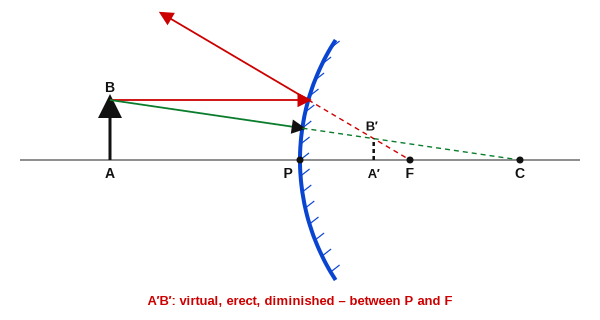
Concept: A convex mirror always forms a virtual, erect and diminished image behind the mirror, between P and F, wherever the object is.

  1. A ray parallel to the axis reflects as if coming from F (behind the mirror).
  2. A ray aimed at C reflects back along itself.
  3. The reflected rays diverge; their backward extensions meet behind the mirror → virtual, erect, smaller image.

Short trick: Convex = 'Always V-E-D' (Virtual, Erect, Diminished) – that is why it is used as a rear-view mirror.

Answer: (C) Virtual, erect, and diminished

अवधारणा: उत्तल दर्पण वस्तु कहीं भी हो, सदैव दर्पण के पीछे P और F के बीच आभासी, सीधा और छोटा प्रतिबिंब बनाता है।

  1. मुख्य अक्ष के समांतर किरण परावर्तन के बाद F (दर्पण के पीछे) से आती प्रतीत होती है।
  2. C की ओर जाने वाली किरण उसी मार्ग से लौटती है।
  3. परावर्तित किरणें अपसारित होती हैं; उनके पीछे के विस्तार दर्पण के पीछे मिलते हैं → आभासी, सीधा, छोटा प्रतिबिंब।

शॉर्ट ट्रिक: उत्तल = 'सदा आ-सी-छो' (आभासी, सीधा, छोटा) – इसी कारण वाहनों में पीछे देखने का दर्पण उत्तल होता है।

उत्तर: (C) आभासी, सीधा और छोटा

RRB ALP CBT 1General ScienceImage formation – convex mirrorRRB ALP CBT 1 2025 · 16 Feb Shift 3 →
Q517.
The double-layered covering of the nucleus is called as ______
केंद्रक के दोहरी परत वाले आवरण को ______ कहा जाता है।
  1. ACell wallकोशिका भित्ति
  2. BNuclear membraneकेंद्रक झिल्ली
  3. CChromatin wallक्रोमैटिन भित्ति
  4. DPlasma membraneप्लाज्मा झिल्ली
Show answer

Concept: The nucleus is bounded by a double-layered nuclear membrane (nuclear envelope) with pores.

  1. The nuclear membrane separates the nucleus from the cytoplasm.
  2. Its pores allow movement of RNA and proteins in and out.
  3. Cell wall and plasma membrane cover the whole cell, not the nucleus; 'chromatin wall' does not exist.

Short trick: Memory hook: Nucleus → Nuclear membrane (double layer, with pores) – the name itself tells the answer.

Answer: (B) Nuclear membrane

अवधारणा: केंद्रक, छिद्रयुक्त दोहरी परत वाली केंद्रक झिल्ली (केंद्रकीय आवरण) से घिरा होता है।

  1. केंद्रक झिल्ली केंद्रक को कोशिकाद्रव्य से अलग करती है।
  2. इसके छिद्रों से RNA और प्रोटीन अंदर-बाहर आते-जाते हैं।
  3. कोशिका भित्ति और प्लाज्मा झिल्ली पूरी कोशिका को ढकती हैं, केंद्रक को नहीं; 'क्रोमैटिन भित्ति' नाम की कोई संरचना नहीं है।

शॉर्ट ट्रिक: याद रखें: केंद्रक → केंद्रक झिल्ली (दोहरी परत, छिद्रयुक्त)।

उत्तर: (B) केंद्रक झिल्ली

RRB ALP CBT 1General ScienceCell – nucleusRRB ALP CBT 1 2025 · 16 Feb Shift 3 →
Q518.
Which of the following substance groups represents the non-biodegradable substances?
निम्नलिखित में से कौन-सा पदार्थ-समूह जैव-अनिम्नीकरणीय (non-biodegradable) पदार्थों को दर्शाता है?
  1. APlastic bubble pack, regular milk packets, medicine plastic bottlesप्लास्टिक बबल पैक, सामान्य दूध के पैकेट, दवा की प्लास्टिक बोतलें
  2. BSpoilt food, vegetable peels, used tea leavesखराब भोजन, सब्जियों के छिलके, इस्तेमाल की गई चाय की पत्ती
  3. CGrasses, spoilt food, vegetable peelsघास, खराब भोजन, सब्जियों के छिलके
  4. DVegetable peels, flowers, paperसब्जियों के छिलके, फूल, कागज
Show answer

Concept: Non-biodegradable substances cannot be broken down by microbes (bacteria, fungi) in a reasonable time.

  1. Plastic bubble pack, plastic milk packets and plastic medicine bottles are all plastics → non-biodegradable.
  2. Food, peels, tea leaves, grass, flowers and paper are organic → biodegradable.

Short trick: Memory hook: 'If it was never alive (plastic, polythene, glass, metal), microbes cannot eat it.'

Answer: (A) Plastic bubble pack, regular milk packets, medicine plastic bottles

अवधारणा: जैव-अनिम्नीकरणीय पदार्थ सूक्ष्मजीवों (जीवाणु, कवक) द्वारा उचित समय में अपघटित नहीं होते।

  1. प्लास्टिक बबल पैक, दूध के प्लास्टिक पैकेट और दवा की प्लास्टिक बोतलें – सभी प्लास्टिक → जैव-अनिम्नीकरणीय।
  2. भोजन, छिलके, चाय पत्ती, घास, फूल और कागज जैविक हैं → जैव-निम्नीकरणीय।

शॉर्ट ट्रिक: याद रखें: 'जो कभी जीवित नहीं था (प्लास्टिक, पॉलीथीन, काँच, धातु), उसे सूक्ष्मजीव नहीं खा सकते।'

उत्तर: (A) प्लास्टिक बबल पैक, दूध के पैकेट, दवा की प्लास्टिक बोतलें

RRB ALP CBT 1General ScienceEnvironment – biodegradable wasteRRB ALP CBT 1 2025 · 16 Feb Shift 3 →
Q519.
Which of the following equations correctly relates the resistance (R) of a conductor to its length (l), area of cross-section (A), and resistivity (ρ)?
निम्नलिखित में से कौन-सा समीकरण किसी चालक के प्रतिरोध (R) का उसकी लंबाई (l), अनुप्रस्थ काट के क्षेत्रफल (A) और प्रतिरोधकता (ρ) से सही संबंध दर्शाता है?
  1. AR=l/ρA
  2. BR=ρl/A
  3. CR=A/ρl
  4. DR=ρA/l
Show answer

Concept: Resistance is directly proportional to length and inversely proportional to area of cross-section: R=ρlA.

  1. R∝l (longer wire, more collisions of electrons).
  2. R∝1A (thicker wire, more paths for current).
  3. Constant of proportionality is resistivity ρ (unit Ω m).

Short trick: Unit check: Ω = (Ω m)(m)/m² ✓ only for ρl/A. Hook: 'Long and thin → high R'.

Answer: (B) R = ρl/A

अवधारणा: प्रतिरोध लंबाई के अनुक्रमानुपाती और अनुप्रस्थ काट के क्षेत्रफल के व्युत्क्रमानुपाती होता है: R=ρlA.

  1. R∝l (लंबा तार, इलेक्ट्रॉनों की अधिक टक्कर)।
  2. R∝1A (मोटा तार, धारा के लिए अधिक मार्ग)।
  3. आनुपातिकता स्थिरांक प्रतिरोधकता ρ (मात्रक Ω m) है।

शॉर्ट ट्रिक: मात्रक जाँच: Ω = (Ω m)(m)/m² ✓ केवल ρl/A में। याद रखें: 'लंबा और पतला → अधिक R'।

उत्तर: (B) R = ρl/A

RRB ALP CBT 1General ScienceElectricity – resistivityRRB ALP CBT 1 2025 · 16 Feb Shift 3 →
Q520.
Which breed of cattle is primarily used for dairy purposes in India?
भारत में मुख्य रूप से डेयरी (दुग्ध उत्पादन) के लिए मवेशियों की किस नस्ल का उपयोग किया जाता है?
  1. ASahiwalसाहीवाल
  2. BOngoleओंगोल
  3. CGirगिर
  4. DKankrejकांकरेज
Show answer

Concept: Indian cattle breeds are grouped as milch (dairy), draught and dual-purpose.

  1. Milch (dairy) breeds: Sahiwal, Gir, Red Sindhi, Rathi.
  2. Draught breeds: Ongole (also dual), Nagori, Hallikar, Amritmahal.
  3. Dual-purpose: Kankrej, Tharparkar, Hariana.
  4. Sahiwal (Punjab region) is regarded as the best indigenous dairy breed – but Gir (Gujarat) is also a dairy breed, so as printed two options (A and C) are correct.

Short trick: Hook for milch breeds: 'SaGiRed' – Sahiwal, Gir, Red Sindhi.

Answer: (A) and (C) Sahiwal and Gir – both are dairy (milch) breeds

अवधारणा: भारतीय मवेशी नस्लें दुधारू, भारवाही और द्वि-उद्देशीय में बाँटी जाती हैं।

  1. दुधारू (डेयरी) नस्लें: साहीवाल, गिर, रेड सिंधी, राठी।
  2. भारवाही नस्लें: ओंगोल (द्वि-उद्देशीय भी), नागोरी, हल्लीकर, अमृतमहल।
  3. द्वि-उद्देशीय: कांकरेज, थारपारकर, हरियाणा।
  4. साहीवाल सर्वश्रेष्ठ देशी दुधारू नस्ल मानी जाती है – परंतु गिर (गुजरात) भी दुधारू नस्ल है, अतः छपे रूप में दो विकल्प (A और C) सही हैं।

शॉर्ट ट्रिक: दुधारू नस्लें याद रखें: 'साहीगिरेड' – साहीवाल, गिर, रेड सिंधी।

उत्तर: (A) और (C) साहीवाल और गिर – दोनों दुधारू नस्लें हैं

RRB ALP CBT 1General ScienceAnimal husbandry – cattle breedsRRB ALP CBT 1 2025 · 16 Feb Shift 3 →