Question bank

Q&A: practice questions with answers

Search questions on any topic. Filter by exam category, exam, subject and topic, try the question, then open the answer and explanation.

Courses – airGurukul

20,719 questions found.

Q11221.
Refer to the following number series and answer the question that follows (all numbers are single digit numbers only).
(Left) 8 8 4 7 5 5 3 2 9 8 6 4 5 3 8 4 5 8 9 1 5 7 4 9 7 5 1 (Right)
How many such even numbers are there, each of which is immediately preceded by an odd number and also immediately followed by an odd number?
निम्नलिखित संख्या श्रृंखला को देखिए और उसके बाद दिए गए प्रश्न का उत्तर दीजिए (सभी संख्याएँ केवल एक अंक वाली संख्याएँ हैं)।
(बाएँ) 8 8 4 7 5 5 3 2 9 8 6 4 5 3 8 4 5 8 9 1 5 7 4 9 7 5 1 (दाएँ)
ऐसी कितनी सम संख्याएँ हैं, जिनमें से प्रत्येक के ठीक पहले एक विषम संख्या है और ठीक बाद भी एक विषम संख्या है?
  1. A0
  2. B4
  3. C2
  4. D3
Show answer

Concept: Pick every even number and check its two neighbours: both must be odd.

  1. 3 2 9 ✓ (positions 7–9).
  2. 5 8 9 ✓ (positions 17–19).
  3. 7 4 9 ✓ (positions 22–24).
  4. Others fail, e.g., 3 8 4 and 8 4 5 have an even neighbour.

Trick: Pattern to scan: odd–even–odd.

Answer: (D) 3

अवधारणा: हर सम संख्या लें और उसके दोनों पड़ोसी देखें: दोनों विषम होने चाहिए।

  1. 3 2 9 ✓ (स्थान 7–9)।
  2. 5 8 9 ✓ (स्थान 17–19)।
  3. 7 4 9 ✓ (स्थान 22–24)।
  4. बाकी असफल, जैसे 3 8 4 और 8 4 5 में एक पड़ोसी सम है।

ट्रिक: खोजें: विषम–सम–विषम।

उत्तर: (D) 3
RRB NTPC Undergraduate CBT 2General Intelligence and ReasoningNumber series – conditionsRRB NTPC Undergraduate CBT 2 2024 · 20 Dec Shift 3 →
Q11222.
Refer to the following number series and answer the question that follows (all numbers are single digit numbers only). Counting to be done from left to right only.
(Left) 9 8 7 4 5 3 2 4 5 6 8 1 2 3 5 6 7 6 5 3 9 (Right)
How many such even digits are there, each of the which is immediately preceded by a perfect square and immediately followed by an odd digit? (NOTE: 1 is also a perfect square)
निम्नलिखित संख्या श्रृंखला को देखिए और उसके बाद दिए गए प्रश्न का उत्तर दीजिए (सभी संख्याएँ केवल एक अंक वाली संख्याएँ हैं)। गिनती केवल बाएँ से दाएँ की जानी है।
(बाएँ) 9 8 7 4 5 3 2 4 5 6 8 1 2 3 5 6 7 6 5 3 9 (दाएँ)
ऐसे कितने सम अंक हैं, जिनमें से प्रत्येक के ठीक पहले एक पूर्ण वर्ग है और ठीक बाद एक विषम अंक है? (ध्यान दें: 1 भी एक पूर्ण वर्ग है)
  1. ANoneएक भी नहीं
  2. BThreeतीन
  3. CTwoदो
  4. DOneएक
Show answer

Concept: Perfect-square digits are 1, 4, 9 (and 0). Find even digits with a perfect square just before and an odd digit just after.

  1. 9 8 7 ✓ (9 is a square, 7 is odd).
  2. 1 2 3 ✓ (1 is a square, 3 is odd).
  3. Other even digits fail: e.g., 7 4 5 (7 not a square), 2 4 5 (2 not a square), 5 6 8 (8 not odd).

Trick: Scan only around 1, 4, 9 – the digit after them must be even, then the next odd.

Answer: (C) Two

अवधारणा: पूर्ण वर्ग अंक 1, 4, 9 (और 0) हैं। ऐसे सम अंक खोजें जिनके ठीक पहले पूर्ण वर्ग और ठीक बाद विषम अंक हो।

  1. 9 8 7 ✓ (9 पूर्ण वर्ग, 7 विषम)।
  2. 1 2 3 ✓ (1 पूर्ण वर्ग, 3 विषम)।
  3. बाकी असफल: जैसे 7 4 5 (7 वर्ग नहीं), 2 4 5 (2 वर्ग नहीं), 5 6 8 (8 विषम नहीं)।

ट्रिक: केवल 1, 4, 9 के बाद देखें – अगला अंक सम और उसके बाद विषम।

उत्तर: (C) दो

RRB NTPC Undergraduate CBT 2General Intelligence and ReasoningNumber series – conditionsRRB NTPC Undergraduate CBT 2 2024 · 20 Dec Shift 3 →
Q11223.
TWSP is related to MPLI in a certain way based on the English alphabetical order. In the same way, LOKH is related to EHDA. To which of the given options is PSOL related, following the same logic?
अंग्रेज़ी वर्णमाला क्रम के आधार पर TWSP एक निश्चित प्रकार से MPLI से संबंधित है। उसी प्रकार, LOKH, EHDA से संबंधित है। समान तर्क का अनुसरण करते हुए, PSOL दिए गए विकल्पों में से किससे संबंधित है?
  1. AILHE
  2. BIKGE
  3. CIMGM
  4. DILGE
Show answer

Concept: Find the shift from each letter of the first term to the second.

  1. TWSP → MPLI: T−7=M, W−7=P, S−7=L, P−7=I.
  2. LOKH → EHDA: each −7 as well.
  3. PSOL: P−7=I, S−7=L, O−7=H, L−7=E → ILHE.

Trick: Moving back 7 = moving forward 19.

Answer: (A) ILHE

अवधारणा: पहले पद के हर अक्षर से दूसरे पद तक का खिसकाव देखें।

  1. TWSP → MPLI: T−7=M, W−7=P, S−7=L, P−7=I।
  2. LOKH → EHDA: हर अक्षर −7।
  3. PSOL: P−7=I, S−7=L, O−7=H, L−7=E → ILHE।

ट्रिक: 7 पीछे = 19 आगे।

उत्तर: (A) ILHE

RRB NTPC Undergraduate CBT 2General Intelligence and ReasoningLetter analogyRRB NTPC Undergraduate CBT 2 2024 · 20 Dec Shift 3 →
Q11224.
Refer to the following letter series and answer the question that follows. (Counting to be done from left to right only.)
(Left) K O P Q W S E D G U J I O P K M N V Y I P O (Right)
How many such consonants are there, each of which is immediately preceded by a vowel and also immediately followed by a vowel?
निम्नलिखित अक्षर श्रृंखला को देखिए और उसके बाद दिए गए प्रश्न का उत्तर दीजिए। (गिनती केवल बाएँ से दाएँ की जानी है।)
(बाएँ) K O P Q W S E D G U J I O P K M N V Y I P O (दाएँ)
ऐसे कितने व्यंजन हैं, जिनमें से प्रत्येक के ठीक पहले एक स्वर है और ठीक बाद भी एक स्वर है?
  1. AMore than twoदो से अधिक
  2. BNoneएक भी नहीं
  3. COneएक
  4. DTwoदो
Show answer

Concept: Mark the vowels (A, E, I, O, U); look for vowel–consonant–vowel.

  1. U J I ✓ (positions 10–12).
  2. I P O ✓ (positions 20–22).
  3. Others fail: O P Q, E D G, O P K have a consonant on one side.

Trick: First circle the vowels, then check only letters sitting between two circles.

Answer: (D) Two

अवधारणा: स्वर (A, E, I, O, U) चिह्नित करें; स्वर–व्यंजन–स्वर खोजें।

  1. U J I ✓ (स्थान 10–12)।
  2. I P O ✓ (स्थान 20–22)।
  3. बाकी असफल: O P Q, E D G, O P K में एक ओर व्यंजन है।

ट्रिक: पहले स्वरों पर घेरा लगाएँ, फिर दो घेरों के बीच वाले अक्षर देखें।

उत्तर: (D) दो

RRB NTPC Undergraduate CBT 2General Intelligence and ReasoningLetter series – conditionsRRB NTPC Undergraduate CBT 2 2024 · 20 Dec Shift 3 →
Q11225.
What should come in place of the question mark (?) in the given series?
30 40 50 60 70 ?
दी गई श्रृंखला में प्रश्न चिह्न (?) के स्थान पर क्या आना चाहिए?
30 40 50 60 70 ?
  1. A78
  2. B80
  3. C79
  4. D77
Show answer

Concept: Each term increases by a constant 10.

  1. 30→40→50→60→70: difference +10.
  2. Next term =70+10=80.

Trick: Constant difference → arithmetic progression.

Answer: (B) 80

अवधारणा: हर पद में 10 जुड़ रहा है।

  1. 30→40→50→60→70: अंतर +10।
  2. अगला पद =70+10=80।

ट्रिक: स्थिर अंतर → समांतर श्रेणी।

उत्तर: (B) 80

RRB NTPC Undergraduate CBT 2General Intelligence and ReasoningNumber seriesRRB NTPC Undergraduate CBT 2 2024 · 20 Dec Shift 3 →
Q11226.
Read the given statements and conclusions carefully. Assuming that the information given in the statements is true, even if it appears to be at variance with commonly known facts, decide which of the given conclusions logically follow(s) from the statements.
Statements: Some bulbs are lights. All bulbs are magnets.
Conclusions:
(I) At least some magnets are lights.
(II) Some magnets are bulbs.
कथन और निष्कर्षों को ध्यानपूर्वक पढ़िए। यह मानते हुए कि कथनों में दी गई जानकारी सत्य है, भले ही वह सामान्यतः ज्ञात तथ्यों से भिन्न प्रतीत होती हो, निर्णय कीजिए कि दिए गए निष्कर्षों में से कौन-सा/कौन-से निष्कर्ष तार्किक रूप से कथनों का अनुसरण करता है/करते हैं।
कथन: कुछ बल्ब, लाइट हैं। सभी बल्ब, चुंबक हैं।
निष्कर्ष:
(I) कम से कम कुछ चुंबक, लाइट हैं।
(II) कुछ चुंबक, बल्ब हैं।
  1. AOnly conclusion (I) follows.केवल निष्कर्ष (I) अनुसरण करता है।
  2. BNeither conclusion (I) nor (II) follows.न तो निष्कर्ष (I) और न ही (II) अनुसरण करता है।
  3. CBoth conclusions (I) and (II) follow.निष्कर्ष (I) और (II) दोनों अनुसरण करते हैं।
  4. DOnly conclusion (II) follows.केवल निष्कर्ष (II) अनुसरण करता है।
Show answer

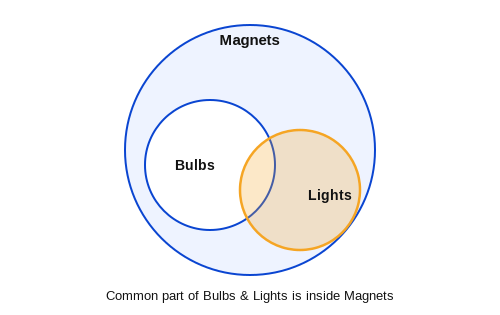
Concept: Draw the Venn diagram: Bulbs lie fully inside Magnets and partly overlap Lights.

  1. Some bulbs are lights, and those bulbs are also magnets → at least some magnets are lights. (I) follows.
  2. All bulbs are magnets → "Some magnets are bulbs" (conversion of "All"). (II) follows.

Trick: "Some A are B" + "All A are C" → "Some C are B" always follows.

Answer: (C) Both conclusions (I) and (II) follow.

अवधारणा: वेन आरेख बनाएँ: Bulbs पूरी तरह Magnets के अंदर हैं और Lights से आंशिक रूप से मिलते हैं।

  1. कुछ bulbs, lights हैं और वे bulbs, magnets भी हैं → कम से कम कुछ magnets, lights हैं। (I) अनुसरण करता है।
  2. सभी bulbs, magnets हैं → "कुछ magnets, bulbs हैं" ("सभी" का रूपांतरण)। (II) अनुसरण करता है।

ट्रिक: "कुछ A, B हैं" + "सभी A, C हैं" → "कुछ C, B हैं" हमेशा सही।

उत्तर: (C) निष्कर्ष (I) और (II) दोनों अनुसरण करते हैं।

RRB NTPC Undergraduate CBT 2General Intelligence and ReasoningSyllogismRRB NTPC Undergraduate CBT 2 2024 · 20 Dec Shift 3 →
Q11227.
In a certain code language, 'bell poet visit' is coded as 'js vx gu' and 'yard visit queen' is coded as 'aw ks js'. How is 'visit' coded in the given language?
एक निश्चित कूट भाषा में, 'bell poet visit' को 'js vx gu' लिखा जाता है और 'yard visit queen' को 'aw ks js' लिखा जाता है। दी गई भाषा में 'visit' को किस प्रकार लिखा जाता है?
  1. Agu
  2. Baw
  3. Cvx
  4. Djs
Show answer

Concept: A word common to two sentences gets the code common to both.

  1. bell poet visit → js vx gu
  2. yard visit queen → aw ks js
  3. Common word "visit" ↔ common code "js".

Trick: Match common word with common code – order of codes does not matter.

Answer: (D) js

अवधारणा: दो वाक्यों में उभयनिष्ठ शब्द का कोड भी दोनों में उभयनिष्ठ होता है।

  1. bell poet visit → js vx gu
  2. yard visit queen → aw ks js
  3. उभयनिष्ठ शब्द "visit" ↔ उभयनिष्ठ कोड "js"।

ट्रिक: उभयनिष्ठ शब्द को उभयनिष्ठ कोड से मिलाएँ – कोड का क्रम मायने नहीं रखता।

उत्तर: (D) js

RRB NTPC Undergraduate CBT 2General Intelligence and ReasoningCoding-DecodingRRB NTPC Undergraduate CBT 2 2024 · 20 Dec Shift 3 →
Q11228.
Select the set in which the numbers are related in the same way as are the numbers of the following sets.
(NOTE: Operations should be performed on the whole numbers, without breaking down the numbers into their constituent digits. E.g. 13 – Operations on 13 such as adding to/subtracting from/multiplying with 13 can be performed. Breaking down 13 into 1 and 3 and then performing mathematical operations on 1 and 3 is not allowed.)
(5, 14, 24)
(3, 10, 16)
उस समुच्चय का चयन कीजिए जिसमें संख्याएँ उसी प्रकार संबंधित हैं जिस प्रकार निम्नलिखित समुच्चयों की संख्याएँ संबंधित हैं।
(ध्यान दें: संक्रियाएँ संख्याओं को उनके घटक अंकों में विभाजित किए बिना, पूर्ण संख्याओं पर की जानी चाहिए। उदाहरण के लिए, 13 – 13 पर संक्रियाएँ जैसे 13 में जोड़ना/13 में से घटाना/13 से गुणा करना आदि की जा सकती हैं। 13 को 1 और 3 में विभाजित करना और फिर 1 और 3 पर गणितीय संक्रियाएँ करने की अनुमति नहीं है।)
(5, 14, 24)
(3, 10, 16)
  1. A(6, 8, 12)
  2. B(7, 18, 32)
  3. C(4, 12, 28)
  4. D(9 , 14, 24)
Show answer

Concept: Find the rule linking the three numbers (a, b, c).

  1. (5, 14, 24): 5×2+4=14, 14+2×5=24.
  2. (3, 10, 16): 3×2+4=10, 10+2×3=16.
  3. Rule: b=2a+4, c=b+2a.
  4. (7, 18, 32): 7×2+4=18, 18+14=32 ✔. Others fail, e.g. (9, 14, 24): 2×9+4=22≠14.

Trick: Check the first link (2a+4) on options first – only (B) survives.

Answer: (B) (7, 18, 32)

अवधारणा: तीनों संख्याओं (a, b, c) को जोड़ने वाला नियम खोजें।

  1. (5, 14, 24): 5×2+4=14, 14+2×5=24।
  2. (3, 10, 16): 3×2+4=10, 10+2×3=16।
  3. नियम: b=2a+4, c=b+2a।
  4. (7, 18, 32): 7×2+4=18, 18+14=32 ✔। अन्य असफल, जैसे (9, 14, 24): 2×9+4=22≠14।

ट्रिक: पहले विकल्पों पर पहला संबंध (2a+4) जाँचें – केवल (B) बचता है।

उत्तर: (B) (7, 18, 32)

RRB NTPC Undergraduate CBT 2General Intelligence and ReasoningNumber Analogy (Sets)RRB NTPC Undergraduate CBT 2 2024 · 20 Dec Shift 3 →
Q11229.
What will come in the place of the question mark (?) in the following equation, if ‘+’ and ‘−’ are interchanged and ‘×’ and ‘÷’ are interchanged?
3 ÷ 2 + 15 × 3 - 5 = ? + 10
यदि '+' और '−' को आपस में बदल दिया जाए तथा '×' और '÷' को आपस में बदल दिया जाए, तो निम्नलिखित समीकरण में प्रश्न चिह्न (?) के स्थान पर क्या आएगा?
3 ÷ 2 + 15 × 3 - 5 = ? + 10
  1. A15
  2. B17
  3. C13
  4. D16
Show answer

Concept: Interchange the signs on both sides, then use BODMAS.

  1. New equation: 3×2−15÷3+5=?−10.
  2. LHS: 6−5+5=6.
  3. ?−10=6⇒?=16.

Trick: Don't forget the "+" on the right side also changes to "−".

Answer: (D) 16

अवधारणा: चिह्नों को दोनों पक्षों में बदलें, फिर BODMAS लगाएँ।

  1. नया समीकरण: 3×2−15÷3+5=?−10।
  2. बायाँ पक्ष: 6−5+5=6।
  3. ?−10=6⇒?=16।

ट्रिक: दाईं ओर का "+" भी "−" में बदलता है, इसे न भूलें।

उत्तर: (D) 16

RRB NTPC Undergraduate CBT 2General Intelligence and ReasoningMathematical OperationsRRB NTPC Undergraduate CBT 2 2024 · 20 Dec Shift 3 →
Q11230.
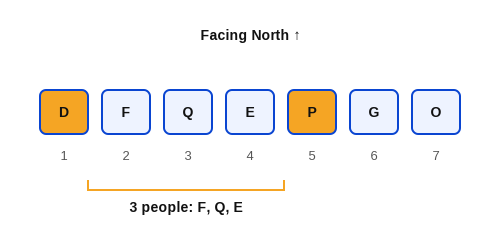
D, E, F, G, O, P and Q are sitting in a straight line, facing north. Only three people sit to the left of E. Only O sits to the right of G. Only three people sit between G and F. Q sits at some place to the left of P but at some place to the right of D. How many people sit between D and P?
D, E, F, G, O, P और Q एक सीधी पंक्ति में उत्तर की ओर मुख करके बैठे हैं। E के बाईं ओर केवल तीन व्यक्ति बैठे हैं। G के दाईं ओर केवल O बैठा है। G और F के बीच केवल तीन व्यक्ति बैठे हैं। Q, P के बाईं ओर किसी स्थान पर लेकिन D के दाईं ओर किसी स्थान पर बैठा है। D और P के बीच कितने व्यक्ति बैठे हैं?
  1. AFourचार
  2. BTwoदो
  3. COneएक
  4. DThreeतीन
Show answer

Concept: Fix the certain positions first (7 seats, numbered from the left).

  1. Three left of E → E is 4th.
  2. Only O right of G → G = 6th, O = 7th.
  3. Three between G and F → F = 2nd.
  4. Left seats 1, 3, 5 for D, Q, P with D left of Q left of P → D = 1, Q = 3, P = 5.
  5. Between D and P: F, Q, E = 3 people.

Trick: People between = difference of positions − 1 = 5−1−1=3.

Answer: (D) Three

अवधारणा: पहले निश्चित स्थान तय करें (7 सीटें, बाएँ से क्रमांकित)।

  1. E के बाएँ तीन → E चौथे स्थान पर।
  2. G के दाएँ केवल O → G = 6, O = 7।
  3. G और F के बीच तीन → F = 2।
  4. शेष सीटें 1, 3, 5 पर D, Q, P (D, Q के बाएँ और Q, P के बाएँ) → D = 1, Q = 3, P = 5।
  5. D और P के बीच: F, Q, E = 3 व्यक्ति।

ट्रिक: बीच के व्यक्ति = स्थानों का अंतर − 1 = 5−1−1=3।

उत्तर: (D) तीन

RRB NTPC Undergraduate CBT 2General Intelligence and ReasoningLinear Seating ArrangementRRB NTPC Undergraduate CBT 2 2024 · 20 Dec Shift 3 →
Q11231.
What should come in place of the question mark (?) in the given series?
57 58 62 71 87 112 ?
दी गई श्रृंखला में प्रश्न चिह्न (?) के स्थान पर क्या आना चाहिए?
57 58 62 71 87 112 ?
  1. A76
  2. B137
  3. C148
  4. D144
Show answer

Concept: Look at the differences between consecutive terms.

  1. Differences: 1,4,9,16,25 = 12,22,32,42,52.
  2. Next difference =62=36.
  3. 112+36=148.

Trick: Slowly growing differences 1, 4, 9 … → perfect squares.

Answer: (C) 148

अवधारणा: क्रमागत पदों का अंतर देखें।

  1. अंतर: 1,4,9,16,25 = 12,22,32,42,52।
  2. अगला अंतर =62=36।
  3. 112+36=148।

ट्रिक: 1, 4, 9 … वाले अंतर → पूर्ण वर्ग।

उत्तर: (C) 148

RRB NTPC Undergraduate CBT 2General Intelligence and ReasoningNumber SeriesRRB NTPC Undergraduate CBT 2 2024 · 20 Dec Shift 3 →
Q11232.
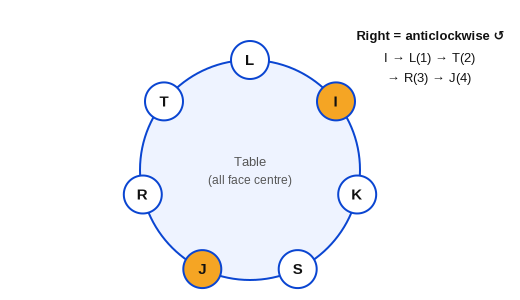
I, J, K, L, R, S and T are sitting around a circular table facing the centre of the table. Only two people sit between K and T when counted from the right of K. Only three people sit between S and L when counted from the right of L. T sits to the immediate right of L. J sits to the immediate right of R.
Who sits fourth to the right of I?
I, J, K, L, R, S और T एक वृत्ताकार मेज़ के चारों ओर मेज़ के केंद्र की ओर मुख करके बैठे हैं। K के दाईं ओर से गिनने पर K और T के बीच केवल दो व्यक्ति बैठे हैं। L के दाईं ओर से गिनने पर S और L के बीच केवल तीन व्यक्ति बैठे हैं। T, L के ठीक दाईं ओर बैठा है। J, R के ठीक दाईं ओर बैठा है।
I के दाईं ओर चौथे स्थान पर कौन बैठा है?
  1. AT
  2. BJ
  3. CS
  4. DL
Show answer

Concept: Facing the centre, "right" means moving anticlockwise.

  1. T is immediate right of L; K and T have two people between (from K's right) → K is second to the left of L.
  2. Three people between L and S (from L's right) → S is fourth to the right of L.
  3. Remaining three seats: two adjacent (for R then J on its right) and one for I.
  4. Order to the right of I: L, T, R, J → 4th to the right of I is J.

Trick: Number seats in the "right" direction: L = 0, T = 1, S = 4, K = 5 → R = 2, J = 3, I = 6; 6+4=10≡3 → J.

Answer: (B) J

अवधारणा: केंद्र की ओर मुख होने पर "दाएँ" का अर्थ वामावर्त (anticlockwise) चलना है।

  1. T, L के ठीक दाएँ; K और T के बीच दो व्यक्ति (K के दाएँ से) → K, L के बाएँ दूसरे स्थान पर।
  2. L और S के बीच तीन व्यक्ति (L के दाएँ से) → S, L के दाएँ चौथे स्थान पर।
  3. शेष तीन सीटें: दो सटी हुई (R और उसके दाएँ J) और एक I के लिए।
  4. I के दाएँ क्रम: L, T, R, J → I के दाएँ चौथा J है।

ट्रिक: "दाएँ" दिशा में क्रमांक: L = 0, T = 1, S = 4, K = 5 → R = 2, J = 3, I = 6; 6+4=10≡3 → J।

उत्तर: (B) J

RRB NTPC Undergraduate CBT 2General Intelligence and ReasoningCircular Seating ArrangementRRB NTPC Undergraduate CBT 2 2024 · 20 Dec Shift 3 →
Q11233.
If ‘A’ stands for ‘÷’, ‘B’ stands for ‘×’, ‘C’ stands for ‘+’ and ‘D’ stands for ‘−’, then what will come in place of question mark (?) in the following equation?
138 B 2 C 24 A 4 D 8 = ?
यदि 'A' का अर्थ '÷', 'B' का अर्थ '×', 'C' का अर्थ '+' और 'D' का अर्थ '−' है, तो निम्नलिखित समीकरण में प्रश्न चिह्न (?) के स्थान पर क्या आएगा?
138 B 2 C 24 A 4 D 8 = ?
  1. A273
  2. B271
  3. C274
  4. D272
Show answer

Concept: Replace letters by signs, then apply BODMAS.

  1. 138×2+24÷4−8
  2. =276+6−8
  3. =274

Trick: Do × and ÷ first: 276 and 6, then 282−8.

Answer: (C) 274

अवधारणा: अक्षरों को चिह्नों से बदलें, फिर BODMAS लगाएँ।

  1. 138×2+24÷4−8
  2. =276+6−8
  3. =274

ट्रिक: पहले × और ÷: 276 और 6, फिर 282−8।

उत्तर: (C) 274

RRB NTPC Undergraduate CBT 2General Intelligence and ReasoningMathematical OperationsRRB NTPC Undergraduate CBT 2 2024 · 20 Dec Shift 3 →
Q11234.
Select the triad which follows the same pattern as that followed by the two triads given below. Both triads follow the same pattern.
BATH – HBAT – THBA
TOYS – STOY – YSTO
उस त्रिक का चयन कीजिए जो उसी पैटर्न का अनुसरण करता है जिसका अनुसरण नीचे दिए गए दोनों त्रिक करते हैं। दोनों त्रिक समान पैटर्न का अनुसरण करते हैं।
BATH – HBAT – THBA
TOYS – STOY – YSTO
  1. ACART – ACTR – CTAR
  2. BTOMB – OMTB – MTOB
  3. CABLE – EABL – LEAB
  4. DLOVE – OVEL – VELO
Show answer

Concept: Each step moves the last letter to the front.

  1. BATH → H + BAT = HBAT → T + HBA = THBA.
  2. TOYS → S + TOY = STOY → Y + STO = YSTO.
  3. ABLE → E + ABL = EABL → L + EAB = LEAB ✔.
  4. LOVE → OVEL moves the first letter to the end – wrong pattern.

Trick: Check if the 2nd term starts with the last letter of the 1st – only ABLE → EABL does.

Answer: (C) ABLE – EABL – LEAB

अवधारणा: हर चरण में अंतिम अक्षर आगे आ जाता है।

  1. BATH → H + BAT = HBAT → T + HBA = THBA।
  2. TOYS → S + TOY = STOY → Y + STO = YSTO।
  3. ABLE → E + ABL = EABL → L + EAB = LEAB ✔।
  4. LOVE → OVEL में पहला अक्षर अंत में गया – गलत पैटर्न।

ट्रिक: देखें कि दूसरा पद पहले पद के अंतिम अक्षर से शुरू होता है – केवल ABLE → EABL।

उत्तर: (C) ABLE – EABL – LEAB

RRB NTPC Undergraduate CBT 2General Intelligence and ReasoningLetter Pattern (Triads)RRB NTPC Undergraduate CBT 2 2024 · 20 Dec Shift 3 →
Q11235.
In a certain code language,
A + B means ‘A is the son of B’,
A # B means ‘A is the sister of B’,
A x B means ‘A is the wife of B’ and
A & B means ‘A is the father of B’.
Based on the above, how is S related to T if 'S + G & J # K x T'?
एक निश्चित कूट भाषा में,
A + B का अर्थ है 'A, B का पुत्र है',
A # B का अर्थ है 'A, B की बहन है',
A x B का अर्थ है 'A, B की पत्नी है' और
A & B का अर्थ है 'A, B का पिता है'।
उपरोक्त के आधार पर, यदि 'S + G & J # K x T' है, तो S, T से किस प्रकार संबंधित है?
  1. AWife's fatherपत्नी का पिता
  2. BFatherपिता
  3. CBrotherभाई
  4. DWife's brotherपत्नी का भाई
Show answer

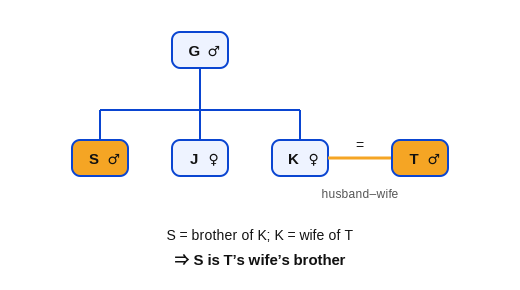
Concept: Decode each symbol and draw the family tree.

  1. S + G → S is the son of G.
  2. G & J → G is the father of J; so S and J are siblings.
  3. J # K → J is the sister of K; so K is also G's child.
  4. K x T → K is the wife of T.
  5. S is the brother of T's wife → wife's brother.

Trick: S (male) and K are children of the same father G; K is T's wife.

Answer: (D) Wife's brother

अवधारणा: हर चिह्न का अर्थ निकालकर वंश-वृक्ष बनाएँ।

  1. S + G → S, G का पुत्र है।
  2. G & J → G, J का पिता है; अतः S और J भाई-बहन हैं।
  3. J # K → J, K की बहन है; अतः K भी G की संतान है।
  4. K x T → K, T की पत्नी है।
  5. S, T की पत्नी का भाई है → पत्नी का भाई (साला)।

ट्रिक: S (पुरुष) और K एक ही पिता G की संतान हैं; K, T की पत्नी है।

उत्तर: (D) पत्नी का भाई (Wife's brother)

RRB NTPC Undergraduate CBT 2General Intelligence and ReasoningCoded Blood RelationsRRB NTPC Undergraduate CBT 2 2024 · 20 Dec Shift 3 →
Q11236.
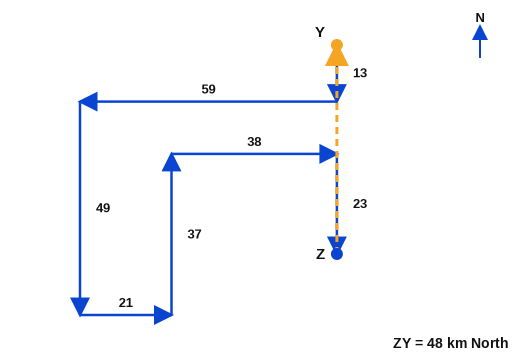
Nitin starts from Point Y and drives 13 km towards south. He then takes a right turn, drives 59 km, turns left and drives 49 km. He then takes a left turn and drives 21 km. He takes a left turn, drives 37 km. He then turns right, drives 38 km, turns right and drives 23 km to stop at Point Z. How far (shortest distance) and towards which direction should he drive in order to reach Point Y again? (All turns are 90° turns only unless specified.)
नितिन बिंदु Y से चलना शुरू करता है और दक्षिण की ओर 13 km ड्राइव करता है। फिर वह दाएँ मुड़ता है, 59 km ड्राइव करता है, बाएँ मुड़ता है और 49 km ड्राइव करता है। फिर वह बाएँ मुड़ता है और 21 km ड्राइव करता है। वह बाएँ मुड़ता है, 37 km ड्राइव करता है। फिर वह दाएँ मुड़ता है, 38 km ड्राइव करता है, दाएँ मुड़ता है और 23 km ड्राइव करके बिंदु Z पर रुक जाता है। बिंदु Y पर फिर से पहुँचने के लिए उसे कितनी दूरी (न्यूनतम दूरी) और किस दिशा में ड्राइव करना चाहिए? (जब तक निर्दिष्ट न हो, सभी मोड़ केवल 90° के मोड़ हैं।)
  1. A51 km towards southदक्षिण की ओर 51 km
  2. B49 km towards southदक्षिण की ओर 49 km
  3. C43 km towards northउत्तर की ओर 43 km
  4. D48 km towards northउत्तर की ओर 48 km
Show answer

Concept: Track net East–West and North–South displacement from Y.

  1. Moves: S 13, W 59, S 49, E 21, N 37, E 38, S 23.
  2. East–West: −59+21+38=0 → Z is directly in line with Y.
  3. North–South: −13−49+37−23=−48 → Z is 48 km south of Y.
  4. To return, drive 48 km towards north.

Trick: After a right turn while facing south you face west; after a left turn while facing west you face south.

Answer: (D) 48 km towards north

अवधारणा: Y से कुल पूर्व–पश्चिम और उत्तर–दक्षिण विस्थापन निकालें।

  1. चालें: दक्षिण 13, पश्चिम 59, दक्षिण 49, पूर्व 21, उत्तर 37, पूर्व 38, दक्षिण 23।
  2. पूर्व–पश्चिम: −59+21+38=0 → Z, Y की सीध में है।
  3. उत्तर–दक्षिण: −13−49+37−23=−48 → Z, Y से 48 km दक्षिण में।
  4. वापस जाने के लिए 48 km उत्तर की ओर चलना होगा।

ट्रिक: दक्षिण की ओर मुख करके दाएँ मुड़ने पर पश्चिम; पश्चिम की ओर से बाएँ मुड़ने पर दक्षिण।

उत्तर: (D) 48 km उत्तर की ओर

RRB NTPC Undergraduate CBT 2General Intelligence and ReasoningDirection and DistanceRRB NTPC Undergraduate CBT 2 2024 · 20 Dec Shift 3 →
Q11237.
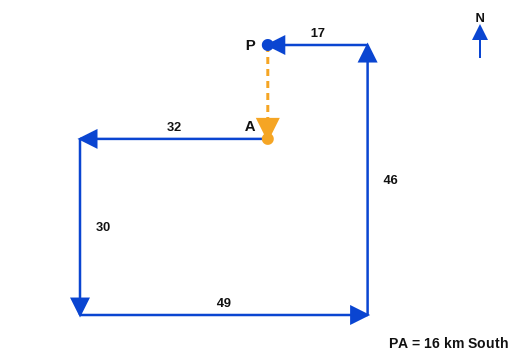
Radhe starts from Point A and drives 32 km towards west. He then takes a left turn, drives 30 km, turns left and drives 49 km. He then takes a left turn and drives 46 km. He takes a final left turn, drives 17 km and stops at Point P. How far (shortest distance) and towards which direction should he drive in order to reach Point A again? (All turns are 90 degrees turns unless specified)
राधे बिंदु A से चलना शुरू करता है और पश्चिम की ओर 32 km ड्राइव करता है। फिर वह बाएँ मुड़ता है, 30 km ड्राइव करता है, बाएँ मुड़ता है और 49 km ड्राइव करता है। फिर वह बाएँ मुड़ता है और 46 km ड्राइव करता है। वह अंतिम बार बाएँ मुड़ता है, 17 km ड्राइव करता है और बिंदु P पर रुक जाता है। बिंदु A पर फिर से पहुँचने के लिए उसे कितनी दूरी (न्यूनतम दूरी) और किस दिशा में ड्राइव करना चाहिए? (जब तक निर्दिष्ट न हो, सभी मोड़ 90 डिग्री के मोड़ हैं)
  1. A12 km to the nouthउत्तर की ओर 12 km
  2. B15 km to the westपश्चिम की ओर 15 km
  3. C16 km to the southदक्षिण की ओर 16 km
  4. D13 km to the southदक्षिण की ओर 13 km
Show answer

Concept: Track net displacement from A.

  1. Moves: W 32, S 30, E 49, N 46, W 17.
  2. East–West: −32+49−17=0.
  3. North–South: −30+46=16 → P is 16 km north of A.
  4. To return, drive 16 km to the south.

Trick: Four left turns from west go W → S → E → N → W.

Answer: (C) 16 km to the south

अवधारणा: A से कुल विस्थापन निकालें।

  1. चालें: पश्चिम 32, दक्षिण 30, पूर्व 49, उत्तर 46, पश्चिम 17।
  2. पूर्व–पश्चिम: −32+49−17=0।
  3. उत्तर–दक्षिण: −30+46=16 → P, A से 16 km उत्तर में।
  4. वापस आने के लिए 16 km दक्षिण की ओर जाना होगा।

ट्रिक: पश्चिम से चार बार बाएँ मुड़ने पर: पश्चिम → दक्षिण → पूर्व → उत्तर → पश्चिम।

उत्तर: (C) 16 km दक्षिण की ओर

RRB NTPC Undergraduate CBT 2General Intelligence and ReasoningDirection and DistanceRRB NTPC Undergraduate CBT 2 2024 · 20 Dec Shift 3 →
Q11238.
In this question, a question is followed by two statements numbered (I) and (II). You have to decide whether the data provided in the statements are sufficient to answer the question. Read both the statements and decide the appropriate answer.
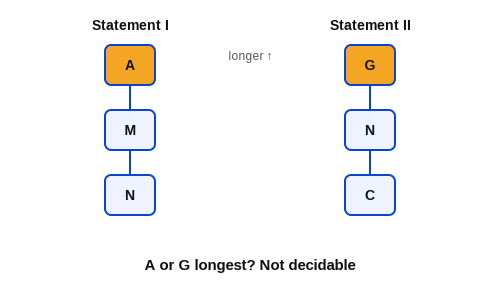
Question: Among 5 Sticks, M,A,N,C and G each having a different length, which stick is the longest?
Statements:
(I) M is shorter than A but longer than N.
(II) N is longer than C but shorter than G.
इस प्रश्न में, एक प्रश्न के बाद (I) और (II) क्रमांकित दो कथन दिए गए हैं। आपको निर्णय करना है कि कथनों में दिए गए आँकड़े प्रश्न का उत्तर देने के लिए पर्याप्त हैं या नहीं। दोनों कथनों को पढ़िए और उपयुक्त उत्तर का निर्णय कीजिए।
प्रश्न: 5 छड़ियों M, A, N, C और G में से, जिनमें से प्रत्येक की लंबाई भिन्न है, कौन-सी छड़ी सबसे लंबी है?
कथन:
(I) M, A से छोटी है लेकिन N से लंबी है।
(II) N, C से लंबी है लेकिन G से छोटी है।
  1. AData in statement II alone is sufficient to answer the question while data in statement I is not.केवल कथन II के आँकड़े प्रश्न का उत्तर देने के लिए पर्याप्त हैं, जबकि कथन I के आँकड़े पर्याप्त नहीं हैं।
  2. BBoth statements I and II together are not sufficient to answer the question.कथन I और II दोनों मिलकर भी प्रश्न का उत्तर देने के लिए पर्याप्त नहीं हैं।
  3. CBoth statements I and II together (and not statement I alone or statement II alone) are sufficient to answer the question.कथन I और II दोनों मिलकर (न कि केवल कथन I या केवल कथन II) प्रश्न का उत्तर देने के लिए पर्याप्त हैं।
  4. DData in statement I alone is sufficient to answer the question while data in statement II is not.केवल कथन I के आँकड़े प्रश्न का उत्तर देने के लिए पर्याप्त हैं, जबकि कथन II के आँकड़े पर्याप्त नहीं हैं।
Show answer

Concept: Combine both statements and check whether one stick is surely the longest.

  1. (I): A > M > N – says nothing about C and G.
  2. (II): G > N > C – says nothing about A and M.
  3. Together: both A and G are longer than N, but A vs G is unknown.
  4. The longest could be A or G → not sufficient.

Trick: Two chains meeting only at a lower member (N) never fix the top.

Answer: (B) Both statements I and II together are not sufficient to answer the question.

अवधारणा: दोनों कथनों को मिलाकर देखें कि कोई एक छड़ी निश्चित रूप से सबसे लंबी है या नहीं।

  1. (I): A > M > N – C और G के बारे में कुछ नहीं।
  2. (II): G > N > C – A और M के बारे में कुछ नहीं।
  3. दोनों मिलाकर: A और G दोनों N से लंबे हैं, पर A और G की तुलना अज्ञात।
  4. सबसे लंबी A या G हो सकती है → पर्याप्त नहीं।

ट्रिक: दो श्रृंखलाएँ केवल नीचे के सदस्य (N) पर मिलें तो शीर्ष तय नहीं होता।

उत्तर: (B) कथन I और II दोनों मिलकर भी पर्याप्त नहीं हैं।

RRB NTPC Undergraduate CBT 2General Intelligence and ReasoningData Sufficiency – RankingRRB NTPC Undergraduate CBT 2 2024 · 20 Dec Shift 3 →
Q11239.
Seven boxes U, V, W, X, E, F and G are kept one over the other but not necessarily in the same order. Only two boxes are kept below G. Only one box is kept above V. Only one box is kept between V and U. X is kept immediately above P. W is kept at some place below E. How many boxes are kept between E and X?
सात बक्से U, V, W, X, E, F और G एक के ऊपर एक रखे गए हैं, लेकिन यह आवश्यक नहीं है कि इसी क्रम में हों। G के नीचे केवल दो बक्से रखे गए हैं। V के ऊपर केवल एक बक्सा रखा गया है। V और U के बीच केवल एक बक्सा रखा गया है। X को P के ठीक ऊपर रखा गया है। W को E के नीचे किसी स्थान पर रखा गया है। E और X के बीच कितने बक्से रखे गए हैं?
  1. AFourचार
  2. BOneएक
  3. CTwoदो
  4. DThreeतीन
Show answer

Concept: Number the positions 1 (bottom) to 7 (top), fix the certain boxes first, then test whether the remaining clues give one unique stack.

  1. Only two boxes below G ⇒ G = 3. Only one box above V ⇒ V = 6. One box between V and U ⇒ U = 4 (position 8 does not exist).
  2. Free positions 1, 2, 5, 7 are for X, W, E, F.
  3. The clue "X is kept immediately above P" names a box P that is not among the seven boxes (U, V, W, X, E, F, G), so it cannot be applied.
  4. With only "W below E" left, several stacks are possible (bottom to top): W, X, G, U, F, V, E gives 4 boxes between E and X; W, F, G, U, X, V, E gives 1; W, X, G, U, E, V, F gives 2; X, W, G, U, E, V, F gives 3.
  5. Every option can occur, so the answer is not unique as printed.
  6. If the clue had been "X is kept immediately above F", the stack would be F, X, G, U, W, V, E and the answer would be Four (A).

Note: When a clue names an item outside the given set, check whether the other clues alone fix the arrangement. In the exam, every candidate gets full marks (bonus) for such a question.

Answer: Bonus – no option is correct as printed; full marks to all.

अवधारणा: स्थानों को 1 (सबसे नीचे) से 7 (सबसे ऊपर) तक क्रमांकित करें, पहले निश्चित बॉक्स रखें, फिर देखें कि बाकी शर्तों से एक ही व्यवस्था बनती है या नहीं।

  1. G के नीचे केवल दो बॉक्स ⇒ G = 3। V के ऊपर केवल एक बॉक्स ⇒ V = 6। V और U के बीच एक बॉक्स ⇒ U = 4 (स्थान 8 नहीं है)।
  2. खाली स्थान 1, 2, 5, 7 पर X, W, E, F आएँगे।
  3. शर्त "X, P के ठीक ऊपर है" में P नाम का बॉक्स सात बॉक्सों (U, V, W, X, E, F, G) में है ही नहीं, इसलिए यह शर्त लागू नहीं हो सकती।
  4. केवल "W, E के नीचे" बचने पर कई व्यवस्थाएँ संभव हैं (नीचे से ऊपर): W, X, G, U, F, V, E में E और X के बीच 4 बॉक्स; W, F, G, U, X, V, E में 1; W, X, G, U, E, V, F में 2; X, W, G, U, E, V, F में 3।
  5. हर विकल्प संभव है, इसलिए छपे प्रश्न का उत्तर अद्वितीय नहीं है।
  6. यदि शर्त "X, F के ठीक ऊपर है" होती, तो क्रम F, X, G, U, W, V, E बनता और उत्तर चार (A) होता।

नोट: जब कोई शर्त दिए गए समूह से बाहर की वस्तु बताए, तो जाँचें कि बाकी शर्तें अकेले व्यवस्था तय करती हैं या नहीं। परीक्षा में ऐसे प्रश्न पर सभी अभ्यर्थियों को पूरे अंक (बोनस) दिए जाते हैं।

उत्तर: बोनस – छपे प्रश्न के अनुसार कोई विकल्प सही नहीं; सभी को पूरे अंक।

RRB NTPC Undergraduate CBT 2General Intelligence and ReasoningBox ArrangementRRB NTPC Undergraduate CBT 2 2024 · 20 Dec Shift 3 →
Q11240.
Based on the English alphabetical order, three of the following four letter-cluster pairs are alike in a certain way and thus form a group. Which letter-cluster pair DOES NOT belong to that group? (Note: The odd one out is not based on the number of
consonants/vowels or their position in the letter-cluster.)
अंग्रेज़ी वर्णमाला क्रम के आधार पर, निम्नलिखित चार अक्षर-समूह युग्मों में से तीन किसी निश्चित प्रकार से एकसमान हैं और इस प्रकार एक समूह बनाते हैं। कौन-सा अक्षर-समूह युग्म उस समूह से संबंधित नहीं है? (ध्यान दें: असंगत का निर्धारण
व्यंजनों/स्वरों की संख्या या अक्षर-समूह में उनकी स्थिति के आधार पर नहीं है।)
  1. AQR – WX
  2. BAB – GH
  3. CMN – SV
  4. DIJ – OP
Show answer

Concept: Compare each letter of the first cluster with the matching letter of the second (A = 1 … Z = 26).

  1. QR – WX: Q(17) + 6 = W, R(18) + 6 = X.
  2. AB – GH: +6, +6. IJ – OP: +6, +6.
  3. MN – SV: M(13) + 6 = S, but N(14) + 8 = V(22) ✘.

Trick: In the pattern, the second cluster is also two consecutive letters; SV is not.

Answer: (C) MN – SV

अवधारणा: पहले समूह के हर अक्षर की तुलना दूसरे समूह के संगत अक्षर से करें (A = 1 … Z = 26)।

  1. QR – WX: Q(17) + 6 = W, R(18) + 6 = X।
  2. AB – GH: +6, +6। IJ – OP: +6, +6।
  3. MN – SV: M(13) + 6 = S, पर N(14) + 8 = V(22) ✘।

ट्रिक: पैटर्न में दूसरा समूह भी दो क्रमागत अक्षर है; SV नहीं है।

उत्तर: (C) MN – SV

RRB NTPC Undergraduate CBT 2General Intelligence and ReasoningOdd One Out – Letter PairsRRB NTPC Undergraduate CBT 2 2024 · 20 Dec Shift 3 →