Question bank

Q&A: practice questions with answers

Search questions on any topic. Filter by exam category, exam, subject and topic, try the question, then open the answer and explanation.

Courses – airGurukul

7,077 questions found.

Q4561.
What will come in place of the question mark (?) in the following equation, if ‘+’ and ‘−’ are interchanged and ‘×’ and ‘÷’ are interchanged?
63 ÷ 12 − 98 × 7 + 35 = ?
यदि ‘+’ और ‘−’ को आपस में बदल दिया जाए तथा ‘×’ और ‘÷’ को आपस में बदल दिया जाए, तो निम्नलिखित समीकरण में प्रश्न चिह्न (?) के स्थान पर क्या आएगा?
63 ÷ 12 − 98 × 7 + 35 = ?
  1. A742
  2. B735
  3. C745
  4. D736
Show answer

Concept: Swap + ↔ − and × ↔ ÷, then use BODMAS.

  1. 63×12+98÷7−35
  2. 756+14−35=735

Trick: Rewrite the whole expression first, then solve.

Answer: (B) 735

अवधारणा: + ↔ − और × ↔ ÷ बदलें, फिर BODMAS।

  1. 63×12+98÷7−35
  2. 756+14−35=735

ट्रिक: पहले पूरा व्यंजक दोबारा लिखें, फिर हल करें।

उत्तर: (B) 735
RRB NTPC Graduate CBT 1General Intelligence and ReasoningMathematical Operations – InterchangeRRB NTPC Graduate CBT 1 2024 · 5 Jun Shift 2 →
Q4562.
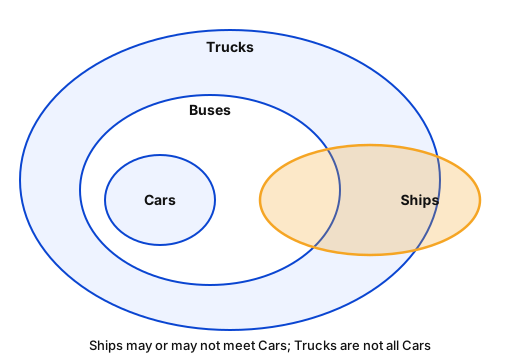
Read the given statements and conclusions carefully. Assuming that the information given in the statements is true, even if it appears to be at variance with commonly known facts, decide which of the given conclusion(s) logically follow(s) from the statements.
Statements:
All cars are buses.
All buses are trucks.
Some buses are ships.
Conclusions:
(I) Some ships are cars.
(II) All trucks are cars.
दिए गए कथनों और निष्कर्षों को ध्यानपूर्वक पढ़िए। यह मानते हुए कि कथनों में दी गई जानकारी सत्य है, भले ही वह सामान्य रूप से ज्ञात तथ्यों से भिन्न प्रतीत होती हो, निर्णय लीजिए कि दिए गए निष्कर्षों में से कौन-सा/से निष्कर्ष तार्किक रूप से कथनों का अनुसरण करता है/करते हैं।
कथन:
सभी कारें, बसें हैं।
सभी बसें, ट्रक हैं।
कुछ बसें, जहाज़ हैं।
निष्कर्ष:
(I) कुछ जहाज़, कारें हैं।
(II) सभी ट्रक, कारें हैं।
  1. ANeither conclusion (I) nor (II) follows.न तो निष्कर्ष (I) और न ही (II) अनुसरण करता है।
  2. BOnly conclusion (I) follows.केवल निष्कर्ष (I) अनुसरण करता है।
  3. CBoth conclusions (I) and (II) follow.निष्कर्ष (I) और (II) दोनों अनुसरण करते हैं।
  4. DOnly conclusion (II) follows.केवल निष्कर्ष (II) अनुसरण करता है।
Show answer

Concept: Draw the least-overlap Venn diagram and test each conclusion.

  1. Cars ⊂ Buses ⊂ Trucks; Ships overlap only some Buses.
  2. (I) Ships may touch Buses outside Cars → "Some ships are cars" not certain.
  3. (II) Trucks are larger than Cars → "All trucks are cars" false.

Trick: "All A are B" never gives "All B are A".

Answer: (A) Neither conclusion (I) nor (II) follows.

अवधारणा: न्यूनतम-अतिव्यापन वाला वेन आरेख बनाकर हर निष्कर्ष जाँचें।

  1. Cars ⊂ Buses ⊂ Trucks; Ships केवल कुछ Buses से मिलते हैं।
  2. (I) Ships, Cars के बाहर वाले Buses से मिल सकते हैं → "कुछ ships, cars हैं" निश्चित नहीं।
  3. (II) Trucks, Cars से बड़ा समूह → "सभी trucks, cars हैं" गलत।

ट्रिक: "सभी A, B हैं" से कभी "सभी B, A हैं" नहीं निकलता।

उत्तर: (A) Neither conclusion (I) nor (II) follows.

RRB NTPC Graduate CBT 1General Intelligence and ReasoningSyllogismRRB NTPC Graduate CBT 1 2024 · 5 Jun Shift 2 →
Q4563.
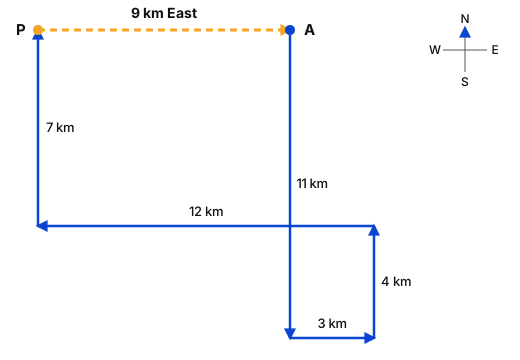
Sunil starts from Point A and drives 11 km towards the south. He then takes a left turn, drives 3 km, turns left and drives 4 km. He then takes a left turn and drives 12 km. He takes a final right turn, drives 7 km and stops at Point P. How far (shortest distance) and towards which direction should he drive in order to reach Point A again? (All turns are 90 degree turns only unless specified.)
सुनील बिंदु A से चलना शुरू करता है और दक्षिण की ओर 11 km गाड़ी चलाता है। फिर वह बाएँ मुड़ता है, 3 km गाड़ी चलाता है, बाएँ मुड़ता है और 4 km गाड़ी चलाता है। फिर वह बाएँ मुड़ता है और 12 km गाड़ी चलाता है। वह अंतिम बार दाएँ मुड़ता है, 7 km गाड़ी चलाता है और बिंदु P पर रुक जाता है। बिंदु A पर फिर से पहुँचने के लिए उसे कितनी दूर (न्यूनतम दूरी) और किस दिशा में गाड़ी चलानी चाहिए? (जब तक निर्दिष्ट न हो, सभी मोड़ केवल 90 डिग्री के हैं।)
  1. A8 km to the eastपूर्व की ओर 8 km
  2. B9 km to the westपश्चिम की ओर 9 km
  3. C7 km to the eastपूर्व की ओर 7 km
  4. D9 km to the eastपूर्व की ओर 9 km
Show answer

Concept: Plot each leg with A at origin.

  1. 11 km S; left → East 3 km; left → North 4 km; left → West 12 km; right → North 7 km.
  2. Vertical: −11+4+7=0 → P is level with A.
  3. Horizontal: 3−12=−9 → P is 9 km West of A → drive 9 km East.

Trick: Facing South, a left turn means East.

Answer: (D) 9 km to the east

अवधारणा: A को मूल बिंदु मानकर हर चरण अंकित करें।

  1. 11 km दक्षिण; बाएँ → पूर्व 3 km; बाएँ → उत्तर 4 km; बाएँ → पश्चिम 12 km; दाएँ → उत्तर 7 km।
  2. ऊर्ध्वाधर: −11+4+7=0 → P, A की सीध में।
  3. क्षैतिज: 3−12=−9 → P, A से 9 km पश्चिम → 9 km पूर्व जाना होगा।

ट्रिक: दक्षिण की ओर मुख हो तो बायाँ मोड़ = पूर्व।

उत्तर: (D) 9 km to the east

RRB NTPC Graduate CBT 1General Intelligence and ReasoningDirection and DistanceRRB NTPC Graduate CBT 1 2024 · 5 Jun Shift 2 →
Q4564.
What should come in place of the question mark (?) in the given series based on the English alphabetical order?
VCJ RYF NUB JQX ?
अंग्रेज़ी वर्णमाला क्रम के आधार पर दी गई श्रृंखला में प्रश्न चिह्न (?) के स्थान पर क्या आना चाहिए?
VCJ RYF NUB JQX ?
  1. AFTM
  2. BFNT
  3. CFMT
  4. DFTN
Show answer

Concept: Track each letter position separately.

  1. 1st letters: V, R, N, J → −4 each → F
  2. 2nd letters: C, Y, U, Q → −4 each → M
  3. 3rd letters: J, F, B, X → −4 each → T

Trick: All three positions move −4 (with wrap-around B → X).

Answer: (C) FMT

अवधारणा: हर स्थान के अक्षर अलग देखें।

  1. पहले अक्षर: V, R, N, J → हर बार −4 → F
  2. दूसरे अक्षर: C, Y, U, Q → −4 → M
  3. तीसरे अक्षर: J, F, B, X → −4 → T

ट्रिक: तीनों स्थान −4 (चक्रीय, B → X)।

उत्तर: (C) FMT

RRB NTPC Graduate CBT 1General Intelligence and ReasoningLetter SeriesRRB NTPC Graduate CBT 1 2024 · 5 Jun Shift 2 →
Q4565.
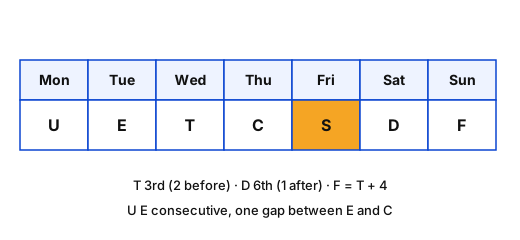
Each of C, D, E, F, S, T and U has an exam on a different day of a week starting from Monday and ending on Sunday of the same week. Only two people have the exam before T. Only one person has the exam after D. Only three people have the exam between T and F. Only one person has the exam between E and C. U has the exam immediately before E. Who among the following has the exam on Friday?
C, D, E, F, S, T और U में से प्रत्येक की परीक्षा एक ही सप्ताह के सोमवार से शुरू होकर रविवार को समाप्त होने वाले सप्ताह के अलग-अलग दिन है। T से पहले केवल दो व्यक्तियों की परीक्षा है। D के बाद केवल एक व्यक्ति की परीक्षा है। T और F के बीच केवल तीन व्यक्तियों की परीक्षा है। E और C के बीच केवल एक व्यक्ति की परीक्षा है। U की परीक्षा E से ठीक पहले है। निम्नलिखित में से किसकी परीक्षा शुक्रवार को है?
  1. AE
  2. BU
  3. CT
  4. DS
Show answer

Concept: Mon–Sun = days 1–7; place the fixed clues first.

  1. Two before T → T = Wed (3). One after D → D = Sat (6). Three between T and F → F = Sun (7).
  2. Left: Mon, Tue, Thu, Fri for C, E, S, U. U just before E and one gap between E and C → U = Mon, E = Tue, C = Thu.
  3. S = Fri.

Trick: Start with clues giving exact positions ("only two before", "only one after").

Answer: (D) S

अवधारणा: सोम–रवि = दिन 1–7; पहले निश्चित संकेत लगाएँ।

  1. T से पहले दो → T = बुध (3)। D के बाद एक → D = शनि (6)। T और F के बीच तीन → F = रवि (7)।
  2. शेष: सोम, मंगल, गुरु, शुक्र – C, E, S, U के लिए। U, E से ठीक पहले और E–C के बीच एक → U = सोम, E = मंगल, C = गुरु।
  3. S = शुक्रवार।

ट्रिक: सटीक स्थान देने वाले संकेत ("केवल दो पहले", "केवल एक बाद") से शुरू करें।

उत्तर: (D) S

RRB NTPC Graduate CBT 1General Intelligence and ReasoningScheduling PuzzleRRB NTPC Graduate CBT 1 2024 · 5 Jun Shift 2 →
Q4566.
In a certain code language,
A + B means ‘A is the mother of B’,
A − B means ‘A is the brother of B’,
A × B means ‘A is the wife of B’ and
A ÷ B means ‘A is the father of B’.
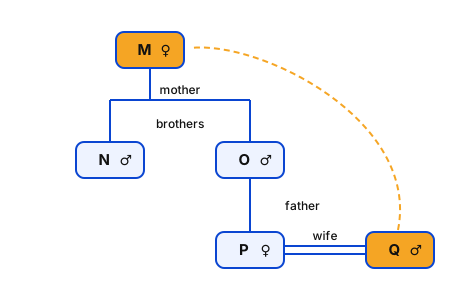
How is M related to Q if ‘M + N − O ÷ P × Q’?
एक निश्चित कूट भाषा में,
A + B का अर्थ है ‘A, B की माता है’,
A − B का अर्थ है ‘A, B का भाई है’,
A × B का अर्थ है ‘A, B की पत्नी है’ और
A ÷ B का अर्थ है ‘A, B का पिता है’।
यदि ‘M + N − O ÷ P × Q’ है, तो M, Q से किस प्रकार संबंधित है?
  1. AWife's father's motherपत्नी के पिता की माता
  2. B​Wife's mother's motherपत्नी की माता की माता
  3. CWife's mother's sisterपत्नी की माता की बहन
  4. DWife's father's sisterपत्नी के पिता की बहन
Show answer

Concept: Decode each symbol one link at a time and build a family tree from M to Q.

  1. M + N: M is the mother of N.
  2. N − O: N is the brother of O, so M is also the mother of O.
  3. O ÷ P: O is the father of P, so M is P's father's mother.
  4. P × Q: P is the wife of Q, so P is Q's wife.
  5. Hence M is Q's wife's father's mother.

Trick: Read the chain from Q backwards: Q → wife (P) → father (O) → mother (M).

Answer: (A) Wife's father's mother

अवधारणा: हर चिह्न का अर्थ एक-एक करके लगाएँ और M से Q तक family tree बनाएँ।

  1. M + N: M, N की माँ है।
  2. N − O: N, O का भाई है, अतः M, O की भी माँ है।
  3. O ÷ P: O, P का पिता है, अतः M, P के पिता की माँ है।
  4. P × Q: P, Q की पत्नी है।
  5. अतः M, Q की पत्नी के पिता की माँ है।

ट्रिक: Q से पीछे की ओर पढ़ें: Q → पत्नी (P) → पिता (O) → माँ (M)।

उत्तर: (A) Wife's father's mother

RRB NTPC Graduate CBT 1General Intelligence and ReasoningCoded Blood RelationsRRB NTPC Graduate CBT 1 2024 · 5 Jun Shift 2 →
Q4567.
In a certain code language, ‘pizza base queen’ is coded as ‘du su qw’ and ‘pig queen wave’ is coded as ‘ic fv su’. How is ‘queen’ coded in the given language?
एक निश्चित कूट भाषा में, ‘pizza base queen’ को ‘du su qw’ के रूप में और ‘pig queen wave’ को ‘ic fv su’ के रूप में कूटबद्ध किया जाता है। दी गई भाषा में ‘queen’ को किस प्रकार कूटबद्ध किया जाता है?
  1. Aic
  2. Bsu
  3. Cdu
  4. Dqw
Show answer

Concept: A word common to two sentences takes the code common to both coded sentences.

  1. Sentence 1: pizza base queen → du su qw.
  2. Sentence 2: pig queen wave → ic fv su.
  3. Common word = queen; common code = su.

Trick: Match common word with common code – no need to decode the other words.

Answer: (B) su

अवधारणा: दो वाक्यों में उभयनिष्ठ शब्द का कोड, दोनों कोडों में उभयनिष्ठ कोड होता है।

  1. वाक्य 1: pizza base queen → du su qw।
  2. वाक्य 2: pig queen wave → ic fv su।
  3. उभयनिष्ठ शब्द = queen; उभयनिष्ठ कोड = su।

ट्रिक: उभयनिष्ठ शब्द ↔ उभयनिष्ठ कोड – बाकी शब्द decode करने की ज़रूरत नहीं।

उत्तर: (B) su

RRB NTPC Graduate CBT 1General Intelligence and ReasoningCoding–Decoding (Common Word)RRB NTPC Graduate CBT 1 2024 · 5 Jun Shift 2 →
Q4568.
If '+' means '−', '−' means '×', '×' means '÷' and '÷' means '+', then what will come in place of the question mark (?) in the following equation?
502 ÷ 78 + 2 − 258 × 2 = ?
यदि '+' का अर्थ '−', '−' का अर्थ '×', '×' का अर्थ '÷' और '÷' का अर्थ '+' है, तो निम्नलिखित समीकरण में प्रश्न चिह्न (?) के स्थान पर क्या आएगा?
502 ÷ 78 + 2 − 258 × 2 = ?
  1. A124
  2. B74562
  3. C322
  4. D560
Show answer

Concept: Replace each sign as instructed, then solve using BODMAS.

  1. Given: 502÷78+2−258×2.
  2. After replacing: 502+78−2×258÷2.
  3. 2×258÷2=258.
  4. 502+78−258=322.

Trick: A number multiplied and divided by the same value (×2 ÷2) cancels out – just compute 580−258.

Answer: (C) 322

अवधारणा: निर्देश अनुसार चिह्न बदलें, फिर BODMAS से हल करें।

  1. दिया है: 502÷78+2−258×2।
  2. बदलने पर: 502+78−2×258÷2।
  3. 2×258÷2=258।
  4. 502+78−258=322।

ट्रिक: ×2 और ÷2 आपस में कट जाते हैं – सीधे 580−258 करें।

उत्तर: (C) 322

RRB NTPC Graduate CBT 1General Intelligence and ReasoningMathematical Operations (Symbol Substitution)RRB NTPC Graduate CBT 1 2024 · 5 Jun Shift 2 →
Q4569.
This question is based on the five, three-digit numbers given below.
(Left) 956 521 251 156 335 (Right)
(Example: 697 – First digit = 6, second digit = 9 and third digit = 7)
(NOTE: All operations to be done from left to right.)
What will be the resultant if the second digit of the highest number is added to the first digit of the lowest number?
यह प्रश्न नीचे दी गई तीन अंकों वाली पाँच संख्याओं पर आधारित है।
(बाएँ) 956 521 251 156 335 (दाएँ)
(उदाहरण: 697 – पहला अंक = 6, दूसरा अंक = 9 और तीसरा अंक = 7)
(ध्यान दें: सभी संक्रियाएँ बाएँ से दाएँ की जानी हैं।)
यदि सबसे बड़ी संख्या के दूसरे अंक को सबसे छोटी संख्या के पहले अंक में जोड़ा जाए, तो परिणाम क्या होगा?
  1. A5
  2. B6
  3. C7
  4. D9
Show answer

Concept: Identify the highest and lowest numbers, then pick the required digits.

  1. Numbers: 956, 521, 251, 156, 335.
  2. Highest = 956 → second digit = 5.
  3. Lowest = 156 → first digit = 1.
  4. Sum =5+1=6.

Trick: Compare hundreds digits first: 9 is highest, 1 is lowest.

Answer: (B) 6

अवधारणा: सबसे बड़ी और सबसे छोटी संख्या पहचानें, फिर वांछित अंक लें।

  1. संख्याएँ: 956, 521, 251, 156, 335।
  2. सबसे बड़ी = 956 → दूसरा अंक = 5।
  3. सबसे छोटी = 156 → पहला अंक = 1।
  4. योग =5+1=6।

ट्रिक: पहले सैकड़े का अंक देखें: 9 सबसे बड़ा, 1 सबसे छोटा।

उत्तर: (B) 6

RRB NTPC Graduate CBT 1General Intelligence and ReasoningNumber Puzzle – DigitsRRB NTPC Graduate CBT 1 2024 · 5 Jun Shift 2 →
Q4570.
This question is based on the words given below.
(Left) DIE CUP BOX ASK (Right)
In each of the words, each vowel is changed to the letter immediately following it in the English alphabetical order and each consonant is changed to the letter immediately preceding in the English alphabetical order. In how many letter clusters thus formed, will no vowel appear?
यह प्रश्न नीचे दिए गए शब्दों पर आधारित है।
(बाएँ) DIE CUP BOX ASK (दाएँ)
प्रत्येक शब्द में, प्रत्येक स्वर को अंग्रेज़ी वर्णमाला क्रम में उसके ठीक बाद वाले अक्षर से बदल दिया जाता है और प्रत्येक व्यंजन को अंग्रेज़ी वर्णमाला क्रम में उसके ठीक पहले वाले अक्षर से बदल दिया जाता है। इस प्रकार बने कितने अक्षर-समूहों में कोई स्वर नहीं आएगा?
  1. ATwoदो
  2. BThreeतीन
  3. CNoneएक भी नहीं
  4. DOneएक
Show answer

Concept: Vowel → next letter; consonant → previous letter. Then check each new cluster for A, E, I, O, U.

  1. DIE → C J F (no vowel).
  2. CUP → B V O (has O).
  3. BOX → A P W (has A).
  4. ASK → B R J (no vowel).
  5. Clusters without a vowel: CJF and BRJ = two.

Trick: A consonant moved back becomes a vowel only if it is B, F, J, P or V; a vowel moved forward never stays a vowel.

Answer: (A) Two

अवधारणा: स्वर → अगला अक्षर; व्यंजन → पिछला अक्षर। फिर हर नए समूह में A, E, I, O, U देखें।

  1. DIE → C J F (कोई स्वर नहीं)।
  2. CUP → B V O (O है)।
  3. BOX → A P W (A है)।
  4. ASK → B R J (कोई स्वर नहीं)।
  5. बिना स्वर वाले समूह: CJF और BRJ = दो।

ट्रिक: पीछे जाने पर व्यंजन स्वर तभी बनेगा जब वह B, F, J, P या V हो; आगे जाने पर स्वर कभी स्वर नहीं रहता।

उत्तर: (A) Two

RRB NTPC Graduate CBT 1General Intelligence and ReasoningLetter Coding – Vowel/Consonant RuleRRB NTPC Graduate CBT 1 2024 · 5 Jun Shift 2 →
Q4571.
Below are given two sets of numbers. In each set of numbers, a certain mathematical operation on the first number results in the second number. Similarly, a certain mathematical operation on the second number results in the third number and so on. Which of the given options follows the same set of operations as in the question? (NOTE – A two/three-digit number cannot be broken into individual digits for operations, e.g. if 37 is followed by 10, the operation cannot be 3+7 as a two-digit number cannot be broken into individual digits.)
3 - 5 - 10 - 12 ; 8 - 10 - 20 - 22
नीचे संख्याओं के दो समुच्चय दिए गए हैं। संख्याओं के प्रत्येक समुच्चय में, पहली संख्या पर एक निश्चित गणितीय संक्रिया करने पर दूसरी संख्या प्राप्त होती है। इसी प्रकार, दूसरी संख्या पर एक निश्चित गणितीय संक्रिया करने पर तीसरी संख्या प्राप्त होती है और इसी प्रकार आगे भी। दिए गए विकल्पों में से कौन-सा विकल्प प्रश्न के समान संक्रियाओं के समुच्चय का अनुसरण करता है? (ध्यान दें – संक्रियाओं के लिए दो/तीन अंकों वाली संख्या को अलग-अलग अंकों में विभाजित नहीं किया जा सकता, उदाहरण के लिए यदि 37 के बाद 10 आता है, तो संक्रिया 3+7 नहीं हो सकती क्योंकि दो अंकों वाली संख्या को अलग-अलग अंकों में विभाजित नहीं किया जा सकता।)
3 - 5 - 10 - 12 ; 8 - 10 - 20 - 22
  1. A6 - 10 - 12 - 24
  2. B18 - 20 - 40 - 42
  3. C28 - 30 - 60 - 64
  4. D4 - 6 - 12 - 24
Show answer

Concept: Find the operation chain in the given sets and test each option.

  1. 3→5 (+2), 5→10 (×2), 10→12 (+2).
  2. 8→10 (+2), 10→20 (×2), 20→22 (+2).
  3. Option B: 18→20 (+2), 20→40 (×2), 40→42 (+2) ✓.
  4. Others fail: A starts with +4, C ends +4, D starts +2 then ×2, ×2.

Trick: Pattern +2, ×2, +2 – the last number is always 2 more than the third.

Answer: (B) 18 - 20 - 40 - 42

अवधारणा: दिए गए सेटों में संक्रियाओं का क्रम पहचानें और हर विकल्प जाँचें।

  1. 3→5 (+2), 5→10 (×2), 10→12 (+2)।
  2. 8→10 (+2), 10→20 (×2), 20→22 (+2)।
  3. विकल्प B: 18→20 (+2), 20→40 (×2), 40→42 (+2) ✓।
  4. बाकी गलत: A में पहले +4, C में अंत में +4, D में ×2, ×2।

ट्रिक: पैटर्न +2, ×2, +2 – अंतिम संख्या तीसरी से हमेशा 2 अधिक।

उत्तर: (B) 18 - 20 - 40 - 42

RRB NTPC Graduate CBT 1General Intelligence and ReasoningNumber Series – Operation PatternRRB NTPC Graduate CBT 1 2024 · 5 Jun Shift 2 →
Q4572.
What should come in place of the question mark (?) in the given series?
802 800 796 790 782 ?
दी गई श्रृंखला में प्रश्न चिह्न (?) के स्थान पर क्या आना चाहिए?
802 800 796 790 782 ?
  1. A776
  2. B774
  3. C772
  4. D770
Show answer

Concept: Check the differences between consecutive terms.

  1. 802−800=2, 800−796=4, 796−790=6, 790−782=8.
  2. The differences increase by 2, so the next difference is 10.
  3. 782−10=772.

Trick: Subtract consecutive even numbers: −2, −4, −6, −8, −10.

Answer: (C) 772

अवधारणा: क्रमागत पदों के बीच का अंतर देखें।

  1. 802−800=2, 800−796=4, 796−790=6, 790−782=8।
  2. अंतर 2-2 से बढ़ रहे हैं, अगला अंतर 10।
  3. 782−10=772।

ट्रिक: क्रमागत सम संख्याएँ घटाएँ: −2, −4, −6, −8, −10।

उत्तर: (C) 772

RRB NTPC Graduate CBT 1General Intelligence and ReasoningNumber Series – DifferencesRRB NTPC Graduate CBT 1 2024 · 5 Jun Shift 2 →
Q4573.
Based on the English alphabetical order, three of the following four letter-clusters are alike in a certain way and thus form a group. Which letter-cluster DOES NOT belong to that group?
(Note: The odd one out is not based on the number of consonants/vowels or their position in the letter-cluster.)
अंग्रेज़ी वर्णमाला क्रम के आधार पर, निम्नलिखित चार अक्षर-समूहों में से तीन किसी निश्चित प्रकार से एकसमान हैं और इस प्रकार एक समूह बनाते हैं। कौन-सा अक्षर-समूह उस समूह से संबंधित नहीं है?
(ध्यान दें: असंगत अक्षर-समूह, उस अक्षर-समूह में व्यंजनों/स्वरों की संख्या या उनके स्थान पर आधारित नहीं है।)
  1. ADAX
  2. BKGE
  3. CSOM
  4. DWSQ
Show answer

Concept: Compare the backward gaps between letters using positions (A = 1 … Z = 26).

  1. KGE: K(11) → G(7) = −4, G(7) → E(5) = −2.
  2. SOM: S(19) → O(15) = −4, O(15) → M(13) = −2.
  3. WSQ: W(23) → S(19) = −4, S(19) → Q(17) = −2.
  4. DAX: D(4) → A(1) = −3, A → X = −3 (cyclic). Pattern differs.

Trick: Three clusters follow −4, −2; the odd one is DAX.

Answer: (A) DAX

अवधारणा: अक्षरों की स्थिति (A = 1 … Z = 26) से पीछे जाने का अंतर तुलना करें।

  1. KGE: K(11) → G(7) = −4, G(7) → E(5) = −2।
  2. SOM: S(19) → O(15) = −4, O(15) → M(13) = −2।
  3. WSQ: W(23) → S(19) = −4, S(19) → Q(17) = −2।
  4. DAX: D(4) → A(1) = −3, A → X = −3 (चक्रीय)। पैटर्न अलग है।

ट्रिक: तीन समूहों में −4, −2; विषम DAX है।

उत्तर: (A) DAX

RRB NTPC Graduate CBT 1General Intelligence and ReasoningOdd One Out – Letter ClustersRRB NTPC Graduate CBT 1 2024 · 5 Jun Shift 2 →
Q4574.
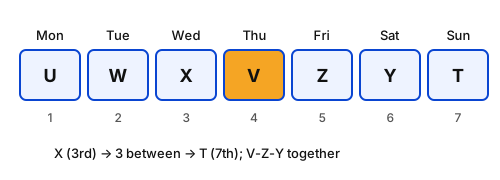
Each of T, U, V, W, X, Y and Z has an exam on a different day of a week starting from Monday and ending on Sunday of the same week. X has an exam on the third day of the week. Only three people has an exam between X and T. Z has an exam immediately after V and Y has an exam immediately after Z. W does not have an exam on Monday. Who has an exam on Thursday?
T, U, V, W, X, Y और Z में से प्रत्येक की परीक्षा एक ही सप्ताह के सोमवार से शुरू होकर रविवार को समाप्त होने वाले सप्ताह के अलग-अलग दिन है। X की परीक्षा सप्ताह के तीसरे दिन है। X और T के बीच केवल तीन व्यक्तियों की परीक्षा है। Z की परीक्षा V के ठीक बाद है और Y की परीक्षा Z के ठीक बाद है। W की परीक्षा सोमवार को नहीं है। गुरुवार को किसकी परीक्षा है?
  1. AV
  2. BZ
  3. CW
  4. DT
Show answer

Concept: Place the fixed person first, then the block of consecutive people.

  1. X is on Wednesday (3rd day).
  2. Three people between X and T → T is on day 7 (Sunday) (day −1 is impossible).
  3. V, Z, Y must be on three consecutive free days: only Thu, Fri, Sat are available together.
  4. W is not on Monday → W = Tuesday, U = Monday. So Thursday = V.

Trick: A block of 3 consecutive days fits only in the longest gap – here Thu–Sat.

Answer: (A) V

अवधारणा: पहले निश्चित व्यक्ति रखें, फिर लगातार दिनों वाला समूह।

  1. X बुधवार (तीसरे दिन) को है।
  2. X और T के बीच तीन लोग → T दिन 7 (रविवार) को (दिन −1 संभव नहीं)।
  3. V, Z, Y लगातार तीन खाली दिनों पर: केवल गुरु, शुक्र, शनि साथ में खाली हैं।
  4. W सोमवार को नहीं → W = मंगलवार, U = सोमवार। अतः गुरुवार = V।

ट्रिक: लगातार 3 दिन का ब्लॉक केवल सबसे लंबे खाली अंतराल में आता है – यहाँ गुरु–शनि।

उत्तर: (A) V

RRB NTPC Graduate CBT 1General Intelligence and ReasoningScheduling – Days of the WeekRRB NTPC Graduate CBT 1 2024 · 5 Jun Shift 2 →
Q4575.
What should come in place of the question mark (?) in the given series based on the English alphabetical order?
FCA GDB HEC IFD ?
अंग्रेज़ी वर्णमाला क्रम के आधार पर दी गई श्रृंखला में प्रश्न चिह्न (?) के स्थान पर क्या आना चाहिए?
FCA GDB HEC IFD ?
  1. AJGE
  2. BJGF
  3. CJHF
  4. DJHE
Show answer

Concept: Track each letter position separately.

  1. First letters: F, G, H, I → J (+1).
  2. Second letters: C, D, E, F → G (+1).
  3. Third letters: A, B, C, D → E (+1).
  4. Next term = JGE.

Trick: Every letter moves +1, so just shift IFD by one: JGE.

Answer: (A) JGE

अवधारणा: हर स्थान के अक्षर को अलग-अलग देखें।

  1. पहले अक्षर: F, G, H, I → J (+1)।
  2. दूसरे अक्षर: C, D, E, F → G (+1)।
  3. तीसरे अक्षर: A, B, C, D → E (+1)।
  4. अगला पद = JGE।

ट्रिक: हर अक्षर +1 – IFD को एक आगे करें: JGE।

उत्तर: (A) JGE

RRB NTPC Graduate CBT 1General Intelligence and ReasoningLetter SeriesRRB NTPC Graduate CBT 1 2024 · 5 Jun Shift 2 →
Q4576.
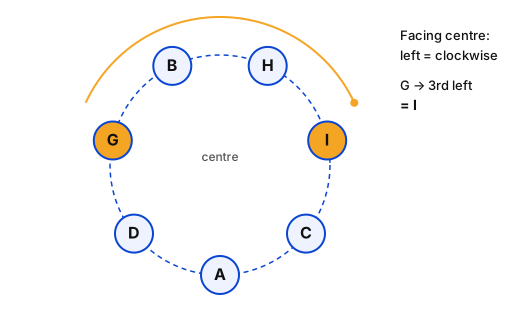
A, B, C, D, G, H, and I are sitting around a circular table facing the centre.
Only two people sit between A and H when counted from the right of A. Only two people sit between H and D. Only three people sit between A and B. C sits to the immediate left of I.
Who sits third to the left of G?
A, B, C, D, G, H और I एक वृत्ताकार मेज़ के चारों ओर केंद्र की ओर मुख करके बैठे हैं।
A के दाएँ से गिनने पर A और H के बीच केवल दो व्यक्ति बैठे हैं। H और D के बीच केवल दो व्यक्ति बैठे हैं। A और B के बीच केवल तीन व्यक्ति बैठे हैं। C, I के ठीक बाएँ बैठा है।
G के बाएँ से तीसरे स्थान पर कौन बैठा है?
  1. AH
  2. BA
  3. CC
  4. DI
Show answer

Concept: For people facing the centre, left = clockwise and right = anticlockwise. Fix A and place the others.

  1. Two people between A and H counted from A's right → H is 3rd to the right of A.
  2. Two between H and D → D is 3rd from H on the other side, i.e. immediate left of A.
  3. Three between A and B → B is 4th from A (the seat next to H on the left side).
  4. Remaining seats for C, G, I: C immediate left of I fixes I, C, and G takes the last seat.
  5. Third to the left of G (clockwise) → I.

Trick: In a 7-seat circle, "3 between" on one side = "2 between" on the other – use this to settle positions quickly.

Answer: (D) I

अवधारणा: केंद्र की ओर मुख वाले व्यक्तियों के लिए बायाँ = दक्षिणावर्त (clockwise), दायाँ = वामावर्त। A को स्थिर करके बाकी रखें।

  1. A के दाएँ से गिनने पर A और H के बीच दो लोग → H, A के दाएँ तीसरे स्थान पर।
  2. H और D के बीच दो → D दूसरी ओर H से तीसरा, अर्थात् A के ठीक बाएँ।
  3. A और B के बीच तीन → B, A से चौथा (बाईं ओर H के बगल वाली सीट)।
  4. शेष सीटें C, G, I के लिए: C, I के ठीक बाएँ – इससे I, C तय, और G अंतिम सीट पर।
  5. G के बाएँ (दक्षिणावर्त) तीसरा → I।

ट्रिक: 7 सीटों के वृत्त में एक ओर "3 बीच में" = दूसरी ओर "2 बीच में" – इससे स्थान जल्दी तय होते हैं।

उत्तर: (D) I

RRB NTPC Graduate CBT 1General Intelligence and ReasoningCircular Seating ArrangementRRB NTPC Graduate CBT 1 2024 · 5 Jun Shift 2 →
Q4577.
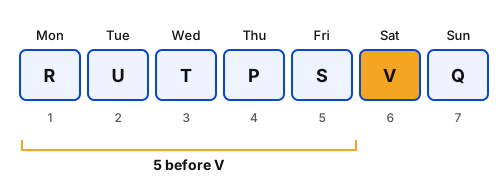
Each of P, Q, R, S, T, U and V has an exam on a different day of a week starting from Monday and ending on Sunday of the same week. P has the exam on Thursday. U has the exam on one of the days after R and on one of the days before T. V has the exam on one of the days after S but on one of the days before Q. S has the exam on one of the days after P. How many people have the exam before V?
P, Q, R, S, T, U और V में से प्रत्येक की परीक्षा एक ही सप्ताह के सोमवार से शुरू होकर रविवार को समाप्त होने वाले सप्ताह के अलग-अलग दिन है। P की परीक्षा गुरुवार को है। U की परीक्षा R के बाद के किसी एक दिन और T से पहले के किसी एक दिन है। V की परीक्षा S के बाद के किसी एक दिन, लेकिन Q से पहले के किसी एक दिन है। S की परीक्षा P के बाद के किसी एक दिन है। V से पहले कितने व्यक्तियों की परीक्षा है?
  1. A5
  2. B2
  3. C3
  4. D4
Show answer

Concept: Combine the "before/after" chains and fit them into the free days.

  1. P is on Thursday. S is after P, V is after S, and Q is after V → S, V, Q need three days after Thursday.
  2. Only Fri, Sat, Sun remain → S = Friday, V = Saturday, Q = Sunday.
  3. R before U before T fill Mon, Tue, Wed → R = Mon, U = Tue, T = Wed.
  4. People before V (Saturday): R, U, T, P, S = 5.

Trick: A chain of three after Thursday must fill Fri–Sat–Sun exactly.

Answer: (A) 5

अवधारणा: "पहले/बाद" वाली श्रृंखलाओं को जोड़ें और खाली दिनों में रखें।

  1. P गुरुवार को है। S, P के बाद; V, S के बाद; Q, V के बाद → S, V, Q को गुरुवार के बाद तीन दिन चाहिए।
  2. केवल शुक्र, शनि, रवि बचे → S = शुक्रवार, V = शनिवार, Q = रविवार।
  3. R, U, T क्रम से सोम, मंगल, बुध → R = सोम, U = मंगल, T = बुध।
  4. V (शनिवार) से पहले: R, U, T, P, S = 5।

ट्रिक: गुरुवार के बाद तीन की श्रृंखला शुक्र–शनि–रवि को ठीक भरती है।

उत्तर: (A) 5

RRB NTPC Graduate CBT 1General Intelligence and ReasoningScheduling – Days of the WeekRRB NTPC Graduate CBT 1 2024 · 5 Jun Shift 2 →
Q4578.
In this question, a group of number/symbol is coded using letter codes as per the codes given below and the conditions which follow.
The correct combination of codes (following only the condition/s that apply) is your answer.
Number/Symbol79@&235#18∆46
CodeLCZMDWAPRTFBK
Conditions:
(i) If the first element is a symbol and the last a number, the codes for these two (the first and the last elements) are to be interchanged.
(ii) If the first element is an even number and the last an odd number, the first and last elements are to be coded as ©
(iii) If both the second and third elements are perfect squares, the third element is to be coded as the code for the second element.
2 # @ 7 9
इस प्रश्न में, संख्याओं/प्रतीकों के एक समूह को नीचे दिए गए कूटों और उसके बाद दी गई शर्तों के अनुसार अक्षर कूटों का उपयोग करके कूटबद्ध किया गया है।
कूटों का सही संयोजन (केवल लागू होने वाली शर्त/शर्तों का पालन करते हुए) आपका उत्तर है।
संख्या/प्रतीक79@&235#18∆46
कूटLCZMDWAPRTFBK
शर्तें:
(i) यदि पहला तत्व एक प्रतीक है और अंतिम तत्व एक संख्या है, तो इन दोनों (पहले और अंतिम तत्वों) के कूट आपस में बदल दिए जाएँगे।
(ii) यदि पहला तत्व एक सम संख्या है और अंतिम तत्व एक विषम संख्या है, तो पहले और अंतिम तत्वों को © के रूप में कूटबद्ध किया जाएगा।
(iii) यदि दूसरा और तीसरा दोनों तत्व पूर्ण वर्ग हैं, तो तीसरे तत्व को दूसरे तत्व के कूट के रूप में कूटबद्ध किया जाएगा।
2 # @ 7 9
  1. AD P Z L ©
  2. B© P L Z C
  3. C© P Z L C
  4. D© P Z L ©
Show answer

Concept: Write the direct codes first, then apply only the condition that matches.

  1. Direct codes: 2 = D, # = P, @ = Z, 7 = L, 9 = C.
  2. Condition (i): first element 2 is not a symbol – does not apply.
  3. Condition (ii): first element 2 is even and last element 9 is odd → both coded as ©.
  4. Condition (iii): second element # is not a perfect square – does not apply.
  5. Code: © P Z L ©.

Trick: Check first and last elements first – conditions (i) and (ii) depend only on them.

Answer: (D) © P Z L ©

अवधारणा: पहले सीधे कोड लिखें, फिर केवल लागू होने वाली शर्त लगाएँ।

  1. सीधे कोड: 2 = D, # = P, @ = Z, 7 = L, 9 = C।
  2. शर्त (i): पहला तत्व 2 चिह्न नहीं – लागू नहीं।
  3. शर्त (ii): पहला तत्व 2 सम और अंतिम 9 विषम → दोनों का कोड ©।
  4. शर्त (iii): दूसरा तत्व # पूर्ण वर्ग नहीं – लागू नहीं।
  5. कोड: © P Z L ©।

ट्रिक: पहले पहला व अंतिम तत्व देखें – शर्तें (i) और (ii) इन्हीं पर निर्भर हैं।

उत्तर: (D) © P Z L ©

RRB NTPC Graduate CBT 1General Intelligence and ReasoningCoding – Symbol/Number Codes with ConditionsRRB NTPC Graduate CBT 1 2024 · 5 Jun Shift 2 →
Q4579.
In which year did Bakshi Jagabandhu lead the Paika Rebellion to protest against the British land revenue policy?
बख्शी जगबंधु ने ब्रिटिश भू-राजस्व नीति के विरोध में पाइका विद्रोह का नेतृत्व किस वर्ष किया था?
  1. A1785
  2. B1717
  3. C1806
  4. D1817
Show answer

Concept: The Paika Rebellion was an armed uprising of the Paikas (traditional militia) of Khurda, Odisha, against British rule.

  1. It broke out in 1817 under Bakshi Jagabandhu, military chief of the Raja of Khurda.
  2. Causes: the new British land-revenue settlement, loss of Paika rent-free lands and rising salt prices.
  3. 1806 is the Vellore Mutiny year – a common trap.

Yaad rakhein: Khurda + Bakshi Jagabandhu = 1817; it is sometimes called the "first war of independence" of Odisha.

Answer: (D) 1817

अवधारणा: पाइका विद्रोह खुर्दा (ओडिशा) के पाइकों (पारंपरिक सैनिकों) का अंग्रेज़ों के विरुद्ध सशस्त्र विद्रोह था।

  1. यह 1817 में बख्शी जगबंधु के नेतृत्व में हुआ, जो खुर्दा के राजा के सेनापति थे।
  2. कारण: अंग्रेज़ों की नई भू-राजस्व नीति, पाइकों की लगान-मुक्त ज़मीनें छिनना और नमक के बढ़ते दाम।
  3. 1806 वेल्लोर विद्रोह का वर्ष है – इससे भ्रमित न हों।

याद रखें: खुर्दा + बख्शी जगबंधु = 1817।

उत्तर: (D) 1817

RRB NTPC Graduate CBT 1General AwarenessModern Indian History – Paika RebellionRRB NTPC Graduate CBT 1 2024 · 5 Jun Shift 1 →
Q4580.
What was the overall unemployment rate in India as reported in the 6th Annual Employment-Unemployment Survey conducted by the Labour Bureau?
श्रम ब्यूरो (Labour Bureau) द्वारा आयोजित 6वें वार्षिक रोज़गार-बेरोज़गारी सर्वेक्षण में भारत में समग्र बेरोज़गारी दर कितनी बताई गई थी?
  1. A5.4%
  2. B6.1%
  3. C4.9%
  4. D7.3%
Show answer

Concept: The Labour Bureau (Ministry of Labour & Employment) conducted the Annual Employment-Unemployment Surveys (EUS) before PLFS replaced them.

  1. The 6th EUS reported the all-India unemployment rate at about 5.4% (usual principal status approach).
  2. The figure 4.9% belongs to the earlier 4th EUS (2013-14), so it is a trap.
  3. Since 2017-18, unemployment data come from NSO's Periodic Labour Force Survey (PLFS).

Yaad rakhein: Labour Bureau EUS → replaced by PLFS (NSO) from 2017-18.

Answer: (A) 5.4%

अवधारणा: श्रम ब्यूरो (Labour Bureau) वार्षिक रोज़गार-बेरोज़गारी सर्वेक्षण (EUS) करता था, जिसे बाद में PLFS ने बदल दिया।

  1. छठे EUS में अखिल भारतीय बेरोज़गारी दर लगभग 5.4% बताई गई।
  2. 4.9% पहले के चौथे EUS (2013-14) का आँकड़ा है, इसलिए वह गलत विकल्प है।
  3. 2017-18 से बेरोज़गारी आँकड़े NSO के आवधिक श्रम बल सर्वेक्षण (PLFS) से आते हैं।

याद रखें: श्रम ब्यूरो EUS → 2017-18 से PLFS (NSO)।

उत्तर: (A) 5.4%

RRB NTPC Graduate CBT 1General AwarenessEconomy – Unemployment SurveyRRB NTPC Graduate CBT 1 2024 · 5 Jun Shift 1 →