Question bank

Q&A: practice questions with answers

Search questions on any topic. Filter by exam category, exam, subject and topic, try the question, then open the answer and explanation.

Courses – airGurukul

7,077 questions found.

Q4641.
Simplify (2x − 5y)2 + (5x + 2y)2 + (2x + 5y)(2x − 5y).
(2x − 5y)2 + (5x + 2y)2 + (2x + 5y)(2x − 5y) को सरल कीजिए।
  1. A34x2 − 4y2
  2. B−34x2 + 4y2
  3. C−33x2 − 4y2
  4. D33x2 + 4y2
Show answer

Concept: Use (a±b)2=a2±2ab+b2 and (a+b)(a−b)=a2−b2.

  1. (2x−5y)2=4x2−20xy+25y2
  2. (5x+2y)2=25x2+20xy+4y2
  3. (2x+5y)(2x−5y)=4x2−25y2
  4. Sum =33x2+4y2 (the xy terms and 25y2 cancel)

Trick: Put x=y=1: 9+49−21=37, and only 33+4=37 matches.

Answer: (D) 33x2+4y2

अवधारणा: (a±b)2=a2±2ab+b2 और (a+b)(a−b)=a2−b2 का प्रयोग करें।

  1. (2x−5y)2=4x2−20xy+25y2
  2. (5x+2y)2=25x2+20xy+4y2
  3. (2x+5y)(2x−5y)=4x2−25y2
  4. योग =33x2+4y2 (xy पद और 25y2 कट जाते हैं)

ट्रिक: x=y=1 रखें: 9+49−21=37, केवल 33+4=37 मेल खाता है।

उत्तर: (D) 33x2+4y2

RRB NTPC Graduate CBT 1MathematicsAlgebraic identitiesRRB NTPC Graduate CBT 1 2024 · 5 Jun Shift 1 →
Q4642.
If the ratio of two numbers is 5 : 3 and the product of their LCM and their HCF is 135, then the sum of the reciprocals of the LCM and the HCF is:
यदि दो संख्याओं का अनुपात 5 : 3 है और उनके LCM तथा HCF का गुणनफल 135 है, तो LCM और HCF के व्युत्क्रमों का योग है:
  1. A1645
  2. B1685
  3. C1661
  4. D1673
Show answer

Concept: For two numbers, LCM×HCF= product of the numbers.

  1. Numbers =5k and 3k (5, 3 co-prime) ⇒ HCF =k, LCM =15k
  2. 15k×k=135 ⇒ k2=9 ⇒ k=3; LCM =45, HCF =3
  3. 145+13=1+1545=1645

Trick: Sum of reciprocals =LCM+HCFLCM×HCF=48135=1645.

Answer: (A) 1645

अवधारणा: दो संख्याओं के लिए LCM×HCF= संख्याओं का गुणनफल।

  1. संख्याएँ =5k और 3k ⇒ HCF =k, LCM =15k
  2. 15k×k=135 ⇒ k2=9 ⇒ k=3; LCM =45, HCF =3
  3. 145+13=1+1545=1645

ट्रिक: व्युत्क्रमों का योग =LCM+HCFLCM×HCF=48135=1645।

उत्तर: (A) 1645

RRB NTPC Graduate CBT 1MathematicsHCF and LCMRRB NTPC Graduate CBT 1 2024 · 5 Jun Shift 1 →
Q4643.
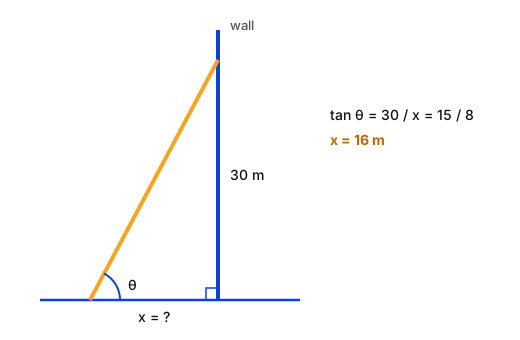
A ladder leaning against a wall makes an angle θ with the horizontal ground such that tanθ=158. If the height of the top of the ladder from the wall is 30 m, find the distance (in m) of the foot of the ladder from the wall.
दीवार के सहारे टिकी एक सीढ़ी क्षैतिज भूमि के साथ θ कोण बनाती है, इस प्रकार कि tanθ=158 है। यदि सीढ़ी के शीर्ष की दीवार पर ऊँचाई 30 m है, तो दीवार से सीढ़ी के पाद की दूरी (m में) ज्ञात कीजिए।
  1. A18
  2. B16
  3. C14
  4. D20
Show answer

Concept: In the right triangle formed by ladder, wall and ground: tanθ=heightbase.

  1. Height on the wall =30 m, base =x
  2. tanθ=30x=158
  3. x=30×815=16 m

Trick: 15→30 means scale ×2, so base 8→16.

Answer: (B) 16

अवधारणा: सीढ़ी, दीवार और ज़मीन से बने समकोण त्रिभुज में: tanθ=ऊँचाईआधार।

  1. दीवार पर ऊँचाई =30 m, आधार =x
  2. tanθ=30x=158
  3. x=30×815=16 m

ट्रिक: 15→30 यानी 2 गुना, अतः आधार 8→16।

उत्तर: (B) 16

RRB NTPC Graduate CBT 1MathematicsHeights and distancesRRB NTPC Graduate CBT 1 2024 · 5 Jun Shift 1 →
Q4644.
A man has to cover a distance of 519 km in 7 hours. If he covers two-third of this distance in 57 of the time, then what should his speed (in km/hr) be to cover the remaining distance in the time left?
एक व्यक्ति को 519 km की दूरी 7 घंटे में तय करनी है। यदि वह इस दूरी का दो-तिहाई भाग 57 समय में तय करता है, तो शेष दूरी को शेष समय में तय करने के लिए उसकी चाल (km/hr में) कितनी होनी चाहिए?
  1. A86.5
  2. B46.5
  3. C66.5
  4. D34.5
Show answer

Concept: Speed =distancetime for the remaining part.

  1. Covered =23×519=346 km in 57×7=5 h
  2. Remaining distance =519−346=173 km; time left =7−5=2 h
  3. Speed =1732=86.5km/h

Trick: Remaining =13 of 519 =173 km in 2 h.

Answer: (A) 86.5

अवधारणा: बचे भाग के लिए चाल=दूरीसमय।

  1. तय दूरी =23×519=346 km, समय 57×7=5 घंटे
  2. शेष दूरी =519−346=173 km; शेष समय =7−5=2 घंटे
  3. चाल =1732=86.5km/h

ट्रिक: शेष =519 का 13=173 km, 2 घंटे में।

उत्तर: (A) 86.5

RRB NTPC Graduate CBT 1MathematicsSpeed, time and distanceRRB NTPC Graduate CBT 1 2024 · 5 Jun Shift 1 →
Q4645.
The median of the observations 76, 83, 30, 11, 81, 52, 18, 34, 84, 35 and 27 is:
प्रेक्षणों 76, 83, 30, 11, 81, 52, 18, 34, 84, 35 और 27 की माध्यिका है:
  1. A30
  2. B35
  3. C52
  4. D34
Show answer

Concept: For n (odd) observations in order, median =(n+12)th value.

  1. Ascending order: 11, 18, 27, 30, 34, 35, 52, 76, 81, 83, 84
  2. n=11 ⇒ median =6th value =35

Trick: Always sort first – the 6th value of the unsorted list (52) is the trap.

Answer: (B) 35

अवधारणा: n (विषम) प्रेक्षणों के लिए क्रम में रखने पर माध्यिका =(n+12)वाँ मान।

  1. आरोही क्रम: 11, 18, 27, 30, 34, 35, 52, 76, 81, 83, 84
  2. n=11 ⇒ माध्यिका =6वाँ मान =35

ट्रिक: पहले क्रम में लगाएँ – बिना क्रम का 6वाँ मान (52) जाल है।

उत्तर: (B) 35

RRB NTPC Graduate CBT 1MathematicsMedianRRB NTPC Graduate CBT 1 2024 · 5 Jun Shift 1 →
Q4646.
The mode and median of a data set is 28.4 and 88, respectively. What is the mean of the data set? (Use empirical formula.)
किसी आँकड़ा समुच्चय का बहुलक और माध्यिका क्रमशः 28.4 और 88 हैं। आँकड़ा समुच्चय का माध्य क्या है? (आनुभविक सूत्र का प्रयोग कीजिए।)
  1. A114.2
  2. B119.2
  3. C117.8
  4. D127.7
Show answer

Concept: Empirical relation: Mode=3Median−2Mean.

  1. 28.4=3×88−2Mean=264−2Mean
  2. 2Mean=264−28.4=235.6
  3. Mean=117.8

Trick: Mean =3Median−Mode2.

Answer: (C) 117.8

अवधारणा: आनुभविक संबंध: बहुलक=3माध्यिका−2माध्य।

  1. 28.4=3×88−2माध्य=264−2माध्य
  2. 2माध्य=264−28.4=235.6
  3. माध्य=117.8

ट्रिक: माध्य=3माध्यिका−बहुलक2।

उत्तर: (C) 117.8

RRB NTPC Graduate CBT 1MathematicsMean, median, modeRRB NTPC Graduate CBT 1 2024 · 5 Jun Shift 1 →
Q4647.
The marked price of a bed is ₹517, which is 30% above the cost price. If the profit percent is 2%. Find the discount percentage. (rounded off to two decimal places)
एक पलंग का अंकित मूल्य ₹517 है, जो क्रय मूल्य से 30% अधिक है। यदि लाभ प्रतिशत 2% है, तो छूट प्रतिशत ज्ञात कीजिए। (दो दशमलव स्थानों तक पूर्णांकित)
  1. A18.57%
  2. B24.06%
  3. C20.36%
  4. D21.54%
Show answer

Concept: Take CP =100; then MP and SP follow from the given percentages.

  1. CP =100 ⇒ MP =130 (30% above CP)
  2. Profit 2% ⇒ SP =102
  3. Discount =130−102=28; Discount%=28130×100≈21.54%

Trick: The ₹517 is not needed: 30−2130×100.

Answer: (D) 21.54%

अवधारणा: क्रय मूल्य =100 मानें; फिर अंकित मूल्य और विक्रय मूल्य निकालें।

  1. क्रय मूल्य =100 ⇒ अंकित मूल्य =130
  2. 2% लाभ ⇒ विक्रय मूल्य =102
  3. बट्टा =130−102=28; बट्टा%=28130×100≈21.54%

ट्रिक: ₹517 की आवश्यकता नहीं: 30−2130×100।

उत्तर: (D) 21.54%

RRB NTPC Graduate CBT 1MathematicsDiscount and profitRRB NTPC Graduate CBT 1 2024 · 5 Jun Shift 1 →
Q4648.
If ‘+’ means ‘−’, ‘−’ means ‘×’, ‘×’ means ‘÷’ and ‘÷’ means ‘+’, then what will come in place of the question mark (?) in the following equation?
32 ÷ 14 + 16 – 8 × 4 = ?
यदि ‘+’ का अर्थ ‘−’, ‘−’ का अर्थ ‘×’, ‘×’ का अर्थ ‘÷’ और ‘÷’ का अर्थ ‘+’ है, तो निम्नलिखित समीकरण में प्रश्न चिह्न (?) के स्थान पर क्या आएगा?
32 ÷ 14 + 16 – 8 × 4 = ?
  1. A14
  2. B18
  3. C16
  4. D22
Show answer

Concept: Replace each sign by its meaning, then solve using BODMAS.

  1. Given: 32÷14+16−8×4
  2. Replace (÷→+, +→−, −→×, ×→÷): 32+14−16×8÷4
  3. 16×8÷4=32, so 32+14−32=14

Trick: Write the new expression first, then apply BODMAS – never solve before replacing signs.

Answer: (A) 14

अवधारणा: प्रत्येक चिह्न को उसके अर्थ से बदलें, फिर BODMAS लगाएँ।

  1. दिया है: 32÷14+16−8×4
  2. चिह्न बदलने पर: 32+14−16×8÷4
  3. 16×8÷4=32, अतः 32+14−32=14

ट्रिक: पहले पूरा नया व्यंजक लिखें, फिर BODMAS लगाएँ।

उत्तर: (A) 14

RRB NTPC Graduate CBT 1General Intelligence and ReasoningMathematical OperationsRRB NTPC Graduate CBT 1 2024 · 5 Jun Shift 1 →
Q4649.
Refer to the following number and symbol series and answer the question that follows. Counting to be done from left to right only. All numbers are single-digit numbers. (Left) # * £ 3 9 € # % £ 1 % £ 8 8 1 4 9 % 5 8 & 7 (Right)
How many such numbers are there each of which is immediately preceded by a symbol and also immediately followed by a symbol?
निम्नलिखित संख्या और प्रतीक श्रृंखला का संदर्भ लीजिए और आगे दिए गए प्रश्न का उत्तर दीजिए। गिनती केवल बाएँ से दाएँ की जानी है। सभी संख्याएँ एक-अंकीय संख्याएँ हैं। (बाएँ) # * £ 3 9 € # % £ 1 % £ 8 8 1 4 9 % 5 8 & 7 (दाएँ)
ऐसी कितनी संख्याएँ हैं जिनमें से प्रत्येक के ठीक पहले एक प्रतीक है और ठीक बाद भी एक प्रतीक है?
  1. A2
  2. B3
  3. C1
  4. D4
Show answer

Concept: Check every digit: the term just before it AND the term just after it must both be symbols.

  1. Series: # * £ 3 9 € # % £ 1 % £ 8 8 1 4 9 % 5 8 & 7
  2. Pattern needed: symbol – number – symbol.
  3. £ 1 % is the only such group (3 is followed by 9; 5 is followed by 8; 8 is preceded by 5; 7 is at the end).

Trick: Scan only the digits and look left/right of each – it is faster than scanning symbols.

Answer: (C) 1

अवधारणा: हर अंक के ठीक पहले और ठीक बाद वाला पद – दोनों प्रतीक होने चाहिए।

  1. श्रृंखला: # * £ 3 9 € # % £ 1 % £ 8 8 1 4 9 % 5 8 & 7
  2. आवश्यक पैटर्न: प्रतीक – अंक – प्रतीक।
  3. केवल £ 1 % ऐसा समूह है (3 के बाद 9 है; 5 के बाद 8; 7 अंत में है)।

ट्रिक: केवल अंकों को देखें और उनके दाएँ-बाएँ जाँचें।

उत्तर: (C) 1

RRB NTPC Graduate CBT 1General Intelligence and ReasoningNumber-Symbol SeriesRRB NTPC Graduate CBT 1 2024 · 5 Jun Shift 1 →
Q4650.
What will come in the place of the question mark (?) in the following equation, if ‘+’ and ‘−‘ are interchanged and ‘×’ and ‘÷’ are interchanged?
38 ÷ 21 + 436 × 4 − 73 = ?
यदि ‘+’ और ‘−‘ को आपस में बदल दिया जाए तथा ‘×’ और ‘÷’ को आपस में बदल दिया जाए, तो निम्नलिखित समीकरण में प्रश्न चिह्न (?) के स्थान पर क्या आएगा?
38 ÷ 21 + 436 × 4 − 73 = ?
  1. A761
  2. B762
  3. C764
  4. D763
Show answer

Concept: Interchange + ↔ − and × ↔ ÷, then apply BODMAS.

  1. Given: 38÷21+436×4−73
  2. After interchange: 38×21−436÷4+73
  3. =798−109+73=762

Trick: Do the swap carefully sign by sign; then BODMAS.

Answer: (B) 762

अवधारणा: + ↔ − तथा × ↔ ÷ बदलें, फिर BODMAS लगाएँ।

  1. दिया है: 38÷21+436×4−73
  2. बदलने पर: 38×21−436÷4+73
  3. =798−109+73=762

ट्रिक: चिह्न एक-एक कर बदलें, फिर BODMAS।

उत्तर: (B) 762

RRB NTPC Graduate CBT 1General Intelligence and ReasoningMathematical OperationsRRB NTPC Graduate CBT 1 2024 · 5 Jun Shift 1 →
Q4651.
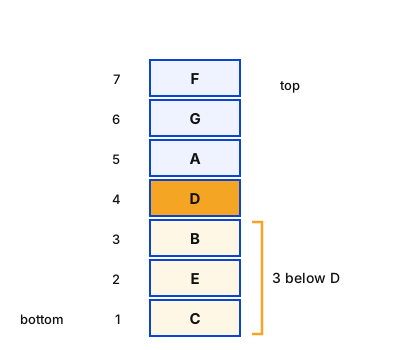
Seven boxes, A, B, C, D, E, F and G, are kept one over the other but not necessarily in the same order. No box is kept above F. Only three boxes are kept between F and B. Only one box is kept between G and D. D is kept immediately above B. Only four boxes are kept between G and C. A is kept in some place above E. How many boxes are kept below D?
सात बक्से, A, B, C, D, E, F और G, एक के ऊपर एक रखे हुए हैं, परंतु आवश्यक नहीं कि इसी क्रम में हों। F के ऊपर कोई बक्सा नहीं रखा है। F और B के बीच केवल तीन बक्से रखे हैं। G और D के बीच केवल एक बक्सा रखा है। D, B के ठीक ऊपर रखा है। G और C के बीच केवल चार बक्से रखे हैं। A, E के ऊपर किसी स्थान पर रखा है। D के नीचे कितने बक्से रखे हैं?
  1. A1
  2. B4
  3. C3
  4. D2
Show answer

Concept: Number positions 1 (bottom) to 7 (top) and place the fixed clues first.

  1. No box above F ⇒ F = 7. Three boxes between F and B ⇒ B = 3. D immediately above B ⇒ D = 4.
  2. One box between G and D ⇒ G = 2 or 6. Four boxes between G and C: G = 2 gives C = 7 (taken), so G = 6, C = 1.
  3. A above E in the remaining places 2 and 5 ⇒ A = 5, E = 2.
  4. Order (bottom→top): C, E, B, D, A, G, F ⇒ boxes below D = C, E, B = 3.

Trick: Start with the "top/bottom" clue – it fixes one box exactly and the rest follow.

Answer: (C) 3

अवधारणा: स्थान 1 (नीचे) से 7 (ऊपर) तक मानें और पहले निश्चित सूचनाएँ लगाएँ।

  1. F के ऊपर कोई बॉक्स नहीं ⇒ F = 7। F और B के बीच तीन ⇒ B = 3। D, B के ठीक ऊपर ⇒ D = 4।
  2. G और D के बीच एक ⇒ G = 2 या 6। G और C के बीच चार: G = 2 से C = 7 (भरा), अतः G = 6, C = 1।
  3. शेष स्थान 2 व 5 में A, E के ऊपर ⇒ A = 5, E = 2।
  4. क्रम (नीचे→ऊपर): C, E, B, D, A, G, F ⇒ D के नीचे 3 बॉक्स।

ट्रिक: "सबसे ऊपर/नीचे" वाली सूचना से शुरू करें।

उत्तर: (C) 3

RRB NTPC Graduate CBT 1General Intelligence and ReasoningPuzzle – Box ArrangementRRB NTPC Graduate CBT 1 2024 · 5 Jun Shift 1 →
Q4652.
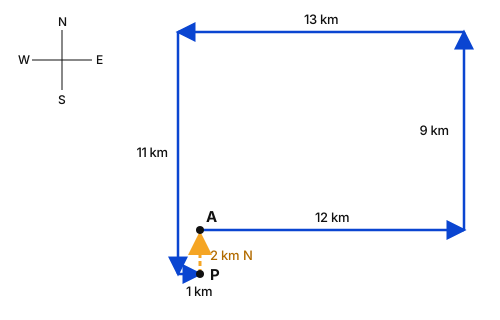
Sundar starts from point A and drives 12 km towards the east. He then takes a left turn, drives 9 km, turns left and drives 13 km. He then takes a left turn and drives 11 km. He takes a final left turn, drives 1 km and stops at point P. How far (shortest distance) and towards which direction should he drive in order to reach point A again? (All turns are 90 degree turns only unless specified.)
सुंदर बिंदु A से चलना शुरू करता है और पूर्व की ओर 12 km गाड़ी चलाता है। फिर वह बाएँ मुड़ता है, 9 km गाड़ी चलाता है, बाएँ मुड़ता है और 13 km गाड़ी चलाता है। फिर वह बाएँ मुड़ता है और 11 km गाड़ी चलाता है। वह अंतिम बार बाएँ मुड़ता है, 1 km गाड़ी चलाता है और बिंदु P पर रुक जाता है। पुनः बिंदु A पर पहुँचने के लिए उसे कितनी दूरी (न्यूनतम दूरी) और किस दिशा में गाड़ी चलानी चाहिए? (जब तक निर्दिष्ट न किया जाए, सभी मोड़ केवल 90 डिग्री के मोड़ हैं।)
  1. A2 km to the southदक्षिण की ओर 2 km
  2. B1 km to the northउत्तर की ओर 1 km
  3. C2 km to the northउत्तर की ओर 2 km
  4. D1 km to the southदक्षिण की ओर 1 km
Show answer

Concept: Take A as origin (0, 0); east = +x, north = +y. A left turn from east is north, from north is west, and so on.

  1. 12 km east → (12, 0); left, 9 km north → (12, 9).
  2. Left, 13 km west → (−1, 9); left, 11 km south → (−1, −2).
  3. Left, 1 km east → P = (0, −2).
  4. P is 2 km directly south of A, so he must drive 2 km north.

Trick: Net east-west: 12 − 13 + 1 = 0; net north-south: 9 − 11 = −2 (south) ⇒ go 2 km north.

Answer: (C) 2 km to the north

अवधारणा: A को मूल बिंदु (0, 0) मानें; पूर्व = +x, उत्तर = +y। पूर्व से बाएँ = उत्तर, उत्तर से बाएँ = पश्चिम आदि।

  1. 12 km पूर्व → (12, 0); बाएँ, 9 km उत्तर → (12, 9)।
  2. बाएँ, 13 km पश्चिम → (−1, 9); बाएँ, 11 km दक्षिण → (−1, −2)।
  3. बाएँ, 1 km पूर्व → P = (0, −2)।
  4. P, A से 2 km ठीक दक्षिण में है, अतः उसे 2 km उत्तर जाना होगा।

ट्रिक: पूर्व-पश्चिम: 12 − 13 + 1 = 0; उत्तर-दक्षिण: 9 − 11 = −2 ⇒ 2 km उत्तर।

उत्तर: (C) 2 km to the north

RRB NTPC Graduate CBT 1General Intelligence and ReasoningDirection & DistanceRRB NTPC Graduate CBT 1 2024 · 5 Jun Shift 1 →
Q4653.
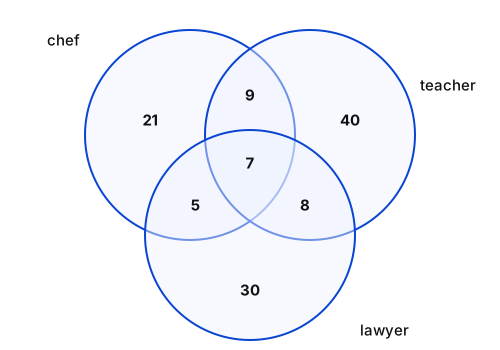
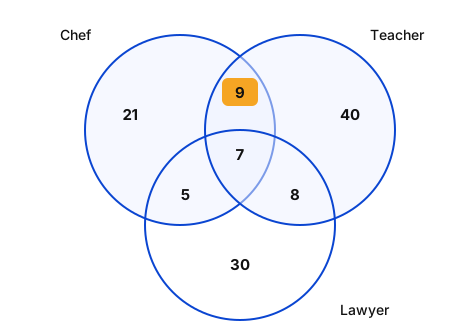
Study the given Venn diagram carefully and answer the question that follows.

The numbers in different sections indicate the number of persons. How many chefs are there who are also teachers but not lawyers?
दिए गए वेन आरेख का ध्यानपूर्वक अध्ययन कीजिए और आगे दिए गए प्रश्न का उत्तर दीजिए।

विभिन्न भागों में दी गई संख्याएँ व्यक्तियों की संख्या को दर्शाती हैं। ऐसे कितने रसोइए (chefs) हैं जो शिक्षक भी हैं परंतु वकील नहीं हैं?
  1. A8
  2. B9
  3. C5
  4. D7
Show answer

Concept: Chefs who are teachers but not lawyers = the region common to Chef and Teacher circles only, outside the Lawyer circle.

  1. Chef ∩ Teacher has two parts: 7 (inside Lawyer too) and 9 (outside Lawyer).
  2. Exclude the lawyer part (7) ⇒ required number = 9.

Trick: "But not X" ⇒ remove every region lying inside X's circle.

Answer: (B) 9

अवधारणा: जो शेफ़ शिक्षक भी हैं पर वकील नहीं = शेफ़ और शिक्षक का उभयनिष्ठ भाग जो वकील वृत्त के बाहर हो।

  1. शेफ़ ∩ शिक्षक के दो भाग: 7 (वकील में भी) और 9 (वकील के बाहर)।
  2. वकील वाला भाग (7) हटाएँ ⇒ उत्तर = 9।

ट्रिक: "पर X नहीं" ⇒ X के वृत्त के अंदर वाले सभी भाग हटाएँ।

उत्तर: (B) 9

RRB NTPC Graduate CBT 1General Intelligence and ReasoningVenn DiagramRRB NTPC Graduate CBT 1 2024 · 5 Jun Shift 1 →
Q4654.
Which of the following letter-clusters should replace # and % so that the pattern and relationship followed between the letter-cluster pair on the left side of :: is the same as that on the right side of ::?
# : VEC :: BNW : %
निम्नलिखित में से कौन-से अक्षर-समूह # और % को प्रतिस्थापित करें ताकि :: के बाईं ओर के अक्षर-समूह युग्म के बीच का पैटर्न और संबंध वही हो जो :: के दाईं ओर है?
# : VEC :: BNW : %
  1. A# = XHA, % = ZKY
  2. B# = ZKY, % = FTS
  3. C# = FTS, % = XHA
  4. D# = DQU, % = XHA
Show answer

Concept: Find the letter-wise rule from # to VEC (test the options) and apply it to BNW.

  1. Option (A): XHA → VEC: X−2=V, H−3=E, A+2=C (A wraps back: Y, Z, A … A+2 = C).
  2. Apply −2, −3, +2 to BNW: B−2=Z, N−3=K, W+2=Y ⇒ ZKY.
  3. This matches % = ZKY in option (A).

Trick: Use position numbers: X(24)→V(22), H(8)→E(5), A(1)→C(3); B(2)→Z(26), N(14)→K(11), W(23)→Y(25).

Answer: (A) # = XHA, % = ZKY

अवधारणा: # से VEC का नियम (विकल्प जाँचकर) निकालें और BNW पर लगाएँ।

  1. विकल्प (A): XHA → VEC: X−2=V, H−3=E, A+2=C।
  2. BNW पर −2, −3, +2: B−2=Z, N−3=K, W+2=Y ⇒ ZKY।
  3. यह विकल्प (A) के % = ZKY से मेल खाता है।

ट्रिक: स्थान संख्या: X(24)→V(22), H(8)→E(5), A(1)→C(3); B(2)→Z(26), N(14)→K(11), W(23)→Y(25)।

उत्तर: (A) # = XHA, % = ZKY

RRB NTPC Graduate CBT 1General Intelligence and ReasoningLetter AnalogyRRB NTPC Graduate CBT 1 2024 · 5 Jun Shift 1 →
Q4655.
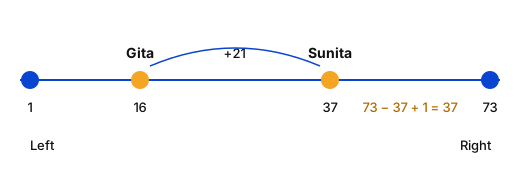
In a row of 73 students facing north, Gita is 16th from the left end. If Sunita is 21st to the right of Gita, what is Sunita’s position from the right end of the line?
उत्तर की ओर मुख करके खड़े 73 विद्यार्थियों की एक पंक्ति में, गीता बाएँ छोर से 16वें स्थान पर है। यदि सुनीता, गीता के दाईं ओर 21वें स्थान पर है, तो पंक्ति के दाएँ छोर से सुनीता का स्थान क्या है?
  1. A31st31वाँ
  2. B28th28वाँ
  3. C22nd22वाँ
  4. D37th37वाँ
Show answer

Concept: Position from right =total−position from left+1.

  1. Sunita from left =16+21=37th.
  2. From right =73−37+1=37th.

Trick: Sunita is exactly the middle student: 36 on each side of her in a row of 73.

Answer: (D) 37th

अवधारणा: दाएँ से स्थान =कुल−बाएँ से स्थान+1।

  1. सुनीता बाएँ से =16+21=37वाँ।
  2. दाएँ से =73−37+1=37वाँ।

ट्रिक: सुनीता बिल्कुल बीच में है: 73 में दोनों ओर 36-36 छात्र।

उत्तर: (D) 37th

RRB NTPC Graduate CBT 1General Intelligence and ReasoningRanking & OrderRRB NTPC Graduate CBT 1 2024 · 5 Jun Shift 1 →
Q4656.
Based on the English alphabetical order, three of the following four letter-cluster pairs are alike in a certain way and thus form a group. Which letter-cluster pair DOES NOT belong to that group? (Note: The odd one out is not based on the number of
consonants/vowels or their position in the letter cluster)
अंग्रेज़ी वर्णमाला क्रम के आधार पर, निम्नलिखित चार अक्षर-समूह युग्मों में से तीन किसी निश्चित प्रकार से एकसमान हैं और इस प्रकार एक समूह बनाते हैं। कौन-सा अक्षर-समूह युग्म उस समूह से संबंधित नहीं है? (ध्यान दें: असंगत अक्षर-समूह, उस अक्षर-समूह में
व्यंजनों/स्वरों की संख्या या उनके स्थान पर आधारित नहीं है)
  1. AHL - JN
  2. BMU - KH
  3. CNR - PT
  4. DSW - UY
Show answer

Concept: Check the gap between letters inside each cluster and between the clusters.

  1. HL – JN: H+4=L, J+4=N (and H+2=J). NR – PT: N+4=R, P+4=T. SW – UY: S+4=W, U+4=Y.
  2. MU – KH: M+8=U, K−3=H – the pattern breaks.
  3. So MU – KH is the odd pair.

Trick: In three pairs both clusters have a +4 gap; spot the one that doesn't.

Answer: (B) MU - KH

अवधारणा: हर समूह के अक्षरों का अंतर और दोनों समूहों का संबंध जाँचें।

  1. HL – JN: H+4=L, J+4=N। NR – PT: N+4=R, P+4=T। SW – UY: S+4=W, U+4=Y।
  2. MU – KH: M+8=U, K−3=H – पैटर्न टूटता है।
  3. अतः MU – KH विषम है।

ट्रिक: तीन युग्मों में दोनों समूहों में +4 का अंतर है।

उत्तर: (B) MU - KH

RRB NTPC Graduate CBT 1General Intelligence and ReasoningOdd One Out – Letter PairsRRB NTPC Graduate CBT 1 2024 · 5 Jun Shift 1 →
Q4657.
Which of the following letter-clusters should replace # and % so that the pattern and relationship followed between the letter-cluster pair on the left side of :: is the same as that on the right side of ::?
# : JLH :: IKG : %
निम्नलिखित में से कौन-से अक्षर-समूह # और % को प्रतिस्थापित करें ताकि :: के बाईं ओर के अक्षर-समूह युग्म के बीच का पैटर्न और संबंध वही हो जो :: के दाईं ओर है?
# : JLH :: IKG : %
  1. A# = FJH, % = MHU
  2. B# = DEG, % = NIU
  3. C# = EGC, % = NPL
  4. D# = FDG, % = MLG
Show answer

Concept: Find the rule # → JLH by testing options, then apply it to IKG.

  1. Option (C): EGC → JLH: E+5=J, G+5=L, C+5=H.
  2. Apply +5 to IKG: I+5=N, K+5=P, G+5=L ⇒ NPL.
  3. This matches % = NPL in option (C).

Trick: Position numbers: E(5)→J(10), G(7)→L(12), C(3)→H(8); I(9)→N(14), K(11)→P(16), G(7)→L(12).

Answer: (C) # = EGC, % = NPL

अवधारणा: विकल्प जाँचकर # → JLH का नियम निकालें और IKG पर लगाएँ।

  1. विकल्प (C): EGC → JLH: E+5=J, G+5=L, C+5=H।
  2. IKG पर +5: I+5=N, K+5=P, G+5=L ⇒ NPL।
  3. यह विकल्प (C) के % = NPL से मेल खाता है।

ट्रिक: स्थान संख्या: E(5)→J(10), G(7)→L(12), C(3)→H(8); I(9)→N(14), K(11)→P(16), G(7)→L(12)।

उत्तर: (C) # = EGC, % = NPL

RRB NTPC Graduate CBT 1General Intelligence and ReasoningLetter AnalogyRRB NTPC Graduate CBT 1 2024 · 5 Jun Shift 1 →
Q4658.
If 2 is added to each even digit and 2 is added to each odd digit in the number 5217643, what will be the sum of the first digit from the left and the first digit from the right in the new number thus formed?
यदि संख्या 5217643 में प्रत्येक सम अंक में 2 जोड़ा जाए और प्रत्येक विषम अंक में 2 जोड़ा जाए, तो इस प्रकार बनी नई संख्या में बाएँ से पहले अंक और दाएँ से पहले अंक का योग क्या होगा?
  1. A10
  2. B11
  3. C12
  4. D13
Show answer

Concept: Every digit (odd or even) gets +2.

  1. 5217643 → 7 4 3 9 8 6 5 ⇒ 7439865.
  2. First digit from left = 7, first from right = 5.
  3. Sum = 7 + 5 = 12.

Trick: Only the two end digits matter: 5+2 = 7 and 3+2 = 5.

Answer: (C) 12

अवधारणा: हर अंक (सम या विषम) में +2 जोड़ना है।

  1. 5217643 → 7 4 3 9 8 6 5 ⇒ 7439865।
  2. बाएँ से पहला अंक = 7, दाएँ से पहला = 5।
  3. योग = 7 + 5 = 12।

ट्रिक: केवल दोनों सिरों के अंक देखें: 5+2 = 7, 3+2 = 5।

उत्तर: (C) 12

RRB NTPC Graduate CBT 1General Intelligence and ReasoningNumber OperationsRRB NTPC Graduate CBT 1 2024 · 5 Jun Shift 1 →
Q4659.
A group of numbers/symbols is coded using letter codes as per the codes given below and the conditions that follow. If none of the conditions apply, then codes for the respective number/symbol to be followed directly as given in the table.
Number/Symbol92@&375%18∆46
CodeLCZMDWAPRTFBK
Conditions:
(i) If the first element is a symbol and the last a number, the codes for these two (the first and the last elements) are to be interchanged.
(ii) If the first element is an odd number and the last an even number, the first and last elements are to be coded as ©.
(iii) If both the second and third elements are perfect squares, the third element is to be coded as the code for the second element.
What will be the code for the following group?
5 & 3 @ 7 % 2
संख्याओं/प्रतीकों के एक समूह को नीचे दिए गए कूटों और उसके बाद दी गई शर्तों के अनुसार अक्षर कूटों का प्रयोग करके कूटबद्ध किया जाता है। यदि कोई भी शर्त लागू नहीं होती है, तो संबंधित संख्या/प्रतीक के लिए तालिका में दिए गए कूटों का सीधे अनुसरण किया जाना है।
संख्या/प्रतीक92@&375%18∆46
कूटLCZMDWAPRTFBK
शर्तें:
(i) यदि पहला तत्व एक प्रतीक है और अंतिम तत्व एक संख्या है, तो इन दोनों (पहले और अंतिम तत्वों) के कूटों को आपस में बदल दिया जाना है।
(ii) यदि पहला तत्व एक विषम संख्या है और अंतिम तत्व एक सम संख्या है, तो पहले और अंतिम तत्वों को © के रूप में कूटबद्ध किया जाना है।
(iii) यदि दूसरा और तीसरा दोनों तत्व पूर्ण वर्ग हैं, तो तीसरे तत्व को दूसरे तत्व के कूट के रूप में कूटबद्ध किया जाना है।
निम्नलिखित समूह के लिए कूट क्या होगा?
5 & 3 @ 7 % 2
  1. A© M D Z W P ©
  2. B© M D Z P W ©
  3. C© D M Z W P ©
  4. D© M D W Z P ©
Show answer

Concept: Check the conditions on the first, last, second and third elements; code the rest from the table.

  1. Group: 5 & 3 @ 7 % 2. First = 5 (odd number), last = 2 (even number) → condition (ii) applies: first and last become ©.
  2. Condition (iii): second = &, third = 3 – not perfect squares, so not applied.
  3. Middle codes: & = M, 3 = D, @ = Z, 7 = W, % = P.

Trick: Test condition (ii) first whenever both ends are numbers – it decides the two © at once.

Answer: (A) © M D Z W P ©

अवधारणा: पहले, अंतिम, दूसरे और तीसरे तत्व पर शर्तें जाँचें; बाकी तत्वों का कोड तालिका से लें।

  1. समूह: 5 & 3 @ 7 % 2. पहला = 5 (विषम संख्या), अंतिम = 2 (सम संख्या) → शर्त (ii) लागू: पहला और अंतिम © होंगे।
  2. शर्त (iii): दूसरा = &, तीसरा = 3 – पूर्ण वर्ग नहीं, लागू नहीं।
  3. बीच के कोड: & = M, 3 = D, @ = Z, 7 = W, % = P.

ट्रिक: दोनों सिरों पर संख्या हो तो पहले शर्त (ii) जाँचें – इससे दोनों © तुरंत तय हो जाते हैं।

उत्तर: (A) © M D Z W P ©

RRB NTPC Graduate CBT 1General Intelligence and ReasoningCoding-decoding (conditions)RRB NTPC Graduate CBT 1 2024 · 5 Jun Shift 1 →
Q4660.
What should come in place of the question mark (?) in the given series?
701 700 697 692 685 ?
दी गई श्रृंखला में प्रश्न चिह्न (?) के स्थान पर क्या आना चाहिए?
701 700 697 692 685 ?
  1. A675
  2. B673
  3. C671
  4. D676
Show answer

Concept: Look at the differences between consecutive terms.

  1. 701−1=700,700−3=697,697−5=692,692−7=685
  2. Differences are odd numbers 1,3,5,7; next is 9.
  3. 685−9=676

Trick: Successive odd-number subtraction: also equals 701 minus a perfect square.

Answer: (D) 676

अवधारणा: क्रमागत पदों का अंतर देखें।

  1. 701−1=700,700−3=697,697−5=692,692−7=685
  2. अंतर विषम संख्याएँ 1,3,5,7 हैं; अगला 9।
  3. 685−9=676

ट्रिक: लगातार विषम संख्याएँ घटाना = 701 में से पूर्ण वर्ग घटाना।

उत्तर: (D) 676

RRB NTPC Graduate CBT 1General Intelligence and ReasoningNumber seriesRRB NTPC Graduate CBT 1 2024 · 5 Jun Shift 1 →