Question bank

Q&A: practice questions with answers

Search questions on any topic. Filter by exam category, exam, subject and topic, try the question, then open the answer and explanation.

Courses – airGurukul

7,077 questions found.

Q5141.
Veer has ₹1404 with him. He divides this amount between his two sons, Nitin and Pravin, and asks them to invest their respective shares at a compound interest rate of 8% per annum, compounded annually. It is observed that Nitin’s investment amounts to the same value after 19 years as Pravin’s investment does after 20 years. How much (in ₹) did Veer give to Pravin?
वीर के पास ₹1404 हैं। वह इस राशि को अपने दो पुत्रों, नितिन और प्रवीण, के बीच बाँटता है और उन्हें अपने-अपने हिस्से को 8% वार्षिक चक्रवृद्धि ब्याज की दर पर, वार्षिक रूप से संयोजित, निवेश करने के लिए कहता है। यह देखा गया कि नितिन का निवेश 19 वर्षों के बाद उतनी ही राशि हो जाता है, जितनी प्रवीण का निवेश 20 वर्षों के बाद होता है। वीर ने प्रवीण को कितनी राशि (₹ में) दी?
  1. A675
  2. B525
  3. C829
  4. D729
Show answer

Concept: If N for n years and P for n+1 years give equal amounts at rate r, then N=P(1+r100).

  1. N(1.08)19=P(1.08)20⇒N=1.08P⇒N:P=108:100=27:25.
  2. Total =52 parts =₹1404⇒ 1 part =27.
  3. Pravin's share =25×27=₹675 (Nitin gets 27×27=729).

Trick: One extra year at 8% → ratio (100+8):100=27:25; the one invested longer gets the smaller share.

Answer: (A) 675

अवधारणा: यदि N को n वर्ष और P को n+1 वर्ष में दर r पर समान मिश्रधन मिले, तो N=P(1+r100)।

  1. N(1.08)19=P(1.08)20⇒N=1.08P⇒N:P=27:25।
  2. कुल 52 भाग =₹1404⇒ 1 भाग =27।
  3. प्रवीण का हिस्सा =25×27=₹675 (नितिन को 729)।

ट्रिक: 8% पर एक वर्ष अधिक → अनुपात 108:100=27:25; जो अधिक समय निवेश करता है उसे छोटा हिस्सा।

उत्तर: (A) 675
RRB NTPC Graduate CBT 1MathematicsCompound interest – equal amountsRRB NTPC Graduate CBT 1 2025 · 25 Mar Shift 2 →
Q5142.
Evaluate: 16 + 20 ÷ 5 - 2 × 4
मान ज्ञात कीजिए: 16 + 20 ÷ 5 - 2 × 4
  1. A11
  2. B15
  3. C12
  4. D14
Show answer

Concept: Division and multiplication before addition and subtraction (BODMAS).

  1. 20÷5=4 and 2×4=8.
  2. 16+4−8=12.

Trick: Never work left to right blindly – 16+20=36 first would be wrong.

Answer: (C) 12

अवधारणा: जोड़-घटाव से पहले भाग और गुणा (BODMAS)।

  1. 20÷5=4 और 2×4=8।
  2. 16+4−8=12।

ट्रिक: बाएँ से दाएँ अंधाधुंध न करें – पहले 16+20=36 करना ग़लत होगा।

उत्तर: (C) 12

RRB NTPC Graduate CBT 1MathematicsBODMASRRB NTPC Graduate CBT 1 2025 · 25 Mar Shift 2 →
Q5143.
What is the fraction equal to (0.5―+0.1) in simplest form?
सरलतम रूप में (0.5―+0.1) के बराबर भिन्न क्या है?
  1. A5191
  2. B7889
  3. C7169
  4. D5990
Show answer

Concept: 0.a―=a9; a terminating decimal is written over a power of 10.

  1. 0.5―=59 and 0.1=110.
  2. 59+110=50+990=5990.
  3. 59 is prime, so the fraction is already in simplest form.

Trick: Pure recurring → denominator 9s; mixed/terminating → 10s. LCM of 9 and 10 is 90.

Answer: (D) 5990

अवधारणा: 0.a―=a9; सांत दशमलव को 10 की घात पर लिखें।

  1. 0.5―=59 और 0.1=110।
  2. 59+110=50+990=5990।
  3. 59 अभाज्य है, अतः भिन्न पहले से सरलतम रूप में है।

ट्रिक: शुद्ध आवर्ती → हर में 9; सांत → हर में 10। 9 और 10 का LCM 90।

उत्तर: (D) 5990

RRB NTPC Graduate CBT 1MathematicsRecurring decimals to fractionsRRB NTPC Graduate CBT 1 2025 · 25 Mar Shift 2 →
Q5144.
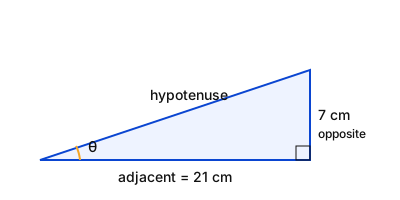
In a right-angled triangle, if the lengths of the opposite side and the adjacent side to angle θ are 7 cm and 21 cm, respectively, then what is the value of tanθ?
एक समकोण त्रिभुज में, यदि कोण θ की सम्मुख भुजा और आसन्न भुजा की लंबाइयाँ क्रमशः 7 cm और 21 cm हैं, तो tanθ का मान क्या है?
  1. A13
  2. B17
  3. C221
  4. D121
Show answer

Concept: tanθ=oppositeadjacent.

  1. Opposite side =7cm, adjacent side =21cm.
  2. tanθ=721=13.

Trick: Remember SOH-CAH-TOA: Tan = Opposite over Adjacent – the hypotenuse is not needed.

Answer: (A) 13

अवधारणा: tanθ=लंबआधार।

  1. लंब (opposite) =7cm, आधार (adjacent) =21cm।
  2. tanθ=721=13।

ट्रिक: SOH-CAH-TOA याद रखें: Tan = लंब/आधार – कर्ण की ज़रूरत नहीं।

उत्तर: (A) 13

RRB NTPC Graduate CBT 1MathematicsTrigonometric ratiosRRB NTPC Graduate CBT 1 2025 · 25 Mar Shift 2 →
Q5145.
Simplify: (2.33)3+(1.55)3+(1.22)3−3×2.33×1.55×1.22(2.33)2+(1.55)2+(1.22)2−3.6115−2.8426−1.891
सरल कीजिए: (2.33)3+(1.55)3+(1.22)3−3×2.33×1.55×1.22(2.33)2+(1.55)2+(1.22)2−3.6115−2.8426−1.891
  1. A5.2
  2. B5.1
  3. C5.3
  4. D5
Show answer

Concept: a3+b3+c3−3abc=(a+b+c)(a2+b2+c2−ab−bc−ca).

  1. Take a=2.33, b=1.55, c=1.22. Then ab=3.6115, ac=2.8426, bc=1.891 – exactly the numbers subtracted in the denominator.
  2. So the expression =(a+b+c)(a2+b2+c2−ab−bc−ca)a2+b2+c2−ab−bc−ca=a+b+c.
  3. 2.33+1.55+1.22=5.10.

Trick: Whenever you see cubes with −3abc on top and squares with products below, the answer is just a+b+c.

Answer: (B) 5.1

अवधारणा: a3+b3+c3−3abc=(a+b+c)(a2+b2+c2−ab−bc−ca)।

  1. a=2.33, b=1.55, c=1.22 लें। तब ab=3.6115, ac=2.8426, bc=1.891 – हर में घटाई गई संख्याएँ यही हैं।
  2. अतः व्यंजक =(a+b+c)(a2+b2+c2−ab−bc−ca)a2+b2+c2−ab−bc−ca=a+b+c।
  3. 2.33+1.55+1.22=5.10।

ट्रिक: ऊपर घन और −3abc, नीचे वर्ग और गुणनफल दिखें तो उत्तर सीधे a+b+c।

उत्तर: (B) 5.1

RRB NTPC Graduate CBT 1MathematicsAlgebraic identity a³+b³+c³−3abcRRB NTPC Graduate CBT 1 2025 · 25 Mar Shift 2 →
Q5146.
A shopkeeper professes to sell his goods at a 35% loss but uses a false balance and gains 55%. The actual weight (rounded off to one decimal place) he uses instead of 1 kg is:
एक दुकानदार अपना सामान 35% हानि पर बेचने का दावा करता है, लेकिन गलत तराजू का उपयोग करता है और 55% लाभ कमाता है। 1 kg के स्थान पर वह वास्तव में जो भार (एक दशमलव स्थान तक पूर्णांकित) उपयोग करता है, वह है:
  1. A419.4 gm
  2. B420.8 gm
  3. C417.6 gm
  4. D417.9 gm
Show answer

Concept: With a false weight w g used for 1000 g, true cost =w1000× CP, while the customer pays the professed price.

  1. Let CP of 1 kg = ₹100. Professing 35% loss, he sells "1 kg" for ₹65.
  2. He actually gains 55%, so his real cost =651.55=₹41.935.
  3. Cost ₹41.935 corresponds to 41.935100×1000≈419.4g.

Trick: w=100−loss%100+gain%×1000=65155×1000=419.4g.

Answer: (A) 419.4gm

अवधारणा: 1000 g की जगह w g का बाट प्रयोग करने पर वास्तविक लागत =w1000× CP, जबकि ग्राहक घोषित मूल्य देता है।

  1. 1 kg का CP = ₹100 मानें। 35% हानि का दावा → "1 kg" ₹65 में बेचता है।
  2. वास्तव में 55% लाभ, अतः असली लागत =651.55=₹41.935।
  3. ₹41.935 लागत =41.935100×1000≈419.4g के बराबर।

ट्रिक: w=100−हानि%100+लाभ%×1000=65155×1000=419.4g।

उत्तर: (A) 419.4gm

RRB NTPC Graduate CBT 1MathematicsDishonest dealer – false weightRRB NTPC Graduate CBT 1 2025 · 25 Mar Shift 2 →
Q5147.
The monthly incomes of two friends Tushar and Salil, are in the ratio 6 : 7 respectively and each of them saves ₹66,000 every month. If the ratio of their monthly expenditure is 2 : 4, find the monthly income of Tushar (in ₹).
दो मित्रों तुषार और सलिल की मासिक आय क्रमशः 6 : 7 के अनुपात में है और उनमें से प्रत्येक हर महीने ₹66,000 की बचत करता है। यदि उनके मासिक व्यय का अनुपात 2 : 4 है, तो तुषार की मासिक आय (₹ में) ज्ञात कीजिए।
  1. A1,10,880
  2. B79,200
  3. C78,200
  4. D80,200
Show answer

Concept: Expenditure = Income − Savings; set up the ratio of expenditures.

  1. Incomes 6x and 7x; savings ₹66,000 each.
  2. 6x−660007x−66000=24=12.
  3. 12x−132000=7x−66000⇒5x=66000⇒x=13200.
  4. Tushar's income =6x=₹79,200.

Trick: Simplify 2:4 to 1:2 first; the cross-multiplication then stays small.

Answer: (B) 79,200

अवधारणा: व्यय = आय − बचत; व्ययों का अनुपात बनाएँ।

  1. आय 6x और 7x; बचत प्रत्येक ₹66,000।
  2. 6x−660007x−66000=24=12।
  3. 12x−132000=7x−66000⇒5x=66000⇒x=13200।
  4. तुषार की आय =6x=₹79,200।

ट्रिक: पहले 2:4 को 1:2 करें; फिर वज्र-गुणन छोटा रहता है।

उत्तर: (B) 79,200

RRB NTPC Graduate CBT 1MathematicsRatio – income, expenditure, savingsRRB NTPC Graduate CBT 1 2025 · 25 Mar Shift 2 →
Q5148.
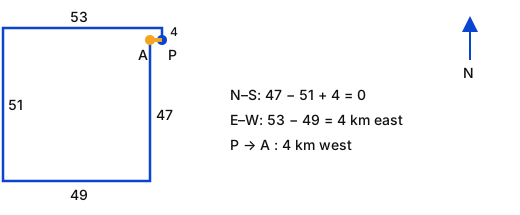
Sharad starts from Point A and drives 47 km towards the South. He then takes a right turn, drives 49 km, turns right and drives 51 km. He then takes a right turn and drives 53 km. He takes a final right turn, drives 4 km and stops at Point P. How far (shortest distance) and towards which direction should he drive in order to reach Point A again? (All turns are 90-degree turns only unless specified.)
शरद बिंदु A से शुरू करता है और दक्षिण की ओर 47 km गाड़ी चलाता है। फिर वह दाएँ मुड़ता है, 49 km चलता है, दाएँ मुड़ता है और 51 km चलता है। फिर वह दाएँ मुड़ता है और 53 km चलता है। अंत में वह दाएँ मुड़ता है, 4 km चलता है और बिंदु P पर रुक जाता है। पुनः बिंदु A तक पहुँचने के लिए उसे कितनी दूरी (न्यूनतम दूरी) और किस दिशा में गाड़ी चलानी चाहिए? (जब तक अन्यथा निर्दिष्ट न हो, सभी मोड़ केवल 90 डिग्री के मोड़ हैं।)
  1. A4 km to the west4 km पश्चिम की ओर
  2. B2 km to the west2 km पश्चिम की ओर
  3. C1 km to the west1 km पश्चिम की ओर
  4. D3 km to the west3 km पश्चिम की ओर
Show answer

Concept: Track north–south and east–west displacements separately; right turns go S→W→N→E→S.

  1. Moves: 47 S, 49 W, 51 N, 53 E, 4 S.
  2. N–S: 47−51+4=0 ⇒ P is level with A.
  3. E–W: 53−49=4 km east of A.
  4. So from P he must drive 4 km to the west.

Trick: Cancel opposite legs (S vs N, E vs W) – the leftover gives distance and direction at once.

Answer: (A) 4 km to the west

अवधारणा: उत्तर–दक्षिण और पूर्व–पश्चिम विस्थापन अलग-अलग जोड़ें; दाएँ मुड़ने पर दिशा S→W→N→E→S बदलती है।

  1. चाल: 47 S, 49 W, 51 N, 53 E, 4 S।
  2. N–S: 47−51+4=0 ⇒ P, A की सीध में है।
  3. E–W: 53−49=4 km, A से पूर्व।
  4. अतः P से 4 km पश्चिम चलना होगा।

ट्रिक: विपरीत भुजाएँ (S–N, E–W) काट दें – बचा हुआ भाग दूरी और दिशा दोनों बता देता है।

उत्तर: (A) 4 km पश्चिम

RRB NTPC Graduate CBT 1General Intelligence and ReasoningDirection SenseRRB NTPC Graduate CBT 1 2025 · 25 Mar Shift 2 →
Q5149.
In a certain code language,
A + B means ‘A is the husband of B’
A - B means ‘A is the daughter of B’
A × B means ‘A is the brother of B’
A ÷ B means ‘A is the sister of B’
Based on the above, how is S related to M if ‘S × R - U + N ÷ M’?
एक निश्चित कूट भाषा में,
A + B का अर्थ है ‘A, B का पति है’
A - B का अर्थ है ‘A, B की पुत्री है’
A × B का अर्थ है ‘A, B का भाई है’
A ÷ B का अर्थ है ‘A, B की बहन है’
उपर्युक्त के आधार पर, यदि ‘S × R - U + N ÷ M’ है, तो S का M से क्या संबंध है?
  1. ADaughter’s sonपुत्री का पुत्र
  2. BBrother’s sonभाई का पुत्र
  3. CSister's sonबहन का पुत्र
  4. DSon’s sonपुत्र का पुत्र
Show answer

Concept: Decode each symbol pair-wise and build the family tree, fixing gender from the words brother/sister/daughter/husband.

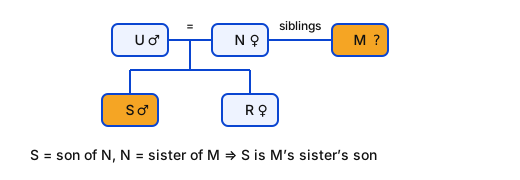
  1. S × R: S is brother of R; R − U: R is daughter of U ⇒ S is son of U.
  2. U + N: U is husband of N ⇒ N is mother of S.
  3. N ÷ M: N is sister of M ⇒ S is the son of M's sister.

Trick: Reach the person asked about (M) through the chain, then read back: M → sister (N) → son (S).

Answer: (C) Sister's son

अवधारणा: हर संकेत को जोड़ी में पढ़ें और वंश-वृक्ष बनाएँ; brother/sister/daughter/husband से लिंग तय करें।

  1. S × R: S, R का भाई; R − U: R, U की बेटी ⇒ S, U का बेटा।
  2. U + N: U, N का पति ⇒ N, S की माँ।
  3. N ÷ M: N, M की बहन ⇒ S, M की बहन का बेटा।

ट्रिक: पूछे गए व्यक्ति (M) तक पहुँचें, फिर उल्टा पढ़ें: M → बहन (N) → बेटा (S)।

उत्तर: (C) बहन का बेटा (Sister's son)

RRB NTPC Graduate CBT 1General Intelligence and ReasoningBlood RelationsRRB NTPC Graduate CBT 1 2025 · 25 Mar Shift 2 →
Q5150.
A, B, C, D, E and F live on six different floors of the same building. The lowermost floor in the building is numbered 1, the floor above it is numbered 2, and so on till the topmost floor is numbered 6. B lives on the topmost floor. Only three people live between B and D. F lives immediately above A, but immediately below E. How many people live between F and C?
A, B, C, D, E और F एक ही भवन की छह अलग-अलग मंज़िलों पर रहते हैं। भवन की सबसे निचली मंज़िल की संख्या 1 है, उसके ऊपर की मंज़िल की संख्या 2 है, और इसी प्रकार सबसे ऊपरी मंज़िल तक, जिसकी संख्या 6 है। B सबसे ऊपरी मंज़िल पर रहता है। B और D के बीच केवल तीन व्यक्ति रहते हैं। F, A के ठीक ऊपर, लेकिन E के ठीक नीचे रहता है। F और C के बीच कितने व्यक्ति रहते हैं?
  1. ANoneकोई नहीं
  2. BOneएक
  3. CTwoदो
  4. DThreeतीन
Show answer

Concept: Fix the definite clues first (top floor, counted gaps), then place the consecutive block.

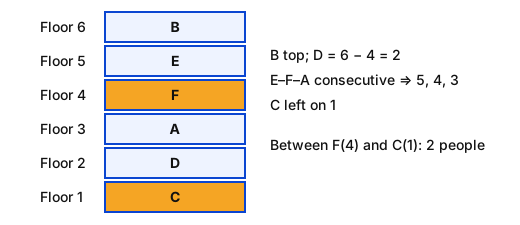
  1. B = 6; three people between B and D ⇒ D = 2.
  2. E, F, A are consecutive (E above F above A); free floors 1, 3, 4, 5 ⇒ E = 5, F = 4, A = 3.
  3. C takes floor 1. Between F (4) and C (1): floors 3 and 2 ⇒ two people.

Trick: "Immediately above/below" clues form a rigid block – slide it into the only gap that fits.

Answer: (C) Two

अवधारणा: पहले निश्चित संकेत (सबसे ऊपरी मंज़िल, बीच की गिनती) लगाएँ, फिर लगातार वाले समूह को रखें।

  1. B = 6; B और D के बीच तीन ⇒ D = 2।
  2. E, F, A लगातार हैं (E ऊपर, फिर F, फिर A); खाली मंज़िलें 1, 3, 4, 5 ⇒ E = 5, F = 4, A = 3।
  3. C मंज़िल 1 पर। F (4) और C (1) के बीच मंज़िल 3, 2 ⇒ दो लोग।

ट्रिक: "ठीक ऊपर/नीचे" वाले संकेत एक कठोर ब्लॉक बनाते हैं – उसे उसी खाली जगह में खिसकाएँ जहाँ वह फिट हो।

उत्तर: (C) दो

RRB NTPC Graduate CBT 1General Intelligence and ReasoningFloor PuzzleRRB NTPC Graduate CBT 1 2025 · 25 Mar Shift 2 →
Q5151.
In this question, a question is followed by two statements numbered (I) and (II). You have to decide whether the data provided in the statements are sufficient to answer the question. Read both the statements and decide the appropriate answer.
Q. Five cousins – Kriti, Leena, Mona, Pooja, and Reema – are of different ages. Who is the youngest?
(I) Leena is older than Kriti but younger than Mona.
(II) Pooja is older than Kriti but younger than Leena.
इस प्रश्न में, एक प्रश्न के बाद (I) और (II) क्रमांकित दो कथन दिए गए हैं। आपको यह निर्णय करना है कि कथनों में दिए गए आँकड़े प्रश्न का उत्तर देने के लिए पर्याप्त हैं या नहीं। दोनों कथनों को पढ़िए और उचित उत्तर का चयन कीजिए।
प्रश्न. पाँच चचेरी बहनें – कृति, लीना, मोना, पूजा और रीमा – अलग-अलग आयु की हैं। सबसे छोटी कौन है?
(I) लीना, कृति से बड़ी है लेकिन मोना से छोटी है।
(II) पूजा, कृति से बड़ी है लेकिन लीना से छोटी है।
  1. AData in Statement II alone is sufficient to answer the question while data in Statement I is notकेवल कथन II के आँकड़े प्रश्न का उत्तर देने के लिए पर्याप्त हैं, जबकि कथन I के आँकड़े पर्याप्त नहीं हैं
  2. BBoth statements I and II together are NOT sufficient to answer the questionकथन I और II दोनों मिलकर भी प्रश्न का उत्तर देने के लिए पर्याप्त नहीं हैं
  3. CBoth statements I and II together (and not statement I alone or statement II alone) are sufficient to answer the questionकथन I और II दोनों मिलकर (और न केवल कथन I अकेले या कथन II अकेले) प्रश्न का उत्तर देने के लिए पर्याप्त हैं
  4. DData in Statement I alone is sufficient to answer the question while data in Statement II is notकेवल कथन I के आँकड़े प्रश्न का उत्तर देने के लिए पर्याप्त हैं, जबकि कथन II के आँकड़े पर्याप्त नहीं हैं
Show answer

Concept: To name the youngest of five, every person must be placed below the others – an unmentioned person leaves the answer open.

  1. (I): Mona > Leena > Kriti. Pooja and Reema unknown.
  2. (II): Leena > Pooja > Kriti. Mona and Reema unknown.
  3. Together: Mona > Leena > Pooja > Kriti, but Reema is not mentioned anywhere – she could be the youngest. Not sufficient.

Trick: First check whether all names appear in the statements; a missing name usually means "not sufficient".

Answer: (B) Both statements together are NOT sufficient

अवधारणा: पाँच में सबसे छोटा बताने के लिए हर व्यक्ति की स्थिति तय होनी चाहिए – जिसका ज़िक्र ही नहीं, वह उत्तर अधूरा छोड़ देता है।

  1. (I): मोना > लीना > कृति; पूजा और रीमा अज्ञात।
  2. (II): लीना > पूजा > कृति; मोना और रीमा अज्ञात।
  3. दोनों मिलाकर: मोना > लीना > पूजा > कृति, पर रीमा का कहीं उल्लेख नहीं – वह सबसे छोटी हो सकती है। अपर्याप्त।

ट्रिक: पहले देखें कि सभी नाम कथनों में आए हैं या नहीं; छूटा हुआ नाम प्रायः "अपर्याप्त" का संकेत है।

उत्तर: (B) दोनों कथन मिलकर भी पर्याप्त नहीं

RRB NTPC Graduate CBT 1General Intelligence and ReasoningData SufficiencyRRB NTPC Graduate CBT 1 2025 · 25 Mar Shift 2 →
Q5152.
What should come in place of ‘?’ in the given series?
99 124 140 149 153 ?
दी गई शृंखला में ‘?’ के स्थान पर क्या आना चाहिए?
99 124 140 149 153 ?
  1. A166
  2. B154
  3. C152
  4. D164
Show answer

Concept: Check the differences between consecutive terms – here they are perfect squares in decreasing order.

  1. 124−99=25, 140−124=16, 149−140=9, 153−149=4.
  2. Pattern 52,42,32,22 ⇒ next difference 12=1.
  3. ?=153+1=154.

Trick: Shrinking differences 25, 16, 9, 4 → squares; next is 1.

Answer: (B) 154

अवधारणा: लगातार पदों के अंतर देखें – यहाँ वे घटते क्रम में पूर्ण वर्ग हैं।

  1. 124−99=25, 140−124=16, 149−140=9, 153−149=4।
  2. पैटर्न 52,42,32,22 ⇒ अगला अंतर 12=1।
  3. ?=153+1=154।

ट्रिक: घटते अंतर 25, 16, 9, 4 → वर्ग संख्याएँ; अगला 1।

उत्तर: (B) 154

RRB NTPC Graduate CBT 1General Intelligence and ReasoningNumber SeriesRRB NTPC Graduate CBT 1 2025 · 25 Mar Shift 2 →
Q5153.
Read the given statements and conclusions carefully. You have to take the given statements to be true even if they seem to be at variance from commonly known facts. You have to decide which conclusion/s logically follow/s from the given statements. Statements:
All papers are books. All books are erasers. Some erasers are crayons.
Conclusions:
(I) Some papers are crayons.
(II) Some books are crayons.
दिए गए कथनों और निष्कर्षों को ध्यानपूर्वक पढ़िए। आपको दिए गए कथनों को सत्य मानना है, भले ही वे सामान्यतः ज्ञात तथ्यों से भिन्न प्रतीत होते हों। आपको यह निर्णय करना है कि दिए गए कथनों से कौन-सा/से निष्कर्ष तार्किक रूप से अनुसरण करता/करते है/हैं। कथन:
सभी कागज़, पुस्तकें हैं। सभी पुस्तकें, रबड़ हैं। कुछ रबड़, क्रेयॉन हैं।
निष्कर्ष:
(I) कुछ कागज़, क्रेयॉन हैं।
(II) कुछ पुस्तकें, क्रेयॉन हैं।
  1. ABoth conclusions I and II follow.निष्कर्ष I और II दोनों अनुसरण करते हैं।
  2. BOnly conclusion I follows.केवल निष्कर्ष I अनुसरण करता है।
  3. CNeither conclusion I nor II follows.न तो निष्कर्ष I और न ही II अनुसरण करता है।
  4. DOnly conclusion II follows.केवल निष्कर्ष II अनुसरण करता है।
Show answer

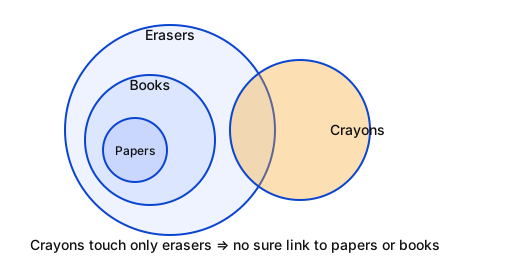
Concept: Draw the Venn diagram: papers ⊂ books ⊂ erasers; "some erasers are crayons" only guarantees an overlap with the eraser set.

  1. The crayon circle can intersect erasers outside the book region, so "some books are crayons" is not definite.
  2. Likewise "some papers are crayons" is not definite.
  3. Neither conclusion follows.

Trick: All + All + Some (at the far end) → the "some" never travels back to the first terms.

Answer: (C) Neither conclusion I nor II follows

अवधारणा: वेन आरेख बनाएँ: papers ⊂ books ⊂ erasers; "कुछ erasers crayons हैं" केवल eraser समूह से ओवरलैप पक्का करता है।

  1. crayon वृत्त erasers के उस भाग को छू सकता है जो books से बाहर है, अतः "कुछ books crayons हैं" निश्चित नहीं।
  2. इसी तरह "कुछ papers crayons हैं" भी निश्चित नहीं।
  3. कोई निष्कर्ष नहीं निकलता।

ट्रिक: All + All + Some (अंत में) → "some" पीछे के पदों तक कभी नहीं लौटता।

उत्तर: (C) न I न II

RRB NTPC Graduate CBT 1General Intelligence and ReasoningSyllogismRRB NTPC Graduate CBT 1 2025 · 25 Mar Shift 2 →
Q5154.
Refer to the following letter, number and symbol series and answer the question that follows. Counting to be done from left to right only.
(Left) D 8 € K K 6 * @ F Y 9 5 L 8 € 7 2 X Y € O & (Right)
If all the letters are dropped from the series, which of the following will be fifth from the left?
निम्नलिखित अक्षर, संख्या और प्रतीक शृंखला को देखिए और उसके बाद दिए गए प्रश्न का उत्तर दीजिए। गिनती केवल बाएँ से दाएँ की जानी है।
(बाएँ) D 8 € K K 6 * @ F Y 9 5 L 8 € 7 2 X Y € O & (दाएँ)
यदि शृंखला से सभी अक्षर हटा दिए जाएँ, तो निम्नलिखित में से कौन-सा बाएँ से पाँचवाँ होगा?
  1. A5
  2. B@
  3. C9
  4. D€
Show answer

Concept: Remove the letters and count the remaining items from the left.

  1. Series without letters: 8 € 6 * @ 9 5 8 € 7 2 € &
  2. Positions: 1st 8, 2nd €, 3rd 6, 4th *, 5th @.

Trick: Strike letters directly in the row and count with a finger – no need to rewrite the whole series.

Answer: (B) @

अवधारणा: अक्षर हटाकर बचे हुए पदों को बाएँ से गिनें।

  1. अक्षर हटाने पर: 8 € 6 * @ 9 5 8 € 7 2 € &
  2. क्रम: पहला 8, दूसरा €, तीसरा 6, चौथा *, पाँचवाँ @।

ट्रिक: पंक्ति में ही अक्षर काटें और उँगली से गिनें – पूरी श्रृंखला दोबारा लिखने की ज़रूरत नहीं।

उत्तर: (B) @

RRB NTPC Graduate CBT 1General Intelligence and ReasoningLetter-Number-Symbol SeriesRRB NTPC Graduate CBT 1 2025 · 25 Mar Shift 2 →
Q5155.
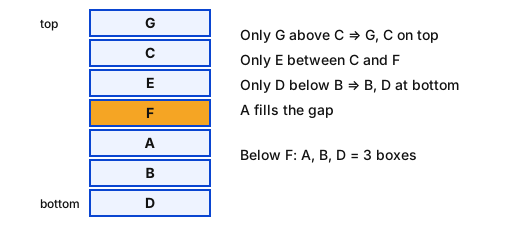
Seven boxes, A, B, C, D, E, F and G, are kept one over the other but not necessarily in the same order. Only G is kept above C. Only E is kept between C and F. Only D is kept below B.
How many boxes are kept below F?
सात बक्से, A, B, C, D, E, F और G, एक के ऊपर एक रखे गए हैं, लेकिन आवश्यक नहीं कि इसी क्रम में हों। C के ऊपर केवल G रखा है। C और F के बीच केवल E रखा है। B के नीचे केवल D रखा है।
F के नीचे कितने बक्से रखे हैं?
  1. A3
  2. B1
  3. C2
  4. D4
Show answer

Concept: "Only X is above/below Y" pins positions at the ends of the stack; fill the middle with the remaining clue.

  1. Only G above C ⇒ G is 1st (top), C is 2nd.
  2. Only E between C and F ⇒ E 3rd, F 4th.
  3. Only D below B ⇒ B 6th, D 7th (bottom); A takes the 5th place.
  4. Below F: A, B, D ⇒ 3 boxes.

Trick: Write the stack top-to-bottom as a column; "only" clues give exact positions without cases.

Answer: (A) 3

अवधारणा: "केवल X, Y के ऊपर/नीचे" जैसे संकेत ढेर के सिरों पर स्थिति तय कर देते हैं; बीच को बचे संकेत से भरें।

  1. केवल G, C के ऊपर ⇒ G पहला (सबसे ऊपर), C दूसरा।
  2. C और F के बीच केवल E ⇒ E तीसरा, F चौथा।
  3. केवल D, B के नीचे ⇒ B छठा, D सातवाँ (सबसे नीचे); A पाँचवें स्थान पर।
  4. F के नीचे: A, B, D ⇒ 3 बॉक्स।

ट्रिक: ढेर को ऊपर से नीचे स्तंभ में लिखें; "केवल" वाले संकेत बिना केस बनाए सटीक स्थान देते हैं।

उत्तर: (A) 3

RRB NTPC Graduate CBT 1General Intelligence and ReasoningBox ArrangementRRB NTPC Graduate CBT 1 2025 · 25 Mar Shift 2 →
Q5156.
Based on the English alphabetical order, three of the following four letter cluster pairs are alike in a certain way and thus form a group. Which is the one that does not belong to that group?
(Note: The odd man out is not based on the number of consonants/vowels or their position in the letter cluster)
अंग्रेज़ी वर्णमाला क्रम के आधार पर, निम्नलिखित चार अक्षर-समूह युग्मों में से तीन एक निश्चित प्रकार से समान हैं और इस प्रकार एक समूह बनाते हैं। वह कौन-सा है जो उस समूह से संबंधित नहीं है?
(नोट: असंगत युग्म का चयन व्यंजनों/स्वरों की संख्या या अक्षर-समूह में उनकी स्थिति पर आधारित नहीं है)
  1. AUW-XZ
  2. BGI-JL
  3. CRT-VX
  4. DAC-DF
Show answer

Concept: Compare the gap inside each pair and the gap between the two clusters.

  1. UW-XZ: U→W (+2), W→X (+1), X→Z (+2).
  2. GI-JL: +2, I→J (+1), +2. AC-DF: +2, C→D (+1), +2.
  3. RT-VX: +2, but T→V is +2, not +1 – different.

Trick: Three options skip exactly one letter between the clusters (W-X, I-J, C-D are neighbours); RT-VX skips U.

Answer: (C) RT-VX

अवधारणा: हर जोड़ी के भीतर का अंतर और दोनों समूहों के बीच का अंतर तुलना करें।

  1. UW-XZ: U→W (+2), W→X (+1), X→Z (+2)।
  2. GI-JL: +2, I→J (+1), +2। AC-DF: +2, C→D (+1), +2।
  3. RT-VX: +2, पर T→V +2 है, +1 नहीं – अलग।

ट्रिक: तीन विकल्पों में दोनों समूह सटे अक्षर हैं (W-X, I-J, C-D); RT-VX में बीच में U छूटता है।

उत्तर: (C) RT-VX

RRB NTPC Graduate CBT 1General Intelligence and ReasoningLetter Cluster ClassificationRRB NTPC Graduate CBT 1 2025 · 25 Mar Shift 2 →
Q5157.
In a certain code language,
A + B means ‘A is the mother of B’
A – B means ‘A is the brother of B’
A x B means ‘A is the sister of B’
A ÷ B means ‘A is the father of B’
A % B means ‘A is the husband of B’
A # B means ‘A is the wife of B’
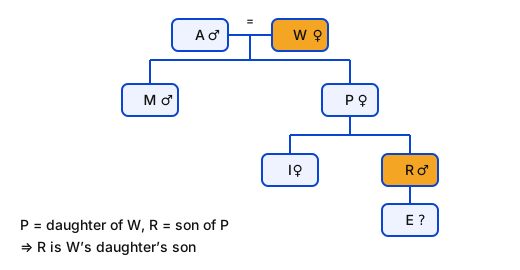
Based on the above, how is R related to W if ‘W # A ÷ M – P + I x R ÷ E’?
एक निश्चित कूट भाषा में,
A + B का अर्थ है ‘A, B की माता है’
A – B का अर्थ है ‘A, B का भाई है’
A x B का अर्थ है ‘A, B की बहन है’
A ÷ B का अर्थ है ‘A, B का पिता है’
A % B का अर्थ है ‘A, B का पति है’
A # B का अर्थ है ‘A, B की पत्नी है’
उपर्युक्त के आधार पर, यदि ‘W # A ÷ M – P + I x R ÷ E’ है, तो R का W से क्या संबंध है?
  1. ABrother's Sonभाई का पुत्र
  2. BSister's Sonबहन का पुत्र
  3. CDaughter's Sonपुत्री का पुत्र
  4. DSon's Sonपुत्र का पुत्र
Show answer

Concept: Decode the chain step by step and build a family tree with genders.

  1. W # A: W is wife of A. A ÷ M: A is father of M. M − P: M is brother of P ⇒ P is also a child of A and W.
  2. P + I: P is mother of I ⇒ P is a daughter of W.
  3. I × R: I is sister of R; R ÷ E: R is father of E ⇒ R is male, a son of P.
  4. So R is the son of W's daughter.

Trick: A person who is a "father/mother" in a later step reveals gender – use it to decide son vs daughter.

Answer: (C) Daughter's Son

अवधारणा: श्रृंखला को चरणबद्ध पढ़ें और लिंग सहित वंश-वृक्ष बनाएँ।

  1. W # A: W, A की पत्नी। A ÷ M: A, M का पिता। M − P: M, P का भाई ⇒ P भी A और W की संतान।
  2. P + I: P, I की माँ ⇒ P, W की बेटी।
  3. I × R: I, R की बहन; R ÷ E: R, E का पिता ⇒ R पुरुष, P का बेटा।
  4. अतः R, W की बेटी का बेटा।

ट्रिक: जो आगे चलकर "पिता/माता" बनता है उससे लिंग पता चलता है – इसी से बेटा/बेटी तय करें।

उत्तर: (C) बेटी का बेटा (Daughter's Son)

RRB NTPC Graduate CBT 1General Intelligence and ReasoningBlood RelationsRRB NTPC Graduate CBT 1 2025 · 25 Mar Shift 2 →
Q5158.
Refer to the following number and symbol series and answer the question. Counting to be done from left to right only. (All numbers are single-digit numbers only.)
(Left) 6 2 @ # & * % ~ 7 = Ω 1 8 ? £ $ 4 3 5 + 9 (Right)
How many such symbols are there, each of which is immediately preceded by a number and also immediately followed by another number?
निम्नलिखित संख्या और प्रतीक शृंखला को देखिए और प्रश्न का उत्तर दीजिए। गिनती केवल बाएँ से दाएँ की जानी है। (सभी संख्याएँ केवल एक-अंकीय संख्याएँ हैं।)
(बाएँ) 6 2 @ # & * % ~ 7 = Ω 1 8 ? £ $ 4 3 5 + 9 (दाएँ)
ऐसे कितने प्रतीक हैं, जिनमें से प्रत्येक के ठीक पहले एक संख्या है और ठीक बाद भी एक अन्य संख्या है?
  1. AOneएक
  2. BThreeतीन
  3. CNoneकोई नहीं
  4. DTwoदो
Show answer

Concept: We need the pattern number – symbol – number. Check each symbol's left and right neighbours.

  1. Symbols and neighbours: @ (2, #), = (7, Ω), Ω (=, 1), ? (8, £), $ (£, 4), + (5, 9).
  2. Only "+" has numbers on both sides (5 + 9).

Trick: Scan only the symbols that sit between two digits – most are flanked by other symbols and can be skipped.

Answer: (A) One

अवधारणा: पैटर्न चाहिए: अंक – प्रतीक – अंक। हर प्रतीक के बाएँ-दाएँ पड़ोसी देखें।

  1. प्रतीक और पड़ोसी: @ (2, #), = (7, Ω), Ω (=, 1), ? (8, £), $ (£, 4), + (5, 9)।
  2. केवल "+" के दोनों ओर अंक हैं (5 + 9)।

ट्रिक: केवल उन्हीं प्रतीकों को देखें जो दो अंकों के बीच हैं – बाकी प्रतीकों के पास प्रतीक ही हैं, छोड़ दें।

उत्तर: (A) एक

RRB NTPC Graduate CBT 1General Intelligence and ReasoningNumber-Symbol SeriesRRB NTPC Graduate CBT 1 2025 · 25 Mar Shift 2 →
Q5159.
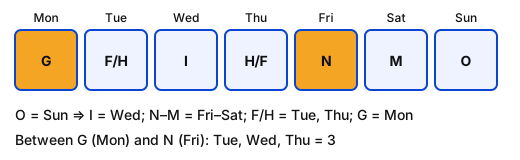
Each of F, G, H, I, M, N and O has an exam on a different day of a week starting from Monday and ending on Sunday of the same week. Only three people have exams between I and O. O has exam on the last day of the week. Only one person has exam between F and H. N has exam immediately the day before M. G doesn't have exam on Friday. How many people have exam(s) between G and N?
F, G, H, I, M, N और O में से प्रत्येक की परीक्षा एक ही सप्ताह के सोमवार से शुरू होकर रविवार को समाप्त होने वाले अलग-अलग दिन है। I और O के बीच केवल तीन व्यक्तियों की परीक्षा है। O की परीक्षा सप्ताह के अंतिम दिन है। F और H के बीच केवल एक व्यक्ति की परीक्षा है। N की परीक्षा M से ठीक एक दिन पहले है। G की परीक्षा शुक्रवार को नहीं है। G और N के बीच कितने व्यक्तियों की परीक्षा है?
  1. AFourचार
  2. BThreeतीन
  3. CTwoदो
  4. DOneएक
Show answer

Concept: Place the fixed person first, then test the rigid pairs (N just before M; one person between F and H) against the remaining days.

  1. O = Sunday; three between I and O ⇒ I = Wednesday.
  2. Free days: Mon, Tue, Thu, Fri, Sat. N–M consecutive: Mon–Tue, Thu–Fri or Fri–Sat.
  3. Only Fri–Sat works, leaving Tue/Thu for F and H (one gap) and Mon for G (G is not on Friday).
  4. Between G (Mon) and N (Fri): Tue, Wed, Thu ⇒ three.

Trick: Eliminate cases quickly: Mon–Tue for N–M forces G on Friday (not allowed); Thu–Fri leaves no slot with one gap for F–H.

Answer: (B) Three

अवधारणा: पहले निश्चित व्यक्ति रखें, फिर कठोर जोड़ियों (N ठीक M से पहले; F–H के बीच एक व्यक्ति) को बचे दिनों में जाँचें।

  1. O = रविवार; I और O के बीच तीन ⇒ I = बुधवार।
  2. खाली दिन: सोम, मंगल, गुरु, शुक्र, शनि। N–M लगातार: सोम–मंगल, गुरु–शुक्र या शुक्र–शनि।
  3. केवल शुक्र–शनि संभव; F, H मंगल/गुरु (बीच में एक) और G सोमवार (G शुक्रवार को नहीं)।
  4. G (सोम) और N (शुक्र) के बीच: मंगल, बुध, गुरु ⇒ तीन।

ट्रिक: केस जल्दी काटें: N–M सोम–मंगल से G शुक्रवार पर आता है (मना है); गुरु–शुक्र में F–H के लिए एक-अंतर वाली जगह नहीं बचती।

उत्तर: (B) तीन

RRB NTPC Graduate CBT 1General Intelligence and ReasoningDay Scheduling PuzzleRRB NTPC Graduate CBT 1 2025 · 25 Mar Shift 2 →
Q5160.
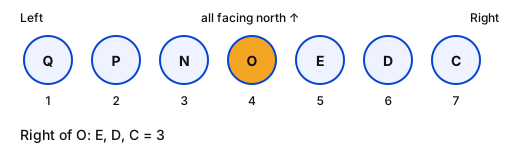
Seven people, C, D, E, N, O, P and Q, are sitting in a straight line, facing north. E sits second to the right of N. Only two people sit between E and P. Only two people sit to the left of N. Only three people sit between N and C. O sits at some place to the right of Q but at some place to the left of D. How many people sit to the right of O?
सात व्यक्ति, C, D, E, N, O, P और Q, एक सीधी पंक्ति में उत्तर की ओर मुख करके बैठे हैं। E, N के दाएँ दूसरे स्थान पर बैठा है। E और P के बीच केवल दो व्यक्ति बैठे हैं। N के बाएँ केवल दो व्यक्ति बैठे हैं। N और C के बीच केवल तीन व्यक्ति बैठे हैं। O, Q के दाएँ किसी स्थान पर, लेकिन D के बाएँ किसी स्थान पर बैठा है। O के दाएँ कितने व्यक्ति बैठे हैं?
  1. ATwoदो
  2. BThreeतीन
  3. COneएक
  4. DFourचार
Show answer

Concept: Number the seats 1–7 from left to right; for people facing north, "right" means a higher number.

  1. Two people left of N ⇒ N = 3; E second to the right ⇒ E = 5.
  2. Two between E and P ⇒ P = 2; three between N and C ⇒ C = 7.
  3. Remaining seats 1, 4, 6 for Q, O, D with Q left of O left of D ⇒ Q = 1, O = 4, D = 6.
  4. To the right of O: E, D, C ⇒ three.

Trick: Start with the clue that fixes an absolute position ("only two sit to the left of N") – it anchors everything.

Answer: (B) Three

अवधारणा: बाएँ से दाएँ सीटें 1–7 मानें; उत्तर की ओर मुख होने पर "दाएँ" का अर्थ बड़ी संख्या।

  1. N के बाएँ दो ⇒ N = 3; E, N के दाएँ दूसरा ⇒ E = 5।
  2. E और P के बीच दो ⇒ P = 2; N और C के बीच तीन ⇒ C = 7।
  3. बची सीटें 1, 4, 6 पर Q, O, D (Q बाएँ, फिर O, फिर D) ⇒ Q = 1, O = 4, D = 6।
  4. O के दाएँ: E, D, C ⇒ तीन।

ट्रिक: उस संकेत से शुरू करें जो निश्चित स्थान देता है ("N के बाएँ केवल दो") – वही पूरी व्यवस्था का आधार बनता है।

उत्तर: (B) तीन

RRB NTPC Graduate CBT 1General Intelligence and ReasoningLinear Seating ArrangementRRB NTPC Graduate CBT 1 2025 · 25 Mar Shift 2 →