RRB NTPC Graduate CBT 1 2025 · Shift 2

RRB NTPC Graduate CBT 1 25 Mar 2026 Shift 2 – Question Paper

100 questions · 100 marks · 90 minutes · +1 for a correct answer, −1/3 for a wrong one. With answer key and detailed solutions in Hindi and English.

Test Series – airGurukul

Paper pattern

SectionQuestionsMarks
General Awareness4040
Mathematics3030
General Intelligence and Reasoning3030

Sample questions from this paper

Q1.
Who was known as the "Mother of Indian Feminism" for her pioneering work in women’s education and rights?
महिलाओं की शिक्षा और अधिकारों के क्षेत्र में अग्रणी कार्य के लिए किसे "भारतीय नारीवाद की जननी" (Mother of Indian Feminism) के रूप में जाना जाता था?
  1. ARukhmabaiरुखमाबाई
  2. BPandita Ramabaiपंडिता रमाबाई
  3. CAnnie Besantएनी बेसेंट
  4. DSavitribai Phuleसावित्रीबाई फुले
Show answer

Concept: Savitribai Phule (1831–1897), with Jyotirao Phule, opened the first school for girls in Pune (1848) and is remembered as the Mother of Indian Feminism.

  1. She was India's first woman teacher and fought for women's education, widow remarriage and against caste discrimination.
  2. Pandita Ramabai and Rukhmabai were also pioneers, but the title "Mother of Indian Feminism" is popularly given to Savitribai Phule.

Yaad rakhein: Savitribai Phule – Bhide Wada girls' school, Pune, 1848; her birthday (3 Jan) is observed as Balika Din in Maharashtra.

Answer: (D) Savitribai Phule

अवधारणा: सावित्रीबाई फुले (1831–1897) ने ज्योतिराव फुले के साथ पुणे में लड़कियों का पहला स्कूल (1848) खोला; उन्हें भारतीय नारीवाद की जननी (Mother of Indian Feminism) कहा जाता है।

  1. वे भारत की पहली महिला शिक्षिका थीं; स्त्री-शिक्षा, विधवा पुनर्विवाह और जाति-भेद के विरुद्ध संघर्ष किया।
  2. पंडिता रमाबाई और रुखमाबाई भी अग्रणी थीं, पर यह उपाधि सावित्रीबाई फुले को दी जाती है।

याद रखें: सावित्रीबाई फुले – भिड़े वाडा कन्या विद्यालय, पुणे, 1848; उनका जन्मदिन (3 जनवरी) महाराष्ट्र में बालिका दिन।

उत्तर: (D) सावित्रीबाई फुले
RRB NTPC Graduate CBT 1General AwarenessSocial Reformers
Q41.
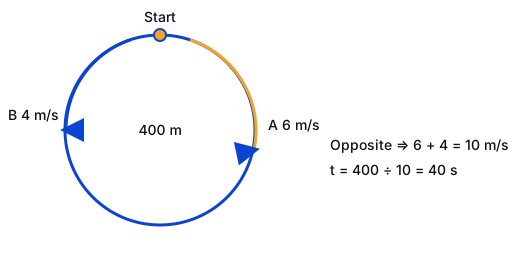
Two people, A and B, start running from the same point on a circular track of length 400 meters, but in opposite directions. A runs at 6 m/s and B at 4 m/s. In how many seconds will they meet for the first time?
दो व्यक्ति, A और B, 400 मीटर लंबे एक वृत्ताकार ट्रैक पर एक ही बिंदु से विपरीत दिशाओं में दौड़ना शुरू करते हैं। A 6 m/s की गति से और B 4 m/s की गति से दौड़ता है। वे पहली बार कितने सेकंड में मिलेंगे?
  1. A50 seconds50 सेकंड
  2. B40 seconds40 सेकंड
  3. C20 seconds20 सेकंड
  4. D30 seconds30 सेकंड
Show answer

Concept: On a circular track, runners moving in opposite directions first meet when together they cover one full lap; relative speed = sum of speeds.

  1. Relative speed =6+4=10m/s.
  2. Time for first meeting =40010=40 s.

Trick: Opposite directions → add speeds; same direction → subtract speeds, and divide the track length by it.

Answer: (B) 40 seconds

अवधारणा: वृत्ताकार ट्रैक पर विपरीत दिशा में दौड़ने वाले पहली बार तब मिलते हैं जब दोनों मिलकर एक पूरा चक्कर (lap) तय कर लें; सापेक्ष चाल = चालों का योग।

  1. सापेक्ष चाल =6+4=10m/s
  2. पहली बार मिलने का समय =40010=40 सेकंड।

ट्रिक: विपरीत दिशा → चालें जोड़ें; समान दिशा → घटाएँ, फिर ट्रैक की लंबाई को उससे भाग दें।

उत्तर: (B) 40 सेकंड

RRB NTPC Graduate CBT 1MathematicsCircular Track
Q71.
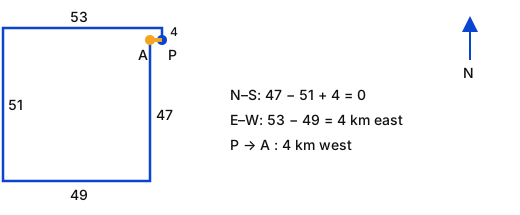
Sharad starts from Point A and drives 47 km towards the South. He then takes a right turn, drives 49 km, turns right and drives 51 km. He then takes a right turn and drives 53 km. He takes a final right turn, drives 4 km and stops at Point P. How far (shortest distance) and towards which direction should he drive in order to reach Point A again? (All turns are 90-degree turns only unless specified.)
शरद बिंदु A से शुरू करता है और दक्षिण की ओर 47 km गाड़ी चलाता है। फिर वह दाएँ मुड़ता है, 49 km चलता है, दाएँ मुड़ता है और 51 km चलता है। फिर वह दाएँ मुड़ता है और 53 km चलता है। अंत में वह दाएँ मुड़ता है, 4 km चलता है और बिंदु P पर रुक जाता है। पुनः बिंदु A तक पहुँचने के लिए उसे कितनी दूरी (न्यूनतम दूरी) और किस दिशा में गाड़ी चलानी चाहिए? (जब तक अन्यथा निर्दिष्ट न हो, सभी मोड़ केवल 90 डिग्री के मोड़ हैं।)
  1. A4 km to the west4 km पश्चिम की ओर
  2. B2 km to the west2 km पश्चिम की ओर
  3. C1 km to the west1 km पश्चिम की ओर
  4. D3 km to the west3 km पश्चिम की ओर
Show answer

Concept: Track north–south and east–west displacements separately; right turns go S→W→N→E→S.

  1. Moves: 47 S, 49 W, 51 N, 53 E, 4 S.
  2. N–S: 47−51+4=0 ⇒ P is level with A.
  3. E–W: 53−49=4 km east of A.
  4. So from P he must drive 4 km to the west.

Trick: Cancel opposite legs (S vs N, E vs W) – the leftover gives distance and direction at once.

Answer: (A) 4 km to the west

अवधारणा: उत्तर–दक्षिण और पूर्व–पश्चिम विस्थापन अलग-अलग जोड़ें; दाएँ मुड़ने पर दिशा S→W→N→E→S बदलती है।

  1. चाल: 47 S, 49 W, 51 N, 53 E, 4 S।
  2. N–S: 47−51+4=0 ⇒ P, A की सीध में है।
  3. E–W: 53−49=4 km, A से पूर्व।
  4. अतः P से 4 km पश्चिम चलना होगा।

ट्रिक: विपरीत भुजाएँ (S–N, E–W) काट दें – बचा हुआ भाग दूरी और दिशा दोनों बता देता है।

उत्तर: (A) 4 km पश्चिम

RRB NTPC Graduate CBT 1General Intelligence and ReasoningDirection Sense

See all 100 solutions

More RRB NTPC Graduate CBT 1 papers

Download our app

Study smarter with the airGurukul App

Your complete exam-prep companion - classes, practice, and progress tracking.

Learn anytime, anywhere - live classes, tests, notes, and updates in one place.

GET IT ONGoogle Play

Have a query? We’re here to help

Fill out the form and our team will get back to you as soon as possible.

  • Ask your questions related to admission, courses, fees, or facilities
  • Share your details so our team can contact you easily
  • Get accurate information from our support team
  • Quick and simple form submission process

All fields marked * are required.