Question bank

Q&A: practice questions with answers

Search questions on any topic. Filter by exam category, exam, subject and topic, try the question, then open the answer and explanation.

Courses – airGurukul

7,077 questions found.

Q5321.
100 men have provisions for 27 days. If 46 men have left, for how many days the same provisions would last for the remaining men?
100 आदमियों के लिए 27 दिनों की खाद्य सामग्री है। यदि 46 आदमी चले जाते हैं, तो वही खाद्य सामग्री शेष आदमियों के लिए कितने दिनों तक चलेगी?
  1. A50
  2. B54
  3. C52
  4. D48
Show answer

Concept: Total provisions = men × days (constant). Fewer men ⇒ more days.

  1. Total = 100×27=2700 man-days.
  2. Remaining men = 100−46=54.
  3. Days = 270054=50.

Trick: M1D1=M2D2⇒D2=100×2754=50.

Answer: (A) 50

अवधारणा: कुल राशन = आदमी × दिन (स्थिर)। कम आदमी ⇒ अधिक दिन।

  1. कुल = 100×27=2700 आदमी-दिन।
  2. बचे आदमी = 100−46=54।
  3. दिन = 270054=50।

ट्रिक: M1D1=M2D2⇒D2=100×2754=50।

उत्तर: (A) 50

RRB NTPC Graduate CBT 1MathematicsInverse variation (provisions)RRB NTPC Graduate CBT 1 2025 · 24 Mar Shift 3 →
Q5322.
If A’s salary is 13% more than that of B, then by what per cent is B’s salary less than that of A? (Give your answer correct to two decimal places.)
यदि A का वेतन B के वेतन से 13% अधिक है, तो B का वेतन A के वेतन से कितने प्रतिशत कम है? (अपना उत्तर दो दशमलव स्थानों तक सही दीजिए।)
  1. A14.72%
  2. B14.22%
  3. C11.50%
  4. D10.50%
Show answer

Concept: If A is x% more than B, then B is x100+x×100% less than A.

  1. Let B = 100, so A = 113.
  2. B is less than A by 13 on a base of 113.
  3. 13113×100=11.504…≈11.50%.

Trick: "More → less" formula: x100+x×100; for x=13: 1300113≈11.50.

Answer: (C) 11.50%

अवधारणा: यदि A, B से x% अधिक है तो B, A से x100+x×100% कम है।

  1. B = 100 लें, तो A = 113।
  2. B, A से 13 कम है, आधार 113।
  3. 13113×100=11.504…≈11.50%।

ट्रिक: "अधिक → कम" सूत्र: x100+x×100; x=13 पर 1300113≈11.50।

उत्तर: (C) 11.50%

RRB NTPC Graduate CBT 1MathematicsPercentage comparisonRRB NTPC Graduate CBT 1 2025 · 24 Mar Shift 3 →
Q5323.
₹6320 is divided among A, B, C, and D in such a way that the shares of A and B, B and C, and C and D are in the ratios of 2 : 3, 4 : 5, and 10 : 3 respectively. The share of A (in ₹) is:
₹6320 को A, B, C और D में इस प्रकार बाँटा जाता है कि A और B, B और C, तथा C और D के हिस्से क्रमशः 2 : 3, 4 : 5 और 10 : 3 के अनुपात में हैं। A का हिस्सा (₹ में) है:
  1. A1280
  2. B1400
  3. C1190
  4. D1350
Show answer

Concept: Combine A:B, B:C, C:D into one ratio by making common terms equal.

  1. A:B=2:3, B:C=4:5, C:D=10:3.
  2. A:B:C:D=(2×4×10):(3×4×10):(3×5×10):(3×5×3)=80:120:150:45.
  3. Sum of parts =395; one part =6320395=16.
  4. A's share =80×16=1280.

Trick: Write the four ratios in a chain and multiply down the diagonals: A=2·4·10, B=3·4·10, C=3·5·10, D=3·5·3.

Answer: (A) ₹1280

अवधारणा: A:B, B:C, C:D को उभयनिष्ठ पदों को बराबर करके एक अनुपात में जोड़ें।

  1. A:B=2:3, B:C=4:5, C:D=10:3।
  2. A:B:C:D=(2×4×10):(3×4×10):(3×5×10):(3×5×3)=80:120:150:45।
  3. भागों का योग =395; एक भाग =6320395=16।
  4. A का हिस्सा =80×16=1280।

ट्रिक: अनुपातों को श्रृंखला में लिखकर विकर्णों पर गुणा करें: A=2·4·10, B=3·4·10, C=3·5·10, D=3·5·3।

उत्तर: (A) ₹1280

RRB NTPC Graduate CBT 1MathematicsChained ratiosRRB NTPC Graduate CBT 1 2025 · 24 Mar Shift 3 →
Q5324.
A man sold an article for ₹234 by first giving a d% discount on its marked price, and then another discount having the same nominal value (in ₹) as that of the first discount. If the marked price of the article is ₹1,800, then what is the value of d?
एक व्यक्ति ने एक वस्तु को उसके अंकित मूल्य पर पहले d% की छूट देकर और फिर पहली छूट के समान नामिक मूल्य (₹ में) की एक और छूट देकर ₹234 में बेचा। यदि वस्तु का अंकित मूल्य ₹1,800 है, तो d का मान क्या है?
  1. A43.5
  2. B47
  3. C38.1
  4. D41.9
Show answer

Concept: The first discount is d% of ₹1800; the second discount is the same rupee amount, so total discount is twice the first.

  1. First discount =d100×1800=18d rupees.
  2. Total discount =2×18d=36d.
  3. 1800−36d=234⇒36d=1566⇒d=43.5.

Trick: Total discount ₹1566 is 87% of MP; same rupee value twice ⇒ d=872=43.5.

Answer: (A) 43.5

अवधारणा: पहली छूट ₹1800 का d% है; दूसरी छूट उतनी ही रुपये राशि की है, अतः कुल छूट पहली की दोगुनी।

  1. पहली छूट =d100×1800=18d रुपये।
  2. कुल छूट =2×18d=36d।
  3. 1800−36d=234⇒36d=1566⇒d=43.5।

ट्रिक: कुल छूट ₹1566 = MP का 87%; वही राशि दो बार ⇒ d=872=43.5।

उत्तर: (A) 43.5

RRB NTPC Graduate CBT 1MathematicsSuccessive discountsRRB NTPC Graduate CBT 1 2025 · 24 Mar Shift 3 →
Q5325.
The HCF of two numbers is 104 and their LCM is 1040. If one of the numbers is 208, what is the sum of the two numbers?
दो संख्याओं का HCF 104 है और उनका LCM 1040 है। यदि इनमें से एक संख्या 208 है, तो दोनों संख्याओं का योग क्या है?
  1. A732
  2. B728
  3. C736
  4. D724
Show answer

Concept: Product of two numbers =HCF×LCM.

  1. Other number =104×1040208=10402=520.
  2. Sum =208+520=728.

Trick: 208=2×10⁴, so the other number =10402=520 directly.

Answer: (B) 728

अवधारणा: दो संख्याओं का गुणनफल =HCF×LCM।

  1. दूसरी संख्या =104×1040208=10402=520।
  2. योग =208+520=728।

ट्रिक: 208=2×10⁴, अतः दूसरी संख्या =10402=520 सीधे।

उत्तर: (B) 728

RRB NTPC Graduate CBT 1MathematicsHCF and LCMRRB NTPC Graduate CBT 1 2025 · 24 Mar Shift 3 →
Q5326.
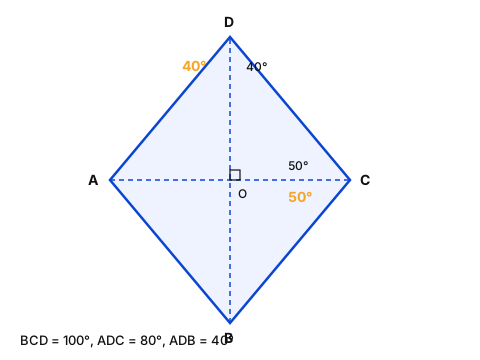
ABCD is a rhombus such that ∠ACB=50∘. The value of ∠ADB is:
ABCD एक समचतुर्भुज है जिसमें ∠ACB=50∘ है। ∠ADB का मान है:
  1. A60∘
  2. B50∘
  3. C70∘
  4. D40∘
Show answer

Concept: In a rhombus the diagonals bisect the vertex angles and bisect each other at 90∘; adjacent angles are supplementary.

  1. ∠ACB=50∘ ⇒ diagonal CA bisects ∠C, so ∠BCD=100∘.
  2. Adjacent angles: ∠ADC=180∘−100∘=80∘.
  3. Diagonal DB bisects ∠D: ∠ADB=80∘2=40∘.

Trick: In triangle DOC (O = centre), ∠DOC=90∘, ∠OCD=50∘ ⇒ ∠ODC=40∘=∠ADB (since DB bisects ∠D). Even faster: ∠ADB=90∘−50∘.

Answer: (D) 40∘

अवधारणा: समचतुर्भुज में विकर्ण शीर्ष-कोणों को समद्विभाजित करते हैं और एक-दूसरे को 90∘ पर काटते हैं; आसन्न कोण संपूरक होते हैं।

  1. ∠ACB=50∘ ⇒ विकर्ण CA, ∠C को आधा करता है, अतः ∠BCD=100∘।
  2. आसन्न कोण: ∠ADC=180∘−100∘=80∘।
  3. विकर्ण DB, ∠D को आधा करता है: ∠ADB=80∘2=40∘।

ट्रिक: त्रिभुज DOC (O = केंद्र) में ∠DOC=90∘, ∠OCD=50∘ ⇒ ∠ODC=40∘=∠ADB। सीधे: ∠ADB=90∘−50∘।

उत्तर: (D) 40∘

RRB NTPC Graduate CBT 1MathematicsRhombus – anglesRRB NTPC Graduate CBT 1 2025 · 24 Mar Shift 3 →
Q5327.
A shopkeeper purchased 33 dozens of articles at the rate of ₹620 per dozen. He sold each one of them at the rate of ₹93. What percentage profit did he make?
एक दुकानदार ने ₹620 प्रति दर्जन की दर से 33 दर्जन वस्तुएँ खरीदीं। उसने उनमें से प्रत्येक को ₹93 की दर से बेचा। उसे कितने प्रतिशत लाभ हुआ?
  1. A79%
  2. B80%
  3. C83%
  4. D82%
Show answer

Concept: Compare cost and selling price for the same quantity (one dozen).

  1. CP of one dozen = ₹620.
  2. SP of one dozen =12×93= ₹1116.
  3. Profit =1116−620=496; Profit%=496620×100=80%.

Trick: 1116620=1.8 ⇒ 80% profit. The "33 dozens" is irrelevant to the percentage.

Answer: (B) 80%

अवधारणा: समान मात्रा (एक दर्जन) का क्रय और विक्रय मूल्य तुलना करें।

  1. एक दर्जन का CP = ₹620।
  2. एक दर्जन का SP =12×93= ₹1116।
  3. लाभ =1116−620=496; लाभ%=496620×100=80%।

ट्रिक: 1116620=1.8 ⇒ 80% लाभ। "33 दर्जन" प्रतिशत के लिए अप्रासंगिक है।

उत्तर: (B) 80%

RRB NTPC Graduate CBT 1MathematicsProfit percentageRRB NTPC Graduate CBT 1 2025 · 24 Mar Shift 3 →
Q5328.
At what rate (in percentage) per year will a sum of money 5 times itself in 20 years on simple interest?
साधारण ब्याज पर प्रति वर्ष किस दर (प्रतिशत में) से कोई धनराशि 20 वर्षों में स्वयं की 5 गुनी हो जाएगी?
  1. A18
  2. B22
  3. C40
  4. D20
Show answer

Concept: If a sum becomes n times in T years at SI, interest =(n−1)P and R=(n−1)×100T.

  1. 5 times ⇒ SI =4P.
  2. 4P=P×R×20100⇒R=40020=20%.

Trick: R=(n−1)×100T=4×10020=20.

Answer: (D) 20

अवधारणा: यदि राशि SI पर T वर्षों में n गुना हो जाए तो ब्याज =(n−1)P और R=(n−1)×100T।

  1. 5 गुना ⇒ SI =4P।
  2. 4P=P×R×20100⇒R=40020=20%।

ट्रिक: R=(n−1)×100T=4×10020=20।

उत्तर: (D) 20

RRB NTPC Graduate CBT 1MathematicsSimple interestRRB NTPC Graduate CBT 1 2025 · 24 Mar Shift 3 →
Q5329.
Evaluate: (-9) - (-56) ÷ (-8) + (-4) × 6
मान ज्ञात कीजिए: (-9) - (-56) ÷ (-8) + (-4) × 6
  1. A-40
  2. B-42
  3. C-43
  4. D-39
Show answer

Concept: Do ÷ and × first, then + and − from left to right.

  1. (−56)÷(−8)=7; (−4)×6=−24.
  2. (−9)−7+(−24)=−9−7−24=−40.

Trick: All three terms end up negative: 9+7+24=40, so the answer is −40.

Answer: (A) −40

अवधारणा: पहले ÷ और ×, फिर बाएँ से दाएँ + और −।

  1. (−56)÷(−8)=7; (−4)×6=−24।
  2. (−9)−7+(−24)=−9−7−24=−40।

ट्रिक: तीनों पद ऋणात्मक हो जाते हैं: 9+7+24=40, अतः उत्तर −40।

उत्तर: (A) −40

RRB NTPC Graduate CBT 1MathematicsBODMAS with integersRRB NTPC Graduate CBT 1 2025 · 24 Mar Shift 3 →
Q5330.
Rupesh’s salary is ₹18000 per month. He spends ₹5000 on house rent, ₹2500 on bills and the rest of the amount is his monthly savings. Find his savings (in ₹) in a year, if in the month of his birthday, he spent his complete monthly saving for birthday
celebration.
रूपेश का वेतन ₹18000 प्रति माह है। वह ₹5000 घर के किराए पर, ₹2500 बिलों पर खर्च करता है और शेष राशि उसकी मासिक बचत है। एक वर्ष में उसकी बचत (₹ में) ज्ञात कीजिए, यदि अपने जन्मदिन के महीने में उसने अपनी पूरी मासिक बचत जन्मदिन
समारोह पर खर्च कर दी।
  1. A115500
  2. B94500
  3. C105000
  4. D126000
Show answer

Concept: Monthly saving = salary − expenses; count only the months in which the saving is actually kept.

  1. Monthly saving =18000−5000−2500=10500.
  2. In the birthday month the whole saving is spent ⇒ savings for 11 months only.
  3. Yearly saving =11×10500=115500.

Trick: 12 months of saving minus one month =11×10500.

Answer: (A) ₹115500

अवधारणा: मासिक बचत = वेतन − खर्च; केवल उन्हीं महीनों को गिनें जिनमें बचत वास्तव में बचती है।

  1. मासिक बचत =18000−5000−2500=10500।
  2. जन्मदिन के महीने में पूरी बचत खर्च ⇒ केवल 11 महीनों की बचत।
  3. वार्षिक बचत =11×10500=115500।

ट्रिक: 12 महीनों की बचत में से एक महीना घटाएँ =11×10500।

उत्तर: (A) ₹115500

RRB NTPC Graduate CBT 1MathematicsSavings calculationRRB NTPC Graduate CBT 1 2025 · 24 Mar Shift 3 →
Q5331.
If 4 : 12 :: 2.1 : x and 9 : 36 :: 8 : y, what is the ratio of x to y?
यदि 4 : 12 :: 2.1 : x और 9 : 36 :: 8 : y है, तो x और y का अनुपात क्या है?
  1. A63 : 320
  2. B61 : 321
  3. C67 : 330
  4. D64 : 318
Show answer

Concept: In a:b::c:d, d=b×ca.

  1. 4:12::2.1:x⇒x=12×2.14=6.3.
  2. 9:36::8:y⇒y=36×89=32.
  3. x:y=6.3:32=63:320.

Trick: 4→12 is ×3 so x=3×2.1; 9→36 is ×4 so y=4×8.

Answer: (A) 63:320

अवधारणा: a:b::c:d में d=b×ca।

  1. 4:12::2.1:x⇒x=12×2.14=6.3।
  2. 9:36::8:y⇒y=36×89=32।
  3. x:y=6.3:32=63:320।

ट्रिक: 4→12 ×3 है, अतः x=3×2.1; 9→36 ×4 है, अतः y=4×8।

उत्तर: (A) 63:320

RRB NTPC Graduate CBT 1MathematicsProportionRRB NTPC Graduate CBT 1 2025 · 24 Mar Shift 3 →
Q5332.
If α,β are roots of the quadratic equation 2x2−3x+5=0, find the value of α2+β2.
यदि α,β द्विघात समीकरण 2x2−3x+5=0 के मूल हैं, तो α2+β2 का मान ज्ञात कीजिए।
  1. A174
  2. B−134
  3. C−114
  4. D74
Show answer

Concept: For ax2+bx+c=0: α+β=−ba, αβ=ca and α2+β2=(α+β)2−2αβ.

  1. 2x2−3x+5=0: α+β=32, αβ=52.
  2. α2+β2=(32)2−2×52=94−5.
  3. =9−204=−114.

Trick: A negative value is possible because the roots are complex (discriminant 9−40<0).

Answer: (C) −114

अवधारणा: ax2+bx+c=0 के लिए: α+β=−ba, αβ=ca और α2+β2=(α+β)2−2αβ।

  1. 2x2−3x+5=0: α+β=32, αβ=52।
  2. α2+β2=(32)2−2×52=94−5।
  3. =9−204=−114।

ट्रिक: ऋणात्मक मान संभव है क्योंकि मूल काल्पनिक (complex) हैं (विविक्तकर 9−40<0)।

उत्तर: (C) −114

RRB NTPC Graduate CBT 1MathematicsQuadratic equations – rootsRRB NTPC Graduate CBT 1 2025 · 24 Mar Shift 3 →
Q5333.
Calculate the median (rounded to two decimal places) from the following data:
Marks0 – 1010 – 3030 – 6060 – 8080 – 90
Number of students91934126
Total frequency N = 80
निम्नलिखित आँकड़ों से माध्यिका (दो दशमलव स्थानों तक पूर्णांकित) की गणना कीजिए:
अंक0 – 1010 – 3030 – 6060 – 8080 – 90
विद्यार्थियों की संख्या91934126
कुल बारंबारता N = 80
  1. A40.59
  2. B37.06
  3. C33.14
  4. D36.27
Show answer

Concept: Median=l+N2−cff×h, where l = lower limit of the median class, cf = cumulative frequency before it, f = its frequency, h = class width.

  1. Cumulative frequencies: 9, 28, 62, 74, 80. N2=40 lies in 30–60 (cf jumps from 28 to 62).
  2. l=30, cf=28, f=34, h=30.
  3. Median=30+40−2834×30=30+36034=30+10.59=40.59.

Trick: Classes are unequal here – always use the actual width of the median class (h=30), not a common width.

Answer: (A) 40.59

अवधारणा: माध्यिका=l+N2−cff×h, जहाँ l = माध्यिका वर्ग की निचली सीमा, cf = उससे पहले की संचयी बारंबारता, f = उसकी बारंबारता, h = वर्ग-चौड़ाई।

  1. संचयी बारंबारता: 9, 28, 62, 74, 80। N2=40 वर्ग 30–60 में है (cf 28 से 62 हो जाता है)।
  2. l=30, cf=28, f=34, h=30।
  3. माध्यिका=30+40−2834×30=30+36034=30+10.59=40.59।

ट्रिक: यहाँ वर्ग असमान हैं – हमेशा माध्यिका वर्ग की वास्तविक चौड़ाई (h=30) लें, कोई साझा चौड़ाई नहीं।

उत्तर: (A) 40.59

RRB NTPC Graduate CBT 1MathematicsStatistics – median of grouped dataRRB NTPC Graduate CBT 1 2025 · 24 Mar Shift 3 →
Q5334.
A man can row 8 km/hr in still water while speed of current is 3 km/hr. How much time (in hours) will he take to row 11 km downstream and 15 km upstream?
एक व्यक्ति शांत जल में 8 km/hr की गति से नाव चला सकता है, जबकि धारा की गति 3 km/hr है। उसे धारा के अनुकूल 11 km और धारा के प्रतिकूल 15 km नाव चलाने में कितना समय (घंटों में) लगेगा?
  1. A4
  2. B6
  3. C3
  4. D5
Show answer

Concept: Downstream speed =u+v, upstream speed =u−v; time =distancespeed.

  1. Downstream: 8+3=11km/h; time =1111=1 h.
  2. Upstream: 8−3=5km/h; time =155=3 h.
  3. Total =1+3=4 hours.

Trick: Numbers are chosen to divide exactly: 11÷11 and 15÷5.

Answer: (A) 4

अवधारणा: धारा के अनुकूल चाल =u+v, प्रतिकूल चाल =u−v; समय =दूरीचाल।

  1. अनुकूल: 8+3=11km/h; समय =1111=1 घंटा।
  2. प्रतिकूल: 8−3=5km/h; समय =155=3 घंटे।
  3. कुल =1+3=4 घंटे।

ट्रिक: संख्याएँ पूरी-पूरी विभाजित होती हैं: 11÷11 और 15÷5।

उत्तर: (A) 4

RRB NTPC Graduate CBT 1MathematicsBoats and streamsRRB NTPC Graduate CBT 1 2025 · 24 Mar Shift 3 →
Q5335.
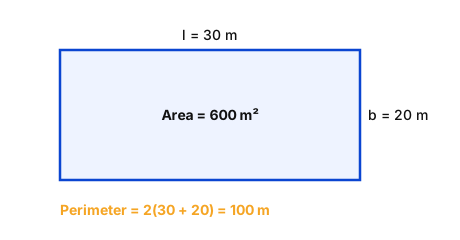
The breadth of a rectangular field is 23 of its length. Its area is 600 m2. Find the cost of fencing it all around at the cost of ₹200/m.
एक आयताकार खेत की चौड़ाई उसकी लंबाई की 23 है। इसका क्षेत्रफल 600 m2 है। ₹200/m की दर से इसके चारों ओर बाड़ लगाने की लागत ज्ञात कीजिए।
  1. A₹30,000
  2. B₹20,000
  3. C₹32,000
  4. D₹26,000
Show answer

Concept: Area =l×b, fencing cost depends on the perimeter 2(l+b).

  1. b=23l⇒l×23l=600⇒l2=900⇒l=30 m, b=20 m.
  2. Perimeter =2(30+20)=100 m.
  3. Cost =100×200= ₹20,000.

Trick: Ratio 3:2 with area 600 ⇒ 6x2=600, x=10 ⇒ sides 30 and 20.

Answer: (B) ₹20,000

अवधारणा: क्षेत्रफल =l×b, बाड़ लगाने की लागत परिमाप 2(l+b) पर निर्भर करती है।

  1. b=23l⇒l×23l=600⇒l2=900⇒l=30 m, b=20 m।
  2. परिमाप =2(30+20)=100 m।
  3. लागत =100×200= ₹20,000।

ट्रिक: अनुपात 3:2 और क्षेत्रफल 600 ⇒ 6x2=600, x=10 ⇒ भुजाएँ 30 और 20।

उत्तर: (B) ₹20,000

RRB NTPC Graduate CBT 1MathematicsMensuration – rectangleRRB NTPC Graduate CBT 1 2025 · 24 Mar Shift 3 →
Q5336.
Find the area of the rectangle with length 10 cm and width 5 cm. (Round off the answer to 2 decimal places.)
10 cm लंबाई और 5 cm चौड़ाई वाले आयत का क्षेत्रफल ज्ञात कीजिए। (उत्तर को 2 दशमलव स्थानों तक पूर्णांकित कीजिए।)
  1. A17.58 sq. cm.17.58 वर्ग cm
  2. B18.52 sq. cm.18.52 वर्ग cm
  3. C15.98 sq. cm.15.98 वर्ग cm
  4. D22.36 sq. cm.22.36 वर्ग cm
Show answer

Concept: Area of a rectangle =length×width.

  1. Area =10×5 sq. cm.
  2. 5≈2.236, so area =10×2.236=22.36 sq. cm.

Yaad rakhein: 2≈1.414, 3≈1.732, 5≈2.236 – multiplying by 10 only shifts the decimal point.

Answer: (D) 22.36 sq. cm.

अवधारणा: आयत का क्षेत्रफल =लंबाई×चौड़ाई।

  1. क्षेत्रफल =10×5 वर्ग सेमी।
  2. 5≈2.236, अतः क्षेत्रफल =10×2.236=22.36 वर्ग सेमी।

याद रखें: 2≈1.414, 3≈1.732, 5≈2.236 – 10 से गुणा करने पर केवल दशमलव खिसकता है।

उत्तर: (D) 22.36 sq. cm.

RRB NTPC Graduate CBT 1MathematicsArea of rectangleRRB NTPC Graduate CBT 1 2025 · 24 Mar Shift 3 →
Q5337.
A car runs for 10 hours and Its speed during the ith hour is i3 km per hour, where i=1,2,3...,10. The average speed of the car for the journey is _____ km per hour.
एक कार 10 घंटे चलती है और iवें घंटे के दौरान इसकी गति i3 km प्रति घंटा है, जहाँ i=1,2,3...,10 है। यात्रा के लिए कार की औसत गति _____ km प्रति घंटा है।
  1. A350.2
  2. B305.2
  3. C302.5
  4. D320.5
Show answer

Concept: When each hour is of equal duration, average speed =total distancetotal time=sum of hourly speedsnumber of hours.

  1. Distance in the ith hour =i3 km, so total distance =13+23+…+103.
  2. ∑i3=[n(n+1)2]2=(10×112)2=552=3025 km.
  3. Average speed =302510=302.5km/h.

Trick: Sum of first n cubes = (sum of first n numbers)2; for n=10 that is 552=3025.

Answer: (C) 302.5

अवधारणा: जब हर घंटा बराबर अवधि का हो, औसत चाल =कुल दूरीकुल समय=घंटेवार चालों का योगघंटों की संख्या।

  1. iवें घंटे में दूरी =i3 km, अतः कुल दूरी =13+23+…+103।
  2. ∑i3=[n(n+1)2]2=(10×112)2=552=3025 km।
  3. औसत चाल =302510=302.5km/h।

ट्रिक: पहले n घनों का योग = (पहली n संख्याओं का योग)2; n=10 के लिए 552=3025।

उत्तर: (C) 302.5

RRB NTPC Graduate CBT 1MathematicsAverage speedRRB NTPC Graduate CBT 1 2025 · 24 Mar Shift 3 →
Q5338.
The average marks of 17 students in a class is 40. If the marks of each student are doubled, find the new average.
एक कक्षा के 17 विद्यार्थियों के औसत अंक 40 हैं। यदि प्रत्येक विद्यार्थी के अंक दुगुने कर दिए जाएँ, तो नया औसत ज्ञात कीजिए।
  1. A80
  2. B17
  3. C40
  4. D34
Show answer

Concept: If every observation is multiplied by k, the average is also multiplied by k.

  1. Original average =40, each mark doubled → k=2.
  2. New average =2×40=80 (the number of students, 17, does not matter).

Trick: Add/subtract a constant → average shifts by it; multiply/divide → average scales by it.

Answer: (A) 80

अवधारणा: यदि हर प्रेक्षण को k से गुणा करें तो औसत भी k गुना हो जाता है।

  1. मूल औसत =40, हर अंक दोगुना → k=2।
  2. नया औसत =2×40=80 (छात्रों की संख्या 17 का कोई असर नहीं)।

ट्रिक: स्थिरांक जोड़ें/घटाएँ → औसत उतना खिसकता है; गुणा/भाग करें → औसत उतने गुना बदलता है।

उत्तर: (A) 80

RRB NTPC Graduate CBT 1MathematicsAverage – scalingRRB NTPC Graduate CBT 1 2025 · 24 Mar Shift 3 →
Q5339.
A typist takes 40 minutes to type 2 pages. How long (in minutes) will he take to type 95 pages?
एक टाइपिस्ट 2 पृष्ठ टाइप करने में 40 मिनट लेता है। 95 पृष्ठ टाइप करने में उसे कितना समय (मिनटों में) लगेगा?
  1. A1905
  2. B1890
  3. C1910
  4. D1900
Show answer

Concept: Time is directly proportional to the number of pages at a constant typing rate.

  1. Time per page =402=20 minutes.
  2. Time for 95 pages =95×20=1900 minutes.

Trick: 95×20=(100−5)×20=2000−100=1900.

Answer: (D) 1900

अवधारणा: टाइपिंग की दर स्थिर हो तो समय पृष्ठों की संख्या के समानुपाती होता है।

  1. प्रति पृष्ठ समय =402=20 मिनट।
  2. 95 पृष्ठों का समय =95×20=1900 मिनट।

ट्रिक: 95×20=(100−5)×20=2000−100=1900।

उत्तर: (D) 1900

RRB NTPC Graduate CBT 1MathematicsUnitary methodRRB NTPC Graduate CBT 1 2025 · 24 Mar Shift 3 →
Q5340.
If the ratio of the ages of A and B is 3 : 5, the ratio of the ages of B and C is 2 : 3, and the ratio of the ages of C and D is 3 : 4, what is the ratio of the ages of A and D?
यदि A और B की आयु का अनुपात 3 : 5, B और C की आयु का अनुपात 2 : 3 तथा C और D की आयु का अनुपात 3 : 4 है, तो A और D की आयु का अनुपात क्या है?
  1. A5 : 11
  2. B3 : 13
  3. C7 : 10
  4. D3 : 10
Show answer

Concept: To combine ratios, make the common term equal in both.

  1. A:B=3:5 and B:C=2:3 → make B =10: A:B:C=6:10:15.
  2. C:D=3:4 → make C =15: C:D=15:20, so A:B:C:D=6:10:15:20.
  3. A:D=6:20=3:10.

Trick: AD=AB×BC×CD=35×23×34=310.

Answer: (D) 3 : 10

अवधारणा: अनुपात जोड़ने के लिए उभयनिष्ठ पद को दोनों में बराबर करें।

  1. A:B=3:5 और B:C=2:3 → B =10 करें: A:B:C=6:10:15।
  2. C:D=3:4 → C =15 करें: C:D=15:20, अतः A:B:C:D=6:10:15:20।
  3. A:D=6:20=3:10।

ट्रिक: AD=AB×BC×CD=35×23×34=310।

उत्तर: (D) 3 : 10

RRB NTPC Graduate CBT 1MathematicsChain ratioRRB NTPC Graduate CBT 1 2025 · 24 Mar Shift 3 →