Question bank

Q&A: practice questions with answers

Search questions on any topic. Filter by exam category, exam, subject and topic, try the question, then open the answer and explanation.

Courses – airGurukul

7,077 questions found.

Q5341.
Find the mode of the following distribution.
Class interval10–1515–2020–2525–3030–3535–40
Frequency304872362418
निम्नलिखित बंटन का बहुलक ज्ञात कीजिए।
वर्ग अंतराल10–1515–2020–2525–3030–3535–40
बारंबारता304872362418
  1. A24.25
  2. B22
  3. C22.5
  4. D25
Show answer

Concept: Mode =l+f1−f02f1−f0−f2×h, where l = lower limit of the modal class, f1 its frequency, f0 and f2 the frequencies of the classes before and after, h = class width.

  1. Highest frequency 72 → modal class 20–25: l=20, f1=72, f0=48, f2=36, h=5.
  2. Mode =20+72−48144−48−36×5=20+2460×5.
  3. =20+2=22.

Trick: The mode always lies inside the modal class (here 20–25) – options 24.25, 25 are out at once; a quick check between 22 and 22.5 decides.

Answer: (B) 22

अवधारणा: बहुलक (mode) =l+f1−f02f1−f0−f2×h, जहाँ l = बहुलक वर्ग की निचली सीमा, f1 उसकी बारंबारता, f0, f2 पहले व बाद के वर्गों की बारंबारताएँ, h = वर्ग-चौड़ाई।

  1. सबसे अधिक बारंबारता 72 → बहुलक वर्ग 20–25: l=20, f1=72, f0=48, f2=36, h=5।
  2. बहुलक =20+72−48144−48−36×5=20+2460×5।
  3. =20+2=22।

ट्रिक: बहुलक हमेशा बहुलक वर्ग (यहाँ 20–25) के अंदर होता है – 24.25 और 25 तुरंत बाहर; 22 व 22.5 में गणना से निर्णय।

उत्तर: (B) 22
RRB NTPC Graduate CBT 1MathematicsMode of grouped dataRRB NTPC Graduate CBT 1 2025 · 24 Mar Shift 3 →
Q5342.
If 2cosecA=3secA, then find the value of (1−cosA)(1+cosA)(1−sinA)(1+sinA).
यदि 2cosecA=3secA है, तो (1−cosA)(1+cosA)(1−sinA)(1+sinA) का मान ज्ञात कीजिए।
  1. A413
  2. B49
  3. C139
  4. D23
Show answer

Concept: (1−cosA)(1+cosA)=1−cos2A=sin2A and (1−sinA)(1+sinA)=cos2A.

  1. 2cosecA=3secA⇒2sinA=3cosA⇒tanA=23.
  2. Required expression =sin2Acos2A=tan2A.
  3. =(23)2=49.

Trick: acosecA=bsecA⇒tanA=ab; products like (1−x)(1+x) always collapse to 1−x2.

Answer: (B) 49

अवधारणा: (1−cosA)(1+cosA)=1−cos2A=sin2A तथा (1−sinA)(1+sinA)=cos2A।

  1. 2cosecA=3secA⇒2sinA=3cosA⇒tanA=23।
  2. अभीष्ट व्यंजक =sin2Acos2A=tan2A।
  3. =(23)2=49।

ट्रिक: acosecA=bsecA⇒tanA=ab; (1−x)(1+x) जैसे गुणनफल हमेशा 1−x2 बन जाते हैं।

उत्तर: (B) 49

RRB NTPC Graduate CBT 1MathematicsTrigonometric identitiesRRB NTPC Graduate CBT 1 2025 · 24 Mar Shift 3 →
Q5343.
Priyanshi wants to solve the expression:
3.6+54×2.4−12
What is the value of the expression?
प्रियांशी निम्नलिखित व्यंजक को हल करना चाहती है:
3.6+54×2.4−12
व्यंजक का मान क्या है?
  1. A6.1
  2. B6.5
  3. C7.5
  4. D7.1
Show answer

Concept: BODMAS – do multiplication before addition and subtraction.

  1. 54×2.4=1.25×2.4=3.
  2. 3.6+3−12=6.6−0.5=6.1.

Trick: 54×2.4=5×2.44=124=3 – cancel before multiplying.

Answer: (A) 6.1

अवधारणा: BODMAS – जोड़-घटाव से पहले गुणा करें।

  1. 54×2.4=1.25×2.4=3।
  2. 3.6+3−12=6.6−0.5=6.1।

ट्रिक: 54×2.4=5×2.44=124=3 – गुणा से पहले काटें।

उत्तर: (A) 6.1

RRB NTPC Graduate CBT 1MathematicsBODMASRRB NTPC Graduate CBT 1 2025 · 24 Mar Shift 3 →
Q5344.
There are 45 members in group A, 31 members in group B and 48 members in group C. All the members of these groups went to a restaurant. The average amounts spent on each member of groups A, B and C are ₹295, ₹311 and ₹233, respectively. The overall average amount (in ₹) spent per member is:
समूह A में 45 सदस्य, समूह B में 31 सदस्य और समूह C में 48 सदस्य हैं। इन समूहों के सभी सदस्य एक रेस्तरां में गए। समूह A, B और C के प्रत्येक सदस्य पर खर्च की गई औसत राशि क्रमशः ₹295, ₹311 और ₹233 है। प्रति सदस्य खर्च की गई कुल औसत राशि (₹ में) है:
  1. A276
  2. B273
  3. C275
  4. D272
Show answer

Concept: Overall average =total amounttotal members.

  1. Totals: 45×295=13275, 31×311=9641, 48×233=11184.
  2. Sum =13275+9641+11184=34100; members =45+31+48=124.
  3. Average =34100124=275.

Trick: Take 275 as base: deviations 45×20=900, 31×36=1116, 48×(−42)=−2016 → total 0, so the average is exactly 275.

Answer: (C) 275

अवधारणा: कुल औसत =कुल राशिकुल सदस्य।

  1. कुल: 45×295=13275, 31×311=9641, 48×233=11184।
  2. योग =13275+9641+11184=34100; सदस्य =45+31+48=124।
  3. औसत =34100124=275।

ट्रिक: 275 को आधार मानें: विचलन 45×20=900, 31×36=1116, 48×(−42)=−2016 → योग 0, अतः औसत ठीक 275।

उत्तर: (C) 275

RRB NTPC Graduate CBT 1MathematicsWeighted averageRRB NTPC Graduate CBT 1 2025 · 24 Mar Shift 3 →
Q5345.
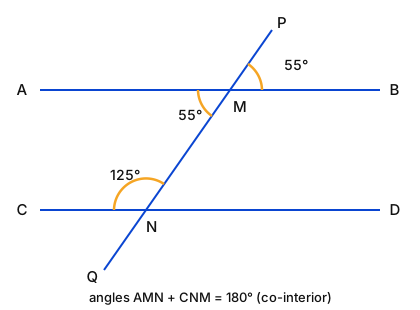
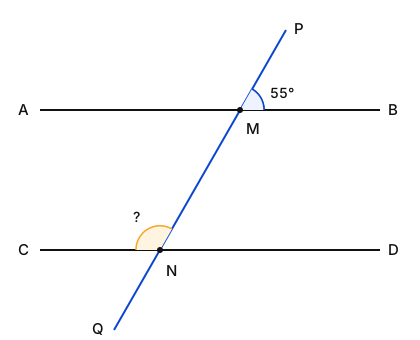
Two parallel lines AB ∥ CD are cut by a transversal line PQ, as shown in the figure. If the angle ∠PMB=55° then find the angle ∠CNM.
दो समांतर रेखाएँ AB ∥ CD एक तिर्यक रेखा PQ द्वारा काटी जाती हैं, जैसा कि चित्र में दिखाया गया है। यदि कोण ∠PMB=55° है, तो कोण ∠CNM ज्ञात कीजिए।
  1. A75°
  2. B125°
  3. C60°
  4. D55°
Show answer

Concept: When a transversal cuts parallel lines, co-interior (same-side interior) angles add up to 180∘; vertically opposite angles are equal.

  1. ∠AMN is vertically opposite to ∠PMB, so ∠AMN=55∘.
  2. ∠AMN and ∠CNM lie between AB and CD on the same side of PQ → co-interior.
  3. ∠CNM=180∘−55∘=125∘.

Trick: With parallel lines every angle at the two crossings is either x or 180∘−x; ∠CNM is the obtuse one, so 125∘.

Answer: (B) 125°

अवधारणा: तिर्यक रेखा समांतर रेखाओं को काटे तो सह-अंतःकोण (co-interior) का योग 180∘ होता है; शीर्षाभिमुख कोण बराबर होते हैं।

  1. ∠AMN, ∠PMB का शीर्षाभिमुख कोण है, अतः ∠AMN=55∘।
  2. ∠AMN और ∠CNM AB व CD के बीच, PQ के एक ही ओर हैं → सह-अंतःकोण।
  3. ∠CNM=180∘−55∘=125∘।

ट्रिक: समांतर रेखाओं में दोनों कटान बिंदुओं पर हर कोण या तो x या 180∘−x होता है; ∠CNM अधिक कोण है, अतः 125∘।

उत्तर: (B) 125°

RRB NTPC Graduate CBT 1MathematicsParallel lines – anglesRRB NTPC Graduate CBT 1 2025 · 24 Mar Shift 3 →
Q5346.
Ashish has ₹1404 with him. He divides this amount between his two sons, Arun and Mahesh, and asks them to invest their respective shares at a compound interest rate of 8% per annum, compounded annually. It is observed that Arun’s investment amounts to the same value after 17 years as Mahesh’s investment does after 18 years. How much (in ₹) did Ashish give to Mahesh?
आशीष के पास ₹1404 हैं। वह इस राशि को अपने दो पुत्रों, अरुण और महेश, के बीच बाँटता है और उन्हें अपने-अपने हिस्से को 8% वार्षिक चक्रवृद्धि ब्याज की दर पर, वार्षिक रूप से संयोजित, निवेश करने को कहता है। यह देखा गया कि अरुण का निवेश 17 वर्षों बाद उतनी ही राशि हो जाता है जितनी महेश का निवेश 18 वर्षों बाद होता है। आशीष ने महेश को कितनी राशि (₹ में) दी?
  1. A675
  2. B525
  3. C729
  4. D829
Show answer

Concept: If amounts become equal after different periods, the ratio of principals is the inverse ratio of the growth factors.

  1. A(1.08)17=M(1.08)18⇒AM=1.08=2725.
  2. Total parts =27+25=52; 140452=27.
  3. Mahesh's share =25×27=675.

Trick: Periods differing by 1 year → shares are in the ratio (100+r):100; for 8% that is 27:25.

Answer: (A) 675

अवधारणा: यदि मिश्रधन अलग-अलग अवधि के बाद बराबर हों तो मूलधनों का अनुपात वृद्धि-गुणकों का व्युत्क्रम अनुपात होता है।

  1. A(1.08)17=M(1.08)18⇒AM=1.08=2725।
  2. कुल भाग =27+25=52; 140452=27।
  3. महेश का हिस्सा =25×27=675।

ट्रिक: अवधि में 1 वर्ष का अंतर → हिस्से (100+r):100 में; 8% पर 27:25।

उत्तर: (A) 675

RRB NTPC Graduate CBT 1MathematicsCompound interest – divisionRRB NTPC Graduate CBT 1 2025 · 24 Mar Shift 3 →
Q5347.
Piyush bought an article for ₹331 and sold it to Payal at a loss of 5%. With this amount, Piyush bought another article and sold it at a gain of 60%. What is Piyush's overall gain percentage?
पीयूष ने ₹331 में एक वस्तु खरीदी और उसे 5% की हानि पर पायल को बेच दिया। इस राशि से पीयूष ने एक अन्य वस्तु खरीदी और उसे 60% के लाभ पर बेच दिया। पीयूष का कुल लाभ प्रतिशत क्या है?
  1. A50%
  2. B52%
  3. C47%
  4. D48%
Show answer

Concept: Successive changes multiply: overall factor =(1−5100)(1+60100).

  1. After 5% loss: 331×0.95=314.45; this is reinvested.
  2. After 60% gain: 314.45×1.6=503.12.
  3. Overall gain =503.12−331331×100=172.12331×100=52%.

Trick: 0.95×1.6=1.52 → 52% gain directly; the ₹331 is irrelevant.

Answer: (B) 52%

अवधारणा: क्रमिक परिवर्तन गुणा होते हैं: कुल गुणक =(1−5100)(1+60100)।

  1. 5% हानि के बाद: 331×0.95=314.45; यही फिर लगाया।
  2. 60% लाभ के बाद: 314.45×1.6=503.12।
  3. कुल लाभ =503.12−331331×100=172.12331×100=52%।

ट्रिक: 0.95×1.6=1.52 → सीधे 52% लाभ; ₹331 की ज़रूरत ही नहीं।

उत्तर: (B) 52%

RRB NTPC Graduate CBT 1MathematicsSuccessive profit/lossRRB NTPC Graduate CBT 1 2025 · 24 Mar Shift 3 →
Q5348.
Refer to the following letter, symbol series and answer the question. Counting to be done from left to right only
(Left) B R © # # # W & S @ Z @ @ A & L @ @ I © O © (Right)
How many such letters are there each of which is immediately preceded by a letter and also immediately followed by a symbol?
निम्नलिखित अक्षर, प्रतीक श्रृंखला को देखिए और प्रश्न का उत्तर दीजिए। गिनती केवल बाएँ से दाएँ की ओर की जानी है
(बाएँ) B R © # # # W & S @ Z @ @ A & L @ @ I © O © (दाएँ)
ऐसे कितने अक्षर हैं जिनमें से प्रत्येक के ठीक पहले एक अक्षर है और ठीक बाद एक प्रतीक है?
  1. A2
  2. B1
  3. C0
  4. D3
Show answer

Concept: We need the pattern letter – LETTER – symbol: the middle letter must have a letter on its left and a symbol on its right.

  1. Series: B R © # # # W & S @ Z @ @ A & L @ @ I © O ©
  2. Scan each letter: R has B before and © after ✓.
  3. W, S, Z, A, L, I, O all have a symbol just before them ✗.

Trick: Only look at letters that come in pairs (two letters side by side); here only 'B R' qualifies, then check the right side.

Answer: (B) 1

अवधारणा: हमें पैटर्न अक्षर – अक्षर – प्रतीक चाहिए: बीच वाले अक्षर के बाएँ अक्षर और दाएँ प्रतीक हो।

  1. श्रृंखला: B R © # # # W & S @ Z @ @ A & L @ @ I © O ©
  2. हर अक्षर जाँचें: R के पहले B और बाद में © है ✓।
  3. W, S, Z, A, L, I, O सबके ठीक पहले प्रतीक है ✗।

ट्रिक: केवल वहीं देखें जहाँ दो अक्षर साथ-साथ हों; यहाँ सिर्फ 'B R' है, फिर दाईं ओर जाँचें।

उत्तर: (B) 1

RRB NTPC Graduate CBT 1General Intelligence and ReasoningLetter–symbol seriesRRB NTPC Graduate CBT 1 2025 · 24 Mar Shift 3 →
Q5349.
In the following number-pairs, the second number is obtained by applying certain mathematical operations to the first number. Select the set in which the numbers are related in the same way as are the numbers of the following sets.
(NOTE : Operations should be performed on the whole numbers, without breaking down the numbers into its constituent digits. E.g. 13 – Operations on 13 such as adding / subtracting /multiplying etc. to 13 can be performed. Breaking down 13 into 1 and 3 and then performing mathematical operations on 1 and 3 is not allowed)
17, 67
22, 87
निम्नलिखित संख्या-युग्मों में, दूसरी संख्या पहली संख्या पर कुछ गणितीय संक्रियाएँ करके प्राप्त की गई है। उस समुच्चय का चयन कीजिए जिसमें संख्याएँ उसी प्रकार संबंधित हैं जैसे निम्नलिखित समुच्चयों की संख्याएँ संबंधित हैं।
(नोट: संक्रियाएँ पूर्ण संख्याओं पर की जानी चाहिए, संख्याओं को उनके घटक अंकों में तोड़े बिना। उदाहरण के लिए 13 – 13 पर संक्रियाएँ जैसे 13 में जोड़ना/घटाना/गुणा करना आदि की जा सकती हैं। 13 को 1 और 3 में तोड़कर फिर 1 और 3 पर गणितीय संक्रियाएँ करने की अनुमति नहीं है)
17, 67
22, 87
  1. A24, 98
  2. B25, 99
  3. C24, 99
  4. D25, 98
Show answer

Concept: Find one operation on the whole first number that gives the second.

  1. 17×4−1=67 ✓; 22×4−1=87 ✓. Rule: second =4× first −1.
  2. Check options: 24×4−1=95 (not 98 or 99); 25×4−1=99 ✓.

Trick: Second number is always odd and just under a multiple of 4 (68, 88, 100) → 25, 99.

Answer: (B) 25, 99

अवधारणा: पहली पूरी संख्या पर ऐसी एक संक्रिया खोजें जिससे दूसरी मिले।

  1. 17×4−1=67 ✓; 22×4−1=87 ✓। नियम: दूसरी =4× पहली −1।
  2. विकल्प जाँचें: 24×4−1=95 (98 या 99 नहीं); 25×4−1=99 ✓।

ट्रिक: दूसरी संख्या हमेशा विषम और 4 के गुणज (68, 88, 100) से 1 कम → 25, 99।

उत्तर: (B) 25, 99

RRB NTPC Graduate CBT 1General Intelligence and ReasoningNumber analogyRRB NTPC Graduate CBT 1 2025 · 24 Mar Shift 3 →
Q5350.
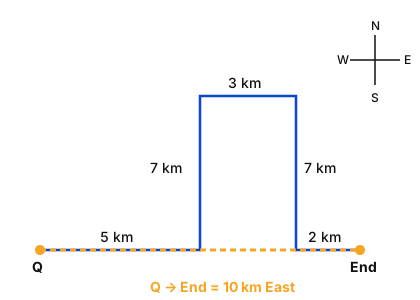
Sneha starts from Point Q, walks 5 km East, turns left and walks 7 km, turns right and walks 3 km, turns right and walks 7 km, then turns left and walks 2 km. How far and in which direction is she from Point Q? (All turns are 90-degree turns only unless specified.)
स्नेहा बिंदु Q से चलना शुरू करती है, 5 km पूर्व की ओर चलती है, बाएँ मुड़कर 7 km चलती है, दाएँ मुड़कर 3 km चलती है, दाएँ मुड़कर 7 km चलती है, फिर बाएँ मुड़कर 2 km चलती है। वह बिंदु Q से कितनी दूर और किस दिशा में है? (जब तक अन्यथा न कहा जाए, सभी मोड़ केवल 90 डिग्री के मोड़ हैं।)
  1. A5 km towards South5 km दक्षिण की ओर
  2. B10 km towards East10 km पूर्व की ओर
  3. C2 km towards West2 km पश्चिम की ओर
  4. D7 km towards North7 km उत्तर की ओर
Show answer

Concept: Track the position on a grid: East = +x, North = +y. Start Q = (0, 0).

  1. 5 km East → (5, 0); turn left (North) 7 km → (5, 7).
  2. Turn right (East) 3 km → (8, 7); turn right (South) 7 km → (8, 0).
  3. Turn left (East) 2 km → (10, 0).
  4. Final point is 10 km due East of Q.

Trick: The 7 km North and 7 km South cancel; East distances add: 5+3+2=10 km.

Answer: (B) 10 km towards East

अवधारणा: ग्रिड पर स्थिति ट्रैक करें: पूर्व = +x, उत्तर = +y। प्रारंभ Q = (0, 0)।

  1. 5 km पूर्व → (5, 0); बाएँ (उत्तर) 7 km → (5, 7)।
  2. दाएँ (पूर्व) 3 km → (8, 7); दाएँ (दक्षिण) 7 km → (8, 0)।
  3. बाएँ (पूर्व) 2 km → (10, 0)।
  4. अंतिम बिंदु Q से ठीक 10 km पूर्व में है।

ट्रिक: 7 km उत्तर और 7 km दक्षिण कट जाते हैं; पूर्व की दूरियाँ जुड़ती हैं: 5+3+2=10 km।

उत्तर: (B) 10 km towards East

RRB NTPC Graduate CBT 1General Intelligence and ReasoningDirection and distanceRRB NTPC Graduate CBT 1 2025 · 24 Mar Shift 3 →
Q5351.
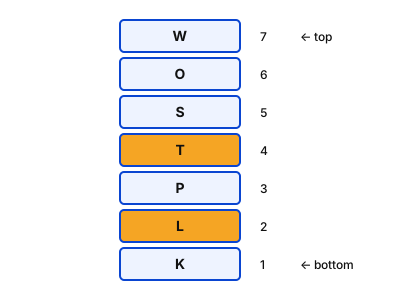
Seven boxes, K, L, O, P, S, T and W are kept one over the other but not necessarily in the same order. Only three boxes are kept below T. Only one box is kept between O and T. Only two boxes are kept between T and W. Only W is kept above O. S is kept immediately below O. L is kept at one of the places above K and at one of the places below P. How many boxes are kept between T and L?
सात बक्से, K, L, O, P, S, T और W एक के ऊपर एक रखे गए हैं, लेकिन आवश्यक नहीं कि इसी क्रम में हों। T के नीचे केवल तीन बक्से रखे हैं। O और T के बीच केवल एक बक्सा रखा है। T और W के बीच केवल दो बक्से रखे हैं। O के ऊपर केवल W रखा है। S, O के ठीक नीचे रखा है। L, K के ऊपर किसी एक स्थान पर और P के नीचे किसी एक स्थान पर रखा है। T और L के बीच कितने बक्से रखे हैं?
  1. AThreeतीन
  2. BTwoदो
  3. CFourचार
  4. DOneएक
Show answer

Concept: Number positions 1 (bottom) to 7 (top) and place the fixed boxes first.

  1. Three boxes below T ⇒ T = 4. One box between O and T ⇒ O = 2 or 6; only W above O ⇒ O = 6, W = 7 (and W is two places from T ✓).
  2. S immediately below O ⇒ S = 5.
  3. Remaining 1, 2, 3 for K, L, P with P above L above K ⇒ K = 1, L = 2, P = 3.
  4. Between T (4) and L (2) is only P.

Trick: "Only W is above O" fixes the top two boxes at once – start from such definite clues.

Answer: (D) One

अवधारणा: स्थान 1 (नीचे) से 7 (ऊपर) तक गिनें और पहले निश्चित बॉक्स रखें।

  1. T के नीचे तीन बॉक्स ⇒ T = 4। O और T के बीच एक ⇒ O = 2 या 6; O के ऊपर केवल W ⇒ O = 6, W = 7 (W, T से दो स्थान दूर ✓)।
  2. S, O के ठीक नीचे ⇒ S = 5।
  3. बचे 1, 2, 3 में K, L, P; P ऊपर, फिर L, फिर K ⇒ K = 1, L = 2, P = 3।
  4. T (4) और L (2) के बीच केवल P।

ट्रिक: "O के ऊपर केवल W" से ऊपर के दो बॉक्स तुरंत तय हो जाते हैं – ऐसे निश्चित सुरागों से शुरू करें।

उत्तर: (D) One

RRB NTPC Graduate CBT 1General Intelligence and ReasoningBox arrangement (stacking)RRB NTPC Graduate CBT 1 2025 · 24 Mar Shift 3 →
Q5352.
WXPL is related to VZMP in a certain way based on the English alphabetical order. In the same way, ZUQH is related to YWNL. To which of the following is TRKF related, following the same logic?
अंग्रेज़ी वर्णमाला क्रम के आधार पर WXPL एक निश्चित तरीके से VZMP से संबंधित है। इसी प्रकार, ZUQH, YWNL से संबंधित है। उसी तर्क का अनुसरण करते हुए, TRKF निम्नलिखित में से किससे संबंधित है?
  1. ARTFL
  2. BSTHJ
  3. CUPNB
  4. DSUGK
Show answer

Concept: Compare each letter position-wise and find the shift pattern.

  1. WXPL → VZMP: W−1=V, X+2=Z, P−3=M, L+4=P. Pattern: −1,+2,−3,+4.
  2. ZUQH → YWNL: Z−1=Y, U+2=W, Q−3=N, H+4=L ✓.
  3. TRKF: T−1=S, R+2=T, K−3=H, F+4=J → STHJ.

Trick: Alternating signs with growing size: −1,+2,−3,+4.

Answer: (B) STHJ

अवधारणा: हर अक्षर की स्थिति मिलाकर शिफ्ट पैटर्न खोजें।

  1. WXPL → VZMP: W−1=V, X+2=Z, P−3=M, L+4=P। पैटर्न: −1,+2,−3,+4।
  2. ZUQH → YWNL: Z−1=Y, U+2=W, Q−3=N, H+4=L ✓।
  3. TRKF: T−1=S, R+2=T, K−3=H, F+4=J → STHJ।

ट्रिक: बारी-बारी चिह्न और बढ़ता आकार: −1,+2,−3,+4।

उत्तर: (B) STHJ

RRB NTPC Graduate CBT 1General Intelligence and ReasoningLetter-cluster analogyRRB NTPC Graduate CBT 1 2025 · 24 Mar Shift 3 →
Q5353.
HEGK is related to DBEJ in a certain way based on the English alphabetical order. In the same way, ILNP is related to EILO. To which of the following is FMRT related, following the same logic?
अंग्रेज़ी वर्णमाला क्रम के आधार पर HEGK एक निश्चित तरीके से DBEJ से संबंधित है। इसी प्रकार, ILNP, EILO से संबंधित है। उसी तर्क का अनुसरण करते हुए, FMRT निम्नलिखित में से किससे संबंधित है?
  1. AAIOS
  2. BDLRS
  3. CCKQS
  4. DBJPS
Show answer

Concept: Find the position-wise shift from the first cluster to the second.

  1. HEGK → DBEJ: H−4=D, E−3=B, G−2=E, K−1=J. Pattern: −4,−3,−2,−1.
  2. ILNP → EILO: I−4=E, L−3=I, N−2=L, P−1=O ✓.
  3. FMRT: F−4=B, M−3=J, R−2=P, T−1=S → BJPS.

Trick: Shifts decrease 4,3,2,1 – all backwards.

Answer: (D) BJPS

अवधारणा: पहले समूह से दूसरे तक स्थिति-वार शिफ्ट खोजें।

  1. HEGK → DBEJ: H−4=D, E−3=B, G−2=E, K−1=J। पैटर्न: −4,−3,−2,−1।
  2. ILNP → EILO: I−4=E, L−3=I, N−2=L, P−1=O ✓।
  3. FMRT: F−4=B, M−3=J, R−2=P, T−1=S → BJPS।

ट्रिक: शिफ्ट 4,3,2,1 घटते हुए – सब पीछे की ओर।

उत्तर: (D) BJPS

RRB NTPC Graduate CBT 1General Intelligence and ReasoningLetter-cluster analogyRRB NTPC Graduate CBT 1 2025 · 24 Mar Shift 3 →
Q5354.
If ‘A’ stands for ‘÷’, ‘B’ stands for ‘×’, ‘C’ stands for ‘+’ and ‘D’ stands for ‘−’, then what will come in place of the question mark (?) in the following equation?
25 A 5 B 7 C 9 D 2 = ?
यदि ‘A’ का अर्थ ‘÷’, ‘B’ का अर्थ ‘×’, ‘C’ का अर्थ ‘+’ और ‘D’ का अर्थ ‘−’ है, तो निम्नलिखित समीकरण में प्रश्नचिह्न (?) के स्थान पर क्या आएगा?
25 A 5 B 7 C 9 D 2 = ?
  1. A41
  2. B40
  3. C43
  4. D42
Show answer

Concept: Replace the letters by the given operators and apply BODMAS.

  1. 25 A 5 B 7 C 9 D 2 =25÷5×7+9−2.
  2. 25÷5=5; 5×7=35.
  3. 35+9−2=42.

Trick: Write the substituted expression first, then solve ÷ and × left to right before + and −.

Answer: (D) 42

अवधारणा: अक्षरों की जगह दिए गए चिह्न रखें और BODMAS लगाएँ।

  1. 25 A 5 B 7 C 9 D 2 =25÷5×7+9−2।
  2. 25÷5=5; 5×7=35।
  3. 35+9−2=42।

ट्रिक: पहले प्रतिस्थापित व्यंजक लिखें, फिर + और − से पहले ÷ और × बाएँ से दाएँ हल करें।

उत्तर: (D) 42

RRB NTPC Graduate CBT 1General Intelligence and ReasoningMathematical operations (symbol substitution)RRB NTPC Graduate CBT 1 2025 · 24 Mar Shift 3 →
Q5355.
What should come in place of ‘?’ in the given series?
81 80 76 67 51 ?
दी गई श्रृंखला में ‘?’ के स्थान पर क्या आना चाहिए?
81 80 76 67 51 ?
  1. A25
  2. B26
  3. C24
  4. D27
Show answer

Concept: Look at the differences between consecutive terms.

  1. 81→80→76→67→51: differences 1, 4, 9, 16.
  2. These are 12,22,32,42; next difference =52=25.
  3. 51−25=26.

Trick: Decreasing series with gaps 1,4,9,16,… → subtract perfect squares.

Answer: (B) 26

अवधारणा: क्रमागत पदों के अंतर देखें।

  1. 81→80→76→67→51: अंतर 1, 4, 9, 16।
  2. ये 12,22,32,42 हैं; अगला अंतर =52=25।
  3. 51−25=26।

ट्रिक: घटती श्रृंखला में अंतर 1,4,9,16,… → पूर्ण वर्ग घटाएँ।

उत्तर: (B) 26

RRB NTPC Graduate CBT 1General Intelligence and ReasoningNumber seriesRRB NTPC Graduate CBT 1 2025 · 24 Mar Shift 3 →
Q5356.
6 is related to 80 following a certain logic. Following the same logic, 12 is related to 140. To which of the following is 24 related, following the same logic?
(NOTE: Operations should be performed on the whole numbers, without breaking down the numbers into their constituent digits. E.g. 13 – Operations on 13 such as adding/ subtracting /multiplying to 13 can be performed. Breaking down 13 into 1 and 3 and then performing mathematical operations on 1 and 3 is not allowed.)
एक निश्चित तर्क के अनुसार 6, 80 से संबंधित है। उसी तर्क के अनुसार 12, 140 से संबंधित है। उसी तर्क का अनुसरण करते हुए, 24 निम्नलिखित में से किससे संबंधित है?
(नोट: संक्रियाएँ पूर्ण संख्याओं पर की जानी चाहिए, संख्याओं को उनके घटक अंकों में तोड़े बिना। उदाहरण के लिए 13 – 13 पर संक्रियाएँ जैसे 13 में जोड़ना/घटाना/गुणा करना की जा सकती हैं। 13 को 1 और 3 में तोड़कर फिर 1 और 3 पर गणितीय संक्रियाएँ करने की अनुमति नहीं है।)
  1. A280
  2. B270
  3. C260
  4. D290
Show answer

Concept: Find one rule on the whole number that works for both given pairs.

  1. 6→80: (6+2)×10=80 ✓.
  2. 12→140: (12+2)×10=140 ✓.
  3. 24→(24+2)×10=260.

Trick: Second number =10n+20; the results 80,140,260 all end in 0.

Answer: (C) 260

अवधारणा: पूरी संख्या पर एक ऐसा नियम खोजें जो दोनों दिए गए युग्मों पर लागू हो।

  1. 6→80: (6+2)×10=80 ✓।
  2. 12→140: (12+2)×10=140 ✓।
  3. 24→(24+2)×10=260।

ट्रिक: दूसरी संख्या =10n+20; 80,140,260 सब 0 पर समाप्त होते हैं।

उत्तर: (C) 260

RRB NTPC Graduate CBT 1General Intelligence and ReasoningNumber analogyRRB NTPC Graduate CBT 1 2025 · 24 Mar Shift 3 →
Q5357.
Based on the English alphabetical order, three of the following four are alike in a certain way and thus form a group. Which is the one that does not belong to that group? (Note: The odd man out is not based on the number of consonants/vowels or their position in the letter cluster)
अंग्रेज़ी वर्णमाला क्रम के आधार पर, निम्नलिखित चार में से तीन एक निश्चित तरीके से समान हैं और इस प्रकार एक समूह बनाते हैं। वह कौन-सा है जो उस समूह से संबंधित नहीं है? (नोट: असंगत का निर्धारण व्यंजनों/स्वरों की संख्या या अक्षर-समूह में उनकी स्थिति के आधार पर नहीं किया गया है)
  1. AJMP
  2. BILN
  3. CQTW
  4. DHKN
Show answer

Concept: Check the gaps between consecutive letters in each cluster.

  1. JMP: J+3=M, M+3=P → +3,+3.
  2. QTW: +3,+3; HKN: +3,+3.
  3. ILN: I+3=L, L+2=N → +3,+2 – breaks the pattern.

Trick: Three clusters have equal steps of 3; only ILN has a step of 2.

Answer: (B) ILN

अवधारणा: हर समूह में क्रमागत अक्षरों के अंतराल जाँचें।

  1. JMP: J+3=M, M+3=P → +3,+3।
  2. QTW: +3,+3; HKN: +3,+3।
  3. ILN: I+3=L, L+2=N → +3,+2 – पैटर्न टूटता है।

ट्रिक: तीन समूहों में 3-3 के समान कदम; केवल ILN में 2 का कदम।

उत्तर: (B) ILN

RRB NTPC Graduate CBT 1General Intelligence and ReasoningOdd one out (letter clusters)RRB NTPC Graduate CBT 1 2025 · 24 Mar Shift 3 →
Q5358.
In a certain code language,
V @ I means ‘ V is the husband of I',
V + I means ‘ V is the daughter of I',
V x I means ‘ V is the father of I', and
V - I means ‘ V is the mother of I'.
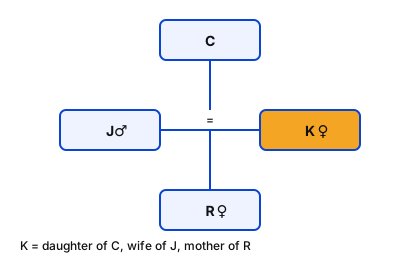
Based on the above, how is K related to R, if ‘R + J @ K + C '?
एक निश्चित कूट भाषा में,
V @ I का अर्थ है ‘V, I का पति है',
V + I का अर्थ है ‘V, I की पुत्री है',
V x I का अर्थ है ‘V, I का पिता है', और
V - I का अर्थ है ‘V, I की माता है'।
उपर्युक्त के आधार पर, यदि ‘R + J @ K + C ' है, तो K, R से किस प्रकार संबंधित है?
  1. ABrotherभाई
  2. BSisterबहन
  3. CMotherमाता
  4. DSonपुत्र
Show answer

Concept: Decode each symbol from left to right and build the family tree.

  1. R + J: R is the daughter of J.
  2. J @ K: J is the husband of K ⇒ K is a female, J's wife.
  3. K + C: K is the daughter of C (extra info).
  4. J is R's father and K is J's wife ⇒ K is R's mother.

Trick: Husband's child = wife's child; gender of K is fixed by "husband of K".

Answer: (C) Mother

अवधारणा: हर प्रतीक को बाएँ से दाएँ डिकोड कर परिवार-वृक्ष बनाएँ।

  1. R + J: R, J की बेटी है।
  2. J @ K: J, K का पति है ⇒ K महिला है, J की पत्नी।
  3. K + C: K, C की बेटी है (अतिरिक्त जानकारी)।
  4. J, R का पिता और K, J की पत्नी ⇒ K, R की माँ है।

ट्रिक: पति की संतान = पत्नी की संतान; "K का पति" से K का लिंग तय हो जाता है।

उत्तर: (C) Mother

RRB NTPC Graduate CBT 1General Intelligence and ReasoningBlood relations (coded)RRB NTPC Graduate CBT 1 2025 · 24 Mar Shift 3 →
Q5359.
Read the given statements and conclusions carefully. Assuming that the information given in the statements is true, even if it appears to be at variance with commonly known facts, decide which of the given conclusion(s) logically follow(s) from the statements.
Statements:
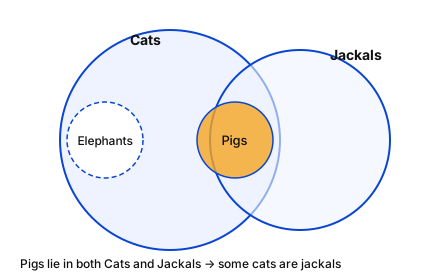
All pigs are jackals. All pigs are cats. All elephants are cats.
Conclusions:
(I) All elephants are jackals.
(II) Some cats are jackals.
दिए गए कथनों और निष्कर्षों को ध्यानपूर्वक पढ़िए। यह मानते हुए कि कथनों में दी गई जानकारी सत्य है, भले ही वह सामान्यतः ज्ञात तथ्यों से भिन्न प्रतीत होती हो, निर्णय कीजिए कि दिए गए निष्कर्षों में से कौन-सा/कौन-से निष्कर्ष कथनों का तार्किक रूप से अनुसरण करता है/करते हैं।
कथन:
सभी सूअर सियार हैं। सभी सूअर बिल्लियाँ हैं। सभी हाथी बिल्लियाँ हैं।
निष्कर्ष:
(I) सभी हाथी सियार हैं।
(II) कुछ बिल्लियाँ सियार हैं।
  1. AOnly conclusion (I) follows.केवल निष्कर्ष (I) अनुसरण करता है।
  2. BNeither conclusion (I) nor (II) follows.न तो निष्कर्ष (I) और न ही (II) अनुसरण करता है।
  3. CBoth conclusions (I) and (II) follow.निष्कर्ष (I) और (II) दोनों अनुसरण करते हैं।
  4. DOnly conclusion (II) follows.केवल निष्कर्ष (II) अनुसरण करता है।
Show answer

Concept: Draw a Venn diagram that satisfies all statements with the least overlap, then test each conclusion.

  1. All pigs are jackals and all pigs are cats ⇒ pigs lie inside both ⇒ cats and jackals definitely overlap ⇒ Some cats are jackals (II follows).
  2. All elephants are cats, but elephants can sit in the part of 'cats' outside 'jackals' ⇒ "All elephants are jackals" is not certain (I does not follow).

Trick: Two "All A are B" and "All A are C" statements always give "Some B are C"; a third class only linked to B gives nothing about C.

Answer: (D) Only conclusion (II) follows.

अवधारणा: सभी कथनों को न्यूनतम ओवरलैप के साथ संतुष्ट करने वाला वेन आरेख बनाएँ, फिर हर निष्कर्ष जाँचें।

  1. सभी pigs jackals हैं और सभी pigs cats हैं ⇒ pigs दोनों के अंदर ⇒ cats और jackals निश्चित रूप से ओवरलैप ⇒ कुछ cats jackals हैं (II सही)।
  2. सभी elephants cats हैं, पर elephants 'cats' के उस भाग में हो सकते हैं जो 'jackals' से बाहर है ⇒ "सभी elephants jackals हैं" निश्चित नहीं (I नहीं)।

ट्रिक: "सभी A, B हैं" और "सभी A, C हैं" से हमेशा "कुछ B, C हैं" निकलता है; केवल B से जुड़ा तीसरा वर्ग C के बारे में कुछ नहीं बताता।

उत्तर: (D) Only conclusion (II) follows.

RRB NTPC Graduate CBT 1General Intelligence and ReasoningSyllogismRRB NTPC Graduate CBT 1 2025 · 24 Mar Shift 3 →
Q5360.
Refer to the following letter and symbol series and answer the question. Counting to be done from left to right only.
(Left) O ? Q ! R + S – T $ U * V / A P < W = X : (Right)
How many such letters are there, each of which is immediately preceded by another letter and also immediately followed by a symbol?
निम्नलिखित अक्षर और प्रतीक श्रृंखला को देखिए और प्रश्न का उत्तर दीजिए। गिनती केवल बाएँ से दाएँ की ओर की जानी है।
(बाएँ) O ? Q ! R + S – T $ U * V / A P < W = X : (दाएँ)
ऐसे कितने अक्षर हैं, जिनमें से प्रत्येक के ठीक पहले एक अन्य अक्षर है और ठीक बाद एक प्रतीक है?
  1. AFOURचार
  2. BONEएक
  3. CTWOदो
  4. DTHREEतीन
Show answer

Concept: Required pattern: letter – LETTER – symbol.

  1. Series: O ? Q ! R + S – T $ U * V / A P < W = X :
  2. Letters are mostly separated by symbols; the only two adjacent letters are A P.
  3. P is preceded by A (letter) and followed by < (symbol) ✓. A itself is preceded by / ✗.

Trick: First find letter-pairs sitting together; only 'A P' exists, giving exactly one answer.

Answer: (B) ONE

अवधारणा: आवश्यक पैटर्न: अक्षर – अक्षर – प्रतीक।

  1. श्रृंखला: O ? Q ! R + S – T $ U * V / A P < W = X :
  2. अधिकतर अक्षर प्रतीकों से अलग हैं; केवल A P साथ-साथ हैं।
  3. P के पहले A (अक्षर) और बाद में < (प्रतीक) ✓। A के पहले / है ✗।

ट्रिक: पहले साथ बैठे अक्षर-युग्म खोजें; केवल 'A P' है, अतः उत्तर ठीक एक।

उत्तर: (B) ONE

RRB NTPC Graduate CBT 1General Intelligence and ReasoningLetter–symbol seriesRRB NTPC Graduate CBT 1 2025 · 24 Mar Shift 3 →