Question bank

Q&A: practice questions with answers

Search questions on any topic. Filter by exam category, exam, subject and topic, try the question, then open the answer and explanation.

Courses – airGurukul

7,077 questions found.

Q5361.
Which of the following letter-number clusters will replace the question mark “?” in the given series to make it logically complete?
TVA 7, QSX 10, NPU 13, KMR 16, ?
निम्नलिखित में से कौन-सा अक्षर-संख्या समूह दी गई श्रृंखला में प्रश्नचिह्न “?” के स्थान पर आकर उसे तार्किक रूप से पूर्ण करेगा?
TVA 7, QSX 10, NPU 13, KMR 16, ?
  1. AHJO 19
  2. BHKQ 19
  3. CIKP 21
  4. DHIM 20
Show answer

Concept: Treat letters and numbers separately.

  1. Letters: TVA → QSX → NPU → KMR: each letter moves back by 3.
  2. Next: K−3=H, M−3=J, R−3=O → HJO.
  3. Numbers: 7, 10, 13, 16 → +3 each → 19.

Trick: Letters go −3, numbers go +3; the only option starting with HJO is (A).

Answer: (A) HJO 19

अवधारणा: अक्षरों और संख्याओं को अलग-अलग देखें।

  1. अक्षर: TVA → QSX → NPU → KMR: हर अक्षर 3 पीछे।
  2. अगला: K−3=H, M−3=J, R−3=O → HJO।
  3. संख्याएँ: 7, 10, 13, 16 → हर बार +3 → 19।

ट्रिक: अक्षर −3, संख्या +3; HJO से शुरू होने वाला एकमात्र विकल्प (A)।

उत्तर: (A) HJO 19
RRB NTPC Graduate CBT 1General Intelligence and ReasoningLetter-number seriesRRB NTPC Graduate CBT 1 2025 · 24 Mar Shift 3 →
Q5362.
Below are given two sets of numbers. In each set of numbers, a certain mathematical operation on the first number results in the second number. Similarly, a certain mathematical operation on the second number results in the third number, and so on. Which of the given options follows the same set of operations as in the question? (NOTE: A two-/three-digit number cannot be broken into individual digits for operations, e.g. if 37 is followed by 10, the operation cannot be 3 + 7, as a two-digit number cannot be broken into individual digits.)
8 – 16 – 26 – 13 ; 5 – 10 – 20 – 10
नीचे संख्याओं के दो समुच्चय दिए गए हैं। संख्याओं के प्रत्येक समुच्चय में, पहली संख्या पर एक निश्चित गणितीय संक्रिया करने से दूसरी संख्या प्राप्त होती है। इसी प्रकार, दूसरी संख्या पर एक निश्चित गणितीय संक्रिया करने से तीसरी संख्या प्राप्त होती है, और इसी तरह आगे। दिए गए विकल्पों में से कौन-सा प्रश्न में दी गई संक्रियाओं के उसी समुच्चय का अनुसरण करता है? (नोट: संक्रियाओं के लिए दो/तीन अंकों की संख्या को अलग-अलग अंकों में नहीं तोड़ा जा सकता, उदाहरण के लिए यदि 37 के बाद 10 आता है, तो संक्रिया 3 + 7 नहीं हो सकती, क्योंकि दो अंकों की संख्या को अलग-अलग अंकों में नहीं तोड़ा जा सकता।)
8 – 16 – 26 – 13 ; 5 – 10 – 20 – 10
  1. A12 – 24 – 34 – 17
  2. B34 – 68 – 78 – 156
  3. C36 – 72 – 144 – 72
  4. D24 – 48 – 68 – 34
Show answer

Concept: Find the same three operations applied in order in both given sets.

  1. 8→16 (×2), 16→26 (+10), 26→13 (÷2).
  2. 5→10 (×2), 10→20 (+10), 20→10 (÷2) ✓.
  3. Option A: 12→24 (×2), 24→34 (+10), 34→17 (÷2) ✓. Others fail (e.g. 68→78→156 doubles instead of halving).

Trick: Pattern ×2, +10, ÷2 ⇒ last number = first number + 5. Only 17=12+5 fits.

Answer: (A) 12 – 24 – 34 – 17

अवधारणा: दोनों दिए गए सेटों में क्रम से लागू वही तीन संक्रियाएँ खोजें।

  1. 8→16 (×2), 16→26 (+10), 26→13 (÷2)।
  2. 5→10 (×2), 10→20 (+10), 20→10 (÷2) ✓।
  3. विकल्प A: 12→24 (×2), 24→34 (+10), 34→17 (÷2) ✓। बाकी असफल (जैसे 68→78→156 आधा होने के बजाय दोगुना)।

ट्रिक: पैटर्न ×2, +10, ÷2 ⇒ अंतिम संख्या = पहली + 5। केवल 17=12+5 सही।

उत्तर: (A) 12 – 24 – 34 – 17

RRB NTPC Graduate CBT 1General Intelligence and ReasoningNumber operation seriesRRB NTPC Graduate CBT 1 2025 · 24 Mar Shift 3 →
Q5363.
In a certain code language, ‘MEAT’ is coded as ‘5267’ and ‘TIME’ is coded as ‘5362’. What is the code for ‘I’ in the given code language?
एक निश्चित कूट भाषा में, ‘MEAT’ को ‘5267’ के रूप में कूटबद्ध किया जाता है और ‘TIME’ को ‘5362’ के रूप में कूटबद्ध किया जाता है। दी गई कूट भाषा में ‘I’ का कूट क्या है?
  1. A6
  2. B5
  3. C2
  4. D3
Show answer

Concept: Each letter has a fixed digit; compare the two words for common letters and digits.

  1. MEAT = 5267, TIME = 5362.
  2. Common letters M, E, T ↔ common digits 5, 2, 6.
  3. The letter unique to MEAT is A ↔ unique digit 7; the letter unique to TIME is I ↔ unique digit 3.

Trick: Cross out the common digits of both codes; the leftover digit in TIME's code (3) is I.

Answer: (D) 3

अवधारणा: हर अक्षर का एक निश्चित अंक है; दोनों शब्दों में उभयनिष्ठ अक्षर और अंक मिलाएँ।

  1. MEAT = 5267, TIME = 5362।
  2. उभयनिष्ठ अक्षर M, E, T ↔ उभयनिष्ठ अंक 5, 2, 6।
  3. MEAT में अलग अक्षर A ↔ अलग अंक 7; TIME में अलग अक्षर I ↔ अलग अंक 3।

ट्रिक: दोनों कोड के साझा अंक काट दें; TIME के कोड में बचा अंक (3) ही I है।

उत्तर: (D) 3

RRB NTPC Graduate CBT 1General Intelligence and ReasoningCoding–decoding (word–number)RRB NTPC Graduate CBT 1 2025 · 24 Mar Shift 3 →
Q5364.
What should come in place of ‘?’ in the given series?
21 22 26 35 51 ?
दी गई श्रृंखला में ‘?’ के स्थान पर क्या आना चाहिए?
21 22 26 35 51 ?
  1. A78
  2. B74
  3. C76
  4. D79
Show answer

Concept: Check the differences between consecutive terms.

  1. 21→22→26→35→51: differences 1, 4, 9, 16 =12,22,32,42.
  2. Next difference =52=25.
  3. 51+25=76.

Trick: Gaps of 1,4,9,16 → add 25 next.

Answer: (C) 76

अवधारणा: क्रमागत पदों के अंतर जाँचें।

  1. 21→22→26→35→51: अंतर 1, 4, 9, 16 =12,22,32,42।
  2. अगला अंतर =52=25।
  3. 51+25=76।

ट्रिक: अंतर 1,4,9,16 → अगला 25 जोड़ें।

उत्तर: (C) 76

RRB NTPC Graduate CBT 1General Intelligence and ReasoningNumber seriesRRB NTPC Graduate CBT 1 2025 · 24 Mar Shift 3 →
Q5365.
Which of the following letter-number clusters will replace the question mark “?” in the given series to make it logically complete?
LEV 16, IBS 20, FYP 24, CVM 28, ?
निम्नलिखित में से कौन-सा अक्षर-संख्या समूह दी गई श्रृंखला में प्रश्नचिह्न “?” के स्थान पर आकर उसे तार्किक रूप से पूर्ण करेगा?
LEV 16, IBS 20, FYP 24, CVM 28, ?
  1. AZTL 32
  2. BZSJ 32
  3. CZRH 35
  4. DATK 33
Show answer

Concept: Treat each letter position and the number as separate series.

  1. 1st letters: L → I → F → C → ? each −3 → C −3 = Z.
  2. 2nd letters: E → B → Y → V → S (−3 each); 3rd letters: V → S → P → M → J (−3 each).
  3. Numbers: 16, 20, 24, 28 → +4 → 32.

Trick: Check only the first letter and the number first – Z and 32 already leave option (B) alone.

Answer: (B) ZSJ 32

अवधारणा: हर अक्षर-स्थान और संख्या को अलग-अलग श्रृंखला मानें।

  1. पहले अक्षर: L → I → F → C → ? हर बार −3 → C −3 = Z।
  2. दूसरे अक्षर: E → B → Y → V → S (−3); तीसरे अक्षर: V → S → P → M → J (−3)।
  3. संख्याएँ: 16, 20, 24, 28 → +4 → 32।

ट्रिक: पहले केवल पहला अक्षर और संख्या जाँचें – Z और 32 से सिर्फ विकल्प (B) बचता है।

उत्तर: (B) ZSJ 32

RRB NTPC Graduate CBT 1General Intelligence and ReasoningLetter-number seriesRRB NTPC Graduate CBT 1 2025 · 24 Mar Shift 3 →
Q5366.
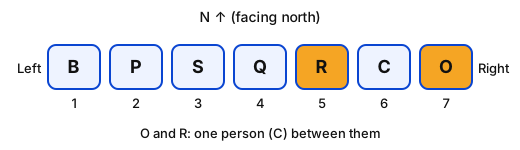
Seven people, B, C, O, P, Q, R and S, are sitting in a straight line, facing north. Only four people sit to the right of S. B sits immediately to the left of P. Only three people sit between P and C, none of whom sit on the extreme ends. R sits immediately to the right of Q. How many people sit between O and R?
सात व्यक्ति, B, C, O, P, Q, R और S, एक सीधी पंक्ति में उत्तर की ओर मुख करके बैठे हैं। S के दाएँ केवल चार व्यक्ति बैठे हैं। B, P के ठीक बाएँ बैठा है। P और C के बीच केवल तीन व्यक्ति बैठे हैं, जिनमें से कोई भी किसी अंतिम सिरे पर नहीं बैठा है। R, Q के ठीक दाएँ बैठा है। O और R के बीच कितने व्यक्ति बैठे हैं?
  1. AZeroशून्य
  2. BTwoदो
  3. COneएक
  4. DThreeतीन
Show answer

Concept: Facing north, left and right are the same as ours. Number the seats 1–7 from left.

  1. Four people right of S → S at seat 3.
  2. Three between P and C, neither at an end → P and C at seats 2 and 6. B is immediately left of P, so P cannot be 6 (B would be 5, leaving C at 2 and no adjacent pair for Q–R). Hence B = 1, P = 2, C = 6.
  3. R immediately right of Q → Q = 4, R = 5; O takes seat 7.
  4. Between O (7) and R (5) sits only C → one person.

Trick: 'Only n people sit to the right/left' pins a seat instantly – start from such a clue.

Answer: (C) One

अवधारणा: उत्तर की ओर मुख होने पर बायाँ-दायाँ हमारे जैसा ही है। सीटें बाएँ से 1–7 मानें।

  1. S के दाएँ चार लोग → S सीट 3 पर।
  2. P और C के बीच तीन लोग, दोनों छोर पर नहीं → P और C सीट 2 व 6 पर। B, P के ठीक बाएँ है, अतः P = 6 संभव नहीं (तब B = 5, C = 2 और Q–R के लिए सटी सीटें नहीं बचतीं)। अतः B = 1, P = 2, C = 6।
  3. R, Q के ठीक दाएँ → Q = 4, R = 5; O सीट 7 पर।
  4. O (7) और R (5) के बीच केवल C → एक व्यक्ति।

ट्रिक: 'केवल n लोग दाएँ/बाएँ बैठे हैं' वाला संकेत सीट तुरंत तय कर देता है – वहीं से शुरू करें।

उत्तर: (C) One

RRB NTPC Graduate CBT 1General Intelligence and ReasoningLinear seatingRRB NTPC Graduate CBT 1 2025 · 24 Mar Shift 3 →
Q5367.
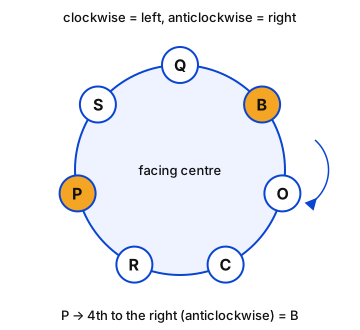
Seven people B, C, O, P, Q, R and S are sitting around a circular table facing the center of the table. S sits to the immediate right of Q. C sits to the immediate right of R. C sits second to the left of B. O sits third to the left of S. Who sits fourth to the right of P?
सात व्यक्ति B, C, O, P, Q, R और S एक वृत्ताकार मेज़ के चारों ओर मेज़ के केंद्र की ओर मुख करके बैठे हैं। S, Q के ठीक दाएँ बैठा है। C, R के ठीक दाएँ बैठा है। C, B के बाएँ से दूसरे स्थान पर बैठा है। O, S के बाएँ से तीसरे स्थान पर बैठा है। P के दाएँ से चौथे स्थान पर कौन बैठा है?
  1. AR
  2. BO
  3. CB
  4. DQ
Show answer

Concept: Facing the centre, 'left' means clockwise and 'right' means anticlockwise.

  1. Fix Q. S is to the immediate right (anticlockwise) of Q; O is third to the left (clockwise) of S.
  2. C is immediate right of R and second to the left of B. With 4 seats left, the only fit is: clockwise order Q, B, O, C, R, P, S.
  3. Fourth to the right of P (anticlockwise 4 seats): P → R → C → O → B.

Trick: In a circle of 7, 4th to the right = 3rd to the left – count whichever is shorter.

Answer: (C) B

अवधारणा: केंद्र की ओर मुख होने पर 'बायाँ' = दक्षिणावर्त (clockwise) और 'दायाँ' = वामावर्त (anticlockwise)।

  1. Q को स्थिर करें। S, Q के ठीक दाएँ (वामावर्त); O, S के बाएँ तीसरे स्थान (दक्षिणावर्त) पर।
  2. C, R के ठीक दाएँ और B के बाएँ दूसरे स्थान पर। बची 4 सीटों में एकमात्र व्यवस्था: दक्षिणावर्त क्रम Q, B, O, C, R, P, S।
  3. P के दाएँ चौथा (वामावर्त 4 सीटें): P → R → C → O → B।

ट्रिक: 7 के वृत्त में दाएँ चौथा = बाएँ तीसरा – जो छोटा हो वही गिनें।

उत्तर: (C) B

RRB NTPC Graduate CBT 1General Intelligence and ReasoningCircular seatingRRB NTPC Graduate CBT 1 2025 · 24 Mar Shift 3 →
Q5368.
In this question, a question is followed by two statements numbered (I) and (II). You have to decide whether the data provided in the statements are sufficient to answer the question. Read both the statements and decide the appropriate answer.
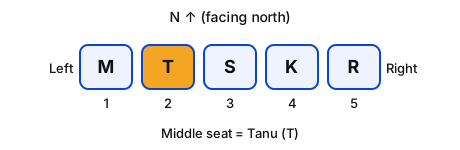
Q. Five people – Riya, Meena, Tanu, Sunita, and Kavita – are sitting in a row facing north.
Who is sitting exactly in the middle of the row?
(I) Tanu sits immediately to the right of Meena, and Sunita sits immediately to the right of Tanu.
(II) Riya is at one of the ends, and Kavita sits immediately to the left of Riya.
इस प्रश्न में, एक प्रश्न के बाद (I) और (II) क्रमांकित दो कथन दिए गए हैं। आपको यह निर्णय करना है कि कथनों में दिए गए आँकड़े प्रश्न का उत्तर देने के लिए पर्याप्त हैं या नहीं। दोनों कथनों को पढ़िए और उचित उत्तर का चयन कीजिए।
प्रश्न. पाँच व्यक्ति – रिया, मीना, तनु, सुनीता और कविता – एक पंक्ति में उत्तर की ओर मुख करके बैठे हैं।
पंक्ति के ठीक मध्य में कौन बैठा है?
(I) तनु, मीना के ठीक दाएँ बैठी है, और सुनीता, तनु के ठीक दाएँ बैठी है।
(II) रिया किसी एक सिरे पर है, और कविता, रिया के ठीक बाएँ बैठी है।
  1. ABoth statements I and II together are NOT sufficient to answer the questionकथन I और II दोनों मिलकर भी प्रश्न का उत्तर देने के लिए पर्याप्त नहीं हैं
  2. BData in Statement I alone is sufficient to answer the question while data in Statement II is notकथन I के आँकड़े अकेले प्रश्न का उत्तर देने के लिए पर्याप्त हैं, जबकि कथन II के आँकड़े पर्याप्त नहीं हैं
  3. CData in Statement II alone is sufficient to answer the question while data in Statement I is notकथन II के आँकड़े अकेले प्रश्न का उत्तर देने के लिए पर्याप्त हैं, जबकि कथन I के आँकड़े पर्याप्त नहीं हैं
  4. DBoth statements I and II together (and not statement I alone or statement II alone) are sufficient to answer the questionकथन I और II दोनों मिलकर (और न कि कथन I अकेले या कथन II अकेले) प्रश्न का उत्तर देने के लिए पर्याप्त हैं
Show answer

Concept: Test each statement alone, then together, for a unique answer.

  1. (I) alone: Meena–Tanu–Sunita form a block, which may occupy seats 1–3, 2–4 or 3–5 → middle could be Tanu, Sunita or Meena. Not sufficient.
  2. (II) alone: Kavita immediately left of Riya at an end → Riya at seat 5, Kavita at 4; seat 3 is unknown. Not sufficient.
  3. Together: seats 4, 5 taken → block M, T, S at 1, 2, 3 → Tanu is in the middle. Sufficient.

Trick: A statement that fixes positions only at one end rarely decides the middle – combine it with the block statement.

Answer: (D) Both statements I and II together (and not statement I alone or statement II alone) are sufficient to answer the question

अवधारणा: पहले हर कथन अकेले, फिर दोनों मिलाकर जाँचें कि उत्तर अद्वितीय मिलता है या नहीं।

  1. (I) अकेले: मीना–तनु–सुनीता का समूह सीट 1–3, 2–4 या 3–5 पर हो सकता है → बीच में तनु, सुनीता या मीना। अपर्याप्त।
  2. (II) अकेले: कविता, छोर पर बैठी रिया के ठीक बाएँ → रिया सीट 5, कविता सीट 4; सीट 3 अज्ञात। अपर्याप्त।
  3. दोनों मिलाकर: सीट 4, 5 भर गईं → M, T, S सीट 1, 2, 3 पर → बीच में तनु। पर्याप्त।

ट्रिक: जो कथन केवल एक छोर तय करे वह बीच की सीट शायद ही बताए – उसे समूह वाले कथन से मिलाएँ।

उत्तर: (D) Both statements I and II together (and not statement I alone or statement II alone) are sufficient to answer the question

RRB NTPC Graduate CBT 1General Intelligence and ReasoningData sufficiency – seatingRRB NTPC Graduate CBT 1 2025 · 24 Mar Shift 3 →
Q5369.
SGYU is related to UJAX in a certain way based on the English alphabetical order. In the same way, ASGG is related to CVIJ. To which of the following options is GBMP related, following the same logic?
अंग्रेज़ी वर्णमाला क्रम के आधार पर SGYU एक निश्चित तरीके से UJAX से संबंधित है। इसी प्रकार, ASGG, CVIJ से संबंधित है। उसी तर्क का अनुसरण करते हुए, GBMP निम्नलिखित में से किस विकल्प से संबंधित है?
  1. ASOMK
  2. BIEOS
  3. CSOMI
  4. DEIKO
Show answer

Concept: Find the position shift applied to each letter.

  1. SGYU → UJAX: S+2=U, G+3=J, Y+2=A, U+3=X → pattern +2,+3,+2,+3.
  2. ASGG → CVIJ: A+2=C, S+3=V, G+2=I, G+3=J ✓ same pattern.
  3. GBMP: G+2=I, B+3=E, M+2=O, P+3=S → IEOS.

Trick: Verify the rule on the second pair before applying – it rules out a coincidental first match.

Answer: (B) IEOS

अवधारणा: हर अक्षर पर लगाया गया स्थान-परिवर्तन ज्ञात करें।

  1. SGYU → UJAX: S+2=U, G+3=J, Y+2=A, U+3=X → पैटर्न +2,+3,+2,+3।
  2. ASGG → CVIJ: A+2=C, S+3=V, G+2=I, G+3=J ✓ वही पैटर्न।
  3. GBMP: G+2=I, B+3=E, M+2=O, P+3=S → IEOS।

ट्रिक: नियम को दूसरे जोड़े पर जाँचकर ही लागू करें – संयोगवश मेल की गलती नहीं होगी।

उत्तर: (B) IEOS

RRB NTPC Graduate CBT 1General Intelligence and ReasoningLetter-cluster analogyRRB NTPC Graduate CBT 1 2025 · 24 Mar Shift 3 →
Q5370.
Read the given statements and conclusions carefully. You have to take the given statements to be true even if they seem to be at variance from commonly known facts. You have to decide which conclusion/s logically follow/s from the given statements. Statements:
All carrots are peas. All peas are onions. No pea is a tomato.
Conclusions:
(I) No onion is a tomato.
(II) No carrot is a tomato.
दिए गए कथनों और निष्कर्षों को ध्यानपूर्वक पढ़िए। आपको दिए गए कथनों को सत्य मानना है, भले ही वे सामान्यतः ज्ञात तथ्यों से भिन्न प्रतीत होते हों। आपको यह निर्णय करना है कि दिए गए कथनों से कौन-सा/कौन-से निष्कर्ष तार्किक रूप से अनुसरण करता है/करते हैं। कथन:
सभी गाजर मटर हैं। सभी मटर प्याज हैं। कोई मटर टमाटर नहीं है।
निष्कर्ष:
(I) कोई प्याज टमाटर नहीं है।
(II) कोई गाजर टमाटर नहीं है।
  1. AOnly conclusion II follows.केवल निष्कर्ष II अनुसरण करता है।
  2. BNeither conclusion I nor II follows.न तो निष्कर्ष I और न ही II अनुसरण करता है।
  3. COnly conclusion I follows.केवल निष्कर्ष I अनुसरण करता है।
  4. DBoth conclusions I and II follow.निष्कर्ष I और II दोनों अनुसरण करते हैं।
Show answer

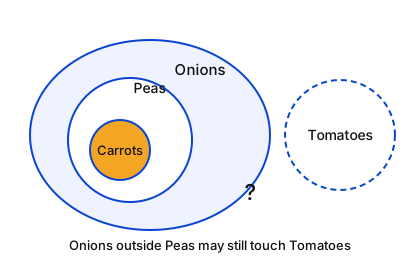
Concept: Draw the sets: Carrots ⊂ Peas ⊂ Onions, and Peas is completely separate from Tomatoes.

  1. Conclusion I: 'No onion is a tomato' – only the Pea part of Onions is cut off from Tomatoes; onions outside Peas may be tomatoes. Does not follow.
  2. Conclusion II: 'No carrot is a tomato' – every carrot is a pea and no pea is a tomato, so it follows.

Trick: All A are B + No B is C ⇒ No A is C (valid). All B are D + No B is C ⇏ No D is C (invalid).

Answer: (A) Only conclusion II follows.

अवधारणा: समुच्चय बनाएँ: गाजर ⊂ मटर ⊂ प्याज़, और मटर टमाटर से पूरी तरह अलग।

  1. निष्कर्ष I: 'कोई प्याज़ टमाटर नहीं' – प्याज़ का केवल मटर वाला भाग टमाटर से अलग है; मटर के बाहर के प्याज़ टमाटर हो सकते हैं। अनुसरण नहीं करता।
  2. निष्कर्ष II: 'कोई गाजर टमाटर नहीं' – हर गाजर मटर है और कोई मटर टमाटर नहीं, अतः अनुसरण करता है।

ट्रिक: All A are B + No B is C ⇒ No A is C (सही)। All B are D + No B is C ⇏ No D is C (गलत)।

उत्तर: (A) Only conclusion II follows.

RRB NTPC Graduate CBT 1General Intelligence and ReasoningSyllogismRRB NTPC Graduate CBT 1 2025 · 24 Mar Shift 3 →
Q5371.
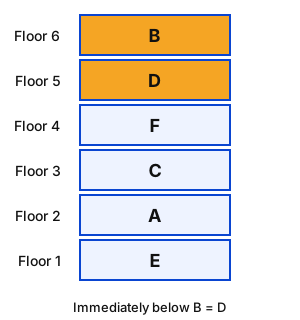
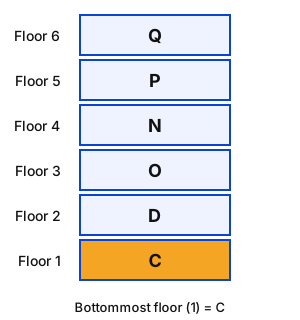
A, B, C, D, E and F live on six different floors of the same building. The lowermost floor in the building is numbered 1, the floor above it is numbered 2 and so on till the topmost floor, which is numbered 6.
Only two people live below C. Only two people live between B and C. A lives above E but below C. F does not live above D.
Who lives immediately below B?
A, B, C, D, E और F एक ही इमारत की छह अलग-अलग मंज़िलों पर रहते हैं। इमारत की सबसे निचली मंज़िल की संख्या 1 है, उसके ऊपर की मंज़िल की संख्या 2 है और इसी प्रकार सबसे ऊपरी मंज़िल तक, जिसकी संख्या 6 है।
C के नीचे केवल दो व्यक्ति रहते हैं। B और C के बीच केवल दो व्यक्ति रहते हैं। A, E के ऊपर लेकिन C के नीचे रहता है। F, D के ऊपर नहीं रहता है।
B के ठीक नीचे कौन रहता है?
  1. AD
  2. BF
  3. CC
  4. DA
Show answer

Concept: Start from the clue that fixes a floor, then place the rest.

  1. Only two below C → C on floor 3. Only two between B and C → B on floor 6 (floor 0 does not exist).
  2. A above E but below C → A = 2, E = 1.
  3. Floors 4 and 5 remain for D and F; F not above D → D = 5, F = 4.
  4. Immediately below B (6) is D (5).

Trick: Draw a 6-row column and strike out impossible floors – 'only two between' with floor 3 leaves just floor 6.

Answer: (A) D

अवधारणा: जिस संकेत से मंज़िल निश्चित हो, वहाँ से शुरू करें।

  1. C के नीचे केवल दो → C मंज़िल 3 पर। B और C के बीच केवल दो → B मंज़िल 6 पर (मंज़िल 0 नहीं होती)।
  2. A, E के ऊपर पर C के नीचे → A = 2, E = 1।
  3. मंज़िल 4 व 5 D और F के लिए; F, D के ऊपर नहीं → D = 5, F = 4।
  4. B (6) के ठीक नीचे D (5)।

ट्रिक: 6 पंक्तियों का स्तंभ बनाकर असंभव मंज़िलें काटें – मंज़िल 3 से 'बीच में केवल दो' सिर्फ मंज़िल 6 छोड़ता है।

उत्तर: (A) D

RRB NTPC Graduate CBT 1General Intelligence and ReasoningFloor puzzleRRB NTPC Graduate CBT 1 2025 · 24 Mar Shift 3 →
Q5372.
In a certain code language,
A + B means ‘A is the mother of B’
A – B means ‘A is the brother of B’
A × B means ‘A is the wife of B’
A % B means ‘A is the father of B’
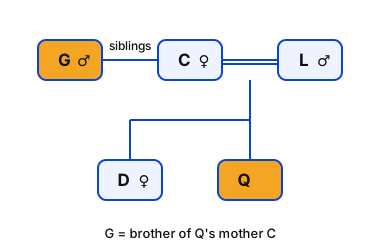
A # B means ‘A is the daughter of B’
Based on the above, how is G related to Q if ‘G – C + D # L % Q’?
एक निश्चित कूट भाषा में,
A + B का अर्थ है ‘A, B की माता है’
A – B का अर्थ है ‘A, B का भाई है’
A × B का अर्थ है ‘A, B की पत्नी है’
A % B का अर्थ है ‘A, B का पिता है’
A # B का अर्थ है ‘A, B की पुत्री है’
उपर्युक्त के आधार पर, यदि ‘G – C + D # L % Q’ है, तो G, Q से किस प्रकार संबंधित है?
  1. AMother’s brotherमाता का भाई
  2. BSister’s daughterबहन की पुत्री
  3. CSister’s husbandबहन का पति
  4. DWife’s brotherपत्नी का भाई
Show answer

Concept: Decode each symbol and build the family tree step by step.

  1. G – C: G is the brother of C. C + D: C is the mother of D.
  2. D # L: D is the daughter of L, so L is C's husband. L % Q: L is the father of Q.
  3. Q is a child of L and C; G is C's brother → G is Q's mother's brother (maternal uncle).

Trick: Decode from the end towards the person asked (Q), then climb the tree to G.

Answer: (A) Mother's brother

अवधारणा: हर चिह्न को डिकोड कर क्रम से वंश-वृक्ष बनाएँ।

  1. G – C: G, C का भाई। C + D: C, D की माँ।
  2. D # L: D, L की पुत्री, अतः L, C का पति। L % Q: L, Q का पिता।
  3. Q, L और C की संतान; G, C का भाई → G, Q की माँ का भाई (मामा)।

ट्रिक: जिसके बारे में पूछा है (Q) उसकी ओर से डिकोड करें, फिर वृक्ष में ऊपर G तक जाएँ।

उत्तर: (A) Mother's brother

RRB NTPC Graduate CBT 1General Intelligence and ReasoningBlood relations – codingRRB NTPC Graduate CBT 1 2025 · 24 Mar Shift 3 →
Q5373.
In a certain code language, ‘NEAR’ is coded as ‘3519’ and ‘GROW’ is coded as ‘8645’. What is the code for ‘R’ in that language?
एक निश्चित कूट भाषा में, ‘NEAR’ को ‘3519’ के रूप में कूटबद्ध किया जाता है और ‘GROW’ को ‘8645’ के रूप में कूटबद्ध किया जाता है। उस भाषा में ‘R’ का कूट क्या है?
  1. A5
  2. B9
  3. C8
  4. D6
Show answer

Concept: In such codes each letter maps to one digit; a letter common to both words gets the digit common to both codes.

  1. NEAR → 3519 and GROW → 8645 share only the letter R.
  2. The codes share only the digit 5 → R = 5.

Trick: Match the common letter with the common digit – no need to find the order of coding.

Answer: (A) 5

अवधारणा: ऐसे कोड में हर अक्षर का एक अंक होता है; दोनों शब्दों में उभयनिष्ठ अक्षर को दोनों कोडों का उभयनिष्ठ अंक मिलता है।

  1. NEAR → 3519 और GROW → 8645 में केवल अक्षर R समान है।
  2. कोडों में केवल अंक 5 समान है → R = 5।

ट्रिक: समान अक्षर को समान अंक से मिलाएँ – कोडिंग का क्रम खोजने की ज़रूरत नहीं।

उत्तर: (A) 5

RRB NTPC Graduate CBT 1General Intelligence and ReasoningCoding – common letterRRB NTPC Graduate CBT 1 2025 · 24 Mar Shift 3 →
Q5374.
If 1 is added to each odd digit and 2 is subtracted from each even digit in the number 4528173, how many digits will appear more than once in the new number thus formed?
यदि संख्या 4528173 के प्रत्येक विषम अंक में 1 जोड़ा जाए और प्रत्येक सम अंक से 2 घटाया जाए, तो इस प्रकार बनी नई संख्या में कितने अंक एक से अधिक बार आएंगे?
  1. ANoneकोई नहीं
  2. BOneएक
  3. CTwoदो
  4. DThreeतीन
Show answer

Concept: Apply the rule digit by digit, then count repeated digits.

  1. 4528173: 4→2, 5→6, 2→0, 8→6, 1→2, 7→8, 3→4.
  2. New number: 2606284.
  3. Digit 2 appears twice and 6 appears twice → two digits repeat.

Trick: Write the new digits directly under the old ones in a line to avoid skipping any.

Answer: (C) Two

अवधारणा: नियम को हर अंक पर लगाएँ, फिर दोहराए गए अंक गिनें।

  1. 4528173: 4→2, 5→6, 2→0, 8→6, 1→2, 7→8, 3→4।
  2. नई संख्या: 2606284।
  3. अंक 2 दो बार और 6 दो बार → दो अंक दोहराए गए।

ट्रिक: नए अंकों को पुराने अंकों के ठीक नीचे एक पंक्ति में लिखें ताकि कोई छूटे नहीं।

उत्तर: (C) Two

RRB NTPC Graduate CBT 1General Intelligence and ReasoningNumber operationsRRB NTPC Graduate CBT 1 2025 · 24 Mar Shift 3 →
Q5375.
Refer to the following letter, number, symbol series and answer the question. (All numbers are single-digit numbers only) (Counting to be done from left to right only) (Left) Z Q Y 7 * 9 E D V Z R X 4 * N G T B 3 X A T 4 H (Right)
How many such symbols are there, each of which is immediately preceded by a number and also immediately followed by a letter?
निम्नलिखित अक्षर, संख्या, प्रतीक श्रृंखला को देखिए और प्रश्न का उत्तर दीजिए। (सभी संख्याएँ केवल एक अंक की संख्याएँ हैं) (गिनती केवल बाएँ से दाएँ की ओर की जानी है) (बाएँ) Z Q Y 7 * 9 E D V Z R X 4 * N G T B 3 X A T 4 H (दाएँ)
ऐसे कितने प्रतीक हैं, जिनमें से प्रत्येक के ठीक पहले एक संख्या है और ठीक बाद एक अक्षर है?
  1. ATwoदो
  2. BNoneकोई नहीं
  3. CThreeतीन
  4. DOneएक
Show answer

Concept: Check each symbol's immediate left (must be a number) and immediate right (must be a letter).

  1. Series: Z Q Y 7 * 9 E D V Z R X 4 * N G T B 3 X A T 4 H – only two symbols (*).
  2. First *: 7 * 9 → followed by a number, not a letter ✗.
  3. Second *: 4 * N → preceded by a number and followed by a letter ✓.

Trick: First circle every symbol, then look at its two neighbours – fastest way in such series.

Answer: (D) One

अवधारणा: हर चिह्न का ठीक बायाँ (संख्या होनी चाहिए) और ठीक दायाँ (अक्षर होना चाहिए) जाँचें।

  1. श्रृंखला: Z Q Y 7 * 9 E D V Z R X 4 * N G T B 3 X A T 4 H – केवल दो चिह्न (*)।
  2. पहला *: 7 * 9 → बाद में संख्या, अक्षर नहीं ✗।
  3. दूसरा *: 4 * N → पहले संख्या और बाद में अक्षर ✓।

ट्रिक: पहले हर चिह्न पर गोला लगाएँ, फिर उसके दोनों पड़ोसी देखें – ऐसी श्रृंखला में सबसे तेज़ तरीका।

उत्तर: (D) One

RRB NTPC Graduate CBT 1General Intelligence and ReasoningMixed series countingRRB NTPC Graduate CBT 1 2025 · 24 Mar Shift 3 →
Q5376.
C, D, N, O, P and Q live on six different floors of the same building. The lowermost floor in the building is numbered 1, the floor above it is numbered 2 and so on, till the topmost floor, which is numbered 6. O lives immediately above D. Only Q lives above P. Only two people live between C and N. C lives on an odd-numbered floor. Who lives on the bottommost floor?
C, D, N, O, P और Q एक ही इमारत की छह अलग-अलग मंज़िलों पर रहते हैं। इमारत की सबसे निचली मंज़िल की संख्या 1 है, उसके ऊपर की मंज़िल की संख्या 2 है और इसी प्रकार सबसे ऊपरी मंज़िल तक, जिसकी संख्या 6 है। O, D के ठीक ऊपर रहता है। P के ऊपर केवल Q रहता है। C और N के बीच केवल दो व्यक्ति रहते हैं। C एक विषम संख्या वाली मंज़िल पर रहता है। सबसे निचली मंज़िल पर कौन रहता है?
  1. AP
  2. BD
  3. CC
  4. DN
Show answer

Concept: Use the 'only' clues first to fix floors.

  1. Only Q above P → Q = 6, P = 5.
  2. Two between C and N using floors 1–4 → C and N on floors 1 and 4; C odd → C = 1, N = 4.
  3. O immediately above D → D = 2, O = 3.
  4. Bottommost floor: C.

Trick: Once the top two floors are fixed, a gap of two in four floors can only be 1 and 4.

Answer: (C) C

अवधारणा: पहले 'केवल' वाले संकेतों से मंज़िलें तय करें।

  1. P के ऊपर केवल Q → Q = 6, P = 5।
  2. मंज़िल 1–4 में C और N के बीच दो → C और N मंज़िल 1 व 4 पर; C विषम → C = 1, N = 4।
  3. O, D के ठीक ऊपर → D = 2, O = 3।
  4. सबसे नीचे की मंज़िल: C।

ट्रिक: ऊपर की दो मंज़िलें तय होने पर चार मंज़िलों में दो का अंतर केवल 1 और 4 पर संभव है।

उत्तर: (C) C

RRB NTPC Graduate CBT 1General Intelligence and ReasoningFloor puzzleRRB NTPC Graduate CBT 1 2025 · 24 Mar Shift 3 →
Q5377.
Based on the English alphabetical order, three of the following four letter cluster pairs are alike in a certain way and thus form a group. Which is the one that does not belong to that group?
(Note: The odd man out is not based on the number of consonants/vowels or their position in the letter cluster)
अंग्रेज़ी वर्णमाला क्रम के आधार पर, निम्नलिखित चार अक्षर-समूह युग्मों में से तीन एक निश्चित तरीके से समान हैं और इस प्रकार एक समूह बनाते हैं। वह कौन-सा है जो उस समूह से संबंधित नहीं है?
(नोट: असंगत का निर्धारण व्यंजनों/स्वरों की संख्या या अक्षर-समूह में उनकी स्थिति के आधार पर नहीं किया गया है)
  1. AAD-BE
  2. BEH-FI
  3. CLO-PS
  4. DRU-SV
Show answer

Concept: Compare how each letter of the first cluster changes to form the second.

  1. AD → BE: A+1 = B, D+1 = E. EH → FI: +1, +1. RU → SV: +1, +1.
  2. LO → PS: L+4 = P, O+4 = S → shift of +4, different from the rest.

Trick: Check the first letters only: A→B, E→F, R→S are +1 but L→P is +4.

Answer: (C) LO-PS

अवधारणा: पहले समूह के हर अक्षर से दूसरे समूह तक का परिवर्तन तुलना करें।

  1. AD → BE: A+1 = B, D+1 = E। EH → FI: +1, +1। RU → SV: +1, +1।
  2. LO → PS: L+4 = P, O+4 = S → +4 का अंतर, बाकी से अलग।

ट्रिक: केवल पहले अक्षर देखें: A→B, E→F, R→S में +1 पर L→P में +4।

उत्तर: (C) LO-PS

RRB NTPC Graduate CBT 1General Intelligence and ReasoningOdd one out – letter pairsRRB NTPC Graduate CBT 1 2025 · 24 Mar Shift 3 →
Q5378.
Which of the following pollutants is most closely associated with the formation of acid rain?
निम्नलिखित में से कौन-सा प्रदूषक अम्लीय वर्षा (acid rain) के निर्माण से सबसे अधिक निकटता से संबंधित है?
  1. AAmmoniaअमोनिया
  2. BMethaneमीथेन
  3. COzoneओज़ोन
  4. DSulphur dioxideसल्फर डाइऑक्साइड
Show answer

Concept: Acid rain forms when oxides of sulphur and nitrogen dissolve in rain water to make acids.

  1. Sulphur dioxide (SO2) from burning coal and oil reacts with water and oxygen to form sulphuric acid (H2SO4) – the main cause of acid rain.
  2. Nitrogen oxides add nitric acid; ammonia is actually alkaline, methane is a greenhouse gas and ozone causes smog, not acid rain.
  3. Acid rain damages the Taj Mahal (marble cancer), forests and lakes.

Yaad rakhein: SO2 + NOx = acid rain; CO2 + CH4 = greenhouse gases; CFC = ozone hole.

Answer: (D) Sulphur dioxide

अवधारणा: अम्लीय वर्षा तब होती है जब सल्फर और नाइट्रोजन के ऑक्साइड वर्षा-जल में घुलकर अम्ल बनाते हैं।

  1. कोयला-तेल जलने से निकली सल्फर डाइऑक्साइड (SO2) जल व ऑक्सीजन से मिलकर सल्फ्यूरिक अम्ल (H2SO4) बनाती है – अम्लीय वर्षा का मुख्य कारण।
  2. नाइट्रोजन ऑक्साइड से नाइट्रिक अम्ल बनता है; अमोनिया क्षारीय है, मीथेन ग्रीनहाउस गैस है और ओज़ोन स्मॉग बनाती है।
  3. अम्लीय वर्षा से ताजमहल (marble cancer), वन और झीलें क्षतिग्रस्त होती हैं।

याद रखें: SO2 + NOx = अम्लीय वर्षा; CO2 + CH4 = ग्रीनहाउस गैसें; CFC = ओज़ोन छिद्र।

उत्तर: (D) सल्फर डाइऑक्साइड

RRB NTPC Graduate CBT 1General AwarenessEnvironment – Acid RainRRB NTPC Graduate CBT 1 2025 · 24 Mar Shift 2 →
Q5379.
Which leader was a close associate of Mahatma Gandhi and carried out a salt protest in the Madras Presidency during the Civil Disobedience Movement?
कौन-से नेता महात्मा गांधी के निकट सहयोगी थे और उन्होंने सविनय अवज्ञा आंदोलन के दौरान मद्रास प्रेसीडेंसी में नमक विरोध (salt protest) का नेतृत्व किया?
  1. ASarojini Naiduसरोजिनी नायडू
  2. BSardar Vallabhbhai Patelसरदार वल्लभभाई पटेल
  3. CC. Rajagopalachariसी. राजगोपालाचारी
  4. DK. Kamarajके. कामराज
Show answer

Concept: The Salt Satyagraha (1930) was repeated in different provinces by regional leaders.

  1. C. Rajagopalachari (Rajaji) led the Vedaranyam Salt March (Tiruchirappalli to Vedaranyam, April 1930) in the Madras Presidency.
  2. Sarojini Naidu led the Dharasana raid in Gujarat; Patel was arrested before the Dandi March; Kamaraj was then a young worker, not the leader.
  3. Other parallel marches: K. Kelappan in Malabar (Payyanur), Gopabandhu Choudhury in Odisha.

Yaad rakhein: Dandi – Gandhi; Vedaranyam – Rajaji; Dharasana – Sarojini Naidu; Payyanur – Kelappan.

Answer: (C) C. Rajagopalachari

अवधारणा: नमक सत्याग्रह (1930) को विभिन्न प्रांतों में क्षेत्रीय नेताओं ने दोहराया।

  1. सी. राजगोपालाचारी (राजाजी) ने मद्रास प्रेसीडेंसी में वेदारण्यम नमक यात्रा (तिरुचिरापल्ली से वेदारण्यम, अप्रैल 1930) का नेतृत्व किया।
  2. सरोजिनी नायडू ने गुजरात में धरसणा आक्रमण का नेतृत्व किया; पटेल दांडी यात्रा से पहले ही गिरफ्तार हुए; कामराज तब युवा कार्यकर्ता थे।
  3. अन्य समानांतर यात्राएँ: मालाबार (पय्यन्नूर) में के. केलप्पन, ओडिशा में गोपबंधु चौधरी।

याद रखें: दांडी – गांधी; वेदारण्यम – राजाजी; धरसणा – सरोजिनी नायडू; पय्यन्नूर – केलप्पन।

उत्तर: (C) सी. राजगोपालाचारी

RRB NTPC Graduate CBT 1General AwarenessCivil Disobedience MovementRRB NTPC Graduate CBT 1 2025 · 24 Mar Shift 2 →
Q5380.
The National Commission for Scheduled Tribes (NCST) was created by which
Constitutional Amendment?
राष्ट्रीय अनुसूचित जनजाति आयोग (NCST) का गठन किस
संविधान संशोधन द्वारा किया गया था?
  1. A97th Amendment97वाँ संशोधन
  2. B65th Amendment65वाँ संशोधन
  3. C89th Amendment89वाँ संशोधन
  4. D102nd Amendment102वाँ संशोधन
Show answer

Concept: NCST is a constitutional body under Article 338A.

  1. The 89th Constitutional Amendment Act, 2003 split the combined Commission for SCs and STs into two: NCSC (Art. 338) and NCST (Art. 338A); NCST started working in 2004.
  2. 65th Amendment (1990) made the combined SC/ST commission a constitutional body; 102nd (2018) gave constitutional status to NCBC (Art. 338B); 97th (2011) is about cooperative societies.

Yaad rakhein: 65th = SC/ST commission constitutional; 89th = NCST separate (338A); 102nd = NCBC (338B).

Answer: (C) 89th Amendment

अवधारणा: NCST अनुच्छेद 338A के अंतर्गत एक संवैधानिक निकाय है।

  1. 89वें संविधान संशोधन अधिनियम, 2003 ने SC/ST के संयुक्त आयोग को दो भागों में बाँटा: NCSC (अनु. 338) और NCST (अनु. 338A); NCST ने 2004 से कार्य शुरू किया।
  2. 65वें संशोधन (1990) ने संयुक्त SC/ST आयोग को संवैधानिक बनाया; 102वें (2018) ने NCBC (अनु. 338B) को संवैधानिक दर्जा दिया; 97वाँ (2011) सहकारी समितियों से संबंधित है।

याद रखें: 65वाँ = SC/ST आयोग संवैधानिक; 89वाँ = अलग NCST (338A); 102वाँ = NCBC (338B)।

उत्तर: (C) 89वाँ संशोधन

RRB NTPC Graduate CBT 1General AwarenessConstitutional Bodies – NCSTRRB NTPC Graduate CBT 1 2025 · 24 Mar Shift 2 →