Question bank

Q&A: practice questions with answers

Search questions on any topic. Filter by exam category, exam, subject and topic, try the question, then open the answer and explanation.

Courses – airGurukul

7,077 questions found.

Q5521.
If a 7-digit number 54572A0 is completely divisible by 3, what is the minimum value of A?
यदि 7 अंकों की एक संख्या 54572A0, 3 से पूर्णतः विभाज्य है, तो A का न्यूनतम मान क्या है?
  1. A4
  2. B1
  3. C5
  4. D3
Show answer

Concept: A number is divisible by 3 when the sum of its digits is a multiple of 3.

  1. Digit sum of 54572A0 =5+4+5+7+2+A+0=23+A.
  2. 23+A must be a multiple of 3 → A=1 (24), 4 (27) or 7 (30).
  3. Minimum value =1.

Trick: 23÷3 leaves remainder 2, so add 3−2=1 → smallest A = 1.

Answer: (B) 1

अवधारणा: कोई संख्या 3 से विभाज्य है यदि उसके अंकों का योग 3 का गुणज हो।

  1. 54572A0 के अंकों का योग =5+4+5+7+2+A+0=23+A।
  2. 23+A 3 का गुणज होना चाहिए → A=1 (24), 4 (27) या 7 (30)।
  3. न्यूनतम मान =1।

ट्रिक: 23÷3 में शेष 2 बचता है, अतः 3−2=1 जोड़ें → सबसे छोटा A = 1।

उत्तर: (B) 1
RRB NTPC Graduate CBT 1MathematicsDivisibility by 3RRB NTPC Graduate CBT 1 2025 · 24 Mar Shift 1 →
Q5522.
A shopkeeper fixes the marked price of an item 100% above its cost price. What percentage of discount on marked price should be allowed to gain 26%?
एक दुकानदार किसी वस्तु का अंकित मूल्य उसके क्रय मूल्य से 100% अधिक निर्धारित करता है। 26% लाभ प्राप्त करने के लिए अंकित मूल्य पर कितने प्रतिशत छूट दी जानी चाहिए?
  1. A36%
  2. B39%
  3. C40%
  4. D37%
Show answer

Concept: Take CP = 100. Marked price = CP + markup; discount % is calculated on the marked price.

  1. CP =100 → MP =100+100%=200.
  2. Required SP for 26% gain =126.
  3. Discount =200−126=74 → Discount % =74200×100=37%.

Trick: SP=MP(1−d) → 126=200(1−d) → d=0.37.

Answer: (D) 37%

अवधारणा: CP = 100 मानें। अंकित मूल्य = CP + वृद्धि; छूट % अंकित मूल्य पर निकलती है।

  1. CP =100 → MP =100+100%=200।
  2. 26% लाभ के लिए आवश्यक SP =126।
  3. छूट =200−126=74 → छूट % =74200×100=37%।

ट्रिक: SP=MP(1−d) → 126=200(1−d) → d=0.37।

उत्तर: (D) 37%

RRB NTPC Graduate CBT 1MathematicsDiscount & MarkupRRB NTPC Graduate CBT 1 2025 · 24 Mar Shift 1 →
Q5523.
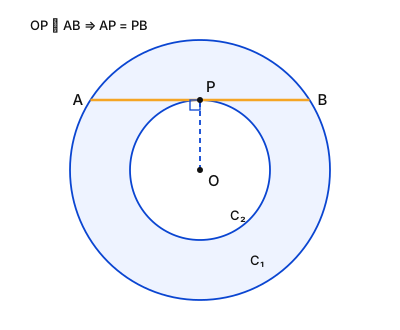
Let C1and C2 be two concentric circles with centre O. Let AB be a chord on C1 the larger circle such that AB touches C2 at the point P. Then which of the following is true? ( i ) OP = AP
( ii ) AP = PB
( iii ) OP = 2PB
( iv ) OP = AB
मान लीजिए C1 और C2 केंद्र O वाले दो संकेंद्रीय वृत्त हैं। मान लीजिए AB बड़े वृत्त C1 की एक ऐसी जीवा है कि AB, C2 को बिंदु P पर स्पर्श करती है। तो निम्नलिखित में से कौन-सा सत्य है? ( i ) OP = AP
( ii ) AP = PB
( iii ) OP = 2PB
( iv ) OP = AB
  1. AAP = PB
  2. BOP = 2PB
  3. COP = AP
  4. DOP = AB
Show answer

Concept: A tangent is perpendicular to the radius at the point of contact, and a perpendicular from the centre to a chord bisects the chord.

  1. AB touches the inner circle C2 at P, so OP (radius of C2) is perpendicular to AB.
  2. For the outer circle C1, AB is a chord and OP ⊥ AB passes through the centre O → P is the midpoint of AB.
  3. Hence AP=PB. OP depends on the radius of C2 and need not equal AP, 2PB or AB.

Yaad rakhein: In concentric circles, a chord of the bigger circle touching the smaller one is bisected at the point of contact.

Answer: (A) AP = PB

अवधारणा: स्पर्श रेखा स्पर्श बिंदु पर त्रिज्या के लंबवत होती है, और केंद्र से जीवा पर डाला गया लंब जीवा को समद्विभाजित करता है।

  1. AB भीतरी वृत्त C2 को P पर स्पर्श करती है, अतः OP (C2 की त्रिज्या) AB पर लंब है।
  2. बाहरी वृत्त C1 के लिए AB एक जीवा है और केंद्र O से गुज़रने वाला OP ⊥ AB → P, AB का मध्य-बिंदु है।
  3. अतः AP=PB। OP, C2 की त्रिज्या पर निर्भर है और AP, 2PB या AB के बराबर होना आवश्यक नहीं।

याद रखें: संकेंद्रीय वृत्तों में बड़े वृत्त की जो जीवा छोटे वृत्त को छूती है, वह स्पर्श बिंदु पर समद्विभाजित होती है।

उत्तर: (A) AP = PB

RRB NTPC Graduate CBT 1MathematicsCircles – Tangent & ChordRRB NTPC Graduate CBT 1 2025 · 24 Mar Shift 1 →
Q5524.
The surface area of a sphere is 154 cm2. What is the radius of the sphere? (Use π=227)
एक गोले का पृष्ठीय क्षेत्रफल 154 cm2 है। गोले की त्रिज्या क्या है? (π=227 का प्रयोग कीजिए)
  1. A3.5 cm
  2. B5 cm
  3. C7 cm
  4. D11 cm
Show answer

Concept: Surface area of a sphere =4πr2.

  1. 4×227×r2=154.
  2. r2=154×74×22=107888=12.25.
  3. r=12.25=3.5 cm.

Trick: 154=22×7, so r2=7×74 → r=72=3.5.

Answer: (A) 3.5 cm

अवधारणा: गोले का पृष्ठीय क्षेत्रफल =4πr2।

  1. 4×227×r2=154।
  2. r2=154×74×22=107888=12.25।
  3. r=12.25=3.5 cm।

ट्रिक: 154=22×7, अतः r2=7×74 → r=72=3.5।

उत्तर: (A) 3.5 cm

RRB NTPC Graduate CBT 1MathematicsSphere – Surface AreaRRB NTPC Graduate CBT 1 2025 · 24 Mar Shift 1 →
Q5525.
Two quadratic equations x2 + x + p = 0 and x2 + 2x − 3 = 0 have one root common. What is a possible value of p?
दो द्विघात समीकरणों x2 + x + p = 0 और x2 + 2x − 3 = 0 का एक मूल उभयनिष्ठ है। p का एक संभावित मान क्या है?
  1. A−1
  2. B−2
  3. C−4
  4. D−3
Show answer

Concept: Solve the equation that has no unknown, then substitute each of its roots in the other equation.

  1. x2+2x−3=0 → (x+3)(x−1)=0 → x=1 or x=−3.
  2. If x=1 is common: 1+1+p=0 → p=−2.
  3. If x=−3 is common: 9−3+p=0 → p=−6 (not in options). So p=−2.

Trick: With a common root, plug the known roots directly – no need for the general common-root formula.

Answer: (B) −2

अवधारणा: जिस समीकरण में अज्ञात नहीं है उसे हल करें, फिर उसके प्रत्येक मूल को दूसरे समीकरण में रखें।

  1. x2+2x−3=0 → (x+3)(x−1)=0 → x=1 या x=−3।
  2. यदि x=1 उभयनिष्ठ है: 1+1+p=0 → p=−2।
  3. यदि x=−3 उभयनिष्ठ है: 9−3+p=0 → p=−6 (विकल्प में नहीं)। अतः p=−2।

ट्रिक: उभयनिष्ठ मूल हो तो ज्ञात मूल सीधे रखें – सामान्य common-root सूत्र की ज़रूरत नहीं।

उत्तर: (B) −2

RRB NTPC Graduate CBT 1MathematicsQuadratic – Common RootRRB NTPC Graduate CBT 1 2025 · 24 Mar Shift 1 →
Q5526.
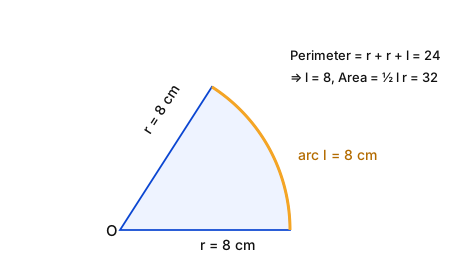
The perimeter of a certain sector of a circle of radius 8 cm is 24 cm. Find the area of the sector.
8 cm त्रिज्या वाले एक वृत्त के किसी त्रिज्यखंड (sector) का परिमाप 24 cm है। त्रिज्यखंड का क्षेत्रफल ज्ञात कीजिए।
  1. A32 cm2
  2. B22 cm2
  3. C29 cm2
  4. D38 cm2
Show answer

Concept: Perimeter of a sector =2r+l (two radii + arc) and area =12lr.

  1. 2×8+l=24 → l=8 cm.
  2. Area =12×l×r=12×8×8=32 cm².

Trick: Sector area =12(arc)(radius) – works without knowing the angle, just like a triangle with base = arc and height = radius.

Answer: (A) 32 cm²

अवधारणा: त्रिज्यखंड का परिमाप =2r+l (दो त्रिज्याएँ + चाप) और क्षेत्रफल =12lr।

  1. 2×8+l=24 → l=8 cm।
  2. क्षेत्रफल =12×l×r=12×8×8=32 cm²।

ट्रिक: त्रिज्यखंड क्षेत्रफल =12(चाप)(त्रिज्या) – कोण जाने बिना काम करता है, जैसे आधार = चाप और ऊँचाई = त्रिज्या वाला त्रिभुज।

उत्तर: (A) 32 cm²

RRB NTPC Graduate CBT 1MathematicsSector of a CircleRRB NTPC Graduate CBT 1 2025 · 24 Mar Shift 1 →
Q5527.
Find the weighted mean of the first 5 natural numbers whose weights are equal to the corresponding numbers.
प्रथम 5 प्राकृत संख्याओं का भारित माध्य ज्ञात कीजिए, जिनके भार संगत संख्याओं के बराबर हैं।
  1. A125
  2. B133
  3. C113
  4. D115
Show answer

Concept: Weighted mean =∑wixi∑wi. Here each number is its own weight, so wi=xi.

  1. ∑wixi=12+22+32+42+52=1+4+9+16+25=55.
  2. ∑wi=1+2+3+4+5=15.
  3. Weighted mean =5515=113.

Trick: For the first n natural numbers weighted by themselves, mean =∑n2∑n=2n+13 → 113 for n = 5.

Answer: (C) 113

अवधारणा: भारित माध्य =∑wixi∑wi। यहाँ हर संख्या स्वयं अपना भार है, अतः wi=xi।

  1. ∑wixi=12+22+32+42+52=1+4+9+16+25=55।
  2. ∑wi=1+2+3+4+5=15।
  3. भारित माध्य =5515=113।

ट्रिक: पहली n प्राकृत संख्याओं का स्वयं से भारित माध्य =∑n2∑n=2n+13 → n = 5 के लिए 113।

उत्तर: (C) 113

RRB NTPC Graduate CBT 1MathematicsWeighted MeanRRB NTPC Graduate CBT 1 2025 · 24 Mar Shift 1 →
Q5528.
By selling an article at 411 of its actual selling price, Nirbhay incurs a loss of 20%. If he sells it at 71% of its actual selling price, then the profit percentage is
किसी वस्तु को उसके वास्तविक विक्रय मूल्य के 411 पर बेचने पर निर्भय को 20% की हानि होती है। यदि वह इसे इसके वास्तविक विक्रय मूल्य के 71% पर बेचता है, तो लाभ प्रतिशत है
  1. A58.3%
  2. B56.2%
  3. C58.5%
  4. D57.8%
Show answer

Concept: First find the actual selling price in terms of CP from the loss condition, then apply the new fraction.

  1. Let CP =100. Selling at 411 of SP gives 20% loss → 411SP=80 → SP =220.
  2. New price =71% of 220=156.2.
  3. Profit =156.2−100=56.2 → profit % =56.2%.

Trick: SP = 2.2 × CP, so any fraction k of SP gives profit % =220k−100 → 220×0.71−100=56.2.

Answer: (B) 56.2%

अवधारणा: पहले हानि की शर्त से वास्तविक विक्रय मूल्य को CP के रूप में निकालें, फिर नया भाग लगाएँ।

  1. CP =100 मानें। SP के 411 पर बेचने से 20% हानि → 411SP=80 → SP =220।
  2. नया मूल्य =220 का 71%=156.2।
  3. लाभ =156.2−100=56.2 → लाभ % =56.2%।

ट्रिक: SP = 2.2 × CP, अतः SP के किसी भाग k पर लाभ % =220k−100 → 220×0.71−100=56.2।

उत्तर: (B) 56.2%

RRB NTPC Graduate CBT 1MathematicsProfit & Loss – Fraction of SPRRB NTPC Graduate CBT 1 2025 · 24 Mar Shift 1 →
Q5529.
Three bells ring at regular intervals. The first bell rings every 120 minutes, the second every 180 minutes, and the third every 240 minutes. If all three bells ring together at 9:00 a.m., at what time will they ring together again?
तीन घंटियाँ नियमित अंतराल पर बजती हैं। पहली घंटी प्रत्येक 120 मिनट में, दूसरी प्रत्येक 180 मिनट में और तीसरी प्रत्येक 240 मिनट में बजती है। यदि तीनों घंटियाँ पूर्वाह्न 9:00 बजे एक साथ बजती हैं, तो वे पुनः किस समय एक साथ बजेंगी?
  1. A9 p.m.रात्रि 9 बजे
  2. B6 p.m.सायं 6 बजे
  3. C12 noonदोपहर 12 बजे
  4. D3 p.m.अपराह्न 3 बजे
Show answer

Concept: Bells ringing at different intervals ring together again after the LCM of the intervals.

  1. 120=23×3×5, 180=22×32×5, 240=24×3×5.
  2. LCM =24×32×5=720 minutes =12 hours.
  3. 9:00 a.m. + 12 h = 9:00 p.m.

Trick: In hours the intervals are 2, 3, 4 → LCM = 12 h, a much quicker calculation.

Answer: (A) 9 p.m.

अवधारणा: अलग-अलग अंतराल पर बजने वाली घंटियाँ अंतरालों के LCM के बाद फिर एक साथ बजती हैं।

  1. 120=23×3×5, 180=22×32×5, 240=24×3×5।
  2. LCM =24×32×5=720 मिनट =12 घंटे।
  3. 9:00 a.m. + 12 घंटे = 9:00 p.m.।

ट्रिक: घंटों में अंतराल 2, 3, 4 हैं → LCM = 12 घंटे, गणना बहुत तेज़।

उत्तर: (A) 9 p.m.

RRB NTPC Graduate CBT 1MathematicsLCM – BellsRRB NTPC Graduate CBT 1 2025 · 24 Mar Shift 1 →
Q5530.
In what duration (in years) will ₹7,200 fetch a simple interest of ₹360 at 4% per annum rate of interest?
₹7,200 पर 4% वार्षिक ब्याज दर से ₹360 का साधारण ब्याज कितनी अवधि (वर्षों में) में प्राप्त होगा?
  1. A2.25
  2. B2.5
  3. C1.25
  4. D0.25
Show answer

Concept: SI=P×R×T100 → T=SI×100P×R.

  1. T=360×1007200×4=3600028800.
  2. =54=1.25 years.

Trick: One year's interest =4% of 7200=288; 360288=1.25 years.

Answer: (C) 1.25

अवधारणा: SI=P×R×T100 → T=SI×100P×R।

  1. T=360×1007200×4=3600028800।
  2. =54=1.25 वर्ष।

ट्रिक: एक वर्ष का ब्याज =7200 का 4%=288; 360288=1.25 वर्ष।

उत्तर: (C) 1.25

RRB NTPC Graduate CBT 1MathematicsSimple InterestRRB NTPC Graduate CBT 1 2025 · 24 Mar Shift 1 →
Q5531.
If p+1m=m+1n=n+1p (p≠m≠n), then the value of p×m×n is:
यदि p+1m=m+1n=n+1p (p≠m≠n) है, तो p×m×n का मान है:
  1. A±2
  2. B±12
  3. C±1
  4. D0
Show answer

Concept: When three expressions are equal, subtract them pairwise; the differences multiply to a neat result.

  1. From p+1m=m+1n: p−m=1n−1m=m−nmn.
  2. Similarly m−n=n−pnp and n−p=p−mpm.
  3. Multiply all three: (p−m)(m−n)(n−p)=(m−n)(n−p)(p−m)(pmn)2.
  4. Since p≠m≠n, cancel the non-zero product: (pmn)2=1⇒pmn=±1.

Yaad rakhein: a+1b=b+1c=c+1a (all distinct) ⇒abc=±1. Standard result – just recall it in the exam.

Answer: (C) ±1

अवधारणा: जब तीन व्यंजक बराबर हों, तो उन्हें जोड़ों में घटाइए; अंतर गुणा करने पर सुंदर परिणाम मिलता है।

  1. p+1m=m+1n से: p−m=1n−1m=m−nmn।
  2. इसी प्रकार m−n=n−pnp और n−p=p−mpm।
  3. तीनों को गुणा करें: (p−m)(m−n)(n−p)=(m−n)(n−p)(p−m)(pmn)2।
  4. p≠m≠n है, अतः अशून्य गुणनफल काटने पर (pmn)2=1⇒pmn=±1।

याद रखें: a+1b=b+1c=c+1a (सभी भिन्न) ⇒abc=±1 – यह मानक परिणाम है, परीक्षा में सीधे लगाइए।

उत्तर: (C) ±1

RRB NTPC Graduate CBT 1MathematicsAlgebra – symmetric equationsRRB NTPC Graduate CBT 1 2025 · 24 Mar Shift 1 →
Q5532.
Vanraj is twice as old as his younger brother, and his other brother is 3 years younger than the younger brother. If the sum of the ages of these three brothers 3 years ago was 20 years, find Vanraj’s present age, in years.
वनराज की आयु अपने छोटे भाई की आयु की दोगुनी है, और उसका दूसरा भाई छोटे भाई से 3 वर्ष छोटा है। यदि 3 वर्ष पहले इन तीनों भाइयों की आयु का योग 20 वर्ष था, तो वनराज की वर्तमान आयु, वर्षों में, ज्ञात कीजिए।
  1. A16
  2. B15
  3. C14
  4. D18
Show answer

Concept: Take the younger brother's age as x and write every age in terms of x; "3 years ago" subtracts 3 from each person.

  1. Younger brother =x, Vanraj =2x, other brother =x−3.
  2. 3 years ago the ages were x−3, 2x−3, x−6; sum =4x−12.
  3. 4x−12=20⇒x=8.
  4. Vanraj's present age =2x=16 years.

Trick: Present sum =20+3×3=29, so x+2x+(x−3)=29⇒x=8 – add 3 per person instead of subtracting thrice.

Answer: (A) 16

अवधारणा: छोटे भाई की आयु x मानकर हर आयु x में लिखिए; "3 वर्ष पहले" का मतलब हर व्यक्ति से 3 घटाना।

  1. छोटा भाई =x, वनराज =2x, दूसरा भाई =x−3।
  2. 3 वर्ष पहले आयु x−3, 2x−3, x−6; योग =4x−12।
  3. 4x−12=20⇒x=8।
  4. वनराज की वर्तमान आयु =2x=16 वर्ष।

ट्रिक: वर्तमान योग =20+3×3=29, अतः x+2x+(x−3)=29⇒x=8 – तीन बार घटाने की जगह हर व्यक्ति के लिए 3 जोड़ दें।

उत्तर: (A) 16

RRB NTPC Graduate CBT 1MathematicsProblems on agesRRB NTPC Graduate CBT 1 2025 · 24 Mar Shift 1 →
Q5533.
₹6241 is divided among A, B, C, and D in such a way that the shares of A and B, B and C, and C and D are in the ratios of 2 : 3, 4 : 5, and 10 : 3 respectively. The share of A (in ₹) is:
₹6241 को A, B, C और D के बीच इस प्रकार विभाजित किया जाता है कि A और B, B और C, तथा C और D के हिस्से क्रमशः 2 : 3, 4 : 5 और 10 : 3 के अनुपात में हैं। A का हिस्सा (₹ में) है:
  1. A1174
  2. B1264
  3. C1384
  4. D1334
Show answer

Concept: Combine chained ratios into one by making the common term equal, then share the total.

  1. A:B=2:3, B:C=4:5, C:D=10:3.
  2. A:B:C:D=2×4×10:3×4×10:3×5×10:3×5×3=80:120:150:45=16:24:30:9.
  3. Sum of parts =16+24+30+9=79; one part =624179=79.
  4. Share of A =16×79=1264.

Trick: For A:B:C:D write A = product of all first terms, D = product of all second terms, and mix for the middle ones: a1a2a3:b1a2a3:b1b2a3:b1b2b3.

Answer: (B) 1264

अवधारणा: श्रृंखला अनुपातों को उभयनिष्ठ पद बराबर करके एक अनुपात बनाइए, फिर कुल को बाँटिए।

  1. A:B=2:3, B:C=4:5, C:D=10:3।
  2. A:B:C:D=2×4×10:3×4×10:3×5×10:3×5×3=80:120:150:45=16:24:30:9।
  3. भागों का योग =79; एक भाग =624179=79।
  4. A का हिस्सा =16×79=1264।

ट्रिक: A:B:C:D के लिए A = सभी पहले पदों का गुणनफल, D = सभी दूसरे पदों का गुणनफल, बीच वाले मिश्रित: a1a2a3:b1a2a3:b1b2a3:b1b2b3।

उत्तर: (B) 1264

RRB NTPC Graduate CBT 1MathematicsRatio – chain ratiosRRB NTPC Graduate CBT 1 2025 · 24 Mar Shift 1 →
Q5534.
What should come in place of ‘?’ in the given series?
45 46 50 59 75 ?
दी गई श्रेणी में ‘?’ के स्थान पर क्या आना चाहिए?
45 46 50 59 75 ?
  1. A98
  2. B101
  3. C99
  4. D100
Show answer

Concept: Check the differences between consecutive terms – here they are perfect squares.

  1. 46−45=1, 50−46=4, 59−50=9, 75−59=16.
  2. Differences 12,22,32,42 → next difference 52=25.
  3. ?=75+25=100.

Trick: Differences 1,4,9,16,… = squares; 1,3,6,10,… = triangular; 1,2,4,8,… = doubling. Spot the family in one glance.

Answer: (D) 100

अवधारणा: क्रमागत पदों के अंतर देखिए – यहाँ वे पूर्ण वर्ग हैं।

  1. 46−45=1, 50−46=4, 59−50=9, 75−59=16।
  2. अंतर 12,22,32,42 → अगला अंतर 52=25।
  3. ?=75+25=100।

ट्रिक: अंतर 1,4,9,16,… = वर्ग; 1,3,6,10,… = त्रिभुजीय; 1,2,4,8,… = दुगुना। एक नज़र में परिवार पहचानिए।

उत्तर: (D) 100

RRB NTPC Graduate CBT 1MathematicsNumber seriesRRB NTPC Graduate CBT 1 2025 · 24 Mar Shift 1 →
Q5535.
If 3(sin2θ+cosec2θ)=10, then the value of cot6θ+cosec6θ is:
यदि 3(sin2θ+cosec2θ)=10 है, तो cot6θ+cosec6θ का मान है:
  1. A35
  2. B43
  3. C28
  4. D37
Show answer

Concept: Use sin2θ·cosec2θ=1 to find sin2θ, then cot2θ=cosec2θ−1.

  1. sin2θ+cosec2θ=103. Let t=sin2θ: t+1t=103⇒3t2−10t+3=0⇒t=13 (as t≤1).
  2. cosec2θ=3, cot2θ=3−1=2.
  3. cot6θ+cosec6θ=23+33=8+27=35.

Trick: x+1x=103=3+13 instantly gives x=3 or 13 – no quadratic needed.

Answer: (A) 35

अवधारणा: sin2θ·cosec2θ=1 से sin2θ निकालिए, फिर cot2θ=cosec2θ−1।

  1. sin2θ+cosec2θ=103। t=sin2θ लें: t+1t=103⇒3t2−10t+3=0⇒t=13 (क्योंकि t≤1)।
  2. cosec2θ=3, cot2θ=3−1=2।
  3. cot6θ+cosec6θ=23+33=8+27=35।

ट्रिक: x+1x=103=3+13 से तुरंत x=3 या 13 – द्विघात हल करने की ज़रूरत नहीं।

उत्तर: (A) 35

RRB NTPC Graduate CBT 1MathematicsTrigonometric identitiesRRB NTPC Graduate CBT 1 2025 · 24 Mar Shift 1 →
Q5536.
The ages of A and B are in the ratio 5 : 8. After 6 years, the ratio becomes 3 : 4. What is A’s present age?
A और B की आयु 5 : 8 के अनुपात में है। 6 वर्ष बाद, यह अनुपात 3 : 4 हो जाता है। A की वर्तमान आयु क्या है?
  1. A9 years9 वर्ष
  2. B9.7 years9.7 वर्ष
  3. C7.5 years7.5 वर्ष
  4. D11 years11 वर्ष
Show answer

Concept: Write the present ages as 5x and 8x, add 6 years to both and equate the new ratio.

  1. 5x+68x+6=34.
  2. 20x+24=24x+18⇒4x=6⇒x=1.5.
  3. A's present age =5×1.5=7.5 years.

Trick: Check: 7.5:12 → after 6 years 13.5:18=3:4 ✓. Non-integer options are fine when x comes out as a fraction.

Answer: (C) 7.5 years

अवधारणा: वर्तमान आयु 5x और 8x लिखिए, दोनों में 6 वर्ष जोड़कर नया अनुपात बराबर कीजिए।

  1. 5x+68x+6=34।
  2. 20x+24=24x+18⇒4x=6⇒x=1.5।
  3. A की वर्तमान आयु =5×1.5=7.5 वर्ष।

ट्रिक: जाँच: 7.5:12 → 6 वर्ष बाद 13.5:18=3:4 ✓। जब x भिन्न आए तो दशमलव विकल्प भी सही हो सकते हैं।

उत्तर: (C) 7.5 years

RRB NTPC Graduate CBT 1MathematicsProblems on ages – ratioRRB NTPC Graduate CBT 1 2025 · 24 Mar Shift 1 →
Q5537.
The mean and the mode of a set of data are 17.9 and 24.7, respectively. Find the median of the data, using the empirical formula (correct to one decimal place).
किसी डेटा समुच्चय का माध्य और बहुलक क्रमशः 17.9 और 24.7 हैं। आनुभविक सूत्र (empirical formula) का प्रयोग करके डेटा की माध्यिका ज्ञात कीजिए (एक दशमलव स्थान तक सही)।
  1. A19.9
  2. B21.4
  3. C20.2
  4. D20.3
Show answer

Concept: Empirical relation: Mode=3Median−2Mean.

  1. Median=Mode+2Mean3.
  2. =24.7+2×17.93=24.7+35.83=60.53.
  3. =20.166…≈20.2.

Trick: Median always lies between mean and mode, closer to the mean (one-third of the way from mean to mode): 17.9+6.83≈20.2.

Answer: (C) 20.2

अवधारणा: आनुभविक संबंध: बहुलक=3माध्यिका−2माध्य (Mode =3 Median −2 Mean)।

  1. Median=Mode+2Mean3।
  2. =24.7+2×17.93=24.7+35.83=60.53।
  3. =20.166…≈20.2।

ट्रिक: माध्यिका सदैव माध्य और बहुलक के बीच, माध्य के करीब (माध्य से बहुलक की ओर एक-तिहाई दूरी) होती है: 17.9+6.83≈20.2।

उत्तर: (C) 20.2

RRB NTPC Graduate CBT 1MathematicsStatistics – empirical relationRRB NTPC Graduate CBT 1 2025 · 24 Mar Shift 1 →
Q5538.
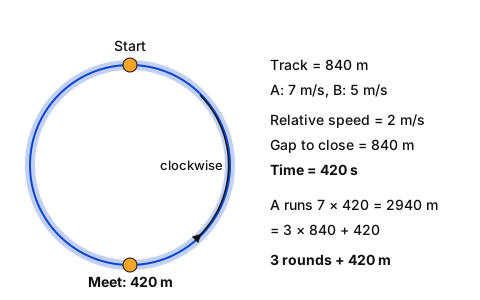
Two runners A and B start simultaneously from the same point on a circular track of length 840 m and run in the clockwise direction. The speed of A is 7 m/s and the speed of B is 5 m/s. At what distance from the starting point in the clockwise direction and after how many complete rounds by A, does A meet with B again the first time?
दो धावक A और B, 840 m लंबाई के एक वृत्ताकार ट्रैक पर एक ही बिंदु से एक साथ चलना प्रारंभ करते हैं और दक्षिणावर्त दिशा में दौड़ते हैं। A की चाल 7 m/s और B की चाल 5 m/s है। प्रारंभिक बिंदु से दक्षिणावर्त दिशा में कितनी दूरी पर और A के कितने पूर्ण चक्कर के बाद, A पहली बार B से पुनः मिलता है?
  1. A210 m after completing 3 rounds3 चक्कर पूरे करने के बाद 210 m पर
  2. B210 m after completing 2 rounds2 चक्कर पूरे करने के बाद 210 m पर
  3. C420 m after completing 3 rounds3 चक्कर पूरे करने के बाद 420 m पर
  4. D420 m after completing 2 rounds2 चक्कर पूरे करने के बाद 420 m पर
Show answer

Concept: Same direction on a circular track: first meeting when the faster runner gains one full lap, i.e. time =track lengthrelative speed.

  1. Relative speed =7−5=2m/s; time to gain 840 m =8402=420 s.
  2. Distance run by A =7×420=2940 m =3×840+420.
  3. So A has completed 3 full rounds and is 420 m from the start (clockwise) when they meet.

Trick: B runs 5×420=2100=2×840+420 – both are 420 m from the start, a quick consistency check.

Answer: (C) 420 m after completing 3 rounds

अवधारणा: वृत्ताकार पथ पर समान दिशा: पहली मुलाकात तब जब तेज़ धावक एक पूरा चक्कर आगे निकल जाए, अर्थात समय =पथ की लंबाईसापेक्ष चाल।

  1. सापेक्ष चाल =7−5=2m/s; 840 m की बढ़त का समय =8402=420 s।
  2. A द्वारा तय दूरी =7×420=2940 m =3×840+420।
  3. अतः मिलते समय A ने 3 पूरे चक्कर लगाए हैं और प्रारंभ बिंदु से 420 m (दक्षिणावर्त) आगे है।

ट्रिक: B 5×420=2100=2×840+420 दौड़ता है – दोनों प्रारंभ से 420 m पर, त्वरित जाँच।

उत्तर: (C) 420 m after completing 3 rounds

RRB NTPC Graduate CBT 1MathematicsCircular track – same directionRRB NTPC Graduate CBT 1 2025 · 24 Mar Shift 1 →
Q5539.
There are 30 members in group A, 21 members in group B and 40 members in group C. All the members of these groups went to a restaurant. The average amounts spent on each member of groups A, B and C are ₹378, ₹355 and ₹224, respectively. The overall average amount (in ₹) spent per member is:
समूह A में 30 सदस्य, समूह B में 21 सदस्य और समूह C में 40 सदस्य हैं। इन समूहों के सभी सदस्य एक रेस्तरां में गए। समूह A, B और C के प्रत्येक सदस्य पर खर्च की गई औसत राशि क्रमशः ₹378, ₹355 और ₹224 है। प्रति सदस्य खर्च की गई समग्र औसत राशि (₹ में) है:
  1. A302
  2. B304
  3. C303
  4. D305
Show answer

Concept: Overall average =total amounttotal members – weight each group average by its size.

  1. Total =30×378+21×355+40×224=11340+7455+8960=27755.
  2. Total members =30+21+40=91.
  3. Average =2775591=305.

Trick: Never average the three averages (378+355+2243=319) – group sizes differ, so weights matter.

Answer: (D) 305

अवधारणा: समग्र औसत =कुल राशिकुल सदस्य – हर समूह के औसत को उसके आकार से भारित कीजिए।

  1. कुल =30×378+21×355+40×224=11340+7455+8960=27755।
  2. कुल सदस्य =30+21+40=91।
  3. औसत =2775591=305।

ट्रिक: तीनों औसतों का औसत (378+355+2243=319) कभी न लें – समूहों के आकार अलग हैं, भार मायने रखता है।

उत्तर: (D) 305

RRB NTPC Graduate CBT 1MathematicsWeighted averageRRB NTPC Graduate CBT 1 2025 · 24 Mar Shift 1 →
Q5540.
Evaluate: (-9) - (-56) ÷ (-8) + (-4) × 7
मान ज्ञात कीजिए: (-9) - (-56) ÷ (-8) + (-4) × 7
  1. A-47
  2. B-44
  3. C-43
  4. D-46
Show answer

Concept: Do division and multiplication before addition/subtraction, and keep track of signs.

  1. (−56)÷(−8)=+7; (−4)×7=−28.
  2. Expression =(−9)−7+(−28).
  3. =−9−7−28=−44.

Trick: Negative ÷ negative = positive; then "minus a positive" makes it −7. Sign slips here give the wrong options −46, −47.

Answer: (B) −44

अवधारणा: जोड़/घटाव से पहले भाग और गुणा कीजिए और चिह्नों का ध्यान रखिए।

  1. (−56)÷(−8)=+7; (−4)×7=−28।
  2. व्यंजक =(−9)−7+(−28)।
  3. =−9−7−28=−44।

ट्रिक: ऋण ÷ ऋण = धन; फिर "धन घटाना" −7 देता है। यहीं चिह्न की चूक से गलत विकल्प −46, −47 बनते हैं।

उत्तर: (B) −44

RRB NTPC Graduate CBT 1MathematicsSimplification – BODMAS with negativesRRB NTPC Graduate CBT 1 2025 · 24 Mar Shift 1 →