RRB NTPC Graduate CBT 1 2025 · Shift 1

RRB NTPC Graduate CBT 1 24 Mar 2026 Shift 1 – Question Paper

100 questions · 100 marks · 90 minutes · +1 for a correct answer, −1/3 for a wrong one. With answer key and detailed solutions in Hindi and English.

Test Series – airGurukul

Paper pattern

SectionQuestionsMarks
General Awareness4040
Mathematics3232
General Intelligence and Reasoning2828

Sample questions from this paper

Q1.
Which of the following is the most significant source of nutrient pollution leading to eutrophication in freshwater bodies?
निम्नलिखित में से कौन-सा स्रोत मीठे जल के निकायों में सुपोषण (eutrophication) का कारण बनने वाले पोषक प्रदूषण का सबसे महत्वपूर्ण स्रोत है?
  1. AIndustrial effluentsऔद्योगिक बहिःस्राव
  2. BAgricultural runoffकृषि अपवाह
  3. CSewage dischargeमल-जल निस्सारण
  4. DUrban stormwaterशहरी वर्षा-जल अपवाह
Show answer

Concept: Eutrophication is the over-enrichment of a water body with nutrients (mainly nitrogen and phosphorus) which causes algal blooms and oxygen depletion.

  1. The largest single source of these nutrients is agricultural runoff – fertilisers and animal manure washed from fields into rivers and lakes.
  2. Sewage, industrial effluents and urban stormwater also add nutrients, but worldwide their share is much smaller than the diffuse (non-point) runoff from farmland.

Yaad rakhein: Fertiliser = N + P → runoff → algal bloom → dead zone. Agriculture is the "non-point" culprit.

Answer: (B) Agricultural runoff

अवधारणा: सुपोषण (eutrophication) में जल-निकाय में पोषक तत्वों (मुख्यतः नाइट्रोजन और फॉस्फोरस) की अधिकता से शैवाल प्रस्फुटन (algal bloom) और ऑक्सीजन की कमी होती है।

  1. इन पोषक तत्वों का सबसे बड़ा स्रोत कृषि अपवाह (agricultural runoff) है – खेतों से बहकर आने वाले उर्वरक और पशु-खाद।
  2. सीवेज, औद्योगिक अपशिष्ट और शहरी वर्षा-जल भी पोषक तत्व जोड़ते हैं, पर विश्व स्तर पर इनका हिस्सा खेतों के फैले हुए (non-point) अपवाह से काफी कम है।

याद रखें: उर्वरक = N + P → अपवाह → शैवाल प्रस्फुटन → मृत क्षेत्र। कृषि ही "non-point" स्रोत है।

उत्तर: (B) Agricultural runoff (कृषि अपवाह)
RRB NTPC Graduate CBT 1General AwarenessEutrophication
Q41.
The average weight of a group of 10 students is 50 kg. If the weight of the teacher is also included, the average weight increases by 1 kg. What is the teacher’s weight?
10 विद्यार्थियों के एक समूह का औसत भार 50 kg है। यदि शिक्षक का भार भी सम्मिलित कर लिया जाए, तो औसत भार 1 kg बढ़ जाता है। शिक्षक का भार क्या है?
  1. A59 kg
  2. B61 kg
  3. C60 kg
  4. D58 kg
Show answer

Concept: Total = Average × Number. When a new member raises the average, his weight = new average + (old count × increase).

  1. Total weight of 10 students =10×50=500 kg.
  2. With the teacher, 11 persons have average 51 kg → total =11×51=561 kg.
  3. Teacher's weight =561−500=61 kg.

Trick: New member = new average + (old number × rise) =51+10×1=61.

Answer: (B) 61 kg

अवधारणा: योग = औसत × संख्या। नया सदस्य जब औसत बढ़ाता है तो उसका भार = नया औसत + (पुरानी संख्या × वृद्धि)।

  1. 10 छात्रों का कुल भार =10×50=500 kg।
  2. शिक्षक सहित 11 व्यक्तियों का औसत 51 kg → कुल =11×51=561 kg।
  3. शिक्षक का भार =561−500=61 kg।

ट्रिक: नया सदस्य = नया औसत + (पुरानी संख्या × वृद्धि) =51+10×1=61।

उत्तर: (B) 61 kg

RRB NTPC Graduate CBT 1MathematicsAverage
Q73.
Seven boxes P, Q, R, S, T, U and V are kept one over the other but not necessarily in the same order.
No box is kept above U. Only three boxes are kept between U and P. Only one box is kept between R and T. T is kept immediately above P. Only four boxes are kept between R and V. Q is kept at some place above S.
How many boxes are kept between S and U?
सात बक्से P, Q, R, S, T, U और V एक के ऊपर एक रखे गए हैं, परंतु आवश्यक नहीं कि इसी क्रम में हों।
U के ऊपर कोई बक्सा नहीं रखा है। U और P के बीच केवल तीन बक्से रखे हैं। R और T के बीच केवल एक बक्सा रखा है। T, P के ठीक ऊपर रखा है। R और V के बीच केवल चार बक्से रखे हैं। Q, S के ऊपर किसी स्थान पर रखा है।
S और U के बीच कितने बक्से रखे हैं?
  1. A3
  2. B2
  3. C4
  4. D1
Show answer

Concept: Fix the box whose position is certain (U at the top), then place the others by counting gaps.

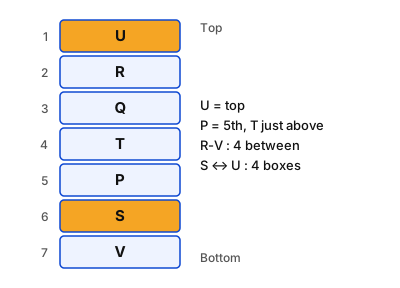
  1. No box above U → U is at position 1 (top). Three boxes between U and P → P is 5th.
  2. T is immediately above P → T is 4th. One box between R and T → R is 2nd or 6th.
  3. Four boxes between R and V → R = 2nd, V = 7th (R = 6th would need V at position 1, which is U).
  4. Q is above S, so Q = 3rd and S = 6th. Final stack (top to bottom): U, R, Q, T, P, S, V.
  5. Between S (6th) and U (1st) lie R, Q, T, P → 4 boxes.

Trick: "Only n boxes between X and Y" means the positions differ by n + 1; start from the box with a fixed end position.

Answer: (C) 4

अवधारणा: जिस बॉक्स की स्थिति निश्चित हो (U सबसे ऊपर) उसे पहले रखें, फिर बीच के बॉक्स गिनकर बाकी रखें।

  1. U के ऊपर कोई बॉक्स नहीं → U स्थान 1 (सबसे ऊपर)। U और P के बीच तीन बॉक्स → P 5वाँ।
  2. T, P के ठीक ऊपर → T 4था। R और T के बीच एक बॉक्स → R 2रा या 6ठा।
  3. R और V के बीच चार बॉक्स → R = 2रा, V = 7वाँ (R = 6ठा होने पर V को स्थान 1 चाहिए, जो U का है)।
  4. Q, S से ऊपर है, अतः Q = 3रा, S = 6ठा। अंतिम क्रम (ऊपर से नीचे): U, R, Q, T, P, S, V।
  5. S (6ठा) और U (1ला) के बीच R, Q, T, P → 4 बॉक्स।

ट्रिक: "X और Y के बीच केवल n बॉक्स" का अर्थ है स्थानों का अंतर n + 1; जिस बॉक्स का सिरा तय हो, वहीं से शुरू करें।

उत्तर: (C) 4

RRB NTPC Graduate CBT 1General Intelligence and ReasoningBox Arrangement

See all 100 solutions

More RRB NTPC Graduate CBT 1 papers

Download our app

Study smarter with the airGurukul App

Your complete exam-prep companion - classes, practice, and progress tracking.

Learn anytime, anywhere - live classes, tests, notes, and updates in one place.

GET IT ONGoogle Play

Have a query? We’re here to help

Fill out the form and our team will get back to you as soon as possible.

  • Ask your questions related to admission, courses, fees, or facilities
  • Share your details so our team can contact you easily
  • Get accurate information from our support team
  • Quick and simple form submission process

All fields marked * are required.