Question bank

Q&A: practice questions with answers

Search questions on any topic. Filter by exam category, exam, subject and topic, try the question, then open the answer and explanation.

Courses – airGurukul

7,077 questions found.

Q5821.
20% of a number is more than 20% of 620 by 200. The number is:
किसी संख्या का 20%, 620 के 20% से 200 अधिक है। वह संख्या है:
  1. A1470
  2. B1670
  3. C1620
  4. D1720
Show answer

Concept: Translate the statement into an equation: 20% of N = 20% of 620 + 200.

  1. 20% of 620 =124.
  2. 0.2N=124+200=324.
  3. N=3240.2=1620.

Trick: 20% of (N − 620) = 200 ⇒ N−620=1000⇒N=1620.

Answer: (C) 1620

अवधारणा: कथन को समीकरण में बदलें: N का 20% = 620 का 20% + 200।

  1. 620 का 20% =124।
  2. 0.2N=124+200=324।
  3. N=3240.2=1620।

ट्रिक: (N − 620) का 20% = 200 ⇒ N−620=1000⇒N=1620।

उत्तर: (C) 1620

RRB NTPC Graduate CBT 1MathematicsPercentageRRB NTPC Graduate CBT 1 2025 · 22 Mar Shift 1 →
Q5822.
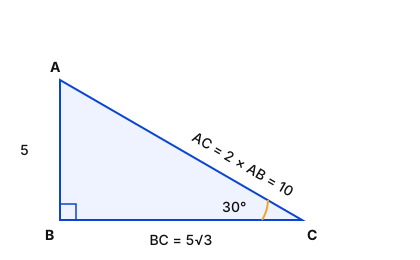
Let ABC be a right-angled triangle such that ∠B = 90°, ∠ACB = 30° and AB = 5 cm. Find the value (in cm) of AC + BC.
मान लीजिए ABC एक समकोण त्रिभुज है जिसमें ∠B = 90°, ∠ACB = 30° और AB = 5 cm है। AC + BC का मान (cm में) ज्ञात कीजिए।
  1. A10+23
  2. B53
  3. C10+53
  4. D123
Show answer

Concept: In a right triangle with a 30° angle, the side opposite 30° is half the hypotenuse and the other leg is 3 times it.

  1. ∠B = 90°, ∠C = 30° → AB is opposite 30°: AB=5.
  2. Hypotenuse AC=2×AB=10; BC=AB3=53 (or tan30∘=ABBC).
  3. AC+BC=10+53.

Trick: 30-60-90 sides are in ratio 1:3:2 (opposite 30°, 60°, 90°). Multiply by 5.

Answer: (C) 10+53

अवधारणा: 30° कोण वाले समकोण त्रिभुज में 30° के सामने की भुजा कर्ण की आधी और दूसरी भुजा उसकी 3 गुनी होती है।

  1. ∠B = 90°, ∠C = 30° → AB, 30° के सामने है: AB=5।
  2. कर्ण AC=2×AB=10; BC=AB3=53 (या tan30∘=ABBC)।
  3. AC+BC=10+53।

ट्रिक: 30-60-90 की भुजाएँ 1:3:2 (30°, 60°, 90° के सामने) के अनुपात में; 5 से गुणा करें।

उत्तर: (C) 10+53

RRB NTPC Graduate CBT 1MathematicsTrigonometry – 30-60-90 TriangleRRB NTPC Graduate CBT 1 2025 · 22 Mar Shift 1 →
Q5823.
A tourist covers his 120 km journey in three stages. In the first stage, he travels at a speed of x km/hr. In the second stage, he increases his speed by 50%. In the third stage, he reduces his second-stage speed by 20%. He spends equal time on all the 3 stages, and his average speed for the entire journey is 48 km/hr. Find the value of x correct to one decimal place.
एक पर्यटक अपनी 120 km की यात्रा तीन चरणों में पूरी करता है। पहले चरण में वह x km/hr की चाल से यात्रा करता है। दूसरे चरण में वह अपनी चाल 50% बढ़ा देता है। तीसरे चरण में वह अपनी दूसरे चरण की चाल को 20% कम कर देता है। वह तीनों चरणों में समान समय व्यतीत करता है, और पूरी यात्रा के लिए उसकी औसत चाल 48 km/hr है। x का मान एक दशमलव स्थान तक सही ज्ञात कीजिए।
  1. A38.9
  2. B38.3
  3. C39.3
  4. D40.3
Show answer

Concept: When equal time is spent at different speeds, average speed = simple average of the speeds.

  1. Speeds: stage 1 =x, stage 2 =1.5x, stage 3 =0.8×1.5x=1.2x.
  2. Average =x+1.5x+1.2x3=3.7x3=48.
  3. x=1443.7≈38.92≈38.9.

Trick: Equal time → arithmetic mean of speeds; equal distance → harmonic mean. The 120 km is not needed here.

Answer: (A) 38.9

अवधारणा: जब अलग-अलग चालों पर बराबर समय लगे, औसत चाल = चालों का साधारण औसत।

  1. चालें: चरण 1 =x, चरण 2 =1.5x, चरण 3 =0.8×1.5x=1.2x।
  2. औसत =x+1.5x+1.2x3=3.7x3=48।
  3. x=1443.7≈38.92≈38.9।

ट्रिक: बराबर समय → चालों का समांतर माध्य; बराबर दूरी → हरात्मक माध्य। यहाँ 120 km की ज़रूरत ही नहीं।

उत्तर: (A) 38.9

RRB NTPC Graduate CBT 1MathematicsAverage SpeedRRB NTPC Graduate CBT 1 2025 · 22 Mar Shift 1 →
Q5824.
If A's salary is 130% more than that of B, then by how much percent is B's salary less than that of A (correct to 2 decimal places)?
यदि A का वेतन B के वेतन से 130% अधिक है, तो B का वेतन A के वेतन से कितने प्रतिशत कम है (2 दशमलव स्थानों तक सही)?
  1. A58.42%
  2. B56.52%
  3. C55.88%
  4. D54.62%
Show answer

Concept: If A is p% more than B, B is less than A by p100+p×100%.

  1. Let B =100; then A =230.
  2. B is less than A by 230−100=130, on base A.
  3. 130230×100=56.52%.

Trick: 130230=1323; 13÷23=0.5652. Always use the larger value as the base when asking "less than".

Answer: (B) 56.52%

अवधारणा: यदि A, B से p% अधिक है तो B, A से p100+p×100% कम है।

  1. B =100 लें; तब A =230।
  2. B, A से 230−100=130 कम है, आधार A।
  3. 130230×100=56.52%।

ट्रिक: 130230=1323; 13÷23=0.5652। "कम" पूछने पर बड़े मान को आधार बनाएँ।

उत्तर: (B) 56.52%

RRB NTPC Graduate CBT 1MathematicsPercentage ComparisonRRB NTPC Graduate CBT 1 2025 · 22 Mar Shift 1 →
Q5825.
Find the solution of the following system of linear equations:
x + 4y + 2z = 12
2x − y + z = 3
x + y − z = 0
निम्नलिखित रैखिक समीकरण निकाय का हल ज्ञात कीजिए:
x + 4y + 2z = 12
2x − y + z = 3
x + y − z = 0
  1. Ax=52, y=1, z=32
  2. Bx=1, y=52, z=32
  3. Cx=1, y=32, z=52
  4. Dx=32, y=1, z=52
Show answer

Concept: Use the simplest equation to substitute one variable and reduce to two equations.

  1. From x+y−z=0: z=x+y.
  2. Eq. 1: x+4y+2(x+y)=12⇒3x+6y=12⇒x+2y=4.
  3. Eq. 2: 2x−y+(x+y)=3⇒3x=3⇒x=1.
  4. y=4−12=32, z=1+32=52.

Trick: Options can be tested: only x=1,y=32,z=52 satisfies x+y−z=0 and 2x−y+z=3 together.

Answer: (C) x=1, y=32, z=52

अवधारणा: सबसे सरल समीकरण से एक चर प्रतिस्थापित कर दो समीकरणों तक लाएँ।

  1. x+y−z=0 से: z=x+y।
  2. समीकरण 1: x+4y+2(x+y)=12⇒3x+6y=12⇒x+2y=4।
  3. समीकरण 2: 2x−y+(x+y)=3⇒3x=3⇒x=1।
  4. y=4−12=32, z=1+32=52।

ट्रिक: विकल्प जाँचें: केवल x=1,y=32,z=52 ही x+y−z=0 और 2x−y+z=3 दोनों को संतुष्ट करता है।

उत्तर: (C) x=1, y=32, z=52

RRB NTPC Graduate CBT 1MathematicsLinear Equations in Three VariablesRRB NTPC Graduate CBT 1 2025 · 22 Mar Shift 1 →
Q5826.
The mode of the following data is 36. Find the missing frequency in it.
Class Interval0-1010-2020-3030-4040-50
Frequency46--95
निम्नलिखित आँकड़ों का बहुलक (mode) 36 है। इसमें लुप्त बारंबारता ज्ञात कीजिए।
वर्ग अंतराल0-1010-2020-3030-4040-50
बारंबारता46--95
  1. A3
  2. B5
  3. C4
  4. D6
Show answer

Concept: Mode =l+f1−f02f1−f0−f2×h, where f1 = modal-class frequency, f0, f2 = frequencies of the classes before and after.

  1. Mode 36 lies in 30–40 → l=30, h=10, f1=9, f2=5, f0=x (20–30).
  2. 36=30+9−x18−x−5×10⇒9−x13−x=0.6.
  3. 9−x=7.8−0.6x⇒0.4x=1.2⇒x=3.

Trick: Check: 9−313−3=610=0.6 → 30+6=36 ✓.

Answer: (A) 3

अवधारणा: बहुलक =l+f1−f02f1−f0−f2×h, जहाँ f1 = बहुलक वर्ग की बारंबारता, f0, f2 = पहले और बाद के वर्गों की बारंबारताएँ।

  1. बहुलक 36, वर्ग 30–40 में → l=30, h=10, f1=9, f2=5, f0=x (20–30)।
  2. 36=30+9−x18−x−5×10⇒9−x13−x=0.6।
  3. 9−x=7.8−0.6x⇒0.4x=1.2⇒x=3।

ट्रिक: जाँच: 9−313−3=610=0.6 → 30+6=36 ✓।

उत्तर: (A) 3

RRB NTPC Graduate CBT 1MathematicsStatistics – Mode of Grouped DataRRB NTPC Graduate CBT 1 2025 · 22 Mar Shift 1 →
Q5827.
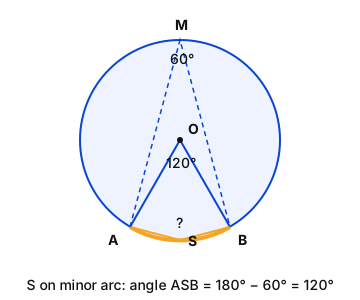
Let C be a circle with centre O and AB be a minor arc on C. Let S be a point on the minor arc AB. If AB subtends an angle 120° at O, then find the measure of ∠ASB.
मान लीजिए C केंद्र O वाला एक वृत्त है और AB, C पर एक लघु चाप है। मान लीजिए S लघु चाप AB पर एक बिंदु है। यदि AB, O पर 120° का कोण अंतरित करता है, तो ∠ASB की माप ज्ञात कीजिए।
  1. A120°
  2. B110°
  3. C100°
  4. D60°
Show answer

Concept: Angle at the centre = 2 × angle at any point of the remaining (major) arc; angles in opposite segments are supplementary.

  1. ∠AOB = 120° → for a point M on the major arc, ∠AMB =120∘2=60∘.
  2. S lies on the minor arc, so ASBM is a cyclic quadrilateral: ∠ASB =180∘−60∘=120∘.

Trick: Point on the minor arc sees the chord at 180∘−central angle2; here 180∘−60∘=120∘. 60° (option D) is the trap for a point on the major arc.

Answer: (A) 120°

अवधारणा: केंद्र पर कोण = शेष (दीर्घ) चाप के किसी बिंदु पर कोण का 2 गुना; विपरीत वृत्तखंडों के कोण संपूरक होते हैं।

  1. ∠AOB = 120° → दीर्घ चाप के बिंदु M पर ∠AMB =120∘2=60∘।
  2. S लघु चाप पर है, अतः ASBM चक्रीय चतुर्भुज है: ∠ASB =180∘−60∘=120∘।

ट्रिक: लघु चाप का बिंदु जीवा को 180∘−केंद्रीय कोण2 पर देखता है; यहाँ 180∘−60∘=120∘। 60° (विकल्प D) दीर्घ चाप के बिंदु का जाल है।

उत्तर: (A) 120°

RRB NTPC Graduate CBT 1MathematicsCircle – Angles in SegmentsRRB NTPC Graduate CBT 1 2025 · 22 Mar Shift 1 →
Q5828.
Two pipes can fill a cistern in 24 minutes and 36 minutes, respectively. A third pipe can empty it in 18 minutes. If all three are opened together, how long will it take to fill the tank?
दो पाइप एक टंकी को क्रमशः 24 मिनट और 36 मिनट में भर सकते हैं। एक तीसरा पाइप इसे 18 मिनट में खाली कर सकता है। यदि तीनों पाइप एक साथ खोल दिए जाएँ, तो टंकी को भरने में कितना समय लगेगा?
  1. A144 minutes144 मिनट
  2. B60 minutes60 मिनट
  3. C108 minutes108 मिनट
  4. D72 minutes72 मिनट
Show answer

Concept: Take total capacity = LCM of the times; add filling rates, subtract the emptying rate.

  1. Capacity =LCM(24,36,18)=72 units.
  2. Rates: 7224=3, 7236=2, outlet 7218=−4 units/min.
  3. Net =3+2−4=1 unit/min → time =72 minutes.

Trick: With LCM units the net rate is often 1 or 2 – here net 1 unit/min means time = capacity = 72 min.

Answer: (D) 72 minutes

अवधारणा: कुल क्षमता = समयों का LCM लें; भरने की दरें जोड़ें, खाली करने की दर घटाएँ।

  1. क्षमता =LCM(24,36,18)=72 इकाई।
  2. दरें: 7224=3, 7236=2, निकास 7218=−4 इकाई/मिनट।
  3. शुद्ध =3+2−4=1 इकाई/मिनट → समय =72 मिनट।

ट्रिक: LCM इकाइयों में शुद्ध दर प्रायः 1 या 2 आती है – यहाँ 1 इकाई/मिनट, अतः समय = क्षमता = 72 मिनट।

उत्तर: (D) 72 minutes

RRB NTPC Graduate CBT 1MathematicsPipes and CisternsRRB NTPC Graduate CBT 1 2025 · 22 Mar Shift 1 →
Q5829.
100 men have provisions for 26 days. If 48 men have left, for how many days the same provisions would last for the remaining men?
100 आदमियों के पास 26 दिनों की खाद्य सामग्री है। यदि 48 आदमी चले जाएँ, तो वही खाद्य सामग्री शेष आदमियों के लिए कितने दिनों तक चलेगी?
  1. A54
  2. B48
  3. C50
  4. D52
Show answer

Concept: Total provision (man-days) is constant: M1D1=M2D2.

  1. Man-days =100×26=2600.
  2. Remaining men =100−48=52.
  3. D2=260052=50 days.

Trick: Fewer men → more days (inverse). 10052×26=260052=50.

Answer: (C) 50

अवधारणा: कुल राशन (व्यक्ति-दिन) स्थिर रहता है: M1D1=M2D2।

  1. व्यक्ति-दिन =100×26=2600।
  2. शेष व्यक्ति =100−48=52।
  3. D2=260052=50 दिन।

ट्रिक: कम व्यक्ति → अधिक दिन (व्युत्क्रम)। 10052×26=260052=50।

उत्तर: (C) 50

RRB NTPC Graduate CBT 1MathematicsInverse Proportion – Men and ProvisionsRRB NTPC Graduate CBT 1 2025 · 22 Mar Shift 1 →
Q5830.
The ratio of the ages of two persons, P and Q, is 3 : 4. After 6 years, the ratio of their ages will become 4 : 5. What is the present age of P?
दो व्यक्तियों P और Q की आयु का अनुपात 3 : 4 है। 6 वर्ष बाद उनकी आयु का अनुपात 4 : 5 हो जाएगा। P की वर्तमान आयु क्या है?
  1. A18 years18 वर्ष
  2. B30 years30 वर्ष
  3. C20 years20 वर्ष
  4. D13 years13 वर्ष
Show answer

Concept: Write present ages as multiples of the ratio and form an equation for the future ratio.

  1. Let P =3x, Q =4x.
  2. After 6 years: 3x+64x+6=45⇒15x+30=16x+24⇒x=6.
  3. P =3×6=18 years.

Trick: Difference of ages is constant: x (present) = 1 unit (future) and the units differ by 6 years → x=6.

Answer: (A) 18 years

अवधारणा: वर्तमान आयु को अनुपात के गुणज में लिखें और भविष्य के अनुपात का समीकरण बनाएँ।

  1. P =3x, Q =4x लें।
  2. 6 वर्ष बाद: 3x+64x+6=45⇒15x+30=16x+24⇒x=6।
  3. P =3×6=18 वर्ष।

ट्रिक: आयु का अंतर स्थिर: वर्तमान में x = भविष्य में 1 इकाई, और इकाइयों में 6 वर्ष का अंतर → x=6।

उत्तर: (A) 18 years

RRB NTPC Graduate CBT 1MathematicsRatio – AgesRRB NTPC Graduate CBT 1 2025 · 22 Mar Shift 1 →
Q5831.
Find the number of possible values for a natural number N such that the LCM of 120 and N is 360, and the HCF of 900 and N is 90.
एक प्राकृत संख्या N के संभव मानों की संख्या ज्ञात कीजिए, जिसके लिए 120 और N का LCM 360 है, तथा 900 और N का HCF 90 है।
  1. A4
  2. B3
  3. C1
  4. D2
Show answer

Concept: Compare powers of each prime. LCM takes the maximum power, HCF the minimum.

  1. 120=23·3·5, 360=23·32·5, 900=22·32·52, 90=2·32·5. Let N=2a3b5c (no other primes, since N | 360).
  2. Prime 2: min(2,a)=1⇒a=1. Prime 3: max(1,b)=2 and min(2,b)=2⇒b=2. Prime 5: min(2,c)=1⇒c=1.
  3. N=2·9·5=90 only. Check: LCM(120, 90) = 360 ✓, HCF(900, 90) = 90 ✓.

Trick: N must be a multiple of HCF 90 and a divisor of LCM 360: candidates 90, 180, 360; only 90 keeps HCF(900, N) = 90.

Answer: (C) 1

अवधारणा: हर अभाज्य की घातें मिलाएँ। LCM में अधिकतम घात, HCF में न्यूनतम घात आती है।

  1. 120=23·3·5, 360=23·32·5, 900=22·32·52, 90=2·32·5। N=2a3b5c लें (अन्य अभाज्य नहीं, क्योंकि N, 360 को विभाजित करता है)।
  2. अभाज्य 2: min(2,a)=1⇒a=1। अभाज्य 3: max(1,b)=2 और min(2,b)=2⇒b=2। अभाज्य 5: min(2,c)=1⇒c=1।
  3. केवल N=2·9·5=90। जाँच: LCM(120, 90) = 360 ✓, HCF(900, 90) = 90 ✓।

ट्रिक: N, HCF 90 का गुणज और LCM 360 का भाजक होना चाहिए: 90, 180, 360; केवल 90 पर HCF(900, N) = 90 रहता है।

उत्तर: (C) 1

RRB NTPC Graduate CBT 1MathematicsLCM and HCF – Prime FactorisationRRB NTPC Graduate CBT 1 2025 · 22 Mar Shift 1 →
Q5832.
At what rate per annum will a sum of money become five times itself in 10 years under simple interest?
साधारण ब्याज पर वार्षिक कितनी दर से एक धनराशि 10 वर्षों में स्वयं की पाँच गुनी हो जाएगी?
  1. A80%
  2. B38%
  3. C40%
  4. D42%
Show answer

Concept: If a sum becomes n times under SI, the interest is (n−1) times the principal: R=(n−1)×100T.

  1. Five times → SI =4P.
  2. 4P=P×R×10100⇒R=40%.

Trick: R=(5−1)×10010=40% per annum.

Answer: (C) 40%

अवधारणा: यदि साधारण ब्याज पर राशि n गुनी हो जाए तो ब्याज मूलधन का (n−1) गुना होता है: R=(n−1)×100T।

  1. पाँच गुना → SI =4P।
  2. 4P=P×R×10100⇒R=40%।

ट्रिक: R=(5−1)×10010=40% वार्षिक।

उत्तर: (C) 40%

RRB NTPC Graduate CBT 1MathematicsSimple InterestRRB NTPC Graduate CBT 1 2025 · 22 Mar Shift 1 →
Q5833.
The sum of 12 numbers is 528. Find their average.
12 संख्याओं का योग 528 है। उनका औसत ज्ञात कीजिए।
  1. A42
  2. B43
  3. C44
  4. D45
Show answer

Concept: Average =Sum of observationsNumber of observations.

  1. Sum =528, count =12.
  2. Average =52812=44.

Trick: 12×44=528 (12×40=480, 12×4=48).

Answer: (C) 44

अवधारणा: औसत =प्रेक्षणों का योगप्रेक्षणों की संख्या।

  1. योग =528, संख्या =12।
  2. औसत =52812=44।

ट्रिक: 12×44=528 (12×40=480, 12×4=48)।

उत्तर: (C) 44

RRB NTPC Graduate CBT 1MathematicsAverageRRB NTPC Graduate CBT 1 2025 · 22 Mar Shift 1 →
Q5834.
Find the difference between the values of ‘m’ for which 2m=5m−2.
‘m’ के उन मानों के बीच का अंतर ज्ञात कीजिए जिनके लिए 2m=5m−2।
  1. A83
  2. B154
  3. C23
  4. D22
Show answer

Concept: Put t=m to turn the equation into a quadratic in t.

  1. 2m=5m−2⇒2t2−5t+2=0.
  2. (2t−1)(t−2)=0⇒t=2 or t=12.
  3. m=t2=4 or 14.
  4. Difference =4−14=154.

Trick: Whenever m and m appear together, substitute t=m – it is just a quadratic.

Answer: (B) 154

अवधारणा: t=m रखने पर समीकरण t में द्विघात (quadratic) बन जाता है।

  1. 2m=5m−2⇒2t2−5t+2=0.
  2. (2t−1)(t−2)=0⇒t=2 या t=12.
  3. m=t2=4 या 14.
  4. अंतर =4−14=154.

ट्रिक: जब m और m साथ आएँ, t=m रख दें – सीधा द्विघात समीकरण बन जाता है।

उत्तर: (B) 154

RRB NTPC Graduate CBT 1MathematicsQuadratic in √mRRB NTPC Graduate CBT 1 2025 · 22 Mar Shift 1 →
Q5835.
There are 21 members in group A, 11 members in group B and 17 members in group C. All the members of these groups went to a restaurant. The average amounts spent on each member of groups A, B and C are ₹465, ₹410 and ₹466, respectively. The overall average amount (in ₹) spent per member is:
समूह A में 21 सदस्य, समूह B में 11 सदस्य और समूह C में 17 सदस्य हैं। इन समूहों के सभी सदस्य एक रेस्तरां में गए। समूह A, B और C के प्रत्येक सदस्य पर खर्च की गई औसत राशि क्रमशः ₹465, ₹410 और ₹466 है। प्रति सदस्य खर्च की गई समग्र औसत राशि (₹ में) है:
  1. A454
  2. B453
  3. C452
  4. D455
Show answer

Concept: Overall average =total amounttotal members.

  1. Total =21×465+11×410+17×466=9765+4510+7922=22197.
  2. Members =21+11+17=49.
  3. Average =2219749=453.

Trick: Take 450 as base: deviations 21×15+11×(−40)+17×16=315−440+272=147; 14749=3, so average =453.

Answer: (B) 453

अवधारणा: कुल औसत =कुल राशिकुल सदस्य.

  1. कुल =21×465+11×410+17×466=9765+4510+7922=22197.
  2. सदस्य =21+11+17=49.
  3. औसत =2219749=453.

ट्रिक: 450 को आधार लें: विचलन 21×15+11×(−40)+17×16=147; 14749=3, अतः औसत =453.

उत्तर: (B) 453

RRB NTPC Graduate CBT 1MathematicsWeighted averageRRB NTPC Graduate CBT 1 2025 · 22 Mar Shift 1 →
Q5836.
A bag contains coins of ₹1, ₹2, and ₹5 in the ratio 8 : 4 : 3. If the total value of the coins is ₹930, what is the total number of coins in the bag?
एक थैले में ₹1, ₹2 और ₹5 के सिक्के 8 : 4 : 3 के अनुपात में हैं। यदि सिक्कों का कुल मूल्य ₹930 है, तो थैले में सिक्कों की कुल संख्या क्या है?
  1. A400
  2. B450
  3. C420
  4. D480
Show answer

Concept: Number of coins 8x:4x:3x; value = number × denomination.

  1. Value =8x×1+4x×2+3x×5=8x+8x+15x=31x.
  2. 31x=930⇒x=30.
  3. Total coins =(8+4+3)x=15×30=450.

Trick: Multiply each ratio term by its denomination, add, and divide the total value by that sum to get x.

Answer: (B) 450

अवधारणा: सिक्कों की संख्या 8x:4x:3x; मूल्य = संख्या × मूल्यवर्ग।

  1. मूल्य =8x×1+4x×2+3x×5=31x.
  2. 31x=930⇒x=30.
  3. कुल सिक्के =(8+4+3)x=15×30=450.

ट्रिक: हर अनुपात-पद को उसके मूल्यवर्ग से गुणा करके जोड़ें, कुल मूल्य को उस योग से भाग दें – x मिल जाएगा।

उत्तर: (B) 450

RRB NTPC Graduate CBT 1MathematicsRatio – coinsRRB NTPC Graduate CBT 1 2025 · 22 Mar Shift 1 →
Q5837.
A woman travelled at a speed of 20 m/min for 90 min, and at a speed of 65 m/min for 60 min. Her average speed (in m/min) for the entire journey is:
एक महिला ने 90 मिनट तक 20 m/min की चाल से और 60 मिनट तक 65 m/min की चाल से यात्रा की। पूरी यात्रा के लिए उसकी औसत चाल (m/min में) है:
  1. A31
  2. B42
  3. C38
  4. D44
Show answer

Concept: Average speed =total distancetotal time (not the average of speeds).

  1. Distance 1 =20×90=1800m; distance 2 =65×60=3900m.
  2. Total =5700m in 150 min.
  3. Average speed =5700150=38m/min.

Trick: With times in ratio 3:2, weighted mean =3×20+2×655=1905=38.

Answer: (C) 38

अवधारणा: औसत चाल =कुल दूरीकुल समय (चालों का औसत नहीं)।

  1. दूरी 1 =20×90=1800m; दूरी 2 =65×60=3900m.
  2. कुल =5700m, समय 150 मिनट।
  3. औसत चाल =5700150=38m/min.

ट्रिक: समय का अनुपात 3:2 है, अतः भारित औसत =3×20+2×655=38.

उत्तर: (C) 38

RRB NTPC Graduate CBT 1MathematicsAverage speedRRB NTPC Graduate CBT 1 2025 · 22 Mar Shift 1 →
Q5838.
The price of each article of type P, Q, and R is ₹280, ₹180 and ₹120, respectively. Subrata buys articles of each type in the ratio 3 : 2 : 3 for ₹6,240. How many articles of type Q did he purchase?
P, Q और R प्रकार की प्रत्येक वस्तु का मूल्य क्रमशः ₹280, ₹180 और ₹120 है। सुब्रत प्रत्येक प्रकार की वस्तुएँ 3 : 2 : 3 के अनुपात में ₹6,240 में खरीदता है। उसने Q प्रकार की कितनी वस्तुएँ खरीदीं?
  1. A16
  2. B8
  3. C14
  4. D5
Show answer

Concept: Let the numbers be 3x,2x,3x; total cost = sum of (number × price).

  1. Cost =3x×280+2x×180+3x×120=840x+360x+360x=1560x.
  2. 1560x=6240⇒x=4.
  3. Articles of type Q =2x=8.

Trick: 1560×4=6240 – spotting that 6240 is 4×1560 gives x instantly.

Answer: (B) 8

अवधारणा: संख्याएँ 3x,2x,3x मानें; कुल लागत = (संख्या × मूल्य) का योग।

  1. लागत =3x×280+2x×180+3x×120=1560x.
  2. 1560x=6240⇒x=4.
  3. Q प्रकार की वस्तुएँ =2x=8.

ट्रिक: 6240=4×1560 पहचानते ही x=4 मिल जाता है।

उत्तर: (B) 8

RRB NTPC Graduate CBT 1MathematicsRatio – total costRRB NTPC Graduate CBT 1 2025 · 22 Mar Shift 1 →
Q5839.
If x4−83x2+1=0 and x>0, then the value of x3−x−3+28 is:
यदि x4−83x2+1=0 और x>0 है, तो x3−x−3+28 का मान है:
  1. A29
  2. B27
  3. C28
  4. D26
Show answer

Concept: Divide by x2 to get x2+1x2, then use (x−1x)2=x2+1x2−2 and x3−1x3=a3+3a where a=x−1x.

  1. x4−83x2+1=0⇒x2+1x2=83.
  2. (x−1x)2=83−2=81⇒x−1x=9 (taking the value that keeps the root real).
  3. x3−x−3=93+3×9=729+27=756.
  4. 756+28=784=28.

Trick: x2+1x2=83⇒x−1x=81=9; then a3+3a – remember ‘minus’ identity has ‘plus 3a’.

Answer: (C) 28

अवधारणा: x2 से भाग देकर x2+1x2 निकालें, फिर (x−1x)2=x2+1x2−2 और x3−1x3=a3+3a (a=x−1x) का प्रयोग करें।

  1. x4−83x2+1=0⇒x2+1x2=83.
  2. (x−1x)2=81⇒x−1x=9 (वह मान जिससे वर्गमूल वास्तविक रहे)।
  3. x3−x−3=93+3×9=756.
  4. 756+28=784=28.

ट्रिक: x2+1x2=83⇒x−1x=9; फिर a3+3a – ‘माइनस’ वाली सर्वसमिका में ‘प्लस 3a’ आता है।

उत्तर: (C) 28

RRB NTPC Graduate CBT 1MathematicsAlgebraic identitiesRRB NTPC Graduate CBT 1 2025 · 22 Mar Shift 1 →
Q5840.
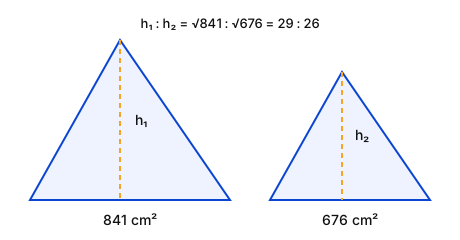
The areas of two similar triangles are 841 cm2 and 676 cm2, respectively. What is the ratio of their corresponding altitudes?
दो समरूप त्रिभुजों के क्षेत्रफल क्रमशः 841 cm2 और 676 cm2 हैं। उनके संगत शीर्षलंबों (altitudes) का अनुपात क्या है?
  1. A38 : 27
  2. B29 : 26
  3. C24 : 28
  4. D27 : 24
Show answer

Concept: For similar triangles, A1A2=(h1h2)2 (ratio of areas = square of ratio of corresponding altitudes/sides).

  1. h1h2=841676.
  2. 841=29, 676=26.
  3. Ratio =29:26.

Trick: Areas → take square root for any length ratio (side, altitude, median, perimeter).

Answer: (B) 29 : 26

अवधारणा: समरूप त्रिभुजों में A1A2=(h1h2)2 (क्षेत्रफलों का अनुपात = संगत शीर्षलंबों/भुजाओं के अनुपात का वर्ग)।

  1. h1h2=841676.
  2. 841=29, 676=26.
  3. अनुपात =29:26.

ट्रिक: क्षेत्रफल दिया हो → किसी भी लंबाई (भुजा, शीर्षलंब, माध्यिका, परिमाप) के अनुपात के लिए वर्गमूल लें।

उत्तर: (B) 29 : 26

RRB NTPC Graduate CBT 1MathematicsSimilar triangles – area ratioRRB NTPC Graduate CBT 1 2025 · 22 Mar Shift 1 →