Question bank

Q&A: practice questions with answers

Search questions on any topic. Filter by exam category, exam, subject and topic, try the question, then open the answer and explanation.

Courses – airGurukul

7,077 questions found.

Q5921.
Two parallel lines L1 and L2​ are cut by a transversal. If one of the alternate interior angles is 65°, what is the measure of the corresponding alternate interior angle?
दो समांतर रेखाएँ L1 और L2 एक तिर्यक रेखा (transversal) द्वारा काटी जाती हैं। यदि एकांतर अंतः कोणों में से एक 65° है, तो संगत एकांतर अंतः कोण का माप क्या है?
  1. A180°
  2. B65°
  3. C110°
  4. D90°
Show answer

Concept: When a transversal cuts two parallel lines, each pair of alternate interior angles is equal.
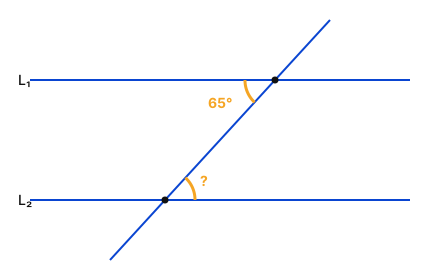
  1. The two alternate interior angles lie on opposite sides of the transversal, between the parallel lines, forming a "Z".
  2. Given one of them =65∘, the other alternate interior angle is also 65∘.
  3. 110∘ would be the co-interior (same-side) angle (180∘−65∘), not the alternate one.

Trick: Z-angles (alternate) equal, F-angles (corresponding) equal, C-angles (co-interior) add to 180∘.

Answer: (B) 65°

अवधारणा: जब एक तिर्यक रेखा दो समांतर रेखाओं को काटती है, तो एकांतर अंतःकोणों का प्रत्येक युग्म बराबर होता है।

  1. दोनों एकांतर अंतःकोण तिर्यक रेखा के विपरीत ओर, समांतर रेखाओं के बीच "Z" बनाते हैं।
  2. एक कोण =65∘ दिया है, अतः दूसरा एकांतर अंतःकोण भी 65∘।
  3. 110∘ तो सह-अंतःकोण (180∘−65∘) होता, एकांतर नहीं।

ट्रिक: Z-कोण (एकांतर) बराबर, F-कोण (संगत) बराबर, C-कोण (सह-अंतः) का योग 180∘।

उत्तर: (B) 65°

RRB NTPC Graduate CBT 1MathematicsParallel Lines and TransversalRRB NTPC Graduate CBT 1 2025 · 19 Mar Shift 3 →
Q5922.
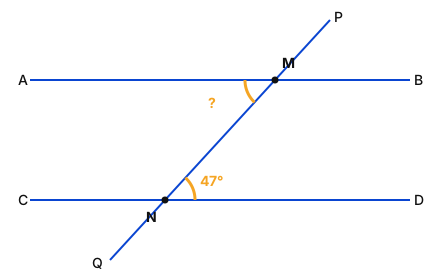
Two lines AB and CD are parallel. Let PQ be the transversal intersecting AB at M and CD at N. If ∠MND=47∘, find ∠AMN.
दो रेखाएँ AB और CD समांतर हैं। मान लीजिए PQ एक तिर्यक रेखा है जो AB को M पर और CD को N पर काटती है। यदि ∠MND=47∘ है, तो ∠AMN ज्ञात कीजिए।
  1. A73∘
  2. B133∘
  3. C47∘
  4. D107∘
Show answer

Concept: Alternate interior angles made by a transversal with two parallel lines are equal.

  1. Transversal PQ meets AB at M and CD at N. ∠AMN (at M, towards A) and ∠MND (at N, towards D) lie between the parallels on opposite sides of MN – alternate interior angles.
  2. Hence ∠AMN=∠MND=47∘.
  3. 133∘ is the adjacent angle (∠BMN or ∠MNC), not the one asked.

Trick: A and D are on opposite sides of the transversal → the "Z" pair → equal.

Answer: (C) 47°

अवधारणा: दो समांतर रेखाओं के साथ तिर्यक रेखा से बने एकांतर अंतःकोण बराबर होते हैं।

  1. तिर्यक PQ, AB को M पर और CD को N पर काटती है। ∠AMN (M पर, A की ओर) और ∠MND (N पर, D की ओर) समांतर रेखाओं के बीच MN के विपरीत ओर हैं – एकांतर अंतःकोण।
  2. अतः ∠AMN=∠MND=47∘।
  3. 133∘ संलग्न कोण (∠BMN या ∠MNC) है, पूछा गया कोण नहीं।

ट्रिक: A और D तिर्यक रेखा के विपरीत ओर → "Z" युग्म → बराबर।

उत्तर: (C) 47°

RRB NTPC Graduate CBT 1MathematicsParallel Lines and TransversalRRB NTPC Graduate CBT 1 2025 · 19 Mar Shift 3 →
Q5923.
Ankur jogs on a circular track X at 123 m/s and Mahima jogs on track Y at 2112 m/s. The total length of Tracks X and Y is 0.325 km. Ankur makes 9 rounds of track X in the same time Mahima makes 5 rounds of track Y. The time taken (in seconds) by Mahima to complete one round of track X is:
अंकुर एक वृत्ताकार ट्रैक X पर 123 m/s की चाल से और महिमा ट्रैक Y पर 2112 m/s की चाल से जॉगिंग करती है। ट्रैक X और Y की कुल लंबाई 0.325 km है। अंकुर ट्रैक X के 9 चक्कर उतने ही समय में लगाता है जितने समय में महिमा ट्रैक Y के 5 चक्कर लगाती है। महिमा द्वारा ट्रैक X का एक चक्कर पूरा करने में लिया गया समय (सेकंड में) है:
  1. A35
  2. B48
  3. C42
  4. D39
Show answer

Concept: Equal time ⇒ distance1speed1=distance2speed2. Use it to find each track length.

  1. Speeds: Ankur =53 m/s, Mahima =2512 m/s. Let track X =x m, track Y =y m, x+y=325.
  2. Same time: 9x5/3=5y25/12⇒27x5=12y5⇒27x=12y⇒y=9x4.
  3. x+9x4=325⇒13x4=325⇒x=100 m (so y=225 m).
  4. Mahima on track X: time =10025/12=100×1225=48 s.

Trick: Convert 0.325 km to 325 m at once and keep speeds as fractions – the numbers cancel neatly.

Answer: (B) 48

अवधारणा: समान समय ⇒ दूरी1चाल1=दूरी2चाल2। इससे प्रत्येक ट्रैक की लंबाई निकालें।

  1. चालें: अंकुर =53 m/s, महिमा =2512 m/s। माना ट्रैक X =x m, ट्रैक Y =y m, x+y=325।
  2. समान समय: 9x5/3=5y25/12⇒27x5=12y5⇒27x=12y⇒y=9x4।
  3. x+9x4=325⇒13x4=325⇒x=100 m (अतः y=225 m)।
  4. महिमा ट्रैक X पर: समय =10025/12=100×1225=48 s।

ट्रिक: 0.325 km को तुरंत 325 m करें और चालें भिन्न में रखें – संख्याएँ साफ़ कटती हैं।

उत्तर: (B) 48

RRB NTPC Graduate CBT 1MathematicsSpeed, Time and Distance – Circular TracksRRB NTPC Graduate CBT 1 2025 · 19 Mar Shift 3 →
Q5924.
What is the mode of the data given below? [Give your answer correct to 2 decimal places.]
Age in years15-2525-3535-4545-5555-6565-7575-85
No. of patients18101514304034
नीचे दिए गए आँकड़ों का बहुलक (mode) क्या है? [अपना उत्तर 2 दशमलव स्थानों तक सही दीजिए।]
आयु (वर्षों में): 15-25, 25-35, 35-45, 45-55, 55-65, 65-75, 75-85
रोगियों की संख्या: 18, 10, 15, 14, 30, 40, 34
  1. A70.25
  2. B72.25
  3. C71.25
  4. D69.25
Show answer

Concept: Mode =l+f1−f02f1−f0−f2×h with l = lower limit of the modal class, f1 its frequency, f0 and f2 the neighbouring frequencies, h = class width.

  1. Highest frequency 40 → modal class 65–75: l=65, f1=40, f0=30, f2=34, h=10.
  2. Mode =65+40−3080−30−34×10=65+1016×10.
  3. =65+6.25=71.25.

Trick: 1016=0.625; the decimal part ".25" of the answer comes straight from 6.25.

Answer: (C) 71.25

अवधारणा: बहुलक =l+f1−f02f1−f0−f2×h, जहाँ l = बहुलक वर्ग की निचली सीमा, f1 उसकी बारंबारता, f0 व f2 पड़ोसी बारंबारताएँ, h = वर्ग-चौड़ाई।

  1. सर्वाधिक बारंबारता 40 → बहुलक वर्ग 65–75: l=65, f1=40, f0=30, f2=34, h=10।
  2. बहुलक =65+40−3080−30−34×10=65+1016×10।
  3. =65+6.25=71.25।

ट्रिक: 1016=0.625; उत्तर का दशमलव भाग ".25" सीधे 6.25 से आता है।

उत्तर: (C) 71.25

RRB NTPC Graduate CBT 1MathematicsMode of Grouped DataRRB NTPC Graduate CBT 1 2025 · 19 Mar Shift 3 →
Q5925.
There are ₹5, ₹2, and ₹1 coins amounting to a total of ₹212. The total number of coins is 112. The number of ₹2 coins is 50 more than the number of ₹5 coins. Find the number of ₹1 coins.
₹5, ₹2 और ₹1 के सिक्के हैं जिनकी कुल राशि ₹212 है। सिक्कों की कुल संख्या 112 है। ₹2 के सिक्कों की संख्या ₹5 के सिक्कों की संख्या से 50 अधिक है। ₹1 के सिक्कों की संख्या ज्ञात कीजिए।
  1. A42
  2. B50
  3. C10
  4. D25
Show answer

Concept: Form equations from the count of coins and their total value.

  1. Let ₹5 coins =x, ₹2 coins =x+50, ₹1 coins =z. Count: x+(x+50)+z=112⇒2x+z=62.
  2. Value: 5x+2(x+50)+z=212⇒7x+z=112.
  3. Subtracting: 5x=50⇒x=10, so z=62−20=42.
  4. Check: 10+60+42=112 coins; 50+120+42=212 ₹ ✓.

Trick: Subtract the count equation from the value equation – the ₹1 coins vanish, leaving only x.

Answer: (A) 42

अवधारणा: सिक्कों की संख्या और कुल मूल्य से समीकरण बनाएँ।

  1. माना ₹5 के सिक्के =x, ₹2 के =x+50, ₹1 के =z। संख्या: x+(x+50)+z=112⇒2x+z=62।
  2. मूल्य: 5x+2(x+50)+z=212⇒7x+z=112।
  3. घटाने पर: 5x=50⇒x=10, अतः z=62−20=42।
  4. जाँच: 10+60+42=112 सिक्के; 50+120+42=212 ₹ ✓।

ट्रिक: मूल्य समीकरण से संख्या समीकरण घटाएँ – ₹1 के सिक्के कट जाते हैं, केवल x बचता है।

उत्तर: (A) 42

RRB NTPC Graduate CBT 1MathematicsLinear Equations – CoinsRRB NTPC Graduate CBT 1 2025 · 19 Mar Shift 3 →
Q5926.
Two pipes can fill a tank in 4 hours and 24 hours, respectively. A third pipe can empty the tank in 6 hours. If all three pipes are opened together, how long (in hours) will it take to fill half of the empty tank?
दो पाइप एक टंकी को क्रमशः 4 घंटे और 24 घंटे में भर सकते हैं। एक तीसरा पाइप टंकी को 6 घंटे में खाली कर सकता है। यदि तीनों पाइप एक साथ खोल दिए जाएँ, तो खाली टंकी का आधा भाग भरने में कितना समय (घंटों में) लगेगा?
  1. A2 hours2 घंटे
  2. B6 hours6 घंटे
  3. C3 hours3 घंटे
  4. D4 hours4 घंटे
Show answer

Concept: Take the tank capacity as the LCM of the times; each pipe's work per hour is then a whole number of units.

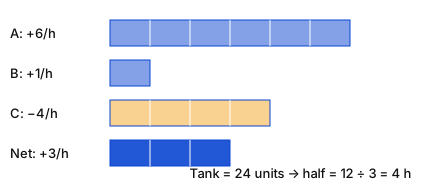
  1. LCM(4, 24, 6) =24 units. Pipe A fills 244=6/h, pipe B fills 2424=1/h, pipe C empties 246=4/h.
  2. Net per hour =6+1−4=3 units.
  3. Half tank =12 units → time =123=4 hours.

Trick: Fraction method: 14+124−16=324=18 → full in 8 h, half in 4 h.

Answer: (D) 4 hours

अवधारणा: टंकी की क्षमता समयों का LCM लें; तब हर पाइप का प्रति घंटा काम पूर्ण इकाइयों में आता है।

  1. LCM(4, 24, 6) =24 इकाई। पाइप A भरता है 244=6/h, पाइप B 2424=1/h, पाइप C खाली करता है 246=4/h।
  2. प्रति घंटा शुद्ध =6+1−4=3 इकाई।
  3. आधी टंकी =12 इकाई → समय =123=4 घंटे।

ट्रिक: भिन्न विधि: 14+124−16=324=18 → पूरी 8 h में, आधी 4 h में।

उत्तर: (D) 4 घंटे (4 hours)

RRB NTPC Graduate CBT 1MathematicsPipes and CisternsRRB NTPC Graduate CBT 1 2025 · 19 Mar Shift 3 →
Q5927.
Find the volume of largest possible sphere that can be inscribed in a cone whose base radius is 423 cm and slant height equal to the diameter of the base. (Use π=227)
उस सबसे बड़े संभव गोले का आयतन ज्ञात कीजिए जो एक ऐसे शंकु के अंतर्गत बनाया जा सकता है जिसके आधार की त्रिज्या 423 cm है और तिर्यक ऊँचाई आधार के व्यास के बराबर है। (π=227 का प्रयोग कीजिए)
  1. A314046 cm3
  2. B301644 cm3
  3. C314064 cm3
  4. D310464 cm3
Show answer

Concept: For a cone with base radius r, height h and slant height l, the radius of the largest inscribed sphere is R=rhl+r.

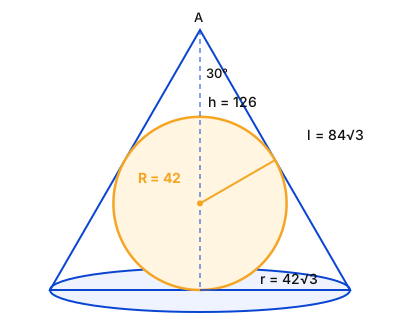
  1. r=423, l=2r=843 ⇒ h=l2−r2=3r2=r3=126 cm.
  2. R=423×126843+423=423×1261263=42 cm.
  3. Volume =43×227×423=8821×74088=310464cm3.

Trick: Slant height = diameter means the cone is equilateral (semi-vertical angle 30∘); then the inscribed sphere has R=h3 directly.

Answer: (D) 310464cm3

अवधारणा: आधार त्रिज्या r, ऊँचाई h और तिर्यक ऊँचाई l वाले शंकु में सबसे बड़े अंतर्वृत्त गोले की त्रिज्या R=rhl+r होती है।

  1. r=423, l=2r=843 ⇒ h=l2−r2=r3=126 cm।
  2. R=423×1261263=42 cm।
  3. आयतन =43×227×423=8821×74088=310464cm3।

ट्रिक: तिर्यक ऊँचाई = व्यास का मतलब समबाहु शंकु (अर्ध-शीर्ष कोण 30∘); तब अंतर्वृत्त गोले की त्रिज्या सीधे R=h3 होती है।

उत्तर: (D) 310464cm3

RRB NTPC Graduate CBT 1MathematicsMensuration – sphere in coneRRB NTPC Graduate CBT 1 2025 · 19 Mar Shift 3 →
Q5928.
What is the average of all the natural numbers from 1 to 60?
1 से 60 तक की सभी प्राकृत संख्याओं का औसत क्या है?
  1. A31
  2. B31.5
  3. C30
  4. D30.5
Show answer

Concept: Numbers 1 to n form an AP, so their average is first+last2=n+12.

  1. Average of 1 to 60 =1+602=30.5.
  2. Check: sum =60×612=1830, 183060=30.5.

Yaad rakhein: Average of first n natural numbers =n+12 — no need to add anything.

Answer: (D) 30.5

अवधारणा: 1 से n तक की संख्याएँ समांतर श्रेढ़ी (AP) हैं, इसलिए औसत =पहली+अंतिम2=n+12।

  1. 1 से 60 का औसत =1+602=30.5।
  2. जाँच: योग =60×612=1830, 183060=30.5।

याद रखें: पहली n प्राकृत संख्याओं का औसत =n+12 — जोड़ने की ज़रूरत नहीं।

उत्तर: (D) 30.5

RRB NTPC Graduate CBT 1MathematicsAverage of natural numbersRRB NTPC Graduate CBT 1 2025 · 19 Mar Shift 3 →
Q5929.
There are 39 members in group A, 33 members in group B and 52 members in group C. All the members of these groups went to a restaurant. The average amounts spent on each member of groups A, B and C are ₹377, ₹401 and ₹233, respectively. The overall average amount (in ₹) spent per member is:
समूह A में 39 सदस्य, समूह B में 33 सदस्य और समूह C में 52 सदस्य हैं। इन समूहों के सभी सदस्य एक रेस्तरां में गए। समूह A, B और C के प्रत्येक सदस्य पर खर्च की गई औसत राशि क्रमशः ₹377, ₹401 और ₹233 है। प्रति सदस्य खर्च की गई कुल औसत राशि (₹ में) है:
  1. A324
  2. B328
  3. C323
  4. D325
Show answer

Concept: Overall average =total amounttotal members (weighted mean).

  1. Totals: 39×377=14703, 33×401=13233, 52×233=12116.
  2. Sum =14703+13233+12116=40052; members =39+33+52=124.
  3. Average =40052124=323.

Trick: Take 323 as base: deviations 39×54=2106, 33×78=2574, 52×(−90)=−4680; they sum to 0, so the average is exactly 323.

Answer: (C) 323

अवधारणा: कुल औसत =कुल राशिकुल सदस्य (भारित औसत)।

  1. कुल: 39×377=14703, 33×401=13233, 52×233=12116।
  2. योग =40052; सदस्य =124।
  3. औसत =40052124=323।

ट्रिक: 323 को आधार मानें: विचलन 39×54=2106, 33×78=2574, 52×(−90)=−4680 — योग 0, अतः औसत ठीक 323।

उत्तर: (C) 323

RRB NTPC Graduate CBT 1MathematicsWeighted averageRRB NTPC Graduate CBT 1 2025 · 19 Mar Shift 3 →
Q5930.
If (125)1.3×(25)1.8÷(5)2.5=5x, then find the value of 18x−5.
यदि (125)1.3×(25)1.8÷(5)2.5=5x है, तो 18x−5 का मान ज्ञात कीजिए।
  1. A85
  2. B95
  3. C80
  4. D90
Show answer

Concept: Write every base as a power of the same prime, then add/subtract exponents: am×an=am+n, am÷an=am−n.

  1. 1251.3=53×1.3=53.9, 251.8=52×1.8=53.6.
  2. 53.9+3.6−2.5=55 ⇒ x=5.
  3. 18x−5=90−5=85.

Trick: 125=53, 25=52 — just multiply the decimal exponents by 3 and 2 mentally.

Answer: (A) 85

अवधारणा: हर आधार को एक ही अभाज्य की घात में लिखें, फिर घातांक जोड़ें/घटाएँ: am×an=am+n, am÷an=am−n।

  1. 1251.3=53.9, 251.8=53.6।
  2. 53.9+3.6−2.5=55 ⇒ x=5।
  3. 18x−5=90−5=85।

ट्रिक: 125=53, 25=52 — दशमलव घातांकों को मन में 3 और 2 से गुणा कर लें।

उत्तर: (A) 85

RRB NTPC Graduate CBT 1MathematicsIndicesRRB NTPC Graduate CBT 1 2025 · 19 Mar Shift 3 →
Q5931.
If a : b = 1 : 3, b : c = 5 : 7 and c : d = 9 : 5, then the value of a : b : c : d is:
यदि a : b = 1 : 3, b : c = 5 : 7 और c : d = 9 : 5 है, तो a : b : c : d का मान है:
  1. A15 : 75 : 105 : 35
  2. B5 : 75 : 105 : 35
  3. C15 : 45 : 63 : 35
  4. D25 : 75 : 105 : 45
Show answer

Concept: To join ratios, make the common term equal by cross-multiplying step by step.

  1. a:b=1:3, b:c=5:7 ⇒ a:b:c=5:15:21.
  2. c:d=9:5 with c=21: multiply first by 9 and second by 21 ⇒ a:b:c:d=45:135:189:105.
  3. Divide by 3: 15:45:63:35.

Trick: a:b:c:d=(1·5·9):(3·5·9):(3·7·9):(3·7·5)=45:135:189:105 — one line.

Answer: (C) 15 : 45 : 63 : 35

अवधारणा: अनुपात जोड़ने के लिए उभयनिष्ठ पद को क्रॉस-गुणा से बराबर करें।

  1. a:b=1:3, b:c=5:7 ⇒ a:b:c=5:15:21।
  2. c:d=9:5, c=21: पहले को 9 से, दूसरे को 21 से गुणा ⇒ 45:135:189:105।
  3. 3 से भाग: 15:45:63:35।

ट्रिक: a:b:c:d=(1·5·9):(3·5·9):(3·7·9):(3·7·5)=45:135:189:105 — एक लाइन में।

उत्तर: (C) 15 : 45 : 63 : 35

RRB NTPC Graduate CBT 1MathematicsCompound ratioRRB NTPC Graduate CBT 1 2025 · 19 Mar Shift 3 →
Q5932.
Find the volume (in cm3) of a sphere having a diameter of 37.8 cm, giving your answer correct to two places of decimal. (take π=227)
37.8 cm व्यास वाले एक गोले का आयतन (cm3 में) ज्ञात कीजिए, अपना उत्तर दो दशमलव स्थानों तक सही दीजिए। (π=227 लीजिए)
  1. A28281.03
  2. B28291.03
  3. C28311.03
  4. D28301.03
Show answer

Concept: V=43πr3 with r=diameter2.

  1. r=37.82=18.9 cm; 18.93=6751.269.
  2. V=43×227×6751.269=88×6751.26921=594111.67221.
  3. V≈28291.03cm3.

Trick: 18.9=18910=7×2710, so the 7 cancels with π=227: V=88×49×2733×1000=88×49×65611000≈28291.03.

Answer: (B) 28291.03

अवधारणा: V=43πr3, जहाँ r=व्यास2।

  1. r=18.9 cm; 18.93=6751.269।
  2. V=43×227×6751.269=594111.67221।
  3. V≈28291.03cm3।

ट्रिक: 18.9=7×2710, अतः 7, π=227 से कट जाता है: V=88×49×65611000≈28291.03।

उत्तर: (B) 28291.03

RRB NTPC Graduate CBT 1MathematicsVolume of sphereRRB NTPC Graduate CBT 1 2025 · 19 Mar Shift 3 →
Q5933.
A shopkeeper fixes the marked price of an item 150% above its cost price. What percentage of discount on marked price should be allowed to gain 60%?
एक दुकानदार किसी वस्तु का अंकित मूल्य उसके क्रय मूल्य से 150% अधिक निर्धारित करता है। 60% लाभ प्राप्त करने के लिए अंकित मूल्य पर कितने प्रतिशत छूट दी जानी चाहिए?
  1. A36%
  2. B34%
  3. C33%
  4. D39%
Show answer

Concept: Discount is on MP, profit is on CP: SP=MP(1−d)=CP(1+p).

  1. Let CP =100. MP =100+150=250.
  2. Required SP for 60% gain =160.
  3. Discount =250−160=90 ⇒ 90250×100=36%.

Trick: SPMP=160250=0.64 ⇒ discount =36%.

Answer: (A) 36%

अवधारणा: छूट अंकित मूल्य (MP) पर, लाभ क्रय मूल्य (CP) पर: SP=MP(1−d)=CP(1+p)।

  1. CP =100 मानें। MP =250।
  2. 60% लाभ के लिए SP =160।
  3. छूट =250−160=90 ⇒ 90250×100=36%।

ट्रिक: SPMP=160250=0.64 ⇒ छूट =36%।

उत्तर: (A) 36%

RRB NTPC Graduate CBT 1MathematicsDiscount and profitRRB NTPC Graduate CBT 1 2025 · 19 Mar Shift 3 →
Q5934.
The minimum value of the expression max {p2 − 2p + 4, −p2 + 2p − 4} in the range 0 ≤ p ≤ 1 is:
0 ≤ p ≤ 1 के परिसर में व्यंजक max {p2 − 2p + 4, −p2 + 2p − 4} का न्यूनतम मान है:
  1. A2
  2. B4
  3. C1
  4. D3
Show answer

Concept: Complete the square: p2−2p+4=(p−1)2+3≥3 and −p2+2p−4=−[(p−1)2+3]≤−3.

  1. The first expression is always ≥3 and the second always ≤−3, so max{·} is always the first one.
  2. Minimum of (p−1)2+3 on 0≤p≤1 occurs at p=1: value =3.

Trick: The two expressions are negatives of each other, so the max is simply the positive one, (p−1)2+3.

Answer: (D) 3

अवधारणा: पूर्ण वर्ग बनाएँ: p2−2p+4=(p−1)2+3≥3 और −p2+2p−4=−[(p−1)2+3]≤−3।

  1. पहला व्यंजक सदैव ≥3, दूसरा सदैव ≤−3, अतः max{·} हमेशा पहला ही है।
  2. 0≤p≤1 में (p−1)2+3 का न्यूनतम p=1 पर: मान =3।

ट्रिक: दोनों व्यंजक एक-दूसरे के ऋणात्मक हैं, अतः max बस धनात्मक वाला (p−1)2+3 है।

उत्तर: (D) 3

RRB NTPC Graduate CBT 1MathematicsQuadratic – max/minRRB NTPC Graduate CBT 1 2025 · 19 Mar Shift 3 →
Q5935.
At what rate (in percentage, rounded off to two decimal place) per year will a sum of money 5 times itself in 12 years on simple interest?
साधारण ब्याज पर कोई धनराशि 12 वर्षों में स्वयं की 5 गुनी किस वार्षिक दर (प्रतिशत में, दो दशमलव स्थानों तक पूर्णांकित) पर हो जाएगी?
  1. A35.33
  2. B31.33
  3. C33.33
  4. D66.66
Show answer

Concept: If a sum becomes n times in T years at SI, interest =(n−1)P and R=(n−1)×100T.

  1. 5 times ⇒ SI =4P in 12 years.
  2. R=4×10012=33.33% per annum.

Trick: "n times in T years" ⇒ R=100(n−1)T — plug and go.

Answer: (C) 33.33

अवधारणा: साधारण ब्याज पर राशि T वर्ष में n गुना हो तो ब्याज =(n−1)P और R=(n−1)×100T।

  1. 5 गुना ⇒ SI =4P, 12 वर्ष में।
  2. R=4×10012=33.33% वार्षिक।

ट्रिक: "T वर्ष में n गुना" ⇒ R=100(n−1)T — सीधे रखें।

उत्तर: (C) 33.33

RRB NTPC Graduate CBT 1MathematicsSimple interest – rateRRB NTPC Graduate CBT 1 2025 · 19 Mar Shift 3 →
Q5936.
Chetan’s salary is ₹18000 per month. He spends ₹5000 on house rent, ₹2000 on bills and the rest of the amount is his monthly savings. Find his savings (in ₹) in a year, if in the month of his birthday, he spent his complete monthly saving for birthday
celebration.
चेतन का वेतन ₹18000 प्रति माह है। वह ₹5000 मकान किराए पर, ₹2000 बिलों पर खर्च करता है और शेष राशि उसकी मासिक बचत है। एक वर्ष में उसकी बचत (₹ में) ज्ञात कीजिए, यदि अपने जन्मदिन के महीने में उसने अपनी पूरी मासिक बचत जन्मदिन समारोह पर खर्च कर दी।
  1. A132000
  2. B121000
  3. C110000
  4. D99000
Show answer

Concept: Monthly saving = salary − expenses; yearly saving = saving × number of months actually saved.

  1. Monthly saving =18000−5000−2000=11000.
  2. In the birthday month the whole saving is spent, so only 11 months count.
  3. Yearly saving =11000×11=121000.

Trick: Read the twist — "12 months" gives 132000 (option A), the trap answer.

Answer: (B) 121000

अवधारणा: मासिक बचत = वेतन − खर्च; वार्षिक बचत = बचत × जितने महीने वास्तव में बचत हुई।

  1. मासिक बचत =18000−5000−2000=11000।
  2. जन्मदिन के महीने में पूरी बचत खर्च, अतः केवल 11 महीने गिनें।
  3. वार्षिक बचत =11000×11=121000।

ट्रिक: मोड़ ध्यान से पढ़ें — "12 महीने" से 132000 (विकल्प A) आता है, जो जाल है।

उत्तर: (B) 121000

RRB NTPC Graduate CBT 1MathematicsSavings calculationRRB NTPC Graduate CBT 1 2025 · 19 Mar Shift 3 →
Q5937.
The least common multiple of x3.5×y1.5, y2.5x−4.5, and xy−3 is:
x3.5×y1.5, y2.5x−4.5 और xy−3 का लघुत्तम समापवर्त्य (LCM) है:
  1. A(xy)3x3
  2. B(xy)2y3
  3. C(xy)2x3
  4. D(xy)3y3
Show answer

Concept: LCM of monomials = each variable raised to its highest power among the terms.

  1. Rewrite: x3.5y1.5; y2.5x−4.5=x4.5y2.5; xy−3=xy3.
  2. Highest powers: x4.5 and y3 ⇒ LCM =x4.5y3.
  3. x4.5y3=x3y3·x1.5=(xy)3x3.

Trick: A negative power in the denominator jumps to the numerator with a positive sign: 1x−a=xa.

Answer: (A) (xy)3x3

अवधारणा: एकपदियों का LCM = हर चर की सबसे बड़ी घात।

  1. पुनर्लेखन: x3.5y1.5; y2.5x−4.5=x4.5y2.5; xy−3=xy3।
  2. सबसे बड़ी घातें: x4.5, y3 ⇒ LCM =x4.5y3।
  3. x4.5y3=(xy)3·x1.5=(xy)3x3।

ट्रिक: हर में ऋणात्मक घात अंश में धनात्मक बन जाती है: 1x−a=xa।

उत्तर: (A) (xy)3x3

RRB NTPC Graduate CBT 1MathematicsLCM of algebraic expressionsRRB NTPC Graduate CBT 1 2025 · 19 Mar Shift 3 →
Q5938.
Simplify: (4.23)3−0.69×(4.23)2+12.69(0.23)2−(0.23)30.4×0.4×4
सरल कीजिए: (4.23)3−0.69×(4.23)2+12.69(0.23)2−(0.23)30.4×0.4×4
  1. A1000
  2. B10
  3. C100
  4. D1
Show answer

Concept: a3−3a2b+3ab2−b3=(a−b)3.

  1. Take a=4.23, b=0.23: 0.69=3b and 12.69=3a.
  2. Numerator =a3−3a2b+3ab2−b3=(a−b)3=43=64.
  3. Denominator =0.4×0.4×4=0.64 ⇒ 640.64=100.

Trick: Spot 0.69=3×0.23 and 12.69=3×4.23 — the sign pattern +,−,+,− screams (a−b)3.

Answer: (C) 100

अवधारणा: a3−3a2b+3ab2−b3=(a−b)3।

  1. a=4.23, b=0.23 लें: 0.69=3b, 12.69=3a।
  2. अंश =(a−b)3=43=64।
  3. हर =0.4×0.4×4=0.64 ⇒ 640.64=100।

ट्रिक: 0.69=3×0.23 और 12.69=3×4.23 पहचानें — चिह्न +,−,+,− का पैटर्न (a−b)3 बताता है।

उत्तर: (C) 100

RRB NTPC Graduate CBT 1MathematicsAlgebraic identity (a−b)³RRB NTPC Graduate CBT 1 2025 · 19 Mar Shift 3 →
Q5939.
A chemical research laboratory uses three compounds A, B, and C in the cost ratio 3 : 5 : 7. When a fourth compound D is added to the mixture, the total cost increases by 40%. If the new ratio becomes A : B : C : D = 3 : 5 : 7 : x, what is the value of x?
एक रासायनिक अनुसंधान प्रयोगशाला तीन यौगिकों A, B और C का उपयोग 3 : 5 : 7 के लागत अनुपात में करती है। जब मिश्रण में एक चौथा यौगिक D मिलाया जाता है, तो कुल लागत 40% बढ़ जाती है। यदि नया अनुपात A : B : C : D = 3 : 5 : 7 : x हो जाता है, तो x का मान क्या है?
  1. A9
  2. B8
  3. C4
  4. D6
Show answer

Concept: When D is added, A, B, C keep their shares; the new total is 140% of the old total.

  1. Old total =3+5+7=15 parts.
  2. New total =15×1.4=21 parts.
  3. x=21−15=6.

Trick: 40% of 15 =6 — the increase itself is D's share.

Answer: (D) 6

अवधारणा: D जोड़ने पर A, B, C के हिस्से वही रहते हैं; नया योग पुराने का 140% है।

  1. पुराना योग =3+5+7=15 भाग।
  2. नया योग =15×1.4=21 भाग।
  3. x=21−15=6।

ट्रिक: 15 का 40%=6 — वृद्धि ही D का हिस्सा है।

उत्तर: (D) 6

RRB NTPC Graduate CBT 1MathematicsRatio and percentageRRB NTPC Graduate CBT 1 2025 · 19 Mar Shift 3 →
Q5940.
Four classes have a ratio of boys to girls as 4 : 5, 3 : 2, 6 : 5 and 5 : 6, respectively. Which class has a higher proportion of boys?
चार कक्षाओं में लड़कों और लड़कियों का अनुपात क्रमशः 4 : 5, 3 : 2, 6 : 5 और 5 : 6 है। किस कक्षा में लड़कों का अनुपात अधिक है?
  1. ASecond class (3 : 2)दूसरी कक्षा (3 : 2)
  2. BThird class (6 : 5)तीसरी कक्षा (6 : 5)
  3. CFirst class (4 : 5)पहली कक्षा (4 : 5)
  4. DFourth class (5 : 6)चौथी कक्षा (5 : 6)
Show answer

Concept: Proportion of boys =boysboys+girls; compare these fractions.

  1. First 49≈0.444; Second 35=0.6; Third 611≈0.545; Fourth 511≈0.455.
  2. Highest is 0.6 — the second class.

Trick: Only 3:2 and 6:5 have more boys than girls; 3:2=1.5 boys per girl beats 6:5=1.2.

Answer: (A) Second class (3 : 2)

अवधारणा: लड़कों का अनुपात =लड़केलड़के+लड़कियाँ; इन भिन्नों की तुलना करें।

  1. पहली 49≈0.444; दूसरी 35=0.6; तीसरी 611≈0.545; चौथी 511≈0.455।
  2. सबसे अधिक 0.6 — दूसरी कक्षा।

ट्रिक: केवल 3:2 और 6:5 में लड़के अधिक हैं; 3:2=1.5 लड़के प्रति लड़की, 6:5=1.2 से बड़ा।

उत्तर: (A) दूसरी कक्षा (3 : 2)

RRB NTPC Graduate CBT 1MathematicsComparing ratiosRRB NTPC Graduate CBT 1 2025 · 19 Mar Shift 3 →