RRB NTPC Graduate CBT 1 2025 · Shift 3

RRB NTPC Graduate CBT 1 19 Mar 2026 Shift 3 – Question Paper

100 questions · 100 marks · 90 minutes · +1 for a correct answer, −1/3 for a wrong one. With answer key and detailed solutions in Hindi and English.

Test Series – airGurukul

Paper pattern

SectionQuestionsMarks
General Awareness4040
Mathematics3030
General Intelligence and Reasoning3030

Sample questions from this paper

Q1.
When a spring is compressed from its equilibrium position, its potential energy will ___________________.
जब किसी स्प्रिंग को उसकी साम्यावस्था से संपीडित किया जाता है, तो उसकी स्थितिज ऊर्जा ___________________।
  1. Aremain unchangedअपरिवर्तित रहेगी
  2. Bfirst decrease then increaseपहले घटेगी फिर बढ़ेगी
  3. Cincreaseबढ़ेगी
  4. Ddecreaseघटेगी
Show answer

Concept: Elastic potential energy of a spring U=12kx2, where x is the compression or extension from equilibrium.

  1. At equilibrium x=0, so U=0 (minimum).
  2. Compressing increases x, and since x2 is always positive, U increases – work done against the spring force is stored in it.

Trick: Stretch or compress – both store energy; U depends on x2, not on direction.

Answer: (C) increase

अवधारणा: स्प्रिंग की प्रत्यास्थ स्थितिज ऊर्जा U=12kx2, जहाँ x साम्य स्थिति से संपीडन या खिंचाव है।

  1. साम्य पर x=0, अतः U=0 (न्यूनतम)।
  2. दबाने पर x बढ़ता है और x2 सदैव धनात्मक है, अतः U बढ़ती है – स्प्रिंग बल के विरुद्ध किया गया कार्य उसमें संचित होता है।

ट्रिक: खींचो या दबाओ – दोनों में ऊर्जा संचित होती है; U, x2 पर निर्भर है, दिशा पर नहीं।

उत्तर: (C) बढ़ेगी (increase)
RRB NTPC Graduate CBT 1General AwarenessElastic Potential Energy
Q41.
The population of a village was 2,90,000. It increased by 5% in the first year and increased by 30% in the second year. Its population after two years is _______.
एक गाँव की जनसंख्या 2,90,000 थी। पहले वर्ष में इसमें 5% की वृद्धि हुई और दूसरे वर्ष में 30% की वृद्धि हुई। दो वर्ष बाद इसकी जनसंख्या _______ है।
  1. A3,95,850
  2. B3,91,500
  3. C3,04,500
  4. D3,77,000
Show answer

Concept: Successive increases multiply: final =P×(1+a100)(1+b100).

  1. After year 1: 2,90,000×105100=3,04,500.
  2. After year 2: 3,04,500×130100=3,95,850.

Trick: Net single change =a+b+ab100=5+30+1.5=36.5%; 2,90,000×1.365=3,95,850.

Answer: (A) 3,95,850

अवधारणा: क्रमिक वृद्धियाँ गुणा होती हैं: अंतिम =P×(1+a100)(1+b100)।

  1. पहले वर्ष बाद: 2,90,000×105100=3,04,500।
  2. दूसरे वर्ष बाद: 3,04,500×130100=3,95,850।

ट्रिक: कुल एक-बार परिवर्तन =a+b+ab100=5+30+1.5=36.5%; 2,90,000×1.365=3,95,850।

उत्तर: (A) 3,95,850

RRB NTPC Graduate CBT 1MathematicsSuccessive Percentage Change
Q71.
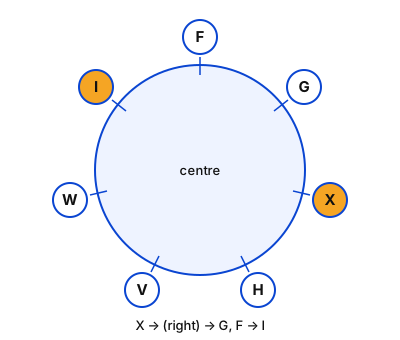
Seven people F, G, H, I, V, W, and X are sitting around a circular table facing the centre of the table. H sits third to the left of F. I sits second to the left of V. Only F sits between G and I. W is not an immediate neighbour of H. How many people sit between X and I when counted from the right of X?
सात व्यक्ति F, G, H, I, V, W और X एक वृत्ताकार मेज के चारों ओर मेज के केंद्र की ओर मुख करके बैठे हैं। H, F के बाईं ओर तीसरे स्थान पर बैठा है। I, V के बाईं ओर दूसरे स्थान पर बैठा है। G और I के बीच केवल F बैठा है। W, H का निकटतम पड़ोसी नहीं है। X के दाईं ओर से गिनने पर X और I के बीच कितने व्यक्ति बैठे हैं?
  1. ATwoदो
  2. BThreeतीन
  3. CZeroशून्य
  4. DOneएक
Show answer

Concept: When people face the centre, "left" means clockwise and "right" means anticlockwise. Fix one person and place the rest.

  1. Fix F. H is 3rd to the left of F. Only F sits between G and I, so G and I are F's two neighbours.
  2. I is 2nd to the left of V. If I were on the clockwise side of F, V would land on G's seat – impossible. So I is on the anticlockwise side, G on the clockwise side, and V sits next to H (clockwise).
  3. Two seats remain, one next to H. W is not H's neighbour, so X sits between G and H and W between V and I.
  4. Clockwise order: F, G, X, H, V, W, I. Counting from the right of X (anticlockwise): G, F, then I → 2 people.

Trick: Whenever a clue gives two possibilities, test both against the next clue – one usually breaks immediately.

Answer: (A) Two

अवधारणा: केंद्र की ओर मुख होने पर "बायाँ" = clockwise और "दायाँ" = anticlockwise। एक व्यक्ति को fix करके बाकी को बैठाइए।

  1. F को fix करें। H, F के बाएँ तीसरा है। G और I के बीच केवल F है, अतः G और I, F के दोनों पड़ोसी हैं।
  2. I, V के बाएँ दूसरा है। यदि I, F के clockwise ओर होता तो V, G की सीट पर आ जाता – असंभव। अतः I anticlockwise ओर, G clockwise ओर और V, H के बगल (clockwise) में बैठता है।
  3. दो सीटें बचीं, एक H के पास। W, H का पड़ोसी नहीं, अतः X, G और H के बीच तथा W, V और I के बीच बैठता है।
  4. Clockwise क्रम: F, G, X, H, V, W, I। X के दाएँ (anticlockwise) से गिनें: G, F, फिर I → 2 लोग।

ट्रिक: जब किसी clue से दो संभावनाएँ बनें, दोनों को अगले clue से जाँचें – एक तुरंत गलत सिद्ध हो जाती है।

उत्तर: (A) दो (Two)

RRB NTPC Graduate CBT 1General Intelligence and ReasoningCircular Seating

See all 100 solutions

More RRB NTPC Graduate CBT 1 papers

Download our app

Study smarter with the airGurukul App

Your complete exam-prep companion - classes, practice, and progress tracking.

Learn anytime, anywhere - live classes, tests, notes, and updates in one place.

GET IT ONGoogle Play

Have a query? We’re here to help

Fill out the form and our team will get back to you as soon as possible.

  • Ask your questions related to admission, courses, fees, or facilities
  • Share your details so our team can contact you easily
  • Get accurate information from our support team
  • Quick and simple form submission process

All fields marked * are required.