Question bank

Q&A: practice questions with answers

Search questions on any topic. Filter by exam category, exam, subject and topic, try the question, then open the answer and explanation.

Courses – airGurukul

7,077 questions found.

Q5941.
21973100004×539×48=?
  1. A8
  2. B4
  3. C2
  4. D16
Show answer

Concept: 21973=13 (since 133=2197) and 100004=10 (since 104=10000).

  1. Expression =1310×539×48.
  2. 1339=13, 510=12 ⇒ 16×48=8.

Trick: Cancel before multiplying: 13 with 39, 5 with 10 — the answer drops out as 486.

Answer: (A) 8

अवधारणा: 21973=13 (133=2197) और 100004=10 (104=10000)।

  1. व्यंजक =1310×539×48।
  2. 1339=13, 510=12 ⇒ 16×48=8।

ट्रिक: गुणा से पहले काटें: 13 को 39 से, 5 को 10 से — उत्तर 486 निकल आता है।

उत्तर: (A) 8

RRB NTPC Graduate CBT 1MathematicsRoots simplificationRRB NTPC Graduate CBT 1 2025 · 19 Mar Shift 3 →
Q5942.
A shopkeeper buys 45 identical calculators for ₹54,000. He sells 30 of them at a profit of 25% and the remaining at a loss of 20%. What is the overall profit or loss percentage?
एक दुकानदार ₹54,000 में 45 एक जैसे कैलकुलेटर खरीदता है। वह उनमें से 30 को 25% लाभ पर और शेष को 20% हानि पर बेचता है। कुल लाभ या हानि प्रतिशत क्या है?
  1. A5% profit5% लाभ
  2. B10% profit10% लाभ
  3. C5% loss5% हानि
  4. D10% loss10% हानि
Show answer

Concept: Overall % =total SP−total CPtotal CP×100.

  1. CP each =5400045=1200.
  2. 30 at 25% profit: 30×1500=45000; 15 at 20% loss: 15×960=14400.
  3. Total SP =59400; profit =5400 ⇒ 540054000×100=10% profit.

Trick: Weighted: 30×25−15×2045=750−30045=10% — CP per item is not even needed.

Answer: (B) 10% profit

अवधारणा: कुल % =कुल SP−कुल CPकुल CP×100।

  1. प्रति कैलकुलेटर CP =5400045=1200।
  2. 30 पर 25% लाभ: 30×1500=45000; 15 पर 20% हानि: 15×960=14400।
  3. कुल SP =59400; लाभ =5400 ⇒ 540054000×100=10% लाभ।

ट्रिक: भारित: 30×25−15×2045=45045=10% — प्रति वस्तु CP की ज़रूरत ही नहीं।

उत्तर: (B) 10% लाभ

RRB NTPC Graduate CBT 1MathematicsProfit and loss – overallRRB NTPC Graduate CBT 1 2025 · 19 Mar Shift 3 →
Q5943.
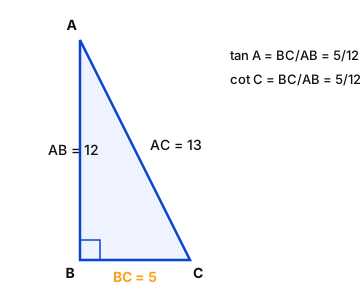
Let ABC be a right-angled triangle such that ∠B = 90°, AB = 12 cm and AC = 13 cm. Find the value of tan A - cot C.
मान लीजिए ABC एक समकोण त्रिभुज है जिसमें ∠B = 90°, AB = 12 cm और AC = 13 cm है। tan A − cot C का मान ज्ञात कीजिए।
  1. A2
  2. B6
  3. C0
  4. D5
Show answer

Concept: In a right triangle, tanA=cotC when A+C=90∘ (complementary angles).

  1. BC=132−122=25=5 cm.
  2. tanA=BCAB=512; cotC=BCAB=512 (adjacent of C is BC, opposite is AB).
  3. tanA−cotC=0.

Trick: ∠A+∠C=90∘ ⇒ cotC=cot(90∘−A)=tanA — the difference is 0 without finding BC.

Answer: (C) 0

अवधारणा: समकोण त्रिभुज में A+C=90∘ (पूरक कोण) होने पर tanA=cotC।

  1. BC=132−122=5 cm।
  2. tanA=BCAB=512; cotC=BCAB=512।
  3. tanA−cotC=0।

ट्रिक: ∠A+∠C=90∘ ⇒ cotC=tanA — BC निकाले बिना ही अंतर 0।

उत्तर: (C) 0

RRB NTPC Graduate CBT 1MathematicsTrigonometric ratiosRRB NTPC Graduate CBT 1 2025 · 19 Mar Shift 3 →
Q5944.
A shopkeeper professes to sell his goods at a 20% loss but uses a false balance and gains 40%. The actual weight (rounded off to one decimal place) he uses for 1 kg is:
एक दुकानदार अपना माल 20% हानि पर बेचने का दावा करता है, परंतु गलत तराजू का उपयोग करके 40% लाभ कमाता है। 1 kg के लिए वह जो वास्तविक बाट (एक दशमलव स्थान तक पूर्णांकित) उपयोग करता है, वह है:
  1. A568.8 gm
  2. B576.7 gm
  3. C571.4 gm
  4. D575.4 gm
Show answer

Concept: If he uses w g instead of 1000 g and sells at 80% of the price of 1000 g, then SPCP=0.8×1000w.

  1. Gain 40% ⇒ 800w=1.4.
  2. w=8001.4=40007≈571.4 g.

Trick: true weightfalse weight=100+gain100−loss=14080 ⇒ false weight =1000×80140=571.4 g.

Answer: (C) 571.4 gm

अवधारणा: यदि वह 1000 g की जगह w g देता है और 1000 g के मूल्य का 80% लेता है, तो SPCP=0.8×1000w।

  1. 40% लाभ ⇒ 800w=1.4।
  2. w=8001.4=40007≈571.4 g।

ट्रिक: सही बाटझूठा बाट=100+लाभ100−हानि=14080 ⇒ झूठा बाट =1000×80140=571.4 g।

उत्तर: (C) 571.4 gm

RRB NTPC Graduate CBT 1MathematicsFalse weight – dishonest dealerRRB NTPC Graduate CBT 1 2025 · 19 Mar Shift 3 →
Q5945.
What is the maximum value that must be assigned to A so that the 8-digit number 445A0208 is divisible by 3?
A को अधिकतम कौन-सा मान दिया जाना चाहिए ताकि 8-अंकीय संख्या 445A0208, 3 से विभाज्य हो?
  1. A9
  2. B5
  3. C2
  4. D7
Show answer

Concept: A number is divisible by 3 if its digit sum is divisible by 3.

  1. Digit sum of 445A0208 =4+4+5+A+0+2+0+8=23+A.
  2. 23+A divisible by 3 ⇒ A=1,4,7.
  3. Maximum A=7 (23+7=30).

Trick: 23≡2(mod3), so A≡1(mod3): 1, 4, 7 — pick the largest digit.

Answer: (D) 7

अवधारणा: कोई संख्या 3 से विभाज्य है यदि उसके अंकों का योग 3 से विभाज्य हो।

  1. 445A0208 का अंक-योग =23+A।
  2. 23+A, 3 से विभाज्य ⇒ A=1,4,7।
  3. अधिकतम A=7 (23+7=30)।

ट्रिक: 23≡2(mod3), अतः A≡1(mod3): 1, 4, 7 — सबसे बड़ा अंक लें।

उत्तर: (D) 7

RRB NTPC Graduate CBT 1MathematicsDivisibility by 3RRB NTPC Graduate CBT 1 2025 · 19 Mar Shift 3 →
Q5946.
Two taps can fill a cistern in 4 hours and 32 hours respectively. A third tap can empty it in 32 hours. How long (in hours) will it take to fill one-fourth of the empty cistern, if all of them are opened together?
दो नल एक हौज को क्रमशः 4 घंटे और 32 घंटे में भर सकते हैं। एक तीसरा नल इसे 32 घंटे में खाली कर सकता है। यदि सभी नल एक साथ खोल दिए जाएँ, तो खाली हौज का एक-चौथाई भाग भरने में कितना समय (घंटों में) लगेगा?
  1. A4
  2. B1
  3. C2
  4. D3
Show answer

Concept: Add the per-hour rates (filling positive, emptying negative).

  1. Net rate =14+132−132=14 cistern per hour.
  2. Full cistern in 4 hours ⇒ one-fourth in 14×4=1 hour.

Trick: The 32-hour filler and 32-hour emptier cancel exactly — only the 4-hour tap matters.

Answer: (B) 1

अवधारणा: प्रति घंटा दरें जोड़ें (भरने वाली धनात्मक, खाली करने वाली ऋणात्मक)।

  1. शुद्ध दर =14+132−132=14 टंकी प्रति घंटा।
  2. पूरी टंकी 4 घंटे में ⇒ एक-चौथाई 14×4=1 घंटे में।

ट्रिक: 32 घंटे वाला भरने वाला और 32 घंटे वाला खाली करने वाला नल एक-दूसरे को काट देते हैं — केवल 4 घंटे वाला नल मायने रखता है।

उत्तर: (B) 1

RRB NTPC Graduate CBT 1MathematicsPipes and cisternsRRB NTPC Graduate CBT 1 2025 · 19 Mar Shift 3 →
Q5947.
Amit invested equal amounts at simple interest and compound interest, compounded annually, for 2 years at the same rate of 4% per annum. In the end, he found a difference of ₹53 between the two interests earned. What was the amount (in ₹) invested in each case?
अमित ने समान राशियाँ साधारण ब्याज पर और वार्षिक रूप से संयोजित चक्रवृद्धि ब्याज पर, 2 वर्षों के लिए 4% वार्षिक की समान दर से निवेश कीं। अंत में उसने पाया कि अर्जित दोनों ब्याजों के बीच ₹53 का अंतर है। प्रत्येक मामले में निवेश की गई राशि (₹ में) क्या थी?
  1. A33475
  2. B33125
  3. C32375
  4. D32225
Show answer

Concept: For 2 years, CI−SI=P(R100)2.

  1. P×(4100)2=53 ⇒ P×1610000=53.
  2. P=53×1000016=33125.

Trick: Difference for 2 years = SI on the first year's interest; P=diff×1002R2.

Answer: (B) 33125

अवधारणा: 2 वर्ष के लिए CI−SI=P(R100)2।

  1. P×(4100)2=53 ⇒ P×1610000=53।
  2. P=53×1000016=33125।

ट्रिक: 2 वर्ष का अंतर = पहले वर्ष के ब्याज पर ब्याज; P=अंतर×1002R2।

उत्तर: (B) 33125

RRB NTPC Graduate CBT 1MathematicsCI – SI differenceRRB NTPC Graduate CBT 1 2025 · 19 Mar Shift 3 →
Q5948.
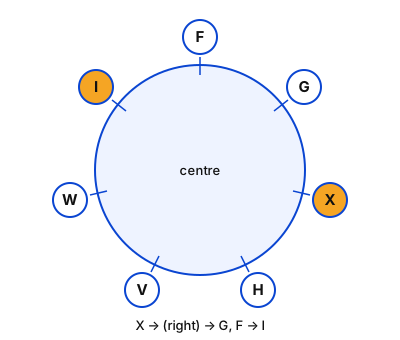
Seven people F, G, H, I, V, W, and X are sitting around a circular table facing the centre of the table. H sits third to the left of F. I sits second to the left of V. Only F sits between G and I. W is not an immediate neighbour of H. How many people sit between X and I when counted from the right of X?
सात व्यक्ति F, G, H, I, V, W और X एक वृत्ताकार मेज के चारों ओर मेज के केंद्र की ओर मुख करके बैठे हैं। H, F के बाईं ओर तीसरे स्थान पर बैठा है। I, V के बाईं ओर दूसरे स्थान पर बैठा है। G और I के बीच केवल F बैठा है। W, H का निकटतम पड़ोसी नहीं है। X के दाईं ओर से गिनने पर X और I के बीच कितने व्यक्ति बैठे हैं?
  1. ATwoदो
  2. BThreeतीन
  3. CZeroशून्य
  4. DOneएक
Show answer

Concept: When people face the centre, "left" means clockwise and "right" means anticlockwise. Fix one person and place the rest.

  1. Fix F. H is 3rd to the left of F. Only F sits between G and I, so G and I are F's two neighbours.
  2. I is 2nd to the left of V. If I were on the clockwise side of F, V would land on G's seat – impossible. So I is on the anticlockwise side, G on the clockwise side, and V sits next to H (clockwise).
  3. Two seats remain, one next to H. W is not H's neighbour, so X sits between G and H and W between V and I.
  4. Clockwise order: F, G, X, H, V, W, I. Counting from the right of X (anticlockwise): G, F, then I → 2 people.

Trick: Whenever a clue gives two possibilities, test both against the next clue – one usually breaks immediately.

Answer: (A) Two

अवधारणा: केंद्र की ओर मुख होने पर "बायाँ" = clockwise और "दायाँ" = anticlockwise। एक व्यक्ति को fix करके बाकी को बैठाइए।

  1. F को fix करें। H, F के बाएँ तीसरा है। G और I के बीच केवल F है, अतः G और I, F के दोनों पड़ोसी हैं।
  2. I, V के बाएँ दूसरा है। यदि I, F के clockwise ओर होता तो V, G की सीट पर आ जाता – असंभव। अतः I anticlockwise ओर, G clockwise ओर और V, H के बगल (clockwise) में बैठता है।
  3. दो सीटें बचीं, एक H के पास। W, H का पड़ोसी नहीं, अतः X, G और H के बीच तथा W, V और I के बीच बैठता है।
  4. Clockwise क्रम: F, G, X, H, V, W, I। X के दाएँ (anticlockwise) से गिनें: G, F, फिर I → 2 लोग।

ट्रिक: जब किसी clue से दो संभावनाएँ बनें, दोनों को अगले clue से जाँचें – एक तुरंत गलत सिद्ध हो जाती है।

उत्तर: (A) दो (Two)

RRB NTPC Graduate CBT 1General Intelligence and ReasoningCircular SeatingRRB NTPC Graduate CBT 1 2025 · 19 Mar Shift 3 →
Q5949.
In a certain code language, ‘GLOW’ is coded as ‘4628’ and ‘WEAR’ is coded as ‘3574’. What is the code for ‘W’ in that language?
एक निश्चित कूट भाषा में, ‘GLOW’ को ‘4628’ लिखा जाता है और ‘WEAR’ को ‘3574’ लिखा जाता है। उस भाषा में ‘W’ का कूट क्या है?
  1. A3
  2. B7
  3. C4
  4. D8
Show answer

Concept: When two words share exactly one letter, the digit common to both codes is that letter's code.

  1. GLOW → 4628, WEAR → 3574. The only common letter is W.
  2. The only common digit is 4. Hence W = 4.

Trick: Match common letters with common digits – no need to decode the whole word.

Answer: (C) 4

अवधारणा: जब दो शब्दों में केवल एक अक्षर समान हो, तो दोनों कोडों का समान अंक उसी अक्षर का कोड होता है।

  1. GLOW → 4628, WEAR → 3574। एकमात्र समान अक्षर W है।
  2. एकमात्र समान अंक 4 है। अतः W = 4।

ट्रिक: समान अक्षर को समान अंक से मिलाइए – पूरा शब्द decode करने की ज़रूरत नहीं।

उत्तर: (C) 4

RRB NTPC Graduate CBT 1General Intelligence and ReasoningCoding – Common LetterRRB NTPC Graduate CBT 1 2025 · 19 Mar Shift 3 →
Q5950.
Which of the following letter-number clusters will replace the question mark (?) in the given series to make it logically complete?
HGH 85 FEF 74 DCD 63 BAB 52 ?
दी गई शृंखला में प्रश्नचिह्न (?) के स्थान पर निम्नलिखित में से कौन-सा अक्षर-संख्या समूह आएगा ताकि शृंखला तार्किक रूप से पूर्ण हो जाए?
HGH 85 FEF 74 DCD 63 BAB 52 ?
  1. AZXY 40
  2. BZYZ 41
  3. CZZY 41
  4. DZHQ 40
Show answer

Concept: Treat the letters and the number as two separate series.

  1. Letters: HGH, FEF, DCD, BAB – each cluster moves back 2 letters (H→F→D→B). After B comes Z (wrapping), so the cluster is ZYZ.
  2. Numbers: 85, 74, 63, 52 – each decreases by 11, so next is 41.
  3. Required term: ZYZ 41.

Trick: Letter clusters of the form XYX with X going back by 2: H, F, D, B, Z, X …

Answer: (B) ZYZ 41

अवधारणा: अक्षरों और संख्या को दो अलग श्रृंखलाओं की तरह देखें।

  1. अक्षर: HGH, FEF, DCD, BAB – हर cluster 2 अक्षर पीछे (H→F→D→B)। B के बाद (घूमकर) Z आता है, अतः cluster ZYZ।
  2. संख्याएँ: 85, 74, 63, 52 – हर बार 11 कम, अगली 41।
  3. अभीष्ट पद: ZYZ 41।

ट्रिक: XYX रूप के cluster जिनमें X 2 पीछे जाता है: H, F, D, B, Z, X …

उत्तर: (B) ZYZ 41

RRB NTPC Graduate CBT 1General Intelligence and ReasoningLetter-Number SeriesRRB NTPC Graduate CBT 1 2025 · 19 Mar Shift 3 →
Q5951.
Which of the following letter-clusters should replace # and % so that the pattern and relationship followed between the letter-cluster pair on the left side of :: is the same as that on the right side of :: ?
# : RWU :: KPN : %
निम्नलिखित में से कौन-से अक्षर-समूह # और % के स्थान पर आने चाहिए ताकि :: के बाईं ओर के अक्षर-समूह युग्म के बीच जो पैटर्न और संबंध है, वही :: के दाईं ओर के युग्म में भी हो?
# : RWU :: KPN : %
  1. A# = TXY , % = JLM
  2. B# = TYX , % = KLI
  3. C# = SXV , % = JOM
  4. D# = SYW , % = KFI
Show answer

Concept: Find one rule that turns # into RWU and KPN into % – the same rule on both sides.

  1. Option (C): SXV → RWU: S−1=R, X−1=W, V−1=U ✓.
  2. KPN → JOM: K−1=J, P−1=O, N−1=M ✓. Same rule (each letter −1) on both sides.
  3. Other options break the rule, e.g. (A) TXY→RWU would need −2, −1, −4.

Trick: Check the second pair (KPN : %) first – it is fully given and quickly eliminates options.

Answer: (C) # = SXV, % = JOM

अवधारणा: एक ऐसा नियम ढूँढें जो # को RWU और KPN को % बनाए – दोनों ओर समान नियम।

  1. विकल्प (C): SXV → RWU: S−1=R, X−1=W, V−1=U ✓।
  2. KPN → JOM: K−1=J, P−1=O, N−1=M ✓। दोनों ओर समान नियम (हर अक्षर −1)।
  3. बाकी विकल्प नियम तोड़ते हैं, जैसे (A) TXY→RWU में −2, −1, −4 आता है।

ट्रिक: पहले दूसरा युग्म (KPN : %) जाँचें – यह पूरा दिया है और विकल्प जल्दी कटते हैं।

उत्तर: (C) # = SXV, % = JOM

RRB NTPC Graduate CBT 1General Intelligence and ReasoningLetter AnalogyRRB NTPC Graduate CBT 1 2025 · 19 Mar Shift 3 →
Q5952.
Based on the alphabetical order, three of the following four are alike in a certain way and thus form a group. Which is the one that does not belong to that group?
(Note: The odd man out is not based on the number of consonants/vowels or their position in the letter cluster.)
वर्णमाला क्रम के आधार पर, निम्नलिखित चार में से तीन किसी निश्चित प्रकार से एक समान हैं और इस प्रकार एक समूह बनाते हैं। वह कौन-सा है जो उस समूह से संबंधित नहीं है?
(नोट: असंगत विकल्प व्यंजनों/स्वरों की संख्या या अक्षर-समूह में उनकी स्थिति पर आधारित नहीं है।)
  1. APWR
  2. BMTP
  3. CGNJ
  4. DJQM
Show answer

Concept: Write the alphabet positions and compare the gaps between consecutive letters.

  1. MTP: M(13)→T(20) = +7, T→P(16) = −4. GNJ: G(7)→N(14) = +7, N→J(10) = −4. JQM: J(10)→Q(17) = +7, Q→M(13) = −4.
  2. PWR: P(16)→W(23) = +7, but W→R(18) = −5. Pattern breaks, so PWR is the odd one.

Trick: Pattern +7, −4 in three clusters; the fourth has −5.

Answer: (A) PWR

अवधारणा: अक्षरों के स्थान लिखकर लगातार अक्षरों के अंतर की तुलना करें।

  1. MTP: M(13)→T(20) = +7, T→P(16) = −4। GNJ: G(7)→N(14) = +7, N→J(10) = −4। JQM: J(10)→Q(17) = +7, Q→M(13) = −4।
  2. PWR: P(16)→W(23) = +7, पर W→R(18) = −5। पैटर्न टूटता है, अतः PWR विषम है।

ट्रिक: तीन समूहों में +7, −4; चौथे में −5।

उत्तर: (A) PWR

RRB NTPC Graduate CBT 1General Intelligence and ReasoningOdd One Out – LettersRRB NTPC Graduate CBT 1 2025 · 19 Mar Shift 3 →
Q5953.
If ‘A’ stands for ‘÷’, ‘B’ stands for ‘×’, ‘C’ stands for ‘+’ and ‘D’ stands for ‘−’, then what will come in place of the question mark (?) in the following equation?
22 A 2 B 1 C 3 D 2 = ?
यदि ‘A’ का अर्थ ‘÷’, ‘B’ का अर्थ ‘×’, ‘C’ का अर्थ ‘+’ और ‘D’ का अर्थ ‘−’ है, तो निम्नलिखित समीकरण में प्रश्नचिह्न (?) के स्थान पर क्या आएगा?
22 A 2 B 1 C 3 D 2 = ?
  1. A10
  2. B11
  3. C12
  4. D13
Show answer

Concept: Replace the letters by the given signs and apply BODMAS.

  1. 22 A 2 B 1 C 3 D 2 → 22÷2×1+3−2.
  2. 22÷2=11; 11×1=11; 11+3−2=12.

Trick: Division and multiplication first (left to right), then addition/subtraction.

Answer: (C) 12

अवधारणा: अक्षरों की जगह दिए गए चिह्न रखकर BODMAS लगाएँ।

  1. 22 A 2 B 1 C 3 D 2 → 22÷2×1+3−2।
  2. 22÷2=11; 11×1=11; 11+3−2=12।

ट्रिक: पहले भाग व गुणा (बाएँ से दाएँ), फिर जोड़/घटाव।

उत्तर: (C) 12

RRB NTPC Graduate CBT 1General Intelligence and ReasoningMathematical OperationsRRB NTPC Graduate CBT 1 2025 · 19 Mar Shift 3 →
Q5954.
Select the pair which follows the same pattern as that followed by the two set of pairs given below. Both pairs follow the same pattern.
AOE:BQH
OST:PUW
उस युग्म का चयन कीजिए जो नीचे दिए गए दोनों युग्मों के समान पैटर्न का अनुसरण करता है। दोनों युग्म एक ही पैटर्न का अनुसरण करते हैं।
AOE:BQH
OST:PUW
  1. ADAF:FCH
  2. BADP:BGQ
  3. CSHF:TJI
  4. DLAJ:MDN
Show answer

Concept: Find the letter-wise shift from the first cluster to the second and apply it to the options.

  1. AOE → BQH: A+1=B, O+2=Q, E+3=H. OST → PUW: O+1=P, S+2=U, T+3=W. Rule: +1, +2, +3.
  2. SHF → TJI: S+1=T, H+2=J, F+3=I ✓.
  3. Others: DAF→FCH is +2,+2,+2; ADP→BGQ is +1,+3,+1; LAJ→MDN is +1,+3,+4.

Trick: Check the first letter of each option (+1) – it already removes DAF:FCH; then test the middle letter.

Answer: (C) SHF:TJI

अवधारणा: पहले cluster से दूसरे तक अक्षरवार shift निकालें और विकल्पों पर लगाएँ।

  1. AOE → BQH: A+1=B, O+2=Q, E+3=H। OST → PUW: O+1=P, S+2=U, T+3=W। नियम: +1, +2, +3।
  2. SHF → TJI: S+1=T, H+2=J, F+3=I ✓।
  3. अन्य: DAF→FCH में +2,+2,+2; ADP→BGQ में +1,+3,+1; LAJ→MDN में +1,+3,+4।

ट्रिक: पहले अक्षर (+1) से DAF:FCH कटता है; फिर बीच का अक्षर जाँचें।

उत्तर: (C) SHF:TJI

RRB NTPC Graduate CBT 1General Intelligence and ReasoningLetter Pair AnalogyRRB NTPC Graduate CBT 1 2025 · 19 Mar Shift 3 →
Q5955.
In a certain code language, ‘LITE’ is coded as ‘8196’ and ‘FELT’ is coded as ‘6481’. What is the code for ‘F’ in the given code language?
एक निश्चित कूट भाषा में, ‘LITE’ को ‘8196’ लिखा जाता है और ‘FELT’ को ‘6481’ लिखा जाता है। दी गई कूट भाषा में ‘F’ का कूट क्या है?
  1. A4
  2. B1
  3. C6
  4. D8
Show answer

Concept: Letters common to both words get the digits common to both codes; the leftover letter gets the leftover digit.

  1. LITE → 8196, FELT → 6481. Common letters: L, T, E. Common digits: 8, 1, 6.
  2. The letter unique to FELT is F; the digit unique to 6481 is 4. So F = 4.

Trick: Find the uncommon letter and the uncommon digit – they match.

Answer: (A) 4

अवधारणा: दोनों शब्दों के समान अक्षरों को समान अंक मिलते हैं; बचा अक्षर = बचा अंक।

  1. LITE → 8196, FELT → 6481। समान अक्षर: L, T, E। समान अंक: 8, 1, 6।
  2. FELT का अलग अक्षर F; 6481 का अलग अंक 4। अतः F = 4।

ट्रिक: असमान अक्षर और असमान अंक ढूँढें – वही जोड़ी है।

उत्तर: (A) 4

RRB NTPC Graduate CBT 1General Intelligence and ReasoningCoding – Common LettersRRB NTPC Graduate CBT 1 2025 · 19 Mar Shift 3 →
Q5956.
Read the given statements and conclusions carefully. Assuming that the information given in the statements is true, even if it appears to be at variance with commonly known facts, decide which of the given conclusions logically follow(s) from the statements.
Statements:
All coppers are irons.
All irons are silvers.
All silvers are golds.
Conclusions:
(I) Some golds are irons.
(II) All silvers are coppers.
दिए गए कथनों और निष्कर्षों को ध्यानपूर्वक पढ़िए। यह मानते हुए कि कथनों में दी गई जानकारी सत्य है, भले ही वह सामान्यतः ज्ञात तथ्यों से भिन्न प्रतीत होती हो, निर्णय कीजिए कि दिए गए निष्कर्षों में से कौन-सा/कौन-से कथनों का तार्किक रूप से अनुसरण करता है/करते हैं।
कथन:
सभी तांबे, लोहे हैं।
सभी लोहे, चांदियाँ हैं।
सभी चांदियाँ, सोने हैं।
निष्कर्ष:
(I) कुछ सोने, लोहे हैं।
(II) सभी चांदियाँ, तांबे हैं।
  1. AOnly conclusion (I) followsकेवल निष्कर्ष (I) अनुसरण करता है
  2. BBoth conclusions (I) and (II) followनिष्कर्ष (I) और (II) दोनों अनुसरण करते हैं
  3. CNeither conclusion (I) nor (II) followsन तो निष्कर्ष (I) और न ही (II) अनुसरण करता है
  4. DOnly conclusion (II) followsकेवल निष्कर्ष (II) अनुसरण करता है
Show answer

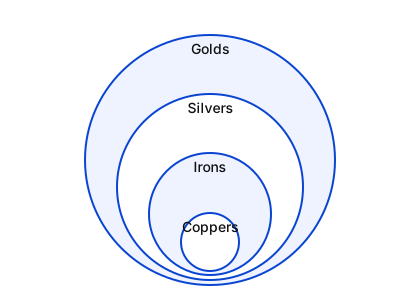
Concept: Draw the Venn diagram of the statements; a conclusion follows only if it is true in every possible diagram.

  1. All coppers ⊂ irons ⊂ silvers ⊂ golds – four nested circles.
  2. (I) Some golds are irons: irons lie entirely inside golds, so the common part is definite → follows.
  3. (II) All silvers are coppers: the reverse of the given chain – silvers may lie outside coppers → does not follow.

Trick: "All A are B" always gives "Some B are A", never "All B are A".

Answer: (A) Only conclusion (I) follows

अवधारणा: कथनों का Venn आरेख बनाएँ; निष्कर्ष तभी मान्य है जब वह हर संभव आरेख में सत्य हो।

  1. सभी coppers ⊂ irons ⊂ silvers ⊂ golds – चार nested वृत्त।
  2. (I) कुछ golds, irons हैं: irons पूरी तरह golds के अंदर हैं, अतः उभयनिष्ठ भाग निश्चित → अनुसरण करता है।
  3. (II) सभी silvers, coppers हैं: दी गई श्रृंखला का उल्टा – silvers, coppers के बाहर भी हो सकते हैं → अनुसरण नहीं करता।

ट्रिक: "सभी A, B हैं" से सदैव "कुछ B, A हैं" निकलता है, कभी "सभी B, A हैं" नहीं।

उत्तर: (A) केवल निष्कर्ष (I) अनुसरण करता है

RRB NTPC Graduate CBT 1General Intelligence and ReasoningSyllogismRRB NTPC Graduate CBT 1 2025 · 19 Mar Shift 3 →
Q5957.
Each of P, Q, R, S, T, U and V has an exam on a different day of a week starting from Monday and ending on Sunday of the same week.
T has the exam on Tuesday. Only two people have exams between R and T. P has the exam immediately after S but not on Sunday. Q has the exam before V but not on Monday.
How many people have exams between U and P?
P, Q, R, S, T, U और V में से प्रत्येक की परीक्षा एक ही सप्ताह के सोमवार से रविवार तक के अलग-अलग दिन है।
T की परीक्षा मंगलवार को है। R और T के बीच केवल दो व्यक्तियों की परीक्षा है। P की परीक्षा S के ठीक बाद है, परंतु रविवार को नहीं। Q की परीक्षा V से पहले है, परंतु सोमवार को नहीं।
U और P के बीच कितने व्यक्तियों की परीक्षा है?
  1. AFourचार
  2. BThreeतीन
  3. CTwoदो
  4. DOneएक
Show answer

Concept: Place the fixed person first, then use "immediately after" and "not on" clues to fill the week.

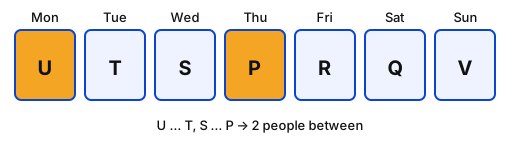
  1. T = Tuesday. Two people between R and T → R = Friday.
  2. P immediately after S, P not Sunday: the only free consecutive pair is Wed–Thu, so S = Wed, P = Thu.
  3. Mon, Sat, Sun remain for Q, U, V. Q not Monday and Q before V → Q = Sat, V = Sun, U = Mon.
  4. Between U (Mon) and P (Thu): T and S → 2 people.

Trick: Consecutive-pair clues (S then P) are the strongest – find free adjacent slots first.

Answer: (C) Two

अवधारणा: पहले निश्चित व्यक्ति रखें, फिर "ठीक बाद" और "उस दिन नहीं" वाले clue से सप्ताह भरें।

  1. T = मंगलवार। R और T के बीच दो लोग → R = शुक्रवार।
  2. P, S के ठीक बाद, P रविवार को नहीं: खाली लगातार जोड़ी केवल बुध–गुरु, अतः S = बुध, P = गुरु।
  3. सोम, शनि, रवि बचे Q, U, V के लिए। Q सोमवार नहीं और Q, V से पहले → Q = शनि, V = रवि, U = सोम।
  4. U (सोम) और P (गुरु) के बीच: T और S → 2 लोग।

ट्रिक: लगातार जोड़ी वाले clue (S फिर P) सबसे मज़बूत होते हैं – पहले खाली सटे slot ढूँढें।

उत्तर: (C) दो (Two)

RRB NTPC Graduate CBT 1General Intelligence and ReasoningLinear Arrangement – DaysRRB NTPC Graduate CBT 1 2025 · 19 Mar Shift 3 →
Q5958.
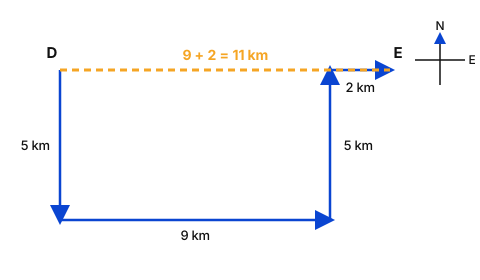
Kinshuk starts from Point D and walks 5 km towards South. She turns left and walks 9 km. She then turns left and walks 5 km. She finally turns right and walks 2 km to reach Point E.
How far and in which direction is Point E from Point D? (All turns are 90-degree turns only, unless specified.)
किंशुक बिंदु D से चलना शुरू करती है और दक्षिण की ओर 5 km चलती है। वह बाएँ मुड़ती है और 9 km चलती है। फिर वह बाएँ मुड़ती है और 5 km चलती है। अंत में वह दाएँ मुड़ती है और 2 km चलकर बिंदु E पर पहुँचती है।
बिंदु E, बिंदु D से कितनी दूर और किस दिशा में है? (जब तक अन्यथा निर्दिष्ट न हो, सभी मोड़ केवल 90 डिग्री के हैं।)
  1. A9 km, East9 km, पूर्व
  2. B12 km, West12 km, पश्चिम
  3. C11 km, East11 km, पूर्व
  4. D10 km, East10 km, पूर्व
Show answer

Concept: Track the walk on a grid; left/right depend on the direction currently faced.

  1. From D, 5 km South. Facing South, left = East: 9 km East.
  2. Left again = North: 5 km North – this cancels the first 5 km, so she is back on D's latitude, 9 km east of D.
  3. Right = East: 2 km more. Total eastward displacement =9+2=11 km. E is 11 km East of D.

Trick: Equal and opposite legs (5 S, 5 N) cancel – only the east-west legs count.

Answer: (C) 11 km, East

अवधारणा: चाल को grid पर बनाएँ; बायाँ/दायाँ वर्तमान मुख की दिशा पर निर्भर है।

  1. D से 5 km दक्षिण। दक्षिण मुख में बायाँ = पूर्व: 9 km पूर्व।
  2. फिर बायाँ = उत्तर: 5 km उत्तर – पहले 5 km को काट देता है, अतः वह D की सीध में, D से 9 km पूर्व है।
  3. दायाँ = पूर्व: 2 km और। कुल पूर्व विस्थापन =9+2=11 km। E, D से 11 km पूर्व।

ट्रिक: बराबर-विपरीत चालें (5 S, 5 N) कटती हैं – केवल पूर्व-पश्चिम चालें गिनें।

उत्तर: (C) 11 km, पूर्व (East)

RRB NTPC Graduate CBT 1General Intelligence and ReasoningDirection and DistanceRRB NTPC Graduate CBT 1 2025 · 19 Mar Shift 3 →
Q5959.
Which of the following letter-number clusters will replace the question mark “?” in the given series to make it logically complete?
MRA 17, QVE 20, UZI 23, YDM 26, ?
दी गई शृंखला में प्रश्नचिह्न “?” के स्थान पर निम्नलिखित में से कौन-सा अक्षर-संख्या समूह आएगा ताकि शृंखला तार्किक रूप से पूर्ण हो जाए?
MRA 17, QVE 20, UZI 23, YDM 26, ?
  1. ACGO 28
  2. BCHQ 29
  3. CCIS 29
  4. DDIR 30
Show answer

Concept: Check the shift of each letter position separately, and the number series separately.

  1. 1st letters M, Q, U, Y → +4 each → next C (Y+4 wraps to C). 2nd letters R, V, Z, D → +4 → H. 3rd letters A, E, I, M → +4 → Q.
  2. Numbers 17, 20, 23, 26 → +3 → 29.
  3. Next term: CHQ 29.

Trick: All letters +4, number +3; option (B) is the only one with CHQ.

Answer: (B) CHQ 29

अवधारणा: हर अक्षर-स्थान का shift अलग और संख्या श्रृंखला अलग जाँचें।

  1. पहले अक्षर M, Q, U, Y → हर बार +4 → अगला C (Y+4 घूमकर C)। दूसरे अक्षर R, V, Z, D → +4 → H। तीसरे अक्षर A, E, I, M → +4 → Q।
  2. संख्याएँ 17, 20, 23, 26 → +3 → 29।
  3. अगला पद: CHQ 29।

ट्रिक: सभी अक्षर +4, संख्या +3; CHQ केवल विकल्प (B) में है।

उत्तर: (B) CHQ 29

RRB NTPC Graduate CBT 1General Intelligence and ReasoningLetter-Number SeriesRRB NTPC Graduate CBT 1 2025 · 19 Mar Shift 3 →
Q5960.
What should come in place of ‘?’ in the given series?
65 63 60 55 48 ?
दी गई शृंखला में ‘?’ के स्थान पर क्या आना चाहिए?
65 63 60 55 48 ?
  1. A33
  2. B37
  3. C39
  4. D36
Show answer

Concept: Look at the differences between consecutive terms.

  1. 65 → 63 → 60 → 55 → 48: differences 2, 3, 5, 7 – consecutive prime numbers.
  2. Next difference is the next prime, 11: 48−11=37.

Trick: Differences 2, 3, 5, 7, 11, 13 … = primes; a very common series pattern.

Answer: (B) 37

अवधारणा: लगातार पदों के अंतर देखें।

  1. 65 → 63 → 60 → 55 → 48: अंतर 2, 3, 5, 7 – क्रमागत अभाज्य संख्याएँ।
  2. अगला अंतर अगली अभाज्य 11: 48−11=37।

ट्रिक: अंतर 2, 3, 5, 7, 11, 13 … = अभाज्य; बहुत सामान्य पैटर्न।

उत्तर: (B) 37

RRB NTPC Graduate CBT 1General Intelligence and ReasoningNumber SeriesRRB NTPC Graduate CBT 1 2025 · 19 Mar Shift 3 →