Question bank

Q&A: practice questions with answers

Search questions on any topic. Filter by exam category, exam, subject and topic, try the question, then open the answer and explanation.

Courses – airGurukul

7,077 questions found.

Q1361.
Find the effective price percentage of the marked price after three consecutive discounts of 18%, 24% and 18%. (Rounded up to two decimal places.)
18%, 24% और 18% की तीन क्रमागत छूटों के बाद अंकित मूल्य का प्रभावी मूल्य प्रतिशत ज्ञात कीजिए। (दशमलव के दो स्थानों तक पूर्णांकित)
  1. A51.10%
  2. B54.41%
  3. C48.56%
  4. D53.54%
Show answer

Concept: Price after discounts = MP × product of (1−d) factors.

  1. 0.82×0.76×0.82
  2. 0.82×0.82=0.6724
  3. 0.6724×0.76=0.511024≈51.10%

Trick: Two equal 18% discounts: 0.822=0.6724 first, then ×0.76.

Answer: (A) 51.10%

अवधारणा: छूट के बाद मूल्य = अंकित मूल्य × (1−d) गुणनफल।

  1. 0.82×0.76×0.82
  2. 0.822=0.6724
  3. 0.6724×0.76=0.511024≈51.10%

ट्रिक: पहले 0.822, फिर ×0.76।

उत्तर: (A) 51.10%

RRB NTPC Graduate CBT 1MathematicsSuccessive discountsRRB NTPC Graduate CBT 1 2024 · 19 Jun Shift 2 →
Q1362.
The roots of the quadratic equation 3x2 − 7x + 1 = 0 are:
द्विघात समीकरण 3x2 − 7x + 1 = 0 के मूल हैं:
  1. A7+371.5 & 7−371.5
  2. B7+376 & 7−376
  3. C−7+373 & −7−373
  4. D−7+373 & 7+371.5
Show answer

Concept: x=−b±b2−4ac2a

  1. a=3, b=−7, c=1
  2. D=49−12=37
  3. x=7±376

Trick: Sum of roots =73 must be positive — check options with it.

Answer: (B) 7+376 & 7−376

अवधारणा: x=−b±b2−4ac2a

  1. a=3, b=−7, c=1
  2. D=49−12=37
  3. x=7±376

ट्रिक: मूलों का योग =73 — विकल्प इसी से जाँचें।

उत्तर: (B) 7+376 & 7−376

RRB NTPC Graduate CBT 1MathematicsQuadratic equationsRRB NTPC Graduate CBT 1 2024 · 19 Jun Shift 2 →
Q1363.
A dishonest shopkeeper claims that he sells rock salt at ₹17/kg, which costs him ₹20/kg. But he gives 567 g instead of 1134 g. What is his profit percentage?
एक बेईमान दुकानदार दावा करता है कि वह सेंधा नमक ₹17/kg पर बेचता है, जिसका क्रय मूल्य उसके लिए ₹20/kg है। परंतु वह 1134 g के स्थान पर 567 g देता है। उसका लाभ प्रतिशत क्या है?
  1. AProfit of 68%68% का लाभ
  2. BProfit of 73%73% का लाभ
  3. CProfit of 70%70% का लाभ
  4. DProfit of 69%69% का लाभ
Show answer

Concept: Profit% = SP−CPCP×100 on the goods actually given.

  1. He charges for 1134 g: SP=1.134×17=19.278
  2. He gives 567 g: CP=0.567×20=11.34
  3. Profit =7.938; %=7.93811.34×100=70%

Trick: SPCP=1720×1134567=1710=1.7 → 70% profit.

Answer: (C) Profit of 70%

अवधारणा: लाभ% =SP−CPCP×100, वास्तव में दिए माल पर।

  1. 1134 g का पैसा: SP=1.134×17=19.278
  2. 567 g देता है: CP=0.567×20=11.34
  3. लाभ% =7.93811.34×100=70%

ट्रिक: SPCP=1720×2=1.7 → 70% लाभ।

उत्तर: (C) Profit of 70%

RRB NTPC Graduate CBT 1MathematicsDishonest dealerRRB NTPC Graduate CBT 1 2024 · 19 Jun Shift 2 →
Q1364.
A and B complete a work in 14 days. If A alone can do it in 56 days, then B alone can do three-fourth of the same work in ______________ days.
A और B मिलकर एक कार्य 14 दिनों में पूरा करते हैं। यदि A अकेले इसे 56 दिनों में कर सकता है, तो B अकेले उसी कार्य का तीन-चौथाई भाग ______________ दिनों में कर सकता है।
  1. A14
  2. B42
  3. C56
  4. D28
Show answer

Concept: B's rate = combined rate − A's rate.

  1. 114−156=4−156=356
  2. B alone: 563 days
  3. 34 work: 34×563=14 days

Trick: Total work 56 units: A = 1, B = 3 per day; 34 of 56 = 42 → 42÷3=14.

Answer: (A) 14

अवधारणा: B की दर = संयुक्त दर − A की दर।

  1. 114−156=356
  2. B अकेला: 563 दिन
  3. 34 कार्य: 34×563=14 दिन

ट्रिक: कुल कार्य 56 इकाई: A = 1, B = 3 प्रतिदिन; 42÷3=14।

उत्तर: (A) 14

RRB NTPC Graduate CBT 1MathematicsTime and workRRB NTPC Graduate CBT 1 2024 · 19 Jun Shift 2 →
Q1365.
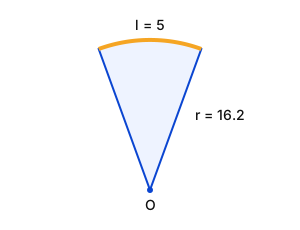
Find the area of the sector when the radius of the circle is 16.2 units and the length of the arc is 5 units.
जब वृत्त की त्रिज्या 16.2 इकाई और चाप की लंबाई 5 इकाई हो, तो त्रिज्यखंड का क्षेत्रफल ज्ञात कीजिए।
  1. A42.5 units242.5 इकाई2
  2. B40.5 units240.5 इकाई2
  3. C46.5 units246.5 इकाई2
  4. D44.5 units244.5 इकाई2
Show answer

Concept: Area of sector=12×l×r

  1. l=5, r=16.2
  2. Area=12×5×16.2=40.5 sq units

Trick: No angle needed when arc length is given.

Answer: (B) 40.5 units2

अवधारणा: त्रिज्यखंड क्षेत्रफल=12×l×r

  1. l=5, r=16.2
  2. क्षेत्रफल=12×5×16.2=40.5 वर्ग इकाई

ट्रिक: चाप की लंबाई दी हो तो कोण नहीं चाहिए।

उत्तर: (B) 40.5 units2

RRB NTPC Graduate CBT 1MathematicsArea of sectorRRB NTPC Graduate CBT 1 2024 · 19 Jun Shift 2 →
Q1366.
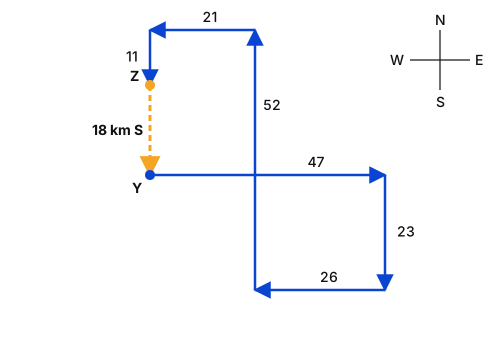
Harit starts from Point Y and drives 47 km towards the east. He then takes a right turn, drives 23 km, turns right and drives 26 km. He then takes a right turn and drives 52 km. He takes a left turn, drives 21 km. He then turns left, drives 11 km to stop at Point Z. How far (shortest distance) and towards which direction should he drive in order to reach Point Y again? (All turns are 90-degree turns only unless specified.)
हरित बिंदु Y से प्रारंभ करता है और पूर्व की ओर 47 km गाड़ी चलाता है। फिर वह दाएँ मुड़ता है, 23 km गाड़ी चलाता है, दाएँ मुड़ता है और 26 km गाड़ी चलाता है। फिर वह दाएँ मुड़ता है और 52 km गाड़ी चलाता है। वह बाएँ मुड़ता है, 21 km गाड़ी चलाता है। फिर वह बाएँ मुड़ता है, 11 km गाड़ी चलाकर बिंदु Z पर रुकता है। बिंदु Y पर पुनः पहुँचने के लिए उसे कितनी दूरी (न्यूनतम दूरी) तक और किस दिशा में गाड़ी चलानी चाहिए? (जब तक निर्दिष्ट न हो, सभी मोड़ केवल 90 डिग्री के मोड़ हैं।)
  1. A19 km towards the northउत्तर की ओर 19 km
  2. B18 km towards the southदक्षिण की ओर 18 km
  3. C20 km towards the southदक्षिण की ओर 20 km
  4. D24 km towards the eastपूर्व की ओर 24 km
Show answer

Concept: Track the position as coordinates, taking Y as origin, East as +x and North as +y.

  1. East 47: (47,0); right turn → South 23: (47,−23).
  2. Right → West 26: (21,−23); right → North 52: (21,29).
  3. Left → West 21: (0,29); left → South 11: Z=(0,18).
  4. Z is 18 km directly north of Y, so he must drive 18 km towards the south.

Trick: Net E–W: 47−26−21=0; net N–S: −23+52−11=18 north. Return trip is the opposite direction.

Answer: (B) 18 km towards the south

अवधारणा: Y को मूल बिंदु मानकर पूर्व =+x, उत्तर =+y लेकर स्थिति ट्रैक करें।

  1. पूर्व 47: (47,0); दाएँ मुड़कर दक्षिण 23: (47,−23)।
  2. दाएँ → पश्चिम 26: (21,−23); दाएँ → उत्तर 52: (21,29)।
  3. बाएँ → पश्चिम 21: (0,29); बाएँ → दक्षिण 11: Z=(0,18)।
  4. Z, Y से ठीक 18 km उत्तर में है, अतः उसे 18 km दक्षिण की ओर जाना होगा।

ट्रिक: कुल पूर्व–पश्चिम: 47−26−21=0; कुल उत्तर–दक्षिण: −23+52−11=18 उत्तर। वापसी उल्टी दिशा में।

उत्तर: (B) 18 km दक्षिण की ओर

RRB NTPC Graduate CBT 1General Intelligence and ReasoningDirection and DistanceRRB NTPC Graduate CBT 1 2024 · 19 Jun Shift 2 →
Q1367.
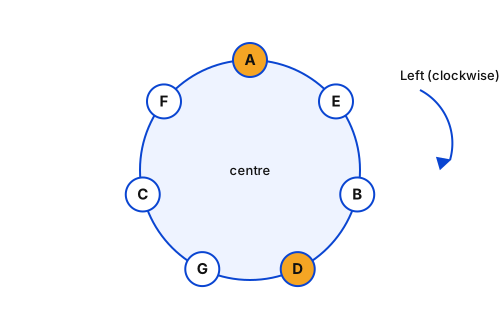
A, B, C, D, E, F, and G are sitting around a circular table facing the centre.
B sits third to the left of F. C sits second to the left of D. Only F sits between A and C. G is not an immediate neighbour of B.
How many people sit between A and D when counted from the left of D?
A, B, C, D, E, F और G एक वृत्ताकार मेज़ के चारों ओर केंद्र की ओर मुख करके बैठे हैं।
B, F के बाईं ओर तीसरे स्थान पर बैठा है। C, D के बाईं ओर दूसरे स्थान पर बैठा है। A और C के बीच केवल F बैठा है। G, B का निकटतम पड़ोसी नहीं है।
D के बाईं ओर से गिनने पर A और D के बीच कितने व्यक्ति बैठे हैं?
  1. AOneएक
  2. BFourचार
  3. CTwoदो
  4. DThreeतीन
Show answer

Concept: Facing the centre, “left” means moving clockwise and “right” anticlockwise.

  1. Fix F; B is third to the left of F.
  2. Only F sits between A and C, so A and C are on either side of F; with C second to the left of D, only the order C, F, A (clockwise) with D two places right of C works.
  3. G is not next to B, so E sits beside B and A: order clockwise A, E, B, D, G, C, F.
  4. From the left of D (clockwise): D → G, C, F → A, i.e. 3 people between.

Trick: Place the person named most often (F) first, then fix the “only one between” clue.

Answer: (D) Three

अवधारणा: केंद्र की ओर मुख होने पर “बाएँ” = दक्षिणावर्त (clockwise), “दाएँ” = वामावर्त।

  1. F को स्थिर करें; B, F के बाएँ से तीसरे स्थान पर।
  2. A और C के बीच केवल F है, अतः A, C दोनों F के आस-पास; C, D के बाएँ दूसरे स्थान पर हो, यह केवल क्रम C, F, A से संभव है।
  3. G, B का पड़ोसी नहीं, अतः E, B और A के बीच: दक्षिणावर्त क्रम A, E, B, D, G, C, F।
  4. D के बाएँ से गिनें: D → G, C, F → A, यानी बीच में 3 व्यक्ति।

ट्रिक: सबसे अधिक बार आए व्यक्ति (F) को पहले रखें, फिर “केवल एक बीच में” वाला सुराग लगाएँ।

उत्तर: (D) तीन

RRB NTPC Graduate CBT 1General Intelligence and ReasoningCircular Seating ArrangementRRB NTPC Graduate CBT 1 2024 · 19 Jun Shift 2 →
Q1368.
Which of the following letter-clusters should replace # and % so that the pattern and relationship followed between the letter-cluster pair on the left side of :: is the same as that on the right side of :: ?
# : KSB :: NVE : %
निम्नलिखित में से कौन-से अक्षर-समूह # और % को प्रतिस्थापित करें ताकि :: के बाईं ओर के अक्षर-समूह युग्म के बीच अनुसरण किया गया पैटर्न और संबंध वही हो जो :: के दाईं ओर के अक्षर-समूह युग्म के बीच है?
# : KSB :: NVE : %
  1. A# = FUW, % = SAJ
  2. B# = FNW, % = SAJ
  3. C# = FNW, % = SAI
  4. D# = FNW, % = SUY
Show answer

Concept: Find the letter shift from the right pair and apply it to the left pair.

  1. Option B: F+5 = K, N+5 = S, W+5 = B (after Z, back to A), so FNW → KSB.
  2. Apply +5 to NVE: N+5 = S, V+5 = A, E+5 = J → SAJ.
  3. Both blanks are satisfied only by # = FNW, % = SAJ.

Trick: Check each option’s shift on the first pair; the matching one must give the same shift on the second pair.

Answer: (B) # = FNW, % = SAJ

अवधारणा: दाईं जोड़ी से अक्षरों का खिसकाव (shift) ज्ञात कर बाईं ओर लागू करें।

  1. विकल्प B: F+5 = K, N+5 = S, W+5 = B (Z के बाद फिर A), अतः FNW → KSB।
  2. NVE पर +5: N+5 = S, V+5 = A, E+5 = J → SAJ।
  3. दोनों रिक्त स्थान केवल # = FNW, % = SAJ से संतुष्ट होते हैं।

ट्रिक: पहली जोड़ी पर विकल्प का shift जाँचें, फिर वही shift दूसरी जोड़ी पर।

उत्तर: (B) # = FNW, % = SAJ

RRB NTPC Graduate CBT 1General Intelligence and ReasoningLetter AnalogyRRB NTPC Graduate CBT 1 2024 · 19 Jun Shift 2 →
Q1369.
Refer to the following number and symbol series and answer the question that follows. Counting to be done from left to right only.
(NOTE: All numbers are single digit numbers only.)
(Left) 7 € 2 5 3 © 8 © 4 € 9 3 € 5 # % * 3 4 7 $ 1 (Right)
How many such symbols are there each of which is immediately preceded by a number and also immediately followed by a number?
निम्नलिखित संख्या और प्रतीक श्रृंखला को देखिए और उसके बाद दिए गए प्रश्न का उत्तर दीजिए। गिनती केवल बाएँ से दाएँ की जानी है।
(ध्यान दें: सभी संख्याएँ केवल एक-अंकीय संख्याएँ हैं।)
(बाएँ) 7 € 2 5 3 © 8 © 4 € 9 3 € 5 # % * 3 4 7 $ 1 (दाएँ)
ऐसे कितने प्रतीक हैं, जिनमें से प्रत्येक के ठीक पहले एक संख्या है और ठीक बाद भी एक संख्या है?
  1. A8
  2. B5
  3. C6
  4. D7
Show answer

Concept: Check every symbol: the element just before and just after it must both be numbers.

  1. 7 € 2 ✓, 3 © 8 ✓, 8 © 4 ✓, 4 € 9 ✓, 3 € 5 ✓, 7 $ 1 ✓.
  2. #, % and * fail (they are next to other symbols).
  3. Total = 6.

Trick: Skip blocks of consecutive symbols — none of them can qualify.

Answer: (C) 6

अवधारणा: हर प्रतीक जाँचें: उसके ठीक पहले और ठीक बाद दोनों संख्याएँ होनी चाहिए।

  1. 7 € 2 ✓, 3 © 8 ✓, 8 © 4 ✓, 4 € 9 ✓, 3 € 5 ✓, 7 $ 1 ✓।
  2. #, % और * शर्त पूरी नहीं करते (बगल में प्रतीक हैं)।
  3. कुल = 6।

ट्रिक: लगातार आए प्रतीकों का समूह छोड़ दें — वे कभी योग्य नहीं होते।

उत्तर: (C) 6

RRB NTPC Graduate CBT 1General Intelligence and ReasoningNumber–Symbol SeriesRRB NTPC Graduate CBT 1 2024 · 19 Jun Shift 2 →
Q1370.
​In a certain code language,
'A + B' means ‘A is the sister of B’
'A – B' means ‘A is the father of B’
'A x B' means ‘A is the daughter of B’
'A ÷ B' means ‘A is the son of B’
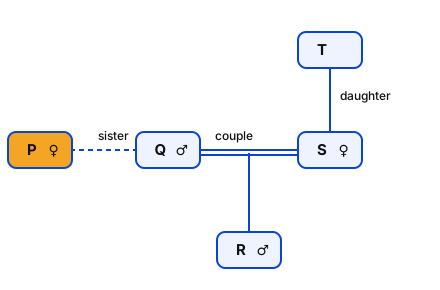
Based on the above, how is P related to T if ‘P + Q – R ÷ S x T’?
​एक निश्चित कूट भाषा में,
'A + B' का अर्थ है ‘A, B की बहन है’
'A – B' का अर्थ है ‘A, B का पिता है’
'A x B' का अर्थ है ‘A, B की पुत्री है’
'A ÷ B' का अर्थ है ‘A, B का पुत्र है’
उपरोक्त के आधार पर, यदि ‘P + Q – R ÷ S x T’ है, तो P का T से क्या संबंध है?
  1. ADaughter's husband's sisterपुत्री के पति की बहन
  2. BFather's sisterपिता की बहन
  3. CDaughter-in-lawपुत्रवधू
  4. DSister's husband's motherबहन के पति की माँ
Show answer

Concept: Decode each symbol step by step and draw the family tree.

  1. P + Q: P is sister of Q (P female).
  2. Q – R: Q is father of R; R ÷ S: R is son of S, so S is R’s mother and Q’s wife.
  3. S × T: S is daughter of T.
  4. So Q is T’s daughter’s husband, and P is his sister: P is T’s daughter’s husband’s sister.

Trick: Write relations from T’s side backward: T → daughter S → her husband Q → his sister P.

Answer: (A) Daughter’s husband’s sister

अवधारणा: हर संकेत को क्रम से डिकोड करें और वंश-वृक्ष बनाएँ।

  1. P + Q: P, Q की बहन है (P स्त्री)।
  2. Q – R: Q, R का पिता; R ÷ S: R, S का पुत्र, अतः S, R की माता और Q की पत्नी।
  3. S × T: S, T की पुत्री है।
  4. अतः Q, T की पुत्री का पति है और P उसकी बहन: P, T की पुत्री के पति की बहन है।

ट्रिक: T से उल्टा चलें: T → पुत्री S → उसका पति Q → उसकी बहन P।

उत्तर: (A) पुत्री के पति की बहन (Daughter’s husband’s sister)

RRB NTPC Graduate CBT 1General Intelligence and ReasoningCoded Blood RelationsRRB NTPC Graduate CBT 1 2024 · 19 Jun Shift 2 →
Q1371.
Based on the English alphabetical order, three of the following four letter-cluster pairs are alike in a certain way and thus form a group. Which letter-cluster pair DOES NOT belong to that group?
(Note: The odd one out is not based on the number of consonants/vowels or their position in the letter-cluster.)
अंग्रेज़ी वर्णमाला क्रम के आधार पर, निम्नलिखित चार अक्षर-समूह युग्मों में से तीन किसी निश्चित प्रकार से एकसमान हैं और इस प्रकार एक समूह बनाते हैं। कौन-सा अक्षर-समूह युग्म उस समूह से संबंधित नहीं है?
(ध्यान दें: असंगत अक्षर-समूह, उस अक्षर-समूह में व्यंजनों/स्वरों की संख्या या उनके स्थान पर आधारित नहीं है।)
  1. AMP - LK
  2. BNP - KM
  3. CKM - HJ
  4. DHJ - EG
Show answer

Concept: Compare positions: each letter of the first cluster vs the matching letter of the second cluster.

  1. NP – KM: N−3 = K, P−3 = M.
  2. KM – HJ: K−3 = H, M−3 = J; HJ – EG: H−3 = E, J−3 = G.
  3. MP – LK: M−1 = L, P−5 = K — different rule.

Trick: Three pairs show a uniform −3 shift; the one breaking it is odd.

Answer: (A) MP - LK

अवधारणा: पहले क्लस्टर के प्रत्येक अक्षर की तुलना दूसरे क्लस्टर के संगत अक्षर से करें।

  1. NP – KM: N−3 = K, P−3 = M।
  2. KM – HJ: K−3 = H, M−3 = J; HJ – EG: H−3 = E, J−3 = G।
  3. MP – LK: M−1 = L, P−5 = K — अलग नियम।

ट्रिक: तीन जोड़ियों में समान −3 का खिसकाव है; जो इसे तोड़े वही विषम।

उत्तर: (A) MP - LK

RRB NTPC Graduate CBT 1General Intelligence and ReasoningOdd One Out – Letter PairsRRB NTPC Graduate CBT 1 2024 · 19 Jun Shift 2 →
Q1372.
This question is based on the five, three-digit numbers given below.
(Left) 617 335 930 459 571 (Right)
(Example- 697 – First digit = 6, second digit = 9 and third digit = 7)
(Note: All operations to be done from left to right.)
What will be the resultant if the first digit of the highest number is added to the third digit of the lowest number?
यह प्रश्न नीचे दी गई पाँच, तीन-अंकीय संख्याओं पर आधारित है।
(बाएँ) 617 335 930 459 571 (दाएँ)
(उदाहरण- 697 – पहला अंक = 6, दूसरा अंक = 9 और तीसरा अंक = 7)
(ध्यान दें: सभी संक्रियाएँ बाएँ से दाएँ की जानी हैं।)
यदि सबसे बड़ी संख्या के पहले अंक को सबसे छोटी संख्या के तीसरे अंक में जोड़ा जाए, तो परिणाम क्या होगा?
  1. A13
  2. B15
  3. C17
  4. D14
Show answer

Concept: First identify the highest and lowest numbers, then pick the required digits.

  1. Highest = 930 → first digit 9.
  2. Lowest = 335 → third digit 5.
  3. 9+5=14.

Trick: Compare first digits only: 9 is highest, 3 is lowest.

Answer: (D) 14

अवधारणा: पहले सबसे बड़ी और सबसे छोटी संख्या पहचानें, फिर अंक चुनें।

  1. सबसे बड़ी = 930 → पहला अंक 9।
  2. सबसे छोटी = 335 → तीसरा अंक 5।
  3. 9+5=14।

ट्रिक: केवल पहले अंक देखें: 9 सबसे बड़ा, 3 सबसे छोटा।

उत्तर: (D) 14

RRB NTPC Graduate CBT 1General Intelligence and ReasoningThree-Digit Number OperationsRRB NTPC Graduate CBT 1 2024 · 19 Jun Shift 2 →
Q1373.
Which of the following letter-clusters should replace # and % so that the pattern and relationship followed between the letter-cluster pair on the left side of :: is the same as that on the right side of ::?
# : QSO :: XZV : %
निम्नलिखित में से कौन-से अक्षर-समूह # और % को प्रतिस्थापित करें ताकि :: के बाईं ओर के अक्षर-समूह युग्म के बीच अनुसरण किया गया पैटर्न और संबंध वही हो जो :: के दाईं ओर के अक्षर-समूह युग्म के बीच है?
# : QSO :: XZV : %
  1. A# = SFR, % = POS
  2. B# = TVR, % = UWS
  3. C# = SVR, % = UWU
  4. D# = TUR, % = UET
Show answer

Concept: Find the shift in the first pair and repeat it in the second pair.

  1. Option B: T−3 = Q, V−3 = S, R−3 = O, so TVR → QSO.
  2. XZV with −3: X→U, Z→W, V→S = UWS.

Trick: Letters QSO are spaced +2, −4; the answer cluster must keep the same spacing (UWS: +2, −4).

Answer: (B) # = TVR, % = UWS

अवधारणा: पहली जोड़ी का खिसकाव ज्ञात कर दूसरी जोड़ी में दोहराएँ।

  1. विकल्प B: T−3 = Q, V−3 = S, R−3 = O, अतः TVR → QSO।
  2. XZV पर −3: X→U, Z→W, V→S = UWS।

ट्रिक: QSO के अक्षरों का अंतर +2, −4 है; उत्तर में भी वही अंतर (UWS: +2, −4)।

उत्तर: (B) # = TVR, % = UWS

RRB NTPC Graduate CBT 1General Intelligence and ReasoningLetter AnalogyRRB NTPC Graduate CBT 1 2024 · 19 Jun Shift 2 →
Q1374.
Select the pair that follows the same pattern as that followed by the two pairs given below. Both pairs follow the same pattern.
HMP : KON
USQ : XUO
उस युग्म का चयन कीजिए जो उसी पैटर्न का अनुसरण करता है जिसका अनुसरण नीचे दिए गए दो युग्मों द्वारा किया गया है। दोनों युग्म एक ही पैटर्न का अनुसरण करते हैं।
HMP : KON
USQ : XUO
  1. AKWZ : GSC
  2. BDLV : GNT
  3. CDWP : JZI
  4. DBIO : FNK
Show answer

Concept: Find the position-wise change from the first cluster to the second.

  1. HMP → KON: H+3, M+2, P−2.
  2. USQ → XUO: U+3, S+2, Q−2.
  3. DLV → GNT: D+3 = G, L+2 = N, V−2 = T ✓.

Trick: Test only the first letter (+3) to shortlist: KWZ (−4) and DWP (+6), BIO (+4) fail at once.

Answer: (B) DLV : GNT

अवधारणा: पहले क्लस्टर से दूसरे तक स्थान-वार बदलाव देखें।

  1. HMP → KON: H+3, M+2, P−2।
  2. USQ → XUO: U+3, S+2, Q−2।
  3. DLV → GNT: D+3 = G, L+2 = N, V−2 = T ✓।

ट्रिक: केवल पहले अक्षर (+3) से छाँटें: KWZ (−4), DWP (+6), BIO (+4) तुरंत बाहर।

उत्तर: (B) DLV : GNT

RRB NTPC Graduate CBT 1General Intelligence and ReasoningLetter Pair PatternRRB NTPC Graduate CBT 1 2024 · 19 Jun Shift 2 →
Q1375.
What should come in place of the question mark (?) in the given series?
428, 405, 372, ?, 276, 213
दी गई श्रृंखला में प्रश्न चिह्न (?) के स्थान पर क्या आना चाहिए?
428, 405, 372, ?, 276, 213
  1. A329
  2. B229
  3. C339
  4. D319
Show answer

Concept: Look at the differences between consecutive terms.

  1. Differences: 428−405=23, 405−372=33 — increasing by 10.
  2. Next difference 43: 372−43=329.
  3. Check: 329−53=276, 276−63=213 ✓.

Trick: Differences 23, 33, 43, 53, 63 — an arithmetic pattern of +10.

Answer: (A) 329

अवधारणा: क्रमागत पदों का अंतर देखें।

  1. अंतर: 428−405=23, 405−372=33 — हर बार 10 अधिक।
  2. अगला अंतर 43: 372−43=329।
  3. जाँच: 329−53=276, 276−63=213 ✓।

ट्रिक: अंतर 23, 33, 43, 53, 63 — हर बार +10।

उत्तर: (A) 329

RRB NTPC Graduate CBT 1General Intelligence and ReasoningNumber SeriesRRB NTPC Graduate CBT 1 2024 · 19 Jun Shift 2 →
Q1376.
A group of numbers and symbols is coded using letter codes as per the codes given below and the conditions that follow. Study the given codes and conditions and answer the question that follows.
Note: If none of the conditions apply, then codes for the respective number/symbol are to be followed directly as given in the table.
Number/symbol5234$&6@#%+897
CodeADFGHJKLZXCVBM
Conditions:
(i) If the first element is a symbol and the last a number, the codes for these two (the first and the last elements) are to be interchanged.
(ii) If the first element is an odd number and the last an even number, the first and last elements are to be coded as ©.
(iii) If both second and third elements are perfect squares, the third element is to be coded as the code for the second element.
What will be the code for the following group?
3 4 9 7
संख्याओं और प्रतीकों के एक समूह को नीचे दिए गए कूटों और उसके बाद दी गई शर्तों के अनुसार अक्षर कूटों का उपयोग करके कूटबद्ध किया गया है। दिए गए कूटों और शर्तों का अध्ययन कीजिए और उसके बाद दिए गए प्रश्न का उत्तर दीजिए।
ध्यान दें: यदि कोई भी शर्त लागू नहीं होती है, तो संबंधित संख्या/प्रतीक के लिए तालिका में दिए गए कूटों का सीधे अनुसरण किया जाना है।
संख्या/प्रतीक5234$&6@#%+897
कूटADFGHJKLZXCVBM
शर्तें:
(i) यदि पहला तत्व एक प्रतीक है और अंतिम तत्व एक संख्या है, तो इन दोनों (पहले और अंतिम तत्वों) के कूटों को आपस में बदल दिया जाना है।
(ii) यदि पहला तत्व एक विषम संख्या है और अंतिम तत्व एक सम संख्या है, तो पहले और अंतिम तत्वों को © के रूप में कूटबद्ध किया जाना है।
(iii) यदि दूसरा और तीसरा दोनों तत्व पूर्ण वर्ग हैं, तो तीसरे तत्व को दूसरे तत्व के कूट के रूप में कूटबद्ध किया जाना है।
निम्नलिखित समूह का कूट क्या होगा?
3 4 9 7
  1. AMGBF
  2. BFGBM
  3. CFGGM
  4. DFBBM
Show answer

Concept: Write the direct codes, then test each condition in order.

  1. Direct codes: 3 = F, 4 = G, 9 = B, 7 = M.
  2. Condition 1: first element is not a symbol — no. Condition 2: last element 7 is odd, not even — no.
  3. Condition 3: second (4) and third (9) are both perfect squares → third gets the code of the second, G.
  4. Code = F G G M.

Trick: Condition 3 makes two adjacent letters identical — look for a repeated letter among options.

Answer: (C) FGGM

अवधारणा: पहले सीधे कोड लिखें, फिर शर्तें क्रम से जाँचें।

  1. सीधे कोड: 3 = F, 4 = G, 9 = B, 7 = M।
  2. शर्त 1: पहला तत्व प्रतीक नहीं — लागू नहीं। शर्त 2: अंतिम 7 विषम है, सम नहीं — लागू नहीं।
  3. शर्त 3: दूसरा (4) और तीसरा (9) दोनों पूर्ण वर्ग → तीसरे को दूसरे का कोड G मिलेगा।
  4. कोड = F G G M।

ट्रिक: शर्त 3 से दो पास-पास के अक्षर समान होंगे — विकल्पों में दोहराया अक्षर देखें।

उत्तर: (C) FGGM

RRB NTPC Graduate CBT 1General Intelligence and ReasoningCoding with ConditionsRRB NTPC Graduate CBT 1 2024 · 19 Jun Shift 2 →
Q1377.
Which of the following letter-number clusters will replace the question mark (?) in the given series to make it logically complete?
QK15 OI26 MG37 KE48 ?
दी गई श्रृंखला को तार्किक रूप से पूर्ण करने के लिए निम्नलिखित में से कौन-सा अक्षर-संख्या समूह प्रश्न चिह्न (?) को प्रतिस्थापित करेगा?
QK15 OI26 MG37 KE48 ?
  1. AIC59
  2. BID58
  3. CIC58
  4. DID59
Show answer

Concept: Track each part of the term separately.

  1. First letter: Q, O, M, K → −2 each → I.
  2. Second letter: K, I, G, E → −2 each → C.
  3. Number: 15, 26, 37, 48 → +11 each → 59.
  4. Next term = IC59.

Trick: Numbers rise by 11 (tens and units both +1) — 59 eliminates options B and C immediately.

Answer: (A) IC59

अवधारणा: पद के हर भाग को अलग-अलग देखें।

  1. पहला अक्षर: Q, O, M, K → हर बार −2 → I।
  2. दूसरा अक्षर: K, I, G, E → −2 → C।
  3. संख्या: 15, 26, 37, 48 → +11 → 59।
  4. अगला पद = IC59।

ट्रिक: संख्या में +11 — 59 से B और C तुरंत बाहर।

उत्तर: (A) IC59

RRB NTPC Graduate CBT 1General Intelligence and ReasoningAlpha-Numeric SeriesRRB NTPC Graduate CBT 1 2024 · 19 Jun Shift 2 →
Q1378.
Based on the English alphabetical order, three of the following four letter-cluster pairs are alike in a certain way and thus form a group. Which letter-cluster pair DOES NOT belong to that group?
(Note: The odd one out is not based on the number of consonants/vowels or their position in the letter-cluster.)
अंग्रेज़ी वर्णमाला क्रम के आधार पर, निम्नलिखित चार अक्षर-समूह युग्मों में से तीन किसी निश्चित प्रकार से एकसमान हैं और इस प्रकार एक समूह बनाते हैं। कौन-सा अक्षर-समूह युग्म उस समूह से संबंधित नहीं है?
(ध्यान दें: असंगत अक्षर-समूह, उस अक्षर-समूह में व्यंजनों/स्वरों की संख्या या उनके स्थान पर आधारित नहीं है।)
  1. ATR – YP
  2. BVT – AR
  3. CYW – DV
  4. DGE – LC
Show answer

Concept: Compare the first letters of the two clusters and the second letters separately.

  1. TR – YP: T+5 = Y, R−2 = P.
  2. VT – AR: V+5 = A, T−2 = R; GE – LC: G+5 = L, E−2 = C.
  3. YW – DV: Y+5 = D but W−1 = V — breaks the rule.

Trick: Within each cluster the letters differ by −2 in all options, so check the cross-cluster shift.

Answer: (C) YW – DV

अवधारणा: दोनों क्लस्टर के पहले अक्षरों तथा दूसरे अक्षरों की अलग-अलग तुलना करें।

  1. TR – YP: T+5 = Y, R−2 = P।
  2. VT – AR: V+5 = A, T−2 = R; GE – LC: G+5 = L, E−2 = C।
  3. YW – DV: Y+5 = D पर W−1 = V — नियम टूटता है।

ट्रिक: क्लस्टर के भीतर सभी में −2 का अंतर है, अतः क्लस्टर के बीच का खिसकाव जाँचें।

उत्तर: (C) YW – DV

RRB NTPC Graduate CBT 1General Intelligence and ReasoningOdd One Out – Letter PairsRRB NTPC Graduate CBT 1 2024 · 19 Jun Shift 2 →
Q1379.
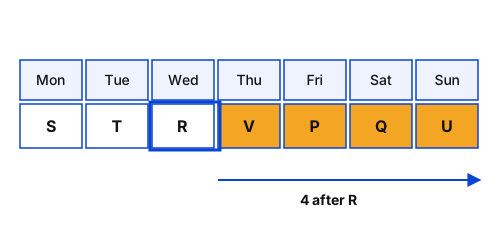
Each of P, Q, R, S, T, U and V has an exam on a different day of a week starting from Monday and ending on Sunday of the same week. Q has an exam on Saturday. Only 4 people have exams between T and U, neither of whom has an exam on Monday. P has an exam immediately after V, and R has an exam immediately before V. U has an exam after P. How many people have exams after R?
P, Q, R, S, T, U और V में से प्रत्येक की परीक्षा एक ही सप्ताह के सोमवार से प्रारंभ होकर रविवार को समाप्त होने वाले सप्ताह के एक अलग दिन है। Q की परीक्षा शनिवार को है। T और U के बीच केवल 4 व्यक्तियों की परीक्षा है, और इन दोनों में से किसी की भी परीक्षा सोमवार को नहीं है। P की परीक्षा V के ठीक बाद है, और R की परीक्षा V के ठीक पहले है। U की परीक्षा P के बाद है। R के बाद कितने व्यक्तियों की परीक्षा है?
  1. A2
  2. B3
  3. C1
  4. D4
Show answer

Concept: Fix the definite clues first, then the block R–V–P.

  1. 4 people between T and U → they are on (Mon, Sat) or (Tue, Sun); Monday is ruled out and Saturday is Q’s, so T/U = Tue/Sun.
  2. U is after P, so U = Sunday, T = Tuesday.
  3. R, V, P are consecutive → Wed, Thu, Fri; S gets Monday.
  4. After R (Wed): V, P, Q, U → 4 people.

Trick: A gap of 4 between two people in a 7-day week leaves only two placements — use it first.

Answer: (D) 4

अवधारणा: पहले निश्चित सुराग लगाएँ, फिर R–V–P का ब्लॉक।

  1. T और U के बीच 4 व्यक्ति → (सोम, शनि) या (मंगल, रवि); सोमवार वर्जित और शनिवार Q का, अतः T/U = मंगल/रवि।
  2. U, P के बाद है, अतः U = रविवार, T = मंगलवार।
  3. R, V, P लगातार → बुध, गुरु, शुक्र; S को सोमवार।
  4. R (बुध) के बाद: V, P, Q, U → 4 व्यक्ति।

ट्रिक: 7 दिनों में दो लोगों के बीच 4 का अंतर केवल दो स्थान देता है — इसे पहले लगाएँ।

उत्तर: (D) 4

RRB NTPC Graduate CBT 1General Intelligence and ReasoningScheduling PuzzleRRB NTPC Graduate CBT 1 2024 · 19 Jun Shift 2 →
Q1380.
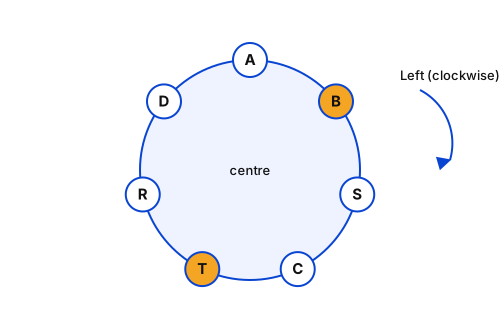
A, B, C, D, R, S and T are sitting around a circular table facing the centre of the table. Only one person sits between D and T when counted from the left of T. S sits third to the right of R. C sits third to the left of A. S sits to the immediate right of C. B is not an immediate neighbour of C. How many people sit between B and T when counted from the right of B?
A, B, C, D, R, S और T एक वृत्ताकार मेज़ के चारों ओर मेज़ के केंद्र की ओर मुख करके बैठे हैं। T के बाईं ओर से गिनने पर D और T के बीच केवल एक व्यक्ति बैठा है। S, R के दाईं ओर तीसरे स्थान पर बैठा है। C, A के बाईं ओर तीसरे स्थान पर बैठा है। S, C के ठीक दाईं ओर बैठा है। B, C का निकटतम पड़ोसी नहीं है। B के दाईं ओर से गिनने पर B और T के बीच कितने व्यक्ति बैठे हैं?
  1. ATwoदो
  2. BFourचार
  3. CThreeतीन
  4. DOneएक
Show answer

Concept: Facing the centre: left = clockwise, right = anticlockwise.

  1. C is third to the left of A; S is immediate right of C; S is third to the right of R.
  2. Taking A first, clockwise: A, _, S, C, _, R, _ .
  3. D is second to the left of T → T in 5th place and D in 7th; B (not beside C) takes the 2nd seat: A, B, S, C, T, R, D.
  4. From the right of B (anticlockwise): B → A, D, R → T: 3 people between.

Trick: Chain the “third to” clues (A–C–S–R) first; they fix four seats at once.

Answer: (C) Three

अवधारणा: केंद्र की ओर मुख: बाएँ = दक्षिणावर्त, दाएँ = वामावर्त।

  1. C, A के बाएँ तीसरे; S, C के ठीक दाएँ; S, R के दाएँ तीसरे स्थान पर।
  2. A से दक्षिणावर्त: A, _, S, C, _, R, _ ।
  3. D, T के बाएँ दूसरे → T पाँचवें, D सातवें; B (C का पड़ोसी नहीं) दूसरे स्थान पर: A, B, S, C, T, R, D।
  4. B के दाएँ से गिनें: B → A, D, R → T: बीच में 3 व्यक्ति।

ट्रिक: पहले “तीसरे स्थान” वाले सुराग (A–C–S–R) जोड़ें; चार सीटें एक साथ तय होती हैं।

उत्तर: (C) तीन

RRB NTPC Graduate CBT 1General Intelligence and ReasoningCircular Seating ArrangementRRB NTPC Graduate CBT 1 2024 · 19 Jun Shift 2 →