Question bank

Q&A: practice questions with answers

Search questions on any topic. Filter by exam category, exam, subject and topic, try the question, then open the answer and explanation.

Courses – airGurukul

7,077 questions found.

Q1861.
A boat travels 176 km upstream in 16 hours and 85 km downstream in 5 hours. What is the speed of the boat in still water?
एक नाव धारा के प्रतिकूल 176 km की दूरी 16 घंटे में और धारा के अनुकूल 85 km की दूरी 5 घंटे में तय करती है। शांत जल में नाव की चाल क्या है?
  1. A24 km/hr
  2. B20 km/hr
  3. C14 km/hr
  4. D23 km/hr
Show answer

Concept: Speed in still water =downstream+upstream2

  1. Upstream speed =17616=11km/h
  2. Downstream speed =855=17km/h
  3. Boat speed =17+112=14km/h (stream =3km/h)

Trick: Boat = average of the two speeds; stream = half their difference.

Answer: (C) 14km/h

अवधारणा: शांत जल में चाल =अनुप्रवाह+ऊर्ध्वप्रवाह2

  1. ऊर्ध्वप्रवाह चाल =17616=11km/h
  2. अनुप्रवाह चाल =855=17km/h
  3. नाव की चाल =17+112=14km/h (धारा =3km/h)

ट्रिक: नाव = दोनों चालों का औसत; धारा = अंतर का आधा।

उत्तर: (C) 14km/h
RRB NTPC Graduate CBT 1MathematicsBoats and StreamsRRB NTPC Graduate CBT 1 2024 · 17 Jun Shift 3 →
Q1862.
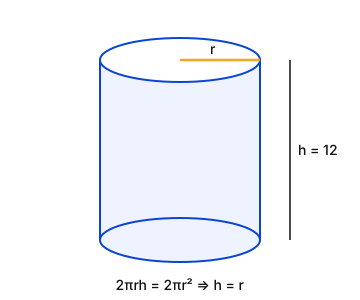
The curved surface area of a cylinder is half of its total surface area. If its height is 12 cm, then find its diameter (in cm).
एक बेलन का वक्र पृष्ठीय क्षेत्रफल उसके कुल पृष्ठीय क्षेत्रफल का आधा है। यदि इसकी ऊँचाई 12 cm है, तो इसका व्यास (cm में) ज्ञात कीजिए।
  1. A24
  2. B20
  3. C33
  4. D22
Show answer

Concept: CSA=2πrh, TSA=2πr(h+r)

  1. 2πrh=12×2πr(h+r)
  2. 2h=h+r⇒r=h=12cm
  3. Diameter =2r=24cm

Trick: CSA = half of TSA means CSA = area of the two ends, i.e. 2πrh=2πr2⇒h=r.

Answer: (A) 24

अवधारणा: वक्र पृष्ठ=2πrh, संपूर्ण पृष्ठ=2πr(h+r)

  1. 2πrh=12×2πr(h+r)
  2. 2h=h+r⇒r=h=12cm
  3. व्यास =2r=24cm

ट्रिक: वक्र पृष्ठ = संपूर्ण पृष्ठ का आधा, अर्थात् वक्र पृष्ठ = दोनों सिरों का क्षेत्रफल: 2πrh=2πr2⇒h=r।

उत्तर: (A) 24

RRB NTPC Graduate CBT 1MathematicsMensuration – CylinderRRB NTPC Graduate CBT 1 2024 · 17 Jun Shift 3 →
Q1863.
Find the simplified value of [81 ÷ {21 + 9 × (5 - 7)}].
[81 ÷ {21 + 9 × (5 - 7)}] का सरलीकृत मान ज्ञात कीजिए।
  1. A27
  2. B26
  3. C24
  4. D25
Show answer

Concept: BODMAS – solve innermost brackets first, then multiplication, then addition, then division.

  1. (5−7)=−2
  2. 9×(−2)=−18
  3. {21−18}=3
  4. 81÷3=27

Trick: Watch the sign: the small bracket is negative, so the curly bracket becomes 21−18.

Answer: (A) 27

अवधारणा: BODMAS – पहले सबसे भीतरी कोष्ठक, फिर गुणा, फिर जोड़, फिर भाग।

  1. (5−7)=−2
  2. 9×(−2)=−18
  3. {21−18}=3
  4. 81÷3=27

ट्रिक: चिह्न पर ध्यान दें: छोटा कोष्ठक ऋणात्मक है, इसलिए मँझला कोष्ठक 21−18 बनता है।

उत्तर: (A) 27

RRB NTPC Graduate CBT 1MathematicsSimplification (BODMAS)RRB NTPC Graduate CBT 1 2024 · 17 Jun Shift 3 →
Q1864.
What will come in the place of the question mark (?) in the following equation, if ‘+’ is replaced by ‘−’ and ‘×’ and ‘÷’ are interchanged?
20 ÷ 5 + 8 × 2 + 1 = ?
यदि ‘+’ को ‘−’ से प्रतिस्थापित कर दिया जाए और ‘×’ तथा ‘÷’ को आपस में बदल दिया जाए, तो निम्नलिखित समीकरण में प्रश्न चिह्न (?) के स्थान पर क्या आएगा?
20 ÷ 5 + 8 × 2 + 1 = ?
  1. A95
  2. B85
  3. C80
  4. D90
Show answer

Concept: After changing signs, solve using BODMAS.

  1. Replace: ‘+’ → ‘−’, ‘×’ ↔ ‘÷’.
  2. New expression: 20×5−8÷2−1
  3. =100−4−1=95

Trick: Rewrite the whole expression first, then apply BODMAS – never solve while changing signs.

Answer: (A) 95

अवधारणा: चिह्न बदलकर BODMAS से हल करें।

  1. ‘+’ → ‘−’ तथा ‘×’ ↔ ‘÷’ करें।
  2. नया व्यंजक: 20×5−8÷2−1
  3. =100−4−1=95

ट्रिक: पहले पूरा व्यंजक दोबारा लिखें, फिर BODMAS लगाएँ।

उत्तर: (A) 95

RRB NTPC Graduate CBT 1General Intelligence and ReasoningMathematical OperationsRRB NTPC Graduate CBT 1 2024 · 17 Jun Shift 3 →
Q1865.
This question is based on the five, three-digit numbers given below.
(Left) 411 559 916 247 769 (Right)
(Example- 697 – First digit = 6, second digit = 9 and third digit = 7)
(NOTE: All operations to be done from left to right.)
What will be the resultant if the first digit of the lowest number is subtracted from the first digit of the highest number?
यह प्रश्न नीचे दी गई तीन अंकों वाली पाँच संख्याओं पर आधारित है।
(बाएँ) 411 559 916 247 769 (दाएँ)
(उदाहरण- 697 – पहला अंक = 6, दूसरा अंक = 9 और तीसरा अंक = 7)
(नोट: सभी संक्रियाएँ बाएँ से दाएँ की जानी हैं।)
यदि सबसे बड़ी संख्या के पहले अंक में से सबसे छोटी संख्या का पहला अंक घटाया जाए, तो परिणाम क्या होगा?
  1. A10
  2. B7
  3. C8
  4. D6
Show answer

Concept: Find the highest and lowest of the given numbers, then use their first digits.

  1. Numbers: 411, 559, 916, 247, 769.
  2. Highest = 916 → first digit 9; Lowest = 247 → first digit 2.
  3. 9−2=7

Trick: Compare only the hundreds digit first – 9 (916) is highest, 2 (247) is lowest.

Answer: (B) 7

अवधारणा: दी गई संख्याओं में सबसे बड़ी और सबसे छोटी संख्या ज्ञात कर उनके पहले अंक लें।

  1. संख्याएँ: 411, 559, 916, 247, 769।
  2. सबसे बड़ी = 916 → पहला अंक 9; सबसे छोटी = 247 → पहला अंक 2।
  3. 9−2=7

ट्रिक: पहले सैकड़े का अंक देखें – 9 सबसे बड़ा, 2 सबसे छोटा।

उत्तर: (B) 7

RRB NTPC Graduate CBT 1General Intelligence and ReasoningNumber AnalysisRRB NTPC Graduate CBT 1 2024 · 17 Jun Shift 3 →
Q1866.
Which of the following letter-clusters should replace # and % so that the pattern and relationship followed between the letter-cluster pair on the left side of :: is the same as that on the right side of :: ?
# : EPV :: RFS : %
निम्नलिखित में से कौन-से अक्षर-समूह # और % को प्रतिस्थापित करें, ताकि :: के बाईं ओर के अक्षर-समूह युग्म के बीच अनुसरित पैटर्न और संबंध वही हो जो :: के दाईं ओर है?
# : EPV :: RFS : %
  1. A# = COW, % = SGQ
  2. B# = DMU, % = SGL
  3. C# = CNU, % = THV
  4. D# = DNU, % = SHT
Show answer

Concept: Find the letter shifts from # to EPV and apply the same to RFS.

  1. Try option (D): D → E (+1), N → P (+2), U → V (+1) gives EPV.
  2. Apply +1, +2, +1 to RFS: R → S, F → H, S → T = SHT.
  3. So # = DNU and % = SHT.

Trick: Check options quickly: only DNU gives EPV with a neat +1, +2, +1 pattern.

Answer: (D) # = DNU, % = SHT

अवधारणा: # से EPV तक का अक्षर-अंतर निकालें और वही RFS पर लगाएँ।

  1. विकल्प (D): D → E (+1), N → P (+2), U → V (+1) = EPV।
  2. RFS पर +1, +2, +1: R → S, F → H, S → T = SHT।
  3. अतः # = DNU, % = SHT।

ट्रिक: विकल्पों से जाँचें – केवल DNU से +1, +2, +1 का नियम बनता है।

उत्तर: (D) # = DNU, % = SHT

RRB NTPC Graduate CBT 1General Intelligence and ReasoningLetter AnalogyRRB NTPC Graduate CBT 1 2024 · 17 Jun Shift 3 →
Q1867.
In a certain code language, ‘MICE’ is coded as ‘6398’ and ‘PEAR’ is coded as ‘3215’. What is the code for ‘E’ in the given code language?
एक निश्चित कूट भाषा में, ‘MICE’ को ‘6398’ और ‘PEAR’ को ‘3215’ के रूप में कूटबद्ध किया जाता है। दी गई कूट भाषा में ‘E’ के लिए कूट क्या है?
  1. A2
  2. B5
  3. C3
  4. D8
Show answer

Concept: A letter common to both words gets the digit common to both codes.

  1. MICE → 6398 and PEAR → 3215.
  2. Common letter: E. Common digit: 3.
  3. So E = 3.

Trick: Common letter ↔ common digit (order of digits does not matter).

Answer: (C) 3

अवधारणा: दोनों शब्दों में उभयनिष्ठ अक्षर का कोड दोनों कोडों में उभयनिष्ठ अंक होता है।

  1. MICE → 6398 तथा PEAR → 3215।
  2. उभयनिष्ठ अक्षर: E; उभयनिष्ठ अंक: 3।
  3. अतः E = 3।

ट्रिक: समान अक्षर ↔ समान अंक।

उत्तर: (C) 3

RRB NTPC Graduate CBT 1General Intelligence and ReasoningCoding-DecodingRRB NTPC Graduate CBT 1 2024 · 17 Jun Shift 3 →
Q1868.
Refer to the following number and symbol series and answer the question that follows. Counting to be done from left to right only.
(NOTE: All numbers are single digit numbers only.)
(Left) 8 9 # 1 9 © 3 5 © € @ # £ @ * © 5 £ € 5 4 4 (Right)
How many such numbers are there each of which is immediately preceded by a number and also immediately followed by a symbol?
निम्नलिखित संख्या और प्रतीक श्रृंखला को देखिए और उसके बाद आने वाले प्रश्न का उत्तर दीजिए। गिनती केवल बाएँ से दाएँ की जानी है।
(नोट: सभी संख्याएँ केवल एक अंक वाली संख्याएँ हैं।)
(बाएँ) 8 9 # 1 9 © 3 5 © € @ # £ @ * © 5 £ € 5 4 4 (दाएँ)
ऐसी कितनी संख्याएँ हैं, जिनमें से प्रत्येक के ठीक पहले एक संख्या है और ठीक बाद एक प्रतीक भी है?
  1. A3
  2. B4
  3. C5
  4. D2
Show answer

Concept: Check each number: the element before it must be a number and the element after it must be a symbol.

  1. 8 9 # → 9 (preceded by 8, followed by #) ✔
  2. 1 9 © → 9 ✔; 3 5 © → 5 ✔
  3. Other numbers fail (e.g. 5 after ©, 4 followed by 4).
  4. Count = 3.

Trick: Scan for the pattern “number–number–symbol”; the middle number is counted.

Answer: (A) 3

अवधारणा: हर संख्या जाँचें: उससे ठीक पहले संख्या और ठीक बाद प्रतीक होना चाहिए।

  1. 8 9 # → 9 (पहले 8, बाद में #) ✔
  2. 1 9 © → 9 ✔; 3 5 © → 5 ✔
  3. बाकी संख्याएँ शर्त पूरी नहीं करतीं।
  4. कुल = 3।

ट्रिक: “संख्या–संख्या–प्रतीक” पैटर्न खोजें; बीच वाली संख्या गिनें।

उत्तर: (A) 3

RRB NTPC Graduate CBT 1General Intelligence and ReasoningNumber-Symbol SeriesRRB NTPC Graduate CBT 1 2024 · 17 Jun Shift 3 →
Q1869.
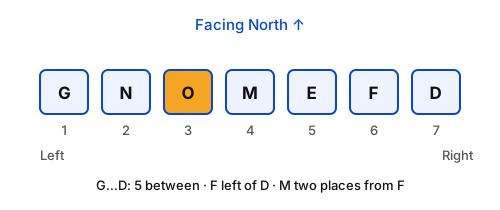
Seven friends, D, E, F, G, M, N and O, are sitting in a row facing north. Only five people sit between G and D. F sits to the immediate left of D. Only one person sits between F and M. O sits at some place to the left of E but at some place to the right of N. Who sits third from the left end of the line?
सात मित्र, D, E, F, G, M, N और O, उत्तर की ओर मुख करके एक पंक्ति में बैठे हैं। G और D के बीच केवल पाँच व्यक्ति बैठे हैं। F, D के ठीक बाईं ओर बैठा है। F और M के बीच केवल एक व्यक्ति बैठा है। O, E के बाईं ओर किसी स्थान पर, लेकिन N के दाईं ओर किसी स्थान पर बैठा है। पंक्ति के बाएँ छोर से तीसरे स्थान पर कौन बैठा है?
  1. AF
  2. BM
  3. CN
  4. DO
Show answer

Concept: Fix the people with the most definite clues first (all face north, so left = left end side).

  1. Five between G and D → they sit at the two ends. F is immediate left of D, so D = 7 (right end), F = 6, G = 1.
  2. One person between F and M → M = 4.
  3. N, O, E fill 2, 3, 5 with N left of O left of E → N = 2, O = 3, E = 5.
  4. Third from left = O.

Trick: “Only five between” in a row of 7 always means the two ends.

Answer: (D) O

अवधारणा: सबसे निश्चित सूचना से शुरू करें (सभी उत्तर की ओर मुख, अतः बायाँ = बायाँ सिरा)।

  1. G और D के बीच पाँच → दोनों सिरों पर। F, D के ठीक बाएँ है, इसलिए D = 7, F = 6, G = 1।
  2. F और M के बीच एक → M = 4।
  3. N, O, E स्थान 2, 3, 5 पर, N, O के बाएँ और O, E के बाएँ → N = 2, O = 3, E = 5।
  4. बाएँ से तीसरा = O।

ट्रिक: 7 की पंक्ति में “बीच में पाँच” = दोनों सिरे।

उत्तर: (D) O

RRB NTPC Graduate CBT 1General Intelligence and ReasoningLinear Seating ArrangementRRB NTPC Graduate CBT 1 2024 · 17 Jun Shift 3 →
Q1870.
What will come in the place of the question mark (?) in the following equation, if ‘+’ and ‘−’ are interchanged and ‘×’ and ‘÷’ are interchanged?
215 ÷ 4 + 822 × 3 − 45 = ?
यदि ‘+’ और ‘−’ को आपस में बदल दिया जाए तथा ‘×’ और ‘÷’ को आपस में बदल दिया जाए, तो निम्नलिखित समीकरण में प्रश्न चिह्न (?) के स्थान पर क्या आएगा?
215 ÷ 4 + 822 × 3 − 45 = ?
  1. A691
  2. B631
  3. C521
  4. D581
Show answer

Concept: Interchange the signs, then solve by BODMAS.

  1. ‘+’ ↔ ‘−’ and ‘×’ ↔ ‘÷’.
  2. New expression: 215×4−822÷3+45
  3. =860−274+45=631

Trick: Do division/multiplication first: 822÷3=274, 215×4=860.

Answer: (B) 631

अवधारणा: चिह्न आपस में बदलें, फिर BODMAS से हल करें।

  1. ‘+’ ↔ ‘−’ तथा ‘×’ ↔ ‘÷’।
  2. नया व्यंजक: 215×4−822÷3+45
  3. =860−274+45=631

ट्रिक: पहले भाग/गुणा: 822÷3=274, 215×4=860।

उत्तर: (B) 631

RRB NTPC Graduate CBT 1General Intelligence and ReasoningMathematical OperationsRRB NTPC Graduate CBT 1 2024 · 17 Jun Shift 3 →
Q1871.
What should come in place of the question mark (?) in the given series?
21 24 33 48 69 96 ?
दी गई श्रृंखला में प्रश्न चिह्न (?) के स्थान पर क्या आना चाहिए?
21 24 33 48 69 96 ?
  1. A116
  2. B138
  3. C141
  4. D129
Show answer

Concept: Look at the differences between consecutive terms.

  1. Differences: 3,9,15,21,27 (increase by 6).
  2. Next difference =27+6=33
  3. 96+33=129

Trick: Second difference constant (6) → next first difference is 33.

Answer: (D) 129

अवधारणा: क्रमागत पदों का अंतर देखें।

  1. अंतर: 3,9,15,21,27 (हर बार 6 बढ़ता है)।
  2. अगला अंतर =27+6=33
  3. 96+33=129

ट्रिक: द्वितीय अंतर स्थिर (6) है।

उत्तर: (D) 129

RRB NTPC Graduate CBT 1General Intelligence and ReasoningNumber SeriesRRB NTPC Graduate CBT 1 2024 · 17 Jun Shift 3 →
Q1872.
Select the triad that follows the same pattern as that followed by the two triads given below. Both triads follow the same pattern.
QT-OR-MP
XA-VY-TW
उस त्रिक का चयन कीजिए जो उसी पैटर्न का अनुसरण करता है जिसका अनुसरण नीचे दिए गए दो त्रिक करते हैं। दोनों त्रिक एक ही पैटर्न का अनुसरण करते हैं।
QT-OR-MP
XA-VY-TW
  1. AJM-HK-FJ
  2. BAD-YB-VZ
  3. CTW-RU-PS
  4. DNQ-LO-JN
Show answer

Concept: Use letter positions: in each pair the 2nd letter = 1st + 3, and each pair starts 2 letters before the previous one.

  1. QT-OR-MP: Q→T (+3), Q→O→M (−2 each).
  2. XA-VY-TW: X→A (+3, wrapping), X→V→T (−2).
  3. TW-RU-PS: T→W, R→U, P→S (+3) and T→R→P (−2) ✔
  4. JM-HK-FJ fails (F→J is +4).

Trick: Check “+3 inside, −2 across” on each option.

Answer: (C) TW-RU-PS

अवधारणा: अक्षरों की स्थिति लें: हर जोड़ी में दूसरा अक्षर = पहला + 3, और हर अगली जोड़ी 2 अक्षर पीछे से शुरू होती है।

  1. QT-OR-MP: Q→T (+3), Q→O→M (−2)।
  2. XA-VY-TW: X→A (+3), X→V→T (−2)।
  3. TW-RU-PS: T→W, R→U, P→S (+3), T→R→P (−2) ✔
  4. JM-HK-FJ गलत (F→J = +4)।

ट्रिक: “अंदर +3, आगे −2” हर विकल्प पर जाँचें।

उत्तर: (C) TW-RU-PS

RRB NTPC Graduate CBT 1General Intelligence and ReasoningLetter TriadsRRB NTPC Graduate CBT 1 2024 · 17 Jun Shift 3 →
Q1873.
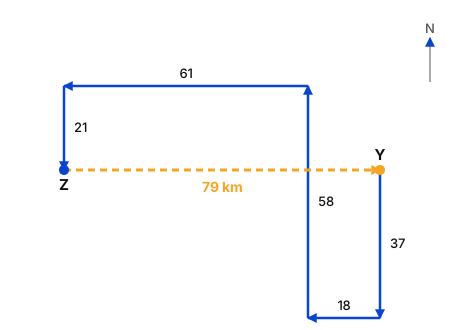
Chetan starts from Point Y and drives 37 km towards the south. He then takes a right turn, drives 18 km, turns right and drives 58 km. He then takes a left turn and drives 61 km. He takes a left turn, drives 21 km and stops at Point Z. How far (shortest distance) and towards which direction should he drive in order to reach Point Y again? (All turns are 90-degree turns only unless specified.)
चेतन बिंदु Y से चलना शुरू करता है और दक्षिण की ओर 37 km गाड़ी चलाता है। फिर वह दाएँ मुड़ता है, 18 km गाड़ी चलाता है, दाएँ मुड़ता है और 58 km गाड़ी चलाता है। फिर वह बाएँ मुड़ता है और 61 km गाड़ी चलाता है। वह बाएँ मुड़ता है, 21 km गाड़ी चलाता है और बिंदु Z पर रुक जाता है। बिंदु Y पर फिर से पहुँचने के लिए उसे कितनी दूरी (न्यूनतम दूरी) और किस दिशा में गाड़ी चलानी चाहिए? (जब तक निर्दिष्ट न हो, सभी मोड़ केवल 90 डिग्री के हैं।)
  1. A39 km towards the southदक्षिण की ओर 39 km
  2. B64 km towards the westपश्चिम की ओर 64 km
  3. C43 km towards the westपश्चिम की ओर 43 km
  4. D79 km towards the eastपूर्व की ओर 79 km
Show answer

Concept: Track the net east–west and north–south displacement.

  1. South 37, right (west) 18, right (north) 58, left (west) 61, left (south) 21.
  2. North–south: −37+58−21=0 → Z is level with Y.
  3. East–west: 18+61=79 km west of Y.
  4. So he must drive 79 km towards the east.

Trick: When the vertical moves cancel, the answer is just the sum of the horizontal moves.

Answer: (D) 79 km towards the east

अवधारणा: कुल पूर्व–पश्चिम और उत्तर–दक्षिण विस्थापन निकालें।

  1. दक्षिण 37, दाएँ (पश्चिम) 18, दाएँ (उत्तर) 58, बाएँ (पश्चिम) 61, बाएँ (दक्षिण) 21।
  2. उत्तर–दक्षिण: −37+58−21=0 → Z, Y की सीध में है।
  3. पूर्व–पश्चिम: 18+61=79 km पश्चिम।
  4. अतः 79 km पूर्व की ओर जाना होगा।

ट्रिक: ऊर्ध्व गतियाँ कट जाएँ तो क्षैतिज दूरियाँ जोड़ दें।

उत्तर: (D) 79 km पूर्व की ओर

RRB NTPC Graduate CBT 1General Intelligence and ReasoningDirection & DistanceRRB NTPC Graduate CBT 1 2024 · 17 Jun Shift 3 →
Q1874.
Based on the English alphabetical order, three of the following four letter-clusters are alike in a certain way and thus form a group. Which letter-cluster DOES NOT belong to that group?
(Note: The odd one out is not based on the number of consonants/vowels or their position in the letter-cluster.)
अंग्रेज़ी वर्णमाला क्रम के आधार पर, निम्नलिखित चार अक्षर-समूहों में से तीन किसी निश्चित प्रकार से एकसमान हैं और इस प्रकार एक समूह बनाते हैं। कौन-सा अक्षर-समूह उस समूह से संबंधित नहीं है?
(नोट: असंगत अक्षर-समूह, व्यंजनों/स्वरों की संख्या या अक्षर-समूह में उनके स्थान पर आधारित नहीं है।)
  1. AKNI
  2. BMPK
  3. CQTP
  4. DORM
Show answer

Concept: Write letter positions and find the gaps.

  1. KNI: 11 → 14 → 9 (+3, −5)
  2. MPK: 13 → 16 → 11 (+3, −5); ORM: 15 → 18 → 13 (+3, −5)
  3. QTP: 17 → 20 → 16 (+3, −4) ✘

Trick: Here the 3rd letter = 1st letter − 2 (K→I, M→K, O→M); QTP breaks it.

Answer: (C) QTP

अवधारणा: अक्षरों के स्थान लिखकर अंतर देखें।

  1. KNI: 11 → 14 → 9 (+3, −5)
  2. MPK: 13 → 16 → 11; ORM: 15 → 18 → 13 (+3, −5)
  3. QTP: 17 → 20 → 16 (+3, −4) ✘

ट्रिक: तीसरा अक्षर = पहला − 2 (K→I, M→K, O→M); QTP में नहीं।

उत्तर: (C) QTP

RRB NTPC Graduate CBT 1General Intelligence and ReasoningOdd One Out – LettersRRB NTPC Graduate CBT 1 2024 · 17 Jun Shift 3 →
Q1875.
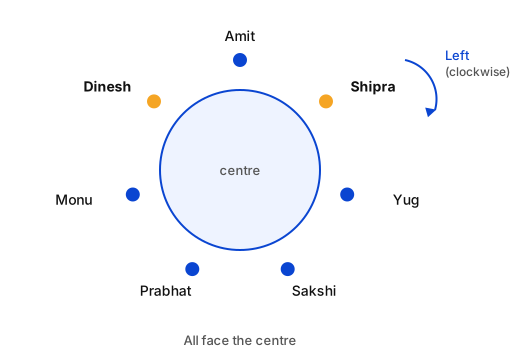
Prabhat, Dinesh, Yug, Monu, Sakshi, Amit and Shipra are sitting around a circular table, facing the centre. Yug sits second to the left of Amit. Prabhat sits third to the right of Amit. Monu sits to the immediate right of Dinesh. Shipra is not an immediate neighbour of Prabhat. Who sits second to the left of Dinesh?
प्रभात, दिनेश, युग, मोनू, साक्षी, अमित और शिप्रा एक वृत्ताकार मेज़ के चारों ओर केंद्र की ओर मुख करके बैठे हैं। युग, अमित के बाईं ओर दूसरे स्थान पर बैठा है। प्रभात, अमित के दाईं ओर तीसरे स्थान पर बैठा है। मोनू, दिनेश के ठीक दाईं ओर बैठा है। शिप्रा, प्रभात की निकटतम पड़ोसी नहीं है। दिनेश के बाईं ओर दूसरे स्थान पर कौन बैठा है?
  1. AShipraशिप्रा
  2. BSakshiसाक्षी
  3. CPrabhatप्रभात
  4. DYugयुग
Show answer

Concept: Facing the centre, “left” means clockwise and “right” means anticlockwise.

  1. Place Amit; Yug is 2nd clockwise from Amit, Prabhat is 3rd anticlockwise.
  2. Monu immediately right of Dinesh: the only free adjacent pair gives Dinesh and Monu the two seats after Prabhat (Monu next to Prabhat).
  3. Shipra is not next to Prabhat → Shipra sits between Amit and Yug; Sakshi between Yug and Prabhat.
  4. 2nd to the left of Dinesh = Shipra.

Trick: Draw the circle and mark the left (clockwise) arrow before placing anyone.

Answer: (A) Shipra

अवधारणा: केंद्र की ओर मुख होने पर “बाएँ” = घड़ी की दिशा, “दाएँ” = घड़ी की विपरीत दिशा।

  1. अमित को रखें; युग अमित से घड़ी की दिशा में दूसरे, प्रभात विपरीत दिशा में तीसरे स्थान पर।
  2. मोनू, दिनेश के ठीक दाएँ: केवल एक खाली सटा जोड़ा बचता है – मोनू प्रभात के बगल में, फिर दिनेश।
  3. शिप्रा प्रभात की पड़ोसी नहीं → शिप्रा अमित और युग के बीच; साक्षी युग और प्रभात के बीच।
  4. दिनेश के बाएँ दूसरा = शिप्रा।

ट्रिक: पहले वृत्त बनाकर “बाएँ” की दिशा का तीर लगाएँ।

उत्तर: (A) शिप्रा

RRB NTPC Graduate CBT 1General Intelligence and ReasoningCircular Seating ArrangementRRB NTPC Graduate CBT 1 2024 · 17 Jun Shift 3 →
Q1876.
If ‘+’ means ‘subtraction’, ‘−’ means ‘multiplication’, ‘×’ means ‘division’ and ‘÷’ means ‘addition’, then what will come in place of the question mark (?) in the following equation?
109 ÷ 76 × 4 − 5 + 18 = ?
यदि ‘+’ का अर्थ ‘घटाना’, ‘−’ का अर्थ ‘गुणा करना’, ‘×’ का अर्थ ‘भाग देना’ और ‘÷’ का अर्थ ‘जोड़ना’ है, तो निम्नलिखित समीकरण में प्रश्न चिह्न (?) के स्थान पर क्या आएगा?
109 ÷ 76 × 4 − 5 + 18 = ?
  1. A189
  2. B186
  3. C201
  4. D191
Show answer

Concept: Replace each symbol by its meaning, then use BODMAS.

  1. ÷ → +, × → ÷, − → ×, + → −
  2. 109+76÷4×5−18
  3. =109+19×5−18=109+95−18=186

Trick: Write the decoded expression on one line before calculating.

Answer: (B) 186

अवधारणा: हर चिह्न को उसके अर्थ से बदलें, फिर BODMAS लगाएँ।

  1. ÷ → +, × → ÷, − → ×, + → −
  2. 109+76÷4×5−18
  3. =109+95−18=186

ट्रिक: गणना से पहले नया व्यंजक एक पंक्ति में लिख लें।

उत्तर: (B) 186

RRB NTPC Graduate CBT 1General Intelligence and ReasoningMathematical OperationsRRB NTPC Graduate CBT 1 2024 · 17 Jun Shift 3 →
Q1877.
What should come in place of the question mark (?) in the given series based on the English alphabetical order?
QJL OHJ MFH KDF ?
अंग्रेज़ी वर्णमाला क्रम के आधार पर दी गई श्रृंखला में प्रश्न चिह्न (?) के स्थान पर क्या आना चाहिए?
QJL OHJ MFH KDF ?
  1. AIBD
  2. BIAD
  3. CIBE
  4. DIAE
Show answer

Concept: Track each letter position separately.

  1. 1st letters: Q, O, M, K → I (−2)
  2. 2nd letters: J, H, F, D → B (−2)
  3. 3rd letters: L, J, H, F → D (−2)
  4. Next term = IBD

Trick: All three positions move back by 2 every step.

Answer: (A) IBD

अवधारणा: हर स्थान के अक्षर को अलग-अलग देखें।

  1. पहले अक्षर: Q, O, M, K → I (−2)
  2. दूसरे अक्षर: J, H, F, D → B (−2)
  3. तीसरे अक्षर: L, J, H, F → D (−2)
  4. अगला पद = IBD

ट्रिक: तीनों अक्षर हर बार 2 पीछे जाते हैं।

उत्तर: (A) IBD

RRB NTPC Graduate CBT 1General Intelligence and ReasoningAlphabet SeriesRRB NTPC Graduate CBT 1 2024 · 17 Jun Shift 3 →
Q1878.
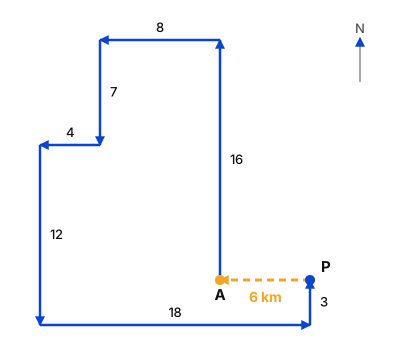
Mr. Chotu starts from Point A and drives 16 km towards the North. He then takes a left turn, drives 8 km, turns left and drives 7 km. He then takes a right turn, drives 4 km, turns left and drives 12 km. He then takes a left turn and drives 18 km. He takes a final left turn, drives 3 km and stops at Point P. How far (shortest distance) and towards which direction should he drive in order to reach Point A again? (All turns are 90 degrees turns only unless specified).
श्री छोटू बिंदु A से चलना शुरू करते हैं और उत्तर की ओर 16 km गाड़ी चलाते हैं। फिर वे बाएँ मुड़ते हैं, 8 km गाड़ी चलाते हैं, बाएँ मुड़ते हैं और 7 km गाड़ी चलाते हैं। फिर वे दाएँ मुड़ते हैं, 4 km गाड़ी चलाते हैं, बाएँ मुड़ते हैं और 12 km गाड़ी चलाते हैं। फिर वे बाएँ मुड़ते हैं और 18 km गाड़ी चलाते हैं। वे अंतिम बार बाएँ मुड़ते हैं, 3 km गाड़ी चलाते हैं और बिंदु P पर रुक जाते हैं। बिंदु A पर फिर से पहुँचने के लिए उन्हें कितनी दूरी (न्यूनतम दूरी) और किस दिशा में गाड़ी चलानी चाहिए? (जब तक निर्दिष्ट न हो, सभी मोड़ केवल 90 डिग्री के हैं।)
  1. A4 km to the Eastपूर्व की ओर 4 km
  2. B6 km to the Westपश्चिम की ओर 6 km
  3. C9 km to the Southदक्षिण की ओर 9 km
  4. D1 km to the Northउत्तर की ओर 1 km
Show answer

Concept: Find net north–south and east–west displacement from A.

  1. Moves: N 16, W 8, S 7, W 4, S 12, E 18, N 3.
  2. North–south: 16−7−12+3=0
  3. East–west: −8−4+18=+6 → P is 6 km east of A.
  4. So he must drive 6 km to the west.

Trick: Vertical moves cancel → answer is the net horizontal shift.

Answer: (B) 6 km to the West

अवधारणा: A से कुल उत्तर–दक्षिण और पूर्व–पश्चिम विस्थापन निकालें।

  1. गतियाँ: उ 16, प 8, द 7, प 4, द 12, पू 18, उ 3।
  2. उत्तर–दक्षिण: 16−7−12+3=0
  3. पूर्व–पश्चिम: −8−4+18=+6 → P, A से 6 km पूर्व।
  4. अतः 6 km पश्चिम की ओर जाना होगा।

ट्रिक: ऊर्ध्व गतियाँ कट जाएँ तो केवल क्षैतिज अंतर देखें।

उत्तर: (B) 6 km पश्चिम की ओर

RRB NTPC Graduate CBT 1General Intelligence and ReasoningDirection & DistanceRRB NTPC Graduate CBT 1 2024 · 17 Jun Shift 3 →
Q1879.
Rajat ranked 16thfrom the top and 55th from the bottom in his class. How many students are there in his class?
रजत की अपनी कक्षा में रैंक ऊपर से 16वीं और नीचे से 55वीं है। उसकी कक्षा में कितने विद्यार्थी हैं?
  1. A70
  2. B71
  3. C72
  4. D69
Show answer

Concept: Total =rank from top+rank from bottom−1.

  1. 16+55−1=70
  2. Rajat is counted in both ranks, so subtract 1 once.

Trick: Add the two ranks and subtract 1.

Answer: (A) 70

अवधारणा: कुल =ऊपर से रैंक+नीचे से रैंक−1।

  1. 16+55−1=70
  2. रजत दोनों रैंकों में गिना गया, इसलिए 1 घटाएँ।

ट्रिक: दोनों रैंक जोड़ें और 1 घटाएँ।

उत्तर: (A) 70

RRB NTPC Graduate CBT 1General Intelligence and ReasoningRankingRRB NTPC Graduate CBT 1 2024 · 17 Jun Shift 3 →
Q1880.
Select the set in which the numbers are related in the same way as are the numbers of the following sets.
(NOTE: Operations should be performed on the whole numbers, without breaking down the numbers into their constituent digits. E.g. 13 – Operations on 13 such as
adding/subtracting/multiplying to 13 can be performed. Breaking down 13 into 1 and 3 and then performing mathematical operations on 1 and 3 is not allowed.)
(2, 20, 4)
(5, 61, 6)
उस समुच्चय का चयन कीजिए जिसमें संख्याएँ उसी प्रकार संबंधित हैं जिस प्रकार निम्नलिखित समुच्चयों की संख्याएँ संबंधित हैं।
(नोट: संक्रियाएँ संख्याओं को उनके घटक अंकों में तोड़े बिना, पूर्ण संख्याओं पर की जानी चाहिए। उदाहरण के लिए 13 – 13 पर संक्रियाएँ, जैसे 13 में
जोड़ना/घटाना/गुणा करना आदि की जा सकती हैं। 13 को 1 और 3 में तोड़ना और फिर 1 और 3 पर गणितीय संक्रियाएँ करना वर्जित है।)
(2, 20, 4)
(5, 61, 6)
  1. A(7, 45, 2)
  2. B(4, 40, 6)
  3. C(1, 8, 3)
  4. D(3, 25, 4)
Show answer

Concept: Find the rule linking the middle number to the outer two.

  1. (2,20,4): 22+42=4+16=20
  2. (5,61,6): 52+62=25+36=61
  3. (3,25,4): 32+42=9+16=25 ✔
  4. Others: 72+22=53, 42+62=52, 12+32=10 ✘

Trick: Middle = sum of squares of the end numbers.

Answer: (D) (3,25,4)

अवधारणा: बीच की संख्या और बाहरी दो संख्याओं का संबंध खोजें।

  1. (2,20,4): 22+42=20
  2. (5,61,6): 52+62=61
  3. (3,25,4): 32+42=25 ✔
  4. अन्य: 53, 52, 10 – मेल नहीं खाते।

ट्रिक: बीच की संख्या = दोनों सिरों के वर्गों का योग।

उत्तर: (D) (3,25,4)

RRB NTPC Graduate CBT 1General Intelligence and ReasoningNumber Set AnalogyRRB NTPC Graduate CBT 1 2024 · 17 Jun Shift 3 →