Question bank

Q&A: practice questions with answers

Search questions on any topic. Filter by exam category, exam, subject and topic, try the question, then open the answer and explanation.

Courses – airGurukul

120 questions found.

Q41.
Who built the Marble Palace in Kolkata, a grand mansion noted for its Renaissance art collection and neoclassical architecture?
कोलकाता में मार्बल पैलेस का निर्माण किसने कराया था, जो अपने पुनर्जागरण (Renaissance) कला संग्रह और नवशास्त्रीय वास्तुकला के लिए प्रसिद्ध एक भव्य हवेली है?
  1. ADadabhai Naorojiदादाभाई नौरोजी
  2. BBankim Chandra Chatterjeeबंकिम चंद्र चटर्जी
  3. CKeshab Chandra Senकेशब चंद्र सेन
  4. DRaja Rajendra Mullickराजा राजेंद्र मल्लिक
Show answer

Concept: Marble Palace is a 19th-century mansion in north Kolkata (Muktaram Babu Street).

  1. It was built in 1835 by Raja Rajendra Mullick, a wealthy Bengali merchant and art collector; it houses paintings by Rubens and Reynolds, marble statues and a small zoo.
  2. The other three were social reformers/writers, not builders of this mansion.

Yaad rakhein: Marble Palace (1835) – Rajendra Mullick; his descendants still live there.

Answer: (D) Raja Rajendra Mullick

अवधारणा: मार्बल पैलेस उत्तरी कोलकाता (मुक्ताराम बाबू स्ट्रीट) की 19वीं सदी की हवेली है।

  1. इसे 1835 में धनी बंगाली व्यापारी व कला-संग्राहक राजा राजेंद्र मल्लिक ने बनवाया; इसमें रूबेंस और रेनॉल्ड्स की पेंटिंग, संगमरमर की मूर्तियाँ और एक छोटा चिड़ियाघर है।
  2. अन्य तीनों समाज-सुधारक/लेखक थे, इस हवेली के निर्माता नहीं।

याद रखें: मार्बल पैलेस (1835) – राजेंद्र मल्लिक; उनके वंशज आज भी वहाँ रहते हैं।

उत्तर: (D) Raja Rajendra Mullick
RRB NTPC Graduate CBT 2General AwarenessArt and Culture – MonumentsRRB NTPC Graduate CBT 2 2025 · 10 Jul Shift 1 →
Q42.
At the Coal India Inter-Company Powerlifting, Weightlifting, and Bodybuilding Championship 2025-26 held in Nagpur in October 2025, which team won the overall championship title?
अक्टूबर 2025 में नागपुर में आयोजित कोल इंडिया अंतर-कंपनी पावरलिफ्टिंग, वेटलिफ्टिंग और बॉडीबिल्डिंग चैंपियनशिप 2025-26 में किस टीम ने समग्र चैंपियनशिप खिताब जीता?
  1. ASCCL
  2. BSECL
  3. CWCL
  4. DMCL
Show answer

Concept: Coal India's inter-company sports meets are hosted by its subsidiaries in rotation.

  1. The 2025-26 Powerlifting, Weightlifting and Bodybuilding Championship was hosted by Western Coalfields Limited at Nagpur in October 2025, and the host WCL team won the overall championship.
  2. SECL, MCL and SCCL (Singareni) fielded teams but did not take the overall title.

Yaad rakhein: WCL is headquartered in Nagpur – host and overall champion 2025-26.

Answer: (C) WCL

अवधारणा: कोल इंडिया की अंतर-कंपनी खेल प्रतियोगिताएँ उसकी सहायक कंपनियाँ बारी-बारी से आयोजित करती हैं।

  1. 2025-26 की पावरलिफ्टिंग, वेटलिफ्टिंग और बॉडीबिल्डिंग चैंपियनशिप अक्टूबर 2025 में वेस्टर्न कोलफील्ड्स लिमिटेड ने नागपुर में आयोजित की और मेज़बान WCL टीम ने समग्र चैंपियनशिप जीती।
  2. SECL, MCL और SCCL (सिंगरेनी) की टीमें शामिल थीं पर समग्र खिताब नहीं जीत सकीं।

याद रखें: WCL का मुख्यालय नागपुर में है – 2025-26 की मेज़बान और समग्र विजेता।

उत्तर: (C) WCL

RRB NTPC Graduate CBT 2General AwarenessCurrent Affairs – Sports (PSU)RRB NTPC Graduate CBT 2 2025 · 10 Jul Shift 1 →
Q43.
Which committee recommended the shift from administered interest rates to market- determined rates in India?
किस समिति ने भारत में प्रशासित ब्याज दरों से बाज़ार-निर्धारित दरों की ओर संक्रमण की सिफ़ारिश की थी?
  1. ANarasimham Committee I (1991)नरसिम्हम समिति I (1991)
  2. BKelkar Committee (2002)केलकर समिति (2002)
  3. CRangarajan Committee (1997)रंगराजन समिति (1997)
  4. DChelliah Committee (1991)चेलैया समिति (1991)
Show answer

Concept: Post-1991 financial sector reforms were based on the Narasimham Committee reports.

  1. Narasimham Committee I (1991) recommended deregulating interest rates (moving from administered to market-determined rates), lowering SLR/CRR and phasing out directed credit.
  2. Chelliah (1991) dealt with tax reforms, Kelkar (2002) with direct/indirect taxes, and Rangarajan (1997) with disinvestment/balance of payments matters.

Yaad rakhein: Banking reforms → Narasimham (I: 1991, II: 1998); tax reforms → Chelliah, Kelkar.

Answer: (A) Narasimham Committee I (1991)

अवधारणा: 1991 के बाद के वित्तीय क्षेत्र सुधार नरसिम्हम समिति की रिपोर्टों पर आधारित थे।

  1. नरसिम्हम समिति I (1991) ने ब्याज दरों को नियंत्रण-मुक्त करने (प्रशासित से बाज़ार-निर्धारित दरों की ओर), SLR/CRR घटाने और निर्देशित ऋण को चरणबद्ध समाप्त करने की सिफ़ारिश की।
  2. चेल्लैया (1991) कर सुधार, केलकर (2002) प्रत्यक्ष/अप्रत्यक्ष कर, और रंगराजन (1997) विनिवेश/भुगतान संतुलन से संबंधित थीं।

याद रखें: बैंकिंग सुधार → नरसिम्हम (I: 1991, II: 1998); कर सुधार → चेल्लैया, केलकर।

उत्तर: (A) Narasimham Committee I (1991)

RRB NTPC Graduate CBT 2General AwarenessEconomy – CommitteesRRB NTPC Graduate CBT 2 2025 · 10 Jul Shift 1 →
Q44.
An object is placed 10 cm in front of a lens, and the image is formed at 30 cm on the same side as the object. What is the magnification produced by the lens?
एक वस्तु को एक लेंस के सामने 10 cm की दूरी पर रखा जाता है और प्रतिबिंब वस्तु की ओर ही 30 cm पर बनता है। लेंस द्वारा उत्पन्न आवर्धन (magnification) कितना है?
  1. A-0.3
  2. B-3
  3. C0.3
  4. D3
Show answer

Concept: Magnification m=vu with the Cartesian sign convention (distances against the incident light are negative).

  1. Object in front: u=−10 cm. Image on the same side (virtual): v=−30 cm.
  2. m=vu=−30−10=+3.
  3. Positive m ⇒ erect, magnified virtual image (a convex lens used as a magnifying glass).

Trick: Image on the same side as the object ⇒ virtual and erect ⇒ m is positive; magnitude =3010=3.

Answer: (D) 3

अवधारणा: आवर्धन m=vu, कार्तीय चिह्न परिपाटी से (आपतित प्रकाश के विपरीत दूरी ऋणात्मक)।

  1. वस्तु सामने: u=−10 cm। प्रतिबिंब उसी ओर (आभासी): v=−30 cm।
  2. m=vu=−30−10=+3।
  3. धनात्मक m ⇒ सीधा, आवर्धित आभासी प्रतिबिंब (उत्तल लेंस आवर्धक काँच की तरह)।

ट्रिक: प्रतिबिंब वस्तु की ओर ही ⇒ आभासी और सीधा ⇒ m धनात्मक; परिमाण =3010=3।

उत्तर: (D) 3

RRB NTPC Graduate CBT 2General AwarenessPhysics – LensesRRB NTPC Graduate CBT 2 2025 · 10 Jul Shift 1 →
Q45.
Which of the following Boards will be established under the Sustainable Harnessing and Advancement of Nuclear Energy for Transforming India Act, 2025?
Sustainable Harnessing and Advancement of Nuclear Energy for Transforming India Act, 2025 के अंतर्गत निम्नलिखित में से किस बोर्ड की स्थापना की जाएगी?
  1. ANuclear Power Development Boardपरमाणु ऊर्जा विकास बोर्ड (Nuclear Power Development Board)
  2. BCentral Radiation Monitoring Boardकेंद्रीय विकिरण निगरानी बोर्ड (Central Radiation Monitoring Board)
  3. CNational Nuclear Safety Boardराष्ट्रीय परमाणु सुरक्षा बोर्ड (National Nuclear Safety Board)
  4. DAtomic Energy Regulatory Boardपरमाणु ऊर्जा नियामक बोर्ड (Atomic Energy Regulatory Board)
Show answer

Concept: The SHANTI Act, 2025 (Sustainable Harnessing and Advancement of Nuclear Energy for Transforming India) replaces the Atomic Energy Act, 1962 and opens the sector to private participation.

  1. It gives a statutory basis to the Atomic Energy Regulatory Board (AERB) as the independent nuclear safety regulator, in place of its earlier executive-order status.
  2. The other three names are not bodies created by this Act.

Yaad rakhein: SHANTI Act 2025 – private players in nuclear power + statutory AERB; target 100 GW nuclear by 2047.

Answer: (D) Atomic Energy Regulatory Board

अवधारणा: SHANTI अधिनियम, 2025 (Sustainable Harnessing and Advancement of Nuclear Energy for Transforming India) परमाणु ऊर्जा अधिनियम, 1962 की जगह लेता है और क्षेत्र को निजी भागीदारी के लिए खोलता है।

  1. यह परमाणु ऊर्जा नियामक बोर्ड (AERB) को स्वतंत्र परमाणु सुरक्षा नियामक के रूप में वैधानिक आधार देता है, जो पहले केवल कार्यकारी आदेश से बना था।
  2. अन्य तीन नाम इस अधिनियम से बनी संस्थाएँ नहीं हैं।

याद रखें: SHANTI अधिनियम 2025 – परमाणु ऊर्जा में निजी भागीदारी + वैधानिक AERB; लक्ष्य 2047 तक 100 GW।

उत्तर: (D) Atomic Energy Regulatory Board

RRB NTPC Graduate CBT 2General AwarenessCurrent Affairs – LegislationRRB NTPC Graduate CBT 2 2025 · 10 Jul Shift 1 →
Q46.
A box initially at rest is pushed with a force of 30 N to the right while friction applies a force of 30 N to the left. What happens to the motion of the box?
प्रारंभ में विराम अवस्था में रखे एक बक्से को 30 N के बल से दाईं ओर धकेला जाता है, जबकि घर्षण 30 N का बल बाईं ओर लगाता है। बक्से की गति का क्या होगा?
  1. AThe box remains at rest.बक्सा विराम अवस्था में ही रहता है।
  2. BThe box accelerates to the right.बक्सा दाईं ओर त्वरित होता है।
  3. CThe box slows down and stops.बक्सा धीमा होकर रुक जाता है।
  4. DThe box moves in the opposite direction.बक्सा विपरीत दिशा में गति करता है।
Show answer

Concept: Net force = mass × acceleration (Newton's 2nd law); zero net force ⇒ no change in motion (1st law).

  1. Push 30 N right and friction 30 N left ⇒ net force =0 ⇒ acceleration =0.
  2. The box was initially at rest, so it stays at rest (static friction balances the push).

Yaad rakhein: Balanced forces keep the state unchanged – rest stays rest, uniform motion stays uniform.

Answer: (A) The box remains at rest.

अवधारणा: शुद्ध बल = द्रव्यमान × त्वरण (न्यूटन का दूसरा नियम); शुद्ध बल शून्य ⇒ गति में कोई परिवर्तन नहीं (पहला नियम)।

  1. दाईं ओर 30 N धक्का और बाईं ओर 30 N घर्षण ⇒ शुद्ध बल =0 ⇒ त्वरण =0।
  2. बॉक्स प्रारंभ में विराम में था, अतः विराम में ही रहेगा (स्थैतिक घर्षण धक्के को संतुलित करता है)।

याद रखें: संतुलित बल अवस्था नहीं बदलते – विराम विराम रहता है, एकसमान गति एकसमान।

उत्तर: (A) The box remains at rest.

RRB NTPC Graduate CBT 2General AwarenessPhysics – Newton's LawsRRB NTPC Graduate CBT 2 2025 · 10 Jul Shift 1 →
Q47.
Which of the following conservation sites in India is famous for the successful conservation of the one-horned rhinoceros?
भारत का निम्नलिखित में से कौन-सा संरक्षण स्थल एक सींग वाले गैंडे के सफल संरक्षण के लिए प्रसिद्ध है?
  1. AGir National Parkगिर राष्ट्रीय उद्यान
  2. BSilent Valley National Parkसाइलेंट वैली राष्ट्रीय उद्यान
  3. CPeriyar Wildlife Sanctuaryपेरियार वन्यजीव अभयारण्य
  4. DKaziranga National Parkकाज़ीरंगा राष्ट्रीय उद्यान
Show answer

Concept: Match protected areas with their flagship species.

  1. Kaziranga National Park (Assam, UNESCO World Heritage Site) holds about two-thirds of the world's greater one-horned rhinoceros – a conservation success story.
  2. Gir – Asiatic lion; Periyar – elephants/tigers; Silent Valley – lion-tailed macaque and rainforest.

Yaad rakhein: Rhino → Kaziranga (also Pobitora, Manas, Orang in Assam; Dudhwa in UP).

Answer: (D) Kaziranga National Park

अवधारणा: संरक्षित क्षेत्रों का उनकी प्रमुख प्रजाति से मिलान।

  1. काज़ीरंगा राष्ट्रीय उद्यान (असम, UNESCO विश्व धरोहर) में विश्व के लगभग दो-तिहाई एक-सींग वाले गैंडे हैं – संरक्षण की सफलता की कहानी।
  2. गिर – एशियाई सिंह; पेरियार – हाथी/बाघ; साइलेंट वैली – सिंह-पूँछ मकाक और वर्षावन।

याद रखें: गैंडा → काज़ीरंगा (असम में पोबितोरा, मानस, ओरंग भी; UP में दुधवा)।

उत्तर: (D) Kaziranga National Park

RRB NTPC Graduate CBT 2General AwarenessEnvironment – National ParksRRB NTPC Graduate CBT 2 2025 · 10 Jul Shift 1 →
Q48.
How can you vertically center the text inside selected cells of a table in MS Word 2021?
MS Word 2021 में किसी तालिका (table) की चयनित सेलों के अंदर टेक्स्ट को ऊर्ध्वाधर रूप से केंद्र में (vertically center) कैसे संरेखित किया जा सकता है?
  1. AHome tab > Paragraph group > Align Left
  2. BHome tab > Paragraph group > Align Right
  3. CRight‑click selection > Table Properties > Cell tab > Vertical alignment: Centerचयन पर Right‑click > Table Properties > Cell tab > Vertical alignment: Center
  4. DHome tab > Paragraph group > Justify
Show answer

Concept: Paragraph alignment (left/right/centre/justify) works horizontally; vertical placement inside a table cell is a cell property.

  1. Select the cells → right-click → Table Properties → Cell tab → Vertical alignment: Center (or use Layout tab → Alignment group → Align Center).
  2. Align Left/Right/Justify only move text sideways, not up or down.

Yaad rakhein: Home tab = horizontal alignment; Table Properties/Layout tab = vertical alignment in cells.

Answer: (C) Right-click selection > Table Properties > Cell tab > Vertical alignment: Center

अवधारणा: पैराग्राफ अलाइनमेंट (left/right/centre/justify) क्षैतिज होता है; टेबल सेल में ऊर्ध्वाधर स्थिति सेल की प्रॉपर्टी है।

  1. सेल चुनें → राइट-क्लिक → Table Properties → Cell टैब → Vertical alignment: Center (या Layout टैब → Alignment समूह → Align Center)।
  2. Align Left/Right/Justify टेक्स्ट को केवल अगल-बगल खिसकाते हैं, ऊपर-नीचे नहीं।

याद रखें: Home टैब = क्षैतिज अलाइनमेंट; Table Properties/Layout टैब = सेल में ऊर्ध्वाधर अलाइनमेंट।

उत्तर: (C) Right-click selection > Table Properties > Cell tab > Vertical alignment: Center

RRB NTPC Graduate CBT 2General AwarenessComputer Awareness – MS WordRRB NTPC Graduate CBT 2 2025 · 10 Jul Shift 1 →
Q49.
The Extremist approach differed from the Moderate approach mainly because Extremists ____.
उग्रवादी (Extremist) दृष्टिकोण उदारवादी (Moderate) दृष्टिकोण से मुख्यतः इसलिए भिन्न था क्योंकि उग्रवादी ____।
  1. AOpposed the use of national economic policies for public welfareजन-कल्याण के लिए राष्ट्रीय आर्थिक नीतियों के उपयोग का विरोध करते थे
  2. BEmphasised mass participation and direct political agitationजन-भागीदारी और प्रत्यक्ष राजनीतिक आंदोलन पर बल देते थे
  3. CAdvocated exclusive constitutional negotiations with the governmentसरकार के साथ केवल संवैधानिक वार्ताओं की वकालत करते थे
  4. DPromoted administrative reforms as the sole path to Swarajप्रशासनिक सुधारों को स्वराज का एकमात्र मार्ग मानकर बढ़ावा देते थे
Show answer

Concept: The Congress split at Surat (1907) over methods of struggle.

  1. Moderates (Gokhale, Naoroji) believed in petitions, prayers and constitutional means; Extremists (Tilak, Lajpat Rai, Bipin Chandra Pal) demanded Swaraj through mass participation, swadeshi, boycott and direct political agitation.
  2. Options A, C and D describe moderate or irrelevant positions.

Yaad rakhein: Lal-Bal-Pal = Extremists = “Swaraj is my birthright” + boycott & mass agitation.

Answer: (B) Emphasised mass participation and direct political agitation

अवधारणा: संघर्ष के तरीकों पर मतभेद से कांग्रेस का सूरत (1907) में विभाजन हुआ।

  1. नरमपंथी (गोखले, नौरोजी) याचिका, प्रार्थना और संवैधानिक तरीकों में विश्वास रखते थे; गरमपंथी (तिलक, लाजपत राय, बिपिन चंद्र पाल) जन-भागीदारी, स्वदेशी, बहिष्कार और प्रत्यक्ष राजनीतिक आंदोलन से स्वराज चाहते थे।
  2. विकल्प A, C और D नरमपंथी या असंगत स्थितियाँ बताते हैं।

याद रखें: लाल-बाल-पाल = गरमपंथी = “स्वराज मेरा जन्मसिद्ध अधिकार” + बहिष्कार और जन-आंदोलन।

उत्तर: (B) Emphasised mass participation and direct political agitation

RRB NTPC Graduate CBT 2General AwarenessModern History – Moderates and ExtremistsRRB NTPC Graduate CBT 2 2025 · 10 Jul Shift 1 →
Q50.
The Industrial Policy Resolution (1956), adopted during the Second Five Year Plan, aimed at which of the following?
द्वितीय पंचवर्षीय योजना के दौरान अपनाए गए औद्योगिक नीति संकल्प (1956) का उद्देश्य निम्नलिखित में से क्या था?
  1. AEstablishing a socialist pattern of societyसमाज के समाजवादी ढाँचे की स्थापना करना
  2. BReducing public sector involvementसार्वजनिक क्षेत्र की भागीदारी कम करना
  3. CPromoting only consumer goods industriesकेवल उपभोक्ता वस्तु उद्योगों को बढ़ावा देना
  4. DPrivatization of heavy industriesभारी उद्योगों का निजीकरण
Show answer

Concept: The Industrial Policy Resolution of 30 April 1956 is called the “economic constitution of India”.

  1. Its declared objective was to accelerate growth and establish a socialist pattern of society (adopted by the Avadi session of Congress, 1955), giving the public sector the commanding heights of heavy industry.
  2. It classified industries into Schedules A, B and C – the opposite of reducing the public sector or privatising heavy industry.

Yaad rakhein: IPR 1948 – mixed economy; IPR 1956 – socialist pattern, Mahalanobis heavy-industry model (2nd Plan).

Answer: (A) Establishing a socialist pattern of society

अवधारणा: 30 अप्रैल 1956 का औद्योगिक नीति प्रस्ताव “भारत का आर्थिक संविधान” कहलाता है।

  1. इसका घोषित उद्देश्य विकास तेज़ करना और समाजवादी ढाँचे का समाज (कांग्रेस के अवाडी अधिवेशन, 1955 में अपनाया) स्थापित करना था, जिसमें भारी उद्योग का नेतृत्व सार्वजनिक क्षेत्र को दिया गया।
  2. इसने उद्योगों को अनुसूची A, B, C में बाँटा – सार्वजनिक क्षेत्र घटाने या भारी उद्योग के निजीकरण के ठीक विपरीत।

याद रखें: IPR 1948 – मिश्रित अर्थव्यवस्था; IPR 1956 – समाजवादी ढाँचा, महालनोबिस भारी-उद्योग मॉडल (दूसरी योजना)।

उत्तर: (A) Establishing a socialist pattern of society

RRB NTPC Graduate CBT 2General AwarenessEconomy – Industrial Policy 1956RRB NTPC Graduate CBT 2 2025 · 10 Jul Shift 1 →
Q51.
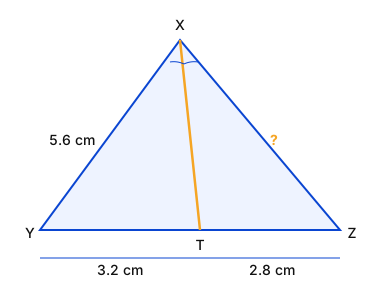
In a Δ XYZ, XT is the bisector of ∠X meeting side YZ at T. If XY = 5.6 cm, YZ = 6 cm, and YT = 3.2 cm, find XZ.
एक Δ XYZ में, XT कोण ∠X का समद्विभाजक है जो भुजा YZ को T पर मिलता है। यदि XY = 5.6 cm, YZ = 6 cm और YT = 3.2 cm है, तो XZ ज्ञात कीजिए।
  1. A6 cm
  2. B5.4 cm
  3. C4.2 cm
  4. D4.9 cm
Show answer

Concept: Angle bisector theorem: the bisector of ∠X divides the opposite side in the ratio of the other two sides, XYXZ=YTTZ.

  1. TZ=YZ−YT=6−3.2=2.8 cm.
  2. 5.6XZ=3.22.8
  3. XZ=5.6×2.83.2=15.683.2=4.9 cm.

Trick: 3.2:2.8=8:7, so XY:XZ=8:7. One part =5.6÷8=0.7, hence XZ=7×0.7=4.9 – no long division needed.

Answer: (D) 4.9 cm

अवधारणा: कोण समद्विभाजक प्रमेय: ∠X का समद्विभाजक सामने की भुजा को शेष दो भुजाओं के अनुपात में बाँटता है, XYXZ=YTTZ।

  1. TZ=YZ−YT=6−3.2=2.8 cm।
  2. 5.6XZ=3.22.8
  3. XZ=5.6×2.83.2=15.683.2=4.9 cm।

ट्रिक: 3.2:2.8=8:7, अतः XY:XZ=8:7। एक भाग =5.6÷8=0.7, इसलिए XZ=7×0.7=4.9 – लंबा भाग करने की ज़रूरत नहीं।

उत्तर: (D) 4.9 cm

RRB NTPC Graduate CBT 2MathematicsAngle bisector theoremRRB NTPC Graduate CBT 2 2025 · 10 Jul Shift 1 →
Q52.
Solve the following equation for x involving mixed recurring decimals and express the solution as vulgar fraction.
3x + 2.3666... = 5.4666...
मिश्रित आवर्ती दशमलवों वाले निम्नलिखित समीकरण को x के लिए हल कीजिए और हल को साधारण भिन्न के रूप में व्यक्त कीजिए।
3x + 2.3666... = 5.4666...
  1. A3120
  2. B2931
  3. C3126
  4. D3130
Show answer

Concept: Mixed recurring decimal 0.ab―: write all digits minus the non-recurring digits over 9s followed by 0s. Here it is faster to subtract first.

  1. 3x=5.46―−2.36―. The recurring parts are identical, so they cancel: 3x=5.4−2.3=3.1.
  2. x=3.13=3130.
  3. Check by fractions: 2.36―=236−2390=7130, 5.46―=546−5490=16430; difference 9330, so x=3130 ✓.

Trick: When both sides have the same recurring tail (…666), subtract directly – the tails vanish and you avoid the 90-denominator work.

Answer: (D) 3130

अवधारणा: मिश्रित आवर्ती दशमलव 0.ab―: सभी अंक घटा अनावर्ती अंक, हर में 9 और फिर 0। यहाँ पहले घटाना तेज़ है।

  1. 3x=5.46―−2.36―। आवर्ती भाग समान हैं, कट जाते हैं: 3x=5.4−2.3=3.1।
  2. x=3.13=3130।
  3. भिन्न से जाँच: 2.36―=236−2390=7130, 5.46―=49290=16430; अंतर 9330, अतः x=3130 ✓।

ट्रिक: जब दोनों ओर एक जैसी आवर्ती पूँछ (…666) हो, सीधे घटाएँ – पूँछ गायब और 90 वाले हर का झंझट नहीं।

उत्तर: (D) 3130

RRB NTPC Graduate CBT 2MathematicsRecurring decimalsRRB NTPC Graduate CBT 2 2025 · 10 Jul Shift 1 →
Q53.
Shivam borrowed a sum of ₹30,000 at a certain rate of simple interest for 3 years. If he paid an interest of ₹4,500 at the end of the period at x% per annum rate of interest, the value of x is:
शिवम ने ₹30,000 की राशि एक निश्चित साधारण ब्याज दर पर 3 वर्षों के लिए उधार ली। यदि उसने x% वार्षिक ब्याज दर पर अवधि के अंत में ₹4,500 ब्याज का भुगतान किया, तो x का मान है:
  1. A5
  2. B6
  3. C7
  4. D4
Show answer

Concept: SI=P×R×T100.

  1. 4500=30000×x×3100=900x.
  2. x=4500900=5.

Trick: Interest per year =4500÷3=1500; 1500 is 5% of 30000 – done mentally.

Answer: (A) 5

अवधारणा: SI=P×R×T100।

  1. 4500=30000×x×3100=900x।
  2. x=4500900=5।

ट्रिक: प्रति वर्ष ब्याज =4500÷3=1500; 1500, 30000 का 5% है – मन में ही हल।

उत्तर: (A) 5

RRB NTPC Graduate CBT 2MathematicsSimple interestRRB NTPC Graduate CBT 2 2025 · 10 Jul Shift 1 →
Q54.
A sum of money triples itself at a certain rate of compound interest, compounded annually in 7 years. In how many years will it amount to 27 times of itself?
एक धनराशि वार्षिक रूप से संयोजित चक्रवृद्धि ब्याज की एक निश्चित दर पर 7 वर्षों में स्वयं की तीन गुनी हो जाती है। कितने वर्षों में यह स्वयं की 27 गुनी हो जाएगी?
  1. A23 years23 वर्ष
  2. B31 years31 वर्ष
  3. C11 years11 वर्ष
  4. D21 years21 वर्ष
Show answer

Concept: Under compound interest, if a sum becomes n times in t years, it becomes nk times in kt years.

  1. 3 times in 7 years.
  2. 27=33, so the time is 3×7=21 years.

Trick: Only in CI do multiples "stack": 3→9→27 takes 7+7+7 years. Under SI you would add equal interests instead.

Answer: (D) 21 years

अवधारणा: चक्रवृद्धि ब्याज में यदि राशि t वर्ष में n गुना हो, तो kt वर्ष में nk गुना होती है।

  1. 7 वर्ष में 3 गुना।
  2. 27=33, अतः समय =3×7=21 वर्ष।

ट्रिक: केवल CI में गुणक "चढ़ते" हैं: 3→9→27 में 7+7+7 वर्ष लगते हैं। SI में बराबर ब्याज जुड़ता है।

उत्तर: (D) 21 years

RRB NTPC Graduate CBT 2MathematicsCompound interest – multiplying timeRRB NTPC Graduate CBT 2 2025 · 10 Jul Shift 1 →
Q55.
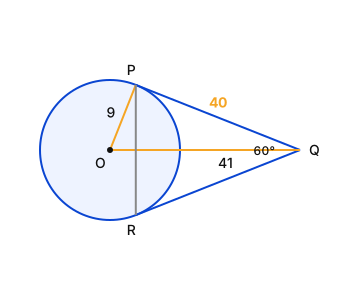
Two tangents, PQ and QR, are drawn from an external point Q to a circle of centre O. If OQ = 41 cm, ∠PQR=60∘ and the radius of the circle is 9 cm, find the perimeter of △PRQ.
केंद्र O वाले एक वृत्त पर एक बाह्य बिंदु Q से दो स्पर्श रेखाएँ PQ और QR खींची गई हैं। यदि OQ = 41 cm, ∠PQR=60∘ और वृत्त की त्रिज्या 9 cm है, तो △PRQ का परिमाप ज्ञात कीजिए।
  1. A80 cm
  2. B135 cm
  3. C120 cm
  4. D95 cm
Show answer

Concept: A radius is perpendicular to the tangent at the point of contact, and the two tangents from an external point are equal.

  1. In right △OPQ: PQ=OQ2−OP2=412−92=1681−81=1600=40 cm.
  2. QR=PQ=40 cm, so △PQR is isosceles with apex angle 60∘ → the base angles are also 60∘ → equilateral, PR=40 cm.
  3. Perimeter =3×40=120 cm.

Trick: (9,40,41) is a Pythagorean triplet; and "equal tangents + 60∘ between them" always makes an equilateral triangle.

Answer: (C) 120 cm

अवधारणा: स्पर्श बिंदु पर त्रिज्या स्पर्श रेखा पर लंब होती है, और बाह्य बिंदु से खींची दोनों स्पर्श रेखाएँ बराबर होती हैं।

  1. समकोण △OPQ में: PQ=OQ2−OP2=412−92=1681−81=1600=40 cm।
  2. QR=PQ=40 cm, अतः △PQR समद्विबाहु है जिसका शीर्ष कोण 60∘ → आधार कोण भी 60∘ → समबाहु, PR=40 cm।
  3. परिमाप =3×40=120 cm।

ट्रिक: (9,40,41) पाइथागोरस त्रिक है; और "बराबर स्पर्श रेखाएँ + बीच में 60∘" से हमेशा समबाहु त्रिभुज बनता है।

उत्तर: (C) 120 cm

RRB NTPC Graduate CBT 2MathematicsCircle – tangents from an external pointRRB NTPC Graduate CBT 2 2025 · 10 Jul Shift 1 →
Q56.
The largest four-digit number which when divided by 8, 7 and 11 leaves remainder 4 in each case is:
चार अंकों की वह सबसे बड़ी संख्या, जिसे 8, 7 और 11 से विभाजित करने पर प्रत्येक स्थिति में शेषफल 4 बचता है, है:
  1. A9956
  2. B9811
  3. C9860
  4. D9624
Show answer

Concept: A number leaving the same remainder r on division by several divisors = (multiple of their LCM) +r.

  1. LCM(8,7,11)=616.
  2. Largest 4-digit multiple of 616: 9999÷616=16 remainder 143, so 616×16=9856.
  3. Required number =9856+4=9860.

Trick: Check options quickly: subtract 4 and test divisibility by 8 and 11 – 9856 is 8×1232 and 11×896 ✓.

Answer: (C) 9860

अवधारणा: कई भाजकों से भाग देने पर समान शेष r देने वाली संख्या = (LCM का गुणज) +r।

  1. LCM(8,7,11)=616।
  2. 616 का सबसे बड़ा 4-अंकीय गुणज: 9999÷616=16, शेष 143, अतः 616×16=9856।
  3. अभीष्ट संख्या =9856+4=9860।

ट्रिक: विकल्पों से 4 घटाकर 8 और 11 से विभाज्यता जाँचें – 9856=8×1232=11×896 ✓।

उत्तर: (C) 9860

RRB NTPC Graduate CBT 2MathematicsLCM – remainder problemsRRB NTPC Graduate CBT 2 2025 · 10 Jul Shift 1 →
Q57.
Find the mean deviation about the mean for the data.
5, 10, 15, 20, 25.
दिए गए आँकड़ों के लिए माध्य के सापेक्ष माध्य विचलन ज्ञात कीजिए।
5, 10, 15, 20, 25.
  1. A7
  2. B6
  3. C5
  4. D8
Show answer

Concept: M.D.=∑|xi−x¯|n.

  1. Mean x¯=5+10+15+20+255=15.
  2. Absolute deviations: 10,5,0,5,10; sum =30.
  3. M.D.=305=6.

Trick: For an AP the mean is the middle term; deviations are symmetric, so just double the one-sided sum (10+5=15) and divide by n.

Answer: (B) 6

अवधारणा: M.D.=∑|xi−x¯|n।

  1. माध्य x¯=5+10+15+20+255=15।
  2. निरपेक्ष विचलन: 10,5,0,5,10; योग =30।
  3. M.D.=305=6।

ट्रिक: समांतर श्रेढ़ी में माध्य = मध्य पद; विचलन सममित होते हैं, अतः एक ओर का योग (10+5=15) दुगुना कर n से भाग दें।

उत्तर: (B) 6

RRB NTPC Graduate CBT 2MathematicsMean deviationRRB NTPC Graduate CBT 2 2025 · 10 Jul Shift 1 →
Q58.
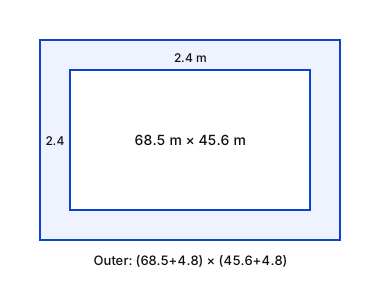
A rectangular field measures 68.5 m by 45.6 m. A path of uniform width 2.4 m is constructed around the outside of the field. Find the difference between the outer perimeter of the path and the perimeter of the original field.
एक आयताकार मैदान की माप 68.5 m × 45.6 m है। मैदान के बाहर चारों ओर 2.4 m की एकसमान चौड़ाई का एक पथ बनाया जाता है। पथ के बाहरी परिमाप और मूल मैदान के परिमाप के बीच का अंतर ज्ञात कीजिए।
  1. A17 m
  2. B20 m
  3. C19.2 m
  4. D18.5 m
Show answer

Concept: A path of width w outside a rectangle adds 2w to both length and breadth, so the perimeter increases by 8w regardless of the field's size.

  1. Outer dimensions: (68.5+4.8) m by (45.6+4.8) m =73.3 m ×50.4 m.
  2. Outer perimeter =2(73.3+50.4)=247.4 m; original perimeter =2(68.5+45.6)=228.2 m.
  3. Difference =247.4−228.2=19.2 m =8×2.4 ✓.

Trick: Perimeter difference =8w for an outside path (and the same for an inside path): 8×2.4=19.2 – the field dimensions are a distraction.

Answer: (C) 19.2 m

अवधारणा: आयत के बाहर w चौड़ाई का पथ लंबाई और चौड़ाई दोनों में 2w जोड़ता है, अतः परिमाप 8w बढ़ता है – खेत के आकार से कोई फ़र्क नहीं।

  1. बाहरी विमाएँ: (68.5+4.8) m × (45.6+4.8) m =73.3 m ×50.4 m।
  2. बाहरी परिमाप =2(73.3+50.4)=247.4 m; मूल परिमाप =2(68.5+45.6)=228.2 m।
  3. अंतर =247.4−228.2=19.2 m =8×2.4 ✓।

ट्रिक: बाहरी पथ (और भीतरी पथ) में परिमाप का अंतर =8w: 8×2.4=19.2 – खेत की विमाएँ केवल भटकाने के लिए हैं।

उत्तर: (C) 19.2 m

RRB NTPC Graduate CBT 2MathematicsMensuration – path around a rectangleRRB NTPC Graduate CBT 2 2025 · 10 Jul Shift 1 →
Q59.
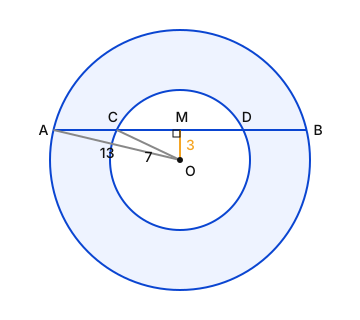
Two concentric circles with a common centre 'O' have a chord AB on the outer circle, which intersects the inner circle at points C and D. If the distance of the chord from the centre is 3 cm, the outer radius is 13 cm and the inner radius is 7 cm, then the length (in cm) of AC is:
एक उभयनिष्ठ केंद्र 'O' वाले दो संकेंद्रीय वृत्तों में, बाहरी वृत्त पर एक जीवा AB है, जो आंतरिक वृत्त को बिंदुओं C और D पर प्रतिच्छेद करती है। यदि केंद्र से जीवा की दूरी 3 cm है, बाहरी त्रिज्या 13 cm है और आंतरिक त्रिज्या 7 cm है, तो AC की लंबाई (cm में) है:
  1. A210
  2. B310
  3. C510
  4. D410
Show answer

Concept: The perpendicular from the centre bisects a chord. Let OM ⊥ AB with OM = 3 cm; M is the midpoint of both AB and CD.

  1. Outer circle: AM=132−32=160=410 cm.
  2. Inner circle: CM=72−32=40=210 cm.
  3. AC=AM−CM=410−210=210 cm.

Trick: For concentric circles, AC=BD always, and AC=AB−CD2 – one subtraction of half-chords.

Answer: (A) 210

अवधारणा: केंद्र से जीवा पर डाला लंब जीवा को समद्विभाजित करता है। OM ⊥ AB, OM = 3 cm; M, AB और CD दोनों का मध्य-बिंदु है।

  1. बाहरी वृत्त: AM=132−32=160=410 cm।
  2. भीतरी वृत्त: CM=72−32=40=210 cm।
  3. AC=AM−CM=410−210=210 cm।

ट्रिक: संकेंद्रीय वृत्तों में हमेशा AC=BD और AC=AB−CD2 – अर्ध-जीवाओं का एक घटाव।

उत्तर: (A) 210

RRB NTPC Graduate CBT 2MathematicsConcentric circles – chordsRRB NTPC Graduate CBT 2 2025 · 10 Jul Shift 1 →
Q60.
The price of a shirt is increased by 20% and then decreased by 20%. What is the net percentage change in the price?
एक कमीज़ के मूल्य में पहले 20% की वृद्धि की जाती है और फिर 20% की कमी की जाती है। मूल्य में शुद्ध प्रतिशत परिवर्तन क्या है?
  1. ANo changeकोई परिवर्तन नहीं
  2. B4% decrease4% की कमी
  3. C8% decrease8% की कमी
  4. D0.4% increase0.4% की वृद्धि
Show answer

Concept: Successive changes of a% and b% give a net change of a+b+ab100%.

  1. a=+20, b=−20: net =20−20+(20)(−20)100=−4%.
  2. Check with ₹100: 100→120→120×0.8=96, a 4% decrease.

Trick: Equal increase and decrease of x% always gives a net decrease of x2100%: here 400100=4%.

Answer: (B) 4% decrease

अवधारणा: a% और b% के क्रमिक परिवर्तन से कुल परिवर्तन =a+b+ab100%।

  1. a=+20, b=−20: कुल =20−20+(20)(−20)100=−4%।
  2. ₹100 से जाँच: 100→120→120×0.8=96, 4% की कमी।

ट्रिक: x% की बराबर वृद्धि और कमी से हमेशा x2100% की कुल कमी: यहाँ 400100=4%।

उत्तर: (B) 4% decrease

RRB NTPC Graduate CBT 2MathematicsSuccessive percentage changeRRB NTPC Graduate CBT 2 2025 · 10 Jul Shift 1 →