Question bank

Q&A: practice questions with answers

Search questions on any topic. Filter by exam category, exam, subject and topic, try the question, then open the answer and explanation.

Courses – airGurukul

8,495 questions found.

Q2081.
What should come in place of the question mark (?) in the given series?
6 13 27 48 76 ?
दी गई श्रृंखला में प्रश्न चिह्न (?) के स्थान पर क्या आना चाहिए?
6 13 27 48 76 ?
  1. A100
  2. B109
  3. C105
  4. D111
Show answer

Concept: Find the differences between consecutive terms.

  1. Differences: 7,14,21,28 (multiples of 7).
  2. Next difference =35 ⇒ 76+35=111.

Trick: Differences form the 7-table: 7×1,7×2,…

Answer: (D) 111

अवधारणा: क्रमागत पदों के अंतर ज्ञात करें।

  1. अंतर: 7,14,21,28 (7 के गुणज)।
  2. अगला अंतर =35 ⇒ 76+35=111।

ट्रिक: अंतर 7 का पहाड़ा हैं: 7×1,7×2,…

उत्तर: (D) 111

RRB NTPC Undergraduate CBT 1General Intelligence and ReasoningNumber SeriesRRB NTPC Undergraduate CBT 1 2024 · 14 Aug Shift 3 →
Q2082.
Select the set in which the numbers are related in the same way as are the numbers of the following sets.
(NOTE: Operations should be performed on the whole numbers, without breaking down the numbers into their constituent digits. E.g. 13 – Operations on 13 such as adding to/subtracting from/multiplying with 13 can be performed. Breaking down 13 into 1 and 3 and then performing mathematical operations on 1 and 3 is not allowed.)
(28, 140, 5)
(41, 533, 13)
उस समुच्चय का चयन कीजिए जिसमें संख्याएँ उसी प्रकार संबंधित हैं जिस प्रकार निम्नलिखित समुच्चयों की संख्याएँ संबंधित हैं।
(ध्यान दें: संख्याओं को उनके घटक अंकों में तोड़े बिना, पूर्ण संख्याओं पर संक्रियाएँ की जानी चाहिए। उदाहरण के लिए 13 – 13 पर संक्रियाएँ जैसे 13 में जोड़ना/घटाना/गुणा करना आदि किया जा सकता है। 13 को 1 और 3 में तोड़ना और फिर 1 और 3 पर गणितीय संक्रियाएँ करना वर्जित है।)
(28, 140, 5)
(41, 533, 13)
  1. A(44, 355, 8)
  2. B(1, 25, 22)
  3. C(35, 735, 21)
  4. D(25, 103, 4)
Show answer

Concept: In each set, the middle number = first number × third number.

  1. 28×5=140 ✓; 41×13=533 ✓.
  2. (35, 735, 21): 35×21=735 ✓.
  3. Others: 44×8=352≠355; 1×22=22≠25; 25×4=100≠103.

Trick: Divide the middle number by the third: it must give the first exactly.

Answer: (C) (35, 735, 21)

अवधारणा: हर समुच्चय में बीच वाली संख्या = पहली × तीसरी।

  1. 28×5=140 ✓; 41×13=533 ✓।
  2. (35, 735, 21): 35×21=735 ✓।
  3. अन्य: 44×8=352≠355; 1×22=22≠25; 25×4=100≠103।

ट्रिक: बीच की संख्या को तीसरी से भाग दें – पहली संख्या ठीक-ठीक आनी चाहिए।

उत्तर: (C) (35, 735, 21)

RRB NTPC Undergraduate CBT 1General Intelligence and ReasoningNumber Analogy – SetsRRB NTPC Undergraduate CBT 1 2024 · 14 Aug Shift 3 →
Q2083.
Read the given statement(s) and conclusions carefully. Assuming that the information given in the statements is true, even if it appears to be at variance with commonly known facts, decide which of the given conclusions logically follow(s) from the statement(s).
Statements:
All prints are banners.
All prints are flexes.
Conclusions:
(I) Some banners are flexes.
(II) All flexes are prints.
दिए गए कथन/कथनों और निष्कर्षों को ध्यानपूर्वक पढ़िए। यह मानते हुए कि कथनों में दी गई जानकारी सत्य है, भले ही वह सामान्य रूप से ज्ञात तथ्यों से भिन्न प्रतीत होती हो, निर्णय कीजिए कि दिए गए निष्कर्षों में से कौन-सा/से निष्कर्ष कथन/कथनों का तार्किक रूप से अनुसरण करता है/करते हैं।
कथन:
सभी प्रिंट, बैनर हैं।
सभी प्रिंट, फ्लेक्स हैं।
निष्कर्ष:
(I) कुछ बैनर, फ्लेक्स हैं।
(II) सभी फ्लेक्स, प्रिंट हैं।
  1. AOnly conclusion (I) follows.केवल निष्कर्ष (I) अनुसरण करता है।
  2. BBoth conclusions (I) and (II) follow.निष्कर्ष (I) और (II) दोनों अनुसरण करते हैं।
  3. COnly conclusion (II) follows.केवल निष्कर्ष (II) अनुसरण करता है।
  4. DNeither conclusion (I) nor (II) follows.न तो निष्कर्ष (I) और न ही (II) अनुसरण करता है।
Show answer

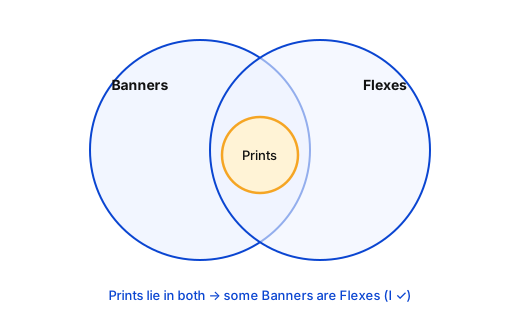
Concept: If the same class (prints) lies inside two classes, those two classes must overlap.

  1. All prints are banners and all prints are flexes ⇒ prints are common to both ⇒ some banners are flexes ⇒ I follows.
  2. Flexes may contain things that are not prints ⇒ "All flexes are prints" is not certain ⇒ II does not follow.

Trick: Two "All" statements with the same subject always give "Some" between the two predicates.

Answer: (A) Only conclusion (I) follows.

अवधारणा: यदि एक ही वर्ग (prints) दो वर्गों के अंदर हो तो वे दोनों वर्ग अवश्य मिलते हैं।

  1. सभी prints, banners हैं और सभी prints, flexes हैं ⇒ prints दोनों में उभयनिष्ठ ⇒ कुछ banners, flexes हैं ⇒ I अनुसरण करता है।
  2. Flexes में prints के अलावा भी कुछ हो सकता है ⇒ II निश्चित नहीं।

ट्रिक: एक ही उद्देश्य वाले दो "All" कथन दोनों विधेयों के बीच "Some" देते हैं।

उत्तर: (A) केवल निष्कर्ष (I) अनुसरण करता है।

RRB NTPC Undergraduate CBT 1General Intelligence and ReasoningSyllogismRRB NTPC Undergraduate CBT 1 2024 · 14 Aug Shift 3 →
Q2084.
Based on the English alphabetical order, three of the following four letter-clusters are alike in a certain way and thus form a group. Which letter-cluster DOES NOT belong to that group?
(Note: The odd one out is not based on the number of consonants/vowels or their position in the letter-cluster.)
अंग्रेज़ी वर्णमाला क्रम के आधार पर, निम्नलिखित चार अक्षर-समूहों में से तीन किसी निश्चित प्रकार से एकसमान हैं और इस प्रकार एक समूह बनाते हैं। कौन-सा अक्षर-समूह उस समूह से संबंधित नहीं है?
(ध्यान दें: असंगत का निर्धारण अक्षर-समूह में व्यंजनों/स्वरों की संख्या या उनके स्थान पर आधारित नहीं है।)
  1. ASOK
  2. BQKG
  3. CEAW
  4. DRNJ
Show answer

Concept: Write position values and check the gaps between consecutive letters.

  1. SOK: 19, 15, 11 (−4, −4). RNJ: 18, 14, 10 (−4, −4).
  2. EAW: 5, 1, 23 (−4, then 1−4 → 23 cyclic) (−4, −4).
  3. QKG: 17, 11, 7 (−6, −4) ✗.

Trick: In the odd cluster the first gap differs: Q to K is 6 steps, not 4.

Answer: (B) QKG

अवधारणा: स्थानीय मान लिखें और क्रमागत अक्षरों का अंतर देखें।

  1. SOK: 19, 15, 11 (−4, −4)। RNJ: 18, 14, 10 (−4, −4)।
  2. EAW: 5, 1, 23 (−4, फिर चक्रीय −4)।
  3. QKG: 17, 11, 7 (−6, −4) ✗।

ट्रिक: विषम समूह में पहला अंतर अलग: Q से K तक 6 कदम।

उत्तर: (B) QKG

RRB NTPC Undergraduate CBT 1General Intelligence and ReasoningOdd One Out – Letter ClustersRRB NTPC Undergraduate CBT 1 2024 · 14 Aug Shift 3 →
Q2085.
Based on the English alphabetical order, three of the following four letter-clusters are alike in a certain way and thus form a group. Which letter-cluster DOES NOT belong to that group?
(Note: The odd one out is not based on the number of consonants/vowels or their position in the letter-cluster.)
अंग्रेज़ी वर्णमाला क्रम के आधार पर, निम्नलिखित चार अक्षर-समूहों में से तीन किसी निश्चित प्रकार से एकसमान हैं और इस प्रकार एक समूह बनाते हैं। कौन-सा अक्षर-समूह उस समूह से संबंधित नहीं है?
(ध्यान दें: असंगत का निर्धारण अक्षर-समूह में व्यंजनों/स्वरों की संख्या या उनके स्थान पर आधारित नहीं है।)
  1. AQWS
  2. BNTP
  3. CTZU
  4. DKQM
Show answer

Concept: Pattern: 1st → 2nd is +6, 2nd → 3rd is −4.

  1. QWS: 17, 23, 19 (+6, −4) ✓. NTP: 14, 20, 16 ✓. KQM: 11, 17, 13 ✓.
  2. TZU: 20, 26, 21 (+6, −5) ✗.

Trick: Check the last step only: Z−4 would be V, not U.

Answer: (C) TZU

अवधारणा: पैटर्न: पहले से दूसरा +6, दूसरे से तीसरा −4।

  1. QWS: 17, 23, 19 (+6, −4) ✓। NTP: 14, 20, 16 ✓। KQM: 11, 17, 13 ✓।
  2. TZU: 20, 26, 21 (+6, −5) ✗।

ट्रिक: केवल अंतिम चरण देखें: Z−4 = V होना चाहिए, U नहीं।

उत्तर: (C) TZU

RRB NTPC Undergraduate CBT 1General Intelligence and ReasoningOdd One Out – Letter ClustersRRB NTPC Undergraduate CBT 1 2024 · 14 Aug Shift 3 →
Q2086.
What will come in place of the question mark (?) in the following equation, if ‘+’ and ‘−’ are interchanged and ‘×’ and ‘÷’ are interchanged?
42 + 75 × 3 − 11 ÷ 3 = ?
यदि ‘+’ और ‘−’ को आपस में बदल दिया जाए तथा ‘×’ और ‘÷’ को आपस में बदल दिया जाए, तो निम्नलिखित समीकरण में प्रश्न चिह्न (?) के स्थान पर क्या आएगा?
42 + 75 × 3 − 11 ÷ 3 = ?
  1. A43
  2. B23
  3. C32
  4. D50
Show answer

Concept: Interchange the signs first, then apply BODMAS.

  1. 42+75×3−11÷3 becomes 42−75÷3+11×3.
  2. =42−25+33.
  3. =50.

Trick: Rewrite the whole expression with new signs before calculating – never swap mid-way.

Answer: (D) 50

अवधारणा: पहले चिह्न बदलें, फिर BODMAS लगाएँ।

  1. 42+75×3−11÷3 बन जाता है 42−75÷3+11×3।
  2. =42−25+33।
  3. =50।

ट्रिक: गणना से पहले पूरा व्यंजक नए चिह्नों के साथ लिख लें।

उत्तर: (D) 50

RRB NTPC Undergraduate CBT 1General Intelligence and ReasoningMathematical OperationsRRB NTPC Undergraduate CBT 1 2024 · 14 Aug Shift 3 →
Q2087.
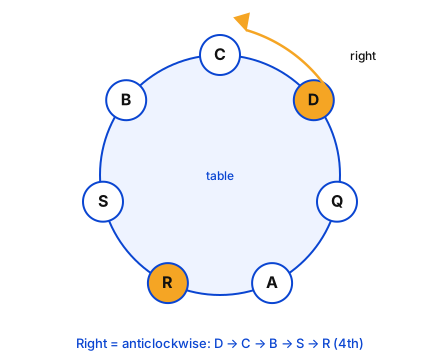
Six friends Q, R, S, T, U and V are sitting around a circular table, facing the centre. S sits third to the right of V. V sits second to the left of Q. U sits to the immediate left of R. Who sits to the immediate right of S?
छह मित्र Q, R, S, T, U और V एक वृत्ताकार मेज़ के चारों ओर केंद्र की ओर मुख करके बैठे हैं। S, V के दाएँ से तीसरे स्थान पर बैठा है। V, Q के बाएँ से दूसरे स्थान पर बैठा है। U, R के ठीक बाएँ बैठा है। S के ठीक दाएँ कौन बैठा है?
  1. AR
  2. BT
  3. CU
  4. DQ
Show answer

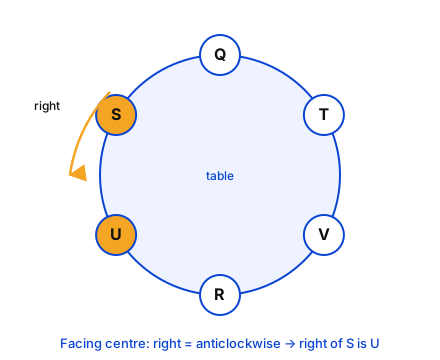
Concept: Facing the centre: left = clockwise, right = anticlockwise.

  1. Place Q. V is second to the left of Q ⇒ two seats clockwise from Q.
  2. S is third to the right of V ⇒ S sits opposite V.
  3. Remaining seats (between Q and V, opposite Q, and next to S) take T, R, U; U immediately left of R fits only with R opposite Q and U between R and S; T between Q and V.
  4. Immediate right of S (anticlockwise) is U.

Trick: In a 6-seat circle, "third to the right/left" always means the person directly opposite.

Answer: (C) U

अवधारणा: केंद्र की ओर मुख: बायाँ = दक्षिणावर्त, दायाँ = वामावर्त।

  1. Q को रखें। V, Q के बाएँ दूसरा ⇒ Q से दो सीट दक्षिणावर्त।
  2. S, V के दाएँ तीसरा ⇒ S, V के ठीक सामने।
  3. बची सीटें T, R, U की; U, R के ठीक बाएँ – यह केवल तभी संभव जब R, Q के सामने और U, R व S के बीच हो; T, Q व V के बीच।
  4. S के ठीक दाएँ (वामावर्त) U है।

ट्रिक: 6 व्यक्तियों के वृत्त में "तीसरा दाएँ/बाएँ" यानी ठीक सामने वाला।

उत्तर: (C) U

RRB NTPC Undergraduate CBT 1General Intelligence and ReasoningCircular Seating ArrangementRRB NTPC Undergraduate CBT 1 2024 · 14 Aug Shift 3 →
Q2088.
In the following triad, each group of letters is related to the subsequent one following a certain logic. Select from the given options, the one which follows the same logic. SINK - ISNK - KISN
PLAY - LPAY - YLPA
निम्नलिखित त्रय में, अक्षरों का प्रत्येक समूह एक निश्चित तर्क का अनुसरण करते हुए अगले समूह से संबंधित है। दिए गए विकल्पों में से उसका चयन कीजिए जो समान तर्क का अनुसरण करता है। SINK - ISNK - KISN
PLAY - LPAY - YLPA
  1. AHOLD - OHLD - DOHL
  2. BCLAY - LCAY - LAYC
  3. CMARK - MRAK - KRAM
  4. DDINE - IDNE - EIND
Show answer

Concept: Step 1: swap the first two letters. Step 2: move the last letter to the front.

  1. SINK → ISNK → KISN; PLAY → LPAY → YLPA.
  2. HOLD → OHLD (swap) → DOHL (D to front) ✓.
  3. CLAY → LCAY → YLCA (not LAYC); MARK → AMRK (not MRAK); DINE → IDNE → EIDN (not EIND).

Trick: Check the third term: it must start with the last letter of the second term.

Answer: (A) HOLD - OHLD - DOHL

अवधारणा: चरण 1: पहले दो अक्षर आपस में बदलें। चरण 2: अंतिम अक्षर को सबसे आगे लाएँ।

  1. SINK → ISNK → KISN; PLAY → LPAY → YLPA।
  2. HOLD → OHLD (अदला-बदली) → DOHL (D आगे) ✓।
  3. CLAY → LCAY → YLCA (LAYC नहीं); MARK → AMRK (MRAK नहीं); DINE → IDNE → EIDN (EIND नहीं)।

ट्रिक: तीसरा पद दूसरे पद के अंतिम अक्षर से शुरू होना चाहिए।

उत्तर: (A) HOLD - OHLD - DOHL

RRB NTPC Undergraduate CBT 1General Intelligence and ReasoningLetter Triads – PatternRRB NTPC Undergraduate CBT 1 2024 · 14 Aug Shift 3 →
Q2089.
If ‘A’ stands for ‘÷’, ‘B’ stands for ‘×’, ‘C’ stands for ‘+’ and ‘D’ stands for ‘−’, then what will come in place of the question mark (?) in the following equation?
25 A 5 D 10 B 3 C 42 = ?
यदि ‘A’ का अर्थ ‘÷’, ‘B’ का अर्थ ‘×’, ‘C’ का अर्थ ‘+’ और ‘D’ का अर्थ ‘−’ है, तो निम्नलिखित समीकरण में प्रश्न चिह्न (?) के स्थान पर क्या आएगा?
25 A 5 D 10 B 3 C 42 = ?
  1. A24
  2. B14
  3. C21
  4. D17
Show answer

Concept: Replace letters by signs (A = ÷, B = ×, C = +, D = −) and apply BODMAS.

  1. 25÷5−10×3+42.
  2. =5−30+42.
  3. =17.

Trick: Do ÷ and × first, then + and − from left to right.

Answer: (D) 17

अवधारणा: अक्षरों को चिह्नों से बदलें (A = ÷, B = ×, C = +, D = −) और BODMAS लगाएँ।

  1. 25÷5−10×3+42।
  2. =5−30+42।
  3. =17।

ट्रिक: पहले ÷ और ×, फिर बाएँ से दाएँ + और −।

उत्तर: (D) 17

RRB NTPC Undergraduate CBT 1General Intelligence and ReasoningMathematical OperationsRRB NTPC Undergraduate CBT 1 2024 · 14 Aug Shift 3 →
Q2090.
In a certain code language, ‘GLUE’ is coded as ‘2475’ and ‘UNIT’ is coded as ‘1536’. What is the code for ‘U’ in that language?
एक निश्चित कूट भाषा में, ‘GLUE’ को ‘2475’ के रूप में कूटबद्ध किया जाता है और ‘UNIT’ को ‘1536’ के रूप में कूटबद्ध किया जाता है। उस भाषा में ‘U’ का कूट क्या है?
  1. A1
  2. B3
  3. C5
  4. D7
Show answer

Concept: A letter common to both words must have the digit common to both codes.

  1. GLUE → 2475 and UNIT → 1536.
  2. Common letter: U. Common digit: 5.
  3. So U = 5.

Trick: Match the common letter with the common digit.

Answer: (C) 5

अवधारणा: दोनों शब्दों में उभयनिष्ठ अक्षर का कोड दोनों कोडों में उभयनिष्ठ अंक होगा।

  1. GLUE → 2475 और UNIT → 1536।
  2. उभयनिष्ठ अक्षर: U; उभयनिष्ठ अंक: 5।
  3. अतः U = 5।

ट्रिक: उभयनिष्ठ अक्षर = उभयनिष्ठ अंक।

उत्तर: (C) 5

RRB NTPC Undergraduate CBT 1General Intelligence and ReasoningCoding–DecodingRRB NTPC Undergraduate CBT 1 2024 · 14 Aug Shift 3 →
Q2091.
What should come in place of the question mark (?) in the given series based on the English alphabetical order?
XSW TOS PKO LGK ?
अंग्रेज़ी वर्णमाला क्रम के आधार पर दी गई श्रृंखला में प्रश्न चिह्न (?) के स्थान पर क्या आना चाहिए?
XSW TOS PKO LGK ?
  1. AHCG
  2. BHCF
  3. CHBG
  4. DHBF
Show answer

Concept: Each letter of a term is 4 positions behind the corresponding letter of the previous term.

  1. XSW → TOS → PKO → LGK: every letter −4.
  2. LGK − 4: L→H, G→C, K→G ⇒ HCG.

Trick: Within each term, 3rd letter = 1st letter −1 (X/W, T/S, P/O, L/K) ⇒ H/G.

Answer: (A) HCG

अवधारणा: हर पद का प्रत्येक अक्षर पिछले पद के संगत अक्षर से 4 स्थान पीछे है।

  1. XSW → TOS → PKO → LGK: हर अक्षर −4।
  2. LGK − 4: L→H, G→C, K→G ⇒ HCG।

ट्रिक: हर पद में तीसरा अक्षर = पहला अक्षर −1 ⇒ H के बाद G।

उत्तर: (A) HCG

RRB NTPC Undergraduate CBT 1General Intelligence and ReasoningLetter SeriesRRB NTPC Undergraduate CBT 1 2024 · 14 Aug Shift 3 →
Q2092.
Town P is to the north of town Q. Town Q is to the east of town R. Town T is to the north of town P. Town S is to the east of town P. What is the position of town S with respect to town Q?
नगर P, नगर Q के उत्तर में है। नगर Q, नगर R के पूर्व में है। नगर T, नगर P के उत्तर में है। नगर S, नगर P के पूर्व में है। नगर Q के सापेक्ष नगर S की स्थिति क्या है?
  1. ANortheastउत्तर-पूर्व
  2. BNorthउत्तर
  3. CSoutheastदक्षिण-पूर्व
  4. DNorthwestउत्तर-पश्चिम
Show answer

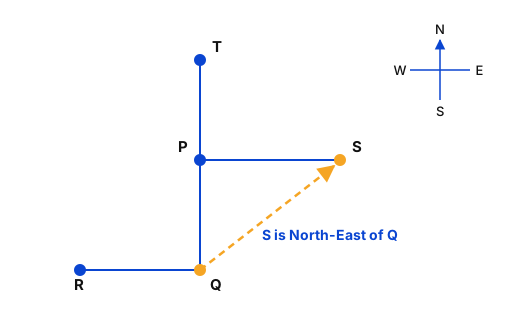
Concept: Place Q at the origin and plot each town relative to it.

  1. P is north of Q; R is west of Q; T is north of P.
  2. S is east of P ⇒ S is to the north (via P) and east of Q.
  3. North + East ⇒ S is northeast of Q.

Trick: Combine the two moves from Q: up (north) then right (east) ⇒ northeast.

Answer: (A) Northeast

अवधारणा: Q को मूल बिंदु मानकर हर नगर की स्थिति बनाएँ।

  1. P, Q के उत्तर में; R, Q के पश्चिम में; T, P के उत्तर में।
  2. S, P के पूर्व में ⇒ S, Q से उत्तर (P होते हुए) और पूर्व में।
  3. उत्तर + पूर्व ⇒ S, Q के उत्तर-पूर्व में।

ट्रिक: Q से दो चालें जोड़ें: ऊपर (उत्तर) फिर दाएँ (पूर्व) ⇒ उत्तर-पूर्व।

उत्तर: (A) उत्तर-पूर्व (Northeast)

RRB NTPC Undergraduate CBT 1General Intelligence and ReasoningDirection SenseRRB NTPC Undergraduate CBT 1 2024 · 14 Aug Shift 3 →
Q2093.
This question is based on the five, three-digit numbers given below.
(Left) 731 890 923 286 378 (Right)
(Example: 697 – First digit = 6, second digit = 9 and third digit = 7)
(NOTE: All operations to be done from left to right.)
In how many numbers is the sum of the 1st and 3rd digits greater than the 2nd digit?
यह प्रश्न नीचे दी गई तीन-तीन अंकों वाली पाँच संख्याओं पर आधारित है।
(बाएँ) 731 890 923 286 378 (दाएँ)
(उदाहरण: 697 – पहला अंक = 6, दूसरा अंक = 9 और तीसरा अंक = 7)
(ध्यान दें: सभी संक्रियाएँ बाएँ से दाएँ की जानी हैं।)
कितनी संख्याओं में 1ले और 3रे अंक का योग 2रे अंक से अधिक है?
  1. ATwoदो
  2. BThreeतीन
  3. COneएक
  4. DFourचार
Show answer

Concept: For each number, compare (1st digit + 3rd digit) with the 2nd digit.

  1. 731: 7+1=8>3 ✓; 890: 8+0=8<9 ✗.
  2. 923: 9+3=12>2 ✓; 286: 2+6=8, not greater than 8 ✗.
  3. 378: 3+8=11>7 ✓ ⇒ three numbers.

Trick: "Greater than" is strict – an equal sum (286) does not count.

Answer: (B) Three

अवधारणा: हर संख्या में (पहला अंक + तीसरा अंक) की तुलना दूसरे अंक से करें।

  1. 731: 7+1=8>3 ✓; 890: 8+0=8<9 ✗।
  2. 923: 9+3=12>2 ✓; 286: 2+6=8, 8 से बड़ा नहीं ✗।
  3. 378: 3+8=11>7 ✓ ⇒ तीन संख्याएँ।

ट्रिक: "बड़ा" का अर्थ सख्ती से बड़ा – बराबर (286) नहीं गिना जाएगा।

उत्तर: (B) तीन (Three)

RRB NTPC Undergraduate CBT 1General Intelligence and ReasoningNumber Operations – DigitsRRB NTPC Undergraduate CBT 1 2024 · 14 Aug Shift 3 →
Q2094.
Younis starts from Point A and drives 17 km towards East. He then takes a left turn, drives 6 km, turns right and drives 11 km. He then takes a right turn and drives 6 km. He takes a final right turn, drives 2 km and stops at Point P. How far (shortest distance) and towards which direction should he drive in order to reach Point A again? (All turns are 90° turns only unless specified.)
यूनुस बिंदु A से शुरू करता है और पूर्व की ओर 17 km गाड़ी चलाता है। फिर वह बाएँ मुड़ता है, 6 km गाड़ी चलाता है, दाएँ मुड़ता है और 11 km गाड़ी चलाता है। फिर वह दाएँ मुड़ता है और 6 km गाड़ी चलाता है। वह अंतिम बार दाएँ मुड़ता है, 2 km गाड़ी चलाता है और बिंदु P पर रुक जाता है। बिंदु A पर पुनः पहुँचने के लिए उसे कितनी दूरी (न्यूनतम दूरी) और किस दिशा में गाड़ी चलानी चाहिए? (जब तक निर्दिष्ट न हो, सभी मोड़ केवल 90° के हैं।)
  1. A29 km towards Eastपूर्व की ओर 29 km
  2. B29 km towards Westपश्चिम की ओर 29 km
  3. C26 km towards Northउत्तर की ओर 26 km
  4. D26 km towards Westपश्चिम की ओर 26 km
Show answer

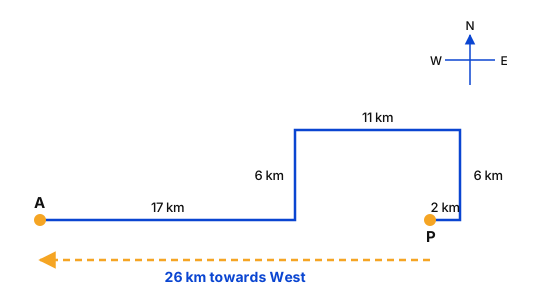
Concept: Track east–west and north–south displacements separately.

  1. East 17 → left (north) 6 → right (east) 11 → right (south) 6 → right (west) 2.
  2. North–south: 6−6=0, so P is on the same line as A.
  3. East–west: 17+11−2=26km east of A.
  4. To return, drive 26km towards west.

Trick: The two 6 km legs cancel; only the east–west total remains.

Answer: (D) 26 km towards West

अवधारणा: पूर्व-पश्चिम और उत्तर-दक्षिण विस्थापन अलग-अलग जोड़ें।

  1. पूर्व 17 → बाएँ (उत्तर) 6 → दाएँ (पूर्व) 11 → दाएँ (दक्षिण) 6 → दाएँ (पश्चिम) 2।
  2. उत्तर-दक्षिण: 6−6=0, अतः P, A की ही रेखा पर है।
  3. पूर्व-पश्चिम: 17+11−2=26km, A के पूर्व में।
  4. वापस जाने के लिए पश्चिम की ओर 26km।

ट्रिक: दोनों 6 km की चालें कट जाती हैं; केवल पूर्व-पश्चिम का योग बचता है।

उत्तर: (D) पश्चिम की ओर 26 km

RRB NTPC Undergraduate CBT 1General Intelligence and ReasoningDirection and DistanceRRB NTPC Undergraduate CBT 1 2024 · 14 Aug Shift 3 →
Q2095.
A, B, C, D, Q, R and S are sitting around a circular table facing the centre of the table. Only two people sit between Q and B when counted from the right of Q. Only three people sit between A and C when counted from the right of C. B sits to the immediate right of C. R sits to the immediate right of S.
Who sits fourth to the right of D?
A, B, C, D, Q, R और S एक वृत्ताकार मेज़ के चारों ओर मेज़ के केंद्र की ओर मुख करके बैठे हैं। Q के दाएँ से गिनने पर Q और B के बीच केवल दो व्यक्ति बैठे हैं। C के दाएँ से गिनने पर A और C के बीच केवल तीन व्यक्ति बैठे हैं। B, C के ठीक दाएँ बैठा है। R, S के ठीक दाएँ बैठा है।
D के दाएँ से चौथे स्थान पर कौन बैठा है?
  1. AS
  2. BC
  3. CA
  4. DR
Show answer

Concept: Facing the centre, moving to the right means going anticlockwise. Fix C first.

  1. B is immediately right of C ⇒ B = 1st right of C.
  2. Three people between C and A counted from C’s right ⇒ A = 4th right of C.
  3. Two people between Q and B counted from Q’s right ⇒ B = 3rd right of Q ⇒ Q = 5th right of C.
  4. Free seats: 2nd, 3rd, 6th right of C. R immediately right of S ⇒ S = 2nd, R = 3rd, D = 6th.
  5. 4th right of D: C, B, S, R ⇒ R.

Trick: With 7 seats, "4th to the right" = "3rd to the left".

Answer: (D) R

अवधारणा: केंद्र की ओर मुख होने पर दाएँ जाना = वामावर्त। पहले C को रखें।

  1. B, C के ठीक दाएँ ⇒ B = C के दाएँ पहला।
  2. C के दाएँ से गिनने पर C और A के बीच तीन ⇒ A = C के दाएँ चौथा।
  3. Q के दाएँ से गिनने पर Q और B के बीच दो ⇒ B = Q के दाएँ तीसरा ⇒ Q = C के दाएँ पाँचवाँ।
  4. खाली सीटें: C के दाएँ 2रा, 3रा, 6ठा। R, S के ठीक दाएँ ⇒ S = 2रा, R = 3रा, D = 6ठा।
  5. D के दाएँ चौथा: C, B, S, R ⇒ R।

ट्रिक: 7 सीटों में "दाएँ चौथा" = "बाएँ तीसरा"।

उत्तर: (D) R

RRB NTPC Undergraduate CBT 1General Intelligence and ReasoningCircular Seating ArrangementRRB NTPC Undergraduate CBT 1 2024 · 14 Aug Shift 3 →
Q2096.
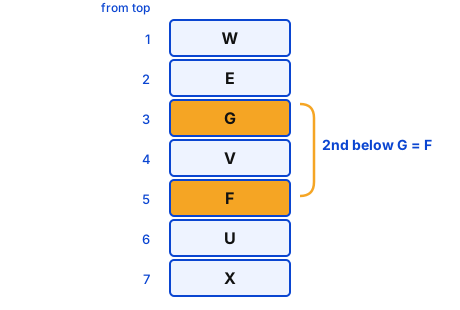
Seven boxes U, V, W, X, E, F and G are kept one over the other but not necessarily in the same order.
No box is kept above W. Only three boxes are kept between W and F. Only one box is kept between E and V. V is kept immediately above F. Only four boxes are kept between E and X. G is kept at some place above U. Which box is kept second below G?
सात बॉक्स U, V, W, X, E, F और G एक के ऊपर एक रखे गए हैं, लेकिन आवश्यक नहीं कि इसी क्रम में हों।
W के ऊपर कोई बॉक्स नहीं रखा गया है। W और F के बीच केवल तीन बॉक्स रखे गए हैं। E और V के बीच केवल एक बॉक्स रखा गया है। V को F के ठीक ऊपर रखा गया है। E और X के बीच केवल चार बॉक्स रखे गए हैं। G को U के ऊपर किसी स्थान पर रखा गया है। G से दूसरे नीचे कौन-सा बॉक्स रखा गया है?
  1. AF
  2. BW
  3. CV
  4. DU
Show answer

Concept: Number positions 1 (top) to 7 (bottom) and place fixed boxes first.

  1. No box above W ⇒ W = 1. Three boxes between W and F ⇒ F = 5; V immediately above F ⇒ V = 4.
  2. One box between E and V ⇒ E = 2 or 6. Four boxes between E and X ⇒ E = 2, X = 7 (E = 6 would need X = 1, taken).
  3. Left: 3 and 6 for G and U; G above U ⇒ G = 3, U = 6.
  4. Second below G (3) is position 5 ⇒ F.

Trick: "n boxes between" means a gap of n+1 positions.

Answer: (A) F

अवधारणा: स्थान 1 (ऊपर) से 7 (नीचे) मानें और निश्चित बक्से पहले रखें।

  1. W के ऊपर कोई नहीं ⇒ W = 1। W और F के बीच तीन ⇒ F = 5; V, F के ठीक ऊपर ⇒ V = 4।
  2. E और V के बीच एक ⇒ E = 2 या 6। E और X के बीच चार ⇒ E = 2, X = 7 (E = 6 पर X = 1 चाहिए, जो भरा है)।
  3. बचे 3 और 6 पर G, U; G, U के ऊपर ⇒ G = 3, U = 6।
  4. G (3) से दूसरा नीचे स्थान 5 ⇒ F।

ट्रिक: "बीच में n बक्से" का अर्थ स्थानों में n+1 का अंतर।

उत्तर: (A) F

RRB NTPC Undergraduate CBT 1General Intelligence and ReasoningPuzzle – Box ArrangementRRB NTPC Undergraduate CBT 1 2024 · 14 Aug Shift 3 →
Q2097.
In a certain code language, ‘are you hungry’ is written as ‘mk tk jb’ and ‘you came early’ is coded as ‘cd ab mk’. How is ‘you’ coded in the given language?
एक निश्चित कूट भाषा में, ‘are you hungry’ को ‘mk tk jb’ लिखा जाता है और ‘you came early’ को ‘cd ab mk’ के रूप में कूटबद्ध किया जाता है। दी गई भाषा में ‘you’ को किस प्रकार कूटबद्ध किया जाता है?
  1. Ajb
  2. Btk
  3. Cmk
  4. Djt
Show answer

Concept: The word common to both sentences has the code common to both coded forms.

  1. ‘are you hungry’ → ‘mk tk jb’; ‘you came early’ → ‘cd ab mk’.
  2. Common word: you; common code: mk.
  3. So ‘you’ = mk.

Trick: Match common word with common code.

Answer: (C) mk

अवधारणा: दोनों वाक्यों में उभयनिष्ठ शब्द का कोड दोनों कोडों में उभयनिष्ठ होगा।

  1. ‘are you hungry’ → ‘mk tk jb’; ‘you came early’ → ‘cd ab mk’।
  2. उभयनिष्ठ शब्द: you; उभयनिष्ठ कोड: mk।
  3. अतः ‘you’ = mk।

ट्रिक: उभयनिष्ठ शब्द = उभयनिष्ठ कोड।

उत्तर: (C) mk

RRB NTPC Undergraduate CBT 1General Intelligence and ReasoningCoding–DecodingRRB NTPC Undergraduate CBT 1 2024 · 14 Aug Shift 3 →
Q2098.
If 1 is added for each odd digit and 1 is subtracted from each even digit of the number 86435621, how many digits are repeated more than once in the new number thus formed?
यदि संख्या 86435621 के प्रत्येक विषम अंक में 1 जोड़ा जाए और प्रत्येक सम अंक में से 1 घटाया जाए, तो इस प्रकार बनी नई संख्या में कितने अंक एक से अधिक बार दोहराए गए हैं?
  1. AThreeतीन
  2. BNoneकोई नहीं
  3. COneएक
  4. DTwoदो
Show answer

Concept: Odd digit +1, even digit −1, then count digits that appear more than once.

  1. 8 6 4 3 5 6 2 1 → 7 5 3 4 6 5 1 2.
  2. Count: 5 appears twice; 7, 3, 4, 6, 1, 2 appear once.
  3. Only one digit (5) repeats.

Trick: The two 6s in the original both become 5, so only that pair repeats.

Answer: (C) One

अवधारणा: विषम अंक +1, सम अंक −1, फिर एक से अधिक बार आने वाले अंक गिनें।

  1. 8 6 4 3 5 6 2 1 → 7 5 3 4 6 5 1 2।
  2. 5 दो बार; 7, 3, 4, 6, 1, 2 एक-एक बार।
  3. केवल एक अंक (5) दोहराया गया है।

ट्रिक: मूल संख्या के दोनों 6 → 5 बन जाते हैं, इसलिए केवल वही युग्म दोहराता है।

उत्तर: (C) एक (One)

RRB NTPC Undergraduate CBT 1General Intelligence and ReasoningDigit OperationsRRB NTPC Undergraduate CBT 1 2024 · 14 Aug Shift 3 →
Q2099.
Market control under Alauddin Khilji aimed mainly to ________.
अलाउद्दीन खिलजी के अधीन बाज़ार नियंत्रण का मुख्य उद्देश्य ________ था।
  1. Apatronise artisan guildsकारीगर श्रेणियों (गिल्डों) को संरक्षण देना
  2. Bencourage foreign tradeविदेशी व्यापार को प्रोत्साहित करना
  3. Cpromote luxury crafts and goodsविलासितापूर्ण शिल्पों और वस्तुओं को बढ़ावा देना
  4. Dcheck price inflation for army provisionsसेना की रसद के लिए मूल्य वृद्धि (महँगाई) पर नियंत्रण करना
Show answer

Concept: Alauddin Khilji (1296–1316) introduced market reforms to maintain a huge standing army cheaply.

  1. He fixed low prices of grain, cloth, horses and cattle and set up separate markets for them.
  2. Officers like the Shahna-i-Mandi and spies (barid) checked hoarding and black-marketing.
  3. Low prices let him pay soldiers modest salaries, so the aim was to check price rise of army provisions – not foreign trade or luxury goods.

Yaad rakhein: Market control = sasta anaaj for a big army.

Answer: (D) check price inflation for army provisions

अवधारणा: अलाउद्दीन खिलजी (1296–1316) ने विशाल स्थायी सेना को कम खर्च में बनाए रखने के लिए बाज़ार सुधार किए।

  1. उसने अनाज, कपड़ा, घोड़े और पशुओं के मूल्य तय किए और उनके लिए अलग बाज़ार बनाए।
  2. शहना-ए-मंडी जैसे अधिकारी और गुप्तचर जमाखोरी पर नज़र रखते थे।
  3. कम कीमतों से सैनिकों को कम वेतन में गुज़ारा हो जाता था – उद्देश्य सेना की रसद की महँगाई रोकना था।

याद रखें: बाज़ार नियंत्रण = बड़ी सेना के लिए सस्ता अनाज।

उत्तर: (D) सेना की रसद के लिए मूल्य वृद्धि (महँगाई) पर नियंत्रण

RRB NTPC Undergraduate CBT 1General AwarenessMedieval History – Delhi SultanateRRB NTPC Undergraduate CBT 1 2024 · 14 Aug Shift 2 →
Q2100.
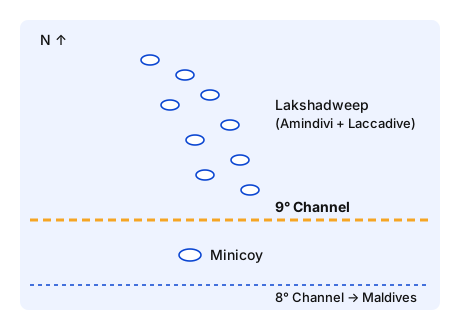
Which natural feature divides the Lakshadweep islands into two broad parts?
कौन-सी प्राकृतिक संरचना लक्षद्वीप द्वीपसमूह को दो व्यापक भागों में विभाजित करती है?
  1. AEquatorभूमध्य रेखा
  2. BNine Degree Channelनौ डिग्री चैनल
  3. CTen Degree Channelदस डिग्री चैनल
  4. DTropic of Cancerकर्क रेखा
Show answer

Concept: Lakshadweep is a group of coral islands in the Arabian Sea, split by a sea channel.

  1. The Nine Degree Channel separates Minicoy island (south) from the main Lakshadweep group (Amindivi and Laccadive islands, north).
  2. The Eight Degree Channel separates Minicoy from the Maldives.
  3. The Ten Degree Channel is in the Bay of Bengal (between Andaman and Nicobar), so it is not the answer.

Yaad rakhein: 9° – Lakshadweep (Minicoy), 10° – Andaman–Nicobar, 8° – Minicoy–Maldives.

Answer: (B) Nine Degree Channel

अवधारणा: लक्षद्वीप अरब सागर में प्रवाल (coral) द्वीपों का समूह है, जिसे एक समुद्री चैनल दो भागों में बाँटता है।

  1. नाइन डिग्री चैनल दक्षिण के मिनिकॉय द्वीप को उत्तर के मुख्य लक्षद्वीप समूह (अमीनदीवी व लक्कादीव) से अलग करता है।
  2. एट डिग्री चैनल मिनिकॉय को मालदीव से अलग करता है।
  3. टेन डिग्री चैनल बंगाल की खाड़ी में (अंडमान–निकोबार के बीच) है।

याद रखें: 9° – लक्षद्वीप (मिनिकॉय), 10° – अंडमान–निकोबार, 8° – मिनिकॉय–मालदीव।

उत्तर: (B) नाइन डिग्री चैनल

RRB NTPC Undergraduate CBT 1General AwarenessIndian Geography – IslandsRRB NTPC Undergraduate CBT 1 2024 · 14 Aug Shift 2 →