Question bank

Q&A: practice questions with answers

Search questions on any topic. Filter by exam category, exam, subject and topic, try the question, then open the answer and explanation.

Courses – airGurukul

8,495 questions found.

Q2161.
Pipe A can fill a tank in 20 hours, pipe B can fill the same tank in 22 hours and pipe C can fill the same tank in 14 hours. The time taken by them to fill the same tank if they operate together is:
पाइप A एक टंकी को 20 घंटे में भर सकता है, पाइप B उसी टंकी को 22 घंटे में भर सकता है और पाइप C उसी टंकी को 14 घंटे में भर सकता है। यदि वे एक साथ कार्य करें, तो उसी टंकी को भरने में उनके द्वारा लिया गया समय है:
  1. A14255257 hours14255257 घंटे
  2. B5255257 hours5255257 घंटे
  3. C2255257 hours2255257 घंटे
  4. D9255257 hours9255257 घंटे
Show answer

Concept: Together, rates add: 1T=120+122+114.

  1. LCM of 20, 22, 14 =1540
  2. 77+70+1101540=2571540
  3. T=1540257=5255257 hours

Trick: Answer must be less than the fastest pipe (14 h) and close to 143–203; only 5255257 fits.

Answer: (B) 5255257 hours

अवधारणा: साथ में दरें जुड़ती हैं: 1T=120+122+114।

  1. 20, 22, 14 का LCM =1540
  2. 77+70+1101540=2571540
  3. T=1540257=5255257 घंटे

ट्रिक: उत्तर सबसे तेज़ पाइप के समय से कम और 143–203 के बीच होना चाहिए; केवल 5255257 सही।

उत्तर: (B) 5255257 घंटे

RRB NTPC Undergraduate CBT 1MathematicsPipes and CisternsRRB NTPC Undergraduate CBT 1 2024 · 14 Aug Shift 2 →
Q2162.
Neha, Rajat and Avinash invested ₹1,210, ₹1,650 and ₹1,300, respectively to start a business. If the profit at the end of the year is ₹1,200, what is Avinash's share of the profit?
नेहा, रजत और अविनाश ने एक व्यवसाय शुरू करने के लिए क्रमशः ₹1,210, ₹1,650 और ₹1,300 का निवेश किया। यदि वर्ष के अंत में लाभ ₹1,200 है, तो लाभ में अविनाश का हिस्सा कितना है?
  1. A₹374
  2. B₹377
  3. C₹375
  4. D₹376
Show answer

Concept: For equal time, profit is shared in the ratio of investments.

  1. 1210:1650:1300=121:165:130 (÷10)
  2. Total =416
  3. Avinash =130416×1200=375

Trick: 13004160=516, and 516×1200=375.

Answer: (C) ₹375

अवधारणा: समान समय हो तो लाभ निवेश के अनुपात में बँटता है।

  1. 1210:1650:1300=121:165:130
  2. कुल =416
  3. अविनाश =130416×1200=375

ट्रिक: 13004160=516, और 516×1200=375।

उत्तर: (C) ₹375

RRB NTPC Undergraduate CBT 1MathematicsPartnershipRRB NTPC Undergraduate CBT 1 2024 · 14 Aug Shift 2 →
Q2163.
The number 769501 is divisible by which of the following?
संख्या 769501 निम्नलिखित में से किससे विभाज्य है?
  1. A96
  2. B97
  3. C90
  4. D105
Show answer

Concept: Eliminate options by easy rules, then divide by the remaining one.

  1. 769501 is odd → not divisible by 96 or 90
  2. It ends in 1 → not divisible by 5, so not by 105
  3. 769501÷97=7933 exactly (97×7933=769501)

Trick: An odd number ending in 1 can't be divisible by any even number or multiple of 5 — only 97 is left.

Answer: (B) 97

अवधारणा: आसान नियमों से विकल्प हटाएँ, फिर बचे हुए से भाग दें।

  1. 769501 विषम है → 96 या 90 से विभाज्य नहीं
  2. अंत में 1 है → 5 से नहीं, अतः 105 से भी नहीं
  3. 769501÷97=7933 (97×7933=769501)

ट्रिक: 1 पर समाप्त विषम संख्या किसी सम संख्या या 5 के गुणज से विभाज्य नहीं — केवल 97 बचता है।

उत्तर: (B) 97

RRB NTPC Undergraduate CBT 1MathematicsDivisibilityRRB NTPC Undergraduate CBT 1 2024 · 14 Aug Shift 2 →
Q2164.
Which of the following numbers is divisible by 22?
निम्नलिखित में से कौन-सी संख्या 22 से विभाज्य है?
  1. A65,80,350
  2. B64,67,614
  3. C61,36,901
  4. D71,32,950
Show answer

Concept: Divisible by 22 ⇔ even AND divisible by 11 (alternate-digit sums differ by 0 or a multiple of 11).

  1. 6580350: (0+3+8+6)−(5+0+5)=17−10=7 ✗; 6467614: (4+6+6+6)−(1+7+4)=22−12=10 ✗; 6136901 is odd ✗
  2. 7132950: (0+9+3+7)−(5+2+1)=19−8=11 ✓ and even ✓

Trick: First drop odd numbers, then test 11 only on the rest.

Answer: (D) 71,32,950

अवधारणा: 22 से विभाज्य ⇔ सम हो और 11 से विभाज्य (एकांतर अंकों के योग का अंतर 0 या 11 का गुणज)।

  1. 6580350: अंतर 7 ✗; 6467614: अंतर 10 ✗; 6136901 विषम ✗
  2. 7132950: (0+9+3+7)−(5+2+1)=11 ✓ और सम ✓

ट्रिक: पहले विषम संख्याएँ हटाएँ, फिर केवल शेष पर 11 का नियम लगाएँ।

उत्तर: (D) 71,32,950

RRB NTPC Undergraduate CBT 1MathematicsDivisibility by 22RRB NTPC Undergraduate CBT 1 2024 · 14 Aug Shift 2 →
Q2165.
In covering a distance of 96 km, Anmol takes 6 hours more than Nikhil. If Anmol doubles his speed, then he would take 2 hours less than Nikhil. Anmol's speed is:
96 km की दूरी तय करने में, अनमोल, निखिल से 6 घंटे अधिक लेता है। यदि अनमोल अपनी चाल दोगुनी कर ले, तो वह निखिल से 2 घंटे कम लेगा। अनमोल की चाल है:
  1. A12 km/hr
  2. B6 km/hr
  3. C2 km/hr
  4. D16 km/hr
Show answer

Concept: Write both conditions as time equations and add them to eliminate Nikhil's time.

  1. Let speeds be a (Anmol), n (Nikhil): 96a−96n=6
  2. Doubling: 96n−962a=2
  3. Add: 96a−48a=8⇒48a=8⇒a=6km/h

Trick: Doubling speed halves time: the saving T2 equals 6+2=8 h, so T=16 h and speed =9616=6.

Answer: (B) 6 km/hr

अवधारणा: दोनों शर्तों को समय के समीकरण में लिखें और जोड़कर निखिल का समय हटाएँ।

  1. 96a−96n=6
  2. गति दोगुनी: 96n−48a=2
  3. जोड़ने पर 48a=8⇒a=6km/h

ट्रिक: गति दोगुनी → समय आधा: बचत T2=6+2=8 घंटे, T=16, गति =9616=6।

उत्तर: (B) 6 km/hr

RRB NTPC Undergraduate CBT 1MathematicsTime and DistanceRRB NTPC Undergraduate CBT 1 2024 · 14 Aug Shift 2 →
Q2166.
₹73,500 were divided among A, B and C such that 6 times the share of A = 9 times the share of B = 2 times the share of C. Find the share of A.
₹73,500 को A, B और C के बीच इस प्रकार विभाजित किया गया कि A के हिस्से का 6 गुना = B के हिस्से का 9 गुना = C के हिस्से का 2 गुना। A का हिस्सा ज्ञात कीजिए।
  1. A₹15,648
  2. B₹15,570
  3. C₹15,750
  4. D₹15,848
Show answer

Concept: If 6A=9B=2C=k, then A:B:C=16:19:12.

  1. Multiply by LCM 18: A:B:C=3:2:9
  2. Total parts =14
  3. A=314×73500=15750

Trick: Total must be divisible by 14 and A's share by 3 → ₹15,750.

Answer: (C) ₹15,750

अवधारणा: यदि 6A=9B=2C, तो A:B:C=16:19:12।

  1. LCM 18 से गुणा: A:B:C=3:2:9
  2. कुल भाग =14
  3. A=314×73500=15750

ट्रिक: कुल को 14 से भाग दें, फिर 3 से गुणा करें → ₹15,750।

उत्तर: (C) ₹15,750

RRB NTPC Undergraduate CBT 1MathematicsRatio and ProportionRRB NTPC Undergraduate CBT 1 2024 · 14 Aug Shift 2 →
Q2167.
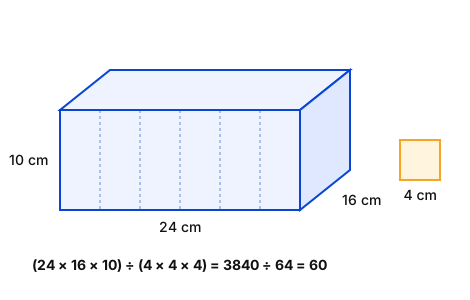
A solid cuboid with dimensions 24 cm × 16 cm × 10 cm is melted to form smaller solid cubes with sides of length 4 cm. Determine the number of cubes formed.
24 cm × 16 cm × 10 cm विमाओं वाले एक ठोस घनाभ को पिघलाकर 4 cm लंबाई की भुजाओं वाले छोटे ठोस घन बनाए जाते हैं। बनाए गए घनों की संख्या ज्ञात कीजिए।
  1. A60
  2. B64
  3. C68
  4. D62
Show answer

Concept: When a solid is melted and recast, volume is conserved: number of cubes =volume of cuboidvolume of one cube.

  1. Cuboid volume =24×16×10=3840cm3
  2. Cube volume =43=64cm3
  3. Number =384064=60

Trick: Cancel first: 24×16×104×4×4=6×4×2.5=60.

Answer: (A) 60

अवधारणा: पिघलाकर नया ठोस बनाने पर आयतन समान रहता है: घनों की संख्या =घनाभ का आयतनएक घन का आयतन।

  1. घनाभ का आयतन =24×16×10=3840cm3
  2. घन का आयतन =43=64cm3
  3. संख्या =384064=60

ट्रिक: पहले काटें: 24×16×104×4×4=6×4×2.5=60।

उत्तर: (A) 60

RRB NTPC Undergraduate CBT 1MathematicsMensuration – RecastingRRB NTPC Undergraduate CBT 1 2024 · 14 Aug Shift 2 →
Q2168.
The sum of the squares of two consecutive even natural numbers is 2740. The sum of the numbers is:
दो क्रमागत सम प्राकृतिक संख्याओं के वर्गों का योग 2740 है। संख्याओं का योग है:
  1. A74
  2. B80
  3. C70
  4. D88
Show answer

Concept: Two consecutive even numbers: x and x+2, each square roughly half of 2740.

  1. 27402=1370, and 1370≈37 → try 36 and 38
  2. 362+382=1296+1444=2740 ✓
  3. Sum =36+38=74

Trick: Sum ≈227402=2×37=74.

Answer: (A) 74

अवधारणा: दो क्रमागत सम संख्याएँ x और x+2; प्रत्येक का वर्ग लगभग 2740 का आधा।

  1. 27402=1370, 1370≈37 → 36 और 38 जाँचें
  2. 362+382=1296+1444=2740 ✓
  3. योग =74

ट्रिक: योग ≈227402=2×37=74।

उत्तर: (A) 74

RRB NTPC Undergraduate CBT 1MathematicsQuadratic – Number ProblemsRRB NTPC Undergraduate CBT 1 2024 · 14 Aug Shift 2 →
Q2169.
Read the given statements and conclusions carefully. Assuming that the information given in the statements is true, even if it appears to be at variance with commonly known facts, decide which of the given conclusions logically follow(s) from the statements.
Statements:
All lakes are ponds.
All ponds are rivers.
Conclusions:
(I): All lakes are rivers.
(II): All rivers are ponds.
दिए गए कथनों और निष्कर्षों को ध्यानपूर्वक पढ़िए। यह मानते हुए कि कथनों में दी गई जानकारी सत्य है, भले ही वह सामान्य रूप से ज्ञात तथ्यों से भिन्न प्रतीत होती हो, निर्णय कीजिए कि दिए गए निष्कर्षों में से कौन-सा/कौन-से निष्कर्ष तार्किक रूप से कथनों का अनुसरण करता है/करते हैं।
कथन:
सभी झीलें, तालाब हैं।
सभी तालाब, नदियाँ हैं।
निष्कर्ष:
(I): सभी झीलें, नदियाँ हैं।
(II): सभी नदियाँ, तालाब हैं।
  1. ANeither Conclusion I nor II followsन तो निष्कर्ष I और न ही II अनुसरण करता है
  2. BBoth Conclusions I and II followनिष्कर्ष I और II दोनों अनुसरण करते हैं
  3. COnly Conclusion I followsकेवल निष्कर्ष I अनुसरण करता है
  4. DOnly Conclusion II followsकेवल निष्कर्ष II अनुसरण करता है
Show answer

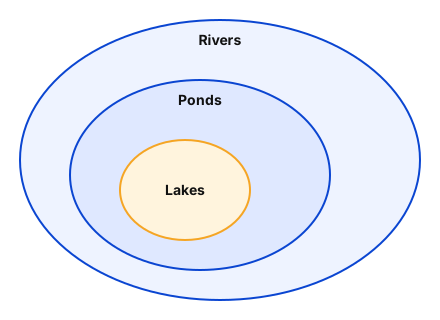
Concept: Two 'All' statements chain: All A are B + All B are C ⇒ All A are C. 'All' cannot be reversed.

  1. Lakes ⊂ Ponds ⊂ Rivers, so all lakes are rivers → I follows
  2. Rivers may be outside ponds, so 'All rivers are ponds' is not certain → II does not follow

Trick: 'All A are B' never gives 'All B are A' — only 'Some B are A'.

Answer: (C) Only Conclusion I follows

अवधारणा: दो 'सभी' कथन जुड़ते हैं: सभी A, B हैं + सभी B, C हैं ⇒ सभी A, C हैं। 'सभी' को उलटा नहीं कर सकते।

  1. Lakes ⊂ Ponds ⊂ Rivers, अतः सभी lakes, rivers हैं → I अनुसरण करता है
  2. कुछ rivers, ponds से बाहर हो सकती हैं → II निश्चित नहीं

ट्रिक: 'सभी A, B हैं' से 'सभी B, A हैं' कभी नहीं — केवल 'कुछ B, A हैं'।

उत्तर: (C) केवल निष्कर्ष I अनुसरण करता है

RRB NTPC Undergraduate CBT 1General Intelligence and ReasoningSyllogismRRB NTPC Undergraduate CBT 1 2024 · 14 Aug Shift 2 →
Q2170.
Based on the English alphabetical order, three of the following four letter-cluster pairs are alike in a certain way and thus form a group. Which letter-cluster pair DOES NOT belong to that group?
(Note: The odd one out is not based on the number of consonants/vowels or their position in the letter-cluster.)
अंग्रेज़ी वर्णमाला क्रम के आधार पर, निम्नलिखित चार अक्षर-समूह युग्मों में से तीन किसी निश्चित प्रकार से एकसमान हैं और इस प्रकार एक समूह बनाते हैं। कौन-सा अक्षर-समूह युग्म उस समूह से संबंधित नहीं है?
(ध्यान दें: असंगत अक्षर-समूह, उस अक्षर-समूह में व्यंजनों/स्वरों की संख्या या उनके स्थान पर आधारित नहीं है।)
  1. AJM-DH
  2. BHK-BF
  3. COR-IN
  4. DMP-GK
Show answer

Concept: Compare gaps inside each cluster using letter positions (A = 1 … Z = 26).

  1. JM-DH: J(10)→M(13) +3, D(4)→H(8) +4
  2. HK-BF: +3, +4; MP-GK: +3, +4
  3. OR-IN: O(15)→R(18) +3, but I(9)→N(14) +5 ✗

Trick: Pattern '+3 then +4' (and first letters −6) breaks only in OR-IN.

Answer: (C) OR-IN

अवधारणा: प्रत्येक समूह में अक्षरों का अंतर स्थान-मान (A = 1 … Z = 26) से देखें।

  1. JM-DH: J(10)→M(13) +3, D(4)→H(8) +4
  2. HK-BF और MP-GK: +3, +4
  3. OR-IN: +3, पर I(9)→N(14) +5 ✗

ट्रिक: '+3 फिर +4' (और पहले अक्षर −6) का पैटर्न केवल OR-IN में टूटता है।

उत्तर: (C) OR-IN

RRB NTPC Undergraduate CBT 1General Intelligence and ReasoningLetter-cluster Odd One OutRRB NTPC Undergraduate CBT 1 2024 · 14 Aug Shift 2 →
Q2171.
RBNH is related to KUGA in a certain way based on the English alphabetical order. In the same way, PZLF is related to ISEY. To which of the given options is UEQK related, following the same logic?
अंग्रेज़ी वर्णमाला क्रम के आधार पर RBNH एक निश्चित प्रकार से KUGA से संबंधित है। उसी प्रकार, PZLF, ISEY से संबंधित है। समान तर्क का अनुसरण करते हुए, UEQK दिए गए विकल्पों में से किससे संबंधित है?
  1. ANXJD
  2. BNXDJ
  3. CNDXJ
  4. DNDFR
Show answer

Concept: Find the position shift for each letter (A = 1 … Z = 26), wrapping around after A.

  1. R(18)→K(11), B(2)→U(21), N(14)→G(7), H(8)→A(1): each −7
  2. Check PZLF→ISEY: −7 each ✓
  3. UEQK: U(21)→N(14), E(5)→X(24), Q(17)→J(10), K(11)→D(4)

Trick: −7 is the same as +19; for letters before H, go back around from Z.

Answer: (A) NXJD

अवधारणा: प्रत्येक अक्षर का स्थान-परिवर्तन देखें (A = 1 … Z = 26), A के बाद Z पर लौटें।

  1. R→K, B→U, N→G, H→A: प्रत्येक −7
  2. PZLF→ISEY: प्रत्येक −7 ✓
  3. UEQK: U→N, E→X, Q→J, K→D

ट्रिक: −7 = +19; H से पहले के अक्षरों के लिए Z से पीछे गिनें।

उत्तर: (A) NXJD

RRB NTPC Undergraduate CBT 1General Intelligence and ReasoningLetter AnalogyRRB NTPC Undergraduate CBT 1 2024 · 14 Aug Shift 2 →
Q2172.
What should come in place of the question mark (?) in the given series?
2 12 32 62 102 ?
दी गई श्रृंखला में प्रश्न चिह्न (?) के स्थान पर क्या आना चाहिए?
2 12 32 62 102 ?
  1. A155
  2. B156
  3. C152
  4. D150
Show answer

Concept: Check differences between consecutive terms.

  1. Differences: 10, 20, 30, 40
  2. Next difference =50
  3. 102+50=152

Trick: Differences in an AP (+10 each time) → add the next multiple of 10.

Answer: (C) 152

अवधारणा: क्रमागत पदों का अंतर देखें।

  1. अंतर: 10, 20, 30, 40
  2. अगला अंतर =50
  3. 102+50=152

ट्रिक: अंतर समांतर श्रेणी में (+10) → अगला 10 का गुणज जोड़ें।

उत्तर: (C) 152

RRB NTPC Undergraduate CBT 1General Intelligence and ReasoningNumber SeriesRRB NTPC Undergraduate CBT 1 2024 · 14 Aug Shift 2 →
Q2173.
What should come in place of the question mark (?) in the given series?
3 3 4 6 9 ?
दी गई श्रृंखला में प्रश्न चिह्न (?) के स्थान पर क्या आना चाहिए?
3 3 4 6 9 ?
  1. A10
  2. B12
  3. C13
  4. D11
Show answer

Concept: Check differences between consecutive terms.

  1. Differences: 0, 1, 2, 3
  2. Next difference =4
  3. 9+4=13

Trick: Differences 0, 1, 2, 3, 4 — consecutive whole numbers.

Answer: (C) 13

अवधारणा: क्रमागत पदों का अंतर देखें।

  1. अंतर: 0, 1, 2, 3
  2. अगला अंतर =4
  3. 9+4=13

ट्रिक: अंतर 0, 1, 2, 3, 4 — क्रमागत पूर्ण संख्याएँ।

उत्तर: (C) 13

RRB NTPC Undergraduate CBT 1General Intelligence and ReasoningNumber SeriesRRB NTPC Undergraduate CBT 1 2024 · 14 Aug Shift 2 →
Q2174.
If 2 is added to each odd digit and 1 is subtracted from each even digit in the number 72518643, then what will be the difference between the first and the last digit in the number thus formed?
यदि संख्या 72518643 के प्रत्येक विषम अंक में 2 जोड़ा जाए और प्रत्येक सम अंक में से 1 घटाया जाए, तो इस प्रकार बनी संख्या के पहले और अंतिम अंक के बीच का अंतर क्या होगा?
  1. A2
  2. B6
  3. C8
  4. D4
Show answer

Concept: Apply the rule digit by digit: odd → +2, even → −1.

  1. 7 2 5 1 8 6 4 3 → 9 1 7 3 7 5 3 5
  2. First digit = 9, last digit = 5
  3. Difference =9−5=4

Trick: Only the first and last digits matter: 7 → 9 and 3 → 5.

Answer: (D) 4

अवधारणा: नियम हर अंक पर लगाएँ: विषम → +2, सम → −1।

  1. 7 2 5 1 8 6 4 3 → 9 1 7 3 7 5 3 5
  2. पहला अंक 9, अंतिम 5
  3. अंतर =9−5=4

ट्रिक: केवल पहले और अंतिम अंक बदलें: 7 → 9, 3 → 5।

उत्तर: (D) 4

RRB NTPC Undergraduate CBT 1General Intelligence and ReasoningDigit OperationsRRB NTPC Undergraduate CBT 1 2024 · 14 Aug Shift 2 →
Q2175.
What should come in place of the question mark (?) in the given series based on the English alphabetical order?
CNQ EPS GRU ITW ?
अंग्रेज़ी वर्णमाला क्रम के आधार पर दी गई श्रृंखला में प्रश्न चिह्न (?) के स्थान पर क्या आना चाहिए?
CNQ EPS GRU ITW ?
  1. AKVY
  2. BJUX
  3. CJVY
  4. DKUX
Show answer

Concept: Track each letter position separately.

  1. 1st letters: C, E, G, I → K (+2)
  2. 2nd letters: N, P, R, T → V (+2)
  3. 3rd letters: Q, S, U, W → Y (+2)

Trick: Every letter moves +2: ITW → KVY.

Answer: (A) KVY

अवधारणा: प्रत्येक स्थान के अक्षर अलग-अलग देखें।

  1. पहले अक्षर: C, E, G, I → K (+2)
  2. दूसरे: N, P, R, T → V (+2)
  3. तीसरे: Q, S, U, W → Y (+2)

ट्रिक: हर अक्षर +2: ITW → KVY।

उत्तर: (A) KVY

RRB NTPC Undergraduate CBT 1General Intelligence and ReasoningAlphabet SeriesRRB NTPC Undergraduate CBT 1 2024 · 14 Aug Shift 2 →
Q2176.
What should come in place of the question mark (?) in the given series?
15, 30, 60, 120, ?, 480
दी गई श्रृंखला में प्रश्न चिह्न (?) के स्थान पर क्या आना चाहिए?
15, 30, 60, 120, ?, 480
  1. A220
  2. B240
  3. C260
  4. D280
Show answer

Concept: Each term is double the previous one.

  1. 15×2=30, 30×2=60, 60×2=120
  2. 120×2=240
  3. Check: 240×2=480 ✓

Trick: Always verify the missing term with the term after it.

Answer: (B) 240

अवधारणा: हर पद पिछले का दोगुना है।

  1. 15×2=30, 60×2=120
  2. 120×2=240
  3. जाँच: 240×2=480 ✓

ट्रिक: लुप्त पद को अगले पद से अवश्य जाँचें।

उत्तर: (B) 240

RRB NTPC Undergraduate CBT 1General Intelligence and ReasoningNumber SeriesRRB NTPC Undergraduate CBT 1 2024 · 14 Aug Shift 2 →
Q2177.
Based on the English alphabetical order, three of the following four letter-cluster pairs are alike in a certain way and thus form a group. Which letter-cluster pair DOES NOT belong to that group?
(Note: The odd one out is not based on the number of consonants/vowels or their position in the letter-cluster.)
अंग्रेज़ी वर्णमाला क्रम के आधार पर, निम्नलिखित चार अक्षर-समूह युग्मों में से तीन किसी निश्चित प्रकार से एकसमान हैं और इस प्रकार एक समूह बनाते हैं। कौन-सा अक्षर-समूह युग्म उस समूह से संबंधित नहीं है?
(ध्यान दें: असंगत अक्षर-समूह, उस अक्षर-समूह में व्यंजनों/स्वरों की संख्या या उनके स्थान पर आधारित नहीं है।)
  1. APT-WR
  2. BRV-YT
  3. CKO-RM
  4. DBF-IC
Show answer

Concept: Use letter positions (A = 1 … Z = 26) within each pair.

  1. PT-WR: P(16)→T(20) +4, W(23)→R(18) −5
  2. RV-YT and KO-RM: +4 and −5 as well
  3. BF-IC: B(2)→F(6) +4, but I(9)→C(3) −6 ✗

Trick: Pattern '+4, then −5' (first letters +7) fails only in BF-IC.

Answer: (D) BF-IC

अवधारणा: हर जोड़ी में अक्षरों के स्थान-मान (A = 1 … Z = 26) देखें।

  1. PT-WR: +4, फिर W→R −5
  2. RV-YT और KO-RM: +4 और −5
  3. BF-IC: +4, पर I→C −6 ✗

ट्रिक: '+4, फिर −5' (पहले अक्षर +7) का पैटर्न केवल BF-IC में टूटता है।

उत्तर: (D) BF-IC

RRB NTPC Undergraduate CBT 1General Intelligence and ReasoningLetter-cluster Odd One OutRRB NTPC Undergraduate CBT 1 2024 · 14 Aug Shift 2 →
Q2178.
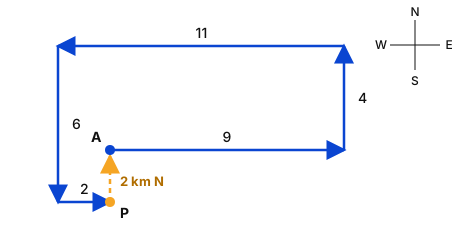
Hitesh starts from Point A and drives 9 km towards East. He then takes a left turn, drives 4 km, turns left and drives 11 km. He then takes a left turn and drives 6 km. He takes a final left turn, drives 2 km and stops at Point P. How far (shortest distance) and towards which direction should he drive in order to reach Point A again? (All turns are 90° turns only unless specified.)
हितेश बिंदु A से चलना शुरू करता है और पूर्व की ओर 9 km गाड़ी चलाता है। फिर वह बाएँ मुड़ता है, 4 km गाड़ी चलाता है, बाएँ मुड़ता है और 11 km गाड़ी चलाता है। फिर वह बाएँ मुड़ता है और 6 km गाड़ी चलाता है। वह अंतिम बार बाएँ मुड़ता है, 2 km गाड़ी चलाता है और बिंदु P पर रुक जाता है। बिंदु A पर फिर से पहुँचने के लिए उसे कितनी दूरी (न्यूनतम दूरी) तक और किस दिशा में गाड़ी चलानी चाहिए? (जब तक निर्दिष्ट न किया जाए, सभी मोड़ केवल 90° के मोड़ हैं।)
  1. A3 km to Southदक्षिण की ओर 3 km
  2. B2 km to Northउत्तर की ओर 2 km
  3. C3 km to Northउत्तर की ओर 3 km
  4. D2 km to Southदक्षिण की ओर 2 km
Show answer

Concept: Plot the path on axes (East = +x, North = +y); each left turn rotates 90° anticlockwise.

  1. A(0, 0) → 9 E → (9, 0) → left, 4 N → (9, 4)
  2. Left, 11 W → (−2, 4) → left, 6 S → (−2, −2)
  3. Left, 2 E → P(0, −2)
  4. A is 2 km straight north of P

Trick: Net E–W: 9−11+2=0; net N–S: 4−6=−2 → P is 2 km south of A, so go 2 km North.

Answer: (B) 2 km to North

अवधारणा: मार्ग को अक्षों पर बनाएँ (पूर्व = +x, उत्तर = +y); हर बायाँ मोड़ 90° वामावर्त।

  1. A(0, 0) → 9 पूर्व → (9, 0) → बाएँ, 4 उत्तर → (9, 4)
  2. बाएँ, 11 पश्चिम → (−2, 4) → बाएँ, 6 दक्षिण → (−2, −2)
  3. बाएँ, 2 पूर्व → P(0, −2)
  4. A, P से 2 km उत्तर में है

ट्रिक: शुद्ध पूर्व-पश्चिम: 9−11+2=0; उत्तर-दक्षिण: 4−6=−2 → 2 km उत्तर जाना होगा।

उत्तर: (B) 2 km उत्तर की ओर

RRB NTPC Undergraduate CBT 1General Intelligence and ReasoningDirection and DistanceRRB NTPC Undergraduate CBT 1 2024 · 14 Aug Shift 2 →
Q2179.
YUWT is related to UQSP in a certain way based on the English alphabetical order. In the same way, OKMJ is related to KGIF. To which of the following is LHJG related, following the same logic?
अंग्रेज़ी वर्णमाला क्रम के आधार पर YUWT एक निश्चित प्रकार से UQSP से संबंधित है। उसी प्रकार, OKMJ, KGIF से संबंधित है। समान तर्क का अनुसरण करते हुए, LHJG निम्नलिखित में से किससे संबंधित है?
  1. AHDEC
  2. BHCEC
  3. CHEEF
  4. DHDFC
Show answer

Concept: Find the shift for each letter position.

  1. Y→U, U→Q, W→S, T→P: each −4
  2. OKMJ→KGIF: each −4 ✓
  3. LHJG: L→H, H→D, J→F, G→C

Trick: Uniform shift −4 on every letter.

Answer: (D) HDFC

अवधारणा: हर अक्षर का स्थान-परिवर्तन देखें।

  1. Y→U, U→Q, W→S, T→P: प्रत्येक −4
  2. OKMJ→KGIF: प्रत्येक −4 ✓
  3. LHJG: L→H, H→D, J→F, G→C

ट्रिक: हर अक्षर पर समान −4 का परिवर्तन।

उत्तर: (D) HDFC

RRB NTPC Undergraduate CBT 1General Intelligence and ReasoningLetter AnalogyRRB NTPC Undergraduate CBT 1 2024 · 14 Aug Shift 2 →
Q2180.
Seven boxes F, G, H, M, N, O and P are kept one over the other but not necessarily in the same order.Only three boxes are kept above G. Only one box is kept between F and G. Only three boxes are kept between F and N. N is kept at some place above G. O is kept immediately below N. M is kept at one of the places above P. H is not kept immediately above or below F.
Which box is kept at the lowermost position?
सात बक्से F, G, H, M, N, O और P एक के ऊपर एक रखे गए हैं, परंतु आवश्यक नहीं कि इसी क्रम में हों। G के ऊपर केवल तीन बक्से रखे हैं। F और G के बीच केवल एक बक्सा रखा है। F और N के बीच केवल तीन बक्से रखे हैं। N, G के ऊपर किसी स्थान पर रखा है। O, N के ठीक नीचे रखा है। M, P के ऊपर के स्थानों में से किसी एक स्थान पर रखा है। H, F के ठीक ऊपर या ठीक नीचे नहीं रखा है।
सबसे नीचे के स्थान पर कौन-सा बक्सा रखा है?
  1. AF
  2. BP
  3. CM
  4. DH
Show answer

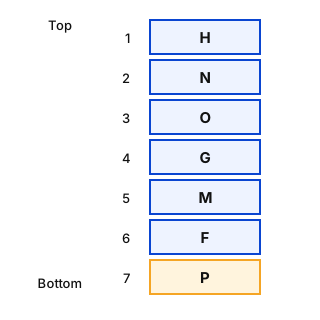
Concept: Number positions 1 (top) to 7 (bottom) and fix the definite clues first.

  1. Three boxes above G → G = 4; one box between F and G → F = 2 or 6
  2. Three between F and N and N above G → F = 6, N = 2; O just below N → O = 3
  3. Left: 1, 5, 7 for H, M, P; H not next to F (6) → H = 1
  4. M above P → M = 5, P = 7

Trick: Start with the exact-position clue (G = 4) and test both F cases.

Answer: (B) P

अवधारणा: स्थान 1 (ऊपर) से 7 (नीचे) तक मानें; पहले निश्चित संकेत लगाएँ।

  1. G के ऊपर तीन → G = 4; F और G के बीच एक → F = 2 या 6
  2. F और N के बीच तीन, N, G के ऊपर → F = 6, N = 2; O = 3
  3. शेष 1, 5, 7: H, F (6) के पास नहीं → H = 1
  4. M, P के ऊपर → M = 5, P = 7

ट्रिक: निश्चित स्थान वाले संकेत (G = 4) से शुरू करें और F के दोनों मामले जाँचें।

उत्तर: (B) P

RRB NTPC Undergraduate CBT 1General Intelligence and ReasoningBox ArrangementRRB NTPC Undergraduate CBT 1 2024 · 14 Aug Shift 2 →