Question bank

Q&A: practice questions with answers

Search questions on any topic. Filter by exam category, exam, subject and topic, try the question, then open the answer and explanation.

Courses – airGurukul

8,495 questions found.

Q2181.
In a certain code language, ‘HUGE’ is coded as ‘4627’ and ‘GIRL’ is coded as ‘1365’. What is the code for ‘G’ in the given code language?
एक निश्चित कूट भाषा में, ‘HUGE’ को ‘4627’ के रूप में कूटबद्ध किया जाता है और ‘GIRL’ को ‘1365’ के रूप में कूटबद्ध किया जाता है। दी गई कूट भाषा में ‘G’ के लिए कूट क्या है?
  1. A5
  2. B1
  3. C6
  4. D7
Show answer

Concept: A letter common to both words gets the digit common to both codes.

  1. HUGE = {4, 6, 2, 7}, GIRL = {1, 3, 6, 5}
  2. Common letter: G; common digit: 6
  3. So G = 6

Yaad rakhein: Common letter ↔ common number — order of digits does not matter.

Answer: (C) 6

अवधारणा: दोनों शब्दों में उभयनिष्ठ अक्षर का कोड दोनों कोडों का उभयनिष्ठ अंक होता है।

  1. HUGE = {4, 6, 2, 7}, GIRL = {1, 3, 6, 5}
  2. उभयनिष्ठ अक्षर G; उभयनिष्ठ अंक 6
  3. अतः G = 6

याद रखें: उभयनिष्ठ अक्षर ↔ उभयनिष्ठ अंक — अंकों का क्रम मायने नहीं रखता।

उत्तर: (C) 6
RRB NTPC Undergraduate CBT 1General Intelligence and ReasoningCoding-DecodingRRB NTPC Undergraduate CBT 1 2024 · 14 Aug Shift 2 →
Q2182.
Which of the following letter-number clusters will replace the question mark (?) in the given series to make it logically complete?
FDS 43 HGO 32 JJK 21 ? NPC -1
निम्नलिखित में से कौन-सा अक्षर-संख्या समूह दी गई श्रृंखला में प्रश्न चिह्न (?) को प्रतिस्थापित करके इसे तार्किक रूप से पूर्ण करेगा?
FDS 43 HGO 32 JJK 21 ? NPC -1
  1. ALKM 12
  2. BLMG 11
  3. CLMG 10
  4. DLMM 14
Show answer

Concept: Track each letter position and the number separately.

  1. 1st letters F, H, J, ?, N → L (+2)
  2. 2nd letters D, G, J, ?, P → M (+3)
  3. 3rd letters S, O, K, ?, C → G (−4)
  4. Numbers 43, 32, 21, ?, −1 → 10 (−11)

Trick: Number −11 each step quickly eliminates 12, 11 and 14.

Answer: (C) LMG 10

अवधारणा: प्रत्येक अक्षर-स्थान और संख्या अलग-अलग देखें।

  1. पहले अक्षर F, H, J, ?, N → L (+2)
  2. दूसरे D, G, J, ?, P → M (+3)
  3. तीसरे S, O, K, ?, C → G (−4)
  4. संख्याएँ 43, 32, 21, ?, −1 → 10 (−11)

ट्रिक: संख्या में −11 का नियम ही 12, 11, 14 को हटा देता है।

उत्तर: (C) LMG 10

RRB NTPC Undergraduate CBT 1General Intelligence and ReasoningLetter-Number SeriesRRB NTPC Undergraduate CBT 1 2024 · 14 Aug Shift 2 →
Q2183.
Select the set in which the numbers are related in the same way as are the numbers of the following sets.
(NOTE: Operations should be performed on the whole numbers, without breaking down the numbers into their constituent digits. E.g. 13 – Operations on 13 such as adding to/subtracting from/multiplying with 13 can be performed. Breaking down 13 into 1 and 3 and then performing mathematical operations on 1 and 3 is not allowed.)
(28, 336, 4)
(19, 285, 5)
उस समुच्चय का चयन कीजिए जिसमें संख्याएँ उसी प्रकार संबंधित हैं जिस प्रकार निम्नलिखित समुच्चयों की संख्याएँ संबंधित हैं।
(ध्यान दें: संख्याओं को उनके घटक अंकों में तोड़े बिना, संक्रियाएँ पूर्ण संख्याओं पर की जानी चाहिए। उदाहरण 13 – 13 पर की जाने वाली संक्रियाएँ, जैसे 13 में जोड़ना/13 में से घटाना/13 से गुणा करना आदि की जा सकती हैं। 13 को 1 और 3 में तोड़कर और फिर 1 और 3 पर गणितीय संक्रियाएँ करने की अनुमति नहीं है।)
(28, 336, 4)
(19, 285, 5)
  1. A(17, 265, 5)
  2. B(21, 341, 7)
  3. C(23, 414, 6)
  4. D(24, 298, 4)
Show answer

Concept: Find how the middle number is built from the outer two.

  1. 28×4×3=336; 19×5×3=285 → middle = first × third × 3
  2. (23, 414, 6): 23×6×3=414 ✓
  3. Others: 17×5×3=255, 21×7×3=441, 24×4×3=288 ✗

Trick: Divide the middle by the product of the outer numbers: always 3.

Answer: (C) (23, 414, 6)

अवधारणा: बीच की संख्या बाहरी दो से कैसे बनती है, खोजें।

  1. 28×4×3=336; 19×5×3=285 → बीच = पहली × तीसरी × 3
  2. (23, 414, 6): 23×6×3=414 ✓
  3. अन्य: 255, 441, 288 ≠ दिए गए ✗

ट्रिक: बीच की संख्या को बाहरी दोनों के गुणनफल से भाग दें: हमेशा 3।

उत्तर: (C) (23, 414, 6)

RRB NTPC Undergraduate CBT 1General Intelligence and ReasoningNumber Set AnalogyRRB NTPC Undergraduate CBT 1 2024 · 14 Aug Shift 2 →
Q2184.
In a row of 111 persons facing north, Mukesh is 19th from the left end. What is his position from the right end?
उत्तर की ओर मुख करके खड़े 111 व्यक्तियों की एक पंक्ति में, मुकेश बाएँ छोर से 19वें स्थान पर है। दाएँ छोर से उसका स्थान क्या है?
  1. A91
  2. B93
  3. C94
  4. D92
Show answer

Concept: Position from right = Total − position from left + 1.

  1. 111−19+1=93

Yaad rakhein: Left + Right − 1 = Total: 19+93−1=111 ✓.

Answer: (B) 93

अवधारणा: दाएँ से स्थान = कुल − बाएँ से स्थान + 1।

  1. 111−19+1=93

याद रखें: बाएँ + दाएँ − 1 = कुल: 19+93−1=111 ✓।

उत्तर: (B) 93

RRB NTPC Undergraduate CBT 1General Intelligence and ReasoningRanking and PositionRRB NTPC Undergraduate CBT 1 2024 · 14 Aug Shift 2 →
Q2185.
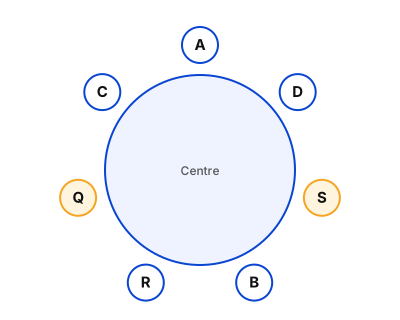
A, B, C, D, Q, R and S are sitting around a circular table, facing the centre of the table. Only two people sit between A and R, when counted from the right of A. Only two people sit between R and D. Only three people sit between A and B. C sits to the immediate left of Q. Who sits third to the left of S?
A, B, C, D, Q, R और S एक वृत्ताकार मेज़ के चारों ओर मेज़ के केंद्र की ओर मुख करके बैठे हैं। A के दाएँ से गिनने पर A और R के बीच केवल दो व्यक्ति बैठे हैं। R और D के बीच केवल दो व्यक्ति बैठे हैं। A और B के बीच केवल तीन व्यक्ति बैठे हैं। C, Q के ठीक बाएँ बैठा है। S के बाएँ से तीसरे स्थान पर कौन बैठा है?
  1. AD
  2. BQ
  3. CC
  4. DA
Show answer

Concept: Facing the centre, a person's left is clockwise and right is anticlockwise.

  1. Fix A; counting to A's right, two people in between → R is 4th to A's right
  2. Two between R and D → D is to A's immediate left; three between A and B → B sits between R and D
  3. Remaining three seats: C immediately left of Q → order (anticlockwise from A) C, Q, R; S sits next to D
  4. From S, going left (clockwise): B, R, Q → third to the left of S is Q

Trick: Draw the circle and place only fixed people first; fill pairs (C–Q) last.

Answer: (B) Q

अवधारणा: केंद्र की ओर मुख होने पर बायाँ = दक्षिणावर्त, दायाँ = वामावर्त।

  1. A को स्थिर करें; A के दाएँ गिनने पर बीच में दो → R, A के दाएँ चौथे स्थान पर
  2. R और D के बीच दो → D, A के ठीक बाएँ; A और B के बीच तीन → B, R और D के बीच
  3. शेष तीन स्थान: C, Q के ठीक बाएँ → A से दाएँ क्रम C, Q, R; S, D के पास
  4. S से बाएँ (दक्षिणावर्त): B, R, Q → S के बाएँ तीसरा Q

ट्रिक: पहले निश्चित व्यक्ति बैठाएँ, जोड़ी (C–Q) अंत में।

उत्तर: (B) Q

RRB NTPC Undergraduate CBT 1General Intelligence and ReasoningCircular SeatingRRB NTPC Undergraduate CBT 1 2024 · 14 Aug Shift 2 →
Q2186.
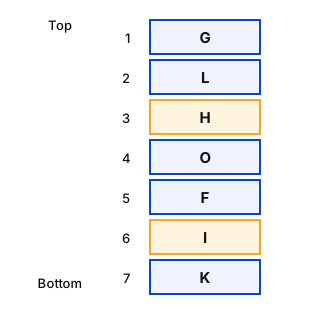
Seven boxes F, G, H, I, K, L and O are kept one over the other but not necessarily in the same order.
Only two boxes are kept between O and K. Only G is kept above L. No box is kept below K. F is kept at some place below H but at some place above I.
Which box is kept third above I?
सात बक्से F, G, H, I, K, L और O एक के ऊपर एक रखे गए हैं, परंतु आवश्यक नहीं कि इसी क्रम में हों।
O और K के बीच केवल दो बक्से रखे हैं। L के ऊपर केवल G रखा है। K के नीचे कोई बक्सा नहीं रखा है। F, H के नीचे किसी स्थान पर परंतु I के ऊपर किसी स्थान पर रखा है।
I के ऊपर तीसरे स्थान पर कौन-सा बक्सा रखा है?
  1. AH
  2. BF
  3. CK
  4. DO
Show answer

Concept: Number positions 1 (top) to 7 (bottom).

  1. Only G above L → G = 1, L = 2; nothing below K → K = 7
  2. Two boxes between O and K → O = 4
  3. F below H and above I in the free slots 3, 5, 6 → H = 3, F = 5, I = 6
  4. Third above I (6) is position 3 → H

Trick: 'Only X is above Y' fixes both X (top) and Y (second) at once.

Answer: (A) H

अवधारणा: स्थान 1 (ऊपर) से 7 (नीचे) तक मानें।

  1. केवल G, L के ऊपर → G = 1, L = 2; K के नीचे कोई नहीं → K = 7
  2. O और K के बीच दो → O = 4
  3. खाली 3, 5, 6 में H > F > I → H = 3, F = 5, I = 6
  4. I (6) से तीसरा ऊपर = स्थान 3 → H

ट्रिक: 'केवल X, Y के ऊपर' से X (सबसे ऊपर) और Y (दूसरा) दोनों तय।

उत्तर: (A) H

RRB NTPC Undergraduate CBT 1General Intelligence and ReasoningBox ArrangementRRB NTPC Undergraduate CBT 1 2024 · 14 Aug Shift 2 →
Q2187.
1 is subtracted from each even digit of the number 95423671. Find the number of digits that are repeated more than once in the new number formed.
संख्या 95423671 के प्रत्येक सम अंक में से 1 घटाया जाता है। इस प्रकार बनी नई संख्या में एक से अधिक बार आने वाले अंकों की संख्या ज्ञात कीजिए।
  1. ANoneकोई नहीं
  2. BOneएक
  3. CTwoदो
  4. DThreeतीन
Show answer

Concept: Change only the even digits, then count digits that appear more than once.

  1. Even digits 4, 2, 6 become 3, 1, 5
  2. 95423671 → 95313571
  3. Repeats: 5 (twice), 3 (twice), 1 (twice) → three digits

Trick: Write the new number fully before counting repeats.

Answer: (D) Three

अवधारणा: केवल सम अंक बदलें, फिर एक से अधिक बार आने वाले अंक गिनें।

  1. सम अंक 4, 2, 6 → 3, 1, 5
  2. 95423671 → 95313571
  3. दोहराए अंक: 5, 3, 1 → तीन

ट्रिक: गिनने से पहले नई संख्या पूरी लिख लें।

उत्तर: (D) तीन

RRB NTPC Undergraduate CBT 1General Intelligence and ReasoningDigit OperationsRRB NTPC Undergraduate CBT 1 2024 · 14 Aug Shift 2 →
Q2188.
If ‘I’ stands for ‘+’, ‘J’ stands for ‘×’, ‘K’ stands for ‘÷’ and ‘L’ stands for ‘−’, then what will come in place of the question mark (?) in the following equation?
29 I (23 J 5) L 23 J 10 I (420 K 4) I 89 = ?
यदि ‘I’ का अर्थ ‘+’, ‘J’ का अर्थ ‘×’, ‘K’ का अर्थ ‘÷’ और ‘L’ का अर्थ ‘−’ है, तो निम्नलिखित समीकरण में प्रश्न चिह्न (?) के स्थान पर क्या आएगा?
29 I (23 J 5) L 23 J 10 I (420 K 4) I 89 = ?
  1. A92
  2. B148
  3. C108
  4. D122
Show answer

Concept: Replace letters by signs (I = +, J = ×, K = ÷, L = −), then apply BODMAS.

  1. 29+(23×5)−23×10+(420÷4)+89
  2. =29+115−230+105+89
  3. =338−230=108

Trick: Do all × and ÷ first, then add positives and subtract negatives together.

Answer: (C) 108

अवधारणा: अक्षरों को चिह्नों से बदलें (I = +, J = ×, K = ÷, L = −), फिर BODMAS।

  1. 29+(23×5)−23×10+(420÷4)+89
  2. =29+115−230+105+89
  3. =338−230=108

ट्रिक: पहले सभी × और ÷, फिर धनात्मक का योग और ऋणात्मक घटाएँ।

उत्तर: (C) 108

RRB NTPC Undergraduate CBT 1General Intelligence and ReasoningMathematical OperationsRRB NTPC Undergraduate CBT 1 2024 · 14 Aug Shift 2 →
Q2189.
This question is based on the five, three-digit numbers given below.
(Left) 817 708 290 322 720 (Right)
(Example- 697 – First digit = 6, second digit = 9 and third digit = 7)
(NOTE: All operations to be done from left to right.)
If all the numbers are arranged in descending order, the position(s) of how many numbers will remain unchanged?
यह प्रश्न नीचे दी गई पाँच, तीन अंकों वाली संख्याओं पर आधारित है।
(बाएँ) 817 708 290 322 720 (दाएँ)
(उदाहरण- 697 – पहला अंक = 6, दूसरा अंक = 9 और तीसरा अंक = 7)
(ध्यान दें: सभी संक्रियाएँ बाएँ से दाएँ की जानी हैं।)
यदि सभी संख्याओं को अवरोही क्रम में व्यवस्थित किया जाए, तो कितनी संख्याओं का/के स्थान अपरिवर्तित रहेगा/रहेंगे?
  1. ATwoदो
  2. BFourचार
  3. CNoneकोई नहीं
  4. DOneएक
Show answer

Concept: Arrange in descending order and compare position by position.

  1. Original: 817, 708, 290, 322, 720
  2. Descending: 817, 720, 708, 322, 290
  3. Same place: 817 (1st) and 322 (4th) → two

Trick: Write the sorted list directly below the original and tick matches.

Answer: (A) Two

अवधारणा: घटते क्रम में लगाएँ और स्थानवार तुलना करें।

  1. मूल: 817, 708, 290, 322, 720
  2. घटता क्रम: 817, 720, 708, 322, 290
  3. समान स्थान: 817 (1st) और 322 (4th) → दो

ट्रिक: क्रमबद्ध सूची मूल के ठीक नीचे लिखकर मिलान करें।

उत्तर: (A) दो

RRB NTPC Undergraduate CBT 1General Intelligence and ReasoningNumber ArrangementRRB NTPC Undergraduate CBT 1 2024 · 14 Aug Shift 2 →
Q2190.
Based on the English alphabetical order, three of the following four letter-clusters are alike in a certain way and thus form a group. Which letter-cluster DOES NOT belong to that group?
(Note: The odd one out is not based on the number of consonants/vowels or their position in the letter-cluster.)
अंग्रेज़ी वर्णमाला क्रम के आधार पर, निम्नलिखित चार अक्षर-समूहों में से तीन किसी निश्चित प्रकार से एकसमान हैं और इस प्रकार एक समूह बनाते हैं। कौन-सा अक्षर-समूह उस समूह से संबंधित नहीं है?
(ध्यान दें: असंगत अक्षर-समूह, उस अक्षर-समूह में व्यंजनों/स्वरों की संख्या या उनके स्थान पर आधारित नहीं है।)
  1. AIMQ
  2. BNRV
  3. CKOS
  4. DMOU
Show answer

Concept: Check the gaps between consecutive letters.

  1. IMQ: +4, +4; NRV: +4, +4; KOS: +4, +4
  2. MOU: M→O +2, O→U +6 ✗

Trick: Three clusters have equal gaps of 4; MOU does not.

Answer: (D) MOU

अवधारणा: क्रमागत अक्षरों का अंतर देखें।

  1. IMQ, NRV, KOS: +4, +4
  2. MOU: +2, +6 ✗

ट्रिक: तीन समूहों में समान अंतर 4 है; MOU में नहीं।

उत्तर: (D) MOU

RRB NTPC Undergraduate CBT 1General Intelligence and ReasoningLetter-cluster Odd One OutRRB NTPC Undergraduate CBT 1 2024 · 14 Aug Shift 2 →
Q2191.
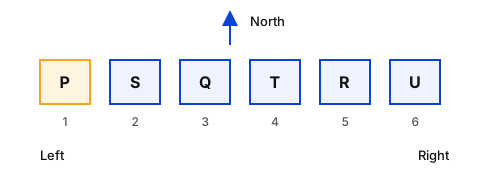
Six friends P, Q, R, S, T and U are sitting in a straight line, facing north. Q is an immediate neighbour of S and T. U sits to the immediate right of R. P sits third to the left of T. Neither S nor T sit on any of the extreme ends. Who sits at the extreme left end?
छह मित्र P, Q, R, S, T और U उत्तर की ओर मुख करके एक सीधी पंक्ति में बैठे हैं। Q, S और T दोनों का निकटतम पड़ोसी है। U, R के ठीक दाएँ बैठा है। P, T के बाएँ से तीसरे स्थान पर बैठा है। न तो S और न ही T किसी भी अंतिम छोर पर बैठा है। सबसे बाएँ छोर पर कौन बैठा है?
  1. AQ
  2. BR
  3. CU
  4. DP
Show answer

Concept: Facing north, left/right are the viewer's left/right; place definite clues first.

  1. P is third to the left of T and T is not at an end → T = 4 (P = 1) or T = 5 (P = 2)
  2. Q is between S and T, S not at an end: T = 4 → S = 2, Q = 3; then R U take 5, 6
  3. T = 5 would leave seats 1 and 6 for R and U (not adjacent) ✗
  4. Order: P S Q T R U → P at extreme left

Trick: Test both cases of the 'third to the left' clue; the R–U pair decides.

Answer: (D) P

अवधारणा: उत्तर की ओर मुख: बायाँ-दायाँ हमारे जैसा; पहले निश्चित संकेत लगाएँ।

  1. P, T के बाएँ तीसरा और T छोर पर नहीं → T = 4 (P = 1) या T = 5 (P = 2)
  2. Q, S और T के बीच, S छोर पर नहीं: T = 4 → S = 2, Q = 3; R U = 5, 6
  3. T = 5 में R, U के लिए 1 और 6 बचते हैं (पास नहीं) ✗
  4. क्रम: P S Q T R U → बाएँ छोर पर P

ट्रिक: 'तीसरा बाएँ' के दोनों मामले जाँचें; R–U जोड़ी निर्णय करती है।

उत्तर: (D) P

RRB NTPC Undergraduate CBT 1General Intelligence and ReasoningLinear SeatingRRB NTPC Undergraduate CBT 1 2024 · 14 Aug Shift 2 →
Q2192.
In the following triads, each group of letters is related to the subsequent one following a certain logic. Select from the given options, the one which follows the same logic. SOAL - ASOL - LAOS
MUGS - GMUS - SGUM
निम्नलिखित त्रिकों में, अक्षरों का प्रत्येक समूह एक निश्चित तर्क का अनुसरण करते हुए अपने बाद वाले समूह से संबंधित है। दिए गए विकल्पों में से उस विकल्प का चयन कीजिए जो समान तर्क का अनुसरण करता है। SOAL - ASOL - LAOS
MUGS - GMUS - SGUM
  1. AZOAL - AZOL - OALZ
  2. BBOND - BNOD - DNOB
  3. CRAIN - IRAN - NIAR
  4. DWIPE - IWPE - EIPW
Show answer

Concept: Track how letter positions move: step 1 takes the 3rd letter to the front; the third word is the first word reversed.

  1. SOAL → ASOL (3,1,2,4) → LAOS (reverse of SOAL)
  2. MUGS → GMUS → SGUM (reverse of MUGS) ✓
  3. RAIN → IRAN (3,1,2,4) → NIAR (reverse of RAIN) ✓
  4. ZOAL → AZOL → should be LAOZ, not OALZ ✗

Trick: Quick check: the 3rd word must be the 1st word read backwards.

Answer: (C) RAIN - IRAN - NIAR

अवधारणा: अक्षरों की स्थिति देखें: पहले चरण में तीसरा अक्षर आगे आता है; तीसरा शब्द पहले का उल्टा है।

  1. SOAL → ASOL (3,1,2,4) → LAOS (SOAL उल्टा)
  2. MUGS → GMUS → SGUM (MUGS उल्टा) ✓
  3. RAIN → IRAN → NIAR (RAIN उल्टा) ✓
  4. ZOAL → AZOL → LAOZ होना चाहिए, OALZ नहीं ✗

ट्रिक: त्वरित जाँच: तीसरा शब्द = पहला शब्द उल्टा।

उत्तर: (C) RAIN - IRAN - NIAR

RRB NTPC Undergraduate CBT 1General Intelligence and ReasoningLetter-cluster TriadsRRB NTPC Undergraduate CBT 1 2024 · 14 Aug Shift 2 →
Q2193.
This question is based on the five, three-digit numbers given below.
(Left) 427 615 253 961 743 (Right)
(Example- 697 – First digit = 6, second digit = 9 and third digit = 7)
(NOTE: All operations to be done from left to right.)
If all the numbers are arranged in ascending order, the position(s) of how many numbers will remain unchanged?
यह प्रश्न नीचे दी गई पाँच, तीन अंकों वाली संख्याओं पर आधारित है।
(बाएँ) 427 615 253 961 743 (दाएँ)
(उदाहरण- 697 – पहला अंक = 6, दूसरा अंक = 9 और तीसरा अंक = 7)
(ध्यान दें: सभी संक्रियाएँ बाएँ से दाएँ की जानी हैं।)
यदि सभी संख्याओं को आरोही क्रम में व्यवस्थित किया जाए, तो कितनी संख्याओं का/के स्थान अपरिवर्तित रहेगा/रहेंगे?
  1. A2
  2. B0
  3. C1
  4. D3
Show answer

Concept: Arrange in ascending order and compare position by position.

  1. Original: 427, 615, 253, 961, 743
  2. Ascending: 253, 427, 615, 743, 961
  3. No number stays in its place → 0

Trick: Write the sorted list below the original and compare column-wise.

Answer: (B) 0

अवधारणा: बढ़ते क्रम में लगाएँ और स्थानवार तुलना करें।

  1. मूल: 427, 615, 253, 961, 743
  2. बढ़ता क्रम: 253, 427, 615, 743, 961
  3. कोई संख्या अपने स्थान पर नहीं → 0

ट्रिक: क्रमबद्ध सूची मूल के नीचे लिखकर स्तंभवार मिलाएँ।

उत्तर: (B) 0

RRB NTPC Undergraduate CBT 1General Intelligence and ReasoningNumber ArrangementRRB NTPC Undergraduate CBT 1 2024 · 14 Aug Shift 2 →
Q2194.
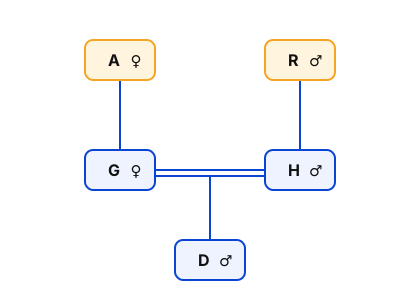
A is the mother of G. G is the mother of D. D is the son of H. R is the father of H. How is A related to R?
A, G की माता है। G, D की माता है। D, H का पुत्र है। R, H का पिता है। A का R से क्या संबंध है?
  1. AWife's sisterपत्नी की बहन
  2. BSon's wife's sisterपुत्र की पत्नी की बहन
  3. CSon's wife's motherपुत्र की पत्नी की माता
  4. DWife's motherपत्नी की माता
Show answer

Concept: Build the family tree; a son's father is the husband of his mother.

  1. G is mother of D and D is son of H → H is D's father, G's husband
  2. R is father of H → G is R's son's wife
  3. A is G's mother → A is R's son's wife's mother

Trick: Go step by step from R: son (H) → son's wife (G) → her mother (A).

Answer: (C) Son's wife's mother

अवधारणा: वंश-वृक्ष बनाएँ; बेटे की माँ का पति उसका पिता है।

  1. G, D की माँ और D, H का बेटा → H, G का पति
  2. R, H का पिता → G, R की बहू (बेटे की पत्नी)
  3. A, G की माँ → A, R के बेटे की पत्नी की माँ

ट्रिक: R से क्रम से चलें: बेटा (H) → बेटे की पत्नी (G) → उसकी माँ (A)।

उत्तर: (C) Son's wife's mother (बेटे की पत्नी की माँ)

RRB NTPC Undergraduate CBT 1General Intelligence and ReasoningBlood RelationsRRB NTPC Undergraduate CBT 1 2024 · 14 Aug Shift 2 →
Q2195.
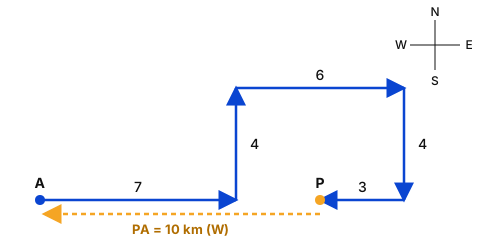
Satwik starts from Point A and drives 7 km towards east. He then takes a left turn, drives 4 km, turns right and drives 6 km. He then takes a right turn and drives 4 km. He takes a final right turn, drives 3 km and stops at Point P. How far (shortest distance) and towards which direction should he drive in order to reach Point A again? (All turns are 90° turns only unless specified.)
सात्विक बिंदु A से चलना शुरू करता है और पूर्व की ओर 7 km गाड़ी चलाता है। फिर वह बाएँ मुड़ता है, 4 km गाड़ी चलाता है, दाएँ मुड़ता है और 6 km गाड़ी चलाता है। फिर वह दाएँ मुड़ता है और 4 km गाड़ी चलाता है। वह अंतिम बार दाएँ मुड़ता है, 3 km गाड़ी चलाता है और बिंदु P पर रुक जाता है। बिंदु A पर फिर से पहुँचने के लिए उसे कितनी दूरी (न्यूनतम दूरी) तक और किस दिशा में गाड़ी चलानी चाहिए? (जब तक निर्दिष्ट न किया जाए, सभी मोड़ केवल 90° के मोड़ हैं।)
  1. A13 km towards westपश्चिम की ओर 13 km
  2. B13 km towards eastपूर्व की ओर 13 km
  3. C10 km towards westपश्चिम की ओर 10 km
  4. D10 km towards northउत्तर की ओर 10 km
Show answer

Concept: Plot the path (East = +x, North = +y); a left turn from East faces North, a right turn from North faces East.

  1. A(0, 0) → 7 E → (7, 0) → left, 4 N → (7, 4)
  2. Right, 6 E → (13, 4) → right, 4 S → (13, 0)
  3. Right, 3 W → P(10, 0)
  4. A is 10 km due west of P

Trick: North 4 and South 4 cancel; net East =7+6−3=10 → go 10 km West.

Answer: (C) 10 km towards west

अवधारणा: मार्ग बनाएँ (पूर्व = +x, उत्तर = +y)।

  1. A(0, 0) → 7 पूर्व → (7, 0) → बाएँ, 4 उत्तर → (7, 4)
  2. दाएँ, 6 पूर्व → (13, 4) → दाएँ, 4 दक्षिण → (13, 0)
  3. दाएँ, 3 पश्चिम → P(10, 0)
  4. A, P से 10 km पश्चिम में

ट्रिक: उत्तर 4 व दक्षिण 4 कट जाते हैं; शुद्ध पूर्व =7+6−3=10 → 10 km पश्चिम।

उत्तर: (C) 10 km पश्चिम की ओर

RRB NTPC Undergraduate CBT 1General Intelligence and ReasoningDirection and DistanceRRB NTPC Undergraduate CBT 1 2024 · 14 Aug Shift 2 →
Q2196.
Each of the digits in the number 4385612 is arranged in the ascending order from left to right. The position(s) of how many digits will remain unchanged as compared to that in the original number?
संख्या 4385612 के प्रत्येक अंक को बाएँ से दाएँ आरोही क्रम में व्यवस्थित किया जाता है। मूल संख्या की तुलना में कितने अंकों का/के स्थान अपरिवर्तित रहेगा/रहेंगे?
  1. ATwoदो
  2. BNoneकोई नहीं
  3. COneएक
  4. DThreeतीन
Show answer

Concept: Sort the digits and compare each position with the original.

  1. Original: 4 3 8 5 6 1 2
  2. Ascending: 1 2 3 4 5 6 8
  3. No position has the same digit → none

Trick: Compare column-by-column; one mismatch per place is enough to rule it out.

Answer: (B) None

अवधारणा: अंकों को क्रमबद्ध करें और हर स्थान की मूल से तुलना करें।

  1. मूल: 4 3 8 5 6 1 2
  2. बढ़ता क्रम: 1 2 3 4 5 6 8
  3. किसी स्थान पर समान अंक नहीं → कोई नहीं

ट्रिक: स्तंभवार तुलना करें।

उत्तर: (B) None (कोई नहीं)

RRB NTPC Undergraduate CBT 1General Intelligence and ReasoningDigit ArrangementRRB NTPC Undergraduate CBT 1 2024 · 14 Aug Shift 2 →
Q2197.
In a certain code language, ‘YOUR’ is coded as ‘2467’ and ‘OPEN’ is coded as ‘1536’. What is the code for ‘O’ in that language?
एक निश्चित कूट भाषा में, ‘YOUR’ को ‘2467’ के रूप में कूटबद्ध किया जाता है और ‘OPEN’ को ‘1536’ के रूप में कूटबद्ध किया जाता है। उस भाषा में ‘O’ के लिए कूट क्या है?
  1. A3
  2. B1
  3. C6
  4. D4
Show answer

Concept: A letter common to both words gets the digit common to both codes.

  1. YOUR = {2, 4, 6, 7}, OPEN = {1, 5, 3, 6}
  2. Common letter: O; common digit: 6
  3. So O = 6

Yaad rakhein: Common letter ↔ common number.

Answer: (C) 6

अवधारणा: उभयनिष्ठ अक्षर का कोड दोनों कोडों का उभयनिष्ठ अंक होता है।

  1. YOUR = {2, 4, 6, 7}, OPEN = {1, 5, 3, 6}
  2. उभयनिष्ठ अक्षर O; उभयनिष्ठ अंक 6
  3. अतः O = 6

याद रखें: उभयनिष्ठ अक्षर ↔ उभयनिष्ठ अंक।

उत्तर: (C) 6

RRB NTPC Undergraduate CBT 1General Intelligence and ReasoningCoding-DecodingRRB NTPC Undergraduate CBT 1 2024 · 14 Aug Shift 2 →
Q2198.
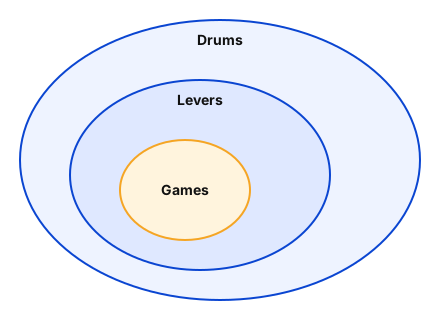
Read the given statements and conclusions carefully. Assuming that the information given in the statements is true, even if it appears to be at variance with commonly known facts, decide which of the given conclusion(s) logically follow(s) from the statements.
Statements:
All games are levers.
All levers are drums.
Conclusions:
(I) Some drums are levers.
(II) All games are drums.
दिए गए कथनों और निष्कर्षों को ध्यानपूर्वक पढ़िए। यह मानते हुए कि कथनों में दी गई जानकारी सत्य है, भले ही वह सामान्य रूप से ज्ञात तथ्यों से भिन्न प्रतीत होती हो, निर्णय कीजिए कि दिए गए निष्कर्षों में से कौन-सा/कौन-से निष्कर्ष तार्किक रूप से कथनों का अनुसरण करता है/करते हैं।
कथन:
सभी खेल, लीवर हैं।
सभी लीवर, ड्रम हैं।
निष्कर्ष:
(I) कुछ ड्रम, लीवर हैं।
(II) सभी खेल, ड्रम हैं।
  1. ABoth conclusions (I) and (II) follow.निष्कर्ष (I) और (II) दोनों अनुसरण करते हैं।
  2. BNeither conclusion (I) nor (II) follows.न तो निष्कर्ष (I) और न ही (II) अनुसरण करता है।
  3. COnly conclusion (II) follows.केवल निष्कर्ष (II) अनुसरण करता है।
  4. DOnly conclusion (I) follows.केवल निष्कर्ष (I) अनुसरण करता है।
Show answer

Concept: All A are B + All B are C ⇒ All A are C; and 'All A are B' also gives 'Some B are A'.

  1. Games ⊂ Levers ⊂ Drums → all games are drums: II follows
  2. All levers are drums → some drums are levers: I follows

Trick: An 'All' statement can always be converted to 'Some' in reverse.

Answer: (A) Both conclusions (I) and (II) follow.

अवधारणा: सभी A, B + सभी B, C ⇒ सभी A, C; और 'सभी A, B हैं' से 'कुछ B, A हैं'।

  1. Games ⊂ Levers ⊂ Drums → सभी games, drums हैं: II अनुसरण करता है
  2. सभी levers, drums हैं → कुछ drums, levers हैं: I अनुसरण करता है

ट्रिक: 'सभी' कथन को उलटकर 'कुछ' बनाया जा सकता है।

उत्तर: (A) दोनों निष्कर्ष (I) और (II) अनुसरण करते हैं

RRB NTPC Undergraduate CBT 1General Intelligence and ReasoningSyllogismRRB NTPC Undergraduate CBT 1 2024 · 14 Aug Shift 2 →
Q2199.
Rabindranath Tagore's "Geetanjali," which was awarded the Nobel Prize in 1913, is best classified as which form of writing?
रवीन्द्रनाथ टैगोर की "गीतांजलि", जिसे 1913 में नोबेल पुरस्कार से सम्मानित किया गया था, को लेखन के किस रूप में सबसे उपयुक्त रूप से वर्गीकृत किया जा सकता है?
  1. AA collection of short storiesलघु कथाओं का संग्रह
  2. BA playएक नाटक
  3. CA collection of poetryकविताओं का संग्रह
  4. DA novelएक उपन्यास
Show answer

Concept: Gitanjali is a collection of devotional poems (song offerings) by Rabindranath Tagore.

  1. Tagore translated his Bengali poems into English as Gitanjali: Song Offerings (1912).
  2. For this work he became the first Asian to win the Nobel Prize in Literature in 1913.
  3. It is neither a novel (e.g., Gora) nor a play (e.g., Dak Ghar).

Trick: Gitanjali = "Geet" (song) + "Anjali" (offering) → poems/songs.

Answer: (C) A collection of poetry

अवधारणा: गीतांजलि रवीन्द्रनाथ टैगोर की भक्तिपूर्ण कविताओं (गीतों) का संग्रह है।

  1. टैगोर ने अपनी बांग्ला कविताओं का अंग्रेज़ी अनुवाद Gitanjali: Song Offerings (1912) के रूप में किया।
  2. इसी के लिए 1913 में वे साहित्य का नोबेल पुरस्कार पाने वाले पहले एशियाई बने।
  3. यह उपन्यास (जैसे गोरा) या नाटक (जैसे डाक घर) नहीं है।

ट्रिक: गीतांजलि = "गीत" + "अंजलि" (भेंट) → गीतों/कविताओं का संग्रह।

उत्तर: (C) कविताओं का संग्रह

RRB NTPC Undergraduate CBT 1General AwarenessLiterature – Nobel PrizeRRB NTPC Undergraduate CBT 1 2024 · 14 Aug Shift 1 →
Q2200.
India participated in the 9th BRICS Industry Ministers' Meeting held on 21 May 2025, under the Chairmanship of which country?
भारत ने 21 मई 2025 को आयोजित 9वीं ब्रिक्स (BRICS) उद्योग मंत्रियों की बैठक में भाग लिया, यह बैठक किस देश की अध्यक्षता में आयोजित की गई थी?
  1. ARussiaरूस
  2. BSouth Africaदक्षिण अफ्रीका
  3. CBrazilब्राज़ील
  4. DUAEसंयुक्त अरब अमीरात (UAE)
Show answer

Concept: The country holding the BRICS chairship for the year hosts the ministerial meetings.

  1. Brazil holds the BRICS Chairship in 2025.
  2. The 9th BRICS Industry Ministers' Meeting was held in Brasília on 21 May 2025, and India took part.
  3. Russia chaired BRICS in 2024 and South Africa in 2023, so they do not fit 2025.

Trick: BRICS 2025 chair → Brazil (the "B" of BRICS); 2026 → India.

Answer: (C) Brazil

अवधारणा: जिस देश के पास उस वर्ष ब्रिक्स की अध्यक्षता होती है, वही मंत्रिस्तरीय बैठकों की मेज़बानी करता है।

  1. 2025 में ब्रिक्स की अध्यक्षता ब्राज़ील के पास है।
  2. 9वीं ब्रिक्स उद्योग मंत्रियों की बैठक 21 मई 2025 को ब्रासीलिया में हुई, जिसमें भारत ने भाग लिया।
  3. रूस ने 2024 में और दक्षिण अफ्रीका ने 2023 में अध्यक्षता की थी।

ट्रिक: ब्रिक्स 2025 अध्यक्ष → ब्राज़ील; 2026 → भारत।

उत्तर: (C) ब्राज़ील

RRB NTPC Undergraduate CBT 1General AwarenessCurrent Affairs – BRICSRRB NTPC Undergraduate CBT 1 2024 · 14 Aug Shift 1 →