Question bank

Q&A: practice questions with answers

Search questions on any topic. Filter by exam category, exam, subject and topic, try the question, then open the answer and explanation.

Courses – airGurukul

8,495 questions found.

Q2281.
HDLI is related to FBJG in a certain way based on the English alphabetical order. In the same way, KGOL is related to IEMJ. To which of the given options is NJRO related, following the same logic?
अंग्रेज़ी वर्णमाला क्रम के आधार पर HDLI एक निश्चित प्रकार से FBJG से संबंधित है। उसी प्रकार, KGOL, IEMJ से संबंधित है। समान तर्क का अनुसरण करते हुए, NJRO दिए गए विकल्पों में से किससे संबंधित है?
  1. ALHPM
  2. BLHMP
  3. CHLPM
  4. DHLMP
Show answer

Concept: Find the shift for each letter.

  1. HDLI → FBJG: each letter −2. KGOL → IEMJ: each −2.
  2. NJRO → N−2 = L, J−2 = H, R−2 = P, O−2 = M.
  3. Code = LHPM.

Trick: Same shift for all letters — move each 2 steps back.

Answer: (A) LHPM

अवधारणा: हर अक्षर का खिसकाव देखें।

  1. HDLI → FBJG: हर अक्षर −2। KGOL → IEMJ: हर अक्षर −2।
  2. NJRO → N−2 = L, J−2 = H, R−2 = P, O−2 = M।
  3. कोड = LHPM।

ट्रिक: सभी अक्षरों का खिसकाव समान — हर अक्षर 2 पीछे।

उत्तर: (A) LHPM
RRB NTPC Undergraduate CBT 1General Intelligence and ReasoningLetter CodingRRB NTPC Undergraduate CBT 1 2024 · 14 Aug Shift 1 →
Q2282.
Based on the English alphabetical order, three of the following four letter-clusters are alike in a certain way and thus form a group. Which letter-cluster DOES NOT belong to that group? (Note: The odd one out is not based on the number of consonants/vowels or their position in the letter-cluster.)
अंग्रेज़ी वर्णमाला क्रम के आधार पर, निम्नलिखित चार अक्षर-समूहों में से तीन किसी निश्चित प्रकार से एकसमान हैं और इस प्रकार एक समूह बनाते हैं। कौन-सा अक्षर-समूह उस समूह से संबंधित नहीं है? (ध्यान दें: असंगत का चयन व्यंजनों/स्वरों की संख्या या अक्षर-समूह में उनकी स्थिति पर आधारित नहीं है।)
  1. ASXR
  2. BLQK
  3. CNSL
  4. DQVP
Show answer

Concept: Relate the 2nd and 3rd letters to the 1st letter.

  1. SXR: S+5 = X, S−1 = R. LQK: L+5 = Q, L−1 = K. QVP: Q+5 = V, Q−1 = P.
  2. NSL: N+5 = S, but N−2 = L ✗.

Trick: The pattern “+5, −1 from the first letter” fails only in NSL.

Answer: (C) NSL

अवधारणा: दूसरे और तीसरे अक्षर को पहले अक्षर से जोड़ें।

  1. SXR: S+5 = X, S−1 = R। LQK: L+5 = Q, L−1 = K। QVP: Q+5 = V, Q−1 = P।
  2. NSL: N+5 = S, पर N−2 = L ✗।

ट्रिक: पैटर्न “पहले अक्षर से +5, −1” केवल NSL में टूटता है।

उत्तर: (C) NSL

RRB NTPC Undergraduate CBT 1General Intelligence and ReasoningLetter-Cluster Odd One OutRRB NTPC Undergraduate CBT 1 2024 · 14 Aug Shift 1 →
Q2283.
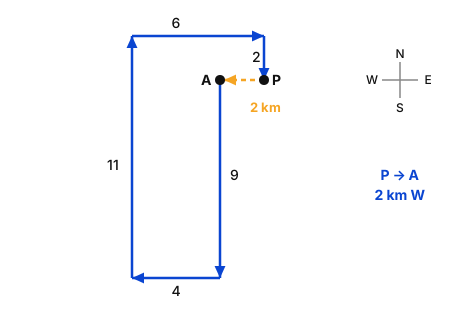
Gautam starts from Point A and drives 9 km towards south. He then takes a right turn, drives 4 km, turns right and drives 11 km. He then takes a right turn and drives 6 km. He takes a final right turn, drives 2 km and stops at Point P. How far (shortest distance) and towards which direction should he drive in order to reach Point A again? (All turns are 90° turns only unless specified.)
गौतम बिंदु A से चलना शुरू करता है और दक्षिण की ओर 9 km गाड़ी चलाता है। फिर वह दाएँ मुड़ता है, 4 km गाड़ी चलाता है, दाएँ मुड़ता है और 11 km गाड़ी चलाता है। फिर वह दाएँ मुड़ता है और 6 km गाड़ी चलाता है। वह अंतिम बार दाएँ मुड़ता है, 2 km गाड़ी चलाता है और बिंदु P पर रुक जाता है। बिंदु A पर फिर से पहुँचने के लिए उसे कितनी दूर (न्यूनतम दूरी) और किस दिशा में गाड़ी चलानी चाहिए? (जब तक निर्दिष्ट न हो, सभी मोड़ केवल 90° के मोड़ हैं।)
  1. A2 km to eastपूर्व की ओर 2 km
  2. B2 km to westपश्चिम की ओर 2 km
  3. C3 km to westपश्चिम की ओर 3 km
  4. D3 km to eastपूर्व की ओर 3 km
Show answer

Concept: Track the position on a grid, taking A as origin (East +x, North +y).

  1. 9 km south → (0, −9). Right (facing south → west) 4 km → (−4, −9).
  2. Right → north 11 km → (−4, 2). Right → east 6 km → (2, 2).
  3. Right → south 2 km → P = (2, 0). A is 2 km to the west of P.

Trick: Net N–S: −9+11−2=0; net E–W: −4+6=+2 (east) → return 2 km west.

Answer: (B) 2 km to west

अवधारणा: A को मूल बिंदु मानकर ग्रिड पर स्थिति ट्रैक करें (पूर्व +x, उत्तर +y)।

  1. 9 km दक्षिण → (0, −9)। दाएँ (दक्षिण की ओर मुख → पश्चिम) 4 km → (−4, −9)।
  2. दाएँ → उत्तर 11 km → (−4, 2)। दाएँ → पूर्व 6 km → (2, 2)।
  3. दाएँ → दक्षिण 2 km → P = (2, 0)। A, P से 2 km पश्चिम में है।

ट्रिक: कुल उत्तर–दक्षिण: −9+11−2=0; कुल पूर्व–पश्चिम: −4+6=+2 (पूर्व) → 2 km पश्चिम लौटें।

उत्तर: (B) 2 km पश्चिम

RRB NTPC Undergraduate CBT 1General Intelligence and ReasoningDirection and DistanceRRB NTPC Undergraduate CBT 1 2024 · 14 Aug Shift 1 →
Q2284.
Which of the following letter-number clusters will replace the question mark (?) in the given series to make it logically complete?
ZY 43 VU 40 RQ 35 NM 28 ?
निम्नलिखित में से कौन-सा अक्षर-संख्या समूह दी गई श्रृंखला में प्रश्न चिह्न (?) को प्रतिस्थापित करके उसे तार्किक रूप से पूर्ण करेगा?
ZY 43 VU 40 RQ 35 NM 28 ?
  1. AJI 19
  2. BJI 18
  3. CKJ 18
  4. DKJ 19
Show answer

Concept: Treat the letter pairs and the numbers as two separate series.

  1. Letters: ZY, VU, RQ, NM → each pair moves 4 back → JI.
  2. Numbers: 43, 40, 35, 28 → differences −3,−5,−7 → next −9.
  3. 28−9=19 → JI 19.

Trick: Odd-number differences (3, 5, 7, 9) are a common pattern.

Answer: (A) JI 19

अवधारणा: अक्षर-जोड़े और संख्याओं को दो अलग श्रृंखलाएँ मानें।

  1. अक्षर: ZY, VU, RQ, NM → हर जोड़ा 4 पीछे → JI।
  2. संख्याएँ: 43, 40, 35, 28 → अंतर −3,−5,−7 → अगला −9।
  3. 28−9=19 → JI 19।

ट्रिक: विषम संख्याओं का अंतर (3, 5, 7, 9) आम पैटर्न है।

उत्तर: (A) JI 19

RRB NTPC Undergraduate CBT 1General Intelligence and ReasoningLetter-Number SeriesRRB NTPC Undergraduate CBT 1 2024 · 14 Aug Shift 1 →
Q2285.
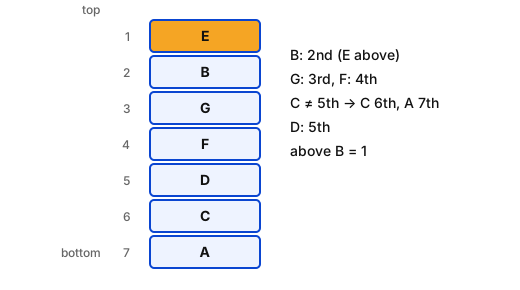
Seven boxes A, B, C, D, E, F and G are kept one over the other but not necessarily in the same order. G is kept immediately above F. C is kept immediately above A. Only E is kept above B. Only two boxes are kept above G. C is not kept at the third position from the bottom. How many boxes are kept above B?
सात बक्से A, B, C, D, E, F और G एक के ऊपर एक रखे गए हैं, लेकिन आवश्यक नहीं कि इसी क्रम में हों। G को F के ठीक ऊपर रखा गया है। C को A के ठीक ऊपर रखा गया है। B के ऊपर केवल E रखा गया है। G के ऊपर केवल दो बक्से रखे गए हैं। C को नीचे से तीसरे स्थान पर नहीं रखा गया है। B के ऊपर कितने बक्से रखे गए हैं?
  1. A1
  2. B4
  3. C3
  4. D2
Show answer

Concept: Number positions 1 (top) to 7 (bottom) and place fixed clues first.

  1. Only E above B → E = 1, B = 2. Two boxes above G → G = 3; F immediately below → F = 4.
  2. C immediately above A in 5–6 or 6–7; C ≠ 5th (3rd from bottom) → C = 6, A = 7, D = 5.
  3. Boxes above B: only E → 1.

Trick: “Only X above Y” fixes both: X at top, Y second.

Answer: (A) 1

अवधारणा: स्थान 1 (ऊपर) से 7 (नीचे) तक मानें और पहले निश्चित सूचनाएँ लगाएँ।

  1. केवल E, B के ऊपर → E = 1, B = 2। G के ऊपर दो बॉक्स → G = 3; F ठीक नीचे → F = 4।
  2. C ठीक A के ऊपर, 5–6 या 6–7 में; C 5वें (नीचे से तीसरे) पर नहीं → C = 6, A = 7, D = 5।
  3. B के ऊपर: केवल E → 1।

ट्रिक: “केवल X, Y के ऊपर” से दोनों तय: X सबसे ऊपर, Y दूसरे।

उत्तर: (A) 1

RRB NTPC Undergraduate CBT 1General Intelligence and ReasoningBox ArrangementRRB NTPC Undergraduate CBT 1 2024 · 14 Aug Shift 1 →
Q2286.
Read the given statement(s) and conclusions carefully. Assuming that the information given in the statement(s) is true, even if it appears to be at variance with commonly known facts, decide which of the given conclusions logically follow(s) from the statement(s).
Statements:
All buckets are mugs.
All mugs are cans.
Conclusions:
(I) Some cans are mugs.
(II) All buckets are cans.
दिए गए कथन/कथनों और निष्कर्षों को ध्यानपूर्वक पढ़िए। यह मानते हुए कि कथन/कथनों में दी गई जानकारी सत्य है, भले ही वह सामान्यतः ज्ञात तथ्यों से भिन्न प्रतीत होती हो, निर्णय कीजिए कि दिए गए निष्कर्षों में से कौन-सा/कौन-से निष्कर्ष तार्किक रूप से कथन/कथनों का अनुसरण करता है/करते हैं।
कथन:
सभी बाल्टियाँ, मग हैं।
सभी मग, डिब्बे हैं।
निष्कर्ष:
(I) कुछ डिब्बे, मग हैं।
(II) सभी बाल्टियाँ, डिब्बे हैं।
  1. ANeither conclusion (I) nor (II) follows.न तो निष्कर्ष (I) और न ही (II) अनुसरण करता है।
  2. BBoth conclusions (I) and (II) follow.निष्कर्ष (I) और (II) दोनों अनुसरण करते हैं।
  3. COnly conclusion (I) follows.केवल निष्कर्ष (I) अनुसरण करता है।
  4. DOnly conclusion (II) follows.केवल निष्कर्ष (II) अनुसरण करता है।
Show answer

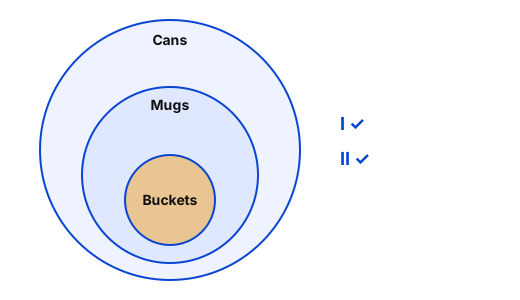
Concept: Draw nested circles: Buckets inside Mugs inside Cans.

  1. All mugs are cans → some cans are mugs (conversion of “All”) → I follows.
  2. All buckets are mugs + all mugs are cans → all buckets are cans → II follows.

Trick: All A are B + All B are C ⇒ All A are C; and “All B are C” ⇒ “Some C are B”.

Answer: (B) Both conclusions (I) and (II) follow.

अवधारणा: नेस्टेड वृत्त बनाएँ: बाल्टियाँ (Buckets) मग (Mugs) के अंदर, मग डिब्बों (Cans) के अंदर।

  1. सभी मग डिब्बे हैं → कुछ डिब्बे मग हैं (“सभी” का परिवर्तन) → I अनुसरण करता है।
  2. सभी बाल्टियाँ मग + सभी मग डिब्बे → सभी बाल्टियाँ डिब्बे → II अनुसरण करता है।

ट्रिक: सभी A, B + सभी B, C ⇒ सभी A, C; और “सभी B, C” ⇒ “कुछ C, B”।

उत्तर: (B) निष्कर्ष (I) और (II) दोनों अनुसरण करते हैं।

RRB NTPC Undergraduate CBT 1General Intelligence and ReasoningSyllogismRRB NTPC Undergraduate CBT 1 2024 · 14 Aug Shift 1 →
Q2287.
This question is based on the five, three-digit numbers given below.
(Left) 629 189 586 643 746 (Right)
(Example- 697 – First digit = 6, second digit = 9 and third digit = 7)
(NOTE: All operations to be done from left to right.)
If 2 is added to the first digit of every number, in how many numbers thus formed will the first digit be exactly divisible by the second digit?
यह प्रश्न नीचे दी गई तीन अंकों वाली पाँच संख्याओं पर आधारित है।
(बाएँ) 629 189 586 643 746 (दाएँ)
(उदाहरण- 697 – पहला अंक = 6, दूसरा अंक = 9 और तीसरा अंक = 7)
(ध्यान दें: सभी संक्रियाएँ बाएँ से दाएँ की जानी हैं।)
यदि प्रत्येक संख्या के पहले अंक में 2 जोड़ दिया जाए, तो इस प्रकार बनी कितनी संख्याओं में पहला अंक दूसरे अंक से पूर्णतः विभाज्य होगा?
  1. AThreeतीन
  2. BNoneकोई नहीं
  3. CTwoदो
  4. DOneएक
Show answer

Concept: Add 2 to the first digit only, then test first digit ÷ second digit.

  1. 629 → 829: 8÷2=4 ✓. 189 → 389: 3 not divisible by 8 ✗.
  2. 586 → 786: 7 not divisible by 8 ✗. 643 → 843: 8÷4=2 ✓.
  3. 746 → 946: 9 not divisible by 4 ✗. Total = 2.

Trick: Only the first digit changes; the second digit stays as given.

Answer: (C) Two

अवधारणा: केवल पहले अंक में 2 जोड़ें, फिर पहला अंक ÷ दूसरा अंक जाँचें।

  1. 629 → 829: 8÷2=4 ✓। 189 → 389: 3, 8 से विभाज्य नहीं ✗।
  2. 586 → 786: 7, 8 से विभाज्य नहीं ✗। 643 → 843: 8÷4=2 ✓।
  3. 746 → 946: 9, 4 से विभाज्य नहीं ✗। कुल = 2।

ट्रिक: केवल पहला अंक बदलता है; दूसरा अंक वही रहता है।

उत्तर: (C) दो

RRB NTPC Undergraduate CBT 1General Intelligence and ReasoningThree-Digit Number PuzzleRRB NTPC Undergraduate CBT 1 2024 · 14 Aug Shift 1 →
Q2288.
In a certain code language, ‘BORN’ is coded as ‘3257’ and ‘RIPE’ is coded as ‘6142’. What is the code for ‘R’ in the given code language?
एक निश्चित कूट भाषा में, 'BORN' को '3257' और 'RIPE' को '6142' के रूप में कूटबद्ध किया जाता है। दी गई कूट भाषा में 'R' के लिए कूट क्या है?
  1. A5
  2. B6
  3. C4
  4. D2
Show answer

Concept: A letter common to both words takes the digit common to both codes.

  1. BORN = {3, 2, 5, 7}; RIPE = {6, 1, 4, 2}.
  2. Common letter: R; common digit: 2.
  3. So R = 2.

Trick: Common letter ↔ common digit (order in the code does not matter).

Answer: (D) 2

अवधारणा: दोनों शब्दों में समान अक्षर का कोड, दोनों कोडों का समान अंक होता है।

  1. BORN = {3, 2, 5, 7}; RIPE = {6, 1, 4, 2}।
  2. समान अक्षर: R; समान अंक: 2।
  3. अतः R = 2।

ट्रिक: समान अक्षर ↔ समान अंक (कोड में क्रम मायने नहीं रखता)।

उत्तर: (D) 2

RRB NTPC Undergraduate CBT 1General Intelligence and ReasoningCoding-DecodingRRB NTPC Undergraduate CBT 1 2024 · 14 Aug Shift 1 →
Q2289.
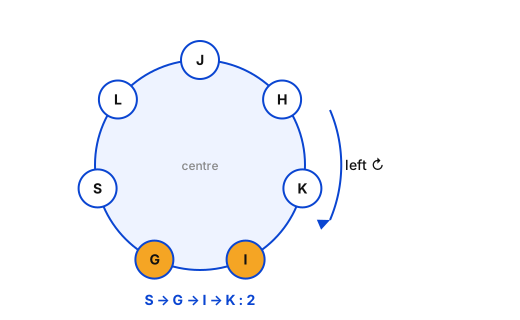
Seven people, G, H, I, J, K, L and S, are sitting around a circular table facing the centre of the table. I sits third to the left of J. Only two people sit between J and G. Only three people sit between I and L. K sits to the immediate left of H. How many people sit between K and S when counted from the right of S?
सात व्यक्ति, G, H, I, J, K, L और S, एक वृत्ताकार मेज़ के चारों ओर मेज़ के केंद्र की ओर मुख करके बैठे हैं। I, J के बाएँ से तीसरे स्थान पर बैठा है। J और G के बीच केवल दो व्यक्ति बैठे हैं। I और L के बीच केवल तीन व्यक्ति बैठे हैं। K, H के ठीक बाएँ बैठा है। S के दाएँ से गिनती करने पर K और S के बीच कितने व्यक्ति बैठे हैं?
  1. AFourचार
  2. BOneएक
  3. CTwoदो
  4. DThreeतीन
Show answer

Concept: Facing the centre, “left” is clockwise and “right” is anticlockwise.

  1. Fix J; I is 3rd to J’s left. Two between J and G → G is next to I (the other seat is I’s).
  2. Three between I and L → L sits to J’s right. Remaining seats for H, K, S: K immediately left of H → J, H, K, I, G, S, L clockwise.
  3. From S to the right (anticlockwise): G, I, then K → 2 people between.

Trick: In circular questions with 7 people, “three between” equals “two between” the other way round.

Answer: (C) Two

अवधारणा: केंद्र की ओर मुख होने पर “बाएँ” = दक्षिणावर्त, “दाएँ” = वामावर्त।

  1. J को तय करें; I, J के बाएँ तीसरा। J और G के बीच दो → G, I के बगल में (दूसरी सीट I की है)।
  2. I और L के बीच तीन → L, J के दाएँ। शेष सीटें H, K, S: K, H के ठीक बाएँ → दक्षिणावर्त J, H, K, I, G, S, L।
  3. S के दाएँ से (वामावर्त): G, I, फिर K → बीच में 2 लोग।

ट्रिक: 7 लोगों की वृत्ताकार व्यवस्था में एक ओर “तीन बीच में” = दूसरी ओर “दो बीच में”।

उत्तर: (C) दो

RRB NTPC Undergraduate CBT 1General Intelligence and ReasoningCircular Seating ArrangementRRB NTPC Undergraduate CBT 1 2024 · 14 Aug Shift 1 →
Q2290.
Pranay ranked 14th from the top and 44th from the bottom in his class. How many students are there in his class?
प्रणय की अपनी कक्षा में ऊपर से 14वीं और नीचे से 44वीं रैंक है। उसकी कक्षा में कितने विद्यार्थी हैं?
  1. A55
  2. B56
  3. C58
  4. D57
Show answer

Concept: Total = rank from top + rank from bottom − 1.

  1. Total =14+44−1.
  2. =57 students.

Yaad rakhein: Subtract 1 because the person is counted in both ranks.

Answer: (D) 57

अवधारणा: कुल = ऊपर से रैंक + नीचे से रैंक − 1।

  1. कुल =14+44−1।
  2. =57 छात्र।

याद रखें: 1 घटाएँ क्योंकि वही व्यक्ति दोनों रैंकों में गिना गया है।

उत्तर: (D) 57

RRB NTPC Undergraduate CBT 1General Intelligence and ReasoningRankingRRB NTPC Undergraduate CBT 1 2024 · 14 Aug Shift 1 →
Q2291.
In a certain code language, ‘CAME’ is coded as ‘6781’ and ‘RACE’ is coded as ‘5618’. What is the code for ‘R’ in the given code language?
एक निश्चित कूट भाषा में, 'CAME' को '6781' और 'RACE' को '5618' के रूप में कूटबद्ध किया जाता है। दी गई कूट भाषा में 'R' के लिए कूट क्या है?
  1. A5
  2. B8
  3. C1
  4. D6
Show answer

Concept: Letters common to both words take the digits common to both codes; the leftover letter gets the leftover digit.

  1. CAME = {6, 7, 8, 1}; RACE = {5, 6, 1, 8}.
  2. Common letters C, A, E ↔ common digits 6, 1, 8.
  3. Leftover: R (only in RACE) ↔ 5 (only in its code). So R = 5.

Trick: The unique letter of a word matches the unique digit of its code.

Answer: (A) 5

अवधारणा: दोनों शब्दों के समान अक्षर, दोनों कोडों के समान अंक लेते हैं; बचा हुआ अक्षर बचा हुआ अंक लेता है।

  1. CAME = {6, 7, 8, 1}; RACE = {5, 6, 1, 8}।
  2. समान अक्षर C, A, E ↔ समान अंक 6, 1, 8।
  3. शेष: R (केवल RACE में) ↔ 5 (केवल उसके कोड में)। अतः R = 5।

ट्रिक: शब्द का अनोखा अक्षर उसके कोड के अनोखे अंक से मेल खाता है।

उत्तर: (A) 5

RRB NTPC Undergraduate CBT 1General Intelligence and ReasoningCoding-DecodingRRB NTPC Undergraduate CBT 1 2024 · 14 Aug Shift 1 →
Q2292.
Each of the digits in the number 7314685 is arranged in ascending order from left to right. What will be the sum of the digits that are third from the left and third from the right in the new number thus formed?
संख्या 7314685 के प्रत्येक अंक को बाएँ से दाएँ आरोही क्रम में व्यवस्थित किया जाता है। इस प्रकार बनी नई संख्या में बाएँ से तीसरे और दाएँ से तीसरे अंकों का योग कितना होगा?
  1. A9
  2. B7
  3. C6
  4. D10
Show answer

Concept: Arrange the digits in ascending order and pick the required places.

  1. 7314685 → 1 3 4 5 6 7 8.
  2. Third from left = 4; third from right = 6.
  3. Sum =4+6=10.

Trick: In a 7-digit number, 3rd from right = 5th from left.

Answer: (D) 10

अवधारणा: अंकों को आरोही क्रम में लगाकर आवश्यक स्थान चुनें।

  1. 7314685 → 1 3 4 5 6 7 8।
  2. बाएँ से तीसरा = 4; दाएँ से तीसरा = 6।
  3. योग =4+6=10।

ट्रिक: 7 अंकों की संख्या में दाएँ से तीसरा = बाएँ से पाँचवाँ।

उत्तर: (D) 10

RRB NTPC Undergraduate CBT 1General Intelligence and ReasoningDigit ArrangementRRB NTPC Undergraduate CBT 1 2024 · 14 Aug Shift 1 →
Q2293.
Read the given statements and conclusions carefully. Assuming that the information given in the statements is true, even if it appears to be at variance with commonly known facts, decide which of the given conclusion(s) logically follow(s) from the statements.
Statements:
All triangles are compasses.
All squares are compasses.
Conclusions:
(I) Some triangles are squares.
(II) Some compasses are squares.
दिए गए कथनों और निष्कर्षों को ध्यानपूर्वक पढ़िए। यह मानते हुए कि कथनों में दी गई जानकारी सत्य है, भले ही वह सामान्यतः ज्ञात तथ्यों से भिन्न प्रतीत होती हो, निर्णय कीजिए कि दिए गए निष्कर्षों में से कौन-सा/कौन-से निष्कर्ष तार्किक रूप से कथनों का अनुसरण करता है/करते हैं।
कथन:
सभी त्रिभुज, परकार हैं।
सभी वर्ग, परकार हैं।
निष्कर्ष:
(I) कुछ त्रिभुज, वर्ग हैं।
(II) कुछ परकार, वर्ग हैं।
  1. ANeither conclusion (I) nor (II) follows.न तो निष्कर्ष (I) और न ही (II) अनुसरण करता है।
  2. BOnly conclusion (II) follows.केवल निष्कर्ष (II) अनुसरण करता है।
  3. CBoth conclusions (I) and (II) follow.निष्कर्ष (I) और (II) दोनों अनुसरण करते हैं।
  4. DOnly conclusion (I) follows.केवल निष्कर्ष (I) अनुसरण करता है।
Show answer

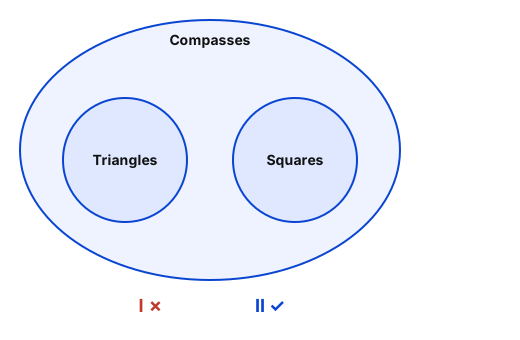
Concept: Two “All … are compasses” statements put both sets inside Compasses, but say nothing about triangles vs squares.

  1. Triangles and squares can be drawn separately inside Compasses → “Some triangles are squares” is not certain → I does not follow.
  2. All squares are compasses → some compasses are squares → II follows.

Trick: Two “All” statements with a common predicate give no relation between the subjects.

Answer: (B) Only conclusion (II) follows.

अवधारणा: दोनों “सभी … कंपास हैं” कथन दोनों समुच्चयों को Compasses के अंदर रखते हैं, पर त्रिभुज (triangles) और वर्ग (squares) के संबंध पर कुछ नहीं कहते।

  1. त्रिभुज और वर्ग कंपास के अंदर अलग-अलग बन सकते हैं → “कुछ त्रिभुज वर्ग हैं” निश्चित नहीं → I अनुसरण नहीं करता।
  2. सभी वर्ग कंपास हैं → कुछ कंपास वर्ग हैं → II अनुसरण करता है।

ट्रिक: समान विधेय वाले दो “सभी” कथनों से उद्देश्यों में कोई संबंध नहीं निकलता।

उत्तर: (B) केवल निष्कर्ष (II) अनुसरण करता है।

RRB NTPC Undergraduate CBT 1General Intelligence and ReasoningSyllogismRRB NTPC Undergraduate CBT 1 2024 · 14 Aug Shift 1 →
Q2294.
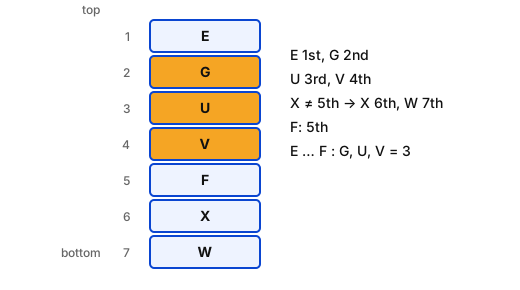
Seven boxes U, V, W, X, E, F and G are kept one over the other but not necessarily in the same order. U is kept immediately above V. X is kept immediately above W. Only E is kept above G. Only two boxes are kept above U. X is not kept at the third position from the bottom. How many boxes are kept between F and E?
सात बक्से U, V, W, X, E, F और G एक के ऊपर एक रखे गए हैं, लेकिन आवश्यक नहीं कि इसी क्रम में हों। U को V के ठीक ऊपर रखा गया है। X को W के ठीक ऊपर रखा गया है। G के ऊपर केवल E रखा गया है। U के ऊपर केवल दो बक्से रखे गए हैं। X को नीचे से तीसरे स्थान पर नहीं रखा गया है। F और E के बीच कितने बक्से रखे गए हैं?
  1. AOneएक
  2. BFourचार
  3. CThreeतीन
  4. DTwoदो
Show answer

Concept: Number positions 1 (top) to 7 (bottom) and place fixed clues first.

  1. Only E above G → E = 1, G = 2. Two boxes above U → U = 3; V immediately below → V = 4.
  2. X immediately above W in 5–6 or 6–7; X ≠ 5th (3rd from bottom) → X = 6, W = 7, F = 5.
  3. Between F (5) and E (1): G, U, V → 3 boxes.

Trick: Boxes between positions p and q =|p−q|−1=5−1−1=3.

Answer: (C) Three

अवधारणा: स्थान 1 (ऊपर) से 7 (नीचे) तक मानें और पहले निश्चित सूचनाएँ लगाएँ।

  1. केवल E, G के ऊपर → E = 1, G = 2। U के ऊपर दो बॉक्स → U = 3; V ठीक नीचे → V = 4।
  2. X ठीक W के ऊपर, 5–6 या 6–7 में; X 5वें (नीचे से तीसरे) पर नहीं → X = 6, W = 7, F = 5।
  3. F (5) और E (1) के बीच: G, U, V → 3 बॉक्स।

ट्रिक: स्थान p और q के बीच बॉक्स =|p−q|−1=5−1−1=3।

उत्तर: (C) तीन

RRB NTPC Undergraduate CBT 1General Intelligence and ReasoningBox ArrangementRRB NTPC Undergraduate CBT 1 2024 · 14 Aug Shift 1 →
Q2295.
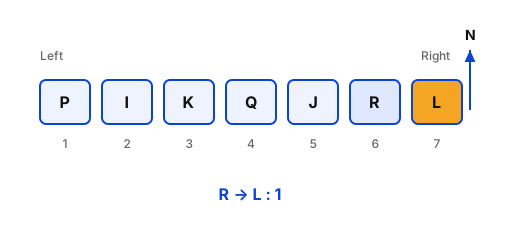
Seven people, I, J, K, L, P, Q and R, are sitting in a row, facing north. Only two people sit to the left of K. Only three people sit between K and L. Only one person sits between L and J. P sits to the immediate left of I. Q is not an immediate neighbour of L. How many people sit to the right of R?
सात व्यक्ति, I, J, K, L, P, Q और R, एक पंक्ति में उत्तर की ओर मुख करके बैठे हैं। K के बाईं ओर केवल दो व्यक्ति बैठे हैं। K और L के बीच केवल तीन व्यक्ति बैठे हैं। L और J के बीच केवल एक व्यक्ति बैठा है। P, I के ठीक बाएँ बैठा है। Q, L का निकटतम पड़ोसी नहीं है। R के दाईं ओर कितने व्यक्ति बैठे हैं?
  1. AOneएक
  2. BFourचार
  3. CThreeतीन
  4. DTwoदो
Show answer

Concept: Facing north, left and right are the solver’s own left and right; number seats 1–7 from the left.

  1. Two to the left of K → K = 3. Three between K and L → L = 7. One between L and J → J = 5.
  2. P immediately left of I: only seats 1–2 are free together → P = 1, I = 2.
  3. Q, R in 4 and 6; Q not next to L → Q = 4, R = 6. Right of R: only L → one.

Trick: Fix the person with an exact position first, then the gaps.

Answer: (A) One

अवधारणा: उत्तर की ओर मुख होने पर बाएँ-दाएँ हमारे ही बाएँ-दाएँ हैं; सीटें बाएँ से 1–7 मानें।

  1. K के बाएँ दो → K = 3। K और L के बीच तीन → L = 7। L और J के बीच एक → J = 5।
  2. P, I के ठीक बाएँ: केवल 1–2 साथ खाली → P = 1, I = 2।
  3. Q, R के लिए 4 और 6; Q, L का पड़ोसी नहीं → Q = 4, R = 6। R के दाएँ: केवल L → एक।

ट्रिक: पहले निश्चित स्थान वाले व्यक्ति को बैठाएँ, फिर अंतराल वालों को।

उत्तर: (A) एक

RRB NTPC Undergraduate CBT 1General Intelligence and ReasoningLinear Seating ArrangementRRB NTPC Undergraduate CBT 1 2024 · 14 Aug Shift 1 →
Q2296.
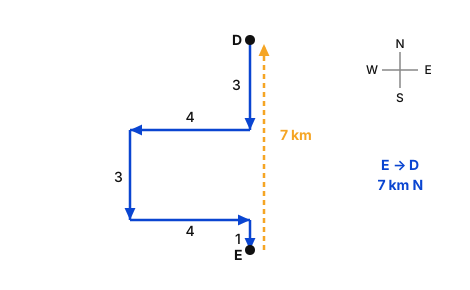
Divesh starts from point D and runs 3 km towards south. He then takes a right turn and runs 4 km. He then takes a left turn and runs 3 km. He takes another left turn and runs 4 km. He takes a final right turn and runs 1 km to reach point E. How far (shortest distance) and towards which direction should he run in order to reach point D again? (All turns are 90-degree turns only unless otherwise specified.)
दिवेश बिंदु D से दौड़ना शुरू करता है और दक्षिण की ओर 3 km दौड़ता है। फिर वह दाएँ मुड़ता है और 4 km दौड़ता है। फिर वह बाएँ मुड़ता है और 3 km दौड़ता है। वह फिर से बाएँ मुड़ता है और 4 km दौड़ता है। वह अंतिम बार दाएँ मुड़ता है और बिंदु E पर पहुँचने के लिए 1 km दौड़ता है। बिंदु D पर फिर से पहुँचने के लिए उसे कितनी दूर (न्यूनतम दूरी) और किस दिशा में दौड़ना चाहिए? (जब तक अन्यथा निर्दिष्ट न हो, सभी मोड़ केवल 90 डिग्री के मोड़ हैं।)
  1. A7 km northउत्तर की ओर 7 km
  2. B6 km northउत्तर की ओर 6 km
  3. C3 km northउत्तर की ओर 3 km
  4. D4 km northउत्तर की ओर 4 km
Show answer

Concept: Track the position on a grid, taking D as origin (East +x, North +y).

  1. 3 km south → (0, −3). Right (→ west) 4 km → (−4, −3). Left (→ south) 3 km → (−4, −6).
  2. Left (→ east) 4 km → (0, −6). Right (→ south) 1 km → E = (0, −7).
  3. D is straight 7 km north of E.

Trick: East–west moves cancel (−4+4=0); south total =3+3+1=7 km.

Answer: (A) 7 km north

अवधारणा: D को मूल बिंदु मानकर ग्रिड पर स्थिति ट्रैक करें (पूर्व +x, उत्तर +y)।

  1. 3 km दक्षिण → (0, −3)। दाएँ (→ पश्चिम) 4 km → (−4, −3)। बाएँ (→ दक्षिण) 3 km → (−4, −6)।
  2. बाएँ (→ पूर्व) 4 km → (0, −6)। दाएँ (→ दक्षिण) 1 km → E = (0, −7)।
  3. D, E से सीधे 7 km उत्तर में है।

ट्रिक: पूर्व–पश्चिम चालें कट जाती हैं (−4+4=0); कुल दक्षिण =3+3+1=7 km।

उत्तर: (A) 7 km उत्तर

RRB NTPC Undergraduate CBT 1General Intelligence and ReasoningDirection and DistanceRRB NTPC Undergraduate CBT 1 2024 · 14 Aug Shift 1 →
Q2297.
Based on the English alphabetical order, three of the following four letter-clusters are alike in a certain way and thus form a group. Which letter-cluster DOES NOT belong to that group? (Note: The odd one out is not based on the number of consonants/vowels or their position in the letter-cluster.)
अंग्रेज़ी वर्णमाला क्रम के आधार पर, निम्नलिखित चार अक्षर-समूहों में से तीन किसी निश्चित प्रकार से एकसमान हैं और इस प्रकार एक समूह बनाते हैं। कौन-सा अक्षर-समूह उस समूह से संबंधित नहीं है? (ध्यान दें: असंगत का चयन व्यंजनों/स्वरों की संख्या या अक्षर-समूह में उनकी स्थिति पर आधारित नहीं है।)
  1. ABEKR
  2. BCGLS
  3. CLPUB
  4. DQUZG
Show answer

Concept: Find the gaps between consecutive letters (A = 1 … Z = 26, wrapping after Z).

  1. CGLS: +4, +5, +7. LPUB: +4, +5, +7 (U → B wraps). QUZG: +4, +5, +7.
  2. BEKR: B→E +3, E→K +6, K→R +7 → different.

Trick: Check only the first gap: three clusters start with +4, BEKR starts with +3.

Answer: (A) BEKR

अवधारणा: क्रमागत अक्षरों के बीच अंतर देखें (A = 1 … Z = 26, Z के बाद चक्रीय)।

  1. CGLS: +4, +5, +7। LPUB: +4, +5, +7 (U → B चक्रीय)। QUZG: +4, +5, +7।
  2. BEKR: B→E +3, E→K +6, K→R +7 → भिन्न।

ट्रिक: केवल पहला अंतर जाँचें: तीन समूह +4 से शुरू, BEKR +3 से।

उत्तर: (A) BEKR

RRB NTPC Undergraduate CBT 1General Intelligence and ReasoningLetter-Cluster Odd One OutRRB NTPC Undergraduate CBT 1 2024 · 14 Aug Shift 1 →
Q2298.
What should come in place of the question mark (?) in the given series?
91, 102, 119, 142, 171, ?
दी गई श्रृंखला में प्रश्न चिह्न (?) के स्थान पर क्या आना चाहिए?
91, 102, 119, 142, 171, ?
  1. A204
  2. B214
  3. C215
  4. D206
Show answer

Concept: Look at the differences between consecutive terms.

  1. Differences: 11,17,23,29 — increasing by 6.
  2. Next difference =35.
  3. 171+35=206.

Trick: Second difference constant (6) → add the next first difference.

Answer: (D) 206

अवधारणा: क्रमागत पदों का अंतर देखें।

  1. अंतर: 11,17,23,29 — हर बार 6 अधिक।
  2. अगला अंतर =35।
  3. 171+35=206।

ट्रिक: दूसरा अंतर स्थिर (6) → अगला पहला अंतर जोड़ें।

उत्तर: (D) 206

RRB NTPC Undergraduate CBT 1General Intelligence and ReasoningNumber SeriesRRB NTPC Undergraduate CBT 1 2024 · 14 Aug Shift 1 →
Q2299.
The Stockholm Convention on Persistent Organic Pollutants was adopted at a Conference of Plenipotentiaries in which year?
स्थायी कार्बनिक प्रदूषकों (Persistent Organic Pollutants) पर स्टॉकहोम कन्वेंशन को पूर्णाधिकारियों के सम्मेलन (Conference of Plenipotentiaries) में किस वर्ष अपनाया गया था?
  1. A2000
  2. B2002
  3. C2001
  4. D2003
Show answer

Concept: The Stockholm Convention is a global treaty to eliminate or restrict Persistent Organic Pollutants (POPs) – toxic chemicals that persist and bio-accumulate.

  1. It was adopted at a Conference of Plenipotentiaries in Stockholm on 22 May 2001.
  2. It entered into force on 17 May 2004; it initially targeted the 'dirty dozen' POPs such as DDT, aldrin and dioxins.
  3. 2004 is the entry-into-force year, not the adoption year – a common trap.

Yaad rakhein: Stockholm = POPs, adopted 2001, in force 2004; Rotterdam = PIC (1998); Basel = hazardous waste (1989).

Answer: (C) 2001

अवधारणा: स्टॉकहोम अभिसमय (Stockholm Convention) एक वैश्विक संधि है जो स्थायी कार्बनिक प्रदूषकों (Persistent Organic Pollutants – POPs) को समाप्त/सीमित करती है।

  1. इसे 22 मई 2001 को स्टॉकहोम में पूर्णाधिकारियों के सम्मेलन (Conference of Plenipotentiaries) में अपनाया गया।
  2. यह 17 मई 2004 से लागू हुआ; शुरुआत में DDT, एल्ड्रिन, डाइऑक्सिन जैसे 'dirty dozen' POPs शामिल थे।
  3. 2004 लागू होने का वर्ष है, अपनाने का नहीं – यही आम भ्रम है।

याद रखें: स्टॉकहोम = POPs, अपनाया 2001, लागू 2004; रॉटरडैम = PIC (1998); बेसल = खतरनाक अपशिष्ट (1989)।

उत्तर: (C) 2001

RRB NTPC Undergraduate CBT 1General AwarenessEnvironmental conventionsRRB NTPC Undergraduate CBT 1 2024 · 13 Aug Shift 3 →
Q2300.
How can you access menus in the menu bar in Windows?
Windows में मेनू बार के मेनू को कैसे एक्सेस किया जा सकता है?
  1. APress Ctrl + M to open the menu.मेनू खोलने के लिए Ctrl + M दबाएँ।
  2. BRight-click on the title bar to open the menu bar.मेनू बार खोलने के लिए टाइटल बार पर राइट-क्लिक करें।
  3. CPress Alt and the letter underlined in the menu title to access a menu.किसी मेनू को एक्सेस करने के लिए Alt और मेनू शीर्षक में रेखांकित (underlined) अक्षर दबाएँ।
  4. DPress F5 to open the menu bar.मेनू बार खोलने के लिए F5 दबाएँ।
Show answer

Concept: In Windows programs, every menu title in the menu bar has an underlined access key that can be used with the Alt key.

  1. Pressing Alt activates the menu bar and shows the underlined letters.
  2. Alt + the underlined letter opens that menu, e.g. Alt + F opens the File menu, Alt + E the Edit menu.
  3. F5 refreshes/reloads; right-clicking the title bar opens the window (system) menu, not the menu bar.

Yaad rakhein: Alt = menu bar key; Alt + F = File, Alt + F4 = close window.

Answer: (C) Press Alt and the letter underlined in the menu title to access a menu.

अवधारणा: Windows प्रोग्राम में मेनू बार के हर मेनू शीर्षक में एक रेखांकित (underlined) अक्षर होता है जिसे Alt कुंजी के साथ दबाया जाता है।

  1. Alt दबाने से मेनू बार सक्रिय होता है और रेखांकित अक्षर दिखते हैं।
  2. Alt + रेखांकित अक्षर से वह मेनू खुलता है, जैसे Alt + F से File मेनू, Alt + E से Edit मेनू।
  3. F5 पेज को refresh करता है; टाइटल बार पर राइट-क्लिक से विंडो (system) मेनू खुलता है, मेनू बार नहीं।

याद रखें: Alt = मेनू बार कुंजी; Alt + F = File, Alt + F4 = विंडो बंद।

उत्तर: (C) Alt और मेनू शीर्षक का रेखांकित अक्षर दबाकर मेनू खोलें।

RRB NTPC Undergraduate CBT 1General AwarenessComputer – keyboard shortcutsRRB NTPC Undergraduate CBT 1 2024 · 13 Aug Shift 3 →