Question bank

Q&A: practice questions with answers

Search questions on any topic. Filter by exam category, exam, subject and topic, try the question, then open the answer and explanation.

Courses – airGurukul

8,495 questions found.

Q2361.
Aarti, Anil, and Naveen invest ₹1,110, ₹1,760, and ₹1,230 respectively to start a business. If the profit at the end of the year is ₹1,620, then what is the share of Naveen in the profit?
आरती, अनिल और नवीन एक व्यवसाय शुरू करने के लिए क्रमशः ₹1,110, ₹1,760 और ₹1,230 का निवेश करते हैं। यदि वर्ष के अंत में लाभ ₹1,620 है, तो लाभ में नवीन का हिस्सा कितना है?
  1. A₹487
  2. B₹486
  3. C₹483
  4. D₹488
Show answer

Concept: For equal time, profit is shared in the ratio of capitals.

  1. Ratio 1110:1760:1230=111:176:123
  2. Sum of ratio =410
  3. Naveen's share =123410×1620=0.3×1620=486

Trick: 12304100=0.3 exactly – Naveen gets 30% of the profit.

Answer: (B) ₹486

अवधारणा: समान समय के लिए लाभ पूँजी के अनुपात में बँटता है।

  1. अनुपात 1110:1760:1230=111:176:123
  2. अनुपात का योग =410
  3. नवीन का हिस्सा =123410×1620=0.3×1620=486

ट्रिक: 12304100=0.3 – नवीन को लाभ का 30% मिलता है।

उत्तर: (B) ₹486

RRB NTPC Undergraduate CBT 1MathematicsPartnershipRRB NTPC Undergraduate CBT 1 2024 · 13 Aug Shift 3 →
Q2362.
The marked price of a watch is ₹2,860. A man bought the watch for ₹2,390.96, after getting two successive discounts, one of which is 12%. What is rate of the other discount?
एक घड़ी का अंकित मूल्य ₹2,860 है। एक व्यक्ति ने दो क्रमिक छूटें प्राप्त करने के बाद घड़ी ₹2,390.96 में खरीदी, जिनमें से एक छूट 12% है। दूसरी छूट की दर क्या है?
  1. A8%
  2. B7%
  3. C5%
  4. D6%
Show answer

Concept: Selling price =MP×(1−d1100)(1−d2100).

  1. After 12%: 2860×0.88=2516.80
  2. 2390.962516.80=0.95
  3. Second discount =1−0.95=5%

Trick: Check option: 2516.80×5%=125.84 and 2516.80−125.84=2390.96 ✓.

Answer: (C) 5%

अवधारणा: विक्रय मूल्य =MP×(1−d1100)(1−d2100)।

  1. 12% के बाद: 2860×0.88=2516.80
  2. 2390.962516.80=0.95
  3. दूसरी छूट =1−0.95=5%

ट्रिक: विकल्प जाँचें: 2516.80×5%=125.84, 2516.80−125.84=2390.96 ✓।

उत्तर: (C) 5%

RRB NTPC Undergraduate CBT 1MathematicsSuccessive DiscountRRB NTPC Undergraduate CBT 1 2024 · 13 Aug Shift 3 →
Q2363.
In an election between two candidates 80% of the registered voters cast their vote and 15% of the votes polled were found invalid. The winning candidate got 60% of the valid votes and won the election by a margin of 1394 votes. How many voters were
registered?
दो उम्मीदवारों के बीच हुए एक चुनाव में 80% पंजीकृत मतदाताओं ने मतदान किया और डाले गए मतों में से 15% मत अवैध पाए गए। विजयी उम्मीदवार को वैध मतों का 60% प्राप्त हुआ और वह 1394 मतों के अंतर से चुनाव जीता। कितने मतदाता
पंजीकृत थे?
  1. A10251
  2. B10250
  3. C10252
  4. D10248
Show answer

Concept: In a two-candidate contest, margin = (winner's % − loser's %) of valid votes.

  1. Let registered =x; polled =0.8x; valid =85% of 0.8x=0.68x
  2. Margin =(60−40)% of 0.68x=0.136x
  3. 0.136x=1394⇒x=10250

Trick: Chain multipliers: 0.8×0.85×0.2=0.136; 13940.136=10250.

Answer: (B) 10250

अवधारणा: दो उम्मीदवारों में जीत का अंतर = (विजेता % − हारने वाले %) × वैध मत।

  1. पंजीकृत मतदाता =x; डाले गए मत =0.8x; वैध =0.8x का 85%=0.68x
  2. अंतर =0.68x का (60−40)%=0.136x
  3. 0.136x=1394⇒x=10250

ट्रिक: गुणकों की शृंखला: 0.8×0.85×0.2=0.136; 13940.136=10250।

उत्तर: (B) 10250

RRB NTPC Undergraduate CBT 1MathematicsPercentage – ElectionsRRB NTPC Undergraduate CBT 1 2024 · 13 Aug Shift 3 →
Q2364.
Anjani can do a certain piece of work in 24 days. Anjani and Khushbu can together do the same work in 20 days, and Anjani, Khushbu and Sushmita can do the same work together in 8 days. In how many days can Anjani and Sushmita do the same work?
अंजनी किसी कार्य को 24 दिनों में कर सकती है। अंजनी और खुशबू मिलकर उसी कार्य को 20 दिनों में कर सकती हैं, तथा अंजनी, खुशबू और सुष्मिता मिलकर उसी कार्य को 8 दिनों में कर सकती हैं। अंजनी और सुष्मिता मिलकर उसी कार्य को कितने दिनों में कर सकती हैं?
  1. A577
  2. B618
  3. C607
  4. D549
Show answer

Concept: One day's work =1days; subtract combined rates to get an individual rate.

  1. Anjani =124; Anjani + Khushbu =120; all three =18
  2. Sushmita =18−120=5−240=340
  3. Anjani + Sushmita =124+340=5+9120=760 ⇒ 607 days

Trick: LCM method: total work 120 units; A = 5, A+K = 6, A+K+S = 15 ⇒ S = 9, A+S = 14 ⇒ 12014=607.

Answer: (C) 607 days

अवधारणा: एक दिन का कार्य =1दिन; संयुक्त दरों को घटाकर अकेले की दर निकालें।

  1. अंजनी =124; अंजनी + खुशबू =120; तीनों =18
  2. सुष्मिता =18−120=5−240=340
  3. अंजनी + सुष्मिता =124+340=5+9120=760 ⇒ 607 दिन

ट्रिक: LCM विधि: कुल कार्य 120 इकाई; A = 5, A+K = 6, A+K+S = 15 ⇒ S = 9, A+S = 14 ⇒ 12014=607।

उत्तर: (C) 607 दिन

RRB NTPC Undergraduate CBT 1MathematicsTime and WorkRRB NTPC Undergraduate CBT 1 2024 · 13 Aug Shift 3 →
Q2365.
The value of 196+0.0324−6.76=
196+0.0324−6.76= का मान
  1. A6.44
  2. B11.58
  3. C4.64
  4. D2.41
Show answer

Concept: For a decimal, the square root has half as many decimal places: 0.0324=0.18 since 182=324.

  1. 196=14
  2. 0.0324=0.18, 6.76=2.6
  3. 14+0.18−2.6=11.58

Trick: 4 decimal places → root has 2; 2 decimal places → root has 1.

Answer: (B) 11.58

अवधारणा: दशमलव संख्या के वर्गमूल में दशमलव स्थान आधे होते हैं: 0.0324=0.18 क्योंकि 182=324।

  1. 196=14
  2. 0.0324=0.18, 6.76=2.6
  3. 14+0.18−2.6=11.58

ट्रिक: 4 दशमलव स्थान → मूल में 2; 2 दशमलव स्थान → मूल में 1।

उत्तर: (B) 11.58

RRB NTPC Undergraduate CBT 1MathematicsSquare Roots of DecimalsRRB NTPC Undergraduate CBT 1 2024 · 13 Aug Shift 3 →
Q2366.
Evaluate: sin240∘+sin250∘cos240∘+cos250∘−sec250∘−cot240∘cos220∘+cos270∘
मान ज्ञात कीजिए: sin240∘+sin250∘cos240∘+cos250∘−sec250∘−cot240∘cos220∘+cos270∘
  1. A−1
  2. B−2
  3. C0
  4. D2
Show answer

Concept: For complementary angles: sin(90∘−θ)=cosθ, sec(90∘−θ)=cscθ; and sin2θ+cos2θ=1, csc2θ−cot2θ=1.

  1. sin250∘=cos240∘ ⇒ numerator =sin240∘+cos240∘=1; denominator =cos240∘+sin240∘=1
  2. sec250∘=csc240∘ ⇒ csc240∘−cot240∘=1
  3. cos270∘=sin220∘ ⇒ denominator =1; value =11−11=0

Trick: Angles adding to 90∘ in each pair → every part collapses to 1, so 1−1=0.

Answer: (C) 0

अवधारणा: पूरक कोणों के लिए: sin(90∘−θ)=cosθ, sec(90∘−θ)=cscθ; तथा sin2θ+cos2θ=1, csc2θ−cot2θ=1।

  1. sin250∘=cos240∘ ⇒ अंश =1; हर =cos240∘+sin240∘=1
  2. sec250∘=csc240∘ ⇒ csc240∘−cot240∘=1
  3. cos270∘=sin220∘ ⇒ हर =1; मान =11−11=0

ट्रिक: हर जोड़ी के कोणों का योग 90∘ → हर भाग 1 बन जाता है, अतः 1−1=0।

उत्तर: (C) 0

RRB NTPC Undergraduate CBT 1MathematicsTrigonometry – Complementary AnglesRRB NTPC Undergraduate CBT 1 2024 · 13 Aug Shift 3 →
Q2367.
Simplify: 2((32)x2−25x+14)−3(x2+4x−13).
सरल कीजिए: 2((32)x2−25x+14)−3(x2+4x−13)।
  1. A62x − 67
  2. B−62x − 67
  3. C−62x + 67
  4. D62x + 67
Show answer

Concept: Expand each bracket (watch the sign of the multiplier) and combine like terms.

  1. 2(32x2−25x+14)=3x2−50x+28
  2. −3(x2+4x−13)=−3x2−12x+39
  3. Sum: (3x2−3x2)+(−50x−12x)+(28+39)=−62x+67

Trick: The x2 terms cancel; only check signs: x-term −50−12=−62, constant 28+39=67.

Answer: (C) −62x+67

अवधारणा: हर कोष्ठक को खोलें (गुणक का चिह्न ध्यान रखें) और समान पदों को जोड़ें।

  1. 2(32x2−25x+14)=3x2−50x+28
  2. −3(x2+4x−13)=−3x2−12x+39
  3. योग: (3x2−3x2)+(−50x−12x)+(28+39)=−62x+67

ट्रिक: x2 पद कट जाते हैं; केवल चिह्न देखें: x-पद −50−12=−62, अचर 28+39=67।

उत्तर: (C) −62x+67

RRB NTPC Undergraduate CBT 1MathematicsAlgebraic SimplificationRRB NTPC Undergraduate CBT 1 2024 · 13 Aug Shift 3 →
Q2368.
The average runs scored by a batsman in 23 matches is 41. In the next 10 matches, the batsman scored an average of 15 runs. Find his average runs scored (rounded off to two decimal places) in all the 33 matches.
23 मैचों में एक बल्लेबाज़ द्वारा बनाए गए औसत रन 41 हैं। अगले 10 मैचों में बल्लेबाज़ ने औसतन 15 रन बनाए। सभी 33 मैचों में उसके द्वारा बनाए गए औसत रन (दो दशमलव स्थानों तक पूर्णांकित) ज्ञात कीजिए।
  1. A32.12
  2. B34.12
  3. C35.12
  4. D33.12
Show answer

Concept: Combined average =total runstotal matches.

  1. Total in 23 matches =23×41=943
  2. Total in 10 matches =10×15=150
  3. Average =943+15033=109333≈33.12

Trick: Deviation method: from 41, the 10 matches are 26 short each → 41−26033=41−7.88=33.12.

Answer: (D) 33.12

अवधारणा: संयुक्त औसत =कुल रनकुल मैच।

  1. 23 मैचों में कुल =23×41=943
  2. 10 मैचों में कुल =10×15=150
  3. औसत =943+15033=109333≈33.12

ट्रिक: विचलन विधि: 41 से 10 मैच हर एक में 26 कम → 41−26033=41−7.88=33.12।

उत्तर: (D) 33.12

RRB NTPC Undergraduate CBT 1MathematicsAverageRRB NTPC Undergraduate CBT 1 2024 · 13 Aug Shift 3 →
Q2369.
Read the given statement(s) and conclusions carefully. Assuming that the information given in the statement(s) is true, even if it appears to be at variance with commonly known facts, decide which of the given conclusions logically follow(s) from the statement(s).
Statements:
Some trucks are cars.
Some cars are bottles.
Conclusions:
(I) Some trucks are bottles.
(II) All bottles are cars.
दिए गए कथन/कथनों और निष्कर्षों को ध्यानपूर्वक पढ़िए। यह मानते हुए कि कथन/कथनों में दी गई जानकारी सत्य है, भले ही वह सामान्य रूप से ज्ञात तथ्यों से भिन्न प्रतीत होती हो, निर्णय कीजिए कि दिए गए निष्कर्षों में से कौन-सा/से निष्कर्ष तार्किक रूप से कथन/कथनों का अनुसरण करता है/करते हैं।
कथन:
कुछ ट्रक, कार हैं।
कुछ कार, बोतलें हैं।
निष्कर्ष:
(I) कुछ ट्रक, बोतलें हैं।
(II) सभी बोतलें, कार हैं।
  1. ABoth conclusions (I) and (II) follow.निष्कर्ष (I) और (II) दोनों अनुसरण करते हैं।
  2. BOnly conclusion (I) follows.केवल निष्कर्ष (I) अनुसरण करता है।
  3. CNeither conclusion (I) nor (II) follows.न तो निष्कर्ष (I) और न ही (II) अनुसरण करता है।
  4. DOnly conclusion (II) follows.केवल निष्कर्ष (II) अनुसरण करता है।
Show answer

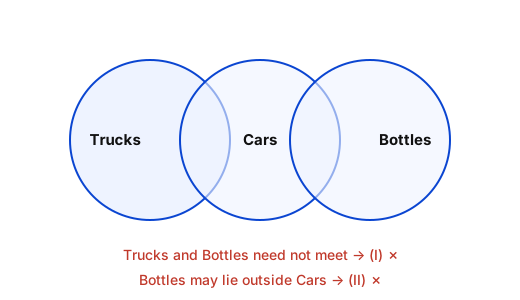
Concept: From two 'Some' statements no definite conclusion links the end terms; draw the least-overlap Venn diagram.

  1. Trucks overlap Cars; Cars overlap Bottles – Trucks and Bottles may not meet, so (I) does not follow.
  2. 'Some cars are bottles' never gives 'All bottles are cars' – (II) does not follow.
  3. Hence neither follows.

Trick: Some + Some = No definite conclusion.

Answer: (C) Neither conclusion (I) nor (II) follows.

अवधारणा: दो 'कुछ' कथनों से अंतिम पदों के बीच कोई निश्चित निष्कर्ष नहीं निकलता; न्यूनतम ओवरलैप वाला वेन आरेख बनाएँ।

  1. ट्रक–कार और कार–बोतल ओवरलैप; ट्रक और बोतल का मिलना ज़रूरी नहीं, अतः (I) अनुसरण नहीं करता।
  2. 'कुछ कार बोतल हैं' से 'सभी बोतल कार हैं' नहीं निकलता – (II) भी नहीं।
  3. अतः कोई भी अनुसरण नहीं करता।

ट्रिक: कुछ + कुछ = कोई निश्चित निष्कर्ष नहीं।

उत्तर: (C) न तो (I) और न ही (II) अनुसरण करता है।

RRB NTPC Undergraduate CBT 1General Intelligence and ReasoningSyllogismRRB NTPC Undergraduate CBT 1 2024 · 13 Aug Shift 3 →
Q2370.
What should come in place of the question mark (?) in the given series based on the English alphabetical order?
YTQ UPM QLI MHE ?
अंग्रेज़ी वर्णमाला क्रम के आधार पर दी गई शृंखला में प्रश्न चिह्न (?) के स्थान पर क्या आना चाहिए?
YTQ UPM QLI MHE ?
  1. AIEB
  2. BIDB
  3. CIEA
  4. DIDA
Show answer

Concept: Compare each letter with the letter in the same position of the next term.

  1. Y→U→Q→M (−4 each); T→P→L→H (−4); Q→M→I→E (−4)
  2. Next: M−4 = I, H−4 = D, E−4 = A
  3. Term = IDA

Trick: All three positions move back by 4 – just shift MHE by −4.

Answer: (D) IDA

अवधारणा: हर अक्षर की तुलना अगले पद में उसी स्थान वाले अक्षर से करें।

  1. Y→U→Q→M (हर बार −4); T→P→L→H (−4); Q→M→I→E (−4)
  2. अगला: M−4 = I, H−4 = D, E−4 = A
  3. पद = IDA

ट्रिक: तीनों स्थान 4 पीछे जाते हैं – MHE को −4 खिसकाएँ।

उत्तर: (D) IDA

RRB NTPC Undergraduate CBT 1General Intelligence and ReasoningLetter SeriesRRB NTPC Undergraduate CBT 1 2024 · 13 Aug Shift 3 →
Q2371.
Seven boxes C, D, E, M, N, O and P are kept one over the other but not necessarily in the same order.
Only D is kept above N. Only two boxes are kept between N and O. Only P is kept below C. E is not kept immediately above O.
How many boxes are kept between M and P?
सात डिब्बे C, D, E, M, N, O और P एक के ऊपर एक रखे गए हैं, परंतु आवश्यक नहीं कि इसी क्रम में हों।
केवल D, N के ऊपर रखा गया है। N और O के बीच केवल दो डिब्बे रखे गए हैं। केवल P, C के नीचे रखा गया है। E, O के ठीक ऊपर नहीं रखा गया है।
M और P के बीच कितने डिब्बे रखे गए हैं?
  1. AOneएक
  2. BThreeतीन
  3. CTwoदो
  4. DFourचार
Show answer

Concept: 'Only X above Y' fixes Y at position 2 from top; 'Only X below Y' fixes Y at position 2 from bottom.

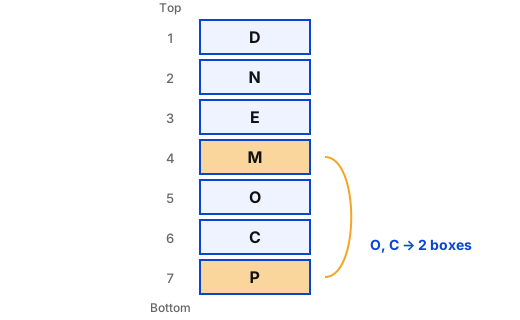
  1. Only D above N ⇒ D = 1, N = 2 (from top). Only P below C ⇒ C = 6, P = 7.
  2. Two boxes between N and O ⇒ O = 5.
  3. E, M fill 3 and 4; E not immediately above O ⇒ E = 3, M = 4.
  4. Between M (4) and P (7): O and C ⇒ two boxes.

Trick: Fix the 'only' clues first – they lock both ends of the stack.

Answer: (C) Two

अवधारणा: 'केवल X, Y के ऊपर' ⇒ Y ऊपर से दूसरे स्थान पर; 'केवल X, Y के नीचे' ⇒ Y नीचे से दूसरे स्थान पर।

  1. केवल D, N के ऊपर ⇒ D = 1, N = 2 (ऊपर से)। केवल P, C के नीचे ⇒ C = 6, P = 7।
  2. N और O के बीच दो बॉक्स ⇒ O = 5।
  3. E, M स्थान 3 और 4 पर; E, O के ठीक ऊपर नहीं ⇒ E = 3, M = 4।
  4. M (4) और P (7) के बीच: O और C ⇒ दो बॉक्स।

ट्रिक: पहले 'केवल' वाले संकेत लगाएँ – वे ढेर के दोनों सिरों को तय कर देते हैं।

उत्तर: (C) दो

RRB NTPC Undergraduate CBT 1General Intelligence and ReasoningBox ArrangementRRB NTPC Undergraduate CBT 1 2024 · 13 Aug Shift 3 →
Q2372.
Read the given statements and conclusions carefully. Assuming that the information given in the statements is true, even if it appears to be at variance with commonly known facts, decide which of the given conclusions logically follow(s) from the statements.
Statements:
Some pepper are spicy.
All spicy are chilly.
Conclusions:
(I): Some pepper are chilly.
(II): All chilly are spicy.
दिए गए कथनों और निष्कर्षों को ध्यानपूर्वक पढ़िए। यह मानते हुए कि कथनों में दी गई जानकारी सत्य है, भले ही वह सामान्य रूप से ज्ञात तथ्यों से भिन्न प्रतीत होती हो, निर्णय कीजिए कि दिए गए निष्कर्षों में से कौन-सा/से निष्कर्ष तार्किक रूप से कथनों का अनुसरण करता है/करते हैं।
कथन:
कुछ पेपर, स्पाइसी हैं।
सभी स्पाइसी, चिली हैं।
निष्कर्ष:
(I): कुछ पेपर, चिली हैं।
(II): सभी चिली, स्पाइसी हैं।
  1. AOnly conclusion (II) follows.केवल निष्कर्ष (II) अनुसरण करता है।
  2. BNeither conclusion (I) nor (II) follows.न तो निष्कर्ष (I) और न ही (II) अनुसरण करता है।
  3. CBoth conclusions (I) and (II) follow.निष्कर्ष (I) और (II) दोनों अनुसरण करते हैं।
  4. DOnly conclusion (I) follows.केवल निष्कर्ष (I) अनुसरण करता है।
Show answer

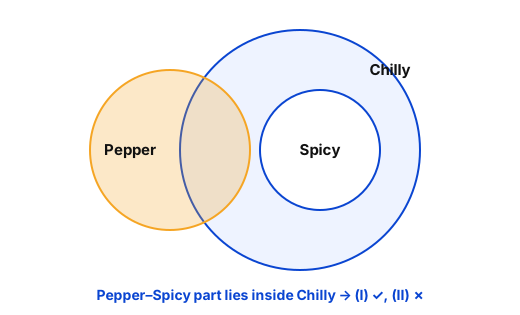
Concept: Some A are B + All B are C ⇒ Some A are C. 'All B are C' does not reverse to 'All C are B'.

  1. The pepper that are spicy lie inside 'chilly' ⇒ some pepper are chilly – (I) follows.
  2. Chilly may be larger than spicy ⇒ 'All chilly are spicy' is not certain – (II) does not follow.

Trick: Some + All = Some (between first and last term).

Answer: (D) Only conclusion (I) follows.

अवधारणा: कुछ A, B हैं + सभी B, C हैं ⇒ कुछ A, C हैं। 'सभी B, C हैं' उलटकर 'सभी C, B हैं' नहीं बनता।

  1. जो pepper spicy हैं वे chilly के अंदर हैं ⇒ कुछ pepper chilly हैं – (I) अनुसरण करता है।
  2. chilly, spicy से बड़ा हो सकता है ⇒ 'सभी chilly spicy हैं' निश्चित नहीं – (II) नहीं।

ट्रिक: कुछ + सभी = कुछ (पहले और अंतिम पद के बीच)।

उत्तर: (D) केवल निष्कर्ष (I) अनुसरण करता है।

RRB NTPC Undergraduate CBT 1General Intelligence and ReasoningSyllogismRRB NTPC Undergraduate CBT 1 2024 · 13 Aug Shift 3 →
Q2373.
What will come in place of the question mark (?) in the following equation, if ‘+’ and ‘−’ are interchanged and ‘×’ and ‘÷’ are interchanged?
28 + 42 × 2 − 4 ÷ 3 = ?
यदि ‘+’ और ‘−’ को आपस में बदल दिया जाए तथा ‘×’ और ‘÷’ को आपस में बदल दिया जाए, तो निम्नलिखित समीकरण में प्रश्न चिह्न (?) के स्थान पर क्या आएगा?
28 + 42 × 2 − 4 ÷ 3 = ?
  1. A31
  2. B37
  3. C19
  4. D24
Show answer

Concept: Interchange the signs as told, then solve using BODMAS.

  1. 28+42×2−4÷3 becomes 28−42÷2+4×3
  2. =28−21+12
  3. =19

Trick: Rewrite the whole expression first, then apply BODMAS – never swap mid-way.

Answer: (C) 19

अवधारणा: बताए अनुसार चिह्न बदलें, फिर BODMAS से हल करें।

  1. 28+42×2−4÷3 बन जाता है 28−42÷2+4×3
  2. =28−21+12
  3. =19

ट्रिक: पहले पूरा व्यंजक दोबारा लिखें, फिर BODMAS लगाएँ।

उत्तर: (C) 19

RRB NTPC Undergraduate CBT 1General Intelligence and ReasoningMathematical OperationsRRB NTPC Undergraduate CBT 1 2024 · 13 Aug Shift 3 →
Q2374.
If 2 is added to each odd digit and 1 is subtracted from each even digit in the number 3851764, what will be the sum of the digits which are third from the left and third from the right in the new number thus formed?
यदि संख्या 3851764 के प्रत्येक विषम अंक में 2 जोड़ दिया जाए और प्रत्येक सम अंक में से 1 घटा दिया जाए, तो इस प्रकार बनी नई संख्या में बाएँ से तीसरे और दाएँ से तीसरे अंकों का योग क्या होगा?
  1. A16
  2. B10
  3. C7
  4. D8
Show answer

Concept: Change each digit by its own rule (odd +2, even −1) keeping positions, then count from the ends.

  1. 3 8 5 1 7 6 4 → 5 7 7 3 9 5 3
  2. Third from left = 7; third from right = 9
  3. Sum =7+9=16

Trick: Only the needed digits: 3rd from left is 5 → 7; 3rd from right is 7 → 9.

Answer: (A) 16

अवधारणा: हर अंक पर उसका नियम लगाएँ (विषम +2, सम −1), स्थान वही रखें, फिर सिरों से गिनें।

  1. 3 8 5 1 7 6 4 → 5 7 7 3 9 5 3
  2. बाएँ से तीसरा = 7; दाएँ से तीसरा = 9
  3. योग =7+9=16

ट्रिक: केवल ज़रूरी अंक बदलें: बाएँ से तीसरा 5 → 7; दाएँ से तीसरा 7 → 9।

उत्तर: (A) 16

RRB NTPC Undergraduate CBT 1General Intelligence and ReasoningNumber OperationsRRB NTPC Undergraduate CBT 1 2024 · 13 Aug Shift 3 →
Q2375.
What should come in place of the question mark (?) in the given series?
1500, 3005, 6015, 12035, 24075, ?
दी गई शृंखला में प्रश्न चिह्न (?) के स्थान पर क्या आना चाहिए?
1500, 3005, 6015, 12035, 24075, ?
  1. A48015
  2. B48155
  3. C48200
  4. D48105
Show answer

Concept: Each term = previous ×2+5.

  1. 1500×2+5=3005, 3005×2+5=6015
  2. 6015×2+5=12035, 12035×2+5=24075
  3. 24075×2+5=48155

Trick: Terms nearly double each time → try ×2 and see the constant left over (+5).

Answer: (B) 48155

अवधारणा: हर पद = पिछला ×2+5।

  1. 1500×2+5=3005, 3005×2+5=6015
  2. 6015×2+5=12035, 12035×2+5=24075
  3. 24075×2+5=48155

ट्रिक: पद लगभग दोगुने हो रहे हैं → ×2 करके बचा अचर (+5) देखें।

उत्तर: (B) 48155

RRB NTPC Undergraduate CBT 1General Intelligence and ReasoningNumber SeriesRRB NTPC Undergraduate CBT 1 2024 · 13 Aug Shift 3 →
Q2376.
In a certain code language, ‘WIRE’ is coded as ‘4726’ and ‘EAST’ is coded as ‘5173’. What is the code for ‘E’ in the given code language?
एक निश्चित कूट भाषा में, ‘WIRE’ को ‘4726’ के रूप में और ‘EAST’ को ‘5173’ के रूप में कूटबद्ध किया जाता है। दी गई कूट भाषा में ‘E’ का कूट क्या है?
  1. A3
  2. B5
  3. C7
  4. D6
Show answer

Concept: When letters are coded by digits in jumbled order, the common letter takes the common digit.

  1. WIRE → {4, 7, 2, 6}; EAST → {5, 1, 7, 3}
  2. Common letter: E; common digit: 7
  3. So E = 7

Trick: Common letter ↔ common digit.

Answer: (C) 7

अवधारणा: जब अक्षरों के अंक बिखरे क्रम में हों, तो उभयनिष्ठ अक्षर = उभयनिष्ठ अंक।

  1. WIRE → {4, 7, 2, 6}; EAST → {5, 1, 7, 3}
  2. उभयनिष्ठ अक्षर: E; उभयनिष्ठ अंक: 7
  3. अतः E = 7

ट्रिक: उभयनिष्ठ अक्षर ↔ उभयनिष्ठ अंक।

उत्तर: (C) 7

RRB NTPC Undergraduate CBT 1General Intelligence and ReasoningCoding–DecodingRRB NTPC Undergraduate CBT 1 2024 · 13 Aug Shift 3 →
Q2377.
Darshan starts from Point Y and drives 6 km towards west. He then takes a right turn and drives 8 km. He then turns right and drives 11 km. He takes a final right turn, drives 8 km and stops at Point Z. How far (shortest distance) and towards which direction should he drive in order to reach Point Y again? (All turns are 90-degree turns only, unless specified.)
दर्शन बिंदु Y से चलना शुरू करता है और पश्चिम की ओर 6 km गाड़ी चलाता है। फिर वह दाएँ मुड़ता है और 8 km गाड़ी चलाता है। फिर वह दाएँ मुड़ता है और 11 km गाड़ी चलाता है। वह अंतिम बार दाएँ मुड़ता है, 8 km गाड़ी चलाता है और बिंदु Z पर रुक जाता है। बिंदु Y पर फिर से पहुँचने के लिए उसे कितनी दूरी (न्यूनतम दूरी) और किस दिशा में गाड़ी चलानी चाहिए? (जब तक निर्दिष्ट न किया जाए, सभी मोड़ केवल 90 डिग्री के मोड़ हैं।)
  1. A4 km towards eastपूर्व की ओर 4 km
  2. B4 km towards northउत्तर की ओर 4 km
  3. C5 km towards westपश्चिम की ओर 5 km
  4. D6 km towards southदक्षिण की ओर 6 km
Show answer

Concept: Track each move on a grid; facing west, a right turn means north.

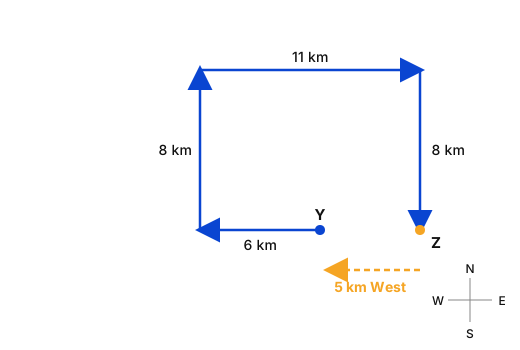
  1. Y → 6 km west; right (north) 8 km; right (east) 11 km; right (south) 8 km → Z
  2. North 8 and south 8 cancel; east-west: 11 − 6 = 5 km east of Y
  3. To return: 5 km towards west

Trick: Equal opposite moves cancel – only 11−6=5 km east remains, so go back west.

Answer: (C) 5 km towards west

अवधारणा: हर चाल ग्रिड पर लिखें; पश्चिम की ओर मुँह हो तो दायाँ मोड़ = उत्तर।

  1. Y → 6 km पश्चिम; दाएँ (उत्तर) 8 km; दाएँ (पूर्व) 11 km; दाएँ (दक्षिण) 8 km → Z
  2. उत्तर 8 और दक्षिण 8 कट जाते हैं; पूर्व–पश्चिम: 11 − 6 = 5 km, Y के पूर्व में
  3. वापसी: 5 km पश्चिम की ओर

ट्रिक: बराबर विपरीत चालें कट जाती हैं – केवल 11−6=5 km पूर्व बचा, अतः पश्चिम जाएँ।

उत्तर: (C) 5 km पश्चिम की ओर

RRB NTPC Undergraduate CBT 1General Intelligence and ReasoningDirection and DistanceRRB NTPC Undergraduate CBT 1 2024 · 13 Aug Shift 3 →
Q2378.
What should come in place of the question mark (?) in the given series?
76 , 87 , 101 , 118 , 138 , ?
दी गई शृंखला में प्रश्न चिह्न (?) के स्थान पर क्या आना चाहिए?
76 , 87 , 101 , 118 , 138 , ?
  1. A164
  2. B159
  3. C162
  4. D161
Show answer

Concept: Check the differences between consecutive terms.

  1. Differences: 11, 14, 17, 20 (increase by 3)
  2. Next difference =23
  3. 138+23=161

Trick: Second-level difference constant (+3) → add the next difference.

Answer: (D) 161

अवधारणा: क्रमागत पदों का अंतर देखें।

  1. अंतर: 11, 14, 17, 20 (हर बार +3)
  2. अगला अंतर =23
  3. 138+23=161

ट्रिक: दूसरे स्तर का अंतर स्थिर (+3) → अगला अंतर जोड़ें।

उत्तर: (D) 161

RRB NTPC Undergraduate CBT 1General Intelligence and ReasoningNumber SeriesRRB NTPC Undergraduate CBT 1 2024 · 13 Aug Shift 3 →
Q2379.
Based on the English alphabetical order, three of the following four letter-clusters are alike in a certain way and thus form a group. Which letter-cluster DOES NOT belong to that group?
(Note: The odd one out is not based on the number of consonants/vowels or their position in the letter-cluster.)
अंग्रेज़ी वर्णमाला क्रम के आधार पर, निम्नलिखित चार अक्षर-समूहों में से तीन किसी निश्चित प्रकार से एकसमान हैं और इस प्रकार एक समूह बनाते हैं। कौन-सा अक्षर-समूह उस समूह से संबंधित नहीं है?
(ध्यान दें: असंगत अक्षर-समूह, व्यंजनों/स्वरों की संख्या या अक्षर-समूह में उनके स्थान पर आधारित नहीं है।)
  1. APTN
  2. BJNH
  3. CMQK
  4. DGKF
Show answer

Concept: Find the letter gaps using positions (A = 1 … Z = 26).

  1. PTN: P+4 = T, T−6 = N; JNH: J+4 = N, N−6 = H
  2. MQK: M+4 = Q, Q−6 = K
  3. GKF: G+4 = K but K−5 = F (not −6) → odd

Trick: Pattern +4, −6; the one breaking either gap is the odd one.

Answer: (D) GKF

अवधारणा: अक्षरों की स्थिति (A = 1 … Z = 26) से अंतर निकालें।

  1. PTN: P+4 = T, T−6 = N; JNH: J+4 = N, N−6 = H
  2. MQK: M+4 = Q, Q−6 = K
  3. GKF: G+4 = K पर K−5 = F (−6 नहीं) → विषम

ट्रिक: पैटर्न +4, −6; जो इसे तोड़े वही विषम।

उत्तर: (D) GKF

RRB NTPC Undergraduate CBT 1General Intelligence and ReasoningOdd One Out – LettersRRB NTPC Undergraduate CBT 1 2024 · 13 Aug Shift 3 →
Q2380.
Select the set in which the numbers are related in the same way as are the numbers of the following sets.
(NOTE: Operations should be performed on the whole numbers, without breaking down the numbers into their constituent digits. E.g. 13 – Operations on 13 such as adding to/subtracting from/multiplying with 13 can be performed. Breaking down 13 into 1 and 3 and then performing mathematical operations on 1 and 3 is not allowed.)
(2, 49, 15)
(29, 112, 18)
उस समुच्चय का चयन कीजिए जिसमें संख्याएँ उसी प्रकार संबंधित हैं जिस प्रकार निम्नलिखित समुच्चयों की संख्याएँ संबंधित हैं।
(ध्यान दें: संख्याओं को उनके घटक अंकों में तोड़े बिना, पूर्ण संख्याओं पर संक्रियाएँ की जानी चाहिए। उदाहरण के लिए 13 – 13 पर संक्रियाएँ जैसे 13 में जोड़ना/13 में से घटाना/13 से गुणा करना आदि की जा सकती हैं। 13 को 1 और 3 में तोड़ना और फिर 1 और 3 पर गणितीय संक्रियाएँ करना वर्जित है।)
(2, 49, 15)
(29, 112, 18)
  1. A(39, 134, 20)
  2. B(30, 75, 5)
  3. C(11, 63, 15)
  4. D(28, 106, 18)
Show answer

Concept: Find a rule linking the middle number to the outer two: middle =2×first+3×third.

  1. (2,49,15): 2×2+3×15=4+45=49
  2. (29,112,18): 58+54=112
  3. (30,75,5): 60+15=75 ✓; others: 78+60=138≠134, 22+45=67≠63, 56+54=110≠106

Trick: When the middle is large, try weighted sums of the outer numbers.

Answer: (B) (30, 75, 5)

अवधारणा: मध्य संख्या का बाहरी दोनों से संबंध खोजें: मध्य =2×पहली+3×तीसरी।

  1. (2,49,15): 2×2+3×15=4+45=49
  2. (29,112,18): 58+54=112
  3. (30,75,5): 60+15=75 ✓; अन्य: 78+60=138≠134, 22+45=67≠63, 56+54=110≠106

ट्रिक: मध्य संख्या बड़ी हो तो बाहरी संख्याओं का भारित योग आज़माएँ।

उत्तर: (B) (30, 75, 5)

RRB NTPC Undergraduate CBT 1General Intelligence and ReasoningNumber Analogy – SetsRRB NTPC Undergraduate CBT 1 2024 · 13 Aug Shift 3 →