Question bank

Q&A: practice questions with answers

Search questions on any topic. Filter by exam category, exam, subject and topic, try the question, then open the answer and explanation.

Courses – airGurukul

8,495 questions found.

Q2461.
The average of first 171 even numbers is
प्रथम 171 सम संख्याओं का औसत है
  1. A172
  2. B173
  3. C172.5
  4. D171.5
Show answer

Concept: Sum of first n even numbers =n(n+1), so their average =n+1.

  1. Here n=171.
  2. Sum =171×172.
  3. Average =171×172171=172.

Yaad rakhein: Average of first n even numbers =n+1; of first n odd numbers =n; of first n natural numbers =n+12.

Answer: (A) 172

अवधारणा: प्रथम n सम संख्याओं का योग =n(n+1), अतः औसत =n+1।

  1. यहाँ n=171।
  2. योग =171×172।
  3. औसत =171×172171=172।

याद रखें: प्रथम n सम संख्याओं का औसत =n+1; विषम संख्याओं का =n; प्राकृत संख्याओं का =n+12।

उत्तर: (A) 172

RRB NTPC Undergraduate CBT 1MathematicsAverage of even numbersRRB NTPC Undergraduate CBT 1 2024 · 13 Aug Shift 2 →
Q2462.
The average weight (in kg) of a family of five members whose weights are 40 kg, 49 kg, 56 kg, 76 kg and 35 kg is:
पाँच सदस्यों वाले एक परिवार, जिनके भार 40 kg, 49 kg, 56 kg, 76 kg और 35 kg हैं, का औसत भार (kg में) है:
  1. A53.2
  2. B52.2
  3. C50.2
  4. D51.2
Show answer

Concept: Average=Sum of observationsNumber of observations.

  1. Sum =40+49+56+76+35=256kg.
  2. Average =2565=51.2kg.

Trick: Take 50 as base: deviations −10,−1,+6,+26,−15 total +6; 50+65=51.2.

Answer: (D) 51.2

अवधारणा: औसत=प्रेक्षणों का योगप्रेक्षणों की संख्या।

  1. योग =40+49+56+76+35=256kg।
  2. औसत =2565=51.2kg।

ट्रिक: 50 को आधार मानें: विचलन −10,−1,+6,+26,−15 का योग +6; 50+65=51.2।

उत्तर: (D) 51.2

RRB NTPC Undergraduate CBT 1MathematicsAverageRRB NTPC Undergraduate CBT 1 2024 · 13 Aug Shift 2 →
Q2463.
Simplify: x(3x - 7) + 7(x2 -4) + 18
सरल कीजिए: x(3x - 7) + 7(x2 -4) + 18
  1. A10x2 - 7x - 10
  2. B-10x2 -7x -10
  3. C10x2 - 7x + 10
  4. D-10x2 -7x + 10
Show answer

Concept: Expand each bracket and combine like terms.

  1. x(3x−7)=3x2−7x.
  2. 7(x2−4)=7x2−28.
  3. Total =3x2−7x+7x2−28+18=10x2−7x−10.

Trick: Check with x=1: 1(−4)+7(−3)+18=−7, and 10−7−10=−7 ✓.

Answer: (A) 10x2−7x−10

अवधारणा: प्रत्येक कोष्ठक खोलकर समान पदों को जोड़ें।

  1. x(3x−7)=3x2−7x।
  2. 7(x2−4)=7x2−28।
  3. कुल =3x2−7x+7x2−28+18=10x2−7x−10।

ट्रिक: x=1 रखकर जाँचें: 1(−4)+7(−3)+18=−7 तथा 10−7−10=−7 ✓।

उत्तर: (A) 10x2−7x−10

RRB NTPC Undergraduate CBT 1MathematicsAlgebraic simplificationRRB NTPC Undergraduate CBT 1 2024 · 13 Aug Shift 2 →
Q2464.
A number, when increased by 60%, gives 3580. The number is:
एक संख्या में 60% की वृद्धि करने पर 3580 प्राप्त होता है। वह संख्या है:
  1. A4475
  2. B6712.5
  3. C2237.5
  4. D1118.75
Show answer

Concept: If a number is increased by r%, new value =number×100+r100.

  1. x×160100=3580.
  2. x=3580×100160=35801.6=2237.5.

Trick: 160%→3580, so 10%→223.75 and 100%→2237.5.

Answer: (C) 2237.5

अवधारणा: किसी संख्या में r% वृद्धि पर नया मान =संख्या×100+r100।

  1. x×160100=3580।
  2. x=35801.6=2237.5।

ट्रिक: 160%→3580, तो 10%→223.75 और 100%→2237.5।

उत्तर: (C) 2237.5

RRB NTPC Undergraduate CBT 1MathematicsPercentageRRB NTPC Undergraduate CBT 1 2024 · 13 Aug Shift 2 →
Q2465.
By selling 6 buttons for a rupee, a man loses 45%. To gain 10% how many must he sell for a rupee?
एक रुपये में 6 बटन बेचने पर एक व्यक्ति को 45% की हानि होती है। 10% लाभ प्राप्त करने के लिए उसे एक रुपये में कितने बटन बेचने चाहिए?
  1. A2
  2. B4
  3. C3
  4. D5
Show answer

Concept: For a fixed amount (₹1), number of articles sold is inversely proportional to the SP percentage.

  1. At 45% loss, SP =55% of CP; at 10% gain, SP =110% of CP.
  2. Number sold per rupee ∝1SP: n2=6×55110.
  3. n2=3.

Trick: n1×(100−loss)=n2×(100+gain) → 6×55=n2×110 → n2=3.

Answer: (C) 3

अवधारणा: निश्चित राशि (₹1) में बेची गई वस्तुओं की संख्या, विक्रय मूल्य प्रतिशत के व्युत्क्रमानुपाती होती है।

  1. 45% हानि पर SP =55% CP; 10% लाभ पर SP =110% CP।
  2. n2=6×55110।
  3. n2=3।

ट्रिक: n1×(100−हानि)=n2×(100+लाभ) → 6×55=n2×110 → n2=3।

उत्तर: (C) 3

RRB NTPC Undergraduate CBT 1MathematicsProfit and loss (articles per rupee)RRB NTPC Undergraduate CBT 1 2024 · 13 Aug Shift 2 →
Q2466.
A, B and C started a business investing ₹610, ₹630 and ₹1,450, respectively. If B's share in the profit earned by them is ₹591. what is the difference in the profit (in ₹) earned by A and C?
A, B और C ने क्रमशः ₹610, ₹630 और ₹1,450 का निवेश करके एक व्यवसाय शुरू किया। यदि उनके द्वारा अर्जित लाभ में B का हिस्सा ₹591 है, तो A और C द्वारा अर्जित लाभ (₹ में) में कितना अंतर है?
  1. A₹785
  2. B₹786
  3. C₹791
  4. D₹788
Show answer

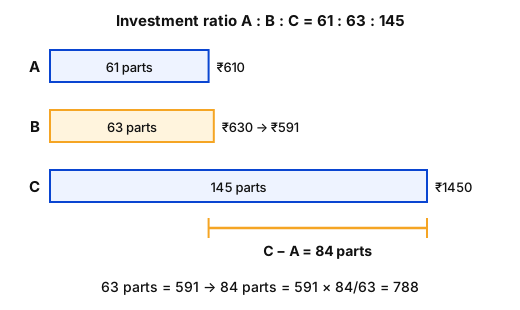
Concept: For the same time period, profit is shared in the ratio of investments.

  1. 610:630:1450=61:63:145.
  2. B's 63 parts =591 → 1 part =59163.
  3. C − A =145−61=84 parts.
  4. Difference =84×59163=43×591=788.

Trick: 8463=43, so the difference is simply 43 of B's share: 43×591=788.

Answer: (D) ₹788

अवधारणा: समान अवधि हो तो लाभ निवेश के अनुपात में बँटता है।

  1. 610:630:1450=61:63:145।
  2. B के 63 भाग =591 → 1 भाग =59163।
  3. C − A =145−61=84 भाग।
  4. अंतर =84×59163=43×591=788।

ट्रिक: 8463=43, अतः अंतर = B के हिस्से का 43 =788।

उत्तर: (D) ₹788

RRB NTPC Undergraduate CBT 1MathematicsPartnershipRRB NTPC Undergraduate CBT 1 2024 · 13 Aug Shift 2 →
Q2467.
A man goes to Indore from Bhopal at a speed of 12 km/hr and returns to Bhopal at speed of 24 km/hr, through the same route. What is his average speed (in km/hr) of the entire journey?
एक व्यक्ति भोपाल से इंदौर 12 km/hr की चाल से जाता है और उसी मार्ग से 24 km/hr की चाल से भोपाल लौटता है। संपूर्ण यात्रा में उसकी औसत चाल (km/hr में) क्या है?
  1. A12
  2. B21
  3. C16
  4. D11
Show answer

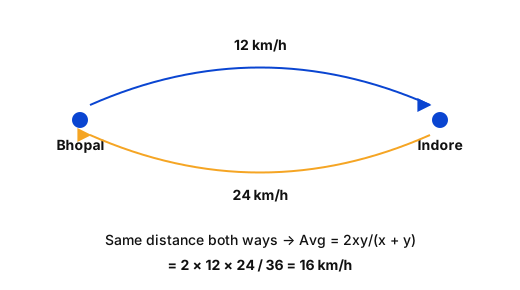
Concept: When equal distances are covered at speeds x and y, average speed =2xyx+y.

  1. x=12, y=24.
  2. Average =2×12×2412+24=57636.
  3. =16km/h.

Trick: Assume distance 24 km: time 2+1=3 h for 48 km → 483=16km/h.

Answer: (C) 16

अवधारणा: समान दूरी x और y चाल से तय हो तो औसत चाल =2xyx+y।

  1. x=12, y=24।
  2. औसत =2×12×2436=57636।
  3. =16km/h।

ट्रिक: दूरी 24 km मानें: समय 2+1=3 घंटे, कुल दूरी 48 km → 483=16km/h।

उत्तर: (C) 16

RRB NTPC Undergraduate CBT 1MathematicsAverage speedRRB NTPC Undergraduate CBT 1 2024 · 13 Aug Shift 2 →
Q2468.
The number of prime numbers lying between 411 and 424, both included, is:
411 और 424 (दोनों सम्मिलित) के बीच स्थित अभाज्य संख्याओं की संख्या है:
  1. A4
  2. B3
  3. C2
  4. D5
Show answer

Concept: A number is prime if no prime up to its square root divides it (424<21, so test 2, 3, 5, 7, 11, 13, 17, 19).

  1. Odd numbers 411–423: 411 (3×137), 413 (7×59), 415 (5×83), 417 (3×139), 423 (3×141) are composite.
  2. 419 and 421 have no prime factor up to 19 → prime.
  3. So there are 2 primes.

Trick: Even numbers and those ending in 5 go out instantly; only test the rest with digit-sum (3), 7, 11, 13, 17, 19.

Answer: (C) 2

अवधारणा: कोई संख्या अभाज्य है यदि उसके वर्गमूल तक की कोई अभाज्य संख्या उसे न विभाजित करे (424<21)।

  1. विषम संख्याएँ: 411 (3×137), 413 (7×59), 415 (5×83), 417 (3×139), 423 (3×141) – भाज्य।
  2. 419 और 421 का 19 तक कोई अभाज्य गुणनखंड नहीं → अभाज्य।
  3. अतः कुल 2 अभाज्य संख्याएँ।

ट्रिक: सम संख्याएँ और 5 पर समाप्त होने वाली तुरंत हटाएँ; बाकी को 3, 7, 11, 13, 17, 19 से जाँचें।

उत्तर: (C) 2

RRB NTPC Undergraduate CBT 1MathematicsPrime numbersRRB NTPC Undergraduate CBT 1 2024 · 13 Aug Shift 2 →
Q2469.
If 2 is added to each even digit and 1 is subtracted from each odd digit in the number 52749631, then how many digits will appear more than once in the new number thus formed?
यदि संख्या 52749631 में प्रत्येक सम अंक में 2 जोड़ा जाए और प्रत्येक विषम अंक में से 1 घटाया जाए, तो इस प्रकार बनी नई संख्या में कितने अंक एक से अधिक बार आएँगे?
  1. ATwoदो
  2. BOneएक
  3. CFourचार
  4. DThreeतीन
Show answer

Concept: Apply the rule digit by digit: even digit +2, odd digit −1.

  1. 52749631 → 5→4, 2→4, 7→6, 4→6, 9→8, 6→8, 3→2, 1→0.
  2. New number: 44668820.
  3. 4, 6 and 8 each appear twice → three digits repeat.

Trick: Write the new digits in a row and tick pairs; don't count 2 and 0 (they appear once).

Answer: (D) Three

अवधारणा: प्रत्येक अंक पर नियम लगाएँ: सम अंक +2, विषम अंक −1।

  1. 52749631 → 5→4, 2→4, 7→6, 4→6, 9→8, 6→8, 3→2, 1→0।
  2. नई संख्या: 44668820।
  3. 4, 6 और 8 दो-दो बार आते हैं → तीन अंक।

ट्रिक: नए अंक एक पंक्ति में लिखकर जोड़े पहचानें; 2 और 0 केवल एक बार हैं।

उत्तर: (D) Three

RRB NTPC Undergraduate CBT 1General Intelligence and ReasoningNumber operationsRRB NTPC Undergraduate CBT 1 2024 · 13 Aug Shift 2 →
Q2470.
KNML is related to ADCB in a certain way based on the English alphabetical order. In the same way, WZYX is related to MPON. To which of the given options is SVUT related, following the same logic?
अंग्रेज़ी वर्णमाला क्रम के आधार पर KNML एक निश्चित प्रकार से ADCB से संबंधित है। उसी प्रकार, WZYX, MPON से संबंधित है। समान तर्क का अनुसरण करते हुए, SVUT दिए गए विकल्पों में से किससे संबंधित है?
  1. AIKLJ
  2. BIKJI
  3. CILKO
  4. DILKJ
Show answer

Concept: Find the letter shift between the pairs using alphabet positions.

  1. K(11)→A(1), N(14)→D(4), M(13)→C(3), L(12)→B(2): each −10.
  2. W(23)→M(13), Z→P, Y→O, X→N: each −10 ✓.
  3. S(19)→I(9), V(22)→L(12), U(21)→K(11), T(20)→J(10).

Trick: The first letter alone (S−10 = I) leaves 3 options; the second (V−10 = L) leaves ILKO and ILKJ; the last (T−10 = J) settles it.

Answer: (D) ILKJ

अवधारणा: वर्णमाला स्थानों से अक्षरों का अंतर ज्ञात करें।

  1. K(11)→A(1), N(14)→D(4), M(13)→C(3), L(12)→B(2): प्रत्येक −10।
  2. W(23)→M(13), Z→P, Y→O, X→N: प्रत्येक −10 ✓।
  3. S(19)→I(9), V(22)→L(12), U(21)→K(11), T(20)→J(10)।

ट्रिक: अंतिम अक्षर T−10 = J देखते ही ILKJ तय हो जाता है।

उत्तर: (D) ILKJ

RRB NTPC Undergraduate CBT 1General Intelligence and ReasoningLetter analogyRRB NTPC Undergraduate CBT 1 2024 · 13 Aug Shift 2 →
Q2471.
If 1 is added to each even digit of the number 36719542, then what will be the sum of the digits that are repeated more than once in the new number formed?
यदि संख्या 36719542 के प्रत्येक सम अंक में 1 जोड़ा जाए, तो बनी नई संख्या में एक से अधिक बार दोहराए गए अंकों का योग क्या होगा?
  1. A8
  2. B12
  3. C15
  4. D10
Show answer

Concept: Add 1 only to even digits; odd digits stay the same.

  1. 36719542: 3, 6→7, 7, 1, 9, 5, 4→5, 2→3.
  2. New number: 37719553.
  3. Repeated digits: 3 (twice), 7 (twice), 5 (twice).
  4. Sum =3+7+5=15.

Trick: 'Sum of the digits that are repeated' = add each repeated digit once, not every occurrence.

Answer: (C) 15

अवधारणा: केवल सम अंकों में 1 जोड़ें; विषम अंक वैसे ही रहेंगे।

  1. 36719542: 3, 6→7, 7, 1, 9, 5, 4→5, 2→3।
  2. नई संख्या: 37719553।
  3. दोहराए अंक: 3, 7 और 5 (प्रत्येक दो बार)।
  4. योग =3+7+5=15।

ट्रिक: दोहराए गए अंकों का योग = प्रत्येक दोहराए अंक को एक बार जोड़ें।

उत्तर: (C) 15

RRB NTPC Undergraduate CBT 1General Intelligence and ReasoningNumber operationsRRB NTPC Undergraduate CBT 1 2024 · 13 Aug Shift 2 →
Q2472.
In a certain code language, ‘CALM’ is coded as ‘3257’ and ‘MONK’ is coded as ‘1346’. What is the code for ‘M’ in the given code language?
एक निश्चित कूट भाषा में, ‘CALM’ को ‘3257’ के रूप में कूटबद्ध किया जाता है और ‘MONK’ को ‘1346’ के रूप में कूटबद्ध किया जाता है। दी गई कूट भाषा में ‘M’ का कूट क्या है?
  1. A5
  2. B3
  3. C1
  4. D7
Show answer

Concept: A letter common to two words takes the digit common to both codes.

  1. CALM → {3, 2, 5, 7}; MONK → {1, 3, 4, 6}.
  2. Common letter: M.
  3. Common digit: 3 → M = 3.

Trick: Compare only the common letter and common digit – order of digits in the code does not matter.

Answer: (B) 3

अवधारणा: दोनों शब्दों में समान अक्षर का कोड दोनों कोडों में समान अंक होता है।

  1. CALM → {3, 2, 5, 7}; MONK → {1, 3, 4, 6}।
  2. समान अक्षर: M।
  3. समान अंक: 3 → M = 3।

ट्रिक: केवल समान अक्षर और समान अंक मिलाएँ – कोड में अंकों का क्रम मायने नहीं रखता।

उत्तर: (B) 3

RRB NTPC Undergraduate CBT 1General Intelligence and ReasoningCoding-decodingRRB NTPC Undergraduate CBT 1 2024 · 13 Aug Shift 2 →
Q2473.
In a certain code language,
A $ B means ‘A is the son of B’
A + B means ‘A is the brother of B’
A @ B means ‘A is the wife of B’
A ÷ B means ‘A is the father of B’
Based on the above, how is E related to N if ‘E $ F ÷ G + M @ N’?
एक निश्चित कूट भाषा में,
A $ B का अर्थ है ‘A, B का पुत्र है’
A + B का अर्थ है ‘A, B का भाई है’
A @ B का अर्थ है ‘A, B की पत्नी है’
A ÷ B का अर्थ है ‘A, B का पिता है’
उपर्युक्त के आधार पर, यदि ‘E $ F ÷ G + M @ N’ है, तो E, N से किस प्रकार संबंधित है?
  1. AWife's fatherपत्नी का पिता
  2. BWife's brotherपत्नी का भाई
  3. CFatherपिता
  4. DBrotherभाई
Show answer

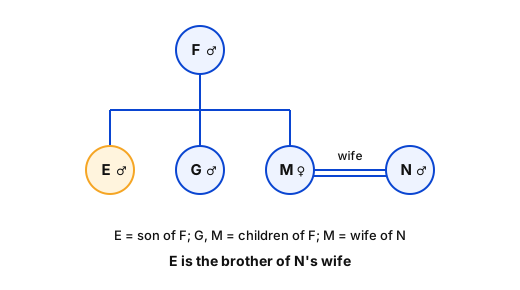
Concept: Decode each symbol and draw the family tree.

  1. E $ F: E is the son of F (E is male).
  2. F ÷ G: F is the father of G; G + M: G is the brother of M.
  3. So E, G and M are children of F; M @ N: M is the wife of N.
  4. E is the brother of M, i.e. N's wife's brother.

Trick: Read the chain left to right and keep track of gender: '$' tells E is male, '@' tells M is female.

Answer: (B) Wife's brother

अवधारणा: प्रत्येक चिह्न का अर्थ लिखकर वंश-वृक्ष बनाएँ।

  1. E $ F: E, F का पुत्र है (E पुरुष)।
  2. F ÷ G: F, G का पिता; G + M: G, M का भाई।
  3. अतः E, G, M तीनों F की संतान; M @ N: M, N की पत्नी।
  4. E, M का भाई = N की पत्नी का भाई।

ट्रिक: शृंखला को बाएँ से दाएँ पढ़ें और लिंग नोट करें: '$' से E पुरुष, '@' से M स्त्री।

उत्तर: (B) Wife's brother (पत्नी का भाई)

RRB NTPC Undergraduate CBT 1General Intelligence and ReasoningBlood relations (coded)RRB NTPC Undergraduate CBT 1 2024 · 13 Aug Shift 2 →
Q2474.
What should come in place of the question mark (?) in the given series?
5 4 2 −2 −10 ?
दी गई शृंखला में प्रश्न चिह्न (?) के स्थान पर क्या आना चाहिए?
5 4 2 −2 −10 ?
  1. A−27
  2. B−24
  3. C−26
  4. D−25
Show answer

Concept: Check the differences between consecutive terms.

  1. Differences: 4−5=−1, 2−4=−2, −2−2=−4, −10−(−2)=−8.
  2. Differences double: −1,−2,−4,−8, next −16.
  3. Next term =−10−16=−26.

Trick: When differences are 1,2,4,8, the next difference is always 16.

Answer: (C) −26

अवधारणा: क्रमागत पदों का अंतर देखें।

  1. अंतर: −1,−2,−4,−8।
  2. अंतर दोगुना हो रहा है, अगला −16।
  3. अगला पद =−10−16=−26।

ट्रिक: अंतर 1,2,4,8 हो तो अगला अंतर 16 होता है।

उत्तर: (C) −26

RRB NTPC Undergraduate CBT 1General Intelligence and ReasoningNumber seriesRRB NTPC Undergraduate CBT 1 2024 · 13 Aug Shift 2 →
Q2475.
Six people, D, E, F, G, H and Y, are sitting around a circular table, facing the centre. F sits third to the left of G. Only one person sits between F and Y when counted from the right of F. Only two people sit between Y and H. D is an immediate neighbour of H. How many people sit between D and E when counted from right of E?
छह व्यक्ति, D, E, F, G, H और Y, एक वृत्ताकार मेज़ के चारों ओर केंद्र की ओर मुख करके बैठे हैं। F, G के बाएँ से तीसरे स्थान पर बैठा है। F के दाएँ से गिनने पर F और Y के बीच केवल एक व्यक्ति बैठा है। Y और H के बीच केवल दो व्यक्ति बैठे हैं। D, H का निकटतम पड़ोसी है। E के दाएँ से गिनने पर D और E के बीच कितने व्यक्ति बैठे हैं?
  1. ATwoदो
  2. BOneएक
  3. CZeroशून्य
  4. DThreeतीन
Show answer

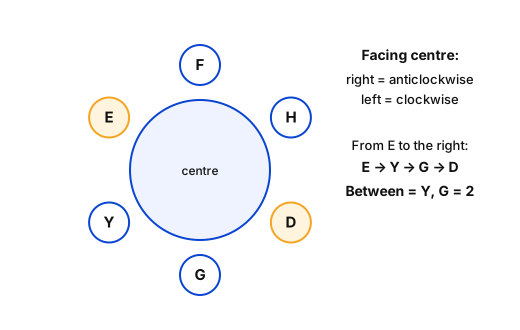
Concept: When everyone faces the centre, a person's left is clockwise and right is anticlockwise.

  1. Fix G; F is third to the left of G → F sits opposite G.
  2. Y is second to the right of F; H is opposite Y (two people between them).
  3. D is next to H at the only free seat beside H; E takes the last seat.
  4. From E going right: Y, G, then D → two people between.

Trick: In a 6-seat circle, 'third to the left/right' always means directly opposite.

Answer: (A) Two

अवधारणा: केंद्र की ओर मुख होने पर बायाँ = दक्षिणावर्त (clockwise), दायाँ = वामावर्त (anticlockwise)।

  1. G को स्थिर करें; F, G के बाएँ तीसरा → G के ठीक सामने।
  2. Y, F के दाएँ दूसरा; H, Y के सामने (बीच में दो व्यक्ति)।
  3. D, H का पड़ोसी (एकमात्र खाली सीट); E अंतिम सीट पर।
  4. E से दाईं ओर: Y, G, फिर D → बीच में दो व्यक्ति।

ट्रिक: 6 सीटों वाले वृत्त में 'तीसरा बाएँ/दाएँ' = ठीक सामने।

उत्तर: (A) Two

RRB NTPC Undergraduate CBT 1General Intelligence and ReasoningCircular seating arrangementRRB NTPC Undergraduate CBT 1 2024 · 13 Aug Shift 2 →
Q2476.
Read the given statements and conclusions carefully. Assuming that the information given in the statements is true, even if it appears to be at variance with commonly known facts, decide which of the given conclusion(s) logically follow(s) from the statements.
Statements:
All oranges are apples.
All apples are grapes.
Conclusions:
(I) Some apples are oranges.
(II) All grapes are oranges.
दिए गए कथनों और निष्कर्षों को ध्यानपूर्वक पढ़िए। यह मानते हुए कि कथनों में दी गई जानकारी सत्य है, भले ही वह सामान्यतः ज्ञात तथ्यों से भिन्न प्रतीत होती हो, निर्णय कीजिए कि दिए गए निष्कर्षों में से कौन-सा/से निष्कर्ष कथनों का तार्किक रूप से अनुसरण करता है/करते हैं।
कथन:
सभी संतरे, सेब हैं।
सभी सेब, अंगूर हैं।
निष्कर्ष:
(I) कुछ सेब, संतरे हैं।
(II) सभी अंगूर, संतरे हैं।
  1. AOnly conclusion (I) follows.केवल निष्कर्ष (I) अनुसरण करता है।
  2. BBoth conclusions (I) and (II) follow.निष्कर्ष (I) और (II) दोनों अनुसरण करते हैं।
  3. CNeither conclusion (I) nor (II) follows.न तो निष्कर्ष (I) और न ही (II) अनुसरण करता है।
  4. DOnly conclusion (II) follows.केवल निष्कर्ष (II) अनुसरण करता है।
Show answer

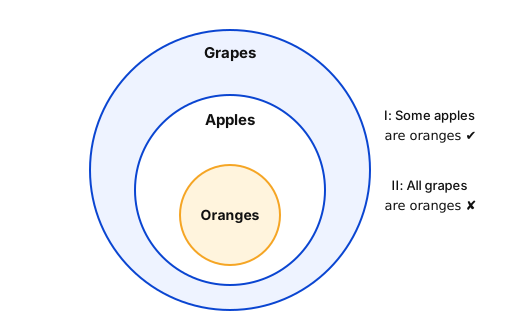
Concept: 'All A are B' lets us conclude 'Some B are A' (conversion), but not 'All B are A'.

  1. All oranges are apples → Some apples are oranges: (I) follows.
  2. Oranges ⊂ Apples ⊂ Grapes, but grapes may contain much more than oranges.
  3. So 'All grapes are oranges' (II) does not follow.

Yaad rakhein: An 'All' statement converts only into a 'Some' statement, never back into 'All'.

Answer: (A) Only conclusion (I) follows.

अवधारणा: 'सभी A, B हैं' से 'कुछ B, A हैं' निकलता है, पर 'सभी B, A हैं' नहीं।

  1. सभी संतरे सेब हैं → कुछ सेब संतरे हैं: (I) सही।
  2. संतरे ⊂ सेब ⊂ अंगूर, पर अंगूर में संतरों के अलावा भी बहुत कुछ हो सकता है।
  3. अतः 'सभी अंगूर संतरे हैं' (II) सही नहीं।

याद रखें: 'सभी' वाला कथन केवल 'कुछ' में बदलता है, उलटकर 'सभी' नहीं।

उत्तर: (A) Only conclusion (I) follows.

RRB NTPC Undergraduate CBT 1General Intelligence and ReasoningSyllogismRRB NTPC Undergraduate CBT 1 2024 · 13 Aug Shift 2 →
Q2477.
112 people are standing in a row facing north. Mr. Into is 11th from the left end while Mr. Toni is 19th from the right end. How many people are there between Mr. Into and Mr. Toni?
112 व्यक्ति उत्तर की ओर मुख करके एक पंक्ति में खड़े हैं। श्री इंटो बाएँ छोर से 11वें स्थान पर हैं जबकि श्री टोनी दाएँ छोर से 19वें स्थान पर हैं। श्री इंटो और श्री टोनी के बीच कितने व्यक्ति हैं?
  1. A82
  2. B83
  3. C81
  4. D85
Show answer

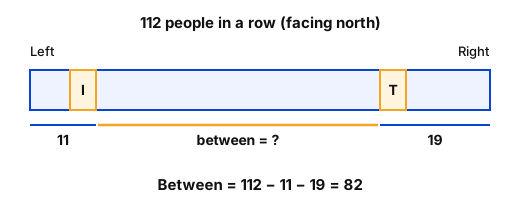
Concept: People between two persons (no overlap) =Total−(left rank+right rank).

  1. Into is 11th from left, Toni is 19th from right.
  2. Positions do not overlap since 11+19<112.
  3. Between =112−(11+19)=82.

Trick: No overlap → subtract both ranks from total; overlap → ranks−total−2.

Answer: (A) 82

अवधारणा: दो व्यक्तियों के बीच (बिना overlap) =कुल−(बायाँ स्थान+दायाँ स्थान)।

  1. Into बाएँ से 11वाँ, Toni दाएँ से 19वाँ।
  2. 11+19<112, अतः कोई overlap नहीं।
  3. बीच में =112−(11+19)=82।

ट्रिक: overlap न हो तो कुल में से दोनों स्थान घटाएँ।

उत्तर: (A) 82

RRB NTPC Undergraduate CBT 1General Intelligence and ReasoningRanking in a rowRRB NTPC Undergraduate CBT 1 2024 · 13 Aug Shift 2 →
Q2478.
If 3 is added to each even digit and 2 is added to each odd digit in the number 2571463, what will be the sum of the first and last digits in the new number thus formed?
यदि संख्या 2571463 में प्रत्येक सम अंक में 3 जोड़ा जाए और प्रत्येक विषम अंक में 2 जोड़ा जाए, तो इस प्रकार बनी नई संख्या में पहले और अंतिम अंकों का योग क्या होगा?
  1. A10
  2. B18
  3. C14
  4. D12
Show answer

Concept: Only the first and last digits matter here.

  1. First digit 2 (even) +3=5.
  2. Last digit 3 (odd) +2=5.
  3. Sum =5+5=10.

Trick: No need to transform all seven digits – change only the two asked for.

Answer: (A) 10

अवधारणा: यहाँ केवल पहला और अंतिम अंक ही चाहिए।

  1. पहला अंक 2 (सम) +3=5।
  2. अंतिम अंक 3 (विषम) +2=5।
  3. योग =5+5=10।

ट्रिक: सभी सात अंक बदलने की ज़रूरत नहीं – केवल पूछे गए दो अंक बदलें।

उत्तर: (A) 10

RRB NTPC Undergraduate CBT 1General Intelligence and ReasoningNumber operationsRRB NTPC Undergraduate CBT 1 2024 · 13 Aug Shift 2 →
Q2479.
In a row of 47 students facing north, Sanjana is 27th from the left end. If Ananad is 18th to the right of Sanjana, what is Ananad's position from the right end of the line?
उत्तर की ओर मुख किए 47 विद्यार्थियों की एक पंक्ति में, संजना बाएँ छोर से 27वें स्थान पर है। यदि आनंद, संजना के दाएँ 18वें स्थान पर है, तो पंक्ति के दाएँ छोर से आनंद का स्थान क्या है?
  1. A1st1ला
  2. B4th4था
  3. C3rd3रा
  4. D2nd2रा
Show answer

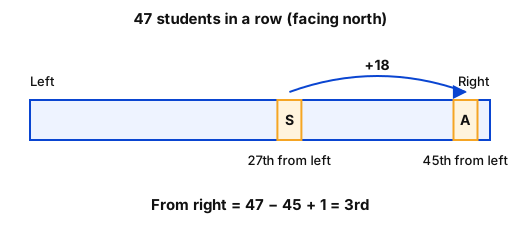
Concept: Position from right =Total−position from left+1.

  1. Sanjana is 27th from left; Anand is 18 places to her right → 27+18=45th from left.
  2. From right =47−45+1=3.

Trick: Left + Right − 1 = Total → Right =47+1−45=3.

Answer: (C) 3rd

अवधारणा: दाएँ से स्थान =कुल−बाएँ से स्थान+1।

  1. संजना बाएँ से 27वीं; आनंद उसके दाएँ 18वाँ → बाएँ से 27+18=45वाँ।
  2. दाएँ से =47−45+1=3।

ट्रिक: बायाँ + दायाँ − 1 = कुल → दायाँ =47+1−45=3।

उत्तर: (C) 3rd

RRB NTPC Undergraduate CBT 1General Intelligence and ReasoningRanking in a rowRRB NTPC Undergraduate CBT 1 2024 · 13 Aug Shift 2 →
Q2480.
This question is based on the five, three-digit numbers given below.
(Left) 121 256 812 658 527 (Right)
(NOTE: All operations to be done from left to right.)
If all the numbers are arranged in descending order, the position(s) of how many numbers will remain unchanged?
यह प्रश्न नीचे दी गई पाँच, तीन अंकों वाली संख्याओं पर आधारित है।
(बाएँ) 121 256 812 658 527 (दाएँ)
(नोट: सभी संक्रियाएँ बाएँ से दाएँ की जानी हैं।)
यदि सभी संख्याओं को अवरोही क्रम में व्यवस्थित किया जाए, तो कितनी संख्याओं का/के स्थान अपरिवर्तित रहेगा/रहेंगे?
  1. AOneएक
  2. BThreeतीन
  3. CZeroशून्य
  4. DTwoदो
Show answer

Concept: Arrange in descending order and compare each position with the original.

  1. Original: 121, 256, 812, 658, 527.
  2. Descending: 812, 658, 527, 256, 121.
  3. Position-wise: 121≠812, 256≠658, 812≠527, 658≠256, 527≠121 → none unchanged.

Trick: Write the two lists one below the other and match column by column.

Answer: (C) Zero

अवधारणा: अवरोही क्रम में लगाकर हर स्थान की मूल क्रम से तुलना करें।

  1. मूल: 121, 256, 812, 658, 527।
  2. अवरोही: 812, 658, 527, 256, 121।
  3. हर स्थान पर संख्या बदल गई → कोई नहीं।

ट्रिक: दोनों सूचियाँ एक के नीचे एक लिखें और स्तंभ-वार मिलाएँ।

उत्तर: (C) Zero

RRB NTPC Undergraduate CBT 1General Intelligence and ReasoningNumber arrangementRRB NTPC Undergraduate CBT 1 2024 · 13 Aug Shift 2 →