Question bank

Q&A: practice questions with answers

Search questions on any topic. Filter by exam category, exam, subject and topic, try the question, then open the answer and explanation.

Courses – airGurukul

2,900 questions found.

Q2881.
AEHB is related to FJMG in a certain way based on the English alphabetical order. In the same way, DHKE is related to IMPJ. To which of the following is GKNH related, following the same logic?
अंग्रेज़ी वर्णमाला क्रम के आधार पर AEHB, FJMG से एक निश्चित प्रकार से संबंधित है। उसी प्रकार, DHKE, IMPJ से संबंधित है। समान तर्क का अनुसरण करते हुए, GKNH निम्नलिखित में से किससे संबंधित है?
  1. ALPSM
  2. BPLMS
  3. CPLSM
  4. DLPMS
Show answer

Concept: Find the position shift applied to each letter of the first cluster.

  1. AEHB → FJMG: A(1)→F(6), E(5)→J(10), H(8)→M(13), B(2)→G(7): each +5.
  2. Check DHKE → IMPJ: D→I, H→M, K→P, E→J: +5 ✓.
  3. GKNH: G(7)→L(12), K(11)→P(16), N(14)→S(19), H(8)→M(13) → LPSM.

Trick: When all letters move by the same amount, just add it to each place value – no need to compare option by option.

Answer: (A) LPSM

अवधारणा: पहले समूह के हर अक्षर पर लगाया गया स्थान-परिवर्तन खोजें।

  1. AEHB → FJMG: A(1)→F(6), E(5)→J(10), H(8)→M(13), B(2)→G(7): हर एक +5।
  2. जाँच DHKE → IMPJ: D→I, H→M, K→P, E→J: +5 ✓।
  3. GKNH: G(7)→L(12), K(11)→P(16), N(14)→S(19), H(8)→M(13) → LPSM।

ट्रिक: जब सभी अक्षर समान कदम चलें, हर स्थान-मान में वही जोड़ दें – विकल्प-दर-विकल्प मिलाने की ज़रूरत नहीं।

उत्तर: (A) LPSM
RRB NTPC Undergraduate CBT 1General Intelligence and ReasoningLetter AnalogyRRB NTPC Undergraduate CBT 1 2025 · 7 May Shift 1 →
Q2882.
Based on the English alphabetical order, three of the following four letter-cluster pairs are alike in a certain way and thus form a group. Which is the one that does not belong to that group? (Note: The odd one out is not based on the number of
consonants/vowels or their position in the letter cluster.)
अंग्रेज़ी वर्णमाला क्रम के आधार पर, निम्नलिखित चार अक्षर-समूह युग्मों में से तीन एक निश्चित प्रकार से समान हैं और इस प्रकार एक समूह बनाते हैं। वह कौन-सा है जो उस समूह से संबंधित नहीं है? (नोट: असंगत युग्म अक्षर-समूह में
व्यंजनों/स्वरों की संख्या या उनकी स्थिति पर आधारित नहीं है।)
  1. ARO-VT
  2. BLI-PN
  3. CPM-TR
  4. DNK-RO
Show answer

Concept: Compare corresponding letters of each pair using place values.

  1. RO–VT: R(18)→V(22) +4, O(15)→T(20) +5.
  2. LI–PN: L→P +4, I→N +5. PM–TR: P→T +4, M→R +5.
  3. NK–RO: N(14)→R(18) +4, K(11)→O(15) +4 – pattern breaks (+4,+4 instead of +4,+5).

Trick: Write the two differences for every option; the one with a different pair of numbers is the odd one.

Answer: (D) NK-RO

अवधारणा: स्थान-मानों से हर युग्म के संगत अक्षरों की तुलना करें।

  1. RO–VT: R(18)→V(22) +4, O(15)→T(20) +5।
  2. LI–PN: L→P +4, I→N +5। PM–TR: P→T +4, M→R +5।
  3. NK–RO: N(14)→R(18) +4, K(11)→O(15) +4 – पैटर्न टूटता है (+4,+5 की जगह +4,+4)।

ट्रिक: हर विकल्प के दोनों अंतर लिखें; जिसकी संख्या-जोड़ी अलग हो वही विषम है।

उत्तर: (D) NK-RO

RRB NTPC Undergraduate CBT 1General Intelligence and ReasoningOdd One Out (Letter Pairs)RRB NTPC Undergraduate CBT 1 2025 · 7 May Shift 1 →
Q2883.
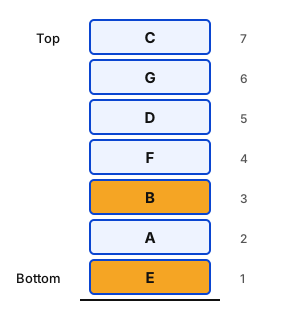
Seven boxes A, B, C, D, E, F and G are kept one over the other but not necessarily in the same order. A is kept second from the bottom. Only three boxes are kept between A and G. E is kept at one of the positions below A. Only D is kept between G and F. C is kept at one of the positions above G. How many boxes are kept between B and E?
सात बक्से A, B, C, D, E, F और G एक के ऊपर एक रखे गए हैं, लेकिन आवश्यक नहीं कि इसी क्रम में हों। A नीचे से दूसरे स्थान पर रखा है। A और G के बीच केवल तीन बक्से रखे हैं। E, A से नीचे किसी एक स्थान पर रखा है। G और F के बीच केवल D रखा है। C, G से ऊपर किसी एक स्थान पर रखा है। B और E के बीच कितने बक्से रखे हैं?
  1. A1
  2. B2
  3. C4
  4. D3
Show answer

Concept: Number positions 1 (bottom) to 7 (top) and fix boxes from the definite clues.

  1. A is second from bottom → A at 2. Three boxes between A and G → G at 6.
  2. E is below A → E at 1. C is above G → C at 7.
  3. Only D between G and F → F at 4, D at 5. The last box B takes 3.
  4. Bottom to top: E, A, B, F, D, G, C. Between B(3) and E(1) there is exactly 1 box (A).

Trick: "Second from bottom" plus "three between" pins two boxes at once – always start with such numeric clues.

Answer: (A) 1

अवधारणा: स्थान 1 (नीचे) से 7 (ऊपर) क्रमांकित करें और निश्चित संकेतों से बॉक्स तय करें।

  1. A नीचे से दूसरा → A स्थान 2 पर। A और G के बीच तीन बॉक्स → G स्थान 6।
  2. E, A से नीचे → E स्थान 1। C, G से ऊपर → C स्थान 7।
  3. G और F के बीच केवल D → F स्थान 4, D स्थान 5। बचा B स्थान 3 पर।
  4. नीचे से ऊपर: E, A, B, F, D, G, C। B(3) और E(1) के बीच ठीक 1 बॉक्स (A)।

ट्रिक: "नीचे से दूसरा" और "बीच में तीन" एक साथ दो बॉक्स तय कर देते हैं – ऐसे संख्यात्मक संकेतों से शुरुआत करें।

उत्तर: (A) 1

RRB NTPC Undergraduate CBT 1General Intelligence and ReasoningBox ArrangementRRB NTPC Undergraduate CBT 1 2025 · 7 May Shift 1 →
Q2884.
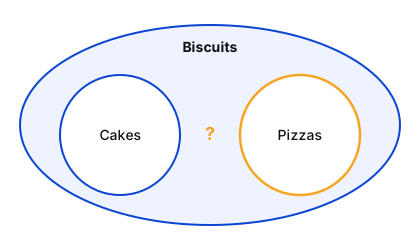
Read the given statements and conclusions carefully. You have to take the given statements to be true even if they seem to be at variance from commonly known facts. You have to decide which conclusions logically follow/s from the given statements. Statements: All cakes are biscuits. All pizzas are biscuits.
Conclusion (I) : Some cakes are pizzas
Conclusion (II) : Some biscuits are pizzas
दिए गए कथनों और निष्कर्षों को ध्यानपूर्वक पढ़िए। आपको दिए गए कथनों को सत्य मानना है, भले ही वे सामान्यतः ज्ञात तथ्यों से भिन्न प्रतीत होते हों। आपको यह निर्णय करना है कि कौन-सा/से निष्कर्ष दिए गए कथनों का तार्किक रूप से अनुसरण करता/करते है/हैं। कथन: सभी केक, बिस्कुट हैं। सभी पिज़्ज़ा, बिस्कुट हैं।
निष्कर्ष (I) : कुछ केक, पिज़्ज़ा हैं
निष्कर्ष (II) : कुछ बिस्कुट, पिज़्ज़ा हैं
  1. ABoth conclusions (I) and (II) followनिष्कर्ष (I) और (II) दोनों अनुसरण करते हैं
  2. BOnly conclusion (I) followsकेवल निष्कर्ष (I) अनुसरण करता है
  3. COnly conclusion (II) followsकेवल निष्कर्ष (II) अनुसरण करता है
  4. DNeither conclusion (I) nor (II) followsन तो निष्कर्ष (I) और न ही (II) अनुसरण करता है
Show answer

Concept: Draw the Venn diagram of the statements; a conclusion follows only if it is true in every possible diagram.

  1. Cakes and pizzas are both inside Biscuits, but nothing links cakes to pizzas – they may or may not overlap. So (I) "Some cakes are pizzas" does not follow.
  2. All pizzas are biscuits ⇒ at least those pizzas are biscuits ⇒ "Some biscuits are pizzas" definitely follows (II ✓).

Trick: "All A are B" always gives "Some B are A" (conversion), but two "All … are B" statements never connect A with the other subset.

Answer: (C) Only conclusion (II) follows

अवधारणा: कथनों का वेन आरेख बनाएँ; निष्कर्ष तभी सही है जब वह हर संभव आरेख में सत्य हो।

  1. Cakes और pizzas दोनों Biscuits के अंदर हैं, पर cakes और pizzas को जोड़ने वाला कुछ नहीं – वे मिल भी सकते हैं, नहीं भी। अतः (I) "Some cakes are pizzas" नहीं निकलता।
  2. All pizzas are biscuits ⇒ कम से कम वे pizzas तो biscuits हैं ⇒ "Some biscuits are pizzas" निश्चित रूप से सही (II ✓)।

ट्रिक: "All A are B" से हमेशा "Some B are A" निकलता है (रूपांतरण), पर दो "All … are B" कथन A को दूसरे उपसमूह से कभी नहीं जोड़ते।

उत्तर: (C) केवल निष्कर्ष (II) सही है

RRB NTPC Undergraduate CBT 1General Intelligence and ReasoningSyllogismRRB NTPC Undergraduate CBT 1 2025 · 7 May Shift 1 →
Q2885.
Uvx ranked 14th from the top and 79th from the bottom in his class. How many students are there in his class?
Uvx का अपनी कक्षा में ऊपर से 14वाँ और नीचे से 79वाँ स्थान है। उसकी कक्षा में कितने विद्यार्थी हैं?
  1. A93
  2. B92
  3. C90
  4. D91
Show answer

Concept: Total = rank from top + rank from bottom −1.

  1. Rank from top =14, rank from bottom =79.
  2. Total students =14+79−1=92.

Trick: Both ranks count the same person, so subtract 1 once.

Answer: (B) 92

अवधारणा: कुल = ऊपर से क्रम + नीचे से क्रम −1।

  1. ऊपर से क्रम =14, नीचे से क्रम =79।
  2. कुल छात्र =14+79−1=92।

ट्रिक: दोनों क्रमों में वही व्यक्ति गिना गया है, इसलिए एक बार 1 घटाएँ।

उत्तर: (B) 92

RRB NTPC Undergraduate CBT 1General Intelligence and ReasoningRankingRRB NTPC Undergraduate CBT 1 2025 · 7 May Shift 1 →
Q2886.
In a certain code language, ‘chest shirt coal’ is coded as 'ym aw xu' and ‘coal lake pig’ is coded as ‘aw yh ky’. How is ‘coal’ coded in the given language?
एक निश्चित कूट भाषा में, ‘chest shirt coal’ को 'ym aw xu' और ‘coal lake pig’ को ‘aw yh ky’ के रूप में कूटबद्ध किया जाता है। दी गई भाषा में ‘coal’ को किस प्रकार कूटबद्ध किया जाता है?
  1. Aym
  2. Baw
  3. Cyh
  4. Dxu
Show answer

Concept: A word common to two sentences has the code common to both coded sentences.

  1. "chest shirt coal" → ym aw xu; "coal lake pig" → aw yh ky.
  2. Only "coal" appears in both sentences and only "aw" appears in both codes.
  3. Hence coal = aw.

Trick: Match the common word with the common code – one glance is enough.

Answer: (B) aw

अवधारणा: दो वाक्यों में समान शब्द का कूट दोनों कूट-वाक्यों में समान होता है।

  1. "chest shirt coal" → ym aw xu; "coal lake pig" → aw yh ky।
  2. दोनों वाक्यों में केवल "coal" समान है और दोनों कूटों में केवल "aw" समान है।
  3. अतः coal = aw।

ट्रिक: समान शब्द को समान कूट से मिलाएँ – एक नज़र काफी है।

उत्तर: (B) aw

RRB NTPC Undergraduate CBT 1General Intelligence and ReasoningCoding–DecodingRRB NTPC Undergraduate CBT 1 2025 · 7 May Shift 1 →
Q2887.
In a certain code language,
A + B means ‘A is the son of B’,
A – B means ‘A is the brother of B’,
A x B means ‘A is the wife of B’ and
A ÷ B means ‘A is the father of B’.
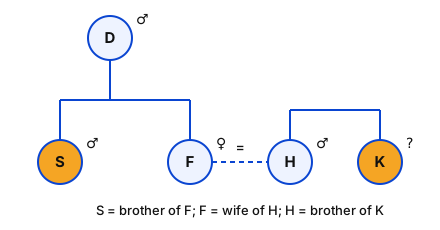
Based on the above, how is S related to K if ‘S + D ÷ F x H – K’?
एक निश्चित कूट भाषा में,
A + B का अर्थ है ‘A, B का पुत्र है’,
A – B का अर्थ है ‘A, B का भाई है’,
A x B का अर्थ है ‘A, B की पत्नी है’ और
A ÷ B का अर्थ है ‘A, B का पिता है’।
उपरोक्त के आधार पर, यदि ‘S + D ÷ F x H – K’ है, तो S का K से क्या संबंध है?
  1. ABrother's wife's fatherभाई की पत्नी का पिता
  2. BWife's brotherपत्नी का भाई
  3. CWife's fatherपत्नी का पिता
  4. DBrother's wife's brotherभाई की पत्नी का भाई
Show answer

Concept: Decode the expression pair by pair and draw the family tree.

  1. S + D: S is the son of D. D ÷ F: D is the father of F → S and F are siblings (S is F's brother).
  2. F × H: F is the wife of H. H – K: H is the brother of K.
  3. So K's brother is H, H's wife is F, and F's brother is S → S is K's brother's wife's brother.

Trick: Read the answer backwards from K: K → brother (H) → wife (F) → brother (S).

Answer: (D) Brother's wife's brother

अवधारणा: व्यंजक को जोड़ी-दर-जोड़ी डिकोड करें और वंश-वृक्ष बनाएँ।

  1. S + D: S, D का पुत्र। D ÷ F: D, F का पिता → S और F भाई-बहन (S, F का भाई)।
  2. F × H: F, H की पत्नी। H – K: H, K का भाई।
  3. अतः K का भाई H, H की पत्नी F, और F का भाई S → S, K के भाई की पत्नी का भाई है।

ट्रिक: उत्तर K से उल्टा पढ़ें: K → भाई (H) → पत्नी (F) → भाई (S)।

उत्तर: (D) Brother's wife's brother (भाई की पत्नी का भाई)

RRB NTPC Undergraduate CBT 1General Intelligence and ReasoningBlood Relations (Coded)RRB NTPC Undergraduate CBT 1 2025 · 7 May Shift 1 →
Q2888.
KH 13 is related to ID 2 in a certain way. In the same way, LO 9 is related to JK −2. To which of the following is LJ 7 related, following the same logic?
KH 13, ID 2 से एक निश्चित प्रकार से संबंधित है। उसी प्रकार, LO 9, JK −2 से संबंधित है। समान तर्क का अनुसरण करते हुए, LJ 7 निम्नलिखित में से किससे संबंधित है?
  1. AJG −6
  2. BKF −4
  3. CKG −6
  4. DJF −4
Show answer

Concept: Find separate rules for the two letters and the number.

  1. KH 13 → ID 2: K(11)→I(9) is −2; H(8)→D(4) is −4; 13−11=2.
  2. LO 9 → JK −2: L→J −2; O(15)→K(11) −4; 9−11=−2 ✓.
  3. LJ 7: L→J, J(10)→F(6), 7−11=−4 → JF −4.

Trick: Rule: 1st letter −2, 2nd letter −4, number −11.

Answer: (D) JF −4

अवधारणा: दोनों अक्षरों और संख्या के लिए अलग-अलग नियम खोजें।

  1. KH 13 → ID 2: K(11)→I(9) यानी −2; H(8)→D(4) यानी −4; 13−11=2।
  2. LO 9 → JK −2: L→J −2; O(15)→K(11) −4; 9−11=−2 ✓।
  3. LJ 7: L→J, J(10)→F(6), 7−11=−4 → JF −4।

ट्रिक: नियम: पहला अक्षर −2, दूसरा अक्षर −4, संख्या −11।

उत्तर: (D) JF −4

RRB NTPC Undergraduate CBT 1General Intelligence and ReasoningLetter–Number AnalogyRRB NTPC Undergraduate CBT 1 2025 · 7 May Shift 1 →
Q2889.
Based on the English alphabetical order, three of the following four letter-cluster pairs are alike in a certain way and thus form a group. Which is the one that does not belong to that group? (Note: The odd one out is not based on the number of
consonants/vowels or their position in the letter cluster.)
अंग्रेज़ी वर्णमाला क्रम के आधार पर, निम्नलिखित चार अक्षर-समूह युग्मों में से तीन एक निश्चित प्रकार से समान हैं और इस प्रकार एक समूह बनाते हैं। वह कौन-सा है जो उस समूह से संबंधित नहीं है? (नोट: असंगत युग्म अक्षर-समूह में
व्यंजनों/स्वरों की संख्या या उनकी स्थिति पर आधारित नहीं है।)
  1. ARP−NL
  2. BLJ−HF
  3. COM−KI
  4. DEC−ZA
Show answer

Concept: Compare corresponding letters of each pair by place value.

  1. RP−NL: R(18)→N(14) −4, P(16)→L(12) −4.
  2. LJ−HF: L→H −4, J→F −4. OM−KI: O→K −4, M→I −4.
  3. EC−ZA: E(5)→Z(26) is −5 (cyclic), C(3)→A(1) is −2 – the pattern breaks.

Trick: Three options follow the same (−4,−4) rule; the one that does not is the odd one.

Answer: (D) EC−ZA

अवधारणा: स्थान-मान से हर युग्म के संगत अक्षरों की तुलना करें।

  1. RP−NL: R(18)→N(14) −4, P(16)→L(12) −4।
  2. LJ−HF: L→H −4, J→F −4। OM−KI: O→K −4, M→I −4।
  3. EC−ZA: E(5)→Z(26) यानी −5 (चक्रीय), C(3)→A(1) यानी −2 – पैटर्न टूटता है।

ट्रिक: तीन विकल्प एक ही (−4,−4) नियम पर चलते हैं; जो नहीं चलता वही विषम है।

उत्तर: (D) EC−ZA

RRB NTPC Undergraduate CBT 1General Intelligence and ReasoningOdd One Out (Letter Pairs)RRB NTPC Undergraduate CBT 1 2025 · 7 May Shift 1 →
Q2890.
Each vowel in the word TRAJECTORIES is changed to the second letter immediately following it in the English alphabetical order, and each consonant is changed to the second letter immediately preceding it in the English alphabetical order. How many letters will appear exactly twice in the new group of letters thus formed?
शब्द TRAJECTORIES के प्रत्येक स्वर को अंग्रेज़ी वर्णमाला क्रम में उसके ठीक बाद आने वाले दूसरे अक्षर में बदल दिया जाता है, और प्रत्येक व्यंजन को अंग्रेज़ी वर्णमाला क्रम में उसके ठीक पहले आने वाले दूसरे अक्षर में बदल दिया जाता है। इस प्रकार बने नए अक्षर-समूह में कितने अक्षर ठीक दो बार आएँगे?
  1. ATwoदो
  2. BOneएक
  3. CThreeतीन
  4. DFourचार
Show answer

Concept: Vowels move +2, consonants move −2; then count repeated letters.

  1. TRAJECTORIES → T→R, R→P, A→C, J→H, E→G, C→A, T→R, O→Q, R→P, I→K, E→G, S→Q.
  2. New group: R P C H G A R Q P K G Q.
  3. Counts: R–2, P–2, G–2, Q–2; C, H, A, K once each → four letters appear exactly twice.

Trick: Letters that were already repeated in the word (T, R, E, O/… ) stay repeated after a uniform shift – T,T→R,R; R,R→P,P; E,E→G,G; and O→Q joins S→Q.

Answer: (D) Four

अवधारणा: स्वर +2, व्यंजन −2 बदलें; फिर दोहराए गए अक्षर गिनें।

  1. TRAJECTORIES → T→R, R→P, A→C, J→H, E→G, C→A, T→R, O→Q, R→P, I→K, E→G, S→Q।
  2. नया समूह: R P C H G A R Q P K G Q।
  3. गिनती: R–2, P–2, G–2, Q–2; C, H, A, K एक-एक बार → चार अक्षर ठीक दो बार आते हैं।

ट्रिक: शब्द में पहले से दोहराए अक्षर समान परिवर्तन के बाद भी दोहराए रहते हैं – T,T→R,R; R,R→P,P; E,E→G,G; और O→Q, S→Q से मिल जाता है।

उत्तर: (D) Four (चार)

RRB NTPC Undergraduate CBT 1General Intelligence and ReasoningWord Formation (Letter Shift)RRB NTPC Undergraduate CBT 1 2025 · 7 May Shift 1 →
Q2891.
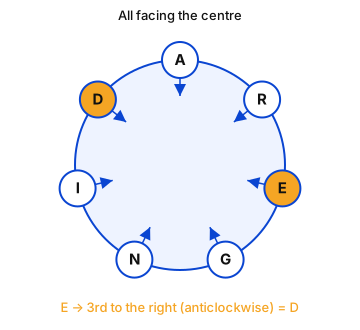
R, E, A, D, I, N and G are sitting around a circular table, facing the centre of the table. Only two people sit between N and R when counted from the left of R. G sits third to the left of A. D sits to the immediate right of A. D sits second to the left of N. I is not an immediate neighbor of G.
Who sits third to the right of E?
R, E, A, D, I, N और G एक वृत्ताकार मेज़ के चारों ओर मेज़ के केंद्र की ओर मुख करके बैठे हैं। R के बाएँ से गिनने पर N और R के बीच केवल दो व्यक्ति बैठे हैं। G, A के बाएँ तीसरे स्थान पर बैठा है। D, A के ठीक दाएँ बैठा है। D, N के बाएँ दूसरे स्थान पर बैठा है। I, G का निकटतम पड़ोसी नहीं है।
E के दाएँ तीसरे स्थान पर कौन बैठा है?
  1. AD
  2. BA
  3. CR
  4. DG
Show answer

Concept: When everyone faces the centre, "left" means clockwise and "right" means anticlockwise.

  1. Fix A. D is immediately right of A; G is third to the left of A.
  2. D is second to the left of N → N is two seats right of D. Check: from the left of R, two people then N → R sits next to A on A's left side (between A and E).
  3. Remaining E and I: I is not next to G, so I sits between N and D, E between R and G.
  4. Clockwise: A, R, E, G, N, I, D. Third to the right (anticlockwise) of E: R, A, D.

Trick: Facing centre → left = clockwise. Fix one person and count seats; verify every clue at the end.

Answer: (A) D

अवधारणा: जब सभी केंद्र की ओर मुख किए हों, "बाएँ" = दक्षिणावर्त (clockwise) और "दाएँ" = वामावर्त।

  1. A को स्थिर करें। D, A के ठीक दाएँ; G, A के बाएँ तीसरा।
  2. D, N के बाएँ दूसरा → N, D से दो सीट दाएँ। जाँच: R के बाएँ से गिनने पर दो लोग फिर N → R, A के बाएँ सटकर (A और E के बीच) बैठा है।
  3. बचे E और I: I, G का पड़ोसी नहीं, अतः I, N और D के बीच; E, R और G के बीच।
  4. दक्षिणावर्त: A, R, E, G, N, I, D। E के दाएँ (वामावर्त) तीसरा: R, A, D।

ट्रिक: केंद्र की ओर मुख → बाएँ = दक्षिणावर्त। एक व्यक्ति स्थिर कर सीटें गिनें; अंत में हर संकेत जाँचें।

उत्तर: (A) D

RRB NTPC Undergraduate CBT 1General Intelligence and ReasoningCircular Seating ArrangementRRB NTPC Undergraduate CBT 1 2025 · 7 May Shift 1 →
Q2892.
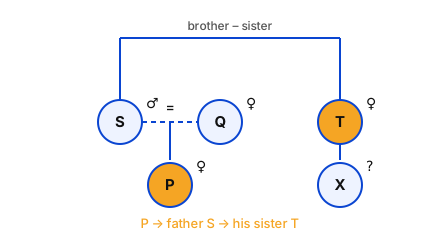
P is the daughter of Q. Q is the wife of S. T is the mother of X. T is the sister of S. How is T related to P?
P, Q की पुत्री है। Q, S की पत्नी है। T, X की माता है। T, S की बहन है। T का P से क्या संबंध है?
  1. ASisterबहन
  2. BFather's sisterपिता की बहन
  3. CHusband's sisterपति की बहन
  4. DMotherमाता
Show answer

Concept: Build the family tree step by step.

  1. P is the daughter of Q, and Q is the wife of S → S is P's father.
  2. T is the sister of S → T is the sister of P's father.
  3. Hence T is P's father's sister (bua). The clue about X is extra information.

Trick: Ignore extra persons (X here) – trace only the chain from P to T.

Answer: (B) Father's sister

अवधारणा: वंश-वृक्ष चरण-दर-चरण बनाएँ।

  1. P, Q की पुत्री और Q, S की पत्नी → S, P का पिता।
  2. T, S की बहन → T, P के पिता की बहन।
  3. अतः T, P की बुआ (father's sister) है। X वाला संकेत अतिरिक्त जानकारी है।

ट्रिक: अतिरिक्त व्यक्तियों (यहाँ X) को छोड़ें – केवल P से T तक की कड़ी देखें।

उत्तर: (B) Father's sister (बुआ)

RRB NTPC Undergraduate CBT 1General Intelligence and ReasoningBlood RelationsRRB NTPC Undergraduate CBT 1 2025 · 7 May Shift 1 →
Q2893.
​Based on the English alphabetical order, three of the following four letter-clusters are alike in a certain way and thus form a group. Which is the one that DOES NOT belong to that group? (Note: The odd one out is not based on the number of consonants/vowels or their position in the letter-cluster.)
अंग्रेज़ी वर्णमाला क्रम के आधार पर, निम्नलिखित चार अक्षर-समूहों में से तीन एक निश्चित प्रकार से समान हैं और इस प्रकार एक समूह बनाते हैं। वह कौन-सा है जो उस समूह से संबंधित नहीं है? (नोट: असंगत अक्षर-समूह, अक्षर-समूह में व्यंजनों/स्वरों की संख्या या उनकी स्थिति पर आधारित नहीं है।)
  1. AMJP
  2. BJGM
  3. CURY
  4. DQNT
Show answer

Concept: Compare the gaps between consecutive letters of each cluster.

  1. MJP: M(13)→J(10) −3, J→P(16) +6.
  2. JGM: J(10)→G(7) −3, G→M(13) +6. QNT: Q(17)→N(14) −3, N→T(20) +6.
  3. URY: U(21)→R(18) −3, R→Y(25) +7 – breaks the (−3,+6) pattern.

Trick: Write the two differences for each cluster; the odd set shows up instantly.

Answer: (C) URY

अवधारणा: हर समूह के क्रमागत अक्षरों के बीच के अंतर की तुलना करें।

  1. MJP: M(13)→J(10) −3, J→P(16) +6।
  2. JGM: J(10)→G(7) −3, G→M(13) +6। QNT: Q(17)→N(14) −3, N→T(20) +6।
  3. URY: U(21)→R(18) −3, R→Y(25) +7 – (−3,+6) पैटर्न टूटता है।

ट्रिक: हर समूह के दोनों अंतर लिखें; विषम समूह तुरंत दिख जाता है।

उत्तर: (C) URY

RRB NTPC Undergraduate CBT 1General Intelligence and ReasoningOdd One Out (Letter Clusters)RRB NTPC Undergraduate CBT 1 2025 · 7 May Shift 1 →
Q2894.
Which of the following options should come in place of the ‘?’ in the given series based on the English alphabetical order?
G 5, M 12, S 19, Y 26, ?
अंग्रेज़ी वर्णमाला क्रम के आधार पर दी गई श्रृंखला में ‘?’ के स्थान पर निम्नलिखित में से कौन-सा विकल्प आना चाहिए?
G 5, M 12, S 19, Y 26, ?
  1. AD 33
  2. BJ 33
  3. CA 33
  4. DE 33
Show answer

Concept: Treat the letters and the numbers as two separate series.

  1. Letters: G(7) → M(13) → S(19) → Y(25) → each +6; 25+6=31, and 31−26=5 → E.
  2. Numbers: 5, 12, 19, 26 → each +7 → 26+7=33.
  3. Next term = E 33.

Trick: After Z the alphabet wraps around – subtract 26 to find the letter.

Answer: (D) E 33

अवधारणा: अक्षरों और संख्याओं को दो अलग श्रृंखलाएँ मानें।

  1. अक्षर: G(7) → M(13) → S(19) → Y(25) → हर बार +6; 25+6=31, और 31−26=5 → E।
  2. संख्याएँ: 5, 12, 19, 26 → हर बार +7 → 26+7=33।
  3. अगला पद = E 33।

ट्रिक: Z के बाद वर्णमाला घूमकर A से शुरू होती है – अक्षर पाने के लिए 26 घटाएँ।

उत्तर: (D) E 33

RRB NTPC Undergraduate CBT 1General Intelligence and ReasoningLetter–Number SeriesRRB NTPC Undergraduate CBT 1 2025 · 7 May Shift 1 →
Q2895.
Which of the following letter-number clusters will replace the question mark (?) in the given series to make it logically complete?
MCK 10, PFN 13, SIQ 16, VLT 19, ?
दी गई श्रृंखला को तार्किक रूप से पूर्ण करने के लिए निम्नलिखित में से कौन-सा अक्षर-संख्या समूह प्रश्नवाचक चिह्न (?) का स्थान लेगा?
MCK 10, PFN 13, SIQ 16, VLT 19, ?
  1. AYOW 22
  2. BXPW 24
  3. CXOV 22
  4. DYPV 22
Show answer

Concept: Check each letter position and the number separately.

  1. 1st letters: M, P, S, V → +3 → Y. 2nd letters: C, F, I, L → +3 → O. 3rd letters: K, N, Q, T → +3 → W.
  2. Numbers: 10, 13, 16, 19 → +3 → 22.
  3. Next term = YOW 22.

Trick: Everything moves by +3 here – a uniform shift is the most common NTPC pattern.

Answer: (A) YOW 22

अवधारणा: हर अक्षर-स्थान और संख्या को अलग-अलग जाँचें।

  1. पहले अक्षर: M, P, S, V → +3 → Y। दूसरे: C, F, I, L → +3 → O। तीसरे: K, N, Q, T → +3 → W।
  2. संख्याएँ: 10, 13, 16, 19 → +3 → 22।
  3. अगला पद = YOW 22।

ट्रिक: यहाँ सब कुछ +3 चलता है – समान परिवर्तन NTPC का सबसे आम पैटर्न है।

उत्तर: (A) YOW 22

RRB NTPC Undergraduate CBT 1General Intelligence and ReasoningLetter–Number SeriesRRB NTPC Undergraduate CBT 1 2025 · 7 May Shift 1 →
Q2896.
If + means -, - means ×, × means ÷, and ÷ means +, then what will come in place of the question mark (?) in the following equation?
92 - 8 ÷ 311 + 715 × 11 = ?
यदि + का अर्थ - है, - का अर्थ × है, × का अर्थ ÷ है, और ÷ का अर्थ + है, तो निम्नलिखित समीकरण में प्रश्नवाचक चिह्न (?) के स्थान पर क्या आएगा?
92 - 8 ÷ 311 + 715 × 11 = ?
  1. A965
  2. B975
  3. C982
  4. D998
Show answer

Concept: Replace each symbol by its meaning, then apply BODMAS.

  1. 92 − 8 ÷ 311 + 715 × 11 becomes 92×8+311−715÷11.
  2. 92×8=736 and 715÷11=65.
  3. 736+311−65=982.

Trick: Do the division first (715÷11=65) – a clean result confirms you decoded correctly.

Answer: (C) 982

अवधारणा: हर चिह्न को उसके अर्थ से बदलें, फिर BODMAS लगाएँ।

  1. 92 − 8 ÷ 311 + 715 × 11 बनता है 92×8+311−715÷11।
  2. 92×8=736 और 715÷11=65।
  3. 736+311−65=982।

ट्रिक: पहले भाग करें (715÷11=65) – साफ़ उत्तर बताता है कि डिकोडिंग सही है।

उत्तर: (C) 982

RRB NTPC Undergraduate CBT 1General Intelligence and ReasoningMathematical OperationsRRB NTPC Undergraduate CBT 1 2025 · 7 May Shift 1 →
Q2897.
Select the set in which the numbers are related in the same way as are the numbers of the following sets.
(NOTE: Operations should be performed on the whole numbers, without breaking down the numbers into their constituent digits. E.g. 13 – Operations on 13 such as adding / subtracting / multiplying etc. to 13 can be performed. Breaking down 13 into 1 and 3 and then performing mathematical operations on 1 and 3 is not allowed.)
8 - 3 - 24
5 - 8 - 40
उस समुच्चय का चयन कीजिए जिसमें संख्याएँ उसी प्रकार संबंधित हैं जिस प्रकार निम्नलिखित समुच्चयों की संख्याएँ संबंधित हैं।
(नोट: संक्रियाएँ पूर्ण संख्याओं पर की जानी चाहिए, संख्याओं को उनके घटक अंकों में तोड़े बिना। उदाहरण के लिए 13 – 13 पर संक्रियाएँ, जैसे 13 में जोड़ना / घटाना / गुणा करना आदि की जा सकती हैं। 13 को 1 और 3 में तोड़कर फिर 1 और 3 पर गणितीय संक्रियाएँ करने की अनुमति नहीं है।)
8 - 3 - 24
5 - 8 - 40
  1. A4 - 8 - 43
  2. B14 - 6 - 34
  3. C2 - 9 - 15
  4. D4 - 9 - 36
Show answer

Concept: Find one operation that links the first two numbers to the third in both given sets.

  1. 8×3=24 ✓ and 5×8=40 ✓ → third = first × second.
  2. Options: 4×8=32≠43; 14×6=84≠34; 2×9=18≠15; 4×9=36 ✓.

Trick: Test the simplest operation (product) first; it fits both sets here, so no need to try anything else.

Answer: (D) 4 - 9 - 36

अवधारणा: ऐसी एक संक्रिया खोजें जो दोनों दिए गए समुच्चयों में पहली दो संख्याओं को तीसरी से जोड़े।

  1. 8×3=24 ✓ और 5×8=40 ✓ → तीसरी = पहली × दूसरी।
  2. विकल्प: 4×8=32≠43; 14×6=84≠34; 2×9=18≠15; 4×9=36 ✓।

ट्रिक: सबसे सरल संक्रिया (गुणा) पहले आज़माएँ; यहाँ दोनों समुच्चयों में फिट है, तो और कुछ आज़माने की ज़रूरत नहीं।

उत्तर: (D) 4 - 9 - 36

RRB NTPC Undergraduate CBT 1General Intelligence and ReasoningNumber Analogy (Triplets)RRB NTPC Undergraduate CBT 1 2025 · 7 May Shift 1 →
Q2898.
GECD is related to CAYZ in a certain way based on the English alphabetical order. In the same way, AYWX is related to WUST. To which of the following is USQR related, following the same logic?
अंग्रेज़ी वर्णमाला क्रम के आधार पर GECD, CAYZ से एक निश्चित प्रकार से संबंधित है। उसी प्रकार, AYWX, WUST से संबंधित है। समान तर्क का अनुसरण करते हुए, USQR निम्नलिखित में से किससे संबंधित है?
  1. AQNLN
  2. BQOLN
  3. CQPLR
  4. DQOMN
Show answer

Concept: Find the shift applied to each letter.

  1. GECD → CAYZ: G(7)→C(3) −4, E(5)→A(1) −4, C(3)→Y(25) −4 (cyclic), D(4)→Z(26) −4.
  2. AYWX → WUST: A→W, Y→U, W→S, X→T: all −4 ✓.
  3. USQR: U(21)→Q(17), S(19)→O(15), Q(17)→M(13), R(18)→N(14) → QOMN.

Trick: Moving back past A wraps to Z (treat A as 27 when subtracting).

Answer: (D) QOMN

अवधारणा: हर अक्षर पर लगाया गया परिवर्तन खोजें।

  1. GECD → CAYZ: G(7)→C(3) −4, E(5)→A(1) −4, C(3)→Y(25) −4 (चक्रीय), D(4)→Z(26) −4।
  2. AYWX → WUST: A→W, Y→U, W→S, X→T: सभी −4 ✓।
  3. USQR: U(21)→Q(17), S(19)→O(15), Q(17)→M(13), R(18)→N(14) → QOMN।

ट्रिक: A से पीछे जाने पर Z पर पहुँचते हैं (घटाते समय A को 27 मानें)।

उत्तर: (D) QOMN

RRB NTPC Undergraduate CBT 1General Intelligence and ReasoningLetter AnalogyRRB NTPC Undergraduate CBT 1 2025 · 7 May Shift 1 →
Q2899.
What should come in place of the ‘?’ in the given series?
5 14 41 122 ? 1094
दी गई श्रृंखला में ‘?’ के स्थान पर क्या आना चाहिए?
5 14 41 122 ? 1094
  1. A365
  2. B361
  3. C381
  4. D368
Show answer

Concept: When terms grow roughly three-fold, test "×3 plus/minus a constant".

  1. 5×3−1=14, 14×3−1=41, 41×3−1=122.
  2. 122×3−1=365.
  3. Check: 365×3−1=1094 ✓ (the last given term).

Trick: Always verify with the term after the blank – here 1094 confirms the rule.

Answer: (A) 365

अवधारणा: जब पद लगभग तिगुने बढ़ें, "×3 ± स्थिरांक" आज़माएँ।

  1. 5×3−1=14, 14×3−1=41, 41×3−1=122।
  2. 122×3−1=365।
  3. जाँच: 365×3−1=1094 ✓ (अंतिम दिया पद)।

ट्रिक: रिक्त स्थान के बाद वाले पद से हमेशा जाँचें – यहाँ 1094 नियम की पुष्टि करता है।

उत्तर: (A) 365

RRB NTPC Undergraduate CBT 1General Intelligence and ReasoningNumber SeriesRRB NTPC Undergraduate CBT 1 2025 · 7 May Shift 1 →
Q2900.
What should come in place of the ‘?’ in the given series?
13 19 31 55 103 ?
दी गई श्रृंखला में ‘?’ के स्थान पर क्या आना चाहिए?
13 19 31 55 103 ?
  1. A199
  2. B203
  3. C190
  4. D195
Show answer

Concept: Look at the differences between consecutive terms.

  1. 19−13=6, 31−19=12, 55−31=24, 103−55=48.
  2. Differences double each time: 6, 12, 24, 48 → next difference =96.
  3. 103+96=199.

Trick: Equivalent rule: each term =2×previous−7 (2×10³−7=199).

Answer: (A) 199

अवधारणा: क्रमागत पदों के अंतर देखें।

  1. 19−13=6, 31−19=12, 55−31=24, 103−55=48।
  2. अंतर हर बार दोगुना: 6, 12, 24, 48 → अगला अंतर =96।
  3. 103+96=199।

ट्रिक: समतुल्य नियम: हर पद =2×पिछला पद−7 (2×10³−7=199)।

उत्तर: (A) 199

RRB NTPC Undergraduate CBT 1General Intelligence and ReasoningNumber SeriesRRB NTPC Undergraduate CBT 1 2025 · 7 May Shift 1 →