Question bank

Q&A: practice questions with answers

Search questions on any topic. Filter by exam category, exam, subject and topic, try the question, then open the answer and explanation.

Courses – airGurukul

8,500 questions found.

Q3441.
Vikram, Komal and Rishi invested ₹1,540, ₹1,760 and ₹1,170 respectively to start a business. If the profit at the end of the year is ₹1,490, what is Rishi’s share of the profit?
विक्रम, कोमल और ऋषि ने एक व्यवसाय शुरू करने के लिए क्रमशः ₹1,540, ₹1,760 और ₹1,170 का निवेश किया। यदि वर्ष के अंत में लाभ ₹1,490 है, तो लाभ में ऋषि का हिस्सा कितना है?
  1. A₹392
  2. B₹390
  3. C₹391
  4. D₹388
Show answer

Concept: In a partnership for the same time, profit is shared in the ratio of investments.
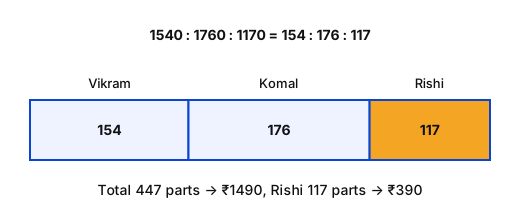
  1. Ratio =1540:1760:1170=154:176:117 (divide by 10).
  2. Total parts =154+176+117=447.
  3. Rishi’s share =117447×1490. Since 1490=447×103, share =117×103=390.

Trick: 447×3=1341 and 1490×3=4470 → each part = 103, so Rishi = 11703=390.

Answer: (B) ₹390

अवधारणा: समान समय की साझेदारी में लाभ निवेश के अनुपात में बँटता है।

  1. अनुपात =1540:1760:1170=154:176:117 (10 से भाग)।
  2. कुल भाग =154+176+117=447।
  3. ऋषि का हिस्सा =117447×1490; चूँकि 1490=447×103, हिस्सा =117×103=390।

ट्रिक: एक भाग =103, अतः ऋषि =11703=390।

उत्तर: (B) ₹390

RRB NTPC Undergraduate CBT 1MathematicsPartnershipRRB NTPC Undergraduate CBT 1 2024 · 9 Sep Shift 1 →
Q3442.
What sum (in ₹) will amount to ₹2,280 in 4 years at 5% per annum simple interest?
कौन-सी राशि (₹ में) 5% वार्षिक साधारण ब्याज की दर से 4 वर्षों में ₹2,280 हो जाएगी?
  1. A₹1,900
  2. B₹11,400
  3. C₹1,850
  4. D₹1,950
Show answer

Concept: Amount A=P(1+R×T100) for simple interest.

  1. Total interest rate =5%×4=20%.
  2. So A=P×120100=2280.
  3. P=2280×100120=1900.

Trick: 120%→2280, so 1%→19 and 100%→1900.

Answer: (A) ₹1,900

अवधारणा: साधारण ब्याज में मिश्रधन A=P(1+R×T100)।

  1. कुल ब्याज दर =5%×4=20%।
  2. अतः A=P×120100=2280।
  3. P=2280×100120=1900।

ट्रिक: 120%→2280, तो 1%→19 और 100%→1900।

उत्तर: (A) ₹1,900

RRB NTPC Undergraduate CBT 1MathematicsSimple interestRRB NTPC Undergraduate CBT 1 2024 · 9 Sep Shift 1 →
Q3443.
Find the value of [147÷{29+2×(4−8)}].
[147÷{29+2×(4−8)}] का मान ज्ञात कीजिए।
  1. A8
  2. B9
  3. C3
  4. D7
Show answer

Concept: Apply BODMAS: innermost bracket first, then multiplication, then addition, then division.

  1. Innermost: (4−8)=−4.
  2. 2×(−4)=−8, so {29+(−8)}=21.
  3. 147÷21=7.

Trick: Solve brackets from inside out: ( ) → { } → [ ].

Answer: (D) 7

अवधारणा: BODMAS लगाएँ: पहले सबसे अंदर का कोष्ठक, फिर गुणा, फिर जोड़, फिर भाग।

  1. सबसे अंदर: (4−8)=−4।
  2. 2×(−4)=−8, अतः {29+(−8)}=21।
  3. 147÷21=7।

ट्रिक: कोष्ठक अंदर से बाहर हल करें: ( ) → { } → [ ]।

उत्तर: (D) 7

RRB NTPC Undergraduate CBT 1MathematicsSimplification – BODMASRRB NTPC Undergraduate CBT 1 2024 · 9 Sep Shift 1 →
Q3444.
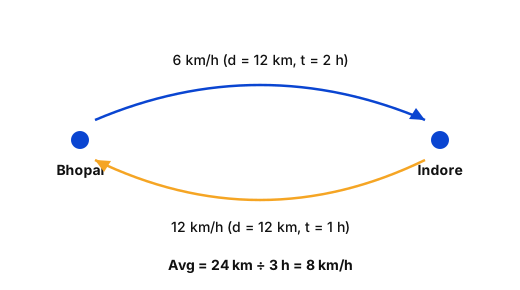
A man goes from Bhopal to Indore at a speed of 6 km/hr and returns to Bhopal by the same route at a speed of 12 km/hr. Find his average speed (in km/hr) for the whole journey.
एक व्यक्ति भोपाल से इंदौर 6 km/hr की चाल से जाता है और उसी मार्ग से 12 km/hr की चाल से भोपाल लौटता है। पूरी यात्रा के लिए उसकी औसत चाल (km/hr में) ज्ञात कीजिए।
  1. A4
  2. B10
  3. C6
  4. D8
Show answer

Concept: For equal distances at speeds x and y, average speed =2xyx+y (harmonic mean, not simple average).

  1. Here x=6, y=12 km/h.
  2. Average speed =2×6×126+12=14418=8 km/h.
  3. Check: take distance 12km → times 2h and 1h → 243=8.

Trick: Simple average 9 is wrong – the slower leg takes more time, so the answer is less than 9.

Answer: (D) 8

अवधारणा: समान दूरी को x और y चाल से तय करने पर औसत चाल =2xyx+y (साधारण औसत नहीं)।

  1. यहाँ x=6, y=12 km/h।
  2. औसत चाल =2×6×126+12=14418=8 km/h।
  3. जाँच: दूरी 12km लें → समय 2h और 1h → 243=8।

ट्रिक: साधारण औसत 9 गलत है – धीमी यात्रा में ज़्यादा समय लगता है, इसलिए उत्तर 9 से कम होगा।

उत्तर: (D) 8

RRB NTPC Undergraduate CBT 1MathematicsAverage speedRRB NTPC Undergraduate CBT 1 2024 · 9 Sep Shift 1 →
Q3445.
Simplify:
1tan2θ+tan2θsin2θ×cos2θ
सरल कीजिए:
1tan2θ+tan2θsin2θ×cos2θ
  1. Asec2θ
  2. Bsin2θ
  3. Ccsc2θ
  4. D1
Show answer

Concept: Use 1tan2θ=cot2θ, tanθ=sinθcosθ and 1+cot2θ=csc2θ.

  1. First term: 1tan2θ=cot2θ.
  2. Second term: tan2θsin2θ=1cos2θ, so 1cos2θ×cos2θ=1.
  3. Sum =cot2θ+1=csc2θ.

Trick: Put θ=45∘: 1+10.5×0.5=2, and csc245∘=2.

Answer: (C) csc2θ

अवधारणा: 1tan2θ=cot2θ, tanθ=sinθcosθ और 1+cot2θ=csc2θ का प्रयोग करें।

  1. पहला पद: 1tan2θ=cot2θ।
  2. दूसरा पद: tan2θsin2θ=1cos2θ, अतः 1cos2θ×cos2θ=1।
  3. योग =cot2θ+1=csc2θ।

ट्रिक: θ=45∘ रखें: 1+10.5×0.5=2 और csc245∘=2।

उत्तर: (C) csc2θ

RRB NTPC Undergraduate CBT 1MathematicsTrigonometric identitiesRRB NTPC Undergraduate CBT 1 2024 · 9 Sep Shift 1 →
Q3446.
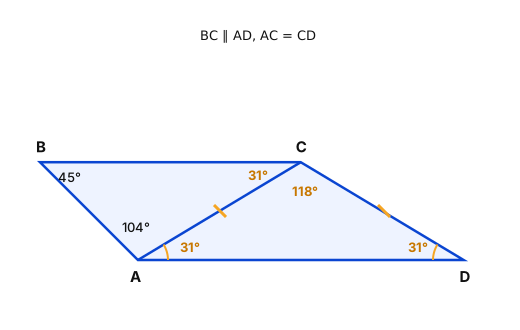
ABCD is a trapezium in which BC∥AD and AC=CD. If ∠ABC=45∘ and ∠BAC=104∘, then what is the measure of ∠ACD (in degrees)?
ABCD एक समलंब चतुर्भुज है जिसमें BC∥AD और AC=CD है। यदि ∠ABC=45∘ और ∠BAC=104∘ है, तो ∠ACD की माप (डिग्री में) क्या है?
  1. A114∘
  2. B130∘
  3. C117∘
  4. D118∘
Show answer

Concept: In △ABC the angle sum is 180∘; with BC∥AD, alternate angles are equal; in an isosceles triangle base angles are equal.

  1. In △ABC: ∠BCA=180∘−45∘−104∘=31∘.
  2. BC∥AD, so ∠CAD=∠BCA=31∘ (alternate angles).
  3. AC=CD, so ∠CDA=∠CAD=31∘.
  4. ∠ACD=180∘−31∘−31∘=118∘.

Trick: Answer =180∘−2×(180∘−45∘−104∘)=180∘−62∘.

Answer: (D) 118∘

अवधारणा: △ABC में कोणों का योग 180∘; BC∥AD होने से एकांतर कोण बराबर; समद्विबाहु त्रिभुज में आधार कोण बराबर।

  1. △ABC में: ∠BCA=180∘−45∘−104∘=31∘।
  2. BC∥AD, अतः ∠CAD=∠BCA=31∘ (एकांतर कोण)।
  3. AC=CD, अतः ∠CDA=∠CAD=31∘।
  4. ∠ACD=180∘−31∘−31∘=118∘।

ट्रिक: उत्तर =180∘−2×(180∘−45∘−104∘)=180∘−62∘।

उत्तर: (D) 118∘

RRB NTPC Undergraduate CBT 1MathematicsTrapezium – anglesRRB NTPC Undergraduate CBT 1 2024 · 9 Sep Shift 1 →
Q3447.
Find the value of 69−4÷6910×69−17.
69−4÷6910×69−17 का मान ज्ञात कीजिए।
  1. A69−36
  2. B69−31
  3. C69−32
  4. D69−21
Show answer

Concept: For the same base: am÷an=am−n and am×an=am+n.

  1. 69−4÷6910=69−4−10=69−14.
  2. 69−14×69−17=69−14−17=69−31.

Trick: Add powers with signs: −4−10−17=−31 (dividing flips the sign of 10).

Answer: (B) 69−31

अवधारणा: समान आधार के लिए: am÷an=am−n और am×an=am+n।

  1. 69−4÷6910=69−4−10=69−14।
  2. 69−14×69−17=69−14−17=69−31।

ट्रिक: घातों को चिह्न सहित जोड़ें: −4−10−17=−31 (भाग से 10 का चिह्न बदलता है)।

उत्तर: (B) 69−31

RRB NTPC Undergraduate CBT 1MathematicsLaws of exponentsRRB NTPC Undergraduate CBT 1 2024 · 9 Sep Shift 1 →
Q3448.
Find the LCM of 53×92×14, 52×142×19 and 93×142×192.
53×92×14, 52×142×19 और 93×142×192 का LCM ज्ञात कीजिए।
  1. A53×93×142×192
  2. B53×92×142×19
  3. C52×92×142×193
  4. D52×93×14×192
Show answer

Concept: LCM of numbers in power form = product of each base with its highest power (the bases 5, 9, 14, 19 are pairwise co-prime).

  1. Highest power of 5: 53; of 9: 93.
  2. Highest power of 14: 142; of 19: 192.
  3. LCM =53×93×142×192.

Yaad rakhein: LCM → highest powers; HCF → lowest powers of common bases.

Answer: (A) 53×93×142×192

अवधारणा: घात रूप में संख्याओं का LCM = हर आधार की सबसे बड़ी घात का गुणनफल (आधार 5, 9, 14, 19 परस्पर सह-अभाज्य हैं)।

  1. 5 की सबसे बड़ी घात 53; 9 की 93।
  2. 14 की सबसे बड़ी घात 142; 19 की 192।
  3. LCM =53×93×142×192।

याद रखें: LCM → सबसे बड़ी घात; HCF → उभयनिष्ठ आधारों की सबसे छोटी घात।

उत्तर: (A) 53×93×142×192

RRB NTPC Undergraduate CBT 1MathematicsLCMRRB NTPC Undergraduate CBT 1 2024 · 9 Sep Shift 1 →
Q3449.
The cost of 13 pens and 3 pencils is ₹152. If the price of a pen decreases by ₹1 per pen and the price of a pencil increases by ₹7 per pencil, then the cost of 18 pens and 3 pencils becomes ₹165. What is the original cost of 12 pens and 11 pencils?
13 पेन और 3 पेंसिलों का मूल्य ₹152 है। यदि एक पेन का मूल्य ₹1 प्रति पेन कम हो जाता है और एक पेंसिल का मूल्य ₹7 प्रति पेंसिल बढ़ जाता है, तो 18 पेन और 3 पेंसिलों का मूल्य ₹165 हो जाता है। 12 पेन और 11 पेंसिलों का मूल मूल्य क्या है?
  1. A₹481
  2. B₹486
  3. C₹489
  4. D₹483
Show answer

Concept: Let a pen cost p and a pencil cost c (in ₹); form two equations and solve.

  1. 13p+3c=152 … (i)
  2. New prices: 18(p−1)+3(c+7)=165⇒18p+3c=165+18−21=162 … (ii)
  3. (ii) − (i): 5p=10⇒p=2; then 3c=152−26=126⇒c=42.
  4. 12p+11c=24+462=486.

Trick: Both equations have 3c – subtract directly to get p.

Answer: (B) ₹486

अवधारणा: पेन का मूल्य p और पेंसिल का c (₹ में) मानें; दो समीकरण बनाकर हल करें।

  1. 13p+3c=152 … (i)
  2. नए मूल्य: 18(p−1)+3(c+7)=165⇒18p+3c=165+18−21=162 … (ii)
  3. (ii) − (i): 5p=10⇒p=2; फिर 3c=152−26=126⇒c=42।
  4. 12p+11c=24+462=486।

ट्रिक: दोनों समीकरणों में 3c है – सीधे घटाकर p निकालें।

उत्तर: (B) ₹486

RRB NTPC Undergraduate CBT 1MathematicsLinear equationsRRB NTPC Undergraduate CBT 1 2024 · 9 Sep Shift 1 →
Q3450.
The number of prime numbers lying between 402 and 409, both included, is:
402 और 409 (दोनों सम्मिलित) के बीच स्थित अभाज्य संख्याओं की संख्या कितनी है?
  1. A1
  2. B4
  3. C6
  4. D3
Show answer

Concept: To test a number n for primality, check division by primes up to n (here up to 19, since 409≈20.2).

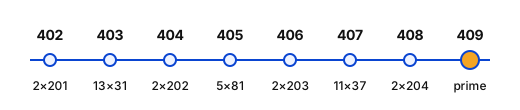
  1. Even numbers 402, 404, 406, 408 and 405 (ends in 5) are not prime.
  2. 403=13×31 and 407=11×37 – not prime.
  3. 409 is not divisible by 2, 3, 5, 7, 11, 13, 17 or 19 – prime. So only 1 prime.

Trick: Odd numbers not ending in 5 are the only candidates: 403, 407, 409.

Answer: (A) 1

अवधारणा: किसी संख्या n के अभाज्य होने की जाँच n तक की अभाज्य संख्याओं से भाग देकर करें (यहाँ 19 तक, क्योंकि 409≈20.2)।

  1. सम संख्याएँ 402, 404, 406, 408 और 405 (अंत में 5) अभाज्य नहीं।
  2. 403=13×31 और 407=11×37 – अभाज्य नहीं।
  3. 409 किसी भी 2, 3, 5, 7, 11, 13, 17, 19 से विभाज्य नहीं – अभाज्य। अतः केवल 1।

ट्रिक: केवल विषम संख्याएँ जो 5 पर समाप्त न हों: 403, 407, 409।

उत्तर: (A) 1

RRB NTPC Undergraduate CBT 1MathematicsPrime numbersRRB NTPC Undergraduate CBT 1 2024 · 9 Sep Shift 1 →
Q3451.
The average runs scored by a batsman in 23 matches is 40. In the next 10 matches, the batsman scored an average of 15 runs. Find the average runs scored by him in all 33 matches (rounded off to two decimal places).
एक बल्लेबाज़ द्वारा 23 मैचों में बनाए गए रनों का औसत 40 है। अगले 10 मैचों में, बल्लेबाज़ ने औसतन 15 रन बनाए। सभी 33 मैचों में उसके द्वारा बनाए गए रनों का औसत (दो दशमलव स्थानों तक पूर्णांकित) ज्ञात कीजिए।
  1. A31.42
  2. B32.42
  3. C33.42
  4. D34.42
Show answer

Concept: Total runs = average × number of matches; combined average = total runs ÷ total matches.

  1. Runs in 23 matches =23×40=920
  2. Runs in next 10 matches =10×15=150
  3. Total =920+150=1070 in 33 matches
  4. Average =107033=32.42

Trick: Deviation method: 40−10×(40−15)33=40−25033=40−7.58=32.42

Answer: (B) 32.42

अवधारणा: कुल रन = औसत × मैचों की संख्या; संयुक्त औसत = कुल रन ÷ कुल मैच।

  1. 23 मैचों के रन =23×40=920
  2. अगले 10 मैचों के रन =10×15=150
  3. कुल =920+150=1070 (33 मैच)
  4. औसत =107033=32.42

ट्रिक: विचलन विधि: 40−10×2533=40−7.58=32.42

उत्तर: (B) 32.42

RRB NTPC Undergraduate CBT 1MathematicsAverageRRB NTPC Undergraduate CBT 1 2024 · 9 Sep Shift 1 →
Q3452.
The sum of two numbers is 40 and their L.C.M. is 351. Find the two numbers.
दो संख्याओं का योग 40 है और उनका L.C.M. 351 है। दोनों संख्याएँ ज्ञात कीजिए।
  1. A13, 27
  2. B18, 22
  3. C11, 29
  4. D6, 34
Show answer

Concept: If two numbers are a and b, both their sum and their LCM must be checked; the quickest way is to test the options.

  1. 351=33×13=27×13
  2. Option (A): 13+27=40 ✓ and LCM(13,27)=351 ✓ (they are co-prime)
  3. (B) LCM(18,22)=198, (C) LCM(11,29)=319, (D) LCM(6,34)=102 — all wrong

Trick: Factorise the LCM first: 351=27×13, and 27+13=40 instantly.

Answer: (A) 13, 27

अवधारणा: दोनों संख्याओं का योग और LCM दोनों मिलाने हैं; विकल्पों की जाँच सबसे तेज़ तरीका है।

  1. 351=33×13=27×13
  2. विकल्प (A): 13+27=40 ✓ और LCM(13,27)=351 ✓ (सह-अभाज्य)
  3. (B) LCM=198, (C) LCM=319, (D) LCM=102 — गलत

ट्रिक: LCM के गुणनखंड करें: 351=27×13 और 27+13=40।

उत्तर: (A) 13, 27

RRB NTPC Undergraduate CBT 1MathematicsLCM and HCFRRB NTPC Undergraduate CBT 1 2024 · 9 Sep Shift 1 →
Q3453.
Raman's income is ₹41,400. He saves 24% of his income. If his income increases by 22% and expenditure increases by 25%, then there will be ____________ in his savings.
रमन की आय ₹41,400 है। वह अपनी आय का 24% बचाता है। यदि उसकी आय में 22% की वृद्धि होती है और व्यय में 25% की वृद्धि होती है, तो उसकी बचत में ____________ होगी।
  1. AIncrease of ₹1,242₹1,242 की वृद्धि
  2. BDecrease of ₹1,241₹1,241 की कमी
  3. CDecrease of ₹1,244₹1,244 की कमी
  4. DIncrease of ₹1,245₹1,245 की वृद्धि
Show answer

Concept: Savings = Income − Expenditure. Increase income and expenditure separately, then compare savings.

  1. Savings =24% of 41400 =9936; Expenditure =41400−9936=31464
  2. New income =41400×1.22=50508
  3. New expenditure =31464×1.25=39330
  4. New savings =50508−39330=11178; change =11178−9936=+1242

Trick: Change in savings =22% of 41400−25% of 31464=9108−7866=1242 (increase).

Answer: (A) Increase of ₹1,242

अवधारणा: बचत = आय − व्यय। आय और व्यय को अलग-अलग बढ़ाकर नई बचत निकालें।

  1. बचत =41400 का 24%=9936; व्यय =31464
  2. नई आय =41400×1.22=50508
  3. नया व्यय =31464×1.25=39330
  4. नई बचत =11178; अंतर =11178−9936=+1242

ट्रिक: बचत में बदलाव =41400 का 22%−31464 का 25%=9108−7866=1242 (वृद्धि)।

उत्तर: (A) ₹1,242 की वृद्धि

RRB NTPC Undergraduate CBT 1MathematicsIncome, expenditure and savingsRRB NTPC Undergraduate CBT 1 2024 · 9 Sep Shift 1 →
Q3454.
Wasim covers a journey of 234 km at a speed of 78 km/hr, the next 441 km at a speed of 49 km/h and the next 488 km at a speed of 61 km/h. What is his average speed (in km/hr) for the entire journey?
वसीम 234 km की यात्रा 78 km/hr की चाल से, अगले 441 km की यात्रा 49 km/h की चाल से और अगले 488 km की यात्रा 61 km/h की चाल से तय करता है। पूरी यात्रा के लिए उसकी औसत चाल (km/hr में) क्या है?
  1. A50.87
  2. B50.13
  3. C58.15
  4. D54.83
Show answer

Concept: Average speed=Total distanceTotal time (never the average of the speeds).

  1. Times: 23478=3 h, 44149=9 h, 48861=8 h
  2. Total time =3+9+8=20 h
  3. Total distance =234+441+488=1163km
  4. Average speed =116320=58.15km/h

Yaad rakhein: Each distance here is an exact multiple of its speed — compute times first.

Answer: (C) 58.15

अवधारणा: औसत चाल=कुल दूरीकुल समय (चालों का साधारण औसत नहीं)।

  1. समय: 23478=3 h, 44149=9 h, 48861=8 h
  2. कुल समय =20 h
  3. कुल दूरी =1163km
  4. औसत चाल =116320=58.15km/h

याद रखें: यहाँ हर दूरी अपनी चाल का पूर्ण गुणज है — पहले समय निकालें।

उत्तर: (C) 58.15

RRB NTPC Undergraduate CBT 1MathematicsAverage speedRRB NTPC Undergraduate CBT 1 2024 · 9 Sep Shift 1 →
Q3455.
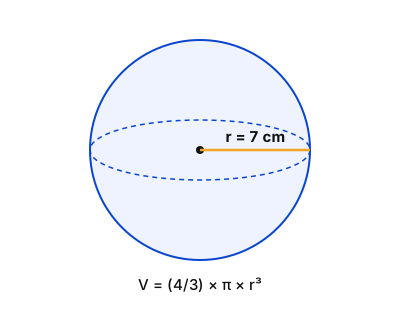
Find the volume (in cm3, rounded off to the nearest integer) of a sphere of radius 7 cm.
(Use π=227)
7 cm त्रिज्या वाले एक गोले का आयतन (cm3 में, निकटतम पूर्णांक तक पूर्णांकित) ज्ञात कीजिए।
(π=227 का उपयोग कीजिए)
  1. A1442 cm3
  2. B1437 cm3
  3. C1436 cm3
  4. D1446 cm3
Show answer

Concept: Volume of a sphere V=43πr3.

  1. r3=73=343
  2. V=43×227×343=4×22×493
  3. =43123=1437.33≈1437cm3

Trick: With r=7: 43×22×49 — cancel 7 first, then divide by 3 at the end.

Answer: (B) 1437cm3

अवधारणा: गोले का आयतन V=43πr3।

  1. r3=73=343
  2. V=43×227×343=4×22×493
  3. =43123=1437.33≈1437cm3

ट्रिक: r=7 होने पर पहले 7 कट जाता है: 43×22×49।

उत्तर: (B) 1437cm3

RRB NTPC Undergraduate CBT 1MathematicsVolume of sphereRRB NTPC Undergraduate CBT 1 2024 · 9 Sep Shift 1 →
Q3456.
Which of the following ratios is the greatest?
निम्नलिखित में से कौन-सा अनुपात सबसे बड़ा है?
  1. A37 : 56
  2. B38 : 75
  3. C33 : 54
  4. D35 : 80
Show answer

Concept: Write each ratio as a fraction (decimal) and compare.

  1. 3756≈0.661
  2. 3875≈0.507
  3. 3354≈0.611
  4. 3580=0.4375 → largest is 37:56

Trick: Only 37:56 and 33:54 are above 12 comfortably; cross-multiply: 37×54=1998>33×56=1848.

Answer: (A) 37:56

अवधारणा: हर अनुपात को भिन्न (दशमलव) में बदलकर तुलना करें।

  1. 3756≈0.661
  2. 3875≈0.507
  3. 3354≈0.611
  4. 3580=0.4375 → सबसे बड़ा 37:56

ट्रिक: वज्र-गुणन: 37×54=1998>33×56=1848।

उत्तर: (A) 37:56

RRB NTPC Undergraduate CBT 1MathematicsComparison of ratiosRRB NTPC Undergraduate CBT 1 2024 · 9 Sep Shift 1 →
Q3457.
Increasing a number by 80% gives 2430. Find the number.
किसी संख्या में 80% की वृद्धि करने पर 2430 प्राप्त होता है। वह संख्या ज्ञात कीजिए।
  1. A4050
  2. B2700
  3. C675
  4. D1350
Show answer

Concept: Increasing a number by 80% multiplies it by 1.8.

  1. x×180100=2430
  2. x=2430×100180=1350

Trick: 180%→2430, so 10%→135 and 100%→1350.

Answer: (D) 1350

अवधारणा: किसी संख्या में 80% वृद्धि = संख्या ×1.8।

  1. x×180100=2430
  2. x=2430×100180=1350

ट्रिक: 180%→2430, तो 10%→135 और 100%→1350।

उत्तर: (D) 1350

RRB NTPC Undergraduate CBT 1MathematicsPercentageRRB NTPC Undergraduate CBT 1 2024 · 9 Sep Shift 1 →
Q3458.
Eight times the present age of P is 12 years more than the present age of Q. After 8 years, three times the age of Q at that time will be 28 years less than eight times the age of P. Find the present age (in years) of Q.
P की वर्तमान आयु का आठ गुना, Q की वर्तमान आयु से 12 वर्ष अधिक है। 8 वर्ष बाद, उस समय Q की आयु का तीन गुना, P की आयु के आठ गुने से 28 वर्ष कम होगा। Q की वर्तमान आयु (वर्षों में) ज्ञात कीजिए।
  1. A12
  2. B8
  3. C15
  4. D7
Show answer

Concept: Form two linear equations from the two conditions and solve.

  1. Now: 8P=Q+12
  2. After 8 years: 3(Q+8)=8(P+8)−28⇒3Q+24=8P+36
  3. Put 8P=Q+12: 3Q+24=Q+48⇒2Q=24
  4. Q=12 years (and P=3)

Trick: Check option (A): Q=12⇒P=3; later 3×20=60 and 8×11−28=60 ✓

Answer: (A) 12

अवधारणा: दोनों शर्तों से दो रैखिक समीकरण बनाकर हल करें।

  1. अभी: 8P=Q+12
  2. 8 वर्ष बाद: 3(Q+8)=8(P+8)−28⇒3Q+24=8P+36
  3. 8P=Q+12 रखने पर: 2Q=24
  4. Q=12 वर्ष (P=3)

ट्रिक: विकल्प (A) जाँचें: Q=12,P=3; बाद में 3×20=60=8×11−28 ✓

उत्तर: (A) 12

RRB NTPC Undergraduate CBT 1MathematicsProblems on agesRRB NTPC Undergraduate CBT 1 2024 · 9 Sep Shift 1 →
Q3459.
Abhay and Bharat can complete a certain work in 5 and 15 days, respectively. They started working together and after 2 days, Bharat left the work. In how many days will Abhay complete the remaining work?
अभय और भरत किसी कार्य को क्रमशः 5 और 15 दिनों में पूरा कर सकते हैं। उन्होंने एक साथ कार्य करना शुरू किया और 2 दिनों के बाद भरत ने कार्य छोड़ दिया। अभय शेष कार्य को कितने दिनों में पूरा करेगा?
  1. A113
  2. B213
  3. C413
  4. D313
Show answer

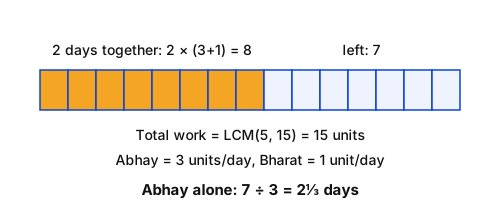
Concept: Take total work = LCM of the days; find each person’s daily units.

  1. Total =LCM(5,15)=15 units; Abhay =3/day, Bharat =1/day
  2. In 2 days together: 2×(3+1)=8 units
  3. Remaining =15−8=7 units
  4. Abhay alone: 73=213 days

Trick: Work done together =2(15+115)=815; rest 715×5=73 days.

Answer: (B) 213

अवधारणा: कुल कार्य = दिनों का LCM; फिर प्रत्येक का प्रतिदिन कार्य निकालें।

  1. कुल =15 इकाई; अभय =3/दिन, भरत =1/दिन
  2. 2 दिन साथ में: 2×4=8 इकाई
  3. शेष =7 इकाई
  4. अभय अकेला: 73=213 दिन

ट्रिक: 2(15+115)=815; शेष 715×5=73 दिन।

उत्तर: (B) 213

RRB NTPC Undergraduate CBT 1MathematicsTime and workRRB NTPC Undergraduate CBT 1 2024 · 9 Sep Shift 1 →
Q3460.
The number 740705 is divisible by which of the following?
संख्या 740705 निम्नलिखित में से किससे विभाज्य है?
  1. A12
  2. B9
  3. C4
  4. D5
Show answer

Concept: Apply the divisibility tests for 5, 4, 9 and 12 (= 3 and 4).

  1. Last digit is 5 → divisible by 5 ✓
  2. Last two digits 05 → not divisible by 4, hence not by 12
  3. Digit sum 7+4+0+7+0+5=23 → not divisible by 9 (or 3)

Yaad rakhein: An odd number can never be divisible by 4 or 12 — check the last digit first.

Answer: (D) 5

अवधारणा: 5, 4, 9 और 12 (= 3 और 4) के विभाज्यता नियम लगाएँ।

  1. अंतिम अंक 5 → 5 से विभाज्य ✓
  2. अंतिम दो अंक 05 → 4 से नहीं, अतः 12 से भी नहीं
  3. अंकों का योग =23 → 9 (या 3) से नहीं

याद रखें: विषम संख्या कभी 4 या 12 से विभाज्य नहीं होती — पहले अंतिम अंक देखें।

उत्तर: (D) 5

RRB NTPC Undergraduate CBT 1MathematicsDivisibility rulesRRB NTPC Undergraduate CBT 1 2024 · 9 Sep Shift 1 →