Question bank

Q&A: practice questions with answers

Search questions on any topic. Filter by exam category, exam, subject and topic, try the question, then open the answer and explanation.

Courses – airGurukul

8,500 questions found.

Q3541.
A bus travelling at 14 km/hr completes a journey in 20 hours. What should its speed be to cover the same distance in 5 hours?
14 km/hr की चाल से चलने वाली एक बस एक यात्रा 20 घंटे में पूरी करती है। समान दूरी 5 घंटे में तय करने के लिए उसकी चाल कितनी होनी चाहिए?
  1. A56 km/hr
  2. B53 km/hr
  3. C61 km/hr
  4. D63 km/hr
Show answer

Concept: For a fixed distance, speed is inversely proportional to time: S1T1=S2T2.

  1. Distance =14×20=280km.
  2. Required speed =2805=56km/h.

Trick: Time becomes 14, so speed becomes 4×14=56.

Answer: (A) 56km/h

अवधारणा: निश्चित दूरी के लिए चाल समय के व्युत्क्रमानुपाती है: S1T1=S2T2।

  1. दूरी =14×20=280km।
  2. आवश्यक चाल =2805=56km/h।

ट्रिक: समय 14 हुआ, तो चाल 4×14=56।

उत्तर: (A) 56km/h

RRB NTPC Undergraduate CBT 1MathematicsSpeed, Time and DistanceRRB NTPC Undergraduate CBT 1 2024 · 8 Sep Shift 3 →
Q3542.
The average of first 149 odd natural numbers, is:
प्रथम 149 विषम प्राकृत संख्याओं का औसत ज्ञात कीजिए।
  1. A149.5
  2. B150
  3. C149
  4. D148.5
Show answer

Concept: Sum of first n odd natural numbers =n2, so their average =n2n=n.

  1. Here n=149.
  2. Average =1492149=149.

Trick: Average of first n odd numbers =n; of first n even numbers =n+1.

Answer: (C) 149

अवधारणा: पहली n विषम प्राकृत संख्याओं का योग =n2, अतः औसत =n2n=n।

  1. यहाँ n=149।
  2. औसत =1492149=149।

ट्रिक: पहली n विषम संख्याओं का औसत =n; पहली n सम संख्याओं का =n+1।

उत्तर: (C) 149

RRB NTPC Undergraduate CBT 1MathematicsAverageRRB NTPC Undergraduate CBT 1 2024 · 8 Sep Shift 3 →
Q3543.
A sum of ₹2,500 amounts to ₹2,809 in 2 years at a certain rate of interest per annum, compounded annually. The rate of interest per annum is:
₹2,500 की एक राशि, वार्षिक रूप से चक्रवृद्धि होने वाली एक निश्चित वार्षिक ब्याज दर पर 2 वर्ष में ₹2,809 हो जाती है। वार्षिक ब्याज दर ज्ञात कीजिए।
  1. A8%
  2. B6%
  3. C7%
  4. D3%
Show answer

Concept: A=P(1+R100)n.

  1. (1+R100)2=28092500.
  2. 1+R100=28092500=5350.
  3. R100=350⇒R=6%.

Trick: 2500=502, 2809=532; 53−5050×100=6%.

Answer: (B) 6%

अवधारणा: A=P(1+R100)n।

  1. (1+R100)2=28092500।
  2. 1+R100=28092500=5350।
  3. R100=350⇒R=6%।

ट्रिक: 2500=502, 2809=532; 53−5050×100=6%।

उत्तर: (B) 6%

RRB NTPC Undergraduate CBT 1MathematicsCompound InterestRRB NTPC Undergraduate CBT 1 2024 · 8 Sep Shift 3 →
Q3544.
The number 877217 is divisible by which of the following?
संख्या 877217 निम्नलिखित में से किससे विभाज्य है?
  1. A2
  2. B16
  3. C12
  4. D11
Show answer

Concept: A number is divisible by 11 if (sum of digits at odd places) − (sum at even places) is 0 or a multiple of 11.

  1. 877217: odd places from right 7+2+7=16; even places 1+7+8=16.
  2. Difference =16−16=0⇒ divisible by 11.
  3. Last digit 7 is odd, so not divisible by 2, 12 or 16.

Trick: Odd last digit rules out every even divisor at once.

Answer: (D) 11

अवधारणा: कोई संख्या 11 से विभाज्य है यदि (विषम स्थानों के अंकों का योग) − (सम स्थानों का योग) 0 या 11 का गुणज हो।

  1. 877217: दाएँ से विषम स्थान 7+2+7=16; सम स्थान 1+7+8=16।
  2. अंतर =16−16=0⇒ 11 से विभाज्य।
  3. अंतिम अंक 7 विषम है, अतः 2, 12, 16 से विभाज्य नहीं।

ट्रिक: अंतिम अंक विषम हो तो सभी सम भाजक तुरंत हट जाते हैं।

उत्तर: (D) 11

RRB NTPC Undergraduate CBT 1MathematicsDivisibilityRRB NTPC Undergraduate CBT 1 2024 · 8 Sep Shift 3 →
Q3545.
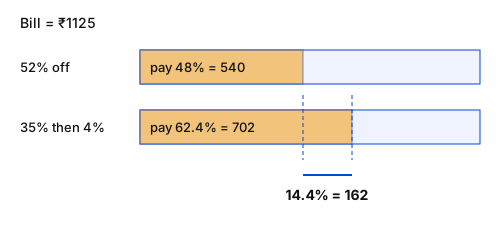
The difference between a single discount of 52%, and two successive discounts of 35% and 4%, applied to a bill of ₹1,125, is ______.
₹1,125 के बिल पर लागू 52% की एकल छूट तथा 35% और 4% की दो क्रमिक छूटों के बीच का अंतर ______ है।
  1. A₹162
  2. B₹152
  3. C₹132
  4. D₹144
Show answer

Concept: Two successive discounts a% and b% equal a single discount of (a+b−ab100)%.

  1. Equivalent of 35% and 4% =35+4−35×4100=37.6%.
  2. Difference of discounts =52%−37.6%=14.4%.
  3. Amount =14.4100×1125=162.

Trick: Directly: pay 0.48×1125=540 vs 0.65×0.96×1125=702; gap =162.

Answer: (A) ₹162

अवधारणा: दो क्रमागत छूट a% और b% = एकल छूट (a+b−ab100)%।

  1. 35% और 4% का तुल्य =35+4−35×4100=37.6%।
  2. छूट का अंतर =52%−37.6%=14.4%।
  3. राशि =14.4100×1125=162।

ट्रिक: सीधे: भुगतान 0.48×1125=540 बनाम 0.65×0.96×1125=702; अंतर =162।

उत्तर: (A) ₹162

RRB NTPC Undergraduate CBT 1MathematicsSuccessive DiscountRRB NTPC Undergraduate CBT 1 2024 · 8 Sep Shift 3 →
Q3546.
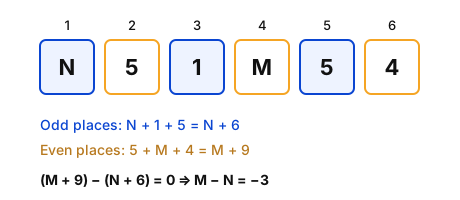
If the 6-digit number N51M54 is divisible by 11, then which of the options below can give a possible correct relation between M and N?
यदि 6-अंकीय संख्या N51M54, 11 से विभाज्य है, तो नीचे दिए गए विकल्पों में से कौन-सा M और N के बीच एक संभावित सही संबंध दे सकता है?
  1. AM - N = 1
  2. BM - N = -3
  3. CM + N = 3
  4. DM = N
Show answer

Concept: For divisibility by 11, the difference of sums of alternate digits must be 0 or a multiple of 11.

  1. N51M54: places 1, 3, 5 give N+1+5=N+6.
  2. Places 2, 4, 6 give 5+M+4=M+9.
  3. (M+9)−(N+6)=M−N+3=0⇒M−N=−3 (e.g. N=4,M=1: 451154=11×41014).

Trick: Write the alternate sums, equate the difference to 0 first.

Answer: (B) M−N=−3

अवधारणा: 11 से विभाज्यता के लिए एकांतर अंकों के योगों का अंतर 0 या 11 का गुणज होना चाहिए।

  1. N51M54: स्थान 1, 3, 5 का योग N+1+5=N+6।
  2. स्थान 2, 4, 6 का योग 5+M+4=M+9।
  3. (M+9)−(N+6)=M−N+3=0⇒M−N=−3 (जैसे N=4,M=1: 451154=11×41014)।

ट्रिक: एकांतर योग लिखें, पहले अंतर =0 रखकर देखें।

उत्तर: (B) M−N=−3

RRB NTPC Undergraduate CBT 1MathematicsDivisibility by 11RRB NTPC Undergraduate CBT 1 2024 · 8 Sep Shift 3 →
Q3547.
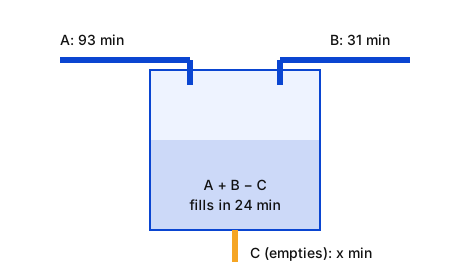
Two pipes can fill a cistern, individually, in 93 min and 31 min, respectively. There is a pipe located at the bottom of the cistern to empty it. If all the three pipes are opened simultaneously, then the empty cistern gets filled in 24 min. How long will the pipe at the bottom of the tank take to empty the completely filled cistern if no other pipe is then open?
दो पाइप अलग-अलग एक टंकी को क्रमशः 93 मिनट और 31 मिनट में भर सकते हैं। टंकी को खाली करने के लिए उसके तल पर एक पाइप लगा है। यदि तीनों पाइप एक साथ खोल दिए जाएँ, तो खाली टंकी 24 मिनट में भर जाती है। यदि कोई अन्य पाइप खुला न हो, तो टंकी के तल पर लगा पाइप पूरी भरी हुई टंकी को खाली करने में कितना समय लेगा?
  1. A730 min730 मिनट
  2. B744 min744 मिनट
  3. C784 min784 मिनट
  4. D761 min761 मिनट
Show answer

Concept: Net rate =1A+1B−1C=1time together.

  1. 193+131=1+393=493.
  2. 1C=493−124=96−932232=32232=1744.
  3. Emptying pipe alone takes 744min.

Trick: LCM method: tank =744 units; A =8, B =24, all =31 per min ⇒ C =1 unit/min.

Answer: (B) 744min

अवधारणा: शुद्ध दर =1A+1B−1C=1साथ में समय।

  1. 193+131=1+393=493।
  2. 1C=493−124=96−932232=32232=1744।
  3. खाली करने वाला नल अकेले 744min लेगा।

ट्रिक: LCM विधि: टंकी =744 इकाई; A =8, B =24, तीनों =31 प्रति मिनट ⇒ C =1 इकाई/मिनट।

उत्तर: (B) 744min

RRB NTPC Undergraduate CBT 1MathematicsPipes and CisternRRB NTPC Undergraduate CBT 1 2024 · 8 Sep Shift 3 →
Q3548.
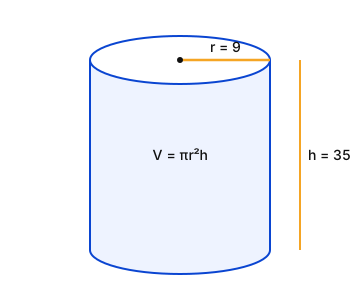
The height of a cylinder is 35 cm, and the radius of its circular base is 9 cm. Find its volume. (Take π=227.)
एक बेलन की ऊँचाई 35 cm है और उसके वृत्ताकार आधार की त्रिज्या 9 cm है। इसका आयतन ज्ञात कीजिए। (π=227 लीजिए।)
  1. A8910cm3
  2. B8110cm3
  3. C8900cm3
  4. D8011cm3
Show answer

Concept: Volume of a cylinder V=πr2h.

  1. V=227×92×35.
  2. =22×81×5.
  3. =8910cm3.

Trick: h=35 is a multiple of 7 — cancel first: 357=5.

Answer: (A) 8910cm3

अवधारणा: बेलन का आयतन V=πr2h।

  1. V=227×92×35।
  2. =22×81×5।
  3. =8910cm3।

ट्रिक: h=35, 7 का गुणज है — पहले काटें: 357=5।

उत्तर: (A) 8910cm3

RRB NTPC Undergraduate CBT 1MathematicsMensuration – CylinderRRB NTPC Undergraduate CBT 1 2024 · 8 Sep Shift 3 →
Q3549.
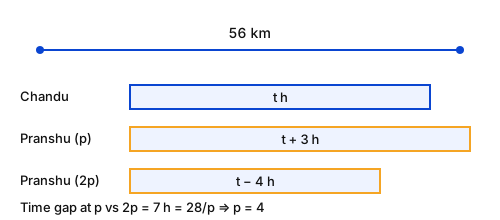
In covering a distance of 56 km, Pranshu takes 3 hours more than Chandu. If Pranshu doubles his speed, he would take 4 hours less than Chandu. Pranshu's speed is:
56 km की दूरी तय करने में, प्रांशु, चंदू से 3 घंटे अधिक लेता है। यदि प्रांशु अपनी चाल दोगुनी कर दे, तो वह चंदू से 4 घंटे कम समय लेगा। प्रांशु की चाल ज्ञात कीजिए।
  1. A8 km/hr
  2. B10 km/hr
  3. C4 km/hr
  4. D9 km/hr
Show answer

Concept: Let Pranshu's speed be p and Chandu's time be t hours.

  1. 56p=t+3 and 562p=t−4.
  2. Subtract: 56p−28p=7⇒28p=7.
  3. p=4km/h (check: 14h vs 7h, Chandu 11h).

Trick: Doubling speed halves time; the halved part equals the gap 3+4=7h.

Answer: (C) 4km/h

अवधारणा: माना प्रांशु की चाल p और चंदू का समय t घंटे।

  1. 56p=t+3 तथा 562p=t−4।
  2. घटाएँ: 56p−28p=7⇒28p=7।
  3. p=4km/h (जाँच: 14h बनाम 7h, चंदू 11h)।

ट्रिक: चाल दोगुनी = समय आधा; घटा हुआ आधा भाग = अंतर 3+4=7h।

उत्तर: (C) 4km/h

RRB NTPC Undergraduate CBT 1MathematicsSpeed, Time and DistanceRRB NTPC Undergraduate CBT 1 2024 · 8 Sep Shift 3 →
Q3550.
Find the mean proportional between 25 and 196.
25 और 196 का मध्यानुपाती ज्ञात कीजिए।
  1. A68
  2. B73
  3. C67
  4. D70
Show answer

Concept: Mean proportional of a and b =ab.

  1. 25×196.
  2. =5×14=70.

Trick: Root each number separately: 25=5, 196=14.

Answer: (D) 70

अवधारणा: a और b का मध्यानुपाती =ab।

  1. 25×196।
  2. =5×14=70।

ट्रिक: अलग-अलग मूल लें: 25=5, 196=14।

उत्तर: (D) 70

RRB NTPC Undergraduate CBT 1MathematicsRatio and ProportionRRB NTPC Undergraduate CBT 1 2024 · 8 Sep Shift 3 →
Q3551.
Find the value of: [167 ÷ {17 + 4 × ( 3 − 7 )}].
[167 ÷ {17 + 4 × ( 3 − 7 )}] का मान ज्ञात कीजिए।
  1. A167
  2. B166
  3. C172
  4. D164
Show answer

Concept: Solve innermost bracket first, then multiplication, then addition, and finally the outer division (BODMAS).

  1. (3−7)=−4
  2. 4×(−4)=−16
  3. 17+(−16)=1
  4. 167÷1=167

Trick: If the curly bracket becomes 1, the answer is the numerator itself.

Answer: (A) 167

अवधारणा: सबसे अंदर के कोष्ठक से शुरू करें, फिर गुणा, फिर जोड़ और अंत में बाहर का भाग (BODMAS)।

  1. (3−7)=−4
  2. 4×(−4)=−16
  3. 17+(−16)=1
  4. 167÷1=167

ट्रिक: मझला कोष्ठक 1 बन जाए तो उत्तर अंश ही होगा।

उत्तर: (A) 167

RRB NTPC Undergraduate CBT 1MathematicsSimplification (BODMAS)RRB NTPC Undergraduate CBT 1 2024 · 8 Sep Shift 3 →
Q3552.
The current population of a town is 20,000. It increases by 30% and 50% in two successive years but decreases by 68% in the third year. What is the population of the town at the end of the third year?
एक कस्बे की वर्तमान जनसंख्या 20,000 है। यह लगातार दो वर्षों में 30% और 50% बढ़ती है, लेकिन तीसरे वर्ष में 68% घट जाती है। तीसरे वर्ष के अंत में कस्बे की जनसंख्या कितनी है?
  1. A12,480
  2. B12,485
  3. C12,481
  4. D12,475
Show answer

Concept: Successive % changes multiply: P3=P×(1+r1100)(1+r2100)(1−r3100).

  1. 20000×1.3=26000
  2. 26000×1.5=39000
  3. Decrease 68% leaves 32%: 39000×0.32=12480

Trick: 20000×1.3×1.5×0.32=20000×0.624=12480 – the answer must be a multiple of 10 here.

Answer: (A) 12,480

अवधारणा: क्रमिक प्रतिशत परिवर्तन गुणा होते हैं: P3=P×(1+r1100)(1+r2100)(1−r3100)।

  1. 20000×1.3=26000
  2. 26000×1.5=39000
  3. 68% कमी के बाद 32% बचता है: 39000×0.32=12480

ट्रिक: 20000×1.3×1.5×0.32=20000×0.624=12480।

उत्तर: (A) 12,480

RRB NTPC Undergraduate CBT 1MathematicsPopulation growthRRB NTPC Undergraduate CBT 1 2024 · 8 Sep Shift 3 →
Q3553.
Simplify: 2((52)x2−22x+11)−5(x2+9x−11)
सरल कीजिए: 2((52)x2−22x+11)−5(x2+9x−11)
  1. A89x − 77
  2. B89x + 77
  3. C−89x + 77
  4. D−89x − 77
Show answer

Concept: Expand each bracket and combine like terms.

  1. 2(52x2−22x+11)=5x2−44x+22
  2. −5(x2+9x−11)=−5x2−45x+55
  3. Add: (5x2−5x2)+(−44x−45x)+(22+55)=−89x+77

Trick: The x2 terms cancel, so only a linear expression remains – check sign of x: −44−45=−89.

Answer: (C) −89x+77

अवधारणा: हर कोष्ठक खोलें और समान पदों को जोड़ें।

  1. 2(52x2−22x+11)=5x2−44x+22
  2. −5(x2+9x−11)=−5x2−45x+55
  3. जोड़ने पर: (5x2−5x2)+(−44x−45x)+(22+55)=−89x+77

ट्रिक: x2 वाले पद कट जाते हैं; x का गुणांक −44−45=−89।

उत्तर: (C) −89x+77

RRB NTPC Undergraduate CBT 1MathematicsAlgebraic simplificationRRB NTPC Undergraduate CBT 1 2024 · 8 Sep Shift 3 →
Q3554.
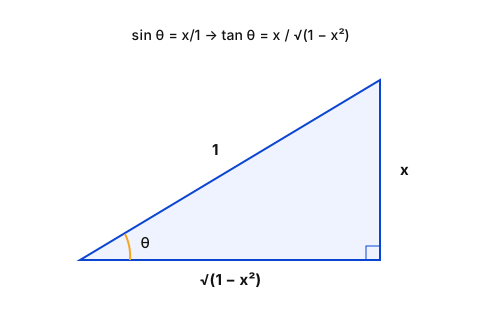
If sinθ=x, then 1+x(tanθ)x= ______.
यदि sinθ=x है, तो 1+x(tanθ)x= ______ है।
  1. A11−x
  2. B11+x
  3. C1−x
  4. D11−x2
Show answer

Concept: If sinθ=x, take perpendicular =x, hypotenuse =1; then base =1−x2 and tanθ=x1−x2.

  1. 1+xtanθx=1+xx×x1−x2
  2. =1+x(1−x)(1+x)
  3. =11−x

Trick: Put x=12 (θ=30∘): LHS =1.5×13×2=2 and 11−0.5=2.

Answer: (A) 11−x

अवधारणा: sinθ=x हो तो लम्ब =x, कर्ण =1; आधार =1−x2 और tanθ=x1−x2।

  1. 1+xtanθx=1+xx×x1−x2
  2. =1+x(1−x)(1+x)
  3. =11−x

ट्रिक: x=12 (θ=30∘) रखकर जाँचें: दोनों तरफ 2 आता है।

उत्तर: (A) 11−x

RRB NTPC Undergraduate CBT 1MathematicsTrigonometric ratiosRRB NTPC Undergraduate CBT 1 2024 · 8 Sep Shift 3 →
Q3555.
Nisha, Sameer, and Rupesh invest ₹1,730, ₹1,420, and ₹1,350 respectively to start a business. If the profit at the end of the year is ₹1,490, then what is the share of Rupesh in the profit?
निशा, समीर और रूपेश एक व्यवसाय शुरू करने के लिए क्रमशः ₹1,730, ₹1,420 और ₹1,350 निवेश करते हैं। यदि वर्ष के अंत में लाभ ₹1,490 है, तो लाभ में रूपेश का हिस्सा कितना है?
  1. A₹449
  2. B₹447
  3. C₹446
  4. D₹445
Show answer

Concept: For the same time period, profit is shared in the ratio of investments.

  1. Ratio =1730:1420:1350=173:142:135
  2. Sum =173+142+135=450
  3. Rupesh's share =135450×1490=0.3×1490=447

Trick: 135450=310, so just take 30% of ₹1490.

Answer: (B) ₹447

अवधारणा: समय समान हो तो लाभ निवेश के अनुपात में बँटता है।

  1. अनुपात =1730:1420:1350=173:142:135
  2. योग =450
  3. रूपेश का हिस्सा =135450×1490=0.3×1490=447

ट्रिक: 135450=310, यानी ₹1490 का 30%।

उत्तर: (B) ₹447

RRB NTPC Undergraduate CBT 1MathematicsPartnershipRRB NTPC Undergraduate CBT 1 2024 · 8 Sep Shift 3 →
Q3556.
If the radius of the base of a right circular cylinder is decreased by 23% and its height is increased by 151%, then what is the percentage increase (closest integer) in its volume?
यदि एक लंब वृत्तीय बेलन के आधार की त्रिज्या 23% कम कर दी जाए और उसकी ऊँचाई 151% बढ़ा दी जाए, तो उसके आयतन में प्रतिशत वृद्धि (निकटतम पूर्णांक) कितनी है?
  1. A20%
  2. B49%
  3. C66%
  4. D69%
Show answer

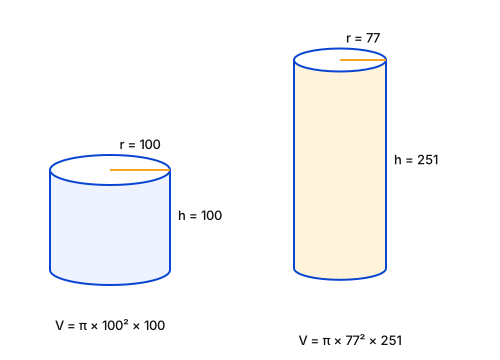
Concept: V=πr2h. Take r=100, h=100; new r=77, new h=251.

  1. Old V∝1002×100=106
  2. New V∝772×251=5929×251=1488179
  3. Increase =1488179−10000001000000×100≈48.8%≈49%

Trick: Multiplying factor =0.772×2.51=0.5929×2.51≈1.488 → about 49% increase.

Answer: (B) 49%

अवधारणा: V=πr2h। मान लें r=100, h=100; नई r=77, नई h=251।

  1. पुराना V∝1002×100=106
  2. नया V∝772×251=1488179
  3. वृद्धि =1488179−10000001000000×100≈48.8%≈49%

ट्रिक: गुणक =0.772×2.51≈1.488 → लगभग 49% वृद्धि।

उत्तर: (B) 49%

RRB NTPC Undergraduate CBT 1MathematicsVolume of cylinder – % changeRRB NTPC Undergraduate CBT 1 2024 · 8 Sep Shift 3 →
Q3557.
If 2 times the age of Ram is 24 years more than 2 times the age of Ramya, and 4 times the age of Ramya is 3 years less than the age of Ram, then what is the difference (in years) between the ages of Ram and Ramya?
यदि राम की आयु का 2 गुना, राम्या की आयु के 2 गुने से 24 वर्ष अधिक है, और राम्या की आयु का 4 गुना, राम की आयु से 3 वर्ष कम है, तो राम और राम्या की आयु के बीच का अंतर (वर्षों में) कितना है?
  1. A15
  2. B12
  3. C11
  4. D9
Show answer

Concept: Form equations from the statements; the first one alone gives the difference.

  1. 2R=2Y+24⇒R−Y=12
  2. Check with second: 4Y=R−3; with R=Y+12: 3Y=9⇒Y=3, R=15
  3. Difference =15−3=12 years

Trick: Divide the first equation by 2 – the difference is directly 242=12.

Answer: (B) 12

अवधारणा: कथनों से समीकरण बनाएँ; पहला समीकरण ही अंतर दे देता है।

  1. 2R=2Y+24⇒R−Y=12
  2. दूसरे से जाँच: 4Y=R−3; R=Y+12 रखने पर Y=3, R=15
  3. अंतर =15−3=12 वर्ष

ट्रिक: पहले समीकरण को 2 से भाग दें – अंतर सीधे 12।

उत्तर: (B) 12

RRB NTPC Undergraduate CBT 1MathematicsProblems on agesRRB NTPC Undergraduate CBT 1 2024 · 8 Sep Shift 3 →
Q3558.
The sum of two numbers is 78 and their L.C.M. is 180. What are the two numbers?
दो संख्याओं का योग 78 है और उनका ल.स.प. (L.C.M.) 180 है। वे दो संख्याएँ कौन-सी हैं?
  1. A58, 20
  2. B53, 25
  3. C60, 18
  4. D65, 13
Show answer

Concept: Check each option: sum must be 78 and LCM must be 180.

  1. 58+20=78 but LCM (58,20)=580 ✗
  2. 53+25=78, LCM =1325 ✗
  3. 60+18=78, 60=22·3·5, 18=2·32, LCM =22·32·5=180 ✓
  4. 65+13=78, LCM =65 ✗

Trick: Both numbers must divide 180; only 60 and 18 are divisors of 180.

Answer: (C) 60, 18

अवधारणा: हर विकल्प जाँचें: योग 78 और LCM 180 होना चाहिए।

  1. 58,20: LCM =580 ✗
  2. 53,25: LCM =1325 ✗
  3. 60,18: LCM =22·32·5=180 ✓
  4. 65,13: LCM =65 ✗

ट्रिक: दोनों संख्याएँ 180 की गुणनखंड होनी चाहिए – केवल 60 और 18।

उत्तर: (C) 60, 18

RRB NTPC Undergraduate CBT 1MathematicsLCM and HCFRRB NTPC Undergraduate CBT 1 2024 · 8 Sep Shift 3 →
Q3559.
Kunal and Abhishek start a business. Kunal invests ₹33,000 more than Abhishek for 7 months and Abhishek invests for 3 months. Kunal's share is ₹2,654 more than that of Abhishek, out of a total profit of ₹5,308. Find the capital contributed by Kunal.
कुणाल और अभिषेक एक व्यवसाय शुरू करते हैं। कुणाल, अभिषेक से ₹33,000 अधिक 7 महीने के लिए निवेश करता है और अभिषेक 3 महीने के लिए निवेश करता है। ₹5,308 के कुल लाभ में से कुणाल का हिस्सा अभिषेक के हिस्से से ₹2,654 अधिक है। कुणाल द्वारा लगाई गई पूँजी ज्ञात कीजिए।
  1. A₹1,48,367
  2. B₹1,48,556
  3. C₹1,48,647
  4. D₹1,48,500
Show answer

Concept: Profit ratio = (capital × time) ratio.

  1. Kunal + Abhishek =5308, difference =2654 → Kunal =3981, Abhishek =1327; ratio 3:1
  2. Let Abhishek =A, Kunal =A+33000: 7(A+33000)3A=3
  3. 7A+231000=9A⇒A=115500
  4. Kunal =115500+33000=148500

Trick: Profit ratio 3:1 with times 7:3 → capital ratio 37:13=9:7; 2 parts =33000 → 9 parts =148500.

Answer: (D) ₹1,48,500

अवधारणा: लाभ का अनुपात = (पूँजी × समय) का अनुपात।

  1. योग 5308, अंतर 2654 → कुणाल =3981, अभिषेक =1327; अनुपात 3:1
  2. अभिषेक =A, कुणाल =A+33000: 7(A+33000)3A=3
  3. 7A+231000=9A⇒A=115500
  4. कुणाल =148500

ट्रिक: पूँजी अनुपात =37:13=9:7; 2 भाग =33000 → 9 भाग =148500।

उत्तर: (D) ₹1,48,500

RRB NTPC Undergraduate CBT 1MathematicsPartnership with timeRRB NTPC Undergraduate CBT 1 2024 · 8 Sep Shift 3 →
Q3560.
Two school bells ring at intervals of 36 minutes and 45 minutes. If both bells ring together at 9:00 a.m., when will they ring together again?
स्कूल की दो घंटियाँ क्रमशः 36 मिनट और 45 मिनट के अंतराल पर बजती हैं। यदि दोनों घंटियाँ सुबह 9:00 बजे एक साथ बजती हैं, तो वे फिर से एक साथ कब बजेंगी?
  1. A1:12 p.m.दोपहर 1:12 बजे
  2. B11:36 a.m.सुबह 11:36 बजे
  3. C12 noonदोपहर 12 बजे
  4. D11:48 a.m.सुबह 11:48 बजे
Show answer

Concept: Bells ring together again after the LCM of their intervals.

  1. 36=22·32, 45=32·5
  2. LCM =22·32·5=180 minutes =3 hours
  3. 9:00 a.m. +3 h = 12:00 noon

Trick: LCM =36×45HCF(9)=180 min.

Answer: (C) 12 noon

अवधारणा: घंटियाँ अंतरालों के LCM के बाद फिर साथ बजती हैं।

  1. 36=22·32, 45=32·5
  2. LCM =180 मिनट =3 घंटे
  3. सुबह 9:00 +3 घंटे = दोपहर 12:00

ट्रिक: LCM =36×45HCF(9)=180 मिनट।

उत्तर: (C) 12 noon (दोपहर 12 बजे)

RRB NTPC Undergraduate CBT 1MathematicsLCM applicationRRB NTPC Undergraduate CBT 1 2024 · 8 Sep Shift 3 →