Question bank

Q&A: practice questions with answers

Search questions on any topic. Filter by exam category, exam, subject and topic, try the question, then open the answer and explanation.

Courses – airGurukul

8,500 questions found.

Q3561.
Sapna invested ₹22,800 on simple interest, partly at 5% per annum and partly at 14% per annum. If she earns equal interests from the two investments after 4 years, then find the sum invested at 5% per annum (in ₹).
सपना ने ₹22,800 साधारण ब्याज पर निवेश किए, कुछ भाग 5% वार्षिक दर पर और कुछ भाग 14% वार्षिक दर पर। यदि 4 वर्ष बाद उसे दोनों निवेशों से समान ब्याज प्राप्त होता है, तो 5% वार्षिक दर पर निवेश की गई राशि (₹ में) ज्ञात कीजिए।
  1. A16,798
  2. B16,799
  3. C16,800
  4. D16,801
Show answer

Concept: Equal interest for equal time ⇒ principal × rate is equal, so principals are in inverse ratio of rates.

  1. P1×5=P2×14⇒P1:P2=14:5
  2. Total parts =19, 1 part =2280019=1200
  3. Sum at 5%=14×1200=16800

Trick: Sum at lower rate is larger: ratio of sums = inverse of rates (14:5).

Answer: (C) 16,800

अवधारणा: समान समय में समान ब्याज ⇒ मूलधन × दर बराबर; अतः मूलधन दरों के व्युत्क्रम अनुपात में।

  1. P1×5=P2×14⇒P1:P2=14:5
  2. कुल 19 भाग, 1 भाग =1200
  3. 5% पर राशि =14×1200=16800

ट्रिक: कम दर पर राशि अधिक होती है – अनुपात दरों का उल्टा (14:5)।

उत्तर: (C) 16,800

RRB NTPC Undergraduate CBT 1MathematicsSimple interestRRB NTPC Undergraduate CBT 1 2024 · 8 Sep Shift 3 →
Q3562.
A shop offers 'Buy three for ₹6,000, get one free' for Dasara celebration, and also offers ₹600 cash back if a person pays in cash. What is the total percentage of discount offered for a customer who pays in cash?
एक दुकान दशहरा उत्सव के लिए 'तीन ₹6,000 में खरीदें, एक मुफ़्त पाएँ' की पेशकश करती है, और यदि कोई व्यक्ति नकद भुगतान करता है तो ₹600 कैशबैक भी देती है। नकद भुगतान करने वाले ग्राहक को दी गई कुल छूट का प्रतिशत कितना है?
  1. A25.5%
  2. B67.5%
  3. C33.33%
  4. D32.5%
Show answer

Concept: Discount %=value given free / offmarked value of all items×100.

  1. Price of one item =60003=2000; customer gets 4 items worth 8000
  2. Pays 6000−600=5400
  3. Discount =8000−54008000×100=26008000×100=32.5%

Trick: Always divide by the value of ALL items received (4 items), not the 3 paid for.

Answer: (D) 32.5%

अवधारणा: छूट %=मुफ़्त/कम की गई राशिसभी वस्तुओं का मूल्य×100।

  1. एक वस्तु =60003=2000; ग्राहक को 4 वस्तुएँ =8000 की मिलती हैं
  2. भुगतान =6000−600=5400
  3. छूट =26008000×100=32.5%

ट्रिक: भाग हमेशा मिली हुई सभी (4) वस्तुओं के मूल्य से दें।

उत्तर: (D) 32.5%

RRB NTPC Undergraduate CBT 1MathematicsDiscount – buy x get yRRB NTPC Undergraduate CBT 1 2024 · 8 Sep Shift 3 →
Q3563.
I bought two dresses for ₹1,200. I sold the first one at a loss of 9% and the second at a gain of 15%. If, on the whole I made neither a loss nor a gain, find the cost price (in ₹) of the first dress.
मैंने दो पोशाकें ₹1,200 में खरीदीं। मैंने पहली को 9% की हानि पर और दूसरी को 15% के लाभ पर बेचा। यदि कुल मिलाकर मुझे न तो हानि हुई और न ही लाभ, तो पहली पोशाक का क्रय मूल्य (₹ में) ज्ञात कीजिए।
  1. A774
  2. B770
  3. C750
  4. D734
Show answer

Concept: No overall gain/loss ⇒ loss on first = gain on second.

  1. 0.09x=0.15(1200−x)
  2. 0.09x+0.15x=180⇒0.24x=180
  3. x=750

Trick: CP ratio = inverse of %: 15:9=5:3 → first =58×1200=750.

Answer: (C) 750

अवधारणा: कुल न लाभ न हानि ⇒ पहली पर हानि = दूसरी पर लाभ।

  1. 0.09x=0.15(1200−x)
  2. 0.24x=180
  3. x=750

ट्रिक: क्रय मूल्य का अनुपात % का उल्टा: 15:9=5:3 → पहली =58×1200=750।

उत्तर: (C) 750

RRB NTPC Undergraduate CBT 1MathematicsProfit and loss – no gain no lossRRB NTPC Undergraduate CBT 1 2024 · 8 Sep Shift 3 →
Q3564.
The value of 72+22−881−7 is
72+22−881−7 का मान है:
  1. A-19
  2. B-27
  3. C-28
  4. D-26
Show answer

Concept: Evaluate each term: powers and roots first, then add/subtract left to right.

  1. 72=49
  2. 22=2
  3. 881=8×9=72
  4. 49+2−72−7=−28

Trick: a2=a for positive a.

Answer: (C) −28

अवधारणा: पहले घात और वर्गमूल निकालें, फिर बाएँ से दाएँ जोड़-घटाव करें।

  1. 72=49
  2. 22=2
  3. 881=72
  4. 49+2−72−7=−28

ट्रिक: धनात्मक a के लिए a2=a।

उत्तर: (C) −28

RRB NTPC Undergraduate CBT 1MathematicsSquares and rootsRRB NTPC Undergraduate CBT 1 2024 · 8 Sep Shift 3 →
Q3565.
The interior angle between two adjacent sides of a regular n-sided polygon is ______ degrees.
एक सम n-भुजीय बहुभुज की दो आसन्न भुजाओं के बीच का अंतः कोण ______ डिग्री है।
  1. A180−90n
  2. B180−180n
  3. C180−360n
  4. D90−90n
Show answer

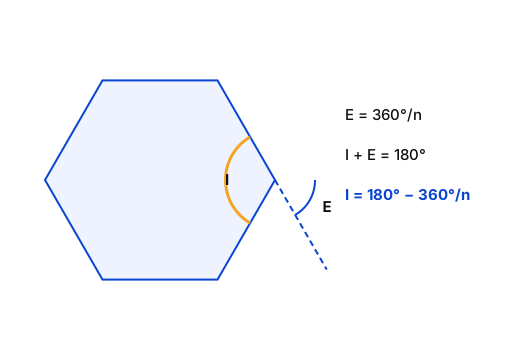
Concept: Exterior angles of any polygon add up to 360∘; interior + exterior =180∘.

  1. Each exterior angle of a regular n-gon =360∘n
  2. Interior angle =180∘−360∘n
  3. Check: n=6 gives 180−60=120∘ ✓

Yaad rakhein: Same as (n−2)×180n.

Answer: (C) 180−360n

अवधारणा: किसी भी बहुभुज के बाह्य कोणों का योग 360∘; अंतः + बाह्य =180∘।

  1. सम n-भुज का प्रत्येक बाह्य कोण =360∘n
  2. अंतः कोण =180∘−360∘n
  3. जाँच: n=6 पर 120∘ ✓

याद रखें: यह (n−2)×180n के बराबर है।

उत्तर: (C) 180−360n

RRB NTPC Undergraduate CBT 1MathematicsPolygons – interior angleRRB NTPC Undergraduate CBT 1 2024 · 8 Sep Shift 3 →
Q3566.
A can do a work in 9 days and B can do the same work in 21 days. If they work on it together for 2 days, then what fraction of the work is left?
A किसी कार्य को 9 दिनों में और B उसी कार्य को 21 दिनों में कर सकता है। यदि वे 2 दिनों तक एक साथ उस पर कार्य करते हैं, तो कार्य का कितना भाग शेष रह जाता है?
  1. A4163
  2. B3863
  3. C4363
  4. D4763
Show answer

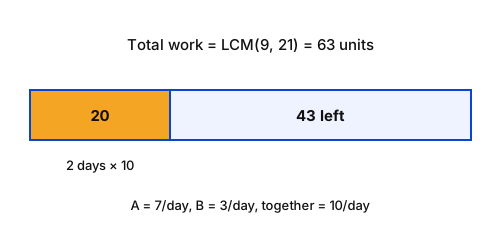
Concept: Take total work = LCM of days, find per-day efficiencies.

  1. Total = LCM(9,21)=63 units; A =7/day, B =3/day
  2. Together =10/day; in 2 days =20 units
  3. Left =63−20=43 units → 4363

Trick: 1−2(19+121)=1−2063=4363.

Answer: (C) 4363

अवधारणा: कुल कार्य = दिनों का LCM लें, फिर प्रतिदिन की क्षमता निकालें।

  1. कुल =63 इकाई; A =7/दिन, B =3/दिन
  2. साथ में 10/दिन; 2 दिन में 20 इकाई
  3. शेष =43 इकाई → 4363

ट्रिक: 1−2(19+121)=4363।

उत्तर: (C) 4363

RRB NTPC Undergraduate CBT 1MathematicsTime and workRRB NTPC Undergraduate CBT 1 2024 · 8 Sep Shift 3 →
Q3567.
The product of two consecutive positive natural numbers is 110. The greater of the two numbers is:
दो क्रमागत धनात्मक प्राकृत संख्याओं का गुणनफल 110 है। दोनों संख्याओं में से बड़ी संख्या है:
  1. A7
  2. B5
  3. C11
  4. D3
Show answer

Concept: Consecutive numbers n and n+1: n(n+1)=110.

  1. n2+n−110=0⇒(n+11)(n−10)=0
  2. n=10 (positive)
  3. Numbers: 10,11; greater =11

Trick: 110 lies next to 102=100, so try 10×11.

Answer: (C) 11

अवधारणा: क्रमागत संख्याएँ n और n+1: n(n+1)=110।

  1. (n+11)(n−10)=0
  2. n=10
  3. संख्याएँ 10,11; बड़ी =11

ट्रिक: 110 का वर्गमूल लगभग 10 – तो 10×11।

उत्तर: (C) 11

RRB NTPC Undergraduate CBT 1MathematicsNumber systemRRB NTPC Undergraduate CBT 1 2024 · 8 Sep Shift 3 →
Q3568.
By how much is 65% of 75 greater than 45 of 25?
65% का 75, 45 के 25 से कितना अधिक है?
  1. A26.75
  2. B28.75
  3. C22.75
  4. D25.75
Show answer

Concept: Find both values and subtract.

  1. 65% of 75=65×75100=48.75
  2. 45 of 25=20
  3. 48.75−20=28.75

Trick: 65% of 75 =75×0.65: 75×0.6=45, 75×0.05=3.75.

Answer: (B) 28.75

अवधारणा: दोनों मान निकालकर घटाएँ।

  1. 75 का 65%=48.75
  2. 25 का 45=20
  3. 48.75−20=28.75

ट्रिक: 75×0.6=45, 75×0.05=3.75 → 48.75।

उत्तर: (B) 28.75

RRB NTPC Undergraduate CBT 1MathematicsPercentage and fractionsRRB NTPC Undergraduate CBT 1 2024 · 8 Sep Shift 3 →
Q3569.
By selling an article at 414 of its actual selling price, Hitesh incurs a loss of 15%.
If he sells it at 60% of its actual selling price, then the profit percentage is:
किसी वस्तु को उसके वास्तविक विक्रय मूल्य के 414 पर बेचने से, हितेश को 15% की हानि होती है।
यदि वह इसे इसके वास्तविक विक्रय मूल्य के 60% पर बेचता है, तो लाभ प्रतिशत है:
  1. A78.7%
  2. B77.5%
  3. C78.1%
  4. D78.5%
Show answer

Concept: Express CP in terms of the actual SP S using the first condition.

  1. 414S=0.85CP⇒CP=4S11.9
  2. New SP =0.6S
  3. 0.6SCP=0.6×11.94=1.785
  4. Profit =78.5%

Trick: Take S=14: then 4=0.85CP; new SP =8.4, so ratio =8.4×0.854=1.785.

Answer: (D) 78.5%

अवधारणा: पहली शर्त से क्रय मूल्य को वास्तविक विक्रय मूल्य S में लिखें।

  1. 414S=0.85CP⇒CP=4S11.9
  2. नया विक्रय मूल्य =0.6S
  3. 0.6SCP=0.6×11.94=1.785
  4. लाभ =78.5%

ट्रिक: S=14 लें: 4=0.85CP, नया SP =8.4 → अनुपात 1.785।

उत्तर: (D) 78.5%

RRB NTPC Undergraduate CBT 1MathematicsProfit and lossRRB NTPC Undergraduate CBT 1 2024 · 8 Sep Shift 3 →
Q3570.
The sum of five numbers is 655. The average of the first two numbers is 80, and the third number is 104. Find the average of the remaining two numbers.
पाँच संख्याओं का योग 655 है। पहली दो संख्याओं का औसत 80 है, और तीसरी संख्या 104 है। शेष दो संख्याओं का औसत ज्ञात कीजिए।
  1. A185
  2. B184
  3. C196.5
  4. D195.5
Show answer

Concept: Sum of the remaining numbers = total − known parts.

  1. First two sum =2×80=160
  2. Remaining two =655−160−104=391
  3. Average =3912=195.5

Trick: Answer must end in .5 because 391 is odd.

Answer: (D) 195.5

अवधारणा: शेष संख्याओं का योग = कुल − ज्ञात भाग।

  1. पहली दो का योग =160
  2. शेष दो =655−160−104=391
  3. औसत =195.5

ट्रिक: 391 विषम है, तो औसत .5 पर ख़त्म होगा।

उत्तर: (D) 195.5

RRB NTPC Undergraduate CBT 1MathematicsAverageRRB NTPC Undergraduate CBT 1 2024 · 8 Sep Shift 3 →
Q3571.
Yash ranked 34th from the top and 47th from the bottom in his class. How many students are there in his class?
यश अपनी कक्षा में ऊपर से 34वें और नीचे से 47वें स्थान पर था। उसकी कक्षा में कितने विद्यार्थी हैं?
  1. A81
  2. B79
  3. C80
  4. D82
Show answer

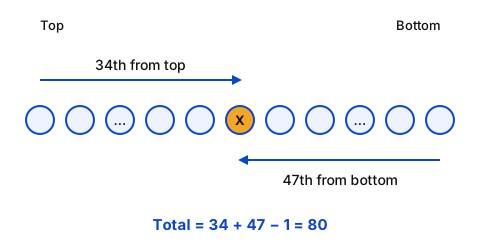
Concept: Total = rank from top + rank from bottom −1 (the person is counted twice).

  1. 34+47=81
  2. Subtract 1: 80

Trick: Always subtract 1 when the same person is counted from both ends.

Answer: (C) 80

अवधारणा: कुल = ऊपर से रैंक + नीचे से रैंक −1 (व्यक्ति दो बार गिना गया)।

  1. 34+47=81
  2. 1 घटाएँ: 80

ट्रिक: दोनों सिरों से गिनने पर हमेशा 1 घटाएँ।

उत्तर: (C) 80

RRB NTPC Undergraduate CBT 1General Intelligence and ReasoningRankingRRB NTPC Undergraduate CBT 1 2024 · 8 Sep Shift 3 →
Q3572.
In the following number-pairs, the second number is obtained by applying certain mathematical operations to the first number. Select the pair in which the numbers are related in the same way as are the numbers of the following pairs.
(Note: Operations should be performed on the whole numbers, without breaking down the numbers into its constituent digits. E.g., 13 – Operations on 13 such as
adding/subtracting/multiplying etc. to 13 can be performed. Breaking down 13 into 1 and 3 and then performing mathematical operations on 1 and 3 is not allowed.) 17, 36
16, 34
निम्नलिखित संख्या-युग्मों में, दूसरी संख्या पहली संख्या पर कुछ गणितीय संक्रियाएँ करके प्राप्त की जाती है। उस युग्म का चयन कीजिए जिसमें संख्याएँ उसी प्रकार संबंधित हैं जिस प्रकार निम्नलिखित युग्मों की संख्याएँ संबंधित हैं।
(नोट: संक्रियाएँ पूर्ण संख्याओं पर की जानी चाहिए, संख्याओं को उनके घटक अंकों में विभाजित किए बिना। उदाहरण के लिए, 13 – 13 पर संक्रियाएँ जैसे
13 में जोड़ना/घटाना/गुणा करना आदि किया जा सकता है। 13 को 1 और 3 में विभाजित करना और फिर 1 और 3 पर गणितीय संक्रियाएँ करना वर्जित है।) 17, 36
16, 34
  1. A53, 97
  2. B23, 48
  3. C12, 24
  4. D18, 39
Show answer

Concept: Find the rule: second =2× first +2.

  1. 17×2+2=36 ✓, 16×2+2=34 ✓
  2. 23×2+2=48 ✓
  3. Others: 53→108, 12→26, 18→38 – do not match

Trick: Second number is just above double – test doubling first.

Answer: (B) 23,48

अवधारणा: नियम: दूसरी =2× पहली +2।

  1. 17×2+2=36, 16×2+2=34
  2. 23×2+2=48 ✓
  3. अन्य: 53→108, 12→26, 18→38 – मेल नहीं

ट्रिक: दूसरी संख्या दोगुने से थोड़ी अधिक – पहले दोगुना जाँचें।

उत्तर: (B) 23,48

RRB NTPC Undergraduate CBT 1General Intelligence and ReasoningNumber pair analogyRRB NTPC Undergraduate CBT 1 2024 · 8 Sep Shift 3 →
Q3573.
Select the pair that follows the same pattern as that followed by the two pairs given below. Both pairs follow the same pattern.
SOQ−NJL
RNP−MIK
उस युग्म का चयन कीजिए जो नीचे दिए गए दो युग्मों द्वारा अनुसरित पैटर्न का ही अनुसरण करता है। दोनों युग्म एक ही पैटर्न का अनुसरण करते हैं।
SOQ−NJL
RNP−MIK
  1. ACYA−XTV
  2. BWRS−QMO
  3. CWRS−RNP
  4. DWSU−QNO
Show answer

Concept: Each letter of the first cluster moves 5 steps back to give the second cluster.

  1. S−5=N, O−5=J, Q−5=L; R−5=M, N−5=I, P−5=K
  2. C−5=X (wrap around), Y−5=T, A−5=V → CYA−XTV ✓
  3. WRS would give RMN, not QMO / RNP; WSU would give RNP, not QNO

Trick: For backward wrap: C(3) −5=−2 → add 26 → 24 = X.

Answer: (A) CYA−XTV

अवधारणा: पहले समूह का हर अक्षर 5 स्थान पीछे जाकर दूसरा समूह बनाता है।

  1. S−5=N, O−5=J, Q−5=L; R−5=M, N−5=I, P−5=K
  2. C−5=X (चक्र), Y−5=T, A−5=V → CYA−XTV ✓
  3. WRS से RMN बनेगा, QMO/RNP नहीं; WSU से RNP बनेगा, QNO नहीं

ट्रिक: पीछे जाने पर ऋणात्मक हो तो 26 जोड़ें: C(3)−5+26=24=X।

उत्तर: (A) CYA−XTV

RRB NTPC Undergraduate CBT 1General Intelligence and ReasoningLetter pair analogyRRB NTPC Undergraduate CBT 1 2024 · 8 Sep Shift 3 →
Q3574.
In the following triads, each group of letters is related to the subsequent one following a certain logic. Select from the given options, the one which follows the same logic. GAPS - SPGA - GPAS
AUNT - TNAU - ANUT
निम्नलिखित त्रिकों में, अक्षरों का प्रत्येक समूह एक निश्चित तर्क के आधार पर अगले समूह से संबंधित है। दिए गए विकल्पों में से उसका चयन कीजिए जो उसी तर्क का अनुसरण करता है। GAPS - SPGA - GPAS
AUNT - TNAU - ANUT
  1. AHAIR - RIHA - HIAR
  2. BDINE - DNIE - ENID
  3. CDIMS - IMDS - IMSD
  4. DHALF - FLHA - ALHF
Show answer

Concept: Positions 1234 → 4312 (first step), then 3241 of the new word (second step).

  1. GAPS → S P G A (4,3,1,2) → G P A S (3,2,4,1); AUNT → TNAU → ANUT follows the same
  2. HAIR → R I H A (4,3,1,2) ✓ → H I A R (3,2,4,1) ✓
  3. DINE would give ENDI, DIMS gives SMDI, HALF gives FLHA then HLAF – not matching

Trick: Overall first → third word: 1234→1324 (middle two letters swap): GAPS→GPAS, HAIR→HIAR.

Answer: (A) HAIR - RIHA - HIAR

अवधारणा: स्थान 1234 → 4312 (पहला चरण), फिर नए शब्द का 3241 (दूसरा चरण)।

  1. GAPS → SPGA → GPAS; AUNT → TNAU → ANUT भी इसी नियम से
  2. HAIR → RIHA (4,3,1,2) ✓ → HIAR (3,2,4,1) ✓
  3. अन्य विकल्प इस नियम पर नहीं बैठते (जैसे HALF → FLHA → HLAF)

ट्रिक: पहले से तीसरे शब्द में केवल बीच के दो अक्षर बदलते हैं: GAPS→GPAS, HAIR→HIAR।

उत्तर: (A) HAIR - RIHA - HIAR

RRB NTPC Undergraduate CBT 1General Intelligence and ReasoningLetter rearrangementRRB NTPC Undergraduate CBT 1 2024 · 8 Sep Shift 3 →
Q3575.
In a certain code language, ‘USER’ is coded as ‘4629’ and ‘LAST’ is coded as ‘1354’. What is the code for ‘S’ in the given code language?
एक निश्चित कूट भाषा में, ‘USER’ को ‘4629’ के रूप में और ‘LAST’ को ‘1354’ के रूप में कूटबद्ध किया जाता है। दी गई कूट भाषा में ‘S’ का कूट क्या है?
  1. A2
  2. B3
  3. C4
  4. D1
Show answer

Concept: A letter common to both words gets the digit common to both codes.

  1. USER → 4629, LAST → 1354
  2. Common letter: S
  3. Common digit: 4 → S = 4

Trick: Match common letters with common digits; order of digits may be jumbled.

Answer: (C) 4

अवधारणा: दोनों शब्दों में उभयनिष्ठ अक्षर को दोनों कोड का उभयनिष्ठ अंक मिलता है।

  1. USER → 4629, LAST → 1354
  2. उभयनिष्ठ अक्षर: S
  3. उभयनिष्ठ अंक: 4 → S = 4

ट्रिक: उभयनिष्ठ अक्षर ↔ उभयनिष्ठ अंक; क्रम बदला हुआ हो सकता है।

उत्तर: (C) 4

RRB NTPC Undergraduate CBT 1General Intelligence and ReasoningCoding–decodingRRB NTPC Undergraduate CBT 1 2024 · 8 Sep Shift 3 →
Q3576.
H, I, J, K, U, V and W are sitting around a circular table facing the centre of the table. Only two people sit between V and I when counted from the right of V. Only three people sit between H and J when counted from the right of J. I sits to the immediate right of J. W sits to the immediate right of K.
Who sits fourth to the right of U?
H, I, J, K, U, V और W एक वृत्ताकार मेज़ के चारों ओर केंद्र की ओर मुख करके बैठे हैं। V के दाईं ओर से गिनने पर V और I के बीच केवल दो व्यक्ति बैठे हैं। J के दाईं ओर से गिनने पर H और J के बीच केवल तीन व्यक्ति बैठे हैं। I, J के ठीक दाईं ओर बैठा है। W, K के ठीक दाईं ओर बैठा है।
U के दाईं ओर चौथे स्थान पर कौन बैठा है?
  1. AW
  2. BK
  3. CH
  4. DJ
Show answer

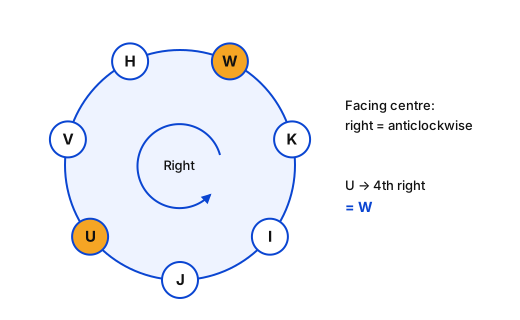
Concept: Facing the centre, 'right' means moving anticlockwise. Fix J and place others.

  1. I is immediate right of J; H is 4th to the right of J (three between)
  2. V: I is 3rd to the right of V → V is 3rd to the left of I
  3. Remaining seats for K, W, U: W immediate right of K → K, W adjacent; U takes the last seat
  4. Order to the right from J: J, I, K, W, H, V, U; 4th to the right of U: J, I, K, W → W

Trick: In a circle of 7, 4th to the right = 3rd to the left.

Answer: (A) W

अवधारणा: केंद्र की ओर मुख हो तो 'दाएँ' = वामावर्त (anticlockwise)। J को स्थिर करें।

  1. I, J के ठीक दाएँ; H, J के दाएँ 4था (बीच में तीन)
  2. V से दाएँ गिनने पर I तीसरा → V, I के बाएँ तीसरा
  3. शेष स्थानों पर K, W साथ (W, K के ठीक दाएँ) और U अंतिम स्थान पर
  4. J से दाएँ क्रम: J, I, K, W, H, V, U; U के दाएँ 4था: J, I, K, W → W

ट्रिक: 7 के वृत्त में दाएँ 4था = बाएँ 3रा।

उत्तर: (A) W

RRB NTPC Undergraduate CBT 1General Intelligence and ReasoningCircular seating arrangementRRB NTPC Undergraduate CBT 1 2024 · 8 Sep Shift 3 →
Q3577.
Based on the English alphabetical order, three of the following four letter-cluster pairs are alike in a certain way and thus form a group. Which letter-cluster pair DOES NOT belong to that group?
(Note: The odd one out is not based on the number of consonants/vowels or their position in the letter-cluster.)
अंग्रेज़ी वर्णमाला क्रम के आधार पर, निम्नलिखित चार अक्षर-समूह युग्मों में से तीन किसी निश्चित प्रकार से एकसमान हैं और इस प्रकार एक समूह बनाते हैं। कौन-सा अक्षर-समूह युग्म उस समूह से संबंधित नहीं है?
(नोट: असंगत अक्षर-समूह युग्म, व्यंजनों/स्वरों की संख्या या अक्षर-समूह में उनकी स्थिति पर आधारित नहीं है।)
  1. AMI-TX
  2. BTP-AE
  3. CJF-QU
  4. DCY-JM
Show answer

Concept: Check the jumps: in each pair, 1st letter +7 and 2nd letter +15.

  1. MI-TX: M+7=T, I+15=X ✓
  2. TP-AE: T+7=A, P+15=E ✓; JF-QU: J+7=Q, F+15=U ✓
  3. CY-JM: C+7=J ✓ but Y+15=N, not M ✗

Trick: Use positions: Y(25)+15=40−26=14 = N.

Answer: (D) CY-JM

अवधारणा: हर युग्म में पहला अक्षर +7 और दूसरा अक्षर +15।

  1. MI-TX: M+7=T, I+15=X ✓
  2. TP-AE ✓, JF-QU ✓
  3. CY-JM: C+7=J ✓ पर Y+15=N, M नहीं ✗

ट्रिक: Y(25)+15=40−26=14 = N।

उत्तर: (D) CY-JM

RRB NTPC Undergraduate CBT 1General Intelligence and ReasoningLetter pair odd one outRRB NTPC Undergraduate CBT 1 2024 · 8 Sep Shift 3 →
Q3578.
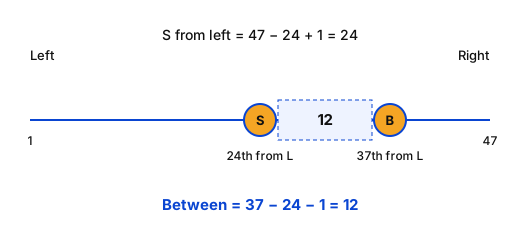
47 people are standing in a row facing north. Suhana is 24th from the right end, while Bimla is 37th from the left end. How many people are there between Suhana and Bimla?
47 व्यक्ति उत्तर की ओर मुख करके एक पंक्ति में खड़े हैं। सुहाना दाएँ छोर से 24वें स्थान पर है, जबकि बिमला बाएँ छोर से 37वें स्थान पर है। सुहाना और बिमला के बीच कितने व्यक्ति हैं?
  1. A12
  2. B13
  3. C11
  4. D10
Show answer

Concept: Convert both positions to the same end: from left =N−right+1.

  1. Suhana from left =47−24+1=24
  2. Bimla from left =37
  3. Between =37−24−1=12

Trick: People between = difference of positions −1.

Answer: (A) 12

अवधारणा: दोनों स्थान एक ही सिरे से लें: बाएँ से =N−दाएँ+1।

  1. सुहाना बाएँ से =47−24+1=24
  2. बिमला बाएँ से =37
  3. बीच में =37−24−1=12

ट्रिक: बीच वाले = स्थानों का अंतर −1।

उत्तर: (A) 12

RRB NTPC Undergraduate CBT 1General Intelligence and ReasoningPosition in a rowRRB NTPC Undergraduate CBT 1 2024 · 8 Sep Shift 3 →
Q3579.
If + means −, − means ×, × means ÷ and ÷ means +, then what will come in place of the question mark (?) in the following equation?
72 × 6 ÷ 18 + 10 − 2 = ?
यदि + का अर्थ −, − का अर्थ ×, × का अर्थ ÷ और ÷ का अर्थ + है, तो निम्नलिखित समीकरण में प्रश्नवाचक चिह्न (?) के स्थान पर क्या आएगा?
72 × 6 ÷ 18 + 10 − 2 = ?
  1. A10
  2. B18
  3. C12
  4. D5
Show answer

Concept: Replace the symbols, then apply BODMAS.

  1. 72×6÷18+10−2 becomes 72÷6+18−10×2
  2. =12+18−20
  3. =10

Trick: Write the new expression fully before calculating – avoids sign mistakes.

Answer: (A) 10

अवधारणा: चिह्न बदलें, फिर BODMAS लगाएँ।

  1. 72÷6+18−10×2
  2. =12+18−20
  3. =10

ट्रिक: गणना से पहले पूरा नया व्यंजक लिख लें।

उत्तर: (A) 10

RRB NTPC Undergraduate CBT 1General Intelligence and ReasoningMathematical operationsRRB NTPC Undergraduate CBT 1 2024 · 8 Sep Shift 3 →
Q3580.
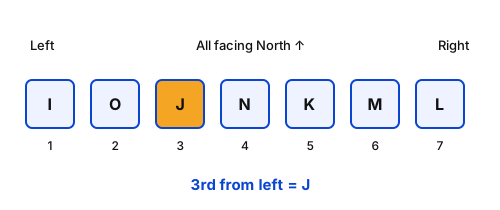
Seven people, I, J, K, L, M, N and O, are sitting in a row, facing north. Only two people sit to the right of K. Only two people sit between K and O. Only two people sit between I and N. N sits to the immediate left of K. L sits to the immediate right of M. Who sits at the third position from the left end of the line?
सात व्यक्ति, I, J, K, L, M, N और O, उत्तर की ओर मुख करके एक पंक्ति में बैठे हैं। K के दाईं ओर केवल दो व्यक्ति बैठे हैं। K और O के बीच केवल दो व्यक्ति बैठे हैं। I और N के बीच केवल दो व्यक्ति बैठे हैं। N, K के ठीक बाईं ओर बैठा है। L, M के ठीक दाईं ओर बैठा है। पंक्ति के बाएँ छोर से तीसरे स्थान पर कौन बैठा है?
  1. AI
  2. BO
  3. CL
  4. DJ
Show answer

Concept: Seats 1–7 from the left, all facing north (their right = our right).

  1. Two people to the right of K → K at 5; N immediate left of K → N at 4
  2. Two between K and O → O at 2; two between I and N → I at 1 or 7
  3. M, L adjacent (L right of M): if I =7, seats 1,3,6 have no adjacent pair; so I =1, M =6, L =7, J =3

Trick: Place the most fixed person (K) first, then use 'immediate' clues.

Answer: (D) J

अवधारणा: बाएँ से स्थान 1–7, सभी उत्तरमुखी (उनका दायाँ = हमारा दायाँ)।

  1. K के दाएँ दो → K स्थान 5; N, K के ठीक बाएँ → 4
  2. K और O के बीच दो → O स्थान 2; I और N के बीच दो → I स्थान 1 या 7
  3. M-L साथ (L, M के दाएँ): I =7 पर खाली 1,3,6 में जोड़ी नहीं बनती; अतः I =1, M =6, L =7, J =3

ट्रिक: सबसे निश्चित व्यक्ति (K) को पहले बैठाएँ।

उत्तर: (D) J

RRB NTPC Undergraduate CBT 1General Intelligence and ReasoningLinear seating arrangementRRB NTPC Undergraduate CBT 1 2024 · 8 Sep Shift 3 →