Question bank

Q&A: practice questions with answers

Search questions on any topic. Filter by exam category, exam, subject and topic, try the question, then open the answer and explanation.

Courses – airGurukul

8,500 questions found.

Q3741.
The product of two consecutive natural numbers is 650. The greater of the two numbers is:
दो क्रमागत प्राकृत संख्याओं का गुणनफल 650 है। दोनों संख्याओं में से बड़ी संख्या है:
  1. A29
  2. B31
  3. C43
  4. D26
Show answer

Concept: For consecutive numbers n(n+1)=650, n is close to 650.

  1. 650≈25.5, so try 25 and 26.
  2. 25×26=650 ✓
  3. Greater number =26.

Trick: Product ending in 0 with numbers near N: 25×26 (5 × even → ends in 0).

Answer: (D) 26

अवधारणा: क्रमागत संख्याओं के लिए n(n+1)=650, n लगभग 650 के बराबर होगा।

  1. 650≈25.5, अतः 25 और 26 लें।
  2. 25×26=650 ✓
  3. बड़ी संख्या =26।

ट्रिक: N के आसपास की दो संख्याएँ जाँचें: 25×26=650।

उत्तर: (D) 26

RRB NTPC Undergraduate CBT 1MathematicsNumber system – consecutive numbersRRB NTPC Undergraduate CBT 1 2024 · 8 Sep Shift 1 →
Q3742.
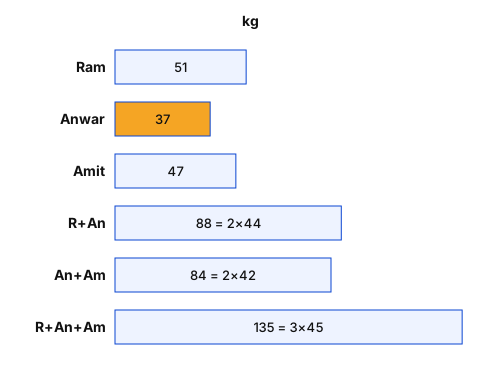
The average weight of Ram, Anwar and Amit is 45 kg. If the average weight of Ram and Anwar is 44 kg and that of Anwar and Amit is 42 kg, then the weight of Anwar (in kg) is:
राम, अनवर और अमित का औसत भार 45 kg है। यदि राम और अनवर का औसत भार 44 kg है और अनवर और अमित का औसत भार 42 kg है, तो अनवर का भार (kg में) है:
  1. A37
  2. B52
  3. C57
  4. D47
Show answer

Concept: Total = average × number of persons.

  1. R+An+Am=3×45=135
  2. R+An=2×44=88, An+Am=2×42=84
  3. Adding: R+2An+Am=172
  4. An=172−135=37kg

Trick: Common person = (sum of pair totals) − (total of all) =88+84−135=37.

Answer: (A) 37

अवधारणा: कुल योग = औसत × व्यक्तियों की संख्या।

  1. R+An+Am=3×45=135
  2. R+An=2×44=88, An+Am=2×42=84
  3. जोड़ने पर: R+2An+Am=172
  4. An=172−135=37kg

ट्रिक: साझा व्यक्ति = दोनों जोड़ियों का योग − कुल =88+84−135=37।

उत्तर: (A) 37

RRB NTPC Undergraduate CBT 1MathematicsAverageRRB NTPC Undergraduate CBT 1 2024 · 8 Sep Shift 1 →
Q3743.
Find the value of: 69−4÷ 6915× 69−9
मान ज्ञात कीजिए: 69−4÷ 6915× 69−9
  1. A69−23
  2. B69−38
  3. C69−37
  4. D69−28
Show answer

Concept: am÷an=am−n and am×an=am+n (left to right).

  1. 69−4÷6915=69−4−15=69−19
  2. 69−19×69−9=69−19−9=69−28

Trick: Add the powers with their signs: −4−15−9=−28.

Answer: (D) 69−28

अवधारणा: am÷an=am−n तथा am×an=am+n (बाएँ से दाएँ)।

  1. 69−4÷6915=69−4−15=69−19
  2. 69−19×69−9=69−19−9=69−28

ट्रिक: चिह्न सहित घातें जोड़ें: −4−15−9=−28।

उत्तर: (D) 69−28

RRB NTPC Undergraduate CBT 1MathematicsLaws of indicesRRB NTPC Undergraduate CBT 1 2024 · 8 Sep Shift 1 →
Q3744.
The price of a laptop is ₹46,000, and a trade discount of 16% is available. What will be the final amount the customer pays?
एक लैपटॉप का मूल्य ₹46,000 है, और उस पर 16% की व्यापारिक छूट उपलब्ध है। ग्राहक द्वारा भुगतान की जाने वाली अंतिम राशि कितनी होगी?
  1. A₹38,640
  2. B₹38,685
  3. C₹38,625
  4. D₹38,610
Show answer

Concept: Selling price = marked price × 100−discount%100.

  1. SP=46000×84100
  2. =460×84=38640

Trick: 16% of 46000=7360; 46000−7360=38640.

Answer: (A) ₹38,640

अवधारणा: विक्रय मूल्य = अंकित मूल्य × 100−छूट%100।

  1. SP=46000×84100
  2. =460×84=38640

ट्रिक: 46000 का 16%=7360; 46000−7360=38640।

उत्तर: (A) ₹38,640

RRB NTPC Undergraduate CBT 1MathematicsDiscountRRB NTPC Undergraduate CBT 1 2024 · 8 Sep Shift 1 →
Q3745.
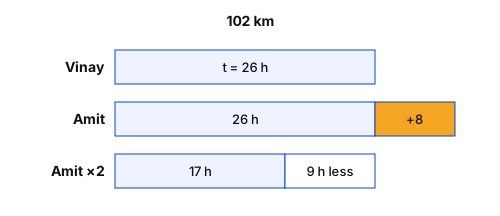
In covering a distance of 102 km, Amit takes 8 hours more than Vinay. If Amit doubles his speed, then he would take 9 hours less than Vinay. Amit's speed is:
102 km की दूरी तय करने में अमित, विनय से 8 घंटे अधिक लेता है। यदि अमित अपनी चाल दोगुनी कर दे, तो वह विनय से 9 घंटे कम लेगा। अमित की चाल है:
  1. A10 km/hr10 km/घंटा
  2. B3 km/hr3 km/घंटा
  3. C8 km/hr8 km/घंटा
  4. D11 km/hr11 km/घंटा
Show answer

Concept: Let Vinay take t hours. Doubling the speed halves the time.

  1. Amit's time =t+8; with double speed t+82=t−9
  2. t+8=2t−18⇒t=26
  3. Amit's time =34h
  4. Amit's speed =10234=3km/h

Trick: Check options: speed 3⇒34h and 17h; difference 34−17=17=8+9 ✓.

Answer: (B) 3km/h

अवधारणा: मान लें विनय को t घंटे लगते हैं। चाल दुगुनी करने पर समय आधा हो जाता है।

  1. अमित का समय =t+8; दुगुनी चाल पर t+82=t−9
  2. t+8=2t−18⇒t=26
  3. अमित का समय =34h
  4. अमित की चाल =10234=3km/h

ट्रिक: विकल्प जाँचें: चाल 3⇒34h व 17h; अंतर 34−17=17=8+9 ✓।

उत्तर: (B) 3km/h

RRB NTPC Undergraduate CBT 1MathematicsTime and distanceRRB NTPC Undergraduate CBT 1 2024 · 8 Sep Shift 1 →
Q3746.
Simplify: (1+sinA)(secA−tanA)cosecA(1−cosA)(cosecA+cotA)
सरल कीजिए: (1+sinA)(secA−tanA)cosecA(1−cosA)(cosecA+cotA)
  1. AtanA
  2. B1
  3. C2
  4. DcosA
Show answer

Concept: Use secA−tanA=1−sinAcosA, cosecA+cotA=1+cosAsinA and 1−sin2A=cos2A, 1−cos2A=sin2A.

  1. Numerator: (1+sinA)1−sinAcosA=cos2AcosA=cosA
  2. Denominator: cosecA(1−cosA)1+cosAsinA=cosecA·sin2AsinA=cosecAsinA=1
  3. Value =cosA1=cosA

Trick: Put A=60∘: numerator =12, denominator =1 → 12=cos60∘.

Answer: (D) cosA

अवधारणा: secA−tanA=1−sinAcosA, cosecA+cotA=1+cosAsinA तथा 1−sin2A=cos2A, 1−cos2A=sin2A का प्रयोग करें।

  1. अंश: (1+sinA)1−sinAcosA=cos2AcosA=cosA
  2. हर: cosecA(1−cosA)1+cosAsinA=cosecA·sin2AsinA=cosecAsinA=1
  3. मान =cosA1=cosA

ट्रिक: A=60∘ रखें: अंश =12, हर =1 → 12=cos60∘।

उत्तर: (D) cosA

RRB NTPC Undergraduate CBT 1MathematicsTrigonometric identitiesRRB NTPC Undergraduate CBT 1 2024 · 8 Sep Shift 1 →
Q3747.
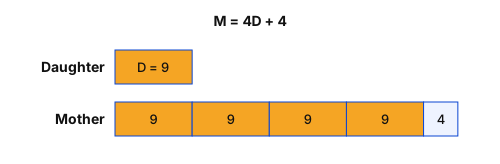
If 2 times a mother's present age is 26 years more than 6 times her daughter's present age, and 4 times the daughter's present age is 4 years less than the mother's present age, then what is the difference (in years) between the ages of the mother and the daughter?
यदि माँ की वर्तमान आयु का 2 गुना, उसकी पुत्री की वर्तमान आयु के 6 गुने से 26 वर्ष अधिक है, और पुत्री की वर्तमान आयु का 4 गुना, माँ की वर्तमान आयु से 4 वर्ष कम है, तो माँ और पुत्री की आयु में अंतर (वर्षों में) कितना है?
  1. A29
  2. B32
  3. C31
  4. D36
Show answer

Concept: Form two equations in mother's age M and daughter's age D.

  1. 2M=6D+26⇒M=3D+13
  2. 4D=M−4⇒M=4D+4
  3. 4D+4=3D+13⇒D=9, M=40
  4. Difference =40−9=31 years

Trick: Check: 2×40=80=6×9+26 ✓ and 4×9=36=40−4 ✓.

Answer: (C) 31

अवधारणा: माँ की आयु M और बेटी की आयु D लेकर दो समीकरण बनाएँ।

  1. 2M=6D+26⇒M=3D+13
  2. 4D=M−4⇒M=4D+4
  3. 4D+4=3D+13⇒D=9, M=40
  4. अंतर =40−9=31 वर्ष

ट्रिक: जाँच: 2×40=80=6×9+26 ✓ तथा 4×9=36=40−4 ✓।

उत्तर: (C) 31

RRB NTPC Undergraduate CBT 1MathematicsProblems on agesRRB NTPC Undergraduate CBT 1 2024 · 8 Sep Shift 1 →
Q3748.
The simple interest on a certain sum for 278 years at the rate of 2.9% per annum is ₹8,671.
What will be the amount payable on the same sum at the rate of 4.5% per annum simple interest in 425 years?
किसी निश्चित राशि पर 278 वर्षों के लिए 2.9% वार्षिक दर से साधारण ब्याज ₹8,671 है।
उसी राशि पर 4.5% वार्षिक साधारण ब्याज की दर से 425 वर्षों में देय मिश्रधन कितना होगा?
  1. A₹1,24,608
  2. B₹1,24,574
  3. C₹1,24,590
  4. D₹1,24,592
Show answer

Concept: SI=P×R×T100, Amount =P+SI.

  1. 278=238 years: 8671=P×2.9×23800⇒P=8671×80066.7=104000
  2. New SI =104000×4.5×4.4100=104000×0.198=20592
  3. Amount =104000+20592=124592

Trick: Rate × time =4.5×4.4=19.8% of P; P×1.198=124592.

Answer: (D) ₹1,24,592

अवधारणा: SI=P×R×T100, मिश्रधन =P+SI।

  1. 278=238 वर्ष: 8671=P×2.9×23800⇒P=8671×80066.7=104000
  2. नया SI =104000×4.5×4.4100=104000×0.198=20592
  3. मिश्रधन =104000+20592=124592

ट्रिक: दर × समय =4.5×4.4=19.8%; P×1.198=124592।

उत्तर: (D) ₹1,24,592

RRB NTPC Undergraduate CBT 1MathematicsSimple interestRRB NTPC Undergraduate CBT 1 2024 · 8 Sep Shift 1 →
Q3749.
Find the value of x satisfying: 3(3x2 − 6) − 3(3x2 + 5x − 7) = 19
x का वह मान ज्ञात कीजिए जो संतुष्ट करता है: 3(3x2 − 6) − 3(3x2 + 5x − 7) = 19
  1. A−1315
  2. B−2615
  3. C−1615
  4. D−1415
Show answer

Concept: Expand the brackets; the x2 terms cancel, leaving a linear equation.

  1. 9x2−18−9x2−15x+21=19
  2. 3−15x=19
  3. −15x=16⇒x=−1615

Trick: Watch the sign: −3×(−7)=+21.

Answer: (C) −1615

अवधारणा: कोष्ठक खोलें; x2 वाले पद कट जाते हैं और रैखिक समीकरण बचता है।

  1. 9x2−18−9x2−15x+21=19
  2. 3−15x=19
  3. −15x=16⇒x=−1615

ट्रिक: चिह्न पर ध्यान: −3×(−7)=+21।

उत्तर: (C) −1615

RRB NTPC Undergraduate CBT 1MathematicsLinear equationsRRB NTPC Undergraduate CBT 1 2024 · 8 Sep Shift 1 →
Q3750.
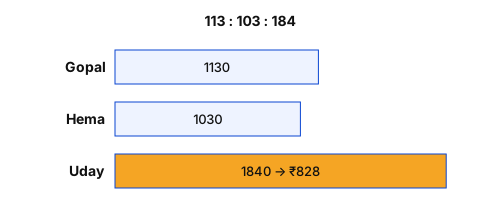
Gopal, Hema, and Uday invest ₹1,130, ₹1,030, and ₹1,840, respectively, to start a business. If the profit at the end of the year is ₹1,800, then what is the share of Uday in the profit?
गोपाल, हेमा और उदय एक व्यवसाय शुरू करने के लिए क्रमशः ₹1,130, ₹1,030 और ₹1,840 का निवेश करते हैं। यदि वर्ष के अंत में लाभ ₹1,800 है, तो लाभ में उदय का हिस्सा कितना है?
  1. A₹830
  2. B₹825
  3. C₹831
  4. D₹828
Show answer

Concept: For equal time periods, profit is shared in the ratio of investments.

  1. Ratio =1130:1030:1840=113:103:184 (sum 400)
  2. Uday's share =184400×1800=184×4.5=828

Trick: Uday's fraction =18404000=46%; 46% of 1800=828.

Answer: (D) ₹828

अवधारणा: समान अवधि के लिए लाभ निवेश के अनुपात में बँटता है।

  1. अनुपात =1130:1030:1840=113:103:184 (योग 400)
  2. उदय का हिस्सा =184400×1800=184×4.5=828

ट्रिक: उदय का भाग =18404000=46%; 1800 का 46%=828।

उत्तर: (D) ₹828

RRB NTPC Undergraduate CBT 1MathematicsPartnershipRRB NTPC Undergraduate CBT 1 2024 · 8 Sep Shift 1 →
Q3751.
A man makes a monthly payment equal to 36% of his monthly salary towards debt repayment. He spends 50% of the remaining salary and saves ₹704. His monthly salary (in ₹) is:
एक व्यक्ति अपने मासिक वेतन के 36% के बराबर राशि का मासिक भुगतान ऋण चुकाने में करता है। वह शेष वेतन का 50% खर्च करता है और ₹704 बचाता है। उसका मासिक वेतन (₹ में) है:
  1. A2,104
  2. B2,116
  3. C2,200
  4. D2,202
Show answer

Concept: Work on the part of salary left after each payment.

  1. Let salary =S. After debt: S−36%S=0.64S.
  2. He spends 50% of this, so savings =0.5×0.64S=0.32S.
  3. 0.32S=704⇒S=7040.32=2200.

Trick: Savings fraction =0.64×0.5=0.32 of salary; divide savings by 0.32 directly.

Answer: (C) ₹2,200

अवधारणा: हर भुगतान के बाद बची सैलरी पर काम करें।

  1. मान लें वेतन =S। कर्ज़ के बाद बचा: S−36%S=0.64S।
  2. इसका 50% खर्च, तो बचत =0.5×0.64S=0.32S।
  3. 0.32S=704⇒S=7040.32=2200।

ट्रिक: बचत = वेतन का 0.64×0.5=0.32 भाग; सीधे 704÷0.32 करें।

उत्तर: (C) ₹2,200

RRB NTPC Undergraduate CBT 1MathematicsPercentage – income & expenditureRRB NTPC Undergraduate CBT 1 2024 · 8 Sep Shift 1 →
Q3752.
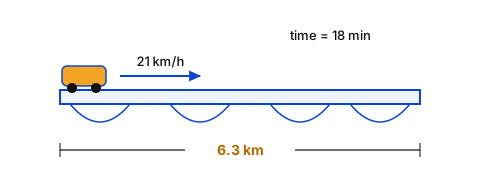
A man driving a car at a speed of 21 km/hr crosses a bridge in 18 minutes. Find the length of the bridge.
21 km/घंटा की चाल से कार चलाने वाला एक व्यक्ति एक पुल को 18 मिनट में पार करता है। पुल की लंबाई ज्ञात कीजिए।
  1. A4.7 km
  2. B15.2 km
  3. C6.3 km
  4. D2.5 km
Show answer

Concept: Distance=Speed×Time, with time in hours.

  1. Time =18 min =1860=0.3 h.
  2. Length of bridge =21×0.3=6.3km.

Trick: 18 min =310 h, so distance =310 of the speed: 3×2110=6.3.

Answer: (C) 6.3 km

अवधारणा: दूरी=चाल×समय (समय घंटों में)।

  1. समय =18 मिनट =1860=0.3 घंटा।
  2. पुल की लंबाई =21×0.3=6.3km।

ट्रिक: 18 मिनट =310 घंटा, इसलिए दूरी =3×2110=6.3।

उत्तर: (C) 6.3 km

RRB NTPC Undergraduate CBT 1MathematicsSpeed, time & distanceRRB NTPC Undergraduate CBT 1 2024 · 8 Sep Shift 1 →
Q3753.
Find the value of: [138 ÷ {13 + 7 × (3 − 4)}].
मान ज्ञात कीजिए: [138 ÷ {13 + 7 × (3 − 4)}]।
  1. A23
  2. B18
  3. C20
  4. D27
Show answer

Concept: Follow BODMAS: innermost bracket first, then multiplication, then addition, then division.

  1. (3−4)=−1.
  2. 7×(−1)=−7, so {13−7}=6.
  3. 138÷6=23.

Yaad rakhein: Solve brackets from inside out: ( ) → { } → [ ].

Answer: (A) 23

अवधारणा: BODMAS: पहले सबसे अंदर का कोष्ठक, फिर गुणा, फिर जोड़, फिर भाग।

  1. (3−4)=−1।
  2. 7×(−1)=−7, अतः {13−7}=6।
  3. 138÷6=23।

याद रखें: कोष्ठक अंदर से बाहर हल करें: ( ) → { } → [ ]।

उत्तर: (A) 23

RRB NTPC Undergraduate CBT 1MathematicsSimplification (BODMAS)RRB NTPC Undergraduate CBT 1 2024 · 8 Sep Shift 1 →
Q3754.
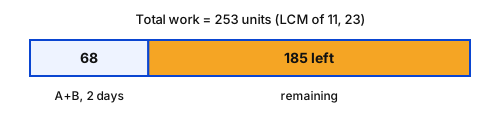
A can do a work in 11 days and B can do the same work in 23 days. If they work on it together for 2 days, then what fraction of the work is left?
A किसी कार्य को 11 दिनों में कर सकता है और B उसी कार्य को 23 दिनों में कर सकता है। यदि वे 2 दिनों तक एक साथ कार्य करते हैं, तो कार्य का कितना भाग शेष रहेगा?
  1. A193253
  2. B192253
  3. C185253
  4. D181253
Show answer

Concept: Take total work = LCM of the days; find the work done together and subtract.

  1. Total work =LCM(11,23)=253 units.
  2. A does 25311=23 units/day, B does 25323=11 units/day; together 34 units/day.
  3. In 2 days: 68 units. Left =253−68=185 units =185253.

Trick: Work left =1−2(111+123)=1−68253.

Answer: (C) 185253

अवधारणा: कुल कार्य = दिनों का LCM लें; साथ में किया कार्य घटाएँ।

  1. कुल कार्य =LCM(11,23)=253 इकाई।
  2. A: 25311=23 इकाई/दिन, B: 25323=11 इकाई/दिन; मिलकर 34 इकाई/दिन।
  3. 2 दिन में 68 इकाई; शेष =253−68=185 इकाई =185253।

ट्रिक: शेष कार्य =1−2(111+123)=1−68253।

उत्तर: (C) 185253

RRB NTPC Undergraduate CBT 1MathematicsTime and workRRB NTPC Undergraduate CBT 1 2024 · 8 Sep Shift 1 →
Q3755.
The LCM of the numbers 2.9 and 0.031 is:
संख्याओं 2.9 और 0.031 का LCM (लघुत्तम समापवर्त्य) है:
  1. A89.9
  2. B0.899
  3. C8.99
  4. D899
Show answer

Concept: Make decimal places equal, find LCM of the whole numbers, then put back the decimal places.

  1. Write with 3 decimal places: 2.900 and 0.031 → 2900 and 31.
  2. 2900=22×52×29 and 31 is prime, so LCM=2900×31=89900.
  3. Put back 3 decimal places: 89.900=89.9.

Trick: LCM of decimals =LCM of numeratorsHCF of denominators: LCM(29,31)HCF(10,1000)=89910=89.9.

Answer: (A) 89.9

अवधारणा: दशमलव स्थान बराबर करें, पूर्ण संख्याओं का LCM निकालें, फिर दशमलव वापस लगाएँ।

  1. 3 दशमलव स्थान: 2.900 और 0.031 → 2900 और 31।
  2. 2900=22×52×29, 31 अभाज्य, अतः LCM=2900×31=89900।
  3. 3 दशमलव स्थान वापस: 89.900=89.9।

ट्रिक: भिन्नों का LCM =अंशों का LCMहरों का HCF: LCM(29,31)HCF(10,1000)=89910=89.9।

उत्तर: (A) 89.9

RRB NTPC Undergraduate CBT 1MathematicsLCM of decimalsRRB NTPC Undergraduate CBT 1 2024 · 8 Sep Shift 1 →
Q3756.
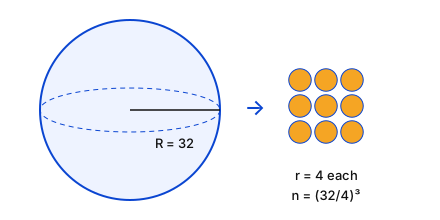
What is the number of iron balls, each of radius 4 cm, that can be moulded out of a sphere of diameter 64 cm?
64 cm व्यास वाले एक गोले से 4 cm त्रिज्या वाली लोहे की कितनी गेंदें ढाली जा सकती हैं?
  1. A729
  2. B216
  3. C343
  4. D512
Show answer

Concept: Volume is conserved: number of balls =volume of big spherevolume of one ball.

  1. Big sphere radius R=642=32 cm, ball radius r=4 cm.
  2. n=43πR343πr3=(324)3=83=512.

Trick: For spheres, n=(Rr)3 — no need to use π.

Answer: (D) 512

अवधारणा: आयतन समान रहता है: गेंदों की संख्या =बड़े गोले का आयतनएक गेंद का आयतन।

  1. बड़े गोले की त्रिज्या R=642=32 cm, गेंद की r=4 cm।
  2. n=43πR343πr3=(324)3=83=512।

ट्रिक: गोलों के लिए n=(Rr)3 — π की ज़रूरत नहीं।

उत्तर: (D) 512

RRB NTPC Undergraduate CBT 1MathematicsMensuration – sphere recastingRRB NTPC Undergraduate CBT 1 2024 · 8 Sep Shift 1 →
Q3757.
₹45,800 were divided among A, B and C such that 2 times the share of A = 4 times the share of B = 7 times the share of C. Find the share of A.
₹45,800 को A, B और C के बीच इस प्रकार बाँटा गया कि A के हिस्से का 2 गुना = B के हिस्से का 4 गुना = C के हिस्से का 7 गुना। A का हिस्सा ज्ञात कीजिए।
  1. A₹25,582
  2. B₹25,828
  3. C₹25,648
  4. D₹25,611
Show answer

Concept: If 2A=4B=7C, the shares are in the ratio 12:14:17.

  1. Multiply by LCM 28: A:B:C=14:7:4; total parts =25.
  2. One part =4580025=1832.
  3. Share of A =14×1832=25648.

Trick: xA=yB=zC⇒A:B:C=yz:xz:xy=28:14:8=14:7:4.

Answer: (C) ₹25,648

अवधारणा: यदि 2A=4B=7C, तो हिस्सों का अनुपात 12:14:17 है।

  1. LCM 28 से गुणा: A:B:C=14:7:4; कुल भाग =25।
  2. एक भाग =4580025=1832।
  3. A का हिस्सा =14×1832=25648।

ट्रिक: xA=yB=zC⇒A:B:C=yz:xz:xy=28:14:8=14:7:4।

उत्तर: (C) ₹25,648

RRB NTPC Undergraduate CBT 1MathematicsRatio – division of moneyRRB NTPC Undergraduate CBT 1 2024 · 8 Sep Shift 1 →
Q3758.
What smallest number should be added to 19964 so that the sum is completely divisible by 76?
19964 में कौन-सी सबसे छोटी संख्या जोड़ी जानी चाहिए ताकि योगफल 76 से पूर्णतः विभाज्य हो?
  1. A21
  2. B25
  3. C24
  4. D22
Show answer

Concept: Number to add =divisor−remainder.

  1. 76×262=19912, so 19964−19912=52 is the remainder.
  2. Number to add =76−52=24; check: 19988=76×263.

Yaad rakhein: Least to add =d−r; least to subtract =r.

Answer: (C) 24

अवधारणा: जोड़ी जाने वाली संख्या =भाजक−शेषफल।

  1. 76×262=19912, अतः शेषफल =19964−19912=52।
  2. जोड़ें 76−52=24; जाँच: 19988=76×263।

याद रखें: न्यूनतम जोड़ना =d−r; न्यूनतम घटाना =r।

उत्तर: (C) 24

RRB NTPC Undergraduate CBT 1MathematicsDivisibility – least number to be addedRRB NTPC Undergraduate CBT 1 2024 · 8 Sep Shift 1 →
Q3759.
The sum of five numbers is 655. The average of the first two numbers is 80 and the third number is 106. Find the average of the remaining two numbers.
पाँच संख्याओं का योग 655 है। पहली दो संख्याओं का औसत 80 है और तीसरी संख्या 106 है। शेष दो संख्याओं का औसत ज्ञात कीजिए।
  1. A195.5
  2. B186
  3. C194.5
  4. D187
Show answer

Concept: Sum=Average×Count.

  1. First two numbers: 80×2=160; third =106.
  2. Last two: 655−160−106=389.
  3. Average =3892=194.5.

Trick: Remove known parts from the total, then divide by the count left.

Answer: (C) 194.5

अवधारणा: योग=औसत×संख्या।

  1. पहली दो संख्याएँ: 80×2=160; तीसरी =106।
  2. अंतिम दो का योग: 655−160−106=389।
  3. औसत =3892=194.5।

ट्रिक: कुल योग से ज्ञात भाग घटाएँ, फिर बची संख्या से भाग दें।

उत्तर: (C) 194.5

RRB NTPC Undergraduate CBT 1MathematicsAverageRRB NTPC Undergraduate CBT 1 2024 · 8 Sep Shift 1 →
Q3760.
A shopkeeper gives two successive discounts of 20% and 10% on a shirt marked at ₹1,200. What is the final selling price?
एक दुकानदार ₹1,200 अंकित मूल्य वाली एक कमीज़ पर 20% और 10% की दो क्रमिक छूट देता है। अंतिम विक्रय मूल्य क्या है?
  1. A₹880
  2. B₹890
  3. C₹870
  4. D₹864
Show answer

Concept: Successive discounts are applied one after another on the reduced price.

  1. After 20%: 1200×0.8=960.
  2. After 10%: 960×0.9=864.

Trick: Net discount of 20% and 10% =20+10−20×10100=28%; 72% of 1200 =864.

Answer: (D) ₹864

अवधारणा: क्रमागत छूट घटे हुए मूल्य पर एक के बाद एक लगती है।

  1. 20% के बाद: 1200×0.8=960।
  2. 10% के बाद: 960×0.9=864।

ट्रिक: कुल छूट =20+10−20×10100=28%; 1200 का 72%=864।

उत्तर: (D) ₹864

RRB NTPC Undergraduate CBT 1MathematicsSuccessive discountsRRB NTPC Undergraduate CBT 1 2024 · 8 Sep Shift 1 →