Question bank

Q&A: practice questions with answers

Search questions on any topic. Filter by exam category, exam, subject and topic, try the question, then open the answer and explanation.

Courses – airGurukul

8,500 questions found.

Q3781.
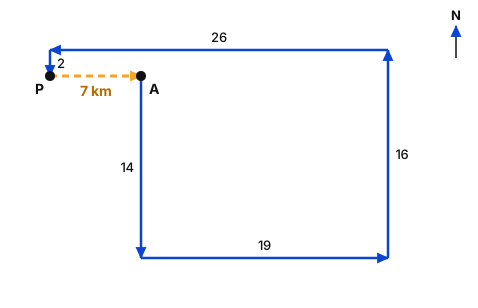
Bismil starts from Point A and drives 14 km towards South. He then takes a left turn, drives 19 km, turns left and drives 16 km. He then takes a left turn and drives 26 km. He takes a final left turn, drives 2 km and stops at Point P. How far (shortest distance) and towards which direction should he drive in order to reach Point A again? (All turns are 90° turns only unless specified.)
बिस्मिल बिंदु A से शुरू करता है और दक्षिण की ओर 14 km गाड़ी चलाता है। फिर वह बाएँ मुड़ता है, 19 km गाड़ी चलाता है, बाएँ मुड़ता है और 16 km गाड़ी चलाता है। फिर वह बाएँ मुड़ता है और 26 km गाड़ी चलाता है। वह अंतिम बार बाएँ मुड़ता है, 2 km गाड़ी चलाता है और बिंदु P पर रुक जाता है। बिंदु A पर पुनः पहुँचने के लिए उसे कितनी दूर (न्यूनतम दूरी) और किस दिशा में गाड़ी चलानी चाहिए? (जब तक निर्दिष्ट न हो, सभी मोड़ केवल 90° के मोड़ हैं।)
  1. A7 km to the eastपूर्व की ओर 7 km
  2. B6 km to the eastपूर्व की ओर 6 km
  3. C7 km to the westपश्चिम की ओर 7 km
  4. D6 km to the westपश्चिम की ओर 6 km
Show answer

Concept: Track the position with coordinates: east +x, north +y, start A =(0,0).

  1. 14 km south → (0,−14); left (east) 19 → (19,−14).
  2. Left (north) 16 → (19,2); left (west) 26 → (−7,2).
  3. Left (south) 2 → P =(−7,0).
  4. A is 7 km east of P.

Trick: Net east–west: 19−26=−7; net north–south: −14+16−2=0.

Answer: (A) 7 km to the east

अवधारणा: निर्देशांक से स्थिति देखें: पूर्व +x, उत्तर +y, आरंभ A =(0,0)।

  1. 14 km दक्षिण → (0,−14); बाएँ (पूर्व) 19 → (19,−14)।
  2. बाएँ (उत्तर) 16 → (19,2); बाएँ (पश्चिम) 26 → (−7,2)।
  3. बाएँ (दक्षिण) 2 → P =(−7,0)।
  4. A, P से 7 km पूर्व में है।

ट्रिक: शुद्ध पूर्व–पश्चिम: 19−26=−7; उत्तर–दक्षिण: −14+16−2=0।

उत्तर: (A) 7 km पूर्व की ओर (to the east)
RRB NTPC Undergraduate CBT 1General Intelligence and ReasoningDirection and distanceRRB NTPC Undergraduate CBT 1 2024 · 8 Sep Shift 1 →
Q3782.
In a certain code language, ‘COLD’ is coded as ‘2357’ and ‘LEAN’ is coded as ‘4136’. What is the code for ‘L’ in that language?
एक निश्चित कूट भाषा में, ‘COLD’ को ‘2357’ लिखा जाता है और ‘LEAN’ को ‘4136’ लिखा जाता है। उस भाषा में ‘L’ के लिए कूट क्या है?
  1. A5
  2. B6
  3. C3
  4. D4
Show answer

Concept: The letter common to both words gets the digit common to both codes.

  1. COLD → 2357 and LEAN → 4136.
  2. Common letter: L; common digit: 3.
  3. So L = 3.

Trick: Common letter ↔ common digit.

Answer: (C) 3

अवधारणा: दोनों शब्दों के सामान्य अक्षर का कोड दोनों कोडों का सामान्य अंक है।

  1. COLD → 2357 और LEAN → 4136।
  2. सामान्य अक्षर: L; सामान्य अंक: 3।
  3. अतः L = 3।

ट्रिक: सामान्य अक्षर ↔ सामान्य अंक।

उत्तर: (C) 3

RRB NTPC Undergraduate CBT 1General Intelligence and ReasoningCoding-decodingRRB NTPC Undergraduate CBT 1 2024 · 8 Sep Shift 1 →
Q3783.
Read the given statements and conclusions carefully. Assuming that the information given in the statements is true, even if it appears to be at variance with commonly known facts, decide which of the given conclusions logically follow(s) from the statements.
Statements:
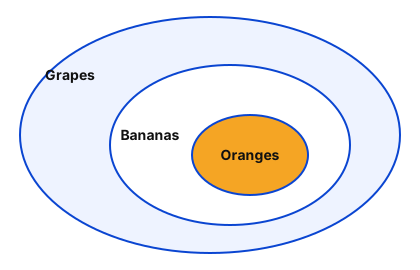
All oranges are bananas.
All bananas are grapes.
Conclusions:
(I): All oranges are grapes.
(II): All grapes are bananas
दिए गए कथनों और निष्कर्षों को ध्यानपूर्वक पढ़िए। कथनों में दी गई जानकारी को सत्य मानते हुए, भले ही वह सामान्यतः ज्ञात तथ्यों से भिन्न प्रतीत होती हो, निर्णय लीजिए कि दिए गए निष्कर्षों में से कौन-सा/से निष्कर्ष कथनों का तार्किक रूप से अनुसरण करता है/करते हैं।
कथन:
सभी संतरे, केले हैं।
सभी केले, अंगूर हैं।
निष्कर्ष:
(I): सभी संतरे, अंगूर हैं।
(II): सभी अंगूर, केले हैं।
  1. ANeither conclusion (I) nor (II) follows.न तो निष्कर्ष (I) और न ही (II) अनुसरण करता है।
  2. BBoth conclusions (I) and (II) follow .निष्कर्ष (I) और (II) दोनों अनुसरण करते हैं।
  3. COnly conclusion (II) follows.केवल निष्कर्ष (II) अनुसरण करता है।
  4. DOnly conclusion (I) follows.केवल निष्कर्ष (I) अनुसरण करता है।
Show answer

Concept: 'All' statements nest circles inside one another.

  1. Oranges ⊂ Bananas ⊂ Grapes.
  2. So all oranges are grapes ⇒ (I) follows.
  3. Grapes can be more than bananas ⇒ (II) does not follow.

Trick: All A are B + All B are C ⇒ All A are C; the reverse 'All C are B' is never certain.

Answer: (D) Only conclusion (I) follows.

अवधारणा: 'सभी' वाले कथनों में वृत्त एक-दूसरे के अंदर बनते हैं।

  1. Oranges ⊂ Bananas ⊂ Grapes।
  2. अतः सभी oranges, grapes हैं ⇒ (I) सही।
  3. Grapes में bananas से अधिक हो सकते हैं ⇒ (II) सही नहीं।

ट्रिक: सभी A, B + सभी B, C ⇒ सभी A, C; उल्टा 'सभी C, B' निश्चित नहीं।

उत्तर: (D) केवल निष्कर्ष (I) अनुसरण करता है।

RRB NTPC Undergraduate CBT 1General Intelligence and ReasoningSyllogismRRB NTPC Undergraduate CBT 1 2024 · 8 Sep Shift 1 →
Q3784.
If 1 is added to each even digit and 1 is subtracted from each odd digit in the number 697312458, what will be the sum of all the odd digits in the new number thus formed?
यदि संख्या 697312458 में प्रत्येक सम अंक में 1 जोड़ दिया जाए और प्रत्येक विषम अंक में से 1 घटा दिया जाए, तो इस प्रकार बनी नई संख्या में सभी विषम अंकों का योग क्या होगा?
  1. A24
  2. B20
  3. C18
  4. D26
Show answer

Concept: Even digit +1, odd digit −1; then add the odd digits of the new number.

  1. 697312458 → 7, 8, 6, 2, 0, 3, 5, 4, 9.
  2. New number: 786203549.
  3. Odd digits: 7, 3, 5, 9 ⇒ sum =24.

Trick: Every even digit becomes odd and every odd digit becomes even, so the odd digits come only from the original even digits (6, 2, 4, 8 → 7, 3, 5, 9).

Answer: (A) 24

अवधारणा: सम अंक +1, विषम अंक −1; फिर नई संख्या के विषम अंक जोड़ें।

  1. 697312458 → 7, 8, 6, 2, 0, 3, 5, 4, 9।
  2. नई संख्या: 786203549।
  3. विषम अंक: 7, 3, 5, 9 ⇒ योग =24।

ट्रिक: सम अंक विषम बनते हैं और विषम अंक सम, इसलिए नए विषम अंक मूल सम अंकों (6, 2, 4, 8) से ही आते हैं।

उत्तर: (A) 24

RRB NTPC Undergraduate CBT 1General Intelligence and ReasoningDigit operationsRRB NTPC Undergraduate CBT 1 2024 · 8 Sep Shift 1 →
Q3785.
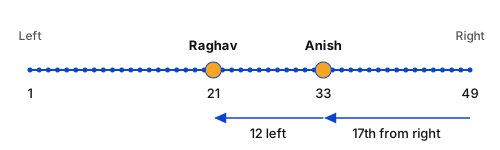
In a row of 49 students facing North, Anish is 17th from the right end. If Raghav is 12th to the left of Anish, what is Raghav's position from the left-end of the line?
उत्तर की ओर मुख करके खड़े 49 विद्यार्थियों की एक पंक्ति में, अनीश दाएँ छोर से 17वें स्थान पर है। यदि राघव, अनीश के बाएँ 12वें स्थान पर है, तो पंक्ति के बाएँ छोर से राघव का स्थान क्या है?
  1. A20th20वाँ
  2. B22nd22वाँ
  3. C21st21वाँ
  4. D23rd23वाँ
Show answer

Concept: Position from left =Total−position from right+1.

  1. Anish from left =49−17+1=33.
  2. Raghav is 12 places to his left ⇒ 33−12=21st.

Trick: Both face north, so 'left' means towards the left end of the row.

Answer: (C) 21st

अवधारणा: बाएँ से स्थान =कुल−दाएँ से स्थान+1।

  1. अनीश बाएँ से =49−17+1=33वाँ।
  2. राघव उसके 12 स्थान बाएँ ⇒ 33−12=21वाँ।

ट्रिक: सभी का मुख उत्तर की ओर है, इसलिए 'बाएँ' = पंक्ति का बायाँ सिरा।

उत्तर: (C) 21st

RRB NTPC Undergraduate CBT 1General Intelligence and ReasoningRanking and positionRRB NTPC Undergraduate CBT 1 2024 · 8 Sep Shift 1 →
Q3786.
Select the number from among the given options that can replace the question mark (?) in the following series.
180 159 135 108 78 ?
दिए गए विकल्पों में से उस संख्या का चयन कीजिए जो निम्नलिखित श्रृंखला में प्रश्न चिह्न (?) के स्थान पर आ सकती है।
180 159 135 108 78 ?
  1. A54
  2. B35
  3. C45
  4. D32
Show answer

Concept: Check the differences between consecutive terms.

  1. Differences: −21,−24,−27,−30 (increasing by 3).
  2. Next difference =−33; 78−33=45.

Trick: Differences form an AP with common difference −3.

Answer: (C) 45

अवधारणा: क्रमागत पदों के अंतर देखें।

  1. अंतर: −21,−24,−27,−30 (हर बार 3 अधिक)।
  2. अगला अंतर =−33; 78−33=45।

ट्रिक: अंतर एक AP बनाते हैं जिसका सार्व अंतर −3 है।

उत्तर: (C) 45

RRB NTPC Undergraduate CBT 1General Intelligence and ReasoningNumber seriesRRB NTPC Undergraduate CBT 1 2024 · 8 Sep Shift 1 →
Q3787.
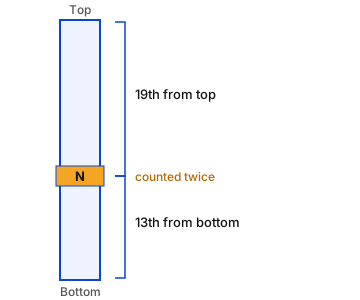
Namit ranked 13th from the bottom and 19th from the top in his class. How many students are there in his class?
नमित अपनी कक्षा में नीचे से 13वें और ऊपर से 19वें स्थान पर है। उसकी कक्षा में कितने विद्यार्थी हैं?
  1. A31
  2. B33
  3. C30
  4. D32
Show answer

Concept: Total=rank from top+rank from bottom−1.

  1. Total =19+13−1=31.
  2. Namit is counted in both ranks, so subtract 1 once.

Yaad rakhein: Top rank + bottom rank − 1 = total.

Answer: (A) 31

अवधारणा: कुल=ऊपर से रैंक+नीचे से रैंक−1।

  1. कुल =19+13−1=31।
  2. नमित दोनों गिनतियों में शामिल है, इसलिए 1 घटाएँ।

याद रखें: ऊपर से रैंक + नीचे से रैंक − 1 = कुल।

उत्तर: (A) 31

RRB NTPC Undergraduate CBT 1General Intelligence and ReasoningRankingRRB NTPC Undergraduate CBT 1 2024 · 8 Sep Shift 1 →
Q3788.
If 2 is added to each even digit and 1 is subtracted from each odd digit in the number 76391452, how many digits will appear more than once in the new number thus formed?
यदि संख्या 76391452 में प्रत्येक सम अंक में 2 जोड़ दिया जाए और प्रत्येक विषम अंक में से 1 घटा दिया जाए, तो इस प्रकार बनी नई संख्या में कितने अंक एक से अधिक बार आएँगे?
  1. AOneएक
  2. BFourचार
  3. CThreeतीन
  4. DTwoदो
Show answer

Concept: Even digit +2, odd digit −1; then count digits that repeat.

  1. 76391452 → 6, 8, 2, 8, 0, 6, 4, 4.
  2. New number: 68280644.
  3. Counts: 6 (twice), 8 (twice), 4 (twice), 2 and 0 once ⇒ 3 digits repeat.

Trick: Write the new digits in a row and tick repeats — don't count a repeated digit twice.

Answer: (C) Three

अवधारणा: सम अंक +2, विषम अंक −1; फिर दोहराए गए अंक गिनें।

  1. 76391452 → 6, 8, 2, 8, 0, 6, 4, 4।
  2. नई संख्या: 68280644।
  3. 6 (दो बार), 8 (दो बार), 4 (दो बार), 2 व 0 एक बार ⇒ 3 अंक दोहराए गए।

ट्रिक: नए अंक एक पंक्ति में लिखकर दोहराव पर निशान लगाएँ — एक अंक को दो बार न गिनें।

उत्तर: (C) तीन (Three)

RRB NTPC Undergraduate CBT 1General Intelligence and ReasoningDigit operationsRRB NTPC Undergraduate CBT 1 2024 · 8 Sep Shift 1 →
Q3789.
In the following number-pairs, the second number is obtained by applying certain mathematical operations to the first number. Select the pair in which the numbers are related in the same way as are the numbers of the following pairs.
(Note: Operations should be performed on the whole numbers, without breaking down the numbers into its constituent digits. E.g., 13 – Operations on 13 such as
adding/subtracting/multiplying etc. to 13 can be performed. Breaking down 13 into 1 and 3 and then performing mathematical operations on 1 and 3 is not allowed.) 21, 124
18, 106
निम्नलिखित संख्या-युग्मों में, पहली संख्या पर कुछ गणितीय संक्रियाएँ करके दूसरी संख्या प्राप्त की जाती है। उस युग्म का चयन कीजिए जिसमें संख्याएँ उसी प्रकार संबंधित हैं जिस प्रकार निम्नलिखित युग्मों की संख्याएँ संबंधित हैं।
(ध्यान दें: संक्रियाएँ संख्याओं को उनके घटक अंकों में विभाजित किए बिना, पूर्ण संख्याओं पर की जानी चाहिए। उदाहरण के लिए, 13 – 13 पर संक्रियाएँ जैसे
13 में जोड़ना/घटाना/गुणा करना आदि किया जा सकता है। 13 को 1 और 3 में विभाजित करना और फिर 1 और 3 पर गणितीय संक्रियाएँ करना वर्जित है।) 21, 124
18, 106
  1. A9, 56
  2. B6, 36
  3. C15, 86
  4. D13, 76
Show answer

Concept: Find one operation that fits both given pairs.

  1. 21×6−2=124 and 18×6−2=106 ⇒ rule: ×6−2.
  2. Check options: 13×6−2=76 ✓ (9→52, 6→34, 15→88 do not match).

Trick: Second number is about 6 times the first, so test ×6±k.

Answer: (D) 13, 76

अवधारणा: ऐसी संक्रिया खोजें जो दोनों युग्मों पर लागू हो।

  1. 21×6−2=124 और 18×6−2=106 ⇒ नियम: ×6−2।
  2. विकल्प जाँचें: 13×6−2=76 ✓ (9→52, 6→34, 15→88 मेल नहीं खाते)।

ट्रिक: दूसरी संख्या पहली की लगभग 6 गुना है, इसलिए ×6±k जाँचें।

उत्तर: (D) 13, 76

RRB NTPC Undergraduate CBT 1General Intelligence and ReasoningNumber-pair analogyRRB NTPC Undergraduate CBT 1 2024 · 8 Sep Shift 1 →
Q3790.
Based on the English alphabetical order, three of the following four letter-cluster pairs are alike in a certain way and thus form a group. Which is the one that DOES NOT belong to that group? (Note: The odd one out is not based on the number of
consonants/vowels or their position in the letter-cluster.)
अंग्रेज़ी वर्णमाला क्रम के आधार पर, निम्नलिखित चार अक्षर-समूह युग्मों में से तीन किसी निश्चित प्रकार से एकसमान हैं और इस प्रकार एक समूह बनाते हैं। वह कौन-सा युग्म है जो उस समूह से संबंधित नहीं है? (ध्यान दें: असंगत युग्म,
व्यंजनों/स्वरों की संख्या या अक्षर-समूह में उनके स्थान पर आधारित नहीं है।)
  1. AAV – HK
  2. BHC – QR
  3. CJE – QT
  4. DVQ – CF
Show answer

Concept: Compare the shift from each letter of the first cluster to the matching letter of the second.

  1. AV – HK: A(1)→H(8) +7, V(22)→K(11) +15 (wrapping).
  2. JE – QT: +7, +15; VQ – CF: V→C +7, Q→F +15.
  3. HC – QR: H→Q +9, C→R +15 ⇒ odd one.

Trick: With wrap-around, +15 is the same as −11.

Answer: (B) HC – QR

अवधारणा: पहले समूह के हर अक्षर से दूसरे समूह के संगत अक्षर तक का अंतर देखें।

  1. AV – HK: A(1)→H(8) +7, V(22)→K(11) +15 (घूमकर)।
  2. JE – QT: +7, +15; VQ – CF: V→C +7, Q→F +15।
  3. HC – QR: H→Q +9, C→R +15 ⇒ विषम।

ट्रिक: घूमकर गिनें तो +15 और −11 एक ही है।

उत्तर: (B) HC – QR

RRB NTPC Undergraduate CBT 1General Intelligence and ReasoningLetter-cluster odd one outRRB NTPC Undergraduate CBT 1 2024 · 8 Sep Shift 1 →
Q3791.
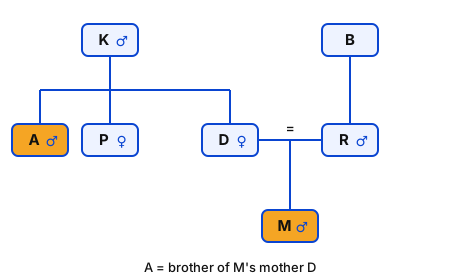
A is the son of K. K is the father of P. P is the sister of D. D is the mother of M. M is the son of R. R is the son of B. How is A related to M?
A, K का पुत्र है। K, P का पिता है। P, D की बहन है। D, M की माता है। M, R का पुत्र है। R, B का पुत्र है। A का M से क्या संबंध है?
  1. AMother's brotherमाता का भाई (मामा)
  2. BFather's brotherपिता का भाई (चाचा)
  3. CMother's fatherमाता का पिता (नाना)
  4. DFather's fatherपिता का पिता (दादा)
Show answer

Concept: Draw the family tree and read A's relation to M.

  1. K is the father of A (son), P and D (P is D's sister) — so A is D's brother.
  2. D is M's mother; R (son of B) is M's father.
  3. A = brother of M's mother.

Trick: Mother's brother = maternal uncle (mama).

Answer: (A) Mother's brother

अवधारणा: वंश-वृक्ष बनाकर M से A का संबंध पढ़ें।

  1. K, A (पुत्र), P और D का पिता है — अतः A, D का भाई है।
  2. D, M की माँ है; R (B का पुत्र) M का पिता है।
  3. A = M की माँ का भाई।

ट्रिक: माँ का भाई = मामा।

उत्तर: (A) माँ का भाई (Mother's brother)

RRB NTPC Undergraduate CBT 1General Intelligence and ReasoningBlood relationsRRB NTPC Undergraduate CBT 1 2024 · 8 Sep Shift 1 →
Q3792.
What should come in place of the question mark (?) in the given series?
44 39 29 14 −6 ?
दी गई श्रृंखला में प्रश्न चिह्न (?) के स्थान पर क्या आना चाहिए?
44 39 29 14 −6 ?
  1. A−31
  2. B−35
  3. C−34
  4. D−32
Show answer

Concept: Look at the differences between terms.

  1. Differences: −5,−10,−15,−20.
  2. Next difference =−25; −6−25=−31.

Trick: Differences are multiples of 5 growing by 5 each time.

Answer: (A) −31

अवधारणा: पदों के अंतर देखें।

  1. अंतर: −5,−10,−15,−20।
  2. अगला अंतर =−25; −6−25=−31।

ट्रिक: अंतर 5 के गुणज हैं जो हर बार 5 से बढ़ते हैं।

उत्तर: (A) −31

RRB NTPC Undergraduate CBT 1General Intelligence and ReasoningNumber seriesRRB NTPC Undergraduate CBT 1 2024 · 8 Sep Shift 1 →
Q3793.
This question is based on the five, three-digit numbers given below.
(Left) 452 561 514 232 294 (Right)
(Example- 697 – First digit = 6, second digit = 9 and third digit = 7)
(NOTE: All operations to be done from left to right.)
What will be the resultant if the first digit of the highest number is added to the third digit of the lowest number?
यह प्रश्न नीचे दी गई पाँच, तीन अंकों वाली संख्याओं पर आधारित है।
(बाएँ) 452 561 514 232 294 (दाएँ)
(उदाहरण- 697 – पहला अंक = 6, दूसरा अंक = 9 और तीसरा अंक = 7)
(ध्यान दें: सभी संक्रियाएँ बाएँ से दाएँ की जानी हैं।)
यदि सबसे बड़ी संख्या के पहले अंक को सबसे छोटी संख्या के तीसरे अंक में जोड़ा जाए, तो परिणाम क्या होगा?
  1. A6
  2. B4
  3. C14
  4. D7
Show answer

Concept: Identify the highest and lowest numbers, then pick the digits asked.

  1. Highest =561 → first digit 5.
  2. Lowest =232 → third digit 2.
  3. 5+2=7.

Trick: Compare by hundreds digit first: 5 > 4 > 2 for the extremes.

Answer: (D) 7

अवधारणा: सबसे बड़ी और सबसे छोटी संख्या पहचानें, फिर माँगे गए अंक लें।

  1. सबसे बड़ी =561 → पहला अंक 5।
  2. सबसे छोटी =232 → तीसरा अंक 2।
  3. 5+2=7।

ट्रिक: पहले सैकड़े का अंक तुलना करें।

उत्तर: (D) 7

RRB NTPC Undergraduate CBT 1General Intelligence and ReasoningThree-digit number operationsRRB NTPC Undergraduate CBT 1 2024 · 8 Sep Shift 1 →
Q3794.
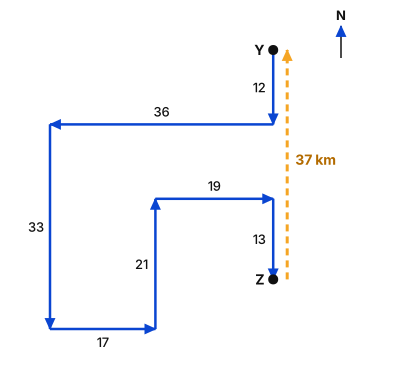
Anil starts from Point Y and drives 12 km towards the south. He then takes a right turn and drives 36 km, then turns left and drives 33 km. He then takes a left turn and drives 17 km. He takes a left turn and drives 21 km. He then turns right and drives 19 km, then turns right and drives 13 km to stop at Point Z. How far (shortest distance) and in which direction should he drive in order to reach Point Y again? (All turns are 90-degree turns only unless specified.)
अनिल बिंदु Y से शुरू करता है और दक्षिण की ओर 12 km गाड़ी चलाता है। फिर वह दाएँ मुड़ता है और 36 km गाड़ी चलाता है, फिर बाएँ मुड़ता है और 33 km गाड़ी चलाता है। फिर वह बाएँ मुड़ता है और 17 km गाड़ी चलाता है। वह बाएँ मुड़ता है और 21 km गाड़ी चलाता है। फिर वह दाएँ मुड़ता है और 19 km गाड़ी चलाता है, फिर दाएँ मुड़ता है और 13 km गाड़ी चलाकर बिंदु Z पर रुक जाता है। बिंदु Y पर पुनः पहुँचने के लिए उसे कितनी दूर (न्यूनतम दूरी) और किस दिशा में गाड़ी चलानी चाहिए? (जब तक निर्दिष्ट न हो, सभी मोड़ केवल 90 डिग्री के मोड़ हैं।)
  1. A42 km towards the northउत्तर की ओर 42 km
  2. B39 km towards the southदक्षिण की ओर 39 km
  3. C41 km towards the southदक्षिण की ओर 41 km
  4. D37 km towards the northउत्तर की ओर 37 km
Show answer

Concept: Use coordinates: east +x, north +y, start Y =(0,0).

  1. 12 S → (0,−12); right (west) 36 → (−36,−12); left (south) 33 → (−36,−45).
  2. Left (east) 17 → (−19,−45); left (north) 21 → (−19,−24).
  3. Right (east) 19 → (0,−24); right (south) 13 → Z =(0,−37).
  4. Y is 37 km north of Z.

Trick: Net east–west: −36+17+19=0; net south: 12+33−21+13=37.

Answer: (D) 37 km towards the north

अवधारणा: निर्देशांक लें: पूर्व +x, उत्तर +y, आरंभ Y =(0,0)।

  1. 12 दक्षिण → (0,−12); दाएँ (पश्चिम) 36 → (−36,−12); बाएँ (दक्षिण) 33 → (−36,−45)।
  2. बाएँ (पूर्व) 17 → (−19,−45); बाएँ (उत्तर) 21 → (−19,−24)।
  3. दाएँ (पूर्व) 19 → (0,−24); दाएँ (दक्षिण) 13 → Z =(0,−37)।
  4. Y, Z से 37 km उत्तर में है।

ट्रिक: शुद्ध पूर्व–पश्चिम: −36+17+19=0; दक्षिण: 12+33−21+13=37।

उत्तर: (D) 37 km उत्तर की ओर (towards the north)

RRB NTPC Undergraduate CBT 1General Intelligence and ReasoningDirection and distanceRRB NTPC Undergraduate CBT 1 2024 · 8 Sep Shift 1 →
Q3795.
Based on the English alphabetical order, three of the following four letter-cluster pairs are alike in a certain way and thus form a group. Which letter-cluster pair DOES NOT belong to that group?
(Note: The odd one out is not based on the number of consonants/vowels or their position in the letter-cluster.)
अंग्रेज़ी वर्णमाला क्रम के आधार पर, निम्नलिखित चार अक्षर-समूह युग्मों में से तीन किसी निश्चित प्रकार से एकसमान हैं और इस प्रकार एक समूह बनाते हैं। कौन-सा अक्षर-समूह युग्म उस समूह से संबंधित नहीं है?
(ध्यान दें: असंगत युग्म, व्यंजनों/स्वरों की संख्या या अक्षर-समूह में उनके स्थान पर आधारित नहीं है।)
  1. ABG-UZ
  2. BKP-DI
  3. CPU-IM
  4. DXC-QV
Show answer

Concept: Check the gap inside each cluster.

  1. BG: B(2)→G(7) +5; UZ: +5. KP: +5; DI: +5. XC: X(24)→C(3) +5 (wrap); QV: +5.
  2. PU: +5 but IM: I(9)→M(13) +4 ⇒ odd one.
  3. (Also, 1st→3rd letter is −7 in BG–UZ, KP–DI, XC–QV.)

Trick: Learn positions: E5, J10, O15, T20, Y25.

Answer: (C) PU-IM

अवधारणा: हर समूह के अंदर अक्षरों का अंतर देखें।

  1. BG: B(2)→G(7) +5; UZ: +5। KP: +5; DI: +5। XC: X(24)→C(3) +5 (घूमकर); QV: +5।
  2. PU: +5 परंतु IM: I(9)→M(13) +4 ⇒ विषम।
  3. (पहले समूह के पहले अक्षर से दूसरे समूह के पहले अक्षर तक −7 भी बाकी तीनों में है।)

ट्रिक: स्थान याद रखें: E5, J10, O15, T20, Y25।

उत्तर: (C) PU-IM

RRB NTPC Undergraduate CBT 1General Intelligence and ReasoningLetter-cluster odd one outRRB NTPC Undergraduate CBT 1 2024 · 8 Sep Shift 1 →
Q3796.
VELG is related to ZZPB in a certain way based on the English alphabetical order. In the same way, DUTW is related to HPXR. To which of the given options is LKBM related, following the same logic?
अंग्रेज़ी वर्णमाला क्रम के आधार पर VELG एक निश्चित प्रकार से ZZPB से संबंधित है। उसी प्रकार, DUTW, HPXR से संबंधित है। समान तर्क का अनुसरण करते हुए, LKBM दिए गए विकल्पों में से किससे संबंधित है?
  1. AREEG
  2. BPFFH
  3. CQDEH
  4. DOEFG
Show answer

Concept: Find the shift for each letter position.

  1. VELG → ZZPB: V+4=Z, E−5=Z, L+4=P, G−5=B.
  2. DUTW → HPXR follows the same +4,−5,+4,−5.
  3. LKBM: L+4=P, K−5=F, B+4=F, M−5=H ⇒ PFFH.

Trick: Alternating +4 and −5 — use wrap-around for E−5 = Z.

Answer: (B) PFFH

अवधारणा: हर अक्षर स्थान पर बदलाव देखें।

  1. VELG → ZZPB: V+4=Z, E−5=Z, L+4=P, G−5=B।
  2. DUTW → HPXR में भी +4,−5,+4,−5।
  3. LKBM: L+4=P, K−5=F, B+4=F, M−5=H ⇒ PFFH।

ट्रिक: बारी-बारी +4 और −5 — E−5 के लिए घूमकर Z।

उत्तर: (B) PFFH

RRB NTPC Undergraduate CBT 1General Intelligence and ReasoningLetter analogyRRB NTPC Undergraduate CBT 1 2024 · 8 Sep Shift 1 →
Q3797.
In the following triads, each group of letters is related to the subsequent one following a certain logic. Select from the given options, the one which follows the same logic. MINT - ITNM - TNIM
​PLUS - LSUP - SULP
निम्नलिखित त्रिकों में, अक्षरों का प्रत्येक समूह एक निश्चित तर्क का अनुसरण करते हुए अगले समूह से संबंधित है। दिए गए विकल्पों में से उसका चयन कीजिए जो समान तर्क का अनुसरण करता है। MINT - ITNM - TNIM
​PLUS - LSUP - SULP
  1. AWANT - AWNT - TANW
  2. BCOIL - OLIC - LIOC
  3. CREST - RSET - TSER
  4. DTOWN - OTWN - NOWT
Show answer

Concept: Find the position rearrangement from word 1 to words 2 and 3.

  1. MINT → ITNM: letters 2, 4, 3, 1. PLUS → LSUP: also 2, 4, 3, 1.
  2. Third word is the first word reversed: MINT → TNIM, PLUS → SULP.
  3. COIL → OLIC (2, 4, 3, 1) and COIL reversed = LIOC ✓.

Trick: Check the easy rule (reverse) for the third word first to eliminate options fast.

Answer: (B) COIL - OLIC - LIOC

अवधारणा: पहले शब्द से दूसरे और तीसरे शब्द तक अक्षरों का स्थान-परिवर्तन खोजें।

  1. MINT → ITNM: अक्षर 2, 4, 3, 1। PLUS → LSUP: भी 2, 4, 3, 1।
  2. तीसरा शब्द पहले शब्द का उल्टा है: MINT → TNIM, PLUS → SULP।
  3. COIL → OLIC (2, 4, 3, 1) और COIL उल्टा = LIOC ✓।

ट्रिक: पहले आसान नियम (उल्टा शब्द) जाँचकर विकल्प जल्दी हटाएँ।

उत्तर: (B) COIL - OLIC - LIOC

RRB NTPC Undergraduate CBT 1General Intelligence and ReasoningLetter-position triadsRRB NTPC Undergraduate CBT 1 2024 · 8 Sep Shift 1 →
Q3798.
Select the pair which follows the same pattern as that followed by the two pairs given below. Both pairs follow the same pattern.
LXK : PVH
BPY : FNV
उस युग्म का चयन कीजिए जो नीचे दिए गए दो युग्मों द्वारा अनुसरित पैटर्न के समान पैटर्न का अनुसरण करता है। दोनों युग्म समान पैटर्न का अनुसरण करते हैं।
LXK : PVH
BPY : FNV
  1. ALBO : PGS
  2. BLHC : PEG
  3. CPNW : TKA
  4. DTTE : XRB
Show answer

Concept: Find the shift for each letter: first, second and third.

  1. LXK → PVH: L+4=P, X−2=V, K−3=H. BPY → FNV: +4,−2,−3 ✓.
  2. TTE → XRB: T+4=X, T−2=R, E−3=B ✓.
  3. Others fail, e.g. LBO → PGS has B+5.

Trick: Pattern +4,−2,−3 — check the middle letter first to reject options quickly.

Answer: (D) TTE : XRB

अवधारणा: हर अक्षर (पहला, दूसरा, तीसरा) का बदलाव देखें।

  1. LXK → PVH: L+4=P, X−2=V, K−3=H। BPY → FNV: +4,−2,−3 ✓।
  2. TTE → XRB: T+4=X, T−2=R, E−3=B ✓।
  3. बाकी विफल, जैसे LBO → PGS में B+5।

ट्रिक: पैटर्न +4,−2,−3 — विकल्प हटाने के लिए पहले बीच का अक्षर जाँचें।

उत्तर: (D) TTE : XRB

RRB NTPC Undergraduate CBT 1General Intelligence and ReasoningLetter-cluster analogyRRB NTPC Undergraduate CBT 1 2024 · 8 Sep Shift 1 →
Q3799.
Refer to the following number and symbol series and answer the question that follows. All numbers are single-digit. Counting to be done from left to right only.
(Left) Ω 2 % 8 & £ 4 * 5 9 ? 6 $ 1 3 # 7 @ (Right)
If all the symbols are dropped from the series, which of the following will be sixth from the right end?
निम्नलिखित संख्या और प्रतीक श्रृंखला को देखिए और उसके बाद दिए गए प्रश्न का उत्तर दीजिए। सभी संख्याएँ एक अंक वाली हैं। गिनती केवल बाएँ से दाएँ की जानी है।
(बाएँ) Ω 2 % 8 & £ 4 * 5 9 ? 6 $ 1 3 # 7 @ (दाएँ)
यदि श्रृंखला से सभी प्रतीक हटा दिए जाएँ, तो दाएँ छोर से छठे स्थान पर निम्नलिखित में से कौन-सा होगा?
  1. A5
  2. B8
  3. C4
  4. D9
Show answer

Concept: Remove all symbols and count from the right.

  1. Digits left: 2 8 4 5 9 6 1 3 7.
  2. From the right: 7(1), 3(2), 1(3), 6(4), 9(5), 5(6).
  3. Sixth from right =5.

Trick: Only digits remain — write them in one line before counting.

Answer: (A) 5

अवधारणा: सभी प्रतीक हटाकर दाएँ से गिनें।

  1. बचे अंक: 2 8 4 5 9 6 1 3 7।
  2. दाएँ से: 7(1), 3(2), 1(3), 6(4), 9(5), 5(6)।
  3. दाएँ से छठा =5।

ट्रिक: केवल अंक बचें — गिनने से पहले उन्हें एक पंक्ति में लिखें।

उत्तर: (A) 5

RRB NTPC Undergraduate CBT 1General Intelligence and ReasoningNumber-symbol seriesRRB NTPC Undergraduate CBT 1 2024 · 8 Sep Shift 1 →
Q3800.
Based on the English alphabetical order, three of the following four letter-cluster pairs are alike in a certain way and thus form a group. Which letter-cluster pair DOES NOT belong to that group?
(Note: The odd one out is not based on the number of consonants/vowels or their position in the letter-cluster.)
अंग्रेज़ी वर्णमाला क्रम के आधार पर, निम्नलिखित चार अक्षर-समूह युग्मों में से तीन किसी निश्चित प्रकार से एकसमान हैं और इस प्रकार एक समूह बनाते हैं। कौन-सा अक्षर-समूह युग्म उस समूह से संबंधित नहीं है?
(ध्यान दें: असंगत युग्म, व्यंजनों/स्वरों की संख्या या अक्षर-समूह में उनके स्थान पर आधारित नहीं है।)
  1. AZC - WX
  2. BKL - HG
  3. CTJ - QE
  4. DOD - KY
Show answer

Concept: Compare first letter → first letter and second letter → second letter across each pair.

  1. ZC – WX: Z→W −3, C→X −5 (wrap).
  2. KL – HG: −3, −5; TJ – QE: −3, −5.
  3. OD – KY: O(15)→K(11) −4 ⇒ odd one.

Trick: Backward wrap: C−5 = X, D−5 = Y.

Answer: (D) OD - KY

अवधारणा: हर युग्म में पहला → पहला और दूसरा → दूसरा अक्षर का अंतर देखें।

  1. ZC – WX: Z→W −3, C→X −5 (घूमकर)।
  2. KL – HG: −3, −5; TJ – QE: −3, −5।
  3. OD – KY: O(15)→K(11) −4 ⇒ विषम।

ट्रिक: पीछे घूमकर: C−5 = X, D−5 = Y।

उत्तर: (D) OD - KY

RRB NTPC Undergraduate CBT 1General Intelligence and ReasoningLetter-cluster odd one outRRB NTPC Undergraduate CBT 1 2024 · 8 Sep Shift 1 →