Question bank

Q&A: practice questions with answers

Search questions on any topic. Filter by exam category, exam, subject and topic, try the question, then open the answer and explanation.

Courses – airGurukul

8,500 questions found.

Q3961.
Find the simple interest (in ₹) on ₹1,200 at an interest rate of 3% per month for 11 months.
₹1,200 पर 3% प्रति माह की ब्याज दर से 11 माह का साधारण ब्याज (₹ में) ज्ञात कीजिए।
  1. A₹53
  2. B₹396
  3. C₹66
  4. D₹33
Show answer

Concept: SI=P×R×T100, with R and T in the same time unit (here months).

  1. P=1200, R=3% per month, T=11 months.
  2. SI=1200×3×11100=12×33=396.

Yaad rakhein: 3% per month =36% per year; 1200×0.36×1112=396 too.

Answer: (B) ₹396

अवधारणा: SI=P×R×T100, जहाँ R और T एक ही इकाई (यहाँ माह) में हों।

  1. P=1200, R=3% प्रति माह, T=11 माह।
  2. SI=1200×3×11100=12×33=396।

याद रखें: 3% प्रति माह =36% प्रति वर्ष; 1200×0.36×1112=396 भी।

उत्तर: (B) ₹396

RRB NTPC Undergraduate CBT 1MathematicsSimple interestRRB NTPC Undergraduate CBT 1 2024 · 8 Aug Shift 2 →
Q3962.
The sum of the squares of two consecutive odd natural numbers is 394. The sum of the numbers is:
दो क्रमागत विषम प्राकृत संख्याओं के वर्गों का योग 394 है। संख्याओं का योग कितना है?
  1. A24
  2. B22
  3. C32
  4. D28
Show answer

Concept: Let the consecutive odd numbers be n and n+2.

  1. n2+(n+2)2=394⇒2n2+4n+4=394⇒n2+2n−195=0.
  2. (n+15)(n−13)=0⇒n=13.
  3. Numbers 13 and 15: 169+225=394 ✓; sum =28.

Trick: 3942=197≈142, so the numbers sit around 14: 13 and 15.

Answer: (D) 28

अवधारणा: मान लें क्रमागत विषम संख्याएँ n और n+2 हैं।

  1. n2+(n+2)2=394⇒2n2+4n+4=394⇒n2+2n−195=0।
  2. (n+15)(n−13)=0⇒n=13।
  3. संख्याएँ 13 व 15: 169+225=394 ✓; योग =28।

ट्रिक: 3942=197≈142, अतः संख्याएँ 14 के आस-पास: 13 और 15।

उत्तर: (D) 28

RRB NTPC Undergraduate CBT 1MathematicsNumber system – squaresRRB NTPC Undergraduate CBT 1 2024 · 8 Aug Shift 2 →
Q3963.
Pipe P can fill 57 part of a tank in 30 hours, and pipe Q can fill 25 part of the same tank in 28 hours. Both P and Q were kept open for 7 hours, then both were closed. Pipe R alone was then opened and it emptied the water in the tank in 8 hours. Pipes P, Q and R together can fill the empty tank in:
पाइप P किसी टंकी के 57 भाग को 30 घंटे में भर सकता है, और पाइप Q उसी टंकी के 25 भाग को 28 घंटे में भर सकता है। P और Q दोनों को 7 घंटे तक खुला रखा गया, फिर दोनों को बंद कर दिया गया। इसके बाद अकेले पाइप R को खोला गया और उसने टंकी का पानी 8 घंटे में खाली कर दिया। पाइप P, Q और R मिलकर खाली टंकी को कितने समय में भर सकते हैं?
  1. A210 hours210 घंटे
  2. B204 hours204 घंटे
  3. C222 hours222 घंटे
  4. D214 hours214 घंटे
Show answer

Concept: Find each pipe's full-tank time, then add rates (emptying pipe negative).

  1. P fills 57 in 30 h → full in 30×75=42 h; Q fills 25 in 28 h → full in 70 h.
  2. In 7 h: 742+770=16+110=415 filled.
  3. R empties 415 in 8 h → full in 8×154=30 h.
  4. Net rate =142+170−130=5+3−7210=1210 → 210 h.

Trick: Take capacity =210 units (LCM of 42, 70, 30): rates 5+3−7=1 unit/h.

Answer: (A) 210 hours

अवधारणा: प्रत्येक पाइप का पूरी टंकी भरने का समय निकालें, फिर दरें जोड़ें (खाली करने वाला ऋणात्मक)।

  1. P, 30 घंटे में 57 भरता है → पूरा 30×75=42 घंटे; Q, 28 घंटे में 25 → पूरा 70 घंटे।
  2. 7 घंटे में: 742+770=16+110=415 भरा।
  3. R, 415 को 8 घंटे में खाली करता है → पूरा 8×154=30 घंटे।
  4. कुल दर =142+170−130=5+3−7210=1210 → 210 घंटे।

ट्रिक: क्षमता =210 इकाई (42, 70, 30 का LCM) लें: दरें 5+3−7=1 इकाई/घंटा।

उत्तर: (A) 210 घंटे

RRB NTPC Undergraduate CBT 1MathematicsPipes and cisternsRRB NTPC Undergraduate CBT 1 2024 · 8 Aug Shift 2 →
Q3964.
A can do a work in 10 days and B can do the same work in 20 days. If they work on it together for 6 days, then what fraction of the work is left?
A किसी कार्य को 10 दिनों में कर सकता है और B उसी कार्य को 20 दिनों में कर सकता है। यदि वे मिलकर उस पर 6 दिनों तक कार्य करते हैं, तो कार्य का कितना भाग शेष रहता है?
  1. A1110
  2. B710
  3. C110
  4. D310
Show answer

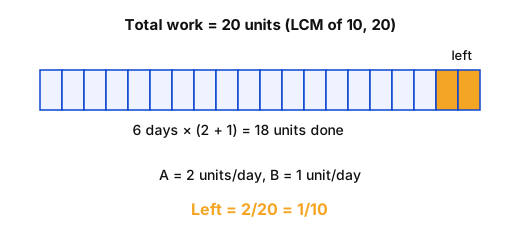
Concept: Take total work = LCM of days; one-day work = units per day.

  1. Total =LCM(10,20)=20 units; A =2, B =1 unit/day.
  2. Together in 6 days: 6×3=18 units.
  3. Left =20−18=2 units =220=110.

Yaad rakhein: Work done =6(110+120)=910; left =110.

Answer: (C) 110

अवधारणा: कुल कार्य = दिनों का LCM लें; एक दिन का कार्य = प्रति दिन इकाइयाँ।

  1. कुल =LCM(10,20)=20 इकाई; A =2, B =1 इकाई/दिन।
  2. 6 दिन में साथ: 6×3=18 इकाई।
  3. शेष =20−18=2 इकाई =220=110।

याद रखें: किया गया कार्य =6(110+120)=910; शेष =110।

उत्तर: (C) 110

RRB NTPC Undergraduate CBT 1MathematicsTime and workRRB NTPC Undergraduate CBT 1 2024 · 8 Aug Shift 2 →
Q3965.
P, Q and R invested a sum in the ratio of 34 : 75 : 6, respectively. If they earned a total profit of ₹3,600 at the end of the year, what is the difference between the shares of Q and R?
P, Q और R ने क्रमशः 34 : 75 : 6 के अनुपात में एक राशि का निवेश किया। यदि वर्ष के अंत में उन्होंने कुल ₹3,600 का लाभ अर्जित किया, तो Q और R के हिस्सों के बीच का अंतर कितना है?
  1. A₹2,109
  2. B₹2,316
  3. C₹2,264
  4. D₹2,160
Show answer

Concept: Profit is divided in the investment ratio; difference of shares = (difference of ratio terms) × one part.

  1. Total ratio =34+75+6=115.
  2. Q − R =75−6=69 parts.
  3. Difference =3600×69115=3600×35=2160.

Trick: 69115=35 – spot the common factor 23.

Answer: (D) ₹2,160

अवधारणा: लाभ निवेश के अनुपात में बँटता है; हिस्सों का अंतर = (अनुपात पदों का अंतर) × एक भाग।

  1. कुल अनुपात =34+75+6=115।
  2. Q − R =75−6=69 भाग।
  3. अंतर =3600×69115=3600×35=2160।

ट्रिक: 69115=35 – उभयनिष्ठ गुणनखंड 23 पहचानें।

उत्तर: (D) ₹2,160

RRB NTPC Undergraduate CBT 1MathematicsPartnership – ratioRRB NTPC Undergraduate CBT 1 2024 · 8 Aug Shift 2 →
Q3966.
Seven times the present age of P exceeds the present age of Q by 46 years. After 8 years, six times Q’s age will be 24 years less than six times P’s age at that time. What is the present age (in years) of Q?
P की वर्तमान आयु का सात गुना, Q की वर्तमान आयु से 46 वर्ष अधिक है। 8 वर्ष बाद, Q की आयु का छह गुना, उस समय P की आयु के छह गुने से 24 वर्ष कम होगा। Q की वर्तमान आयु (वर्षों में) कितनी है?
  1. A11
  2. B12
  3. C5
  4. D3
Show answer

Concept: Form two equations from the statements and solve.

  1. 7P−Q=46 … (i)
  2. After 8 years: 6(Q+8)=6(P+8)−24⇒Q=P−4 … (ii)
  3. From (i): 7P−P+4=46⇒P=7, so Q=3.

Yaad rakhein: Check: 7×7−3=46 ✓; after 8 yrs 6×11=66, 6×15−24=66 ✓.

Answer: (D) 3

अवधारणा: कथनों से दो समीकरण बनाकर हल करें।

  1. 7P−Q=46 … (i)
  2. 8 वर्ष बाद: 6(Q+8)=6(P+8)−24⇒Q=P−4 … (ii)
  3. (i) से: 7P−P+4=46⇒P=7, अतः Q=3।

याद रखें: जाँच: 7×7−3=46 ✓; 8 वर्ष बाद 6×11=66, 6×15−24=66 ✓।

उत्तर: (D) 3

RRB NTPC Undergraduate CBT 1MathematicsProblems on agesRRB NTPC Undergraduate CBT 1 2024 · 8 Aug Shift 2 →
Q3967.
The area of a triangle is 1080 cm2 and its sides are in the ratio 5 : 12 : 13. The perimeter of the triangle is:
एक त्रिभुज का क्षेत्रफल 1080 cm2 है और उसकी भुजाएँ 5 : 12 : 13 के अनुपात में हैं। त्रिभुज का परिमाप कितना है?
  1. A210 cm
  2. B180 cm
  3. C150 cm
  4. D120 cm
Show answer

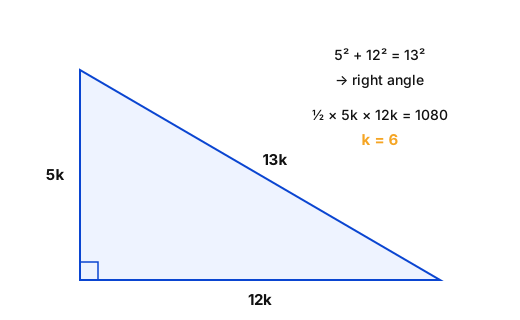
Concept: 5:12:13 is a Pythagorean triplet, so the triangle is right-angled; area =12×base×height.

  1. Sides 5k,12k,13k; (5k)2+(12k)2=(13k)2.
  2. Area =12×5k×12k=30k2=1080⇒k2=36, k=6.
  3. Perimeter =30k=180cm.

Yaad rakhein: Triplets 3-4-5, 5-12-13, 8-15-17, 7-24-25 → right triangle, use the two legs.

Answer: (B) 180 cm

अवधारणा: 5:12:13 पाइथागोरस त्रिक है, अतः त्रिभुज समकोण है; क्षेत्रफल =12×आधार×ऊँचाई।

  1. भुजाएँ 5k,12k,13k; (5k)2+(12k)2=(13k)2।
  2. क्षेत्रफल =12×5k×12k=30k2=1080⇒k2=36, k=6।
  3. परिमाप =30k=180cm।

याद रखें: त्रिक 3-4-5, 5-12-13, 8-15-17, 7-24-25 → समकोण त्रिभुज, दो लंब भुजाएँ लें।

उत्तर: (B) 180 cm

RRB NTPC Undergraduate CBT 1MathematicsMensuration – triangleRRB NTPC Undergraduate CBT 1 2024 · 8 Aug Shift 2 →
Q3968.
Find the simple interest (in ₹) on ₹4,000 at 6.75% per annum rate of interest deposited on 22 February 2024 and withdrawn on 23 April 2024.
22 फ़रवरी 2024 को जमा किए गए और 23 अप्रैल 2024 को निकाले गए ₹4,000 पर 6.75% वार्षिक ब्याज दर से साधारण ब्याज (₹ में) ज्ञात कीजिए।
  1. A₹44
  2. B₹43
  3. C₹46
  4. D₹45
Show answer

Concept: Count days excluding the deposit day (include withdrawal day); 2024 is a leap year (366 days).

  1. Days: Feb (23–29) =7, March =31, April =23 → 61 days.
  2. SI=4000×6.75×61100×366=270×61366.
  3. =270×16=45.

Yaad rakhein: 366=6×61, so 61 days of a leap year =16 year.

Answer: (D) ₹45

अवधारणा: जमा वाले दिन को छोड़कर (निकासी दिन गिनें) दिन गिनें; 2024 लीप वर्ष है (366 दिन)।

  1. दिन: फरवरी (23–29) =7, मार्च =31, अप्रैल =23 → 61 दिन।
  2. SI=4000×6.75×61100×366=270×61366।
  3. =270×16=45।

याद रखें: 366=6×61, अतः लीप वर्ष के 61 दिन =16 वर्ष।

उत्तर: (D) ₹45

RRB NTPC Undergraduate CBT 1MathematicsSimple interest – daysRRB NTPC Undergraduate CBT 1 2024 · 8 Aug Shift 2 →
Q3969.
Simplify the given expression.
x(3x − 5) + 5(x2 − 3) + 16
दिए गए व्यंजक को सरल कीजिए।
x(3x − 5) + 5(x2 − 3) + 16
  1. A8x2−5x−1
  2. B8x2−5x+1
  3. C8x2−5x−1
  4. D−8x2−5x−1
Show answer

Concept: Expand the brackets and combine like terms.

  1. x(3x−5)=3x2−5x; 5(x2−3)=5x2−15.
  2. Sum: 3x2−5x+5x2−15+16.
  3. =8x2−5x+1.

Yaad rakhein: Put x=0: expression =−15+16=1 → constant term must be +1.

Answer: (B) 8x2−5x+1

अवधारणा: कोष्ठक खोलें और समान पदों को जोड़ें।

  1. x(3x−5)=3x2−5x; 5(x2−3)=5x2−15।
  2. योग: 3x2−5x+5x2−15+16।
  3. =8x2−5x+1।

याद रखें: x=0 रखें: व्यंजक =−15+16=1 → अचर पद +1 होगा।

उत्तर: (B) 8x2−5x+1

RRB NTPC Undergraduate CBT 1MathematicsAlgebraic simplificationRRB NTPC Undergraduate CBT 1 2024 · 8 Aug Shift 2 →
Q3970.
What smallest number should be added to 91673 so that the sum is completely divisible by 88?
91673 में कौन-सी सबसे छोटी संख्या जोड़ी जानी चाहिए ताकि योगफल 88 से पूर्णतः विभाज्य हो?
  1. A24
  2. B21
  3. C23
  4. D26
Show answer

Concept: Number to add = divisor − remainder.

  1. 91673÷88: 88×1041=91608, remainder =65.
  2. Add 88−65=23 → 91696=88×1042.

Yaad rakhein: Least number to subtract = remainder; to add = divisor − remainder.

Answer: (C) 23

अवधारणा: जोड़ी जाने वाली संख्या = भाजक − शेषफल।

  1. 91673÷88: 88×1041=91608, शेषफल =65।
  2. 88−65=23 जोड़ें → 91696=88×1042।

याद रखें: घटाने हेतु न्यूनतम = शेषफल; जोड़ने हेतु = भाजक − शेषफल।

उत्तर: (C) 23

RRB NTPC Undergraduate CBT 1MathematicsDivisibility – least number to addRRB NTPC Undergraduate CBT 1 2024 · 8 Aug Shift 2 →
Q3971.
If ‘+’ means ‘subtraction’, ‘−’ means ‘multiplication’, ‘×’ means ‘division’ and ‘÷’ means ‘addition’, then what will come in place of the question mark (?) in the following equation?
12 + 105 × 3 ÷ 14 − 3 = ?
यदि ‘+’ का अर्थ ‘घटाना’, ‘−’ का अर्थ ‘गुणा’, ‘×’ का अर्थ ‘भाग’ और ‘÷’ का अर्थ ‘जोड़ना’ है, तो निम्नलिखित समीकरण में प्रश्न चिह्न (?) के स्थान पर क्या आएगा?
12 + 105 × 3 ÷ 14 − 3 = ?
  1. A30
  2. B19
  3. C23
  4. D27
Show answer

Concept: Replace each symbol by its meaning, then apply BODMAS.

  1. 12+105×3÷14−3 becomes 12−105÷3+14×3.
  2. =12−35+42.
  3. =19.

Yaad rakhein: Swap symbols first on paper, then solve – never solve mentally while swapping.

Answer: (B) 19

अवधारणा: प्रत्येक चिह्न को उसके अर्थ से बदलें, फिर BODMAS लगाएँ।

  1. 12+105×3÷14−3 बन जाता है 12−105÷3+14×3।
  2. =12−35+42।
  3. =19।

याद रखें: पहले कागज़ पर चिह्न बदलें, फिर हल करें।

उत्तर: (B) 19

RRB NTPC Undergraduate CBT 1General Intelligence and ReasoningMathematical operationsRRB NTPC Undergraduate CBT 1 2024 · 8 Aug Shift 2 →
Q3972.
In a certain code language, ‘PEST’ is coded as ‘6324’ and ‘PENS’ is coded as ‘8634’. What is the code for ‘N’ in the given code language?
एक निश्चित कूट भाषा में, ‘PEST’ को ‘6324’ लिखा जाता है और ‘PENS’ को ‘8634’ लिखा जाता है। उस कूट भाषा में ‘N’ के लिए क्या कूट है?
  1. A4
  2. B8
  3. C6
  4. D3
Show answer

Concept: Letters common to both words share the common digits; the leftover letter takes the leftover digit.

  1. PEST → 6324, PENS → 8634.
  2. Common letters P, E, S ↔ common digits 6, 3, 4.
  3. Left: T ↔ 2 and N ↔ 8.

Yaad rakhein: Compare only the non-common letter and digit.

Answer: (B) 8

अवधारणा: दोनों शब्दों के उभयनिष्ठ अक्षरों के कोड भी उभयनिष्ठ अंक होते हैं; बचे अक्षर का कोड बचा अंक।

  1. PEST → 6324, PENS → 8634।
  2. उभयनिष्ठ अक्षर P, E, S ↔ उभयनिष्ठ अंक 6, 3, 4।
  3. शेष: T ↔ 2 तथा N ↔ 8।

याद रखें: केवल गैर-उभयनिष्ठ अक्षर और अंक मिलाएँ।

उत्तर: (B) 8

RRB NTPC Undergraduate CBT 1General Intelligence and ReasoningCoding-decodingRRB NTPC Undergraduate CBT 1 2024 · 8 Aug Shift 2 →
Q3973.
LGEI is related to RMKO in a certain way based on the English alphabetical order. In the same way, JECG is related to PKIM. To which of the given options is HCAE related, following the same logic?
अंग्रेज़ी वर्णमाला क्रम के आधार पर LGEI एक निश्चित प्रकार से RMKO से संबंधित है। उसी प्रकार, JECG, PKIM से संबंधित है। समान तर्क का अनुसरण करते हुए, HCAE दिए गए विकल्पों में से किससे संबंधित है?
  1. AINKG
  2. BNIKG
  3. CINGK
  4. DNIGK
Show answer

Concept: Find the shift of each letter position.

  1. L→R, G→M, E→K, I→O: each +6.
  2. J→P, E→K, C→I, G→M: each +6 ✓.
  3. H+6 = N, C+6 = I, A+6 = G, E+6 = K → NIGK.

Yaad rakhein: Position values: A1, E5, J10, O15, T20, Y25 (EJOTY).

Answer: (D) NIGK

अवधारणा: प्रत्येक अक्षर का स्थानांतरण ज्ञात करें।

  1. L→R, G→M, E→K, I→O: प्रत्येक +6।
  2. J→P, E→K, C→I, G→M: प्रत्येक +6 ✓।
  3. H+6 = N, C+6 = I, A+6 = G, E+6 = K → NIGK।

याद रखें: स्थानीय मान: A1, E5, J10, O15, T20, Y25 (EJOTY)।

उत्तर: (D) NIGK

RRB NTPC Undergraduate CBT 1General Intelligence and ReasoningLetter analogyRRB NTPC Undergraduate CBT 1 2024 · 8 Aug Shift 2 →
Q3974.
Based on the English alphabetical order, three of the following four letter-clusters are alike in a certain way and thus form a group. Which letter-cluster DOES NOT belong to that group?
(Note: The odd one out is not based on the number of consonants/vowels or their position in the letter-cluster.)
अंग्रेज़ी वर्णमाला क्रम के आधार पर, निम्नलिखित चार अक्षर-समूहों में से तीन किसी निश्चित प्रकार से एकसमान हैं और इस प्रकार एक समूह बनाते हैं। कौन-सा अक्षर-समूह उस समूह से संबंधित नहीं है?
(ध्यान दें: असंगत अक्षर-समूह, उस अक्षर-समूह में व्यंजनों/स्वरों की संख्या या उनकी स्थिति पर आधारित नहीं है।)
  1. ANJL
  2. BLHJ
  3. CTPS
  4. DQMO
Show answer

Concept: Check the gaps between consecutive letters.

  1. NJL: N−4 = J, J+2 = L.
  2. LHJ: −4, +2; QMO: −4, +2.
  3. TPS: T−4 = P, but P+3 = S → odd.

Yaad rakhein: Write alphabet positions: T20, P16, S19.

Answer: (C) TPS

अवधारणा: क्रमागत अक्षरों के बीच का अंतर जाँचें।

  1. NJL: N−4 = J, J+2 = L।
  2. LHJ: −4, +2; QMO: −4, +2।
  3. TPS: T−4 = P, पर P+3 = S → विषम।

याद रखें: स्थानीय मान लिखें: T20, P16, S19।

उत्तर: (C) TPS

RRB NTPC Undergraduate CBT 1General Intelligence and ReasoningOdd one out – lettersRRB NTPC Undergraduate CBT 1 2024 · 8 Aug Shift 2 →
Q3975.
What should come in place of the question mark (?) in the given series?
670 669 661 634 570 ?
दी गई शृंखला में प्रश्न चिह्न (?) के स्थान पर क्या आना चाहिए?
670 669 661 634 570 ?
  1. A441
  2. B445
  3. C440
  4. D447
Show answer

Concept: Differences are cubes of natural numbers.

  1. 670−13=669, 669−23=661, 661−33=634, 634−43=570.
  2. Next: 570−53=570−125=445.

Yaad rakhein: Differences 1, 8, 27, 64 … are n3.

Answer: (B) 445

अवधारणा: अंतर प्राकृत संख्याओं के घन हैं।

  1. 670−13=669, 669−23=661, 661−33=634, 634−43=570।
  2. अगला: 570−53=570−125=445।

याद रखें: अंतर 1, 8, 27, 64 … n3 हैं।

उत्तर: (B) 445

RRB NTPC Undergraduate CBT 1General Intelligence and ReasoningNumber series – cubesRRB NTPC Undergraduate CBT 1 2024 · 8 Aug Shift 2 →
Q3976.
Read the given statements and conclusions carefully. Assuming that the information given in the statements is true, even if it appears to be at variance with commonly known facts, decide which of the given conclusion(s) logically follow(s) from the statements.
Statements:
Some woods are chisels.
Some chisels are graphs.
Conclusions:
(I) Some woods are graphs.
(II) All graphs are chisels.
दिए गए कथनों और निष्कर्षों को ध्यानपूर्वक पढ़िए। यह मानते हुए कि कथनों में दी गई जानकारी सत्य है, भले ही वह सामान्यतः ज्ञात तथ्यों से भिन्न प्रतीत होती हो, निर्णय लीजिए कि दिए गए निष्कर्षों में से कौन-सा/से निष्कर्ष तार्किक रूप से कथनों का अनुसरण करता है/करते हैं।
कथन:
कुछ लकड़ियाँ, छेनियाँ हैं।
कुछ छेनियाँ, ग्राफ़ हैं।
निष्कर्ष:
(I) कुछ लकड़ियाँ, ग्राफ़ हैं।
(II) सभी ग्राफ़, छेनियाँ हैं।
  1. ABoth conclusions (I) and (II) follow.निष्कर्ष (I) और (II) दोनों अनुसरण करते हैं।
  2. BOnly conclusion (I) follows.केवल निष्कर्ष (I) अनुसरण करता है।
  3. COnly conclusion (II) follows.केवल निष्कर्ष (II) अनुसरण करता है।
  4. DNeither conclusion (I) nor (II) follows.न तो निष्कर्ष (I) और न ही (II) अनुसरण करता है।
Show answer

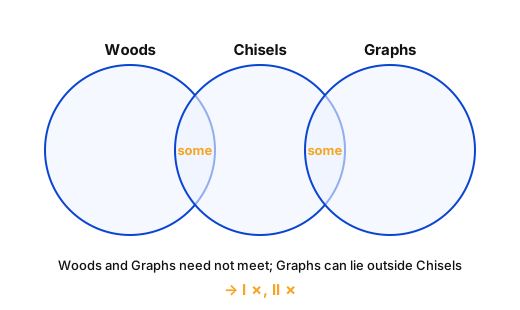
Concept: Two 'some' statements give no definite relation between the end terms.

  1. Some woods are chisels; some chisels are graphs – woods and graphs may not overlap → I does not follow.
  2. 'Some chisels are graphs' cannot become 'All graphs are chisels' → II does not follow.

Yaad rakhein: Some + Some = no conclusion.

Answer: (D) Neither conclusion (I) nor (II) follows.

अवधारणा: दो 'कुछ' कथनों से अंतिम पदों के बीच कोई निश्चित संबंध नहीं बनता।

  1. कुछ लकड़ियाँ छेनी हैं; कुछ छेनी ग्राफ हैं – लकड़ी व ग्राफ का मिलना आवश्यक नहीं → I अनुसरण नहीं करता।
  2. 'कुछ छेनी ग्राफ हैं' से 'सभी ग्राफ छेनी हैं' नहीं निकलता → II अनुसरण नहीं करता।

याद रखें: कुछ + कुछ = कोई निष्कर्ष नहीं।

उत्तर: (D) न तो (I) न ही (II) अनुसरण करता है।

RRB NTPC Undergraduate CBT 1General Intelligence and ReasoningSyllogismRRB NTPC Undergraduate CBT 1 2024 · 8 Aug Shift 2 →
Q3977.
Read the given statements and conclusions carefully. You have to take the given statements to be true even if they seem to be at variance from commonly known facts. You have to decide which conclusion(s) logically follow(s) from the given statements Statements:
Some nuts are berries.
All fruits are berries.
Conclusions (I): Some nuts are fruits.
Conclusions (II): All berries are fruits.
दिए गए कथनों और निष्कर्षों को ध्यानपूर्वक पढ़िए। आपको दिए गए कथनों को सत्य मानना है, भले ही वे सामान्यतः ज्ञात तथ्यों से भिन्न प्रतीत होते हों। आपको निर्णय लेना है कि कौन-सा/से निष्कर्ष तार्किक रूप से दिए गए कथनों का अनुसरण करता है/करते हैं। कथन:
कुछ मेवे, बेरी हैं।
सभी फल, बेरी हैं।
निष्कर्ष (I): कुछ मेवे, फल हैं।
निष्कर्ष (II): सभी बेरी, फल हैं।
  1. AOnly conclusion (I) follows.केवल निष्कर्ष (I) अनुसरण करता है।
  2. BBoth conclusions (I) and (II) follow.निष्कर्ष (I) और (II) दोनों अनुसरण करते हैं।
  3. CNeither conclusion (I) nor (II) follows.न तो निष्कर्ष (I) और न ही (II) अनुसरण करता है।
  4. DOnly conclusion (II) follows.केवल निष्कर्ष (II) अनुसरण करता है।
Show answer

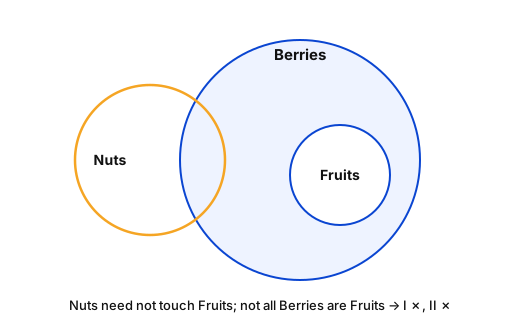
Concept: Draw the least-overlap diagram; a conclusion follows only if it is true in every possible diagram.

  1. All fruits are berries; some nuts are berries – those nuts may be berries that are not fruits → I does not follow.
  2. 'All fruits are berries' does not mean all berries are fruits → II does not follow.

Yaad rakhein: 'All A are B' never reverses to 'All B are A'.

Answer: (C) Neither conclusion (I) nor (II) follows.

अवधारणा: न्यूनतम-संबंध वाला चित्र बनाएँ; निष्कर्ष तभी सही है जब हर संभव चित्र में सत्य हो।

  1. सभी फल बेरी हैं; कुछ नट बेरी हैं – ये नट वे बेरी हो सकते हैं जो फल नहीं → I अनुसरण नहीं करता।
  2. 'सभी फल बेरी हैं' का अर्थ 'सभी बेरी फल हैं' नहीं → II अनुसरण नहीं करता।

याद रखें: 'सभी A, B हैं' को उलटकर 'सभी B, A हैं' नहीं कह सकते।

उत्तर: (C) न तो (I) न ही (II) अनुसरण करता है।

RRB NTPC Undergraduate CBT 1General Intelligence and ReasoningSyllogismRRB NTPC Undergraduate CBT 1 2024 · 8 Aug Shift 2 →
Q3978.
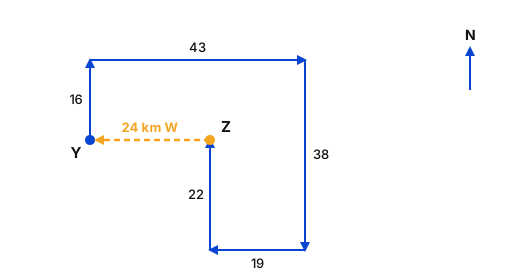
Binoy starts from Point Y and drives 16 km towards the north. He then takes a right turn and drives 43 km, then turns right and drives 38 km. He then takes a right turn and drives 19 km. He takes a final right turn, drives 22 km and stops at Point Z. How far (shortest distance) and in which direction should he drive in order to reach Point Y again? (All turns are 90-degree turns only unless specified.)
बिनॉय बिंदु Y से चलना शुरू करता है और उत्तर की ओर 16 km गाड़ी चलाता है। फिर वह दाएँ मुड़ता है और 43 km गाड़ी चलाता है, फिर दाएँ मुड़ता है और 38 km गाड़ी चलाता है। फिर वह दाएँ मुड़ता है और 19 km गाड़ी चलाता है। वह अंतिम बार दाएँ मुड़ता है, 22 km गाड़ी चलाता है और बिंदु Z पर रुक जाता है। फिर से बिंदु Y पर पहुँचने के लिए उसे कितनी दूरी (न्यूनतम दूरी) तक और किस दिशा में गाड़ी चलानी चाहिए? (जब तक निर्दिष्ट न किया जाए, सभी मोड़ केवल 90 डिग्री के मोड़ हैं।)
  1. A31 km towards the southदक्षिण की ओर 31 km
  2. B24 km towards the westपश्चिम की ओर 24 km
  3. C29 km towards the eastपूर्व की ओर 29 km
  4. D22 km towards the eastपूर्व की ओर 22 km
Show answer

Concept: Track net north–south and east–west displacement.

  1. N 16, then right → E 43, right → S 38, right → W 19, right → N 22.
  2. North–south: 16−38+22=0.
  3. East–west: 43−19=24 km east of Y.
  4. So Z is 24 km east of Y → drive 24 km towards the west.

Yaad rakhein: Four right turns from north: E, S, W, N.

Answer: (B) 24 km towards the west

अवधारणा: उत्तर–दक्षिण और पूर्व–पश्चिम का शुद्ध विस्थापन निकालें।

  1. उत्तर 16, दाएँ → पूर्व 43, दाएँ → दक्षिण 38, दाएँ → पश्चिम 19, दाएँ → उत्तर 22।
  2. उत्तर–दक्षिण: 16−38+22=0।
  3. पूर्व–पश्चिम: 43−19=24 km, Y के पूर्व में।
  4. अतः Z, Y से 24 km पूर्व → पश्चिम की ओर 24 km चलना होगा।

याद रखें: उत्तर से चार बार दाएँ: पूर्व, दक्षिण, पश्चिम, उत्तर।

उत्तर: (B) पश्चिम की ओर 24 km

RRB NTPC Undergraduate CBT 1General Intelligence and ReasoningDirection and distanceRRB NTPC Undergraduate CBT 1 2024 · 8 Aug Shift 2 →
Q3979.
In a certain code language, ‘GUNS’ is coded as ‘7642’ and ‘STUN’ is coded as ‘2364’. What is the code for ‘T’ in the given code language?
एक निश्चित कूट भाषा में, ‘GUNS’ को ‘7642’ लिखा जाता है और ‘STUN’ को ‘2364’ लिखा जाता है। उस कूट भाषा में ‘T’ के लिए क्या कूट है?
  1. A4
  2. B3
  3. C2
  4. D6
Show answer

Concept: Common letters share common digits; the leftover letter gets the leftover digit.

  1. GUNS → 7642, STUN → 2364.
  2. Common S, U, N ↔ common digits 2, 6, 4.
  3. Left: G ↔ 7 and T ↔ 3.

Yaad rakhein: Strike out common digits; what remains in the second code is T.

Answer: (B) 3

अवधारणा: उभयनिष्ठ अक्षरों के कोड उभयनिष्ठ अंक; बचे अक्षर का कोड बचा अंक।

  1. GUNS → 7642, STUN → 2364।
  2. उभयनिष्ठ S, U, N ↔ अंक 2, 6, 4।
  3. शेष: G ↔ 7 तथा T ↔ 3।

याद रखें: उभयनिष्ठ अंक काट दें; दूसरे कोड में बचा अंक T है।

उत्तर: (B) 3

RRB NTPC Undergraduate CBT 1General Intelligence and ReasoningCoding-decodingRRB NTPC Undergraduate CBT 1 2024 · 8 Aug Shift 2 →
Q3980.
DUMB is related to TMCT in a certain way based on the English alphabetical order. In the same way, POYV is related to FGON. To which of the given options is LQUX related, following the same logic?
अंग्रेज़ी वर्णमाला क्रम के आधार पर DUMB एक निश्चित प्रकार से TMCT से संबंधित है। उसी प्रकार, POYV, FGON से संबंधित है। समान तर्क का अनुसरण करते हुए, LQUX दिए गए विकल्पों में से किससे संबंधित है?
  1. ABIPL
  2. BBPKI
  3. CBIPK
  4. DBIKP
Show answer

Concept: Find the backward shift of each letter (wrap around after A).

  1. DUMB→TMCT: D−10 = T, U−8 = M, M−10 = C, B−8 = T.
  2. POYV→FGON: P−10 = F, O−8 = G, Y−10 = O, V−8 = N ✓.
  3. LQUX: L−10 = B, Q−8 = I, U−10 = K, X−8 = P → BIKP.

Yaad rakhein: Pattern −10,−8,−10,−8; −10 is the same as +16.

Answer: (D) BIKP

अवधारणा: प्रत्येक अक्षर का पीछे की ओर स्थानांतरण निकालें (A के बाद Z से घूमें)।

  1. DUMB→TMCT: D−10 = T, U−8 = M, M−10 = C, B−8 = T।
  2. POYV→FGON: P−10 = F, O−8 = G, Y−10 = O, V−8 = N ✓।
  3. LQUX: L−10 = B, Q−8 = I, U−10 = K, X−8 = P → BIKP।

याद रखें: पैटर्न −10,−8,−10,−8; −10 और +16 समान हैं।

उत्तर: (D) BIKP

RRB NTPC Undergraduate CBT 1General Intelligence and ReasoningLetter analogyRRB NTPC Undergraduate CBT 1 2024 · 8 Aug Shift 2 →