Question bank

Q&A: practice questions with answers

Search questions on any topic. Filter by exam category, exam, subject and topic, try the question, then open the answer and explanation.

Courses – airGurukul

8,495 questions found.

Q5141.
In △ABC, BD ⟂ AC at D and ∠DBC = 72°. E is a point on BC such that ∠CAE = 56°. What is the measure of ∠AEB?
△ABC में, BD ⟂ AC, बिंदु D पर है और ∠DBC = 72° है। E, BC पर एक ऐसा बिंदु है कि ∠CAE = 56° है। ∠AEB की माप कितनी है?
  1. A69°
  2. B65°
  3. C71°
  4. D74°
Show answer

Concept: The angles of a triangle add up to 180∘; an exterior angle equals the sum of the two opposite interior angles.
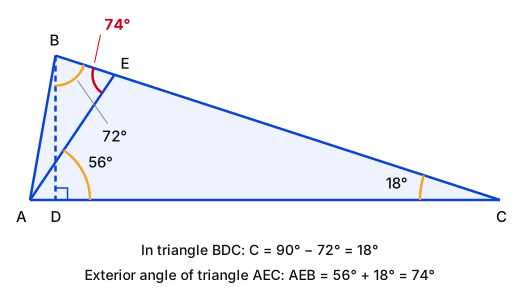
  1. In right △BDC (∠BDC=90∘): ∠C=180∘−90∘−72∘=18∘.
  2. In △AEC: ∠EAC=56∘ and ∠ECA=18∘.
  3. ∠AEB is the exterior angle of △AEC at E (since B, E, C are collinear).
  4. ∠AEB=56∘+18∘=74∘.

Trick: ∠AEB=∠CAE+(90∘−∠DBC)=56∘+18∘.

Answer: (D) 74∘

अवधारणा: त्रिभुज के कोणों का योग 180∘ होता है; बहिष्कोण दो सम्मुख अंतःकोणों के योग के बराबर होता है।

  1. समकोण △BDC (∠BDC=90∘) में: ∠C=180∘−90∘−72∘=18∘।
  2. △AEC में: ∠EAC=56∘ और ∠ECA=18∘।
  3. B, E, C एक रेखा पर हैं, अतः ∠AEB, △AEC का E पर बहिष्कोण है।
  4. ∠AEB=56∘+18∘=74∘।

ट्रिक: ∠AEB=∠CAE+(90∘−∠DBC)=56∘+18∘।

उत्तर: (D) 74∘

RRB NTPC Undergraduate CBT 1MathematicsTriangles – AnglesRRB NTPC Undergraduate CBT 1 2024 · 2 Sep Shift 2 →
Q5142.
The product of two consecutive natural numbers is 240. The greater of the two numbers is:
दो क्रमागत प्राकृत संख्याओं का गुणनफल 240 है। दोनों संख्याओं में से बड़ी संख्या है:
  1. A35
  2. B23
  3. C19
  4. D16
Show answer

Concept: If two consecutive numbers multiply to N, they lie just around N.

  1. Let the numbers be n and n+1: n(n+1)=240.
  2. 240≈15.5, so try 15×16=240. ✓
  3. (Or n2+n−240=0⇒(n+16)(n−15)=0⇒n=15.)
  4. Greater number =16.

Trick: Check options: only 16×15=240; 19×18, 23×22 are far bigger.

Answer: (D) 16

अवधारणा: दो क्रमागत संख्याओं का गुणनफल N हो तो वे N के आसपास होती हैं।

  1. संख्याएँ n और n+1 मानें: n(n+1)=240।
  2. 240≈15.5, अतः 15×16=240 ✓।
  3. (या n2+n−240=0⇒(n+16)(n−15)=0⇒n=15।)
  4. बड़ी संख्या =16।

ट्रिक: विकल्प जाँचें: केवल 16×15=240; 19×18, 23×22 बहुत बड़े हैं।

उत्तर: (D) 16

RRB NTPC Undergraduate CBT 1MathematicsNumber SystemRRB NTPC Undergraduate CBT 1 2024 · 2 Sep Shift 2 →
Q5143.
The simple interest on a certain sum for 723 years at the rate of 5.4% per annum is ₹4,347.
What will be the amount payable on the same sum at the rate of 7.5% per annum simple interest in 445 years?
किसी निश्चित धनराशि पर 5.4% वार्षिक दर से 723 वर्षों का साधारण ब्याज ₹4,347 है।
उसी धनराशि पर 7.5% वार्षिक साधारण ब्याज की दर से 445 वर्षों में देय मिश्रधन कितना होगा?
  1. A₹14,282
  2. B₹14,280
  3. C₹14,273
  4. D₹14,272
Show answer

Concept: SI=P×R×T100 and Amount=P+SI.

  1. 723=233 years: 4347=P×5.4×233×100=P×0.414.
  2. P=43470.414=₹10500.
  3. New SI at 7.5% for 445=4.8 years: 10500×7.5×4.8100=₹3780.
  4. Amount =10500+3780=₹14280.

Trick: R×T first: 5.4×233=41.4% of P is ₹4347; then 7.5×4.8=36%, so amount =136% of 10500.

Answer: (B) ₹14,280

अवधारणा: SI=P×R×T100 तथा मिश्रधन=P+SI।

  1. 723=233 वर्ष: 4347=P×5.4×233×100=P×0.414।
  2. P=43470.414=₹10500।
  3. 7.5% पर 445=4.8 वर्ष का नया SI: 10500×7.5×4.8100=₹3780।
  4. मिश्रधन =10500+3780=₹14280।

ट्रिक: पहले R×T: 5.4×233=41.4% = ₹4347; फिर 7.5×4.8=36%, अतः मिश्रधन =10500 का 136%।

उत्तर: (B) ₹14,280

RRB NTPC Undergraduate CBT 1MathematicsSimple InterestRRB NTPC Undergraduate CBT 1 2024 · 2 Sep Shift 2 →
Q5144.
Find the mean proportional between 26 and 104.
26 और 104 का मध्यानुपाती ज्ञात कीजिए।
  1. A53
  2. B52
  3. C51
  4. D49
Show answer

Concept: The mean proportional x between a and b satisfies a:x=x:b, so x=ab.

  1. x=26×104.
  2. 104=4×26, so 26×104=4×262.
  3. x=4×262=2×26=52.

Trick: When b=4a, mean proportional =2a.

Answer: (B) 52

अवधारणा: a और b का मध्यानुपाती x हो तो a:x=x:b, अतः x=ab।

  1. x=26×104।
  2. 104=4×26, अतः 26×104=4×262।
  3. x=4×262=2×26=52।

ट्रिक: जब b=4a हो, मध्यानुपाती =2a।

उत्तर: (B) 52

RRB NTPC Undergraduate CBT 1MathematicsMean ProportionalRRB NTPC Undergraduate CBT 1 2024 · 2 Sep Shift 2 →
Q5145.
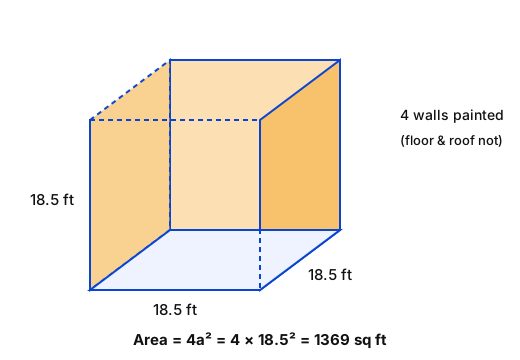
Mahita is painting the four walls of her study room, which is shaped like a cube with a side length of 18.5 feet. What is the total area she needs to paint (in square feet)?
महिता अपने अध्ययन कक्ष की चारों दीवारों को पेंट कर रही है, जिसका आकार 18.5 फीट भुजा वाले एक घन के समान है। उसे कुल कितना क्षेत्रफल (वर्ग फीट में) पेंट करना होगा?
  1. A1385
  2. B1358
  3. C1396
  4. D1369
Show answer

Concept: Area of four walls of a room =2h(l+b); for a cube with side a it becomes 4a2 (floor and ceiling are not painted).

  1. Side a=18.5ft.
  2. a2=18.52=342.25ft2.
  3. Four walls =4×342.25=1369ft2.

Trick: 4a2=(2a)2=372=1369.

Answer: (D) 1369

अवधारणा: कमरे की चार दीवारों का क्षेत्रफल =2h(l+b); भुजा a वाले घन के लिए यह 4a2 है (फ़र्श और छत नहीं रंगी जातीं)।

  1. भुजा a=18.5ft।
  2. a2=18.52=342.25ft2।
  3. चार दीवारें =4×342.25=1369ft2।

ट्रिक: 4a2=(2a)2=372=1369।

उत्तर: (D) 1369

RRB NTPC Undergraduate CBT 1MathematicsMensuration – CubeRRB NTPC Undergraduate CBT 1 2024 · 2 Sep Shift 2 →
Q5146.
The income of Raman is ₹44,200. He saves 31% of his income. If his income increases by 22% and expenditure increases by 50%, then his savings will:
रमन की आय ₹44,200 है। वह अपनी आय का 31% बचाता है। यदि उसकी आय में 22% की वृद्धि होती है और व्यय में 50% की वृद्धि होती है, तो उसकी बचत:
  1. Aincrease by ₹5,521₹5,521 बढ़ जाएगी
  2. Bdecrease by ₹5,525₹5,525 घट जाएगी
  3. Cincrease by ₹5,530₹5,530 बढ़ जाएगी
  4. Ddecrease by ₹5,524₹5,524 घट जाएगी
Show answer

Concept: Savings = Income − Expenditure; apply each % change separately.

  1. Old savings =31%×44200=13702, old expenditure =44200−13702=30498.
  2. New income =44200×1.22=53924.
  3. New expenditure =30498×1.5=45747.
  4. New savings =53924−45747=8177; change =13702−8177=5525 (a fall).

Trick: Change in savings =22% of 44200−50% of 30498=9724−15249=−5525 – one line!

Answer: (B) decrease by ₹5,525

अवधारणा: बचत = आय − व्यय; हर प्रतिशत बदलाव अलग से लगाएँ।

  1. पुरानी बचत =31%×44200=13702, पुराना व्यय =30498।
  2. नई आय =44200×1.22=53924।
  3. नया व्यय =30498×1.5=45747।
  4. नई बचत =8177; अंतर =13702−8177=5525 (कमी)।

ट्रिक: बचत में बदलाव =9724−15249=−5525 (आय की वृद्धि − व्यय की वृद्धि)।

उत्तर: (B) ₹5,525 की कमी

RRB NTPC Undergraduate CBT 1MathematicsPercentage – income, expenditure, savingsRRB NTPC Undergraduate CBT 1 2024 · 2 Sep Shift 2 →
Q5147.
If the 6-digit number N46M66 is divisible by 11, then which of the options below can give a possible correct relation between M and N?
यदि 6-अंकीय संख्या N46M66, 11 से विभाज्य है, तो नीचे दिए गए विकल्पों में से कौन-सा M और N के बीच एक संभावित सही संबंध दे सकता है?
  1. AM - N = 1
  2. BM = N
  3. CM + N = -2
  4. DM - N = 2
Show answer

Concept: A number is divisible by 11 if (sum of odd-place digits) − (sum of even-place digits) is 0 or a multiple of 11.

  1. Digits of N46M66: odd places N, 6, 6 → N+12; even places 4, M, 6 → M+10.
  2. Difference =(N+12)−(M+10)=N−M+2.
  3. For the smallest case, N−M+2=0⇒M−N=2.

Trick: Test option (D) quickly: M=N+2, e.g. N=1,M=3: 146366 =11×13306 ✓.

Answer: (D) M−N=2

अवधारणा: कोई संख्या 11 से विभाज्य है यदि (विषम स्थानों के अंकों का योग) − (सम स्थानों के अंकों का योग) 0 या 11 का गुणज हो।

  1. N46M66: विषम स्थान N, 6, 6 → N+12; सम स्थान 4, M, 6 → M+10।
  2. अंतर =N−M+2।
  3. N−M+2=0⇒M−N=2।

ट्रिक: जाँच: N=1,M=3 लें: 146366 =11×13306 ✓।

उत्तर: (D) M−N=2

RRB NTPC Undergraduate CBT 1MathematicsDivisibility by 11RRB NTPC Undergraduate CBT 1 2024 · 2 Sep Shift 2 →
Q5148.
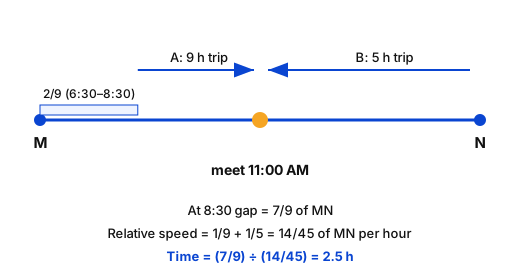
Train A leaves station M at 6:30 AM and reaches station N at 3:30 PM on the same day. Train B leaves station N at 8:30 AM and reaches station M at 1:30 PM on the same day. Find the time when trains A and B meet.
ट्रेन A स्टेशन M से सुबह 6:30 बजे (6:30 AM) चलती है और उसी दिन दोपहर 3:30 बजे (3:30 PM) स्टेशन N पहुँचती है। ट्रेन B स्टेशन N से सुबह 8:30 बजे (8:30 AM) चलती है और उसी दिन दोपहर 1:30 बजे (1:30 PM) स्टेशन M पहुँचती है। वह समय ज्ञात कीजिए जब ट्रेन A और B मिलती हैं।
  1. A11:30 AM
  2. B11:00 AM
  3. C10:50 AM
  4. D12:00 PM
Show answer

Concept: Take distance MN as 1 unit; speeds = 1time. Time to meet = gap ÷ relative speed.

  1. A takes 9 h (19 per h), B takes 5 h (15 per h).
  2. By 8:30 AM, A has gone 2 h: 29; gap left =79.
  3. Relative speed =19+15=1445 per h.
  4. Time =79÷1445=79×4514=2.5 h → 8:30 + 2:30 = 11:00 AM.

Trick: Take MN = LCM(9, 5) = 45 km: speeds 5 and 9 km/h; gap at 8:30 = 35 km; 35÷14=2.5 h.

Answer: (B) 11:00 AM

अवधारणा: दूरी MN = 1 इकाई मानें; चाल =1समय। मिलने का समय = शेष दूरी ÷ सापेक्ष चाल।

  1. A को 9 घंटे (19 प्रति घंटा), B को 5 घंटे (15 प्रति घंटा)।
  2. 8:30 AM तक A 2 घंटे चली: 29; शेष 79।
  3. सापेक्ष चाल =1445 प्रति घंटा।
  4. समय =79×4514=2.5 घंटे → 11:00 AM।

ट्रिक: MN = 45 km मानें: चालें 5 व 9 km/h; शेष 35 km; 35÷14=2.5 घंटे।

उत्तर: (B) 11:00 AM

RRB NTPC Undergraduate CBT 1MathematicsTrains – meeting timeRRB NTPC Undergraduate CBT 1 2024 · 2 Sep Shift 2 →
Q5149.
A shopkeeper lists the price of a fan at 50% above its cost price and offers a 30% discount on its list price. If he earns a profit of ₹86, then what is the list price (in ₹) of the fan?
एक दुकानदार एक पंखे का सूची मूल्य उसके क्रय मूल्य से 50% अधिक अंकित करता है और सूची मूल्य पर 30% की छूट देता है। यदि उसे ₹86 का लाभ होता है, तो पंखे का सूची मूल्य (₹ में) कितना है?
  1. A2,444
  2. B2,580
  3. C2,825
  4. D2,386
Show answer

Concept: SP = CP × (1 + markup) × (1 − discount).

  1. Let CP =x; list price =1.5x.
  2. SP =1.5x×0.7=1.05x, so profit =0.05x.
  3. 0.05x=86⇒x=1720.
  4. List price =1.5×1720=2580.

Trick: Net effect of +50% and −30%: 50−30−50×30100=5% profit → CP =86×20.

Answer: (B) 2,580

अवधारणा: विक्रय मूल्य = क्रय मूल्य × (1 + अंकन) × (1 − छूट)।

  1. क्रय मूल्य =x; अंकित मूल्य =1.5x।
  2. विक्रय मूल्य =1.05x, लाभ =0.05x।
  3. 0.05x=86⇒x=1720।
  4. अंकित मूल्य =1.5×1720=2580।

ट्रिक: +50% व −30% का शुद्ध प्रभाव =5% लाभ → क्रय मूल्य =86×20=1720।

उत्तर: (B) 2,580

RRB NTPC Undergraduate CBT 1MathematicsProfit, loss and discountRRB NTPC Undergraduate CBT 1 2024 · 2 Sep Shift 2 →
Q5150.
The average weight of Ketan, Tushar and Salil is 46 kg. If the average weight of Ketan and Tushar is 36 kg and that of Tushar and Salil is 44 kg, then the weight of Tushar (in kg) is:
केतन, तुषार और सलिल का औसत भार 46 kg है। यदि केतन और तुषार का औसत भार 36 kg है तथा तुषार और सलिल का औसत भार 44 kg है, तो तुषार का भार (kg में) है:
  1. A37
  2. B22
  3. C42
  4. D32
Show answer

Concept: Sum = average × number. Common member = (sum of two pairs) − (total).

  1. K + T + S =46×3=138.
  2. K + T =72, T + S =88.
  3. Adding pairs: K + 2T + S =160; T =160−138=22.

Trick: Common person = sum of both pairs − total sum.

Answer: (B) 22

अवधारणा: योग = औसत × संख्या। साझा व्यक्ति = दोनों जोड़ियों का योग − कुल योग।

  1. K + T + S =46×3=138।
  2. K + T =72, T + S =88।
  3. K + 2T + S =160; T =160−138=22।

ट्रिक: साझा व्यक्ति = दोनों जोड़ियों का योग − कुल योग।

उत्तर: (B) 22

RRB NTPC Undergraduate CBT 1MathematicsAveragesRRB NTPC Undergraduate CBT 1 2024 · 2 Sep Shift 2 →
Q5151.
Simplify:
289+0.04−5.76
सरल कीजिए:
289+0.04−5.76
  1. A1.78
  2. B11.65
  3. C14.8
  4. D3.07
Show answer

Concept: 0.04=0.2 because 0.22=0.04; decimal places in the root = half of those in the number.

  1. 289=17.
  2. 0.04=0.2.
  3. 5.76=2.4 (since 242=576).
  4. 17+0.2−2.4=14.8.

Trick: Remove decimals: 576=24, then put back one decimal place → 2.4.

Answer: (C) 14.8

अवधारणा: 0.04=0.2 क्योंकि 0.22=0.04; मूल में दशमलव स्थान संख्या के आधे होते हैं।

  1. 289=17।
  2. 0.04=0.2।
  3. 5.76=2.4 (क्योंकि 242=576)।
  4. 17+0.2−2.4=14.8।

ट्रिक: दशमलव हटाकर 576=24, फिर एक दशमलव स्थान → 2.4।

उत्तर: (C) 14.8

RRB NTPC Undergraduate CBT 1MathematicsSquare roots of decimalsRRB NTPC Undergraduate CBT 1 2024 · 2 Sep Shift 2 →
Q5152.
A bus travelling at 99 km/hr completes a journey in 20 hours. What should its speed be to cover the same distance in 12 hours?
99 km/hr की चाल से चल रही एक बस 20 घंटे में एक यात्रा पूरी करती है। उसी दूरी को 12 घंटे में तय करने के लिए उसकी चाल कितनी होनी चाहिए?
  1. A165 km/hr
  2. B159 km/hr
  3. C168 km/hr
  4. D156 km/hr
Show answer

Concept: For a fixed distance, speed ∝ 1time.

  1. Distance =99×20=1980 km.
  2. Required speed =198012=165 km/hr.

Trick: 99×2012=99×53=165.

Answer: (A) 165 km/hr

अवधारणा: स्थिर दूरी के लिए चाल ∝ 1समय।

  1. दूरी =99×20=1980 km।
  2. आवश्यक चाल =198012=165 km/hr।

ट्रिक: 99×2012=165।

उत्तर: (A) 165 km/hr

RRB NTPC Undergraduate CBT 1MathematicsSpeed, time and distanceRRB NTPC Undergraduate CBT 1 2024 · 2 Sep Shift 2 →
Q5153.
8 years ago, the age of a father was 21 years more than twice his son's age. After how many years, from now, will he be twice his son's age?
8 वर्ष पहले, एक पिता की आयु उसके पुत्र की आयु के दोगुने से 21 वर्ष अधिक थी। अब से कितने वर्ष बाद, उसकी आयु उसके पुत्र की आयु की दोगुनी होगी?
  1. A13
  2. B11
  3. C8
  4. D17
Show answer

Concept: Form an equation from the past condition, then use it for the future.

  1. 8 years ago: F−8=2(S−8)+21⇒F=2S+13.
  2. After x years: F+x=2(S+x)⇒x=F−2S.
  3. x=13 years.

Trick: "Twice" condition: years needed =F−2S; here F−2S=13 directly.

Answer: (A) 13

अवधारणा: बीते समय की शर्त से समीकरण बनाएँ, फिर भविष्य के लिए प्रयोग करें।

  1. 8 वर्ष पहले: F−8=2(S−8)+21⇒F=2S+13।
  2. x वर्ष बाद: F+x=2(S+x)⇒x=F−2S।
  3. x=13 वर्ष।

ट्रिक: "दोगुना" शर्त में आवश्यक वर्ष =F−2S=13।

उत्तर: (A) 13

RRB NTPC Undergraduate CBT 1MathematicsProblems on agesRRB NTPC Undergraduate CBT 1 2024 · 2 Sep Shift 2 →
Q5154.
By how much is 65% of 55 greater than 25 of 25?
55 का 65%, 25 के 25 से कितना अधिक है?
  1. A19.75
  2. B25.75
  3. C22.75
  4. D23.75
Show answer

Concept: Convert both to numbers and subtract.

  1. 65% of 55=65×55100=35.75.
  2. 25 of 25=10.
  3. Difference =35.75−10=25.75.

Trick: 65% of 55=55% of 65: 0.65×55=35.75.

Answer: (B) 25.75

अवधारणा: दोनों को संख्या में बदलकर घटाएँ।

  1. 65% of 55=35.75।
  2. 25 of 25=10।
  3. अंतर =35.75−10=25.75।

ट्रिक: x% of y=y% of x।

उत्तर: (B) 25.75

RRB NTPC Undergraduate CBT 1MathematicsPercentages and fractionsRRB NTPC Undergraduate CBT 1 2024 · 2 Sep Shift 2 →
Q5155.
The H.C.F. and the L.C.M. of two numbers are 3 and 276 respectively. If one of the numbers is 69, find the other one.
दो संख्याओं का महत्तम समापवर्तक (H.C.F.) और लघुत्तम समापवर्त्य (L.C.M.) क्रमशः 3 और 276 हैं। यदि उनमें से एक संख्या 69 है, तो दूसरी संख्या ज्ञात कीजिए।
  1. A12
  2. B35
  3. C100
  4. D110
Show answer

Concept: Product of two numbers = HCF × LCM.

  1. Other number =3×27669=82869=12.
  2. Check: HCF(69, 12) = 3 and LCM = 276 ✓.

Trick: Other number =HCF×LCMgiven number.

Answer: (A) 12

अवधारणा: दो संख्याओं का गुणनफल = म.स. × ल.स.।

  1. दूसरी संख्या =3×27669=12।
  2. जाँच: HCF(69, 12) = 3, LCM = 276 ✓।

ट्रिक: दूसरी संख्या =HCF×LCMदी गई संख्या।

उत्तर: (A) 12

RRB NTPC Undergraduate CBT 1MathematicsHCF and LCMRRB NTPC Undergraduate CBT 1 2024 · 2 Sep Shift 2 →
Q5156.
What smallest number should be added to 15335 so that the sum is completely divisible by 79?
15335 में कौन-सी सबसे छोटी संख्या जोड़ी जाए ताकि योगफल 79 से पूर्णतः विभाज्य हो जाए?
  1. A71
  2. B68
  3. C70
  4. D65
Show answer

Concept: Number to add = divisor − remainder.

  1. 79×194=15326, so remainder =15335−15326=9.
  2. Number to add =79−9=70.

Trick: Check: 15335+70=15405=79×195 ✓.

Answer: (C) 70

अवधारणा: जोड़ी जाने वाली संख्या = भाजक − शेषफल।

  1. 79×194=15326, शेषफल =9।
  2. जोड़ें =79−9=70।

ट्रिक: जाँच: 15405=79×195 ✓।

उत्तर: (C) 70

RRB NTPC Undergraduate CBT 1MathematicsDivision and remaindersRRB NTPC Undergraduate CBT 1 2024 · 2 Sep Shift 2 →
Q5157.
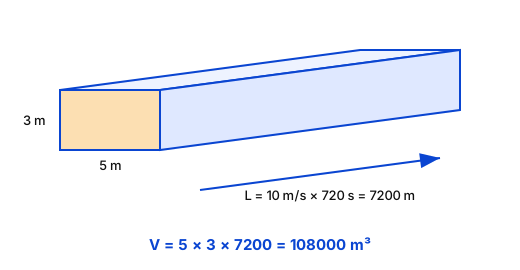
If the shape of a water pipe is a rectangle with dimensions 5 m and 3 m and if water runs out of it at the speed of 36 km/hr, then what is the volume (in m3) of the water that passed through the pipe in 12 minutes?
यदि एक जल पाइप का आकार 5 m और 3 m विमाओं वाला एक आयत है और उसमें से पानी 36 km/hr की चाल से बाहर निकलता है, तो 12 मिनट में पाइप से होकर गुज़रे पानी का आयतन (m3 में) कितना है?
  1. A216000
  2. B108000
  3. C5400
  4. D54000
Show answer

Concept: Volume of water = cross-section area × length of water column (speed × time).

  1. Area =5×3=15m2.
  2. Speed =36km/h=10m/s; time =12×60=720 s.
  3. Length =10×720=7200 m.
  4. Volume =15×7200=108000m3.

Trick: 36km/h×1260h=7.2km=7200m.

Answer: (B) 108000

अवधारणा: पानी का आयतन = अनुप्रस्थ क्षेत्रफल × पानी की लंबाई (चाल × समय)।

  1. क्षेत्रफल =15m2।
  2. चाल =10m/s; समय =720 s।
  3. लंबाई =7200 m।
  4. आयतन =15×7200=108000m3।

ट्रिक: 36×1260=7.2km।

उत्तर: (B) 108000

RRB NTPC Undergraduate CBT 1MathematicsMensuration – flow through a pipeRRB NTPC Undergraduate CBT 1 2024 · 2 Sep Shift 2 →
Q5158.
Two pipes can fill a cistern, individually, in 40 minutes and 14 minutes, respectively. There is a pipe located at the bottom of the cistern to empty it. If all the three pipes are opened simultaneously, then the empty cistern gets filled in 20 minutes. How long will the pipe at the bottom of the tank take to empty the completely filled cistern if no other pipe is then open?
दो पाइप अलग-अलग एक टंकी को क्रमशः 40 मिनट और 14 मिनट में भर सकते हैं। टंकी को खाली करने के लिए उसके तल पर एक पाइप लगा है। यदि तीनों पाइप एक साथ खोल दिए जाएँ, तो खाली टंकी 20 मिनट में भर जाती है। यदि कोई अन्य पाइप खुला न हो, तो टंकी के तल पर लगा पाइप पूरी भरी हुई टंकी को खाली करने में कितना समय लेगा?
  1. A20713 minutes20713 मिनट
  2. B21713 minutes21713 मिनट
  3. C19713 minutes19713 मिनट
  4. D22713 minutes22713 मिनट
Show answer

Concept: Net filling rate = sum of inlet rates − outlet rate (part per minute).

  1. 140+114−1x=120.
  2. 140+114=7+20280=27280; 120=14280.
  3. 1x=13280⇒x=28013=21713 min.

Trick: Capacity = LCM(40, 14, 20) = 280 units: rates 7 + 20 − e = 14 → e = 13; time =28013.

Answer: (B) 21713 minutes

अवधारणा: शुद्ध भरने की दर = भरने वाले नलों की दर − खाली करने वाले नल की दर।

  1. 140+114−1x=120।
  2. 27280−1x=14280।
  3. 1x=13280⇒x=21713 मिनट।

ट्रिक: टंकी = LCM = 280 इकाई: 7 + 20 − e = 14 → e = 13; समय =28013।

उत्तर: (B) 21713 मिनट

RRB NTPC Undergraduate CBT 1MathematicsPipes and cisternsRRB NTPC Undergraduate CBT 1 2024 · 2 Sep Shift 2 →
Q5159.
I bought two toy guns for ₹1,200. I sold the first one at a loss of 9% and the second at a gain of 16%. If, on the whole I made neither a loss nor a gain, find the cost price (in ₹) of the first toy gun.
मैंने दो खिलौना बंदूकें ₹1,200 में खरीदीं। मैंने पहली को 9% की हानि पर और दूसरी को 16% के लाभ पर बेचा। यदि कुल मिलाकर मुझे न तो हानि हुई और न ही लाभ, तो पहली खिलौना बंदूक का क्रय मूल्य (₹ में) ज्ञात कीजिए।
  1. A788
  2. B792
  3. C768
  4. D752
Show answer

Concept: No overall gain/loss ⇒ loss on first = gain on second.

  1. Let first CP =x, second =1200−x.
  2. 0.09x=0.16(1200−x)⇒0.25x=192.
  3. x=768.

Trick: CPs are in inverse ratio of %: x:(1200−x)=16:9 → x=1625×1200=768.

Answer: (C) 768

अवधारणा: कुल न लाभ न हानि ⇒ पहले की हानि = दूसरे का लाभ।

  1. पहले का क्रय मूल्य =x, दूसरे का =1200−x।
  2. 0.09x=0.16(1200−x)⇒0.25x=192।
  3. x=768।

ट्रिक: अनुपात 16:9 → 1625×1200=768।

उत्तर: (C) 768

RRB NTPC Undergraduate CBT 1MathematicsProfit and loss – no profit no lossRRB NTPC Undergraduate CBT 1 2024 · 2 Sep Shift 2 →
Q5160.
Successive discounts of 5% and 40% are equivalent to a single discount of:
5% और 40% की क्रमिक छूटें किस एकल छूट के समतुल्य हैं?
  1. A41%
  2. B45%
  3. C43%
  4. D42%
Show answer

Concept: Two successive discounts a% and b% = (a+b−ab100)%.

  1. 5+40−5×40100=45−2=43%.
  2. Check: ₹100 → ₹95 → ₹57; discount ₹43.

Trick: Take ₹100 and apply discounts one by one.

Answer: (C) 43%

अवधारणा: क्रमिक छूट a% और b% = (a+b−ab100)%।

  1. 5+40−2=43%।
  2. जाँच: ₹100 → ₹95 → ₹57; छूट ₹43।

ट्रिक: ₹100 लेकर एक-एक छूट लगाएँ।

उत्तर: (C) 43%

RRB NTPC Undergraduate CBT 1MathematicsSuccessive discountsRRB NTPC Undergraduate CBT 1 2024 · 2 Sep Shift 2 →