Question bank

Q&A: practice questions with answers

Search questions on any topic. Filter by exam category, exam, subject and topic, try the question, then open the answer and explanation.

Courses – airGurukul

8,495 questions found.

Q541.
A company earns a profit (in ₹) that is distributed among the company's three partners in the ratio of 12 : 3 : 14. If the difference between the smallest and the largest shares is ₹61,699, the total profit (in ₹) of the company is:
एक कंपनी लाभ (₹ में) अर्जित करती है जिसे कंपनी के तीन साझेदारों में 12 : 3 : 14 के अनुपात में वितरित किया जाता है। यदि सबसे छोटे और सबसे बड़े हिस्से के बीच का अंतर ₹61,699 है, तो कंपनी का कुल लाभ (₹ में) कितना है?
  1. A1,62,661
  2. B1,62,566
  3. C1,62,581
  4. D1,62,673
Show answer

Concept: Shares in a ratio are equal 'parts'; find the value of one part from the given difference.
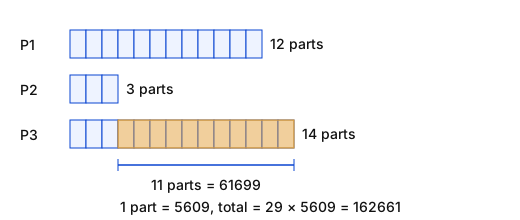
  1. Ratio 12:3:14; smallest =3 parts, largest =14 parts.
  2. Difference =14−3=11 parts =61699 ⇒ 1 part =6169911=5609.
  3. Total =(12+3+14)×5609=29×5609=162661.

Trick: Total must be a multiple of 29: only 162661=29×5609 works.

Answer: (A) ₹1,62,661

अवधारणा: अनुपात में हिस्से बराबर 'भाग' होते हैं; दिए गए अंतर से एक भाग का मान निकालें।

  1. अनुपात 12:3:14; सबसे छोटा =3 भाग, सबसे बड़ा =14 भाग।
  2. अंतर =14−3=11 भाग =61699 ⇒ 1 भाग =6169911=5609।
  3. कुल =(12+3+14)×5609=29×5609=162661।

ट्रिक: कुल लाभ 29 का गुणज होना चाहिए: केवल 162661=29×5609।

उत्तर: (A) ₹1,62,661

RRB NTPC Undergraduate CBT 1MathematicsRatio and proportionRRB NTPC Undergraduate CBT 1 2024 · 28 Aug Shift 1 →
Q542.
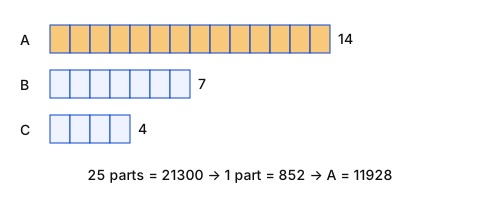
₹21,300 were divided among A, B and C, such that 2 times the share of A = 4 times the share of B = 7 times the share of C. Find the share of A.
₹21,300 को A, B और C में इस प्रकार बाँटा गया कि A के हिस्से का 2 गुना = B के हिस्से का 4 गुना = C के हिस्से का 7 गुना। A का हिस्सा ज्ञात कीजिए।
  1. A₹11,868
  2. B₹11,919
  3. C₹12,099
  4. D₹11,928
Show answer

Concept: If 2A=4B=7C=k, then A:B:C=12:14:17.

  1. Multiply by LCM 28: A:B:C=14:7:4.
  2. Total parts =14+7+4=25; 1 part =2130025=852.
  3. A=14×852=11928.

Trick: For aA=bB=cC, A:B:C=bc:ca:ab=28:14:8=14:7:4.

Answer: (D) ₹11,928

अवधारणा: यदि 2A=4B=7C=k, तो A:B:C=12:14:17।

  1. LCM 28 से गुणा: A:B:C=14:7:4।
  2. कुल भाग =14+7+4=25; 1 भाग =2130025=852।
  3. A=14×852=11928।

ट्रिक: aA=bB=cC हो तो A:B:C=bc:ca:ab=28:14:8=14:7:4।

उत्तर: (D) ₹11,928

RRB NTPC Undergraduate CBT 1MathematicsRatio – equal multiplesRRB NTPC Undergraduate CBT 1 2024 · 28 Aug Shift 1 →
Q543.
A number, when increased by 60%, gives 3640. The number is:
एक संख्या में 60% की वृद्धि करने पर 3640 प्राप्त होता है। वह संख्या है:
  1. A4550
  2. B1137.5
  3. C6825
  4. D2275
Show answer

Concept: Increasing a number by 60% means multiplying it by 160100.

  1. x×160100=3640.
  2. x=3640×100160=3640×58=455×5=2275.

Trick: 60%=35 ⇒ number : new =5:8; 36408×5=2275.

Answer: (D) 2275

अवधारणा: किसी संख्या में 60% वृद्धि का अर्थ है उसे 160100 से गुणा करना।

  1. x×160100=3640।
  2. x=3640×100160=3640×58=455×5=2275।

ट्रिक: 60%=35 ⇒ संख्या : नई =5:8; 36408×5=2275।

उत्तर: (D) 2275

RRB NTPC Undergraduate CBT 1MathematicsPercentageRRB NTPC Undergraduate CBT 1 2024 · 28 Aug Shift 1 →
Q544.
A shopkeeper offers the following four discount schemes to his customers for the purchase of articles in his shop.
(i) Buy 5 and get 3 free
(ii) Buy 6 and get 3 free
(iii) Buy 20 and get 5 free
(iv) Buy 8 and get 6 free
Which scheme is the most beneficial to the customers?
एक दुकानदार अपनी दुकान में वस्तुओं की खरीद के लिए अपने ग्राहकों को निम्नलिखित चार छूट योजनाएँ प्रदान करता है।
(i) 5 खरीदें और 3 मुफ़्त पाएँ
(ii) 6 खरीदें और 3 मुफ़्त पाएँ
(iii) 20 खरीदें और 5 मुफ़्त पाएँ
(iv) 8 खरीदें और 6 मुफ़्त पाएँ
ग्राहकों के लिए कौन-सी योजना सबसे अधिक लाभदायक है?
  1. A(ii)
  2. B(i)
  3. C(iv)
  4. D(iii)
Show answer

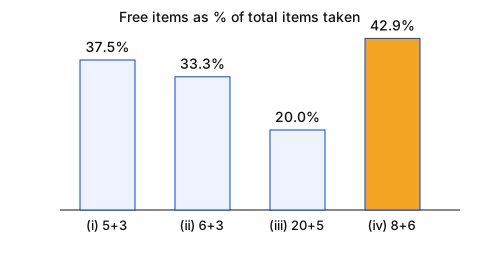
Concept: In 'buy x get y free', the customer gets x+y items for the price of x; effective discount =yx+y×100%.

  1. (i) 38=37.5%; (ii) 39=33.3%.
  2. (iii) 525=20%; (iv) 614=42.86%.
  3. Highest discount is (iv) – most beneficial.

Trick: Compare freetotal, not freebought – but here both rankings give (iv).

Answer: (C) (iv)

अवधारणा: 'x खरीदें y मुफ्त' में ग्राहक को x के दाम में x+y वस्तुएँ मिलती हैं; प्रभावी छूट =yx+y×100%।

  1. (i) 38=37.5%; (ii) 39=33.3%।
  2. (iii) 525=20%; (iv) 614=42.86%।
  3. सबसे अधिक छूट (iv) में – सबसे लाभदायक।

ट्रिक: मुफ्तकुल की तुलना करें; यहाँ (iv) सबसे बड़ा है।

उत्तर: (C) (iv)

RRB NTPC Undergraduate CBT 1MathematicsDiscount – buy x get y freeRRB NTPC Undergraduate CBT 1 2024 · 28 Aug Shift 1 →
Q545.
The sum of the squares of two consecutive even natural numbers is 452. The sum of the numbers is:
दो क्रमागत सम प्राकृत संख्याओं के वर्गों का योग 452 है। संख्याओं का योग है:
  1. A48
  2. B30
  3. C44
  4. D26
Show answer

Concept: Consecutive even numbers: n and n+2.

  1. n2+(n+2)2=452 ⇒ 2n2+4n+4=452 ⇒ n2+2n−224=0.
  2. (n+16)(n−14)=0 ⇒ n=14 (natural).
  3. Numbers 14,16: 196+256=452 ✓; sum =30.

Trick: 4522=226≈152, so numbers lie around 15: try 14,16.

Answer: (B) 30

अवधारणा: क्रमागत सम संख्याएँ: n और n+2।

  1. n2+(n+2)2=452 ⇒ 2n2+4n+4=452 ⇒ n2+2n−224=0।
  2. (n+16)(n−14)=0 ⇒ n=14 (प्राकृत)।
  3. संख्याएँ 14,16: 196+256=452 ✓; योग =30।

ट्रिक: 4522=226≈152, अतः संख्याएँ 15 के आसपास: 14,16।

उत्तर: (B) 30

RRB NTPC Undergraduate CBT 1MathematicsNumber system – squaresRRB NTPC Undergraduate CBT 1 2024 · 28 Aug Shift 1 →
Q546.
Evaluate: (-9) - (-60) ÷ (-12) + (-2) × 9
मान ज्ञात कीजिए: (-9) - (-60) ÷ (-12) + (-2) × 9
  1. A-34
  2. B-32
  3. C-31
  4. D-35
Show answer

Concept: Do division and multiplication before addition and subtraction (BODMAS), keeping track of signs.

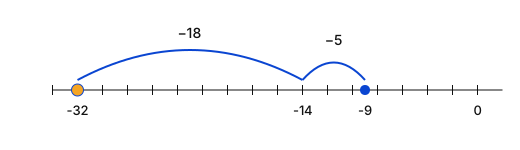
  1. (−60)÷(−12)=5 and (−2)×9=−18.
  2. Expression =−9−5+(−18).
  3. =−14−18=−32.

Trick: Negative ÷ negative = positive; then subtracting a positive moves left on the number line.

Answer: (B) −32

अवधारणा: जोड़-घटाव से पहले भाग और गुणा करें (BODMAS), चिह्नों का ध्यान रखें।

  1. (−60)÷(−12)=5 और (−2)×9=−18।
  2. व्यंजक =−9−5+(−18)।
  3. =−14−18=−32।

ट्रिक: ऋण ÷ ऋण = धन; फिर धन घटाने पर संख्या रेखा पर बाएँ जाते हैं।

उत्तर: (B) −32

RRB NTPC Undergraduate CBT 1MathematicsSimplification – BODMASRRB NTPC Undergraduate CBT 1 2024 · 28 Aug Shift 1 →
Q547.
The LCM of the numbers 8.6 and 0.12 is:
संख्याओं 8.6 और 0.12 का LCM है:
  1. A2.58
  2. B258
  3. C25.8
  4. D0.258
Show answer

Concept: Make the decimal places equal, find the LCM of the whole numbers, then put back the decimal places.

  1. 8.6=8.60=860100, 0.12=12100.
  2. 860=22×5×43, 12=22×3 ⇒ LCM=22×3×5×43=2580.
  3. LCM=2580100=25.80.

Trick: LCM must be a multiple of 8.6: 8.6×3=25.8, and 25.80.12=215 ✓.

Answer: (C) 25.8

अवधारणा: दशमलव स्थान बराबर करें, पूर्णांकों का LCM निकालें, फिर दशमलव वापस लगाएँ।

  1. 8.6=8.60=860100, 0.12=12100।
  2. 860=22×5×43, 12=22×3 ⇒ LCM=22×3×5×43=2580।
  3. LCM=2580100=25.80।

ट्रिक: LCM, 8.6 का गुणज होगा: 8.6×3=25.8, और 25.80.12=215 ✓।

उत्तर: (C) 25.8

RRB NTPC Undergraduate CBT 1MathematicsLCM of decimalsRRB NTPC Undergraduate CBT 1 2024 · 28 Aug Shift 1 →
Q548.
Sapna invested ₹20,000 on simple interest, partly at 12% per annum and partly at 13% per annum. If she earns equal interests from the two investments after 7 years, then find the sum invested at 12% per annum (in ₹).
सपना ने ₹20,000 साधारण ब्याज पर निवेश किए, कुछ भाग 12% वार्षिक दर पर और कुछ भाग 13% वार्षिक दर पर। यदि 7 वर्ष बाद उसे दोनों निवेशों से समान ब्याज प्राप्त होता है, तो 12% वार्षिक दर पर निवेश की गई राशि (₹ में) ज्ञात कीजिए।
  1. A10,398
  2. B10,403
  3. C10,400
  4. D10,399
Show answer

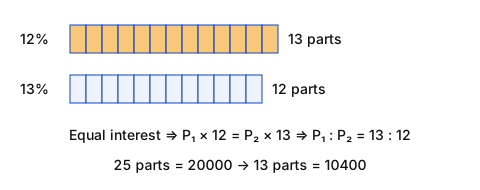
Concept: Same time, equal interest: P1×R1=P2×R2, so principal is inversely proportional to rate.

  1. P1×12×7=P2×13×7 ⇒ P1:P2=13:12.
  2. Total parts =25; 1 part =2000025=800.
  3. Sum at 12% =13×800=10400.

Trick: Rates swap into the ratio: rates 12:13 ⇒ sums 13:12 (time does not matter).

Answer: (C) ₹10,400

अवधारणा: समान समय, समान ब्याज: P1×R1=P2×R2, अर्थात् मूलधन दर के व्युत्क्रमानुपाती।

  1. P1×12×7=P2×13×7 ⇒ P1:P2=13:12।
  2. कुल भाग =25; 1 भाग =2000025=800।
  3. 12% पर राशि =13×800=10400।

ट्रिक: दरें 12:13 ⇒ राशियाँ 13:12 (समय से फर्क नहीं)।

उत्तर: (C) ₹10,400

RRB NTPC Undergraduate CBT 1MathematicsSimple interestRRB NTPC Undergraduate CBT 1 2024 · 28 Aug Shift 1 →
Q549.
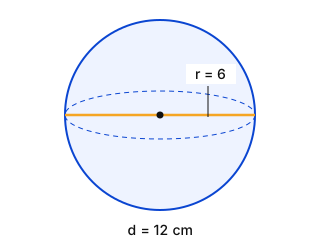
The diameter of a sphere is 12 cm. Find its volume.
एक गोले का व्यास 12 cm है। इसका आयतन ज्ञात कीजिए।
  1. A144π cm3
  2. B288π cm3
  3. C576π cm3
  4. D192π cm3
Show answer

Concept: Volume of a sphere =43πr3, where r=d2.

  1. r=122=6cm.
  2. V=43π×63=43π×216.
  3. V=4×72π=288πcm3.

Yaad rakhein: Sphere: V=43πr3, SA=4πr2; hemisphere volume is half.

Answer: (B) 288πcm3

अवधारणा: गोले का आयतन =43πr3, जहाँ r=d2।

  1. r=122=6cm।
  2. V=43π×63=43π×216।
  3. V=4×72π=288πcm3।

याद रखें: गोला: V=43πr3, पृष्ठ क्षेत्रफल =4πr2; अर्धगोले का आयतन आधा।

उत्तर: (B) 288πcm3

RRB NTPC Undergraduate CBT 1MathematicsMensuration – sphereRRB NTPC Undergraduate CBT 1 2024 · 28 Aug Shift 1 →
Q550.
Simplify: 2((72)x2−28x+17)−7(x2+6x−11).
सरल कीजिए: 2((72)x2−28x+17)−7(x2+6x−11)।
  1. A−98x−111
  2. B98x−111
  3. C−98x+111
  4. D98x+111
Show answer

Concept: Remove brackets by multiplying each term, then combine like terms.

  1. 2(72x2−28x+17)=7x2−56x+34.
  2. −7(x2+6x−11)=−7x2−42x+77.
  3. Add: (7x2−7x2)+(−56x−42x)+(34+77)=−98x+111.

Trick: x2 terms cancel; constant =34+77=111 (positive) → only option (C) fits.

Answer: (C) −98x+111

अवधारणा: प्रत्येक पद से गुणा करके कोष्ठक हटाएँ, फिर समान पद जोड़ें।

  1. 2(72x2−28x+17)=7x2−56x+34।
  2. −7(x2+6x−11)=−7x2−42x+77।
  3. जोड़ें: (7x2−7x2)+(−56x−42x)+(34+77)=−98x+111।

ट्रिक: x2 पद कट जाते हैं; अचर =34+77=111 (धनात्मक) → केवल (C)।

उत्तर: (C) −98x+111

RRB NTPC Undergraduate CBT 1MathematicsAlgebra – simplificationRRB NTPC Undergraduate CBT 1 2024 · 28 Aug Shift 1 →
Q551.
A trader claims to sell flour at a profit of 44%, but also dishonestly uses a weight which is 10% less than what is mentioned on it. Find the total percentage of profit earned by the trader. (Round off the answer to the nearest whole number.)
एक व्यापारी 44% लाभ पर आटा बेचने का दावा करता है, लेकिन साथ ही बेईमानी से ऐसे बाट का उपयोग करता है जो उस पर अंकित भार से 10% कम है। व्यापारी द्वारा अर्जित कुल लाभ प्रतिशत ज्ञात कीजिए। (उत्तर को निकटतम पूर्ण संख्या तक पूर्णांकित कीजिए।)
  1. A62%
  2. B61%
  3. C63%
  4. D60%
Show answer

Concept: With a false weight, profit is found by comparing what the buyer pays with what the trader really gives: CP of goods given vs SP received.

  1. Let CP of 1000 g = ₹100. He charges for 1000 g at 44% profit: SP = ₹144.
  2. But he gives only 900 g (10% less), whose CP = ₹90.
  3. Profit =144−90=54 on cost 90 → 5490×100=60%.

Trick: Overall factor =1.440.9=1.6 → 60% profit.

Answer: (D) 60%

अवधारणा: कम तौल में वास्तविक दिए गए सामान का CP और लिया गया SP तुलना करें।

  1. माना 1000 g का CP = ₹100; 44% लाभ पर वह 144 लेता है।
  2. पर देता केवल 900 g है, जिसका CP = ₹90।
  3. लाभ =144−90=54 → 5490×100=60%।

ट्रिक: कुल गुणक =1.440.9=1.6 → 60% लाभ।

उत्तर: (D) 60%

RRB NTPC Undergraduate CBT 1MathematicsProfit & Loss – False WeightRRB NTPC Undergraduate CBT 1 2024 · 28 Aug Shift 1 →
Q552.
I bought two bicycles for ₹1,200. I sold the first one at a loss of 9% and the second at a gain of 27%. If, on the whole I made neither a loss nor a gain, find the cost price (in ₹) of the first bicycle.
मैंने दो साइकिलें ₹1,200 में खरीदीं। मैंने पहली साइकिल 9% की हानि पर और दूसरी 27% के लाभ पर बेची। यदि कुल मिलाकर मुझे न तो हानि हुई और न ही लाभ, तो पहली साइकिल का क्रय मूल्य (₹ में) ज्ञात कीजिए।
  1. A920
  2. B924
  3. C884
  4. D900
Show answer

Concept: No overall profit/loss means the loss on one article equals the gain on the other.

  1. Let CP of first =x, second =1200−x.
  2. Loss = gain: 0.09x=0.27(1200−x).
  3. 0.36x=324 → x=900.

Trick: Losses balance: CP ratio =27:9=3:1 → first =34×1200=900.

Answer: (D) 900

अवधारणा: कुल न लाभ न हानि का अर्थ है एक पर हानि = दूसरे पर लाभ।

  1. पहली का CP =x, दूसरी का =1200−x।
  2. 0.09x=0.27(1200−x)।
  3. 0.36x=324 → x=900।

ट्रिक: CP अनुपात =27:9=3:1 → पहली =34×1200=900।

उत्तर: (D) 900

RRB NTPC Undergraduate CBT 1MathematicsProfit & Loss – Overall No GainRRB NTPC Undergraduate CBT 1 2024 · 28 Aug Shift 1 →
Q553.
A chair was sold for ₹4,600 after giving two successive discounts of 12% and 9%. What is the marked price? (Rounded up to two decimal places.)
12% और 9% की दो क्रमिक छूटें देने के बाद एक कुर्सी ₹4,600 में बेची गई। अंकित मूल्य क्या है? (दशमलव के दो स्थानों तक पूर्णांकित।)
  1. A₹8,008.39
  2. B₹7,820.12
  3. C₹7,948.74
  4. D₹5,744.26
Show answer

Concept: After successive discounts d1,d2: SP=MP×(1−d1100)(1−d2100).

  1. SP=MP×0.88×0.91=0.8008MP.
  2. 0.8008MP=4600 → MP=46000.8008.
  3. MP≈5744.26.

Trick: Net discount of 12% and 9% =12+9−12×9100=19.92% → MP is just under 4600×1.25=5750; only ₹5,744.26 fits.

Answer: (D) ₹5,744.26

अवधारणा: क्रमागत छूट पर: SP=MP×(1−d1100)(1−d2100)।

  1. SP=MP×0.88×0.91=0.8008MP।
  2. MP=46000.8008।
  3. MP≈5744.26।

ट्रिक: शुद्ध छूट =12+9−12×9100=19.92% → केवल ₹5,744.26 सही बैठता है।

उत्तर: (D) ₹5,744.26

RRB NTPC Undergraduate CBT 1MathematicsSuccessive DiscountsRRB NTPC Undergraduate CBT 1 2024 · 28 Aug Shift 1 →
Q554.
If the sum of all interior angles of a regular polygon is 28 right angles, then its number of sides is:
यदि किसी समबहुभुज के सभी आंतरिक कोणों का योग 28 समकोण है, तो उसकी भुजाओं की संख्या है:
  1. A15
  2. B14
  3. C13
  4. D16
Show answer

Concept: Sum of interior angles of an n-sided polygon =(2n−4) right angles =(n−2)×180∘.

  1. 2n−4=28.
  2. 2n=32 → n=16.

Trick: Right angles ÷2 + 2 = sides: 282+2=16.

Answer: (D) 16

अवधारणा: n भुजाओं वाले बहुभुज के अंतः कोणों का योग =(2n−4) समकोण।

  1. 2n−4=28।
  2. 2n=32 → n=16।

ट्रिक: समकोण ÷2 + 2 = भुजाएँ: 282+2=16।

उत्तर: (D) 16

RRB NTPC Undergraduate CBT 1MathematicsPolygons – Interior AnglesRRB NTPC Undergraduate CBT 1 2024 · 28 Aug Shift 1 →
Q555.
A sum of money triples itself at a certain rate of compound interest in 16 years. In how many years will it amount to 9 times of itself?
कोई धनराशि चक्रवृद्धि ब्याज की एक निश्चित दर पर 16 वर्षों में स्वयं की तीन गुनी हो जाती है। कितने वर्षों में यह स्वयं की 9 गुनी हो जाएगी?
  1. A29 years29 वर्ष
  2. B26 years26 वर्ष
  3. C27 years27 वर्ष
  4. D32 years32 वर्ष
Show answer

Concept: Under compound interest, if money becomes k times in t years, it becomes kn times in nt years.

  1. 3 times in 16 years.
  2. 9=32 → time =2×16=32 years.

Trick: CI multiplies: 3→9→27 takes 16→32→48 years.

Answer: (D) 32 years

अवधारणा: चक्रवृद्धि ब्याज में धन t वर्ष में k गुना हो तो nt वर्ष में kn गुना होता है।

  1. 16 वर्ष में 3 गुना।
  2. 9=32 → समय =2×16=32 वर्ष।

ट्रिक: CI में गुणा होता है: 3→9→27 के लिए 16→32→48 वर्ष।

उत्तर: (D) 32 वर्ष

RRB NTPC Undergraduate CBT 1MathematicsCompound Interest – MultiplesRRB NTPC Undergraduate CBT 1 2024 · 28 Aug Shift 1 →
Q556.
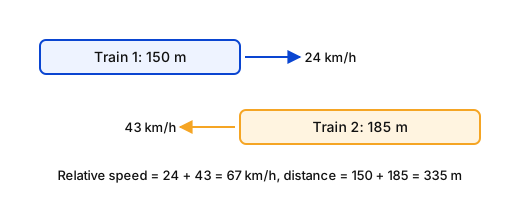
A train that has a length of 150 m overtakes a man moving at a speed of 9 km/hr (in the same direction) in 36 seconds. How much time (in seconds) will it take this train to completely cross another train that is 185 m long, moving in the opposite direction at a speed of 43 km/hr?
150 m लंबी एक रेलगाड़ी 9 km/hr की चाल से (समान दिशा में) चल रहे एक व्यक्ति को 36 सेकंड में पार करती है। विपरीत दिशा में 43 km/hr की चाल से चल रही 185 m लंबी एक अन्य रेलगाड़ी को पूरी तरह पार करने में यह रेलगाड़ी कितना समय (सेकंड में) लेगी?
  1. A35
  2. B18
  3. C23
  4. D12
Show answer

Concept: Same direction: relative speed = difference; opposite direction: relative speed = sum. Distance = sum of the lengths.

  1. Overtaking the man: 15036=256m/s=15km/h relative → train =15+9=24km/h.
  2. Opposite train: relative speed =24+43=67km/h=67×518m/s.
  3. Time =335×1867×5=6030335=18s.

Trick: 335=67×5, so time =335×1867×5=18 straight away.

Answer: (B) 18

अवधारणा: एक दिशा में सापेक्ष चाल = अंतर; विपरीत दिशा में = योग। दूरी = दोनों लंबाइयों का योग।

  1. आदमी को पार करना: 15036=256m/s=15km/h → ट्रेन =15+9=24km/h।
  2. विपरीत दिशा: 24+43=67km/h।
  3. समय =335×1867×5=18s।

ट्रिक: 335=67×5 → समय सीधे 18 s।

उत्तर: (B) 18

RRB NTPC Undergraduate CBT 1MathematicsTrains – Relative SpeedRRB NTPC Undergraduate CBT 1 2024 · 28 Aug Shift 1 →
Q557.
The marks scored by 10 students are given below.
11, 11, 14, 12, 20, 19, 16, 18, 11, 12
The mode of the data is:
10 विद्यार्थियों द्वारा प्राप्त अंक नीचे दिए गए हैं।
11, 11, 14, 12, 20, 19, 16, 18, 11, 12
आँकड़ों का बहुलक है:
  1. A12
  2. B14
  3. C10
  4. D11
Show answer

Concept: Mode is the value that occurs most often in the data.

  1. Counts: 11 → 3 times, 12 → 2 times, all others once.
  2. Highest frequency is for 11.

Trick: Just tally the repeats – the most repeated value is the mode.

Answer: (D) 11

अवधारणा: बहुलक (mode) वह मान है जो सबसे अधिक बार आता है।

  1. गिनती: 11 → 3 बार, 12 → 2 बार, बाकी 1-1 बार।
  2. सबसे अधिक बारंबारता 11 की है।

ट्रिक: सबसे ज़्यादा दोहराया गया मान ही बहुलक है।

उत्तर: (D) 11

RRB NTPC Undergraduate CBT 1MathematicsStatistics – ModeRRB NTPC Undergraduate CBT 1 2024 · 28 Aug Shift 1 →
Q558.
If 3 times Mary’s present age is 27 years more than 9 times Diya's present age, and 4 times Diya's present age is 7 years less than Mary's present age, then what is the difference (in years) between the ages of Mary and Diya?
यदि मैरी की वर्तमान आयु का 3 गुना, दीया की वर्तमान आयु के 9 गुने से 27 वर्ष अधिक है, और दीया की वर्तमान आयु का 4 गुना, मैरी की वर्तमान आयु से 7 वर्ष कम है, तो मैरी और दीया की आयु के बीच का अंतर (वर्षों में) क्या है?
  1. A13
  2. B10
  3. C8
  4. D17
Show answer

Concept: Convert each statement into an equation and solve simultaneously (Mary =M, Diya =D).

  1. 3M=9D+27 → M=3D+9.
  2. 4D=M−7 → 4D=3D+2 → D=2.
  3. M=15; difference =15−2=13.

Trick: Check: 3×15=45=9×2+27 ✓ and 4×2=8=15−7 ✓.

Answer: (A) 13

अवधारणा: हर कथन को समीकरण में बदलें (मैरी =M, दीया =D)।

  1. 3M=9D+27 → M=3D+9।
  2. 4D=M−7 → 4D=3D+2 → D=2।
  3. M=15; अंतर =13।

ट्रिक: जाँच: 3×15=45=9×2+27 ✓, 4×2=15−7 ✓।

उत्तर: (A) 13

RRB NTPC Undergraduate CBT 1MathematicsProblems on AgesRRB NTPC Undergraduate CBT 1 2024 · 28 Aug Shift 1 →
Q559.
Simplify:
secθ(1+sinθ)(secθ−tanθ)
सरल कीजिए:
secθ(1+sinθ)(secθ−tanθ)
  1. Asecθ
  2. B−1
  3. C1
  4. Dtanθ
Show answer

Concept: Use secθ−tanθ=1−sinθcosθ and 1−sin2θ=cos2θ.

  1. (1+sinθ)(secθ−tanθ)=(1+sinθ)(1−sinθ)cosθ=cos2θcosθ=cosθ.
  2. Expression =secθ×cosθ=1.

Trick: Put θ=0∘: 1×1×(1−0)=1.

Answer: (C) 1

अवधारणा: secθ−tanθ=1−sinθcosθ तथा 1−sin2θ=cos2θ का प्रयोग।

  1. (1+sinθ)(secθ−tanθ)=cos2θcosθ=cosθ।
  2. व्यंजक =secθ×cosθ=1।

ट्रिक: θ=0∘ रखें: 1×1×1=1।

उत्तर: (C) 1

RRB NTPC Undergraduate CBT 1MathematicsTrigonometric IdentitiesRRB NTPC Undergraduate CBT 1 2024 · 28 Aug Shift 1 →
Q560.
A man goes to Lucknow from Kanpur at a speed of 18 km/hr and returns to Kanpur at speed of 36 km/hr, through the same route. What is his average speed (in km/hr) of the entire journey?
एक व्यक्ति कानपुर से लखनऊ 18 km/hr की चाल से जाता है और उसी मार्ग से 36 km/hr की चाल से कानपुर लौटता है। पूरी यात्रा की उसकी औसत चाल (km/hr में) क्या है?
  1. A18
  2. B24
  3. C22
  4. D27
Show answer

Concept: For equal distances at speeds a and b: average speed =2aba+b.

  1. 2×18×3618+36=129654.
  2. =24km/h.

Trick: Speeds in ratio 1:2 → average =43×18=24.

Answer: (B) 24

अवधारणा: समान दूरी, चाल a और b: औसत चाल =2aba+b।

  1. 2×18×3654=129654।
  2. =24km/h।

ट्रिक: चाल अनुपात 1:2 → औसत =43×18=24।

उत्तर: (B) 24

RRB NTPC Undergraduate CBT 1MathematicsAverage SpeedRRB NTPC Undergraduate CBT 1 2024 · 28 Aug Shift 1 →