Question bank

Q&A: practice questions with answers

Search questions on any topic. Filter by exam category, exam, subject and topic, try the question, then open the answer and explanation.

Courses – airGurukul

8,495 questions found.

Q5681.
Which of the following letter-number clusters will replace the question mark (?) in the given series to make it logically complete?
BVY 32, WQT 16, RLO 8, MGJ 4, ?
निम्नलिखित में से कौन-सा अक्षर-संख्या समूह दी गई श्रृंखला में प्रश्न चिह्न (?) का स्थान लेकर उसे तार्किक रूप से पूर्ण करेगा?
BVY 32, WQT 16, RLO 8, MGJ 4, ?
  1. AREX 4
  2. BHCD 2
  3. CLFY 8
  4. DHBE 2
Show answer

Concept: Track each letter position with its alphabet number (A = 1 … Z = 26) and the number separately.

  1. First letters: B(2) → W(23) → R(18) → M(13): each step −5 (B − 5 wraps to W) → next 13−5=8 = H.
  2. Second letters: V → Q → L → G (−5) → B; third letters: Y → T → O → J (−5) → E.
  3. Numbers: 32, 16, 8, 4 → ÷2 → 2.
  4. Missing term = HBE 2.

Trick: All three letters move back 5 together, the number halves.

Answer: (D) HBE 2

अवधारणा: हर अक्षर-स्थान को उसके क्रमांक (A = 1 … Z = 26) से और संख्या को अलग देखें।

  1. पहले अक्षर: B(2) → W(23) → R(18) → M(13): हर बार −5 (B − 5 = W, चक्र में) → अगला 13−5=8 = H।
  2. दूसरे अक्षर: V → Q → L → G (−5) → B; तीसरे: Y → T → O → J (−5) → E।
  3. संख्याएँ: 32, 16, 8, 4 → ÷2 → 2।
  4. लुप्त पद = HBE 2।

ट्रिक: तीनों अक्षर साथ-साथ 5 पीछे, संख्या आधी।

उत्तर: (D) HBE 2
RRB NTPC Undergraduate CBT 1General Intelligence and ReasoningLetter-Number SeriesRRB NTPC Undergraduate CBT 1 2025 · 20 Jun Shift 3 →
Q5682.
Each of the digits in the number 3749685 is arranged in ascending order from left to right. The position of how many digits will remain unchanged as compared to that in the original number?
संख्या 3749685 के प्रत्येक अंक को बाएँ से दाएँ आरोही क्रम में व्यवस्थित किया जाता है। मूल संख्या की तुलना में कितने अंकों का स्थान अपरिवर्तित रहेगा?
  1. AThreeतीन
  2. BNoneकोई नहीं
  3. CTwoदो
  4. DOneएक
Show answer

Concept: Write the original number and the ascending-order number one below the other and compare position by position.

  1. Original: 3 7 4 9 6 8 5.
  2. Ascending: 3 4 5 6 7 8 9.
  3. Same digit at the same place: 1st (3) and 6th (8).
  4. So two digits keep their positions.

Trick: Compare column by column – never count by memory.

Answer: (C) Two

अवधारणा: मूल संख्या और आरोही क्रम वाली संख्या एक के नीचे एक लिखकर हर स्थान की तुलना करें।

  1. मूल: 3 7 4 9 6 8 5।
  2. आरोही: 3 4 5 6 7 8 9।
  3. समान स्थान पर समान अंक: पहला (3) और छठा (8)।
  4. अतः दो अंकों की स्थिति नहीं बदलती।

ट्रिक: स्तंभ-दर-स्तंभ मिलाएँ – याद से न गिनें।

उत्तर: (C) दो

RRB NTPC Undergraduate CBT 1General Intelligence and ReasoningDigit ArrangementRRB NTPC Undergraduate CBT 1 2025 · 20 Jun Shift 3 →
Q5683.
Based on the English alphabetical order, three of the following four letter-cluster pairs are alike in a certain way and thus form a group. Which is the one that does not belong to that group?
(Note: The odd one out is not based on the number of consonants/vowels or their position in the letter-cluster pairs.)
अंग्रेज़ी वर्णमाला क्रम के आधार पर, निम्नलिखित चार अक्षर-समूह युग्मों में से तीन किसी निश्चित प्रकार से एकसमान हैं और इस प्रकार एक समूह बनाते हैं। वह कौन-सा युग्म है जो उस समूह से संबंधित नहीं है?
(ध्यान दें: असंगत युग्म, व्यंजनों/स्वरों की संख्या या अक्षर-समूह युग्मों में उनके स्थान पर आधारित नहीं है।)
  1. AVB-TN
  2. BSY – QK
  3. CKQ-IC
  4. DPV – MH
Show answer

Concept: Compare each letter of the first cluster with the matching letter of the second (A = 1 … Z = 26).

  1. VB-TN: V−2=T, B+12=N.
  2. SY-QK: S−2=Q, Y+12=K (25 + 12 = 37, 37−26=11). KQ-IC: K−2=I, Q+12=C.
  3. PV-MH: P−3=M (not −2), V+12=H → the first rule breaks.
  4. So PV – MH is the odd one.

Trick: Check the simple shift (first letters) first – the odd pair often fails there.

Answer: (D) PV – MH

अवधारणा: पहले समूह के हर अक्षर की तुलना दूसरे समूह के संगत अक्षर से करें (A = 1 … Z = 26)।

  1. VB-TN: V−2=T, B+12=N।
  2. SY-QK: S−2=Q, Y+12=K (25 + 12 = 37, 37−26=11)। KQ-IC: K−2=I, Q+12=C।
  3. PV-MH: P−3=M (−2 नहीं), V+12=H → पहला नियम टूटता है।
  4. अतः PV – MH विषम है।

ट्रिक: पहले आसान बदलाव (पहले अक्षर) जाँचें – विषम युग्म अक्सर वहीं पकड़ा जाता है।

उत्तर: (D) PV – MH

RRB NTPC Undergraduate CBT 1General Intelligence and ReasoningOdd One Out – Letter PairsRRB NTPC Undergraduate CBT 1 2025 · 20 Jun Shift 3 →
Q5684.
In a certain code language, ‘tale jaw bow’ is coded as 'vl ud np' and ‘law bow fresh’ is coded as ‘pq re ud’. How is ‘bow’ coded in the given language?
एक निश्चित कूट भाषा में, ‘tale jaw bow’ को ‘vl ud np’ के रूप में कूटबद्ध किया जाता है और ‘law bow fresh’ को ‘pq re ud’ के रूप में कूटबद्ध किया जाता है। उस भाषा में ‘bow’ को किस प्रकार कूटबद्ध किया जाता है?
  1. Aud
  2. Bpq
  3. Cnp
  4. Dvl
Show answer

Concept: A word common to two sentences gets the code common to both coded sentences.

  1. ‘tale jaw bow’ → vl ud np.
  2. ‘law bow fresh’ → pq re ud.
  3. Common word = bow; common code = ud → bow = ud.

Trick: Match the common word with the common code – order of codes does not matter.

Answer: (A) ud

अवधारणा: दो वाक्यों में समान शब्द का कोड दोनों कोडित वाक्यों में समान कोड होता है।

  1. ‘tale jaw bow’ → vl ud np।
  2. ‘law bow fresh’ → pq re ud।
  3. समान शब्द = bow; समान कोड = ud → bow = ud।

ट्रिक: समान शब्द ↔ समान कोड – कोडों का क्रम मायने नहीं रखता।

उत्तर: (A) ud

RRB NTPC Undergraduate CBT 1General Intelligence and ReasoningCoding-Decoding – Common WordsRRB NTPC Undergraduate CBT 1 2025 · 20 Jun Shift 3 →
Q5685.
Select the pair which follows the same pattern as that followed by the two pairs given below. Both pairs follow the same pattern.
VUT−PON
TSR−NML
उस युग्म का चयन कीजिए जो उसी पैटर्न का अनुसरण करता है जिसका अनुसरण नीचे दिए गए दो युग्म करते हैं। दोनों युग्म समान पैटर्न का अनुसरण करते हैं।
VUT−PON
TSR−NML
  1. AYWU−SRQ
  2. BYXW−RRP
  3. CYXW−SRQ
  4. DYWU−RQP
Show answer

Concept: Find how each letter of the first cluster changes into the second (A = 1 … Z = 26).

  1. VUT – PON: V(22)−6=P(16), U−6=O, T−6=N; also each cluster is three consecutive letters going backward.
  2. TSR – NML: again −6 for every letter.
  3. YXW: consecutive backward ✓; Y(25)−6=S(19), X−6=R, W−6=Q → SRQ.
  4. YWU is not consecutive; RRP and RQP give a wrong shift.

Trick: First-letter check: Y − 6 = S, so only options starting with S survive.

Answer: (C) YXW−SRQ

अवधारणा: पहले समूह का हर अक्षर दूसरे में कैसे बदला, देखें (A = 1 … Z = 26)।

  1. VUT – PON: V(22)−6=P(16), U−6=O, T−6=N; हर समूह में तीन लगातार उल्टे अक्षर।
  2. TSR – NML: फिर हर अक्षर −6।
  3. YXW: लगातार उल्टे ✓; Y(25)−6=S(19), X−6=R, W−6=Q → SRQ।
  4. YWU लगातार नहीं है; RRP और RQP में अंतर गलत है।

ट्रिक: पहला अक्षर जाँचें: Y − 6 = S, अतः S से शुरू होने वाला विकल्प ही बचता है।

उत्तर: (C) YXW−SRQ

RRB NTPC Undergraduate CBT 1General Intelligence and ReasoningLetter Pair AnalogyRRB NTPC Undergraduate CBT 1 2025 · 20 Jun Shift 3 →
Q5686.
Each vowel in the word PERBLAD is changed to the letter immediately following it in the English alphabetical order, and each consonant is changed to the letter immediately preceding it in the English alphabetical order. How many letters will appear exactly twice in the new group of letters thus formed?
शब्द PERBLAD में प्रत्येक स्वर को अंग्रेज़ी वर्णमाला क्रम में उसके ठीक बाद वाले अक्षर में बदल दिया जाता है, और प्रत्येक व्यंजन को अंग्रेज़ी वर्णमाला क्रम में उसके ठीक पहले वाले अक्षर में बदल दिया जाता है। इस प्रकार बने अक्षरों के नए समूह में कितने अक्षर ठीक दो बार आएँगे?
  1. AOneएक
  2. BTwoदो
  3. CThreeतीन
  4. DZeroशून्य
Show answer

Concept: Vowels move one letter forward; consonants move one letter back.

  1. P → O, E → F, R → Q, B → A, L → K, A → B, D → C.
  2. New group: O F Q A K B C.
  3. All seven letters are different, so no letter appears twice → zero.

Trick: Write the new letters in alphabetical order (A B C F K O Q) – repeats become obvious at once.

Answer: (D) Zero

अवधारणा: स्वर एक अक्षर आगे, व्यंजन एक अक्षर पीछे।

  1. P → O, E → F, R → Q, B → A, L → K, A → B, D → C।
  2. नया समूह: O F Q A K B C।
  3. सातों अक्षर अलग हैं, कोई अक्षर दो बार नहीं → शून्य।

ट्रिक: नए अक्षरों को वर्णक्रम में लिखें (A B C F K O Q) – दोहराव तुरंत दिख जाता है।

उत्तर: (D) शून्य

RRB NTPC Undergraduate CBT 1General Intelligence and ReasoningLetter CodingRRB NTPC Undergraduate CBT 1 2025 · 20 Jun Shift 3 →
Q5687.
Which two numbers should be interchanged to make the given equation correct? (6 × 14) ÷ 2 + 18 × 4 - 28 ÷ 7 + 34 = 87
दिए गए समीकरण को सही बनाने के लिए किन दो संख्याओं को आपस में बदला जाना चाहिए? (6 × 14) ÷ 2 + 18 × 4 - 28 ÷ 7 + 34 = 87
  1. A7 and 47 और 4
  2. B14 and 1814 और 18
  3. C6 and 46 और 4
  4. D4 and 24 और 2
Show answer

Concept: Try each option, then solve using BODMAS.

  1. As given: (6×14)÷2+18×4−28÷7+34=42+72−4+34=144≠87.
  2. Interchange 4 and 2: (6×14)÷4+18×2−28÷7+34.
  3. =21+36−4+34=87 ✓.

Trick: The value must fall from 144 to 87 – swap numbers so that a big term (18 × 4) shrinks.

Answer: (D) 4 and 2

अवधारणा: हर विकल्प आज़माएँ और BODMAS से हल करें।

  1. जैसा दिया है: (6×14)÷2+18×4−28÷7+34=42+72−4+34=144≠87।
  2. 4 और 2 बदलें: (6×14)÷4+18×2−28÷7+34।
  3. =21+36−4+34=87 ✓।

ट्रिक: मान 144 से 87 करना है – ऐसी अदला-बदली करें जिससे बड़ा पद (18 × 4) छोटा हो।

उत्तर: (D) 4 और 2

RRB NTPC Undergraduate CBT 1General Intelligence and ReasoningMathematical Operations – InterchangeRRB NTPC Undergraduate CBT 1 2025 · 20 Jun Shift 3 →
Q5688.
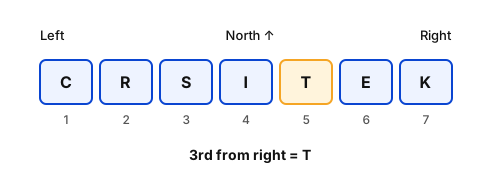
Seven people, S, T, I, C, K, E and R, are sitting in a row, facing north. Only two people sit between C and I. Only K sits to the right of E. Only one person sits between I and E. S sits at some place to the right of R but at some place to the left of T. Who sits third from the right end of the line?
सात व्यक्ति, S, T, I, C, K, E और R, एक पंक्ति में उत्तर की ओर मुख करके बैठे हैं। C और I के बीच केवल दो व्यक्ति बैठे हैं। E के दाईं ओर केवल K बैठा है। I और E के बीच केवल एक व्यक्ति बैठा है। S, R के दाईं ओर कहीं बैठा है लेकिन T के बाईं ओर कहीं बैठा है। पंक्ति के दाएँ छोर से तीसरे स्थान पर कौन बैठा है?
  1. AC
  2. BI
  3. CS
  4. DT
Show answer

Concept: All face north, so left and right are the solver's left and right. Fix the sure positions first.

  1. Only K is to the right of E → K at the right end (7), E at 6.
  2. One person between I and E → I at 4. Two people between C and I → C at 1 (7 is taken).
  3. R, S, T fill 2, 3, 5 in the order R – S – T (S between R and T) → R 2, S 3, T 5.
  4. Row: C R S I T E K → third from the right is T.

Trick: Clues with ‘only’ (only K to the right) lock the end seats – start there.

Answer: (D) T

अवधारणा: सभी उत्तर की ओर मुख किए हैं, इसलिए बायाँ-दायाँ हमारे जैसा ही है। पहले निश्चित स्थान भरें।

  1. केवल K, E के दाएँ है → K दाएँ छोर (7) पर, E 6 पर।
  2. I और E के बीच एक व्यक्ति → I 4 पर। C और I के बीच दो → C 1 पर (7 भरा है)।
  3. R, S, T स्थान 2, 3, 5 पर R – S – T क्रम में → R 2, S 3, T 5।
  4. पंक्ति: C R S I T E K → दाएँ से तीसरा T।

ट्रिक: ‘केवल’ वाले संकेत (केवल K दाएँ) छोर की सीट तय करते हैं – वहीं से शुरू करें।

उत्तर: (D) T

RRB NTPC Undergraduate CBT 1General Intelligence and ReasoningLinear Seating ArrangementRRB NTPC Undergraduate CBT 1 2025 · 20 Jun Shift 3 →
Q5689.
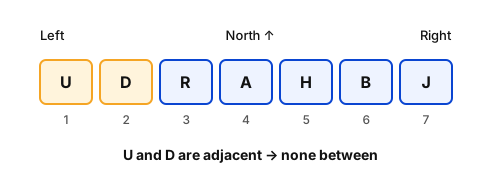
Seven people, A, B, U, D, R, H and J, are sitting in a row, facing north.
Only five people sit to the right of D. Only four people sit to the left of H. R is the immediate neighbour of A and D. J sits to the immediate right of B.
How many people sit between U and D?
सात व्यक्ति, A, B, U, D, R, H और J, एक पंक्ति में उत्तर की ओर मुख करके बैठे हैं।
D के दाईं ओर केवल पाँच व्यक्ति बैठे हैं। H के बाईं ओर केवल चार व्यक्ति बैठे हैं। R, A और D का निकटतम पड़ोसी है। J, B के ठीक दाईं ओर बैठा है।
U और D के बीच कितने व्यक्ति बैठे हैं?
  1. ATwoदो
  2. BOneएक
  3. CNoneकोई नहीं
  4. DThreeतीन
Show answer

Concept: Facing north, left–right is the same as ours. Place the people fixed by count clues first.

  1. Five people to the right of D → D is 2nd from the left. Four people to the left of H → H is 5th.
  2. R is the neighbour of both A and D → R at 3 and A at 4 (R at 1 would leave no seat for A).
  3. Seats 1, 6, 7 remain; J is immediately right of B → B 6, J 7, so U 1.
  4. Row: U D R A H B J → U and D are adjacent, no one between them.

Trick: ‘n people to the right’ in a row of 7 means position 7−n from the left.

Answer: (C) None

अवधारणा: उत्तर की ओर मुख – बायाँ-दायाँ हमारे जैसा। पहले संख्या वाले संकेतों से स्थान तय करें।

  1. D के दाएँ पाँच लोग → D बाएँ से दूसरा। H के बाएँ चार लोग → H पाँचवाँ।
  2. R, A और D दोनों का पड़ोसी → R 3 पर, A 4 पर (R 1 पर हो तो A के लिए जगह नहीं)।
  3. स्थान 1, 6, 7 बचे; J, B के ठीक दाएँ → B 6, J 7, अतः U 1।
  4. पंक्ति: U D R A H B J → U और D पास-पास, बीच में कोई नहीं।

ट्रिक: 7 की पंक्ति में ‘n लोग दाएँ’ = बाएँ से स्थान 7−n।

उत्तर: (C) कोई नहीं

RRB NTPC Undergraduate CBT 1General Intelligence and ReasoningLinear Seating ArrangementRRB NTPC Undergraduate CBT 1 2025 · 20 Jun Shift 3 →
Q5690.
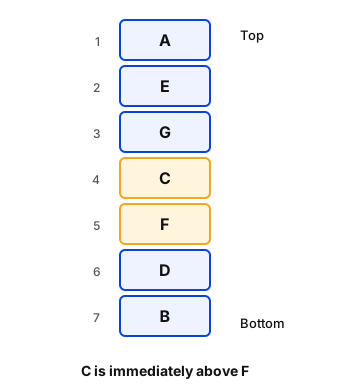
Seven boxes A, B, C, D, E, F and G are kept one over the other but not necessarily in the same order. Only three boxes are kept above C. Only one box is kept between D and C. Only three boxes are kept between D and E. E is kept at some place above C. G is kept immediately below E. F is kept at one of the places above B. A is not kept immediately above or below D. Which box is kept immediately above F?
सात बक्से A, B, C, D, E, F और G एक के ऊपर एक रखे गए हैं, लेकिन यह आवश्यक नहीं है कि इसी क्रम में हों। C के ऊपर केवल तीन बक्से रखे गए हैं। D और C के बीच केवल एक बक्सा रखा गया है। D और E के बीच केवल तीन बक्से रखे गए हैं। E, C के ऊपर कहीं रखा गया है। G, E के ठीक नीचे रखा गया है। F, B के ऊपर के स्थानों में से किसी एक स्थान पर रखा गया है। A, D के ठीक ऊपर या ठीक नीचे नहीं रखा गया है। F के ठीक ऊपर कौन-सा बक्सा रखा गया है?
  1. AD
  2. BG
  3. CA
  4. DC
Show answer

Concept: Number the positions 1 (top) to 7 (bottom) and place the fixed boxes first.

  1. Three boxes above C → C at 4. One box between D and C → D at 2 or 6.
  2. Three boxes between D and E, and E above C → D at 6, E at 2. G just below E → G at 3.
  3. Positions 1, 5, 7 remain for A, B, F. A not next to D (5 or 7) → A at 1; F above B → F 5, B 7.
  4. Stack: A, E, G, C, F, D, B → box just above F is C.

Trick: Test both cases of an ‘either–or’ clue; the one that breaks a later rule is dropped.

Answer: (D) C

अवधारणा: स्थानों को 1 (ऊपर) से 7 (नीचे) क्रमांक दें और पहले निश्चित बॉक्स रखें।

  1. C के ऊपर तीन बॉक्स → C 4 पर। D और C के बीच एक → D 2 या 6 पर।
  2. D और E के बीच तीन, और E, C के ऊपर → D 6, E 2। G, E के ठीक नीचे → G 3।
  3. स्थान 1, 5, 7 पर A, B, F। A, D के पास (5 या 7) नहीं → A 1; F, B के ऊपर → F 5, B 7।
  4. क्रम: A, E, G, C, F, D, B → F के ठीक ऊपर C।

ट्रिक: ‘या’ वाले संकेत के दोनों केस जाँचें; जो आगे के नियम तोड़े, उसे हटाएँ।

उत्तर: (D) C

RRB NTPC Undergraduate CBT 1General Intelligence and ReasoningBox ArrangementRRB NTPC Undergraduate CBT 1 2025 · 20 Jun Shift 3 →
Q5691.
Which of the following letter-number clusters will replace the question mark (?) in the given series to make it logically complete?
ADG 3 EHK 6 ILO 9 MPS 12 ?
निम्नलिखित में से कौन-सा अक्षर-संख्या समूह दी गई श्रृंखला में प्रश्न चिह्न (?) का स्थान लेकर उसे तार्किक रूप से पूर्ण करेगा?
ADG 3 EHK 6 ILO 9 MPS 12 ?
  1. ARUX 15
  2. BQTV 15
  3. CQTW 15
  4. DQSW 15
Show answer

Concept: Follow each letter position and the number separately.

  1. First letters: A, E, I, M → +4 → Q.
  2. Second letters: D, H, L, P → T; third letters: G, K, O, S → W.
  3. Numbers: 3, 6, 9, 12 → +3 → 15.
  4. Missing term = QTW 15.

Trick: Inside each cluster letters are 3 apart (A_ _D_ _G) – Q, T, W keeps this gap.

Answer: (C) QTW 15

अवधारणा: हर अक्षर-स्थान और संख्या को अलग-अलग देखें।

  1. पहले अक्षर: A, E, I, M → +4 → Q।
  2. दूसरे अक्षर: D, H, L, P → T; तीसरे: G, K, O, S → W।
  3. संख्याएँ: 3, 6, 9, 12 → +3 → 15।
  4. लुप्त पद = QTW 15।

ट्रिक: हर समूह में अक्षर 3-3 के अंतर पर (A_ _D_ _G) – Q, T, W में भी यही अंतर।

उत्तर: (C) QTW 15

RRB NTPC Undergraduate CBT 1General Intelligence and ReasoningLetter-Number SeriesRRB NTPC Undergraduate CBT 1 2025 · 20 Jun Shift 3 →
Q5692.
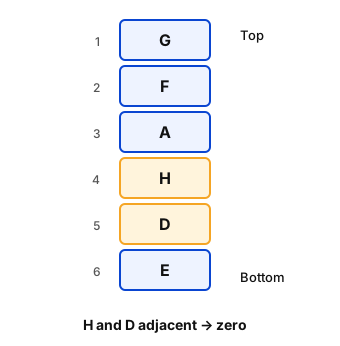
Six boxes D, E, F, G, H and A are kept one over the other but not necessarily in the same order. Only three boxes are kept below A. Only two boxes are kept between A and E. No box is kept above G. H is kept at some place below F and at some place above D. How many boxes are kept between H and D?
छह बक्से D, E, F, G, H और A एक के ऊपर एक रखे गए हैं, लेकिन यह आवश्यक नहीं है कि इसी क्रम में हों। A के नीचे केवल तीन बक्से रखे गए हैं। A और E के बीच केवल दो बक्से रखे गए हैं। G के ऊपर कोई बक्सा नहीं रखा गया है। H, F के नीचे कहीं और D के ऊपर कहीं रखा गया है। H और D के बीच कितने बक्से रखे गए हैं?
  1. AZeroशून्य
  2. BOneएक
  3. CTwoदो
  4. DThreeतीन
Show answer

Concept: Number positions 1 (top) to 6 (bottom).

  1. No box above G → G at 1. Three boxes below A → A at 3.
  2. Two boxes between A and E → E at 6.
  3. Positions 2, 4, 5 remain; F above H above D → F 2, H 4, D 5.
  4. H and D are adjacent → zero boxes between them.

Trick: ‘No box above X’ means X is on top – the easiest anchor.

Answer: (A) Zero

अवधारणा: स्थानों को 1 (ऊपर) से 6 (नीचे) क्रमांक दें।

  1. G के ऊपर कोई बॉक्स नहीं → G 1 पर। A के नीचे तीन बॉक्स → A 3 पर।
  2. A और E के बीच दो बॉक्स → E 6 पर।
  3. स्थान 2, 4, 5 बचे; F के नीचे H और H के नीचे D → F 2, H 4, D 5।
  4. H और D पास-पास → बीच में शून्य बॉक्स।

ट्रिक: ‘X के ऊपर कोई नहीं’ = X सबसे ऊपर – सबसे आसान शुरुआत।

उत्तर: (A) शून्य

RRB NTPC Undergraduate CBT 1General Intelligence and ReasoningBox ArrangementRRB NTPC Undergraduate CBT 1 2025 · 20 Jun Shift 3 →
Q5693.
In the following number-pairs, the second number is obtained by applying certain mathematical operations to the first number. Select the set in which the numbers are related in the same way as are the numbers of the following sets.
(NOTE: Operations should be performed on the whole numbers, without breaking down the numbers into their constituent digits. E.g. 13 – Operations on 13 such as adding / subtracting /multiplying etc. to 13 can be performed. Breaking down 13 into 1 and 3 and then performing mathematical operations on 1 and 3 is not allowed.)
89, 104
157, 172
निम्नलिखित संख्या-युग्मों में, दूसरी संख्या पहली संख्या पर कुछ निश्चित गणितीय संक्रियाएँ करके प्राप्त की जाती है। उस समुच्चय का चयन कीजिए जिसमें संख्याएँ उसी प्रकार संबंधित हैं जिस प्रकार निम्नलिखित समुच्चयों की संख्याएँ संबंधित हैं।
(ध्यान दें: संख्याओं को उनके घटक अंकों में विभाजित किए बिना, संक्रियाएँ पूर्ण संख्याओं पर की जानी चाहिए। उदाहरण के लिए, 13 – 13 पर संक्रियाएँ जैसे 13 में जोड़ना/घटाना/गुणा करना आदि किया जा सकता है। 13 को 1 और 3 में विभाजित करके फिर 1 और 3 पर गणितीय संक्रियाएँ करने की अनुमति नहीं है।)
89, 104
157, 172
  1. A56, 72
  2. B97, 111
  3. C39, 64
  4. D138, 153
Show answer

Concept: Find the operation that turns the first number into the second in both given pairs.

  1. 104−89=15 and 172−157=15 → rule: add 15.
  2. 138+15=153 ✓.
  3. Others: 56+15=71≠72, 97+15=112≠111, 39+15=54≠64.

Trick: Small, equal differences → simple addition rule; check the difference first.

Answer: (D) 138, 153

अवधारणा: दोनों युग्मों में पहली संख्या से दूसरी संख्या बनाने वाली संक्रिया खोजें।

  1. 104−89=15 और 172−157=15 → नियम: 15 जोड़ें।
  2. 138+15=153 ✓।
  3. अन्य: 56+15=71≠72, 97+15=112≠111, 39+15=54≠64।

ट्रिक: छोटे और समान अंतर → जोड़ का नियम; पहले अंतर देखें।

उत्तर: (D) 138, 153

RRB NTPC Undergraduate CBT 1General Intelligence and ReasoningNumber Pair AnalogyRRB NTPC Undergraduate CBT 1 2025 · 20 Jun Shift 3 →
Q5694.
In a certain code language, ‘bat view month’ is coded as 'nd wz nh' and ‘oven month gum’ is coded as ‘on ju wz’. How is ‘month’ coded in the given language?
एक निश्चित कूट भाषा में, ‘bat view month’ को ‘nd wz nh’ के रूप में कूटबद्ध किया जाता है और ‘oven month gum’ को ‘on ju wz’ के रूप में कूटबद्ध किया जाता है। उस भाषा में ‘month’ को किस प्रकार कूटबद्ध किया जाता है?
  1. Anh
  2. Bon
  3. Cwz
  4. Dnd
Show answer

Concept: A word common to two sentences has the code common to both coded sentences.

  1. ‘bat view month’ → nd wz nh.
  2. ‘oven month gum’ → on ju wz.
  3. Common word = month; common code = wz → month = wz.

Trick: Common word ↔ common code – ignore positions.

Answer: (C) wz

अवधारणा: दो वाक्यों में समान शब्द का कोड दोनों कोडित वाक्यों में समान होता है।

  1. ‘bat view month’ → nd wz nh।
  2. ‘oven month gum’ → on ju wz।
  3. समान शब्द = month; समान कोड = wz → month = wz।

ट्रिक: समान शब्द ↔ समान कोड – क्रम पर ध्यान न दें।

उत्तर: (C) wz

RRB NTPC Undergraduate CBT 1General Intelligence and ReasoningCoding-Decoding – Common WordsRRB NTPC Undergraduate CBT 1 2025 · 20 Jun Shift 3 →
Q5695.
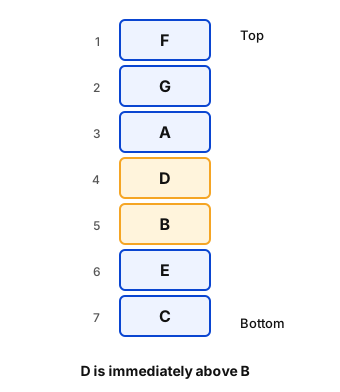
Seven boxes A, B, C, D, E, F and G are kept one over the other but not necessarily in the same order. Only three boxes are kept below D. Only two boxes are kept between D and C. Only F is kept above G. B is kept at some place below A and some place above E. Which box is kept immediately above B?
सात बक्से A, B, C, D, E, F और G एक के ऊपर एक रखे गए हैं, लेकिन यह आवश्यक नहीं है कि इसी क्रम में हों। D के नीचे केवल तीन बक्से रखे गए हैं। D और C के बीच केवल दो बक्से रखे गए हैं। G के ऊपर केवल F रखा गया है। B, A के नीचे कहीं और E के ऊपर कहीं रखा गया है। B के ठीक ऊपर कौन-सा बक्सा रखा गया है?
  1. AC
  2. BA
  3. CF
  4. DD
Show answer

Concept: Number the positions 1 (top) to 7 (bottom).

  1. Only F above G → F at 1, G at 2. Three boxes below D → D at 4.
  2. Two boxes between D and C → C at 1 or 7; 1 is F, so C at 7.
  3. Positions 3, 5, 6 remain; A above B above E → A 3, B 5, E 6.
  4. Stack: F, G, A, D, B, E, C → box just above B is D.

Trick: ‘Only F above G’ fixes the top two boxes at once.

Answer: (D) D

अवधारणा: स्थानों को 1 (ऊपर) से 7 (नीचे) क्रमांक दें।

  1. केवल F, G के ऊपर → F 1, G 2। D के नीचे तीन बॉक्स → D 4।
  2. D और C के बीच दो → C 1 या 7; 1 पर F है, अतः C 7।
  3. स्थान 3, 5, 6 बचे; A के नीचे B, B के नीचे E → A 3, B 5, E 6।
  4. क्रम: F, G, A, D, B, E, C → B के ठीक ऊपर D।

ट्रिक: ‘केवल F, G के ऊपर’ से ऊपर के दो बॉक्स तुरंत तय।

उत्तर: (D) D

RRB NTPC Undergraduate CBT 1General Intelligence and ReasoningBox ArrangementRRB NTPC Undergraduate CBT 1 2025 · 20 Jun Shift 3 →
Q5696.
Which of the following statements about the National Industrial Corridor Development Programme is INCORRECT?
राष्ट्रीय औद्योगिक गलियारा विकास कार्यक्रम (National Industrial Corridor Development Programme) के संबंध में निम्नलिखित में से कौन-सा कथन गलत है?
  1. AIt seeks to develop new industrial cities as smart cities by integrating next-generation technologies across infrastructure sectorsइसका उद्देश्य बुनियादी ढाँचा क्षेत्रों में अगली पीढ़ी की प्रौद्योगिकियों को एकीकृत करके नए औद्योगिक शहरों को स्मार्ट सिटी के रूप में विकसित करना है
  2. BIt is an infrastructure initiative that aims to shape the future of urban and industrial developmentयह एक बुनियादी ढाँचा पहल है जिसका उद्देश्य शहरी और औद्योगिक विकास के भविष्य को आकार देना है
  3. CIt aims at providing complete “plug and play” infrastructure till the plot level along with building sustainable future ready citiesइसका उद्देश्य संधारणीय एवं भविष्य के लिए तैयार शहरों के निर्माण के साथ-साथ प्लॉट स्तर तक संपूर्ण “प्लग एंड प्ले” बुनियादी ढाँचा उपलब्ध कराना है
  4. DThe program started with the launch of Palakkad-Bangalore-Mumbai-Ahmedabad Industrial Corridor in 2010इस कार्यक्रम की शुरुआत 2010 में पलक्कड़-बेंगलुरु-मुंबई-अहमदाबाद औद्योगिक गलियारे के शुभारंभ के साथ हुई थी
Show answer

Concept: The National Industrial Corridor Development Programme (NICDP) builds greenfield industrial smart cities with “plug and play” infrastructure.

  1. The programme began with the Delhi–Mumbai Industrial Corridor (DMIC), approved in 2007 with Japanese support – not a Palakkad-Bangalore-Mumbai-Ahmedabad corridor in 2010.
  2. Statements on smart cities, next-generation infrastructure and plot-level plug-and-play facilities are correct objectives of NICDP.
  3. It is implemented through the National Industrial Corridor Development and Implementation Trust (NICDIT).

Yaad rakhein: First corridor = DMIC (Delhi–Mumbai); the 2024 approval added 12 new industrial smart cities under NICDP.

Answer: (D) The program started with the launch of Palakkad-Bangalore-Mumbai-Ahmedabad Industrial Corridor in 2010

अवधारणा: राष्ट्रीय औद्योगिक गलियारा विकास कार्यक्रम (NICDP) “प्लग एंड प्ले” बुनियादी ढाँचे के साथ नए औद्योगिक स्मार्ट शहर विकसित करता है।

  1. कार्यक्रम की शुरुआत दिल्ली–मुंबई औद्योगिक गलियारा (DMIC) से हुई, जिसे 2007 में जापान के सहयोग से मंज़ूरी मिली – 2010 में पलक्कड़-बेंगलुरु-मुंबई-अहमदाबाद गलियारे से नहीं।
  2. स्मार्ट सिटी, अगली पीढ़ी की तकनीक और प्लॉट स्तर तक प्लग-एंड-प्ले सुविधा – ये NICDP के सही उद्देश्य हैं।
  3. इसे राष्ट्रीय औद्योगिक गलियारा विकास एवं कार्यान्वयन ट्रस्ट (NICDIT) लागू करता है।

याद रखें: पहला गलियारा = DMIC (दिल्ली–मुंबई); 2024 में NICDP के तहत 12 नए औद्योगिक स्मार्ट शहर मंज़ूर हुए।

उत्तर: (D) यह कार्यक्रम 2010 में पलक्कड़-बेंगलुरु-मुंबई-अहमदाबाद औद्योगिक गलियारे के शुभारंभ से शुरू हुआ

RRB NTPC Undergraduate CBT 1General AwarenessIndustrial corridorsRRB NTPC Undergraduate CBT 1 2025 · 20 Jun Shift 2 →
Q5697.
Who among the following wrote the book 'The World After Gaza'?
निम्नलिखित में से किसने 'The World After Gaza' पुस्तक लिखी है?
  1. ADr. S Jaishankarडॉ. एस. जयशंकर
  2. BDr. Aishwarya Panditडॉ. ऐश्वर्या पंडित
  3. CAmitabh Kantअमिताभ कांत
  4. DPankaj Mishraपंकज मिश्रा
Show answer

Concept: The World After Gaza (2025) is a non-fiction book by Indian essayist and novelist Pankaj Mishra.

  1. It examines the Gaza war and its effect on global politics and moral thinking.
  2. Pankaj Mishra is also the author of Age of Anger and From the Ruins of Empire.
  3. Dr. S. Jaishankar wrote The India Way and Why Bharat Matters; Amitabh Kant wrote Made in India.

Yaad rakhein: Pankaj Mishra – Age of Anger, The World After Gaza.

Answer: (D) Pankaj Mishra

अवधारणा: The World After Gaza (2025) भारतीय निबंधकार और उपन्यासकार पंकज मिश्रा की पुस्तक है।

  1. यह गाज़ा युद्ध और विश्व राजनीति व नैतिक सोच पर उसके प्रभाव की पड़ताल करती है।
  2. पंकज मिश्रा ने Age of Anger और From the Ruins of Empire भी लिखी हैं।
  3. डॉ. एस. जयशंकर ने The India Way व Why Bharat Matters लिखी; अमिताभ कांत ने Made in India।

याद रखें: पंकज मिश्रा – Age of Anger, The World After Gaza।

उत्तर: (D) पंकज मिश्रा

RRB NTPC Undergraduate CBT 1General AwarenessBooks and authorsRRB NTPC Undergraduate CBT 1 2025 · 20 Jun Shift 2 →
Q5698.
The International Day for the Elimination of Violence against Women marks the beginning of which global campaign?
महिलाओं के विरुद्ध हिंसा उन्मूलन का अंतर्राष्ट्रीय दिवस किस वैश्विक अभियान की शुरुआत का प्रतीक है?
  1. A30 Days of Human Rights Protectionमानवाधिकार संरक्षण के 30 दिन
  2. B7 Days for Womenमहिलाओं के लिए 7 दिन
  3. C16 Days of Activism against Gender-Based Violenceलिंग-आधारित हिंसा के विरुद्ध सक्रियता के 16 दिन
  4. D10 Days of Equalityसमानता के 10 दिन
Show answer

Concept: The International Day for the Elimination of Violence against Women is observed on 25 November.

  1. It launches the 16 Days of Activism against Gender-Based Violence.
  2. The campaign runs from 25 November to 10 December (Human Rights Day).
  3. The UN “UNiTE” campaign uses the colour orange for these 16 days.

Yaad rakhein: 25 Nov to 10 Dec = 16 days of activism.

Answer: (C) 16 Days of Activism against Gender-Based Violence

अवधारणा: महिलाओं के विरुद्ध हिंसा उन्मूलन का अंतर्राष्ट्रीय दिवस 25 नवंबर को मनाया जाता है।

  1. इसी दिन से लैंगिक हिंसा के विरुद्ध 16 दिवसीय सक्रियता अभियान (16 Days of Activism) शुरू होता है।
  2. यह अभियान 25 नवंबर से 10 दिसंबर (मानवाधिकार दिवस) तक चलता है।
  3. संयुक्त राष्ट्र का “UNiTE” अभियान इन 16 दिनों के लिए नारंगी रंग का प्रयोग करता है।

याद रखें: 25 नवंबर से 10 दिसंबर = 16 दिन की सक्रियता।

उत्तर: (C) 16 Days of Activism against Gender-Based Violence

RRB NTPC Undergraduate CBT 1General AwarenessImportant daysRRB NTPC Undergraduate CBT 1 2025 · 20 Jun Shift 2 →
Q5699.
Which of the following Deccan rulers defeated Harshavardhana and assumed the title “Dakshinapatheshvara” (Lord of the Deccan)?
निम्नलिखित में से किस दक्कन शासक ने हर्षवर्धन को पराजित किया और “दक्षिणापथेश्वर” (दक्कन का स्वामी) की उपाधि धारण की?
  1. ADhruva Dharavarshaध्रुव धारावर्ष
  2. BVikramaditya Iविक्रमादित्य प्रथम
  3. CNarasimhavarman Iनरसिंहवर्मन प्रथम
  4. DPulakeshin IIपुलकेशिन द्वितीय
Show answer

Concept: Pulakeshin II (c. 610–642 CE) was the greatest Chalukya ruler of Badami (Vatapi).

  1. He defeated Harshavardhana on the banks of the Narmada, stopping his southward expansion.
  2. After this victory he took the title Dakshinapatheshvara (Lord of the South); the Aihole inscription by Ravikirti records it.
  3. Narasimhavarman I (Pallava) later defeated Pulakeshin II and took the title Vatapikonda.

Yaad rakhein: Aihole inscription → Ravikirti → Pulakeshin II beats Harsha at the Narmada.

Answer: (D) Pulakeshin II

अवधारणा: पुलकेशिन द्वितीय (लगभग 610–642 ई.) बादामी (वातापी) के सबसे महान चालुक्य शासक थे।

  1. उन्होंने नर्मदा के तट पर हर्षवर्धन को पराजित कर उसके दक्षिण विस्तार को रोका।
  2. इस विजय के बाद उन्होंने दक्षिणापथेश्वर की उपाधि ली; रविकीर्ति का ऐहोल अभिलेख इसका वर्णन करता है।
  3. पल्लव नरसिंहवर्मन प्रथम ने बाद में पुलकेशिन द्वितीय को हराकर “वातापीकोंड” उपाधि ली।

याद रखें: ऐहोल अभिलेख → रविकीर्ति → पुलकेशिन द्वितीय ने नर्मदा पर हर्ष को हराया।

उत्तर: (D) पुलकेशिन द्वितीय

RRB NTPC Undergraduate CBT 1General AwarenessChalukyas of BadamiRRB NTPC Undergraduate CBT 1 2025 · 20 Jun Shift 2 →
Q5700.
The Supreme Court of India can issue how many types of writs (orders)?
भारत का सर्वोच्च न्यायालय कितने प्रकार की रिट (आदेश) जारी कर सकता है?
  1. A2
  2. B3
  3. C6
  4. D5
Show answer

Concept: Under Article 32 the Supreme Court (and under Article 226 the High Courts) can issue five types of writs.

  1. Habeas Corpus, Mandamus, Prohibition, Certiorari and Quo Warranto.
  2. These are used to enforce Fundamental Rights; High Courts can also use them for other legal rights.

Yaad rakhein: “HM PCQ” – Habeas corpus, Mandamus, Prohibition, Certiorari, Quo warranto.

Answer: (D) 5

अवधारणा: अनुच्छेद 32 के तहत सर्वोच्च न्यायालय (और अनुच्छेद 226 के तहत उच्च न्यायालय) पाँच प्रकार की रिट जारी कर सकते हैं।

  1. बंदी प्रत्यक्षीकरण (Habeas Corpus), परमादेश (Mandamus), प्रतिषेध (Prohibition), उत्प्रेषण (Certiorari) और अधिकार-पृच्छा (Quo Warranto)।
  2. ये मौलिक अधिकारों को लागू कराने के लिए हैं; उच्च न्यायालय इन्हें अन्य कानूनी अधिकारों के लिए भी जारी कर सकते हैं।

याद रखें: “HM PCQ” – हेबियस कॉर्पस, मैंडमस, प्रोहिबिशन, सर्शियोरारी, क्वो वारंटो।

उत्तर: (D) 5

RRB NTPC Undergraduate CBT 1General AwarenessWritsRRB NTPC Undergraduate CBT 1 2025 · 20 Jun Shift 2 →