RRB NTPC Undergraduate CBT 1 2025 · Shift 3

RRB NTPC Undergraduate CBT 1 20 Jun 2026 Shift 3 – Question Paper

100 questions · 100 marks · 90 minutes · +1 for a correct answer, −1/3 for a wrong one. With answer key and detailed solutions in Hindi and English.

Test Series – airGurukul

Paper pattern

SectionQuestionsMarks
General Awareness4040
Mathematics3030
General Intelligence and Reasoning3030

Sample questions from this paper

Q1.
In a Word document form, when you press the Tab key after filling a name field, to which element does the focus shift?
Word डॉक्यूमेंट के किसी फ़ॉर्म में, नाम फ़ील्ड भरने के बाद Tab कुंजी दबाने पर फ़ोकस किस तत्व पर चला जाता है?
  1. ADeletes all entered form data instantlyदर्ज किया गया सारा फ़ॉर्म डेटा तुरंत हटा देता है
  2. B​Moves cursor to subsequent input field or table cellकर्सर को अगले इनपुट फ़ील्ड या तालिका सेल पर ले जाता है
  3. CPrints the form with current entriesफ़ॉर्म को वर्तमान प्रविष्टियों के साथ प्रिंट करता है
  4. DSaves document and closes the form viewडॉक्यूमेंट को सेव करके फ़ॉर्म व्यू बंद कर देता है
Show answer

Concept: In MS Word forms and tables, the Tab key moves focus forward.

  1. In a protected form, Tab jumps to the next form field (content control).
  2. In a table, Tab moves to the next cell (in the last cell it adds a new row).
  3. Tab never deletes, prints or saves data.

Trick: Tab = next field; Shift + Tab = previous field.

Answer: (B) Moves cursor to subsequent input field or table cell

अवधारणा: MS Word के फ़ॉर्म और टेबल में Tab कुंजी फ़ोकस आगे बढ़ाती है।

  1. सुरक्षित फ़ॉर्म में Tab अगले फ़ॉर्म फ़ील्ड (content control) पर ले जाती है।
  2. टेबल में Tab अगली cell पर ले जाती है (अंतिम cell में नई row जोड़ती है)।
  3. Tab डेटा delete, print या save नहीं करती।

ट्रिक: Tab = अगला फ़ील्ड; Shift + Tab = पिछला फ़ील्ड।

उत्तर: (B) Moves cursor to subsequent input field or table cell
RRB NTPC Undergraduate CBT 1General AwarenessComputer – MS Word Forms
Q41.
A person walks 40 km at a speed of 5 km/hr, then runs 30 km at a speed of 10 km/hr. What is the ratio of walking time to running time?
एक व्यक्ति 5 km/hr की चाल से 40 km पैदल चलता है, फिर 10 km/hr की चाल से 30 km दौड़ता है। पैदल चलने के समय और दौड़ने के समय का अनुपात क्या है?
  1. A3 : 8
  2. B3 : 5
  3. C5 : 3
  4. D8 : 3
Show answer

Concept: Time=DistanceSpeed.

  1. Walking time =405=8 h.
  2. Running time =3010=3 h.
  3. Ratio =8:3.

Trick: Find each time separately, then compare – never compare speeds directly.

Answer: (D) 8:3

अवधारणा: समय=दूरीचाल.

  1. चलने का समय =405=8 घंटे।
  2. दौड़ने का समय =3010=3 घंटे।
  3. अनुपात =8:3।

ट्रिक: पहले दोनों समय अलग-अलग निकालें, फिर अनुपात लें।

उत्तर: (D) 8:3

RRB NTPC Undergraduate CBT 1MathematicsTime, Speed and Distance
Q71.
Read the given statements and conclusions carefully. You have to take the given statements to be true even if they seem to be at variance from commonly known facts. You have to decide which conclusions logically follow/s from the given statements. Statements: All vans are trailers. No trailer is a scooter.
Conclusion (I) : No van is a scooter
Conclusion (II) : Some scooters are trailers
दिए गए कथनों और निष्कर्षों को ध्यानपूर्वक पढ़िए। आपको दिए गए कथनों को सत्य मानना है, भले ही वे सामान्यतः ज्ञात तथ्यों से भिन्न प्रतीत होते हों। आपको निर्णय करना है कि कौन-सा/से निष्कर्ष दिए गए कथनों का तार्किक रूप से अनुसरण करता है/करते हैं। कथन: सभी वैन, ट्रेलर हैं। कोई ट्रेलर, स्कूटर नहीं है।
निष्कर्ष (I) : कोई वैन, स्कूटर नहीं है
निष्कर्ष (II) : कुछ स्कूटर, ट्रेलर हैं
  1. AOnly conclusion (II) followsकेवल निष्कर्ष (II) अनुसरण करता है
  2. BBoth conclusions (I) and (II) followनिष्कर्ष (I) और (II) दोनों अनुसरण करते हैं
  3. COnly conclusion (I) followsकेवल निष्कर्ष (I) अनुसरण करता है
  4. DNeither conclusion (I) nor (II) followsन तो निष्कर्ष (I) और न ही (II) अनुसरण करता है
Show answer

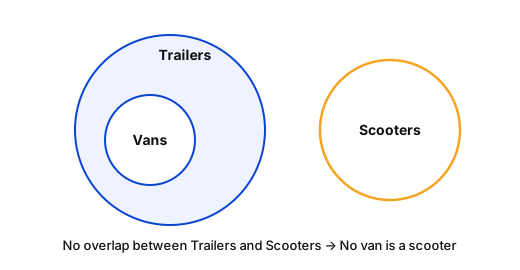
Concept: Draw the least-overlap Venn diagram for the statements and test each conclusion.

  1. All vans are trailers → Vans circle lies inside Trailers.
  2. No trailer is a scooter → Scooters circle is completely separate from Trailers.
  3. Since vans are inside trailers, no van can touch scooters → Conclusion I follows.
  4. Scooters and trailers never meet, so ‘Some scooters are trailers’ is false → II does not follow.

Trick: All A are B + No B is C ⇒ No A is C (always).

Answer: (C) Only conclusion (I) follows

अवधारणा: कथनों का न्यूनतम-संभव वेन आरेख बनाकर हर निष्कर्ष जाँचें।

  1. सभी वैन ट्रेलर हैं → वैन का वृत्त ट्रेलर के अंदर।
  2. कोई ट्रेलर स्कूटर नहीं → स्कूटर का वृत्त ट्रेलर से पूरी तरह अलग।
  3. वैन ट्रेलर के अंदर है, इसलिए कोई वैन स्कूटर नहीं → निष्कर्ष I सही।
  4. स्कूटर और ट्रेलर कभी नहीं मिलते, अतः ‘कुछ स्कूटर ट्रेलर हैं’ गलत → II अनुसरण नहीं करता।

ट्रिक: सभी A, B हैं + कोई B, C नहीं ⇒ कोई A, C नहीं।

उत्तर: (C) केवल निष्कर्ष (I) अनुसरण करता है

RRB NTPC Undergraduate CBT 1General Intelligence and ReasoningSyllogism

See all 100 solutions

More RRB NTPC Undergraduate CBT 1 papers

Download our app

Study smarter with the airGurukul App

Your complete exam-prep companion - classes, practice, and progress tracking.

Learn anytime, anywhere - live classes, tests, notes, and updates in one place.

GET IT ONGoogle Play

Have a query? We’re here to help

Fill out the form and our team will get back to you as soon as possible.

  • Ask your questions related to admission, courses, fees, or facilities
  • Share your details so our team can contact you easily
  • Get accurate information from our support team
  • Quick and simple form submission process

All fields marked * are required.