RRB NTPC Undergraduate CBT 1 2025 · Shift 3

RRB NTPC Undergraduate CBT 1 8 May 2026 Shift 3 – Question Paper

100 questions · 100 marks · 90 minutes · +1 for a correct answer, −1/3 for a wrong one. With answer key and detailed solutions in Hindi and English.

Test Series – airGurukul

Paper pattern

SectionQuestionsMarks
General Awareness4040
Mathematics3030
General Intelligence and Reasoning3030

Sample questions from this paper

Q1.
Why were tax incentives provided to foreign investors during the 1991 economic reform period in India?
भारत में 1991 के आर्थिक सुधार काल के दौरान विदेशी निवेशकों को कर प्रोत्साहन क्यों दिए गए थे?
  1. ATo promote domestic monopoliesघरेलू एकाधिकारों को बढ़ावा देने के लिए
  2. BTo discourage foreign investmentविदेशी निवेश को हतोत्साहित करने के लिए
  3. CTo attract foreign investmentविदेशी निवेश को आकर्षित करने के लिए
  4. DTo increase tax revenue for the governmentसरकार के कर राजस्व में वृद्धि करने के लिए
Show answer

Concept: The 1991 reforms (LPG – Liberalisation, Privatisation, Globalisation) opened the Indian economy to foreign capital.

  1. India faced a severe balance-of-payments crisis in 1991; foreign exchange reserves were enough for barely two weeks of imports.
  2. To bring in foreign capital and technology, the government offered tax incentives and concessions to foreign investors and raised FDI limits.
  3. Options A, B and D go against the very aim of liberalisation.

Yaad rakhein: 1991 reforms = LPG; tax holidays for foreign investors were part of "Globalisation".

Answer: (C) To attract foreign investment

अवधारणा: 1991 के सुधार (LPG – उदारीकरण, निजीकरण, वैश्वीकरण) ने भारतीय अर्थव्यवस्था को विदेशी पूँजी के लिए खोला।

  1. 1991 में भारत गंभीर भुगतान-संतुलन संकट में था; विदेशी मुद्रा भंडार मुश्किल से दो सप्ताह के आयात लायक था।
  2. विदेशी पूँजी और तकनीक लाने के लिए सरकार ने विदेशी निवेशकों को कर प्रोत्साहन (tax incentives) और रियायतें दीं तथा FDI सीमा बढ़ाई।
  3. विकल्प A, B और D उदारीकरण के उद्देश्य के ही विरुद्ध हैं।

याद रखें: 1991 सुधार = LPG; विदेशी निवेशकों को कर छूट "वैश्वीकरण" का हिस्सा थी।

उत्तर: (C) विदेशी निवेश आकर्षित करने के लिए
RRB NTPC Undergraduate CBT 1General AwarenessEconomy – 1991 Reforms
Q41.
Simplify: {1636÷164}÷(27×146+512)+47÷3912 of 127
सरल कीजिए: {1636÷164}÷(27×146+512)+47÷3912 of 127
  1. A1247
  2. B839
  3. C−143
  4. D733
Show answer

Concept: Apply BODMAS – brackets first, then "of", then ÷, ×, +, −.

  1. 1636÷164=49×416=19
  2. 27×146+512=23+512=1312, so first part =19÷1312=19×1213=439
  3. 3912 of 127=397, so 47÷397=47×739=439
  4. Total =439+439=839

Trick: "of" is done before ÷. Cancel common factors early – both parts come out as 439, so the answer is simply double.

Answer: (B) 839

अवधारणा: BODMAS लगाएँ – पहले कोष्ठक, फिर "of", फिर ÷, ×, +, −।

  1. 1636÷164=49×416=19
  2. 27×146+512=23+512=1312, अतः पहला भाग =19×1213=439
  3. 3912 of 127=397, अतः 47÷397=439
  4. योग =439+439=839

ट्रिक: "of" को ÷ से पहले हल करें। शुरू में ही common factor काटें – दोनों भाग 439 आते हैं, उत्तर बस दोगुना।

उत्तर: (B) 839

RRB NTPC Undergraduate CBT 1MathematicsSimplification (BODMAS)
Q71.
Read the given statements and conclusions carefully. Assuming that the information given in the statements is true, even if it appears to be at variance with commonly known facts, decide which of the given conclusions logically follow(s) from the statements.
Statement: All Chickens are Quails. All Quails are Pigeons.
Conclusion (I): No Pigeons are Chickens.
Conclusion (II): Some Pigeons are Chickens.
दिए गए कथनों और निष्कर्षों को ध्यानपूर्वक पढ़िए। यह मानते हुए कि कथनों में दी गई जानकारी सत्य है, भले ही वह सामान्यतः ज्ञात तथ्यों से भिन्न प्रतीत होती हो, निर्णय कीजिए कि दिए गए निष्कर्षों में से कौन-सा/कौन-से निष्कर्ष कथनों का तार्किक रूप से अनुसरण करता है/करते हैं।
कथन: सभी मुर्गियाँ बटेर हैं। सभी बटेर कबूतर हैं।
निष्कर्ष (I): कोई कबूतर मुर्गी नहीं है।
निष्कर्ष (II): कुछ कबूतर मुर्गियाँ हैं।
  1. ABoth conclusions (I) and (II) followनिष्कर्ष (I) और (II) दोनों अनुसरण करते हैं
  2. BOnly conclusion (I) followsकेवल निष्कर्ष (I) अनुसरण करता है
  3. COnly conclusion (II) followsकेवल निष्कर्ष (II) अनुसरण करता है
  4. DNeither conclusion (I) nor (II) followsन तो निष्कर्ष (I) और न ही (II) अनुसरण करता है
Show answer

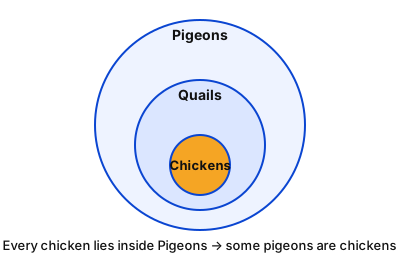
Concept: Draw the Venn diagram for two "All" statements – the sets nest inside each other.

  1. All Chickens are Quails and all Quails are Pigeons → Chickens ⊂ Quails ⊂ Pigeons, so all Chickens are Pigeons.
  2. Conclusion (I) "No Pigeons are Chickens" is the opposite of this – false.
  3. Conclusion (II) "Some Pigeons are Chickens" is the converse of "All Chickens are Pigeons" – it follows.

Trick: All A are B ⇒ Some B are A (always true); "No" can never follow from two "All" statements.

Answer: (C) Only conclusion (II) follows

अवधारणा: दो "All" कथनों का Venn चित्र बनाएँ – समूह एक-दूसरे के अंदर समा जाते हैं।

  1. सभी Chickens, Quails हैं और सभी Quails, Pigeons हैं → Chickens ⊂ Quails ⊂ Pigeons, अतः सभी Chickens, Pigeons हैं।
  2. निष्कर्ष (I) "कोई Pigeon, Chicken नहीं" इसके विपरीत है – गलत।
  3. निष्कर्ष (II) "कुछ Pigeons, Chickens हैं" – "सभी Chickens, Pigeons हैं" का converse है – सही।

ट्रिक: All A are B ⇒ Some B are A (हमेशा सही); दो "All" कथनों से "No" कभी नहीं निकलता।

उत्तर: (C) Only conclusion (II) follows

RRB NTPC Undergraduate CBT 1General Intelligence and ReasoningSyllogism

See all 100 solutions

More RRB NTPC Undergraduate CBT 1 papers

Download our app

Study smarter with the airGurukul App

Your complete exam-prep companion - classes, practice, and progress tracking.

Learn anytime, anywhere - live classes, tests, notes, and updates in one place.

GET IT ONGoogle Play

Have a query? We’re here to help

Fill out the form and our team will get back to you as soon as possible.

  • Ask your questions related to admission, courses, fees, or facilities
  • Share your details so our team can contact you easily
  • Get accurate information from our support team
  • Quick and simple form submission process

All fields marked * are required.