Question bank

Q&A: practice questions with answers

Search questions on any topic. Filter by exam category, exam, subject and topic, try the question, then open the answer and explanation.

Courses – airGurukul

8,495 questions found.

Q561.
The average of first 164 even numbers is
प्रथम 164 सम संख्याओं का औसत है
  1. A165
  2. B164.5
  3. C166
  4. D165.5
Show answer

Concept: Average of the first n even numbers =n+1 (sum =n(n+1)).

  1. Sum =164×165.
  2. Average =164×165164=165.

Trick: First n even → n+1; first n odd → n.

Answer: (A) 165

अवधारणा: प्रथम n सम संख्याओं का औसत =n+1 (योग =n(n+1))।

  1. योग =164×165।
  2. औसत =165।

ट्रिक: प्रथम n सम → n+1; प्रथम n विषम → n।

उत्तर: (A) 165

RRB NTPC Undergraduate CBT 1MathematicsAverage – Even NumbersRRB NTPC Undergraduate CBT 1 2024 · 28 Aug Shift 1 →
Q562.
Pipe P can fill 56 part of a tank in 30 hours, and pipe Q can fill 34 part of the same tank in 27 hours. Both P and Q were kept open for 2 hours, then both were closed. Pipe R alone was then opened and it emptied the water in the tank in 4 hours. Pipes P, Q and R together can fill the empty tank in:
पाइप P किसी टंकी का 56 भाग 30 घंटे में भर सकता है, और पाइप Q उसी टंकी का 34 भाग 27 घंटे में भर सकता है। P और Q दोनों को 2 घंटे तक खुला रखा गया, फिर दोनों को बंद कर दिया गया। इसके बाद केवल पाइप R को खोला गया और उसने टंकी का पानी 4 घंटे में खाली कर दिया। पाइप P, Q और R मिलकर खाली टंकी को कितने समय में भर सकते हैं?
  1. A54 hours54 घंटे
  2. B44 hours44 घंटे
  3. C36 hours36 घंटे
  4. D48 hours48 घंटे
Show answer

Concept: Find each pipe's full-tank time, take tank = LCM units, and add rates (emptying pipe negative).

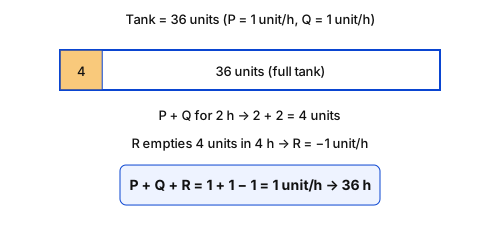
  1. P: 56 in 30 h → full in 36 h. Q: 34 in 27 h → full in 36 h.
  2. Tank =36 units; P = Q = 1 unit/h. In 2 h they fill 4 units.
  3. R empties 4 units in 4 h → R =−1 unit/h.
  4. P + Q + R =1+1−1=1 unit/h → 36 hours.

Trick: P and R cancel each other, so the time equals Q's time alone: 36 h.

Answer: (C) 36 hours

अवधारणा: हर पाइप का पूरा समय निकालें, टंकी = LCM इकाइयाँ लें, दरें जोड़ें (खाली करने वाला ऋणात्मक)।

  1. P: 30 घंटे में 56 → पूरा 36 घंटे; Q: 27 घंटे में 34 → पूरा 36 घंटे।
  2. टंकी =36 इकाई; P = Q = 1 इकाई/घंटा; 2 घंटे में 4 इकाई भरी।
  3. R ने 4 इकाई 4 घंटे में खाली की → R =−1 इकाई/घंटा।
  4. P + Q + R =1 इकाई/घंटा → 36 घंटे।

ट्रिक: P और R एक-दूसरे को काट देते हैं, अतः समय = Q का समय = 36 घंटे।

उत्तर: (C) 36 घंटे

RRB NTPC Undergraduate CBT 1MathematicsPipes & CisternsRRB NTPC Undergraduate CBT 1 2024 · 28 Aug Shift 1 →
Q563.
If 51% of first number is equal to six-sevenths of second number, what is the ratio of first number to the second number?
यदि पहली संख्या का 51%, दूसरी संख्या के छह-सातवें भाग के बराबर है, तो पहली संख्या और दूसरी संख्या का अनुपात क्या है?
  1. A205 : 116
  2. B195 : 114
  3. C199 : 124
  4. D200 : 119
Show answer

Concept: If p% of a = mn of b, then ab=mn÷p100.

  1. 51100a=67b.
  2. ab=6×1007×51=600357.
  3. Divide by 3: 200119.

Trick: Ratio = (fraction of second) : (fraction of first), cross-style.

Answer: (D) 200 : 119

अवधारणा: यदि a का p% = b का mn, तो ab=mn÷p100।

  1. 51100a=67b।
  2. ab=600357।
  3. 3 से भाग: 200119।

ट्रिक: अनुपात = (दूसरी का भिन्न) : (पहली का भिन्न)।

उत्तर: (D) 200 : 119

RRB NTPC Undergraduate CBT 1MathematicsRatio – Percentage & FractionRRB NTPC Undergraduate CBT 1 2024 · 28 Aug Shift 1 →
Q564.
A can lay railway track between two given stations in 19 days and B can do the same job in 11 days. With the help of C, they did the job in 2 days only. Then, C alone can do the job in
A दो दिए गए स्टेशनों के बीच रेलवे ट्रैक 19 दिनों में बिछा सकता है और B वही कार्य 11 दिनों में कर सकता है। C की सहायता से उन्होंने यह कार्य केवल 2 दिनों में पूरा कर लिया। तो, C अकेले यह कार्य कितने दिनों में कर सकता है?
  1. A11120149 days11120149 दिन
  2. B2120149 days2120149 दिन
  3. C12120149 days12120149 दिन
  4. D6120149 days6120149 दिन
Show answer

Concept: One-day works add: 1A+1B+1C=1together.

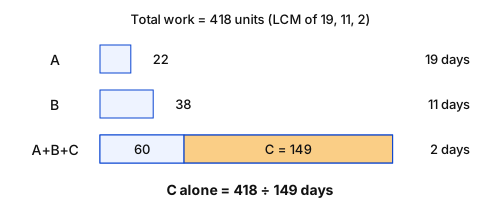
  1. Total work =418 units (LCM of 19, 11, 2). A =22, B =38, all three =209 units/day.
  2. C =209−60=149 units/day.
  3. C alone =418149=2120149 days.

Trick: Together they take 2 days, so C alone must take just over 2 days – only option (B) is near.

Answer: (B) 2rac120149 days

अवधारणा: एक दिन के कार्य जुड़ते हैं: 1A+1B+1C=1साथ।

  1. कुल कार्य =418 इकाई; A =22, B =38, तीनों =209 इकाई/दिन।
  2. C =209−60=149 इकाई/दिन।
  3. C अकेला =418149=2120149 दिन।

ट्रिक: तीनों मिलकर 2 दिन लेते हैं, अतः C को 2 से थोड़ा अधिक समय लगेगा।

उत्तर: (B) 2120149 दिन

RRB NTPC Undergraduate CBT 1MathematicsTime & WorkRRB NTPC Undergraduate CBT 1 2024 · 28 Aug Shift 1 →
Q565.
A man makes a monthly payment equal to 25% of his monthly salary towards debt repayment. He spends 52% of the remaining salary and saves ₹288. His monthly salary (in ₹) is:
एक व्यक्ति अपने मासिक वेतन के 25% के बराबर राशि का मासिक भुगतान ऋण चुकाने के लिए करता है। वह शेष वेतन का 52% खर्च करता है और ₹288 बचाता है। उसका मासिक वेतन (₹ में) है:
  1. A811
  2. B816
  3. C800
  4. D888
Show answer

Concept: Work through successive percentages of the salary to reach savings.

  1. After debt: 75% of S remains.
  2. Saves 48% of that: 0.75×0.48S=0.36S.
  3. 0.36S=288 → S=800.

Trick: Check: 800→600→ spends 312, saves 288 ✓.

Answer: (C) 800

अवधारणा: वेतन पर क्रमागत प्रतिशत लगाकर बचत तक पहुँचें।

  1. कर्ज़ के बाद 75% बचा।
  2. उसका 48% बचत: 0.36S।
  3. 0.36S=288 → S=800।

ट्रिक: जाँच: 800→600→ खर्च 312, बचत 288 ✓।

उत्तर: (C) 800

RRB NTPC Undergraduate CBT 1MathematicsPercentage – Income & SavingsRRB NTPC Undergraduate CBT 1 2024 · 28 Aug Shift 1 →
Q566.
Which of the following numbers divides 74,75,79,723?
निम्नलिखित में से कौन-सी संख्या 74,75,79,723 को विभाजित करती है?
  1. A13
  2. B9
  3. C8
  4. D11
Show answer

Concept: Divisibility by 11: (sum of digits at odd places) − (sum at even places) must be 0 or a multiple of 11.

  1. Number 747579723: odd places from right 3+7+7+7+7=31, even places 2+9+5+4=20.
  2. 31−20=11 → divisible by 11.
  3. Digit sum =51 → not by 9; last three digits 723 odd → not by 8; division by 13 leaves remainder 7.

Trick: Test 11 first whenever the digits look scattered – alternate-sum rule is quick.

Answer: (D) 11

अवधारणा: 11 से विभाज्यता: विषम स्थानों का योग − सम स्थानों का योग = 0 या 11 का गुणज।

  1. 747579723: विषम स्थान 3+7+7+7+7=31, सम स्थान 2+9+5+4=20।
  2. 31−20=11 → 11 से विभाज्य।
  3. अंकों का योग 51 → 9 से नहीं; 723 विषम → 8 से नहीं; 13 से शेष 7।

ट्रिक: अंकों का एकांतर योग-अंतर निकालें – 11 का नियम सबसे तेज़ है।

उत्तर: (D) 11

RRB NTPC Undergraduate CBT 1MathematicsDivisibility RulesRRB NTPC Undergraduate CBT 1 2024 · 28 Aug Shift 1 →
Q567.
If the 6-digit number N42M47 is divisible by 11, then which of the options below can give a possible correct relation between M and N?
यदि 6 अंकों की संख्या N42M47, 11 से विभाज्य है, तो नीचे दिए गए विकल्पों में से कौन-सा M और N के बीच एक संभावित सही संबंध दे सकता है?
  1. AM - N = 1
  2. BM + N = 5
  3. CM = N
  4. DM - N = -5
Show answer

Concept: For divisibility by 11, (sum of odd-place digits) − (sum of even-place digits) =0 or ±11.

  1. N42M47: odd places N+2+4=N+6, even places 4+M+7=M+11.
  2. (N+6)−(M+11)=N−M−5∈{0,11,−11}; N−M=16 is impossible and N−M=−6 matches no option, so N−M=5.
  3. N−M=5 → M−N=−5.

Trick: Example: N = 5, M = 0 gives 542047 =11×49277 ✓.

Answer: (D) M − N = −5

अवधारणा: 11 से विभाज्यता: विषम स्थानों का योग − सम स्थानों का योग =0 या ±11।

  1. N42M47: विषम स्थान N+6, सम स्थान M+11।
  2. N−M−5∈{0,11,−11}; N−M=16 असंभव, N−M=−6 किसी विकल्प में नहीं, अतः N−M=5।
  3. N−M=5 → M−N=−5।

ट्रिक: उदाहरण: N = 5, M = 0 → 542047 =11×49277 ✓।

उत्तर: (D) M − N = −5

RRB NTPC Undergraduate CBT 1MathematicsDivisibility by 11RRB NTPC Undergraduate CBT 1 2024 · 28 Aug Shift 1 →
Q568.
Find the value of [960 ÷ {28 + 5 × (7 − 3)}].
[960 ÷ {28 + 5 × (7 − 3)}] का मान ज्ञात कीजिए।
  1. A29
  2. B20
  3. C23
  4. D15
Show answer

Concept: BODMAS: innermost bracket first, then multiplication, then addition, then division outside.

  1. (7−3)=4; 5×4=20.
  2. 28+20=48.
  3. 960÷48=20.

Trick: Solve brackets from inside out: ( ) → { } → [ ].

Answer: (B) 20

अवधारणा: BODMAS: सबसे भीतरी कोष्ठक पहले, फिर गुणा, जोड़, फिर बाहर का भाग।

  1. (7−3)=4; 5×4=20।
  2. 28+20=48।
  3. 960÷48=20।

ट्रिक: कोष्ठक भीतर से बाहर: ( ) → { } → [ ]।

उत्तर: (B) 20

RRB NTPC Undergraduate CBT 1MathematicsSimplification – BODMASRRB NTPC Undergraduate CBT 1 2024 · 28 Aug Shift 1 →
Q569.
Five solid cubes, each of volume 216000 cm3, are joined end to end to form a cuboid. What is the lateral surface area (in cm2) of the cuboid?
पाँच ठोस घन, जिनमें से प्रत्येक का आयतन 216000 cm3 है, सिरे से सिरा मिलाकर जोड़े जाते हैं जिससे एक घनाभ बनता है। घनाभ का पार्श्व पृष्ठीय क्षेत्रफल (cm2 में) क्या है?
  1. A43045
  2. B43464
  3. C43245
  4. D43200
Show answer

Concept: Lateral surface area of a cuboid =2(l+b)h.

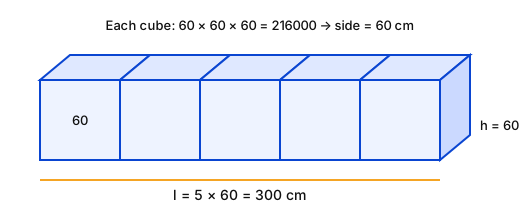
  1. Side of each cube =2160003=60cm.
  2. Cuboid: l=5×60=300, b=h=60.
  3. LSA =2(300+60)×60=43200cm2.

Trick: LSA = base perimeter × height =720×60.

Answer: (D) 43200

अवधारणा: घनाभ का पार्श्व पृष्ठीय क्षेत्रफल =2(l+b)h।

  1. प्रत्येक घन की भुजा =2160003=60cm।
  2. घनाभ: l=300, b=h=60।
  3. LSA =2(360)×60=43200cm2।

ट्रिक: LSA में ऊपर-नीचे नहीं, केवल चारों ओर की सतहें गिनें।

उत्तर: (D) 43200

RRB NTPC Undergraduate CBT 1MathematicsMensuration – Cuboid from CubesRRB NTPC Undergraduate CBT 1 2024 · 28 Aug Shift 1 →
Q570.
The sum of two numbers is 66 and their L.C.M. is 400. What are the two numbers?
दो संख्याओं का योग 66 है और उनका L.C.M. 400 है। वे दो संख्याएँ कौन-सी हैं?
  1. A21, 45
  2. B14, 52
  3. C16, 50
  4. D9, 57
Show answer

Concept: Check each option for both conditions: sum and LCM.

  1. All options sum to 66.
  2. LCM(16,50)=24×52=400 ✓.
  3. Others: LCM(21,45)=315, LCM(14,52)=364, LCM(9,57)=171.

Trick: LCM 400 has only factors 2 and 5 – so both numbers must be made only of 2s and 5s: 16 and 50.

Answer: (C) 16, 50

अवधारणा: हर विकल्प में योग और LCM दोनों जाँचें।

  1. सभी विकल्पों का योग 66 है।
  2. LCM(16,50)=24×52=400 ✓।
  3. बाकी: 315, 364, 171।

ट्रिक: 400 में केवल 2 और 5 गुणनखंड हैं – अतः दोनों संख्याएँ केवल 2 व 5 से बनी हों: 16, 50।

उत्तर: (C) 16, 50

RRB NTPC Undergraduate CBT 1MathematicsLCM & Sum of NumbersRRB NTPC Undergraduate CBT 1 2024 · 28 Aug Shift 1 →
Q571.
What should come in place of the question mark (?) in the given series?
21 23 33 51 77 ?
दी गई श्रृंखला में प्रश्न चिह्न (?) के स्थान पर क्या आना चाहिए?
21 23 33 51 77 ?
  1. A131
  2. B111
  3. C112
  4. D140
Show answer

Concept: Look at the differences; they form an arithmetic pattern.

  1. Differences: 2,10,18,26 (each +8).
  2. Next difference =34.
  3. 77+34=111.

Trick: Second-level difference constant (8) → AP of differences.

Answer: (B) 111

अवधारणा: अंतर देखें; वे समांतर श्रेणी में हैं।

  1. अंतर: 2,10,18,26 (हर बार +8)।
  2. अगला अंतर =34।
  3. 77+34=111।

ट्रिक: अंतरों का अंतर स्थिर (8) है।

उत्तर: (B) 111

RRB NTPC Undergraduate CBT 1General Intelligence and ReasoningNumber SeriesRRB NTPC Undergraduate CBT 1 2024 · 28 Aug Shift 1 →
Q572.
W is the daughter of A. A is the brother of K. K is the wife of E. E is the father of S. How is W related to S?
W, A की पुत्री है। A, K का भाई है। K, E की पत्नी है। E, S का पिता है। W का S से क्या संबंध है?
  1. AMother's sister's sonमाँ की बहन का पुत्र
  2. BMother's sister's daughterमाँ की बहन की पुत्री
  3. CMother's brother's daughterमाँ के भाई की पुत्री
  4. DMother's brother's sonमाँ के भाई का पुत्र
Show answer

Concept: Draw a family tree starting from S and move step by step.

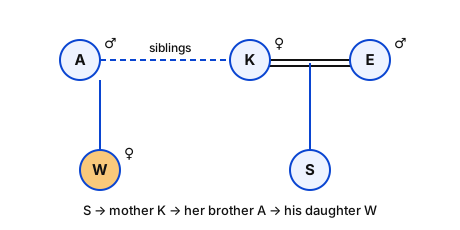
  1. E is S's father and K is E's wife → K is S's mother.
  2. A is K's brother → A is S's mother's brother (maternal uncle).
  3. W is A's daughter → W is S's mother's brother's daughter.

Trick: Trace the path from S: mother → brother → daughter.

Answer: (C) Mother's brother's daughter

अवधारणा: S से शुरू करके परिवार वृक्ष बनाएँ।

  1. E, S का पिता और K, E की पत्नी → K, S की माँ।
  2. A, K का भाई → S का मामा।
  3. W, A की बेटी → S की माँ के भाई की बेटी (ममेरी बहन)।

ट्रिक: S से रास्ता: माँ → भाई → बेटी।

उत्तर: (C) माँ के भाई की बेटी

RRB NTPC Undergraduate CBT 1General Intelligence and ReasoningBlood RelationsRRB NTPC Undergraduate CBT 1 2024 · 28 Aug Shift 1 →
Q573.
Based on the English alphabetical order, three of the following four letter-clusters are alike in a certain way and thus form a group. Which letter-cluster DOES NOT belong to that group?
(Note: The odd one out is not based on the number of consonants/vowels or their position in the letter-cluster.)
अंग्रेज़ी वर्णमाला क्रम के आधार पर, निम्नलिखित चार अक्षर-समूहों में से तीन किसी निश्चित प्रकार से एक समान हैं और इस प्रकार एक समूह बनाते हैं। कौन-सा अक्षर-समूह उस समूह से संबंधित नहीं है?
(ध्यान दें: असंगत अक्षर-समूह, उस अक्षर-समूह में व्यंजनों/स्वरों की संख्या या उनके स्थान पर आधारित नहीं है।)
  1. AUWS
  2. BMOJ
  3. CSUP
  4. DPRM
Show answer

Concept: Convert letters to positions and compare the gaps.

  1. MOJ: 13, 15, 10 → +2, −5. SUP: 19, 21, 16 → +2, −5. PRM: 16, 18, 13 → +2, −5.
  2. UWS: 21, 23, 19 → +2, −4.
  3. UWS breaks the pattern.

Yaad rakhein: Keep EJOTY (5, 10, 15, 20, 25) in mind for quick letter positions.

Answer: (A) UWS

अवधारणा: अक्षरों को स्थानांक में बदलकर अंतर देखें।

  1. MOJ, SUP, PRM: +2, −5।
  2. UWS: 21, 23, 19 → +2, −4।
  3. UWS अलग है।

याद रखें: EJOTY (5, 10, 15, 20, 25) याद रखें।

उत्तर: (A) UWS

RRB NTPC Undergraduate CBT 1General Intelligence and ReasoningOdd One Out – LettersRRB NTPC Undergraduate CBT 1 2024 · 28 Aug Shift 1 →
Q574.
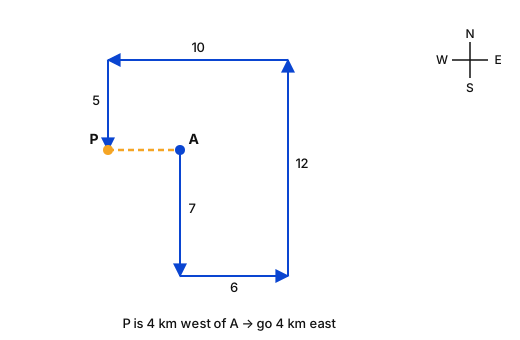
Pranay starts from Point A and drives 7 km towards the south. He then takes a left turn and drives 6 km, then turns left and drives 12 km. He then takes a left turn and drives 10 km. He takes a final left turn, drives 5 km and stops at Point P. How far (shortest distance) and in which direction should he drive in order to reach Point A again? (All turns are 90-degree turns only unless specified.)
प्रणय बिंदु A से चलना प्रारंभ करता है और दक्षिण की ओर 7 km गाड़ी चलाता है। फिर वह बाएँ मुड़ता है और 6 km गाड़ी चलाता है, फिर बाएँ मुड़ता है और 12 km गाड़ी चलाता है। फिर वह बाएँ मुड़ता है और 10 km गाड़ी चलाता है। वह अंतिम बार बाएँ मुड़ता है, 5 km गाड़ी चलाता है और बिंदु P पर रुक जाता है। पुनः बिंदु A पर पहुँचने के लिए उसे कितनी दूरी (न्यूनतम दूरी) तक और किस दिशा में गाड़ी चलानी चाहिए? (जब तक निर्दिष्ट न हो, सभी मोड़ केवल 90 डिग्री के मोड़ हैं।)
  1. A4 km to the eastपूर्व की ओर 4 km
  2. B4 km to the westपश्चिम की ओर 4 km
  3. C5 km to the westपश्चिम की ओर 5 km
  4. D5 km to the eastपूर्व की ओर 5 km
Show answer

Concept: Plot each move on a grid (left turn when facing south = east, etc.).

  1. A(0, 0) → 7 km south → left (east) 6 km → left (north) 12 km → left (west) 10 km → left (south) 5 km.
  2. Net east-west: 6−10=−4 → 4 km west of A. Net north-south: −7+12−5=0.
  3. P is 4 km west of A, so he must drive 4 km to the east.

Trick: Add the vertical moves and horizontal moves separately.

Answer: (A) 4 km to the east

अवधारणा: हर चाल को ग्रिड पर बनाएँ (दक्षिण की ओर मुख होने पर बायाँ = पूर्व)।

  1. A से 7 km दक्षिण → पूर्व 6 → उत्तर 12 → पश्चिम 10 → दक्षिण 5।
  2. पूर्व-पश्चिम: 6−10=−4 (4 km पश्चिम); उत्तर-दक्षिण: −7+12−5=0।
  3. P, A से 4 km पश्चिम में है → 4 km पूर्व जाना होगा।

ट्रिक: ऊर्ध्व और क्षैतिज चालें अलग-अलग जोड़ें।

उत्तर: (A) 4 km पूर्व की ओर

RRB NTPC Undergraduate CBT 1General Intelligence and ReasoningDirection & DistanceRRB NTPC Undergraduate CBT 1 2024 · 28 Aug Shift 1 →
Q575.
DACB is related to FCED in a certain way based on the English alphabetical order. In the same way, YVXW is related to AXZY. To which of the given options is VSUT related, following the same logic?
अंग्रेज़ी वर्णमाला क्रम के आधार पर DACB एक निश्चित प्रकार से FCED से संबंधित है। उसी प्रकार, YVXW, AXZY से संबंधित है। समान तर्क का अनुसरण करते हुए, VSUT दिए गए विकल्पों में से किससे संबंधित है?
  1. AXUWV
  2. BXUVV
  3. CXTVV
  4. DXVVE
Show answer

Concept: Find the shift applied to each letter.

  1. DACB → FCED: each letter +2.
  2. YVXW → AXZY: each +2 (Y+2 = A).
  3. VSUT → X U W V.

Trick: Same shift for all letters → shift the whole word.

Answer: (A) XUWV

अवधारणा: हर अक्षर पर लगा अंतर ज्ञात करें।

  1. DACB → FCED: हर अक्षर +2।
  2. YVXW → AXZY: +2।
  3. VSUT → XUWV।

ट्रिक: सभी अक्षरों पर समान अंतर → पूरा शब्द खिसकाएँ।

उत्तर: (A) XUWV

RRB NTPC Undergraduate CBT 1General Intelligence and ReasoningAnalogy – Letter CodingRRB NTPC Undergraduate CBT 1 2024 · 28 Aug Shift 1 →
Q576.
Based on the English alphabetical order, three of the following four letter-clusters are alike in a certain way and thus form a group. Which letter-cluster DOES NOT belong to that group?
(Note: The odd one out is not based on the number of consonants/vowels or their position in the letter-cluster.)
अंग्रेज़ी वर्णमाला क्रम के आधार पर, निम्नलिखित चार अक्षर-समूहों में से तीन किसी निश्चित प्रकार से एक समान हैं और इस प्रकार एक समूह बनाते हैं। कौन-सा अक्षर-समूह उस समूह से संबंधित नहीं है?
(ध्यान दें: असंगत अक्षर-समूह, उस अक्षर-समूह में व्यंजनों/स्वरों की संख्या या उनके स्थान पर आधारित नहीं है।)
  1. ARMH
  2. BDYT
  3. CAVO
  4. DIDY
Show answer

Concept: Check the backward gaps between letters (cyclic alphabet).

  1. RMH: 18 → 13 → 8 (−5, −5). DYT: 4 → 25 → 20 (−5, −5). IDY: 9 → 4 → 25 (−5, −5).
  2. AVO: 1 → 22 → 15 is −5, then −7.
  3. AVO is the odd one.

Trick: Going back from A wraps to Z: A − 5 = V.

Answer: (C) AVO

अवधारणा: अक्षरों के पीछे की ओर अंतर देखें (चक्रीय वर्णमाला)।

  1. RMH, DYT, IDY: −5, −5।
  2. AVO: −5, फिर −7।
  3. AVO अलग है।

ट्रिक: A से पीछे जाने पर Z आता है: A − 5 = V।

उत्तर: (C) AVO

RRB NTPC Undergraduate CBT 1General Intelligence and ReasoningOdd One Out – LettersRRB NTPC Undergraduate CBT 1 2024 · 28 Aug Shift 1 →
Q577.
Based on the English alphabetical order, three of the following four letter-clusters are alike in a certain way and thus form a group. Which letter-cluster DOES NOT belong to that group? (Note: The odd one out is not based on the number of consonants/vowels or their position in the letter-cluster.)
अंग्रेज़ी वर्णमाला क्रम के आधार पर, निम्नलिखित चार अक्षर-समूहों में से तीन किसी निश्चित प्रकार से एक समान हैं और इस प्रकार एक समूह बनाते हैं। कौन-सा अक्षर-समूह उस समूह से संबंधित नहीं है? (ध्यान दें: असंगत अक्षर-समूह, उस अक्षर-समूह में व्यंजनों/स्वरों की संख्या या उनके स्थान पर आधारित नहीं है।)
  1. AVZFM
  2. BPTZG
  3. CSWCI
  4. DIMSZ
Show answer

Concept: Find the gaps between consecutive letters (cyclic).

  1. VZFM: +4, +6, +7. PTZG: +4, +6, +7. IMSZ: +4, +6, +7.
  2. SWCI: S → W +4, W → C +6, C → I +6.
  3. SWCI differs.

Trick: Write positions once: V22 Z26 F6 M13 – the gaps make the rule clear.

Answer: (C) SWCI

अवधारणा: क्रमागत अक्षरों के बीच अंतर ज्ञात करें।

  1. VZFM, PTZG, IMSZ: +4, +6, +7।
  2. SWCI: +4, +6, +6।
  3. SWCI अलग है।

ट्रिक: स्थानांक लिखें – अंतर से नियम स्पष्ट होता है।

उत्तर: (C) SWCI

RRB NTPC Undergraduate CBT 1General Intelligence and ReasoningOdd One Out – LettersRRB NTPC Undergraduate CBT 1 2024 · 28 Aug Shift 1 →
Q578.
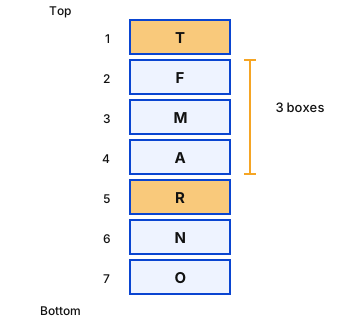
Seven boxes, N, O, T, F, A, R and M, are kept one over the other but not necessarily in the same order. M is kept immediately above A. N is kept immediately above O. Only T is kept above F. Only two boxes are kept above M. N is not kept at third position from the bottom.
How many boxes are kept between R and T?
सात बक्से N, O, T, F, A, R और M एक के ऊपर एक रखे गए हैं, लेकिन यह आवश्यक नहीं है कि इसी क्रम में हों। M को A के ठीक ऊपर रखा गया है। N को O के ठीक ऊपर रखा गया है। F के ऊपर केवल T रखा गया है। M के ऊपर केवल दो बक्से रखे गए हैं। N को नीचे से तीसरे स्थान पर नहीं रखा गया है।
R और T के बीच कितने बक्से रखे गए हैं?
  1. AThreeतीन
  2. BOneएक
  3. CZeroशून्य
  4. DTwoदो
Show answer

Concept: Fix definite positions first (top = 1, bottom = 7).

  1. Only T above F → T = 1, F = 2.
  2. Two boxes above M → M = 3, A = 4.
  3. N directly above O, N not at 5 (3rd from bottom) → N = 6, O = 7, so R = 5.
  4. Between R (5) and T (1): F, M, A → three boxes.

Trick: Start with 'only' and number-based clues; they lock positions.

Answer: (A) Three

अवधारणा: पहले निश्चित स्थान तय करें (ऊपर = 1, नीचे = 7)।

  1. केवल T, F के ऊपर → T = 1, F = 2।
  2. M के ऊपर दो → M = 3, A = 4।
  3. N ठीक O के ऊपर, N 5 पर नहीं → N = 6, O = 7, R = 5।
  4. R और T के बीच: F, M, A → तीन।

ट्रिक: 'केवल' और संख्या वाले संकेत पहले लगाएँ।

उत्तर: (A) तीन

RRB NTPC Undergraduate CBT 1General Intelligence and ReasoningPuzzle – Box StackingRRB NTPC Undergraduate CBT 1 2024 · 28 Aug Shift 1 →
Q579.
If 1 is added to each odd digit and 2 is subtracted from each even digit in the number 7856413, what will be the sum of the digits which are third from the left and third from the right in the new number thus formed?
यदि संख्या 7856413 में प्रत्येक विषम अंक में 1 जोड़ दिया जाए और प्रत्येक सम अंक में से 2 घटा दिया जाए, तो इस प्रकार बनी नई संख्या में बाएँ से तीसरे और दाएँ से तीसरे अंकों का योग क्या होगा?
  1. A6
  2. B10
  3. C12
  4. D8
Show answer

Concept: Apply the rule digit by digit, then read the required positions.

  1. 7856413 → 7+1, 8−2, 5+1, 6−2, 4−2, 1+1, 3+1 = 8664224.
  2. Third from left =6; third from right =2.
  3. Sum =6+2=8.

Trick: Write the new number fully before counting positions.

Answer: (D) 8

अवधारणा: नियम हर अंक पर लगाएँ, फिर स्थान पढ़ें।

  1. 7856413 → 8664224।
  2. बाएँ से तीसरा =6; दाएँ से तीसरा =2।
  3. योग =8।

ट्रिक: स्थान गिनने से पहले पूरी नई संख्या लिखें।

उत्तर: (D) 8

RRB NTPC Undergraduate CBT 1General Intelligence and ReasoningDigit OperationsRRB NTPC Undergraduate CBT 1 2024 · 28 Aug Shift 1 →
Q580.
What should come in place of the question mark (?) in the given series?
73 76 81 90 107 ?
दी गई श्रृंखला में प्रश्न चिह्न (?) के स्थान पर क्या आना चाहिए?
73 76 81 90 107 ?
  1. A139
  2. B123
  3. C155
  4. D140
Show answer

Concept: Differences grow in a pattern.

  1. Differences: 3,5,9,17.
  2. Each difference = previous ×2−1 (or differences of differences 2,4,8 doubling).
  3. Next difference =33 → 107+33=140.

Trick: 3,5,9,17,33 are 2n+1.

Answer: (D) 140

अवधारणा: अंतर एक नियम से बढ़ते हैं।

  1. अंतर: 3,5,9,17।
  2. अंतरों के अंतर 2,4,8 (दोगुने) → अगला अंतर 33।
  3. 107+33=140।

ट्रिक: 3,5,9,17,33 = 2n+1।

उत्तर: (D) 140

RRB NTPC Undergraduate CBT 1General Intelligence and ReasoningNumber SeriesRRB NTPC Undergraduate CBT 1 2024 · 28 Aug Shift 1 →