Question bank

Q&A: practice questions with answers

Search questions on any topic. Filter by exam category, exam, subject and topic, try the question, then open the answer and explanation.

Courses – airGurukul

8,495 questions found.

Q581.
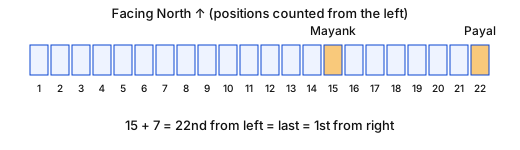
In a row of 22 students facing north, Mayank is 15th from the left end. If Payal is 7th to the right of Mayank, what is Payal's position from the right end of the line?
उत्तर की ओर मुख करके खड़े 22 विद्यार्थियों की एक पंक्ति में, मयंक बाएँ छोर से 15वें स्थान पर है। यदि पायल, मयंक के दाएँ 7वें स्थान पर है, तो पंक्ति के दाएँ छोर से पायल का स्थान क्या है?
  1. A1st1ला
  2. B3rd3रा
  3. C4th4था
  4. D2nd2रा
Show answer

Concept: Position from right = total − position from left +1.

  1. Payal from left =15+7=22.
  2. From right =22−22+1=1.

Trick: 22nd in a row of 22 is the last person → 1st from right.

Answer: (A) 1st

अवधारणा: दाएँ से स्थान = कुल − बाएँ से स्थान +1।

  1. पायल बाएँ से =15+7=22वीं।
  2. दाएँ से =22−22+1=1।

ट्रिक: 22 में 22वाँ = अंतिम = दाएँ से पहला।

उत्तर: (A) पहला
RRB NTPC Undergraduate CBT 1General Intelligence and ReasoningRanking & PositionRRB NTPC Undergraduate CBT 1 2024 · 28 Aug Shift 1 →
Q582.
Refer to the following number and symbol series and answer the question that follows. Counting to be done from left to right only.
(Left) / 8 5 2 1 1 4 < $ 2 & 8 # 7 5 & 3 + 1 6 ^ (Right)
How many such numbers are there that are immediately preceded by a symbol and also immediately followed by another number?
निम्नलिखित संख्या और प्रतीक श्रृंखला को देखिए और उसके बाद दिए गए प्रश्न का उत्तर दीजिए। गणना केवल बाएँ से दाएँ की जानी है।
(बाएँ) / 8 5 2 1 1 4 < $ 2 & 8 # 7 5 & 3 + 1 6 ^ (दाएँ)
ऐसी कितनी संख्याएँ हैं जिनके ठीक पहले एक प्रतीक है और ठीक बाद में एक अन्य संख्या है?
  1. AFourचार
  2. BOneएक
  3. CThreeतीन
  4. DTwoदो
Show answer

Concept: Check each number: the item just before must be a symbol and the item just after must be a number.

  1. 8 (after /, before 5) ✓.
  2. 7 (after #, before 5) ✓; 1 (after +, before 6) ✓.
  3. 2 after $ is followed by &, 8 after & is followed by #, 3 after & is followed by + → ✗.

Trick: Scan only the numbers that sit right after a symbol, then look one step ahead.

Answer: (C) Three

अवधारणा: हर संख्या जाँचें: ठीक पहले प्रतीक और ठीक बाद संख्या होनी चाहिए।

  1. 8 (/ के बाद, 5 से पहले) ✓।
  2. 7 (# के बाद, 5 से पहले) ✓; 1 (+ के बाद, 6 से पहले) ✓।
  3. $ के बाद 2, & के बाद 8 और 3 – इनके बाद प्रतीक है ✗।

ट्रिक: केवल प्रतीक के ठीक बाद वाली संख्याएँ देखें, फिर एक कदम आगे।

उत्तर: (C) तीन

RRB NTPC Undergraduate CBT 1General Intelligence and ReasoningSymbol–Number SeriesRRB NTPC Undergraduate CBT 1 2024 · 28 Aug Shift 1 →
Q583.
Refer to the following number and symbol series and answer the question that follows. Counting to be done from left to right only.
(Left) 2 & % 4 6 Ω * 7 $ £ 8 & 1 % @ 5 3 # * 9 (Right)
How many such symbols are there, each of which is immediately preceded by a number and also immediately followed by another number?
निम्नलिखित संख्या और प्रतीक श्रृंखला को देखिए और उसके बाद दिए गए प्रश्न का उत्तर दीजिए। गणना केवल बाएँ से दाएँ की जानी है।
(बाएँ) 2 & % 4 6 Ω * 7 $ £ 8 & 1 % @ 5 3 # * 9 (दाएँ)
ऐसे कितने प्रतीक हैं, जिनमें से प्रत्येक के ठीक पहले एक संख्या है और ठीक बाद में एक अन्य संख्या है?
  1. ANoneकोई नहीं
  2. BTwoदो
  3. COneएक
  4. DMore than twoदो से अधिक
Show answer

Concept: Look for the pattern number – symbol – number.

  1. Only “8 & 1” fits.
  2. Others fail: “6 Ω *”, “7 $ £”, “1 % @”, “3 # *”, “2 & %”.

Trick: Find symbols lying between two numbers.

Answer: (C) One

अवधारणा: संख्या – प्रतीक – संख्या पैटर्न खोजें।

  1. केवल “8 & 1” सही है।
  2. बाकी में एक ओर प्रतीक है।

ट्रिक: दो संख्याओं के बीच फँसे प्रतीक खोजें।

उत्तर: (C) एक

RRB NTPC Undergraduate CBT 1General Intelligence and ReasoningSymbol–Number SeriesRRB NTPC Undergraduate CBT 1 2024 · 28 Aug Shift 1 →
Q584.
What should come in place of ? in the given series based on the English alphabetical order?
ELY FNX GPW HRV ?
अंग्रेज़ी वर्णमाला क्रम के आधार पर दी गई श्रृंखला में ? के स्थान पर क्या आना चाहिए?
ELY FNX GPW HRV ?
  1. AHYV
  2. BHGU
  3. CIUV
  4. DITU
Show answer

Concept: Treat each letter position as a separate series.

  1. 1st: E, F, G, H → I (+1).
  2. 2nd: L, N, P, R → T (+2).
  3. 3rd: Y, X, W, V → U (−1).

Trick: Split the clusters column-wise.

Answer: (D) ITU

अवधारणा: हर स्थान की अलग श्रृंखला बनाएँ।

  1. पहला: E, F, G, H → I (+1)।
  2. दूसरा: L, N, P, R → T (+2)।
  3. तीसरा: Y, X, W, V → U (−1)।

ट्रिक: समूहों को स्तंभ-वार तोड़ें।

उत्तर: (D) ITU

RRB NTPC Undergraduate CBT 1General Intelligence and ReasoningLetter SeriesRRB NTPC Undergraduate CBT 1 2024 · 28 Aug Shift 1 →
Q585.
What should come in place of the question mark (?) in the given series?
819 829 830 840 841 851 852 ?
दी गई श्रृंखला में प्रश्न चिह्न (?) के स्थान पर क्या आना चाहिए?
819 829 830 840 841 851 852 ?
  1. A853
  2. B854
  3. C862
  4. D861
Show answer

Concept: Alternate additions.

  1. +10,+1,+10,+1,…
  2. 852+10=862.

Trick: Alternating steps: look at every other term (819, 830, 841, 852 … rise by 11).

Answer: (C) 862

अवधारणा: एकांतर जोड़।

  1. +10,+1,+10,+1,…
  2. 852+10=862।

ट्रिक: एकांतर पदों में 11 का अंतर है।

उत्तर: (C) 862

RRB NTPC Undergraduate CBT 1General Intelligence and ReasoningNumber SeriesRRB NTPC Undergraduate CBT 1 2024 · 28 Aug Shift 1 →
Q586.
In a certain code language, ‘TEMP’ is coded as ‘3129’ and ‘ITEM’ is coded as ‘1396’. What is the code for ‘I’ in the given code language?
एक निश्चित कूट भाषा में, ‘TEMP’ को ‘3129’ के रूप में कूटबद्ध किया जाता है और ‘ITEM’ को ‘1396’ के रूप में कूटबद्ध किया जाता है। दी गई कूट भाषा में ‘I’ के लिए कूट क्या है?
  1. A1
  2. B3
  3. C9
  4. D6
Show answer

Concept: Letters common to both words share the common digits.

  1. TEMP = 3129, ITEM = 1396.
  2. Common letters T, E, M ↔ common digits 3, 1, 9.
  3. Left over in ITEM: I ↔ 6.

Trick: Remove common letters/digits; the leftovers match.

Answer: (D) 6

अवधारणा: दोनों शब्दों के उभयनिष्ठ अक्षरों के कूट भी उभयनिष्ठ होते हैं।

  1. TEMP = 3129, ITEM = 1396।
  2. उभयनिष्ठ T, E, M ↔ 3, 1, 9।
  3. शेष I ↔ 6।

ट्रिक: उभयनिष्ठ हटाएँ; बचे हुए आपस में मेल खाते हैं।

उत्तर: (D) 6

RRB NTPC Undergraduate CBT 1General Intelligence and ReasoningCoding – Common LettersRRB NTPC Undergraduate CBT 1 2024 · 28 Aug Shift 1 →
Q587.
Read the given statements and conclusions carefully. Assuming that the information given in the statements is true, even if it appears to be at variance with commonly known facts, decide which of the given conclusion(s) logically follow(s) from the statements.
Statements:
All magnets are rocks.
All rocks are soils.
Conclusions:
(I) Some soils are rocks.
(II) All magnets are soils.
दिए गए कथनों और निष्कर्षों को ध्यानपूर्वक पढ़िए। कथनों में दी गई जानकारी को सत्य मानते हुए, भले ही वह सामान्यतः ज्ञात तथ्यों से भिन्न प्रतीत होती हो, निर्णय कीजिए कि दिए गए निष्कर्षों में से कौन-सा/से निष्कर्ष कथनों का तार्किक रूप से अनुसरण करता है/करते हैं।
कथन:
सभी चुंबक, चट्टानें हैं।
सभी चट्टानें, मिट्टियाँ हैं।
निष्कर्ष:
(I) कुछ मिट्टियाँ, चट्टानें हैं।
(II) सभी चुंबक, मिट्टियाँ हैं।
  1. ANeither conclusion (I) nor (II) follows.न तो निष्कर्ष (I) और न ही (II) अनुसरण करता है।
  2. BOnly conclusion (II) follows.केवल निष्कर्ष (II) अनुसरण करता है।
  3. COnly conclusion (I) follows.केवल निष्कर्ष (I) अनुसरण करता है।
  4. DBoth conclusions (I) and (II) follow.निष्कर्ष (I) और (II) दोनों अनुसरण करते हैं।
Show answer

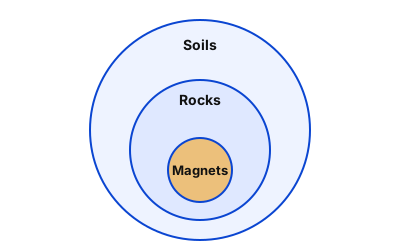
Concept: Draw the Venn diagram: Magnets inside Rocks inside Soils.

  1. (I) All rocks are soils → some soils are rocks ✓ (conversion).
  2. (II) Magnets ⊂ Rocks ⊂ Soils → all magnets are soils ✓.

Yaad rakhein: “All A are B” always gives “Some B are A”.

Answer: (D) Both conclusions (I) and (II) follow.

अवधारणा: वेन आरेख: Magnets ⊂ Rocks ⊂ Soils।

  1. (I) सभी rocks, soils हैं → कुछ soils, rocks हैं ✓।
  2. (II) Magnets पूरी तरह Soils में ✓।

याद रखें: “सभी A, B हैं” से हमेशा “कुछ B, A हैं” निकलता है।

उत्तर: (D) दोनों निष्कर्ष (I) और (II) अनुसरण करते हैं।

RRB NTPC Undergraduate CBT 1General Intelligence and ReasoningSyllogismRRB NTPC Undergraduate CBT 1 2024 · 28 Aug Shift 1 →
Q588.
Read the given statement(s) and conclusions carefully. Assuming that the information given in the statements is true, even if it appears to be at variance with commonly known facts, decide which of the given conclusion(s) logically follow(s) from the statement(s).
Statements:
Some Beetroots are Radishes.
Some Radishes are Onions.
Conclusions:
I. Some Beetroots are Onions.
II. No Beetroots are Onions.
दिए गए कथन/कथनों और निष्कर्षों को ध्यानपूर्वक पढ़िए। कथनों में दी गई जानकारी को सत्य मानते हुए, भले ही वह सामान्यतः ज्ञात तथ्यों से भिन्न प्रतीत होती हो, निर्णय कीजिए कि दिए गए निष्कर्षों में से कौन-सा/से निष्कर्ष कथन/कथनों का तार्किक रूप से अनुसरण करता है/करते हैं।
कथन:
कुछ चुकंदर, मूलियाँ हैं।
कुछ मूलियाँ, प्याज़ हैं।
निष्कर्ष:
I. कुछ चुकंदर, प्याज़ हैं।
II. कोई भी चुकंदर, प्याज़ नहीं है।
  1. AOnly conclusion (I) follows.केवल निष्कर्ष (I) अनुसरण करता है।
  2. BOnly conclusion (II) follows.केवल निष्कर्ष (II) अनुसरण करता है।
  3. CBoth conclusions (I) and (II) follow.निष्कर्ष (I) और (II) दोनों अनुसरण करते हैं।
  4. DNeither conclusion (I) nor (II) follows.न तो निष्कर्ष (I) और न ही (II) अनुसरण करता है।
Show answer

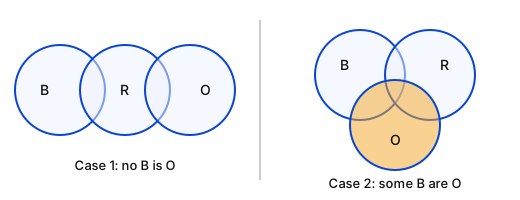
Concept: With two “some” statements there is no definite link between the end terms.

  1. Beetroots and Onions are connected only through Radishes.
  2. They may or may not overlap (both diagrams possible).
  3. So neither “some B are O” nor “no B is O” is certain; as a single conclusion neither follows.

Yaad rakhein: Some + Some → no definite conclusion.

Answer: (D) Neither conclusion (I) nor (II) follows.

अवधारणा: दो “कुछ” कथनों से अंतिम पदों के बीच कोई निश्चित संबंध नहीं बनता।

  1. Beetroots और Onions केवल Radishes से जुड़े हैं।
  2. वे मिल भी सकते हैं, नहीं भी।
  3. अतः कोई भी निष्कर्ष निश्चित नहीं।

याद रखें: कुछ + कुछ → कोई निश्चित निष्कर्ष नहीं।

उत्तर: (D) न तो (I) न (II) अनुसरण करता है।

RRB NTPC Undergraduate CBT 1General Intelligence and ReasoningSyllogismRRB NTPC Undergraduate CBT 1 2024 · 28 Aug Shift 1 →
Q589.
Which of the following letter-number clusters will replace the question mark (?) in the given series to make it logically complete?
TKF 4, SJE 8, RID 12, QHC 16, ?
दी गई श्रृंखला को तार्किक रूप से पूर्ण करने के लिए निम्नलिखित में से कौन-सा अक्षर-संख्या समूह प्रश्न चिह्न (?) का स्थान लेगा?
TKF 4, SJE 8, RID 12, QHC 16, ?
  1. AOGB 20
  2. BPFA 18
  3. COFA 18
  4. DPGB 20
Show answer

Concept: Each letter moves back by 1; the number increases by 4.

  1. T, S, R, Q → P; K, J, I, H → G; F, E, D, C → B.
  2. Number: 4, 8, 12, 16 → 20.
  3. Next: PGB 20.

Trick: Check one position at a time.

Answer: (D) PGB 20

अवधारणा: हर अक्षर 1 पीछे; संख्या 4 बढ़ती है।

  1. T, S, R, Q → P; K, J, I, H → G; F, E, D, C → B।
  2. संख्या: 4, 8, 12, 16 → 20।
  3. अगला: PGB 20।

ट्रिक: एक-एक स्थान अलग जाँचें।

उत्तर: (D) PGB 20

RRB NTPC Undergraduate CBT 1General Intelligence and ReasoningLetter–Number SeriesRRB NTPC Undergraduate CBT 1 2024 · 28 Aug Shift 1 →
Q590.
In the following number-pairs, the second number is obtained by applying certain mathematical operation(s) to the first number. Select the number-pair in which the numbers are related in the same way as are the numbers of the following pairs. (NOTE: Operations should be performed on the whole numbers, without breaking down the numbers into their constituent digits. E.g. 13 – Operations on 13 such as adding to/subtracting from/multiplying with 13 can be performed. Breaking down 13 into 1 and 3 and then performing mathematical operations on 1 and 3 is not allowed.)
12, 134
9, 71
निम्नलिखित संख्या-युग्मों में, दूसरी संख्या पहली संख्या पर कुछ गणितीय संक्रिया/संक्रियाएँ करके प्राप्त की जाती है। उस संख्या-युग्म का चयन कीजिए जिसमें संख्याएँ उसी प्रकार संबंधित हैं जिस प्रकार निम्नलिखित युग्मों की संख्याएँ संबंधित हैं। (ध्यान दें: संख्याओं को उसके घटक अंकों में विभक्त किए बिना, संक्रियाएँ पूर्ण संख्याओं पर की जानी चाहिए। उदाहरण के लिए 13 – 13 पर संक्रियाएँ जैसे 13 में जोड़ना/13 में से घटाना/13 से गुणा करना आदि किया जा सकता है। 13 को 1 और 3 में विभक्त करके फिर 1 और 3 पर गणितीय संक्रियाएँ करने की अनुमति नहीं है।)
12, 134
9, 71
  1. A15, 235
  2. B13, 170
  3. C16, 246
  4. D11, 130
Show answer

Concept: Find a single operation that works for both given pairs.

  1. 122−10=134; 92−10=71.
  2. 162−10=246 ✓.
  3. Others: 152−10=215, 132−10=159, 112−10=111.

Trick: Second number close to a square → try n2±k.

Answer: (C) 16, 246

अवधारणा: ऐसी संक्रिया खोजें जो दोनों युग्मों पर लागू हो।

  1. 122−10=134; 92−10=71।
  2. 162−10=246 ✓।
  3. बाकी: 215, 159, 111।

ट्रिक: दूसरी संख्या वर्ग के पास हो → n2±k आज़माएँ।

उत्तर: (C) 16, 246

RRB NTPC Undergraduate CBT 1General Intelligence and ReasoningNumber Pair AnalogyRRB NTPC Undergraduate CBT 1 2024 · 28 Aug Shift 1 →
Q591.
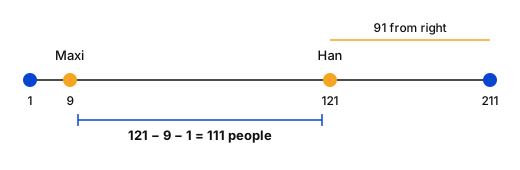
211 people are standing in a row facing north. Mr. Maxi is 9th from the left end while Mr. Han is 91st from the right end. How many people are there between Mr. Maxi and Mr. Han?
211 लोग उत्तर की ओर मुख करके एक पंक्ति में खड़े हैं। श्री मैक्सी बाएँ छोर से 9वें स्थान पर हैं जबकि श्री हान दाएँ छोर से 91वें स्थान पर हैं। श्री मैक्सी और श्री हान के बीच कितने लोग हैं?
  1. A112
  2. B111
  3. C109
  4. D110
Show answer

Concept: Convert both positions to the same end, then persons between = difference −1.

  1. Han from left =211−91+1=121.
  2. Maxi from left =9.
  3. Between =121−9−1=111.

Trick: Shortcut: total − (left rank + right rank) =211−100=111.

Answer: (B) 111

अवधारणा: दोनों स्थान एक ही छोर से लें; बीच में = अंतर −1।

  1. हान बाएँ से =211−91+1=121।
  2. मैक्सी बाएँ से =9।
  3. बीच में =121−9−1=111।

ट्रिक: शॉर्टकट: कुल − (दोनों स्थानों का योग) =211−100=111।

उत्तर: (B) 111

RRB NTPC Undergraduate CBT 1General Intelligence and ReasoningRanking – Persons BetweenRRB NTPC Undergraduate CBT 1 2024 · 28 Aug Shift 1 →
Q592.
SKEA is related to PGBW in a certain way based on the English alphabetical order. In the same way, GUSK is related to DQPG. To which of the given options is XIJY related, following the same logic?
अंग्रेज़ी वर्णमाला क्रम के आधार पर SKEA एक निश्चित प्रकार से PGBW से संबंधित है। उसी प्रकार, GUSK, DQPG से संबंधित है। समान तर्क का अनुसरण करते हुए, XIJY दिए गए विकल्पों में से किससे संबंधित है?
  1. APPOI
  2. BUGEU
  3. CUIOP
  4. DUEGU
Show answer

Concept: Find the alternating shift.

  1. SKEA → PGBW: −3, −4, −3, −4.
  2. GUSK → DQPG: −3, −4, −3, −4 ✓.
  3. XIJY → U, E, G, U.

Trick: Pattern −3, −4 repeats.

Answer: (D) UEGU

अवधारणा: एकांतर अंतर देखें।

  1. SKEA → PGBW: −3, −4, −3, −4।
  2. GUSK → DQPG ✓।
  3. XIJY → UEGU।

ट्रिक: −3, −4 का पैटर्न दोहराता है।

उत्तर: (D) UEGU

RRB NTPC Undergraduate CBT 1General Intelligence and ReasoningAnalogy – Letter CodingRRB NTPC Undergraduate CBT 1 2024 · 28 Aug Shift 1 →
Q593.
What will come in the place of the question mark (?) in the following equation, if ‘+’ and ‘−’ are interchanged and ‘×’ and ‘÷’ are interchanged?
26 × 4 ÷ 8 − 15 + 6 = ?
यदि ‘+’ और ‘−’ को आपस में बदल दिया जाए तथा ‘×’ और ‘÷’ को आपस में बदल दिया जाए, तो निम्नलिखित समीकरण में प्रश्न चिह्न (?) के स्थान पर क्या आएगा?
26 × 4 ÷ 8 − 15 + 6 = ?
  1. A62
  2. B59
  3. C61
  4. D60
Show answer

Concept: Interchange the signs, then apply BODMAS.

  1. New: 26÷4×8+15−6.
  2. 26÷4=6.5; 6.5×8=52.
  3. 52+15−6=61.

Trick: Rewrite the whole expression first, then calculate.

Answer: (C) 61

अवधारणा: चिह्न बदलें, फिर BODMAS लगाएँ।

  1. नया: 26÷4×8+15−6।
  2. 6.5×8=52।
  3. 52+15−6=61।

ट्रिक: पहले पूरा व्यंजक दोबारा लिखें, फिर हल करें।

उत्तर: (C) 61

RRB NTPC Undergraduate CBT 1General Intelligence and ReasoningMathematical OperationsRRB NTPC Undergraduate CBT 1 2024 · 28 Aug Shift 1 →
Q594.
Seven people A, B, C, D, E, F and G are sitting in a row, facing the north. Only one person sits to the right of B. E sits third from the left end of the row. G is the immediate neighbour of F and B. C sits to the immediate left of A. How many people sit to the left of D?
सात व्यक्ति A, B, C, D, E, F और G उत्तर की ओर मुख करके एक पंक्ति में बैठे हैं। B के दाईं ओर केवल एक व्यक्ति बैठा है। E पंक्ति के बाएँ छोर से तीसरे स्थान पर बैठा है। G, F और B का निकटतम पड़ोसी है। C, A के ठीक बाईं ओर बैठा है। D के बाईं ओर कितने व्यक्ति बैठे हैं?
  1. AFourचार
  2. BThreeतीन
  3. CSixछह
  4. DFiveपाँच
Show answer

Concept: Place fixed persons first (facing north: left = left end).

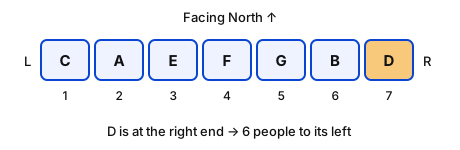
  1. Only one to the right of B → B = 6th; E = 3rd.
  2. G neighbours F and B → G = 5, F = 4.
  3. C immediately left of A → C = 1, A = 2; D = 7.
  4. D at the right end → 6 people to its left.

Trick: ‘Neighbour of both’ means that person sits between them.

Answer: (C) Six

अवधारणा: पहले निश्चित स्थान तय करें (उत्तरमुखी: बायाँ = बायाँ छोर)।

  1. B के दाएँ केवल एक → B = 6; E = 3।
  2. G, F और B दोनों का पड़ोसी → G = 5, F = 4।
  3. C, A के ठीक बाएँ → C = 1, A = 2; D = 7।
  4. D दाएँ छोर पर → बाएँ 6 लोग।

ट्रिक: ‘दोनों का पड़ोसी’ = दोनों के बीच बैठा।

उत्तर: (C) छह

RRB NTPC Undergraduate CBT 1General Intelligence and ReasoningLinear Seating ArrangementRRB NTPC Undergraduate CBT 1 2024 · 28 Aug Shift 1 →
Q595.
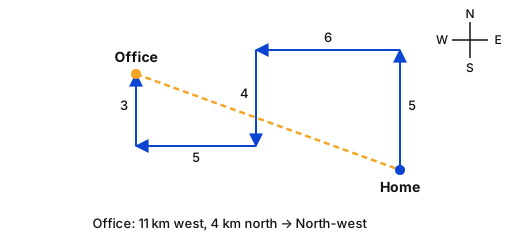
Satheesh starts from his home and drives 5 km towards north. He then takes a left turn, drives 6 km, turns left, and drives 4 km. He then takes a right turn and drives 5 km and turns right, then drives 3 km to reach his office. In which direction is the office with respect to his home?
(Note: All turns are 90° turns only, unless specified.)
सतीश अपने घर से चलना प्रारंभ करता है और उत्तर की ओर 5 km गाड़ी चलाता है। फिर वह बाएँ मुड़ता है, 6 km गाड़ी चलाता है, बाएँ मुड़ता है और 4 km गाड़ी चलाता है। फिर वह दाएँ मुड़ता है और 5 km गाड़ी चलाता है और दाएँ मुड़ता है, फिर अपने कार्यालय पहुँचने के लिए 3 km गाड़ी चलाता है। उसके घर के सापेक्ष कार्यालय किस दिशा में है?
(ध्यान दें: जब तक निर्दिष्ट न हो, सभी मोड़ केवल 90° के मोड़ हैं।)
  1. ANorth-westउत्तर-पश्चिम
  2. BNorthउत्तर
  3. CSouthदक्षिण
  4. DWestपश्चिम
Show answer

Concept: Track net displacement from home.

  1. 5 N → left (W) 6 → left (S) 4 → right (W) 5 → right (N) 3.
  2. West total =6+5=11 km; North net =5−4+3=4 km.
  3. Office is north and west of home → North-west.

Trick: Net two non-zero components → a diagonal direction.

Answer: (A) North-west

अवधारणा: घर से कुल विस्थापन ज्ञात करें।

  1. 5 उत्तर → बाएँ (पश्चिम) 6 → बाएँ (दक्षिण) 4 → दाएँ (पश्चिम) 5 → दाएँ (उत्तर) 3।
  2. पश्चिम =11 km; उत्तर =5−4+3=4 km।
  3. कार्यालय घर के उत्तर-पश्चिम में।

ट्रिक: दोनों घटक शून्य न हों → तिरछी दिशा।

उत्तर: (A) उत्तर-पश्चिम

RRB NTPC Undergraduate CBT 1General Intelligence and ReasoningDirection SenseRRB NTPC Undergraduate CBT 1 2024 · 28 Aug Shift 1 →
Q596.
In a certain code language, ‘LIKE’ is coded as ‘7029’ and ‘KAIL’ is coded as ‘1279’. What is the code for ‘A’ in the given code language?
एक निश्चित कूट भाषा में, ‘LIKE’ को ‘7029’ के रूप में कूटबद्ध किया जाता है और ‘KAIL’ को ‘1279’ के रूप में कूटबद्ध किया जाता है। दी गई कूट भाषा में ‘A’ के लिए कूट क्या है?
  1. A1
  2. B2
  3. C9
  4. D7
Show answer

Concept: Common letters share common digits.

  1. LIKE = 7029, KAIL = 1279.
  2. Common L, I, K ↔ 7, 2, 9.
  3. Left in KAIL: A ↔ 1 (and E ↔ 0).

Trick: Cancel the matching letters and digits.

Answer: (A) 1

अवधारणा: उभयनिष्ठ अक्षरों के कूट भी उभयनिष्ठ।

  1. LIKE = 7029, KAIL = 1279।
  2. L, I, K ↔ 7, 2, 9।
  3. शेष A ↔ 1।

ट्रिक: मिलते अक्षर व अंक हटा दें।

उत्तर: (A) 1

RRB NTPC Undergraduate CBT 1General Intelligence and ReasoningCoding – Common LettersRRB NTPC Undergraduate CBT 1 2024 · 28 Aug Shift 1 →
Q597.
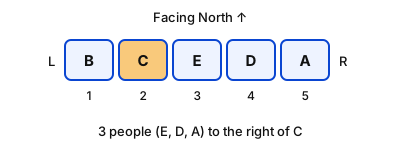
Five people, A, B, C, D and E are sitting in a straight line, facing North. B is sitting to the extreme left end. Only two people are sitting between D and B. E is seated second to the right of B. A is not an immediate neighbour of E. How many people are sitting to the right of C?
पाँच व्यक्ति A, B, C, D और E उत्तर की ओर मुख करके एक सीधी पंक्ति में बैठे हैं। B बिल्कुल बाएँ छोर पर बैठा है। D और B के बीच केवल दो व्यक्ति बैठे हैं। E, B के दाईं ओर दूसरे स्थान पर बैठा है। A, E का निकटतम पड़ोसी नहीं है। C के दाईं ओर कितने व्यक्ति बैठे हैं?
  1. AThreeतीन
  2. BOneएक
  3. CZeroशून्य
  4. DTwoदो
Show answer

Concept: Fix B at the left end and place others.

  1. B = 1; E second to right of B → E = 3.
  2. Two between D and B → D = 4.
  3. A not next to E → A = 5, C = 2.
  4. Right of C: E, D, A → three.

Trick: Use the ‘not neighbour’ clue last to choose between the two empty seats.

Answer: (A) Three

अवधारणा: B को बाएँ छोर पर रखकर बाकी बैठाएँ।

  1. B = 1; E = 3।
  2. D और B के बीच दो → D = 4।
  3. A, E का पड़ोसी नहीं → A = 5, C = 2।
  4. C के दाएँ: E, D, A → तीन।

ट्रिक: ‘पड़ोसी नहीं’ संकेत अंत में खाली स्थान तय करता है।

उत्तर: (A) तीन

RRB NTPC Undergraduate CBT 1General Intelligence and ReasoningLinear Seating ArrangementRRB NTPC Undergraduate CBT 1 2024 · 28 Aug Shift 1 →
Q598.
CROWD is related to HWTBI in a certain way based on the English alphabetical order. In the same way, DRAWN is related to IWFBS. To which of the given options is BRUSH related, following the same logic?
अंग्रेज़ी वर्णमाला क्रम के आधार पर CROWD एक निश्चित प्रकार से HWTBI से संबंधित है। उसी प्रकार, DRAWN, IWFBS से संबंधित है। समान तर्क का अनुसरण करते हुए, BRUSH दिए गए विकल्पों में से किससे संबंधित है?
  1. AGWZXM
  2. BFVYWL
  3. CGWZYM
  4. DHXAYN
Show answer

Concept: Find the uniform shift.

  1. CROWD → HWTBI: each letter +5.
  2. DRAWN → IWFBS: +5 ✓.
  3. BRUSH +5 → G W Z X M.

Trick: W + 5 wraps to B; S + 5 = X.

Answer: (A) GWZXM

अवधारणा: समान अंतर ज्ञात करें।

  1. CROWD → HWTBI: हर अक्षर +5।
  2. DRAWN → IWFBS ✓।
  3. BRUSH → GWZXM।

ट्रिक: W + 5 = B (चक्रीय); S + 5 = X।

उत्तर: (A) GWZXM

RRB NTPC Undergraduate CBT 1General Intelligence and ReasoningAnalogy – Letter CodingRRB NTPC Undergraduate CBT 1 2024 · 28 Aug Shift 1 →
Q599.
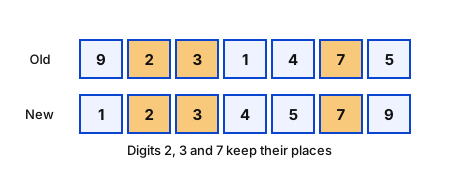
Each of the digits in the number 9231475 is arranged in ascending order from left to right. The position(s) of how many digits will remain unchanged as compared to that in the original number?
संख्या 9231475 के प्रत्येक अंक को बाएँ से दाएँ आरोही क्रम में व्यवस्थित किया जाता है। मूल संख्या की तुलना में कितने अंकों का/के स्थान अपरिवर्तित रहेगा/रहेंगे?
  1. AOneएक
  2. BNoneकोई नहीं
  3. CThreeतीन
  4. DTwoदो
Show answer

Concept: Write the original and the ascending arrangement one above the other and compare.

  1. Original: 9 2 3 1 4 7 5.
  2. Ascending: 1 2 3 4 5 7 9.
  3. Same place: 2, 3, 7 → three digits.

Trick: Compare column by column.

Answer: (C) Three

अवधारणा: मूल और आरोही क्रम को एक के नीचे एक लिखकर तुलना करें।

  1. मूल: 9 2 3 1 4 7 5।
  2. आरोही: 1 2 3 4 5 7 9।
  3. स्थान अपरिवर्तित: 2, 3, 7 → तीन।

ट्रिक: स्तंभ-दर-स्तंभ मिलाएँ।

उत्तर: (C) तीन

RRB NTPC Undergraduate CBT 1General Intelligence and ReasoningDigit ArrangementRRB NTPC Undergraduate CBT 1 2024 · 28 Aug Shift 1 →
Q600.
If 1 is added to each even digit and 3 is subtracted from each odd digit in the number 943372856, what will be difference between the highest and lowest digits thus formed?
यदि संख्या 943372856 में प्रत्येक सम अंक में 1 जोड़ दिया जाए और प्रत्येक विषम अंक में से 3 घटा दिया जाए, तो इस प्रकार बने उच्चतम और निम्नतम अंकों के बीच का अंतर क्या होगा?
  1. A9
  2. B7
  3. C8
  4. D6
Show answer

Concept: Apply +1 to even digits and −3 to odd digits.

  1. 943372856 → 6 5 0 0 4 3 9 2 7.
  2. Highest =9, lowest =0.
  3. Difference =9.

Trick: Write the new digits under the old ones to avoid mistakes.

Answer: (A) 9

अवधारणा: सम अंकों में +1 और विषम अंकों में −3।

  1. 943372856 → 6 5 0 0 4 3 9 2 7।
  2. सबसे बड़ा =9, सबसे छोटा =0।
  3. अंतर =9।

ट्रिक: नए अंक पुराने के नीचे लिखें।

उत्तर: (A) 9

RRB NTPC Undergraduate CBT 1General Intelligence and ReasoningDigit OperationsRRB NTPC Undergraduate CBT 1 2024 · 28 Aug Shift 1 →