Question bank

Q&A: practice questions with answers

Search questions on any topic. Filter by exam category, exam, subject and topic, try the question, then open the answer and explanation.

Courses – airGurukul

8,495 questions found.

Q7881.
Based on the English alphabetical order, three of the following four are alike in a certain way and thus form a group. Which is the one that does not belong to that group? (Note: The odd man out is not based on the number of consonants/vowels or their position in the letter cluster.)
अंग्रेज़ी वर्णमाला क्रम के आधार पर, निम्नलिखित चार में से तीन एक निश्चित प्रकार से समान हैं और इस प्रकार एक समूह बनाते हैं। वह कौन-सा है जो उस समूह से संबंधित नहीं है? (नोट: असंगत का निर्धारण व्यंजनों/स्वरों की संख्या या अक्षर-समूह में उनकी स्थिति के आधार पर नहीं किया गया है।)
  1. ACEH
  2. BPRU
  3. CUWX
  4. DJLO
Show answer

Concept: Look at the gaps between consecutive letters inside each cluster.

  1. CEH: C→E +2, E→H +3. PRU: P→R +2, R→U +3.
  2. JLO: J→L +2, L→O +3.
  3. UWX: U→W +2, W→X +1 – the second gap is different.

Trick: Pattern (+2, +3) in three clusters; UWX has (+2, +1), so it is the odd one.

Answer: (C) UWX

अवधारणा: हर समूह के भीतर क्रमागत अक्षरों के बीच का अंतर देखें।

  1. CEH: C→E +2, E→H +3। PRU: P→R +2, R→U +3।
  2. JLO: J→L +2, L→O +3।
  3. UWX: U→W +2, W→X +1 – दूसरा अंतर भिन्न है।

ट्रिक: तीन समूहों में पैटर्न (+2, +3); UWX में (+2, +1), अतः यही विषम है।

उत्तर: (C) UWX
RRB NTPC Undergraduate CBT 1General Intelligence and ReasoningOdd One Out – Letter ClustersRRB NTPC Undergraduate CBT 1 2025 · 9 May Shift 1 →
Q7882.
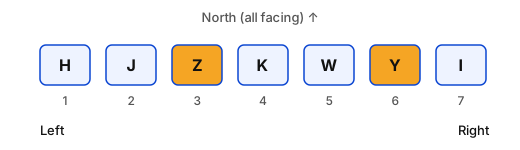
Seven people H, I, J, K, W, Y and Z are sitting in a row facing north. Only three people sit between H and W. K sits to the immediate left of W. No one sits to the right of I. Only two people sit between I and K. Z sits to the immediate right of J. How many people sit between Y and Z?
सात व्यक्ति H, I, J, K, W, Y और Z एक पंक्ति में उत्तर की ओर मुख करके बैठे हैं। H और W के बीच केवल तीन व्यक्ति बैठे हैं। K, W के ठीक बाएँ बैठा है। I के दाएँ कोई नहीं बैठा है। I और K के बीच केवल दो व्यक्ति बैठे हैं। Z, J के ठीक दाएँ बैठा है। Y और Z के बीच कितने व्यक्ति बैठे हैं?
  1. AOneएक
  2. BThreeतीन
  3. CFourचार
  4. DTwoदो
Show answer

Concept: All face north, so left and right are the same as ours. Number the seats 1 (left) to 7 (right).

  1. No one to the right of I → I = 7. Two people between I and K → K = 4.
  2. K is to the immediate left of W → W = 5. Three people between H and W → H = 1.
  3. Z is immediately right of J → J, Z need adjacent seats among 2, 3, 6 → J = 2, Z = 3; Y = 6.
  4. Between Y (6) and Z (3): K and W → two people.

Trick: Fix the end person first ("no one to the right of I"), then work inward with "n people between" clues.

Answer: (D) Two

अवधारणा: सभी उत्तर की ओर मुख किए हैं, अतः बाएँ-दाएँ हमारे जैसे ही हैं। सीटें 1 (बाएँ) से 7 (दाएँ) तक क्रमांकित करें।

  1. I के दाएँ कोई नहीं → I = 7। I और K के बीच दो लोग → K = 4।
  2. K, W के ठीक बाएँ → W = 5। H और W के बीच तीन लोग → H = 1।
  3. Z, J के ठीक दाएँ → J, Z के लिए 2, 3, 6 में सटी सीटें चाहिए → J = 2, Z = 3; Y = 6।
  4. Y (6) और Z (3) के बीच: K और W → दो लोग।

ट्रिक: पहले छोर वाले व्यक्ति को तय करें ("I के दाएँ कोई नहीं"), फिर "बीच में n लोग" संकेतों से अंदर की ओर बढ़ें।

उत्तर: (D) दो (Two)

RRB NTPC Undergraduate CBT 1General Intelligence and ReasoningLinear Seating ArrangementRRB NTPC Undergraduate CBT 1 2025 · 9 May Shift 1 →
Q7883.
What will come in place of the question mark (?) in the following equation if ‘+’ and ‘−’ are interchanged and ‘×’ and ‘÷’ are interchanged?
2814 × 7 − 3 ÷ 75 + 5 = ?
यदि '+' और '−' को आपस में बदल दिया जाए तथा '×' और '÷' को आपस में बदल दिया जाए, तो निम्नलिखित समीकरण में प्रश्नचिह्न (?) के स्थान पर क्या आएगा?
2814 × 7 − 3 ÷ 75 + 5 = ?
  1. A321
  2. B622
  3. C421
  4. D522
Show answer

Concept: Replace the signs as instructed, then apply BODMAS (÷ and × before + and −).

  1. After interchange: 2814÷7+3×75−5.
  2. 2814÷7=402; 3×75=225.
  3. 402+225−5=622.

Trick: Do the division and multiplication first; the big number divided by 7 gives a clean 402, which is the signal you are on track.

Answer: (B) 622

अवधारणा: निर्देशानुसार चिह्न बदलें, फिर BODMAS लागू करें (÷ और × पहले, + और − बाद में)।

  1. अदला-बदली के बाद: 2814÷7+3×75−5।
  2. 2814÷7=402; 3×75=225।
  3. 402+225−5=622।

ट्रिक: पहले भाग और गुणा करें; बड़ी संख्या का 7 से पूरा भाग (402) होना संकेत है कि आप सही रास्ते पर हैं।

उत्तर: (B) 622

RRB NTPC Undergraduate CBT 1General Intelligence and ReasoningMathematical OperationsRRB NTPC Undergraduate CBT 1 2025 · 9 May Shift 1 →
Q7884.
If 2 is added to each odd digit and 2 is subtracted from each even digit in the number 7213546, which of the following digits will be third from the left in the new number thus formed?
यदि संख्या 7213546 में प्रत्येक विषम अंक में 2 जोड़ा जाए और प्रत्येक सम अंक में से 2 घटाया जाए, तो इस प्रकार बनी नई संख्या में बाएँ से तीसरा अंक निम्नलिखित में से कौन-सा होगा?
  1. A7
  2. B9
  3. C5
  4. D3
Show answer

Concept: Apply the rule to each digit separately: odd digit +2, even digit −2.

  1. 7213546 → 7+2 = 9, 2−2 = 0, 1+2 = 3, 3+2 = 5, 5+2 = 7, 4−2 = 2, 6−2 = 4.
  2. New number: 9 0 3 5 7 2 4.
  3. Third digit from the left = 3.

Trick: Only the asked position matters – third digit is 1 (odd) → 1+2 = 3; no need to convert the whole number.

Answer: (D) 3

अवधारणा: नियम हर अंक पर अलग-अलग लागू करें: विषम अंक +2, सम अंक −2।

  1. 7213546 → 7+2 = 9, 2−2 = 0, 1+2 = 3, 3+2 = 5, 5+2 = 7, 4−2 = 2, 6−2 = 4।
  2. नई संख्या: 9 0 3 5 7 2 4।
  3. बाएँ से तीसरा अंक = 3।

ट्रिक: केवल पूछा गया स्थान देखें – तीसरा अंक 1 (विषम) → 1+2 = 3; पूरी संख्या बदलने की ज़रूरत नहीं।

उत्तर: (D) 3

RRB NTPC Undergraduate CBT 1General Intelligence and ReasoningNumber OperationsRRB NTPC Undergraduate CBT 1 2025 · 9 May Shift 1 →
Q7885.
Each letter in the word GUILDER is arranged in the English alphabetical order. How many letters are there in the English alphabetical order between the letter which is fourth from the left and the one which is second from the right in the new letter cluster thus formed?
शब्द GUILDER के प्रत्येक अक्षर को अंग्रेज़ी वर्णमाला क्रम में व्यवस्थित किया जाता है। इस प्रकार बने नए अक्षर-समूह में बाएँ से चौथे अक्षर और दाएँ से दूसरे अक्षर के बीच अंग्रेज़ी वर्णमाला क्रम में कितने अक्षर हैं?
  1. A8
  2. B11
  3. C9
  4. D7
Show answer

Concept: Arrange the letters alphabetically, pick the required letters and count the letters strictly between them in the alphabet.

  1. GUILDER → D, E, G, I, L, R, U.
  2. Fourth from left = I (9); second from right = R (18).
  3. Letters between I and R in the alphabet: J K L M N O P Q = 18−9−1=8.

Trick: Letters between two letters = difference of positions −1.

Answer: (A) 8

अवधारणा: अक्षरों को वर्णमाला क्रम में लगाएँ, माँगे गए अक्षर चुनें और वर्णमाला में उनके बीच के अक्षर गिनें।

  1. GUILDER → D, E, G, I, L, R, U।
  2. बाएँ से चौथा = I (9); दाएँ से दूसरा = R (18)।
  3. वर्णमाला में I और R के बीच: J K L M N O P Q = 18−9−1=8।

ट्रिक: दो अक्षरों के बीच के अक्षर = स्थानों का अंतर −1।

उत्तर: (A) 8

RRB NTPC Undergraduate CBT 1General Intelligence and ReasoningAlphabet TestRRB NTPC Undergraduate CBT 1 2025 · 9 May Shift 1 →
Q7886.
Read the given statement(s) and conclusions carefully. Assuming that the information given in the statements is true, even if it appears to be at variance with commonly known facts, decide which of the given conclusions logically follow(s) from the statement(s).
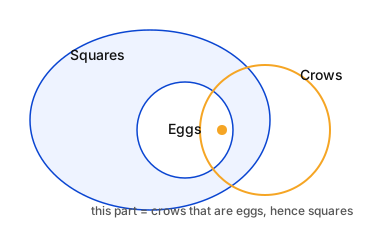
Statements: All eggs are squares. Some crows are eggs.
Conclusion (I): Some squares are crows.
Conclusion (II): All eggs are crows.
दिए गए कथन(नों) और निष्कर्षों को ध्यानपूर्वक पढ़िए। यह मानते हुए कि कथनों में दी गई जानकारी सत्य है, भले ही वह सामान्यतः ज्ञात तथ्यों से भिन्न प्रतीत होती हो, निर्णय कीजिए कि दिए गए निष्कर्षों में से कौन-सा/से निष्कर्ष कथन(नों) का तार्किक रूप से अनुसरण करता/करते है/हैं।
कथन: सभी अंडे वर्ग हैं। कुछ कौए अंडे हैं।
निष्कर्ष (I): कुछ वर्ग कौए हैं।
निष्कर्ष (II): सभी अंडे कौए हैं।
  1. ABoth conclusions (I) and (II) followनिष्कर्ष (I) और (II) दोनों अनुसरण करते हैं
  2. BOnly conclusion (I) followsकेवल निष्कर्ष (I) अनुसरण करता है
  3. CNeither conclusion (I) nor (II) followsन तो निष्कर्ष (I) और न ही (II) अनुसरण करता है
  4. DOnly conclusion (II) followsकेवल निष्कर्ष (II) अनुसरण करता है
Show answer

Concept: Draw a Venn diagram: 'All eggs are squares' puts the eggs circle inside squares; 'Some crows are eggs' makes crows overlap eggs.

  1. The crows that are eggs lie inside squares, so some squares are crows – Conclusion (I) follows.
  2. 'All eggs are crows' is not forced: eggs may exist outside the crows circle – Conclusion (II) does not follow.

Trick: All A are B + Some C are A ⇒ Some B are C (definite); a 'Some' statement never yields an 'All' conclusion.

Answer: (B) Only conclusion (I) follows

अवधारणा: वेन आरेख बनाएँ: 'सभी अंडे वर्ग हैं' → अंडे का वृत्त वर्ग के अंदर; 'कुछ कौवे अंडे हैं' → कौवे का वृत्त अंडे को काटता है।

  1. जो कौवे अंडे हैं वे वर्ग के अंदर हैं, अतः कुछ वर्ग कौवे हैं – निष्कर्ष (I) अनुसरण करता है।
  2. 'सभी अंडे कौवे हैं' आवश्यक नहीं: अंडे कौवे के वृत्त के बाहर भी हो सकते हैं – निष्कर्ष (II) अनुसरण नहीं करता।

ट्रिक: सभी A, B हैं + कुछ C, A हैं ⇒ कुछ B, C हैं (निश्चित); 'कुछ' कथन से कभी 'सभी' निष्कर्ष नहीं निकलता।

उत्तर: (B) केवल निष्कर्ष (I) अनुसरण करता है

RRB NTPC Undergraduate CBT 1General Intelligence and ReasoningSyllogismRRB NTPC Undergraduate CBT 1 2025 · 9 May Shift 1 →
Q7887.
In a certain code language, ‘eagle gum novel’ is coded as 'fq ko hz' and ‘novel fresh zebra’ is coded as ‘ko ef ni’. How is ‘novel’ coded in the given language?
एक निश्चित कूट भाषा में, 'eagle gum novel' को 'fq ko hz' के रूप में कूटबद्ध किया जाता है और 'novel fresh zebra' को 'ko ef ni' के रूप में कूटबद्ध किया जाता है। उसी भाषा में 'novel' को किस प्रकार कूटबद्ध किया जाएगा?
  1. Aef
  2. Bhz
  3. Cfq
  4. Dko
Show answer

Concept: In sentence coding, a word common to two sentences has the code common to both.

  1. 'eagle gum novel' → fq ko hz; 'novel fresh zebra' → ko ef ni.
  2. Common word: novel; common code: ko.
  3. Hence novel = ko.

Trick: Match the overlap of words with the overlap of codes – no other step needed.

Answer: (D) ko

अवधारणा: वाक्य कूट में दो वाक्यों में समान शब्द का कोड भी दोनों में समान होता है।

  1. 'eagle gum novel' → fq ko hz; 'novel fresh zebra' → ko ef ni।
  2. समान शब्द: novel; समान कोड: ko।
  3. अतः novel = ko।

ट्रिक: शब्दों के साझा भाग को कोड के साझा भाग से मिलाएँ – और कुछ करने की ज़रूरत नहीं।

उत्तर: (D) ko

RRB NTPC Undergraduate CBT 1General Intelligence and ReasoningCoding–DecodingRRB NTPC Undergraduate CBT 1 2025 · 9 May Shift 1 →
Q7888.
If ‘A’ stands for ‘÷’, ‘B’ stands for ‘×’, ‘C’ stands for ‘+’ and ‘D’ stands for ‘−’, then the resultant of which of the following will be 486?
यदि 'A' का अर्थ '÷', 'B' का अर्थ '×', 'C' का अर्थ '+' और 'D' का अर्थ '−' है, तो निम्नलिखित में से किसका परिणाम 486 होगा?
  1. A404 A 4 C 15 D 50 B 8
  2. B404 D 4 D 15 C 50 A 8
  3. C404 B 4 D 15 C 50 A 8
  4. D404 A 4 D 15 C 50 B 8
Show answer

Concept: Substitute A = ÷, B = ×, C = +, D = − and evaluate each option with BODMAS.

  1. Option D: 404÷4−15+50×8=101−15+400=486 ✓.
  2. Option A: 404÷4+15−50×8=101+15−400=−284.
  3. Option B: 404−4−15+50÷8=385+6.25=391.25; Option C: 404×4−15+50÷8=1607.25.

Trick: 404÷4=101 and 50×8=400 add up near 486 – test the option that has A with 4 and B with 8 first.

Answer: (D) 404 A 4 D 15 C 50 B 8

अवधारणा: A = ÷, B = ×, C = +, D = − रखें और हर विकल्प को BODMAS से हल करें।

  1. विकल्प D: 404÷4−15+50×8=101−15+400=486 ✓।
  2. विकल्प A: 404÷4+15−50×8=101+15−400=−284।
  3. विकल्प B: 404−4−15+50÷8=385+6.25=391.25; विकल्प C: 404×4−15+50÷8=1607.25।

ट्रिक: 404÷4=101 और 50×8=400 मिलकर 486 के पास आते हैं – पहले वही विकल्प जाँचें जिसमें 4 के साथ A और 8 के साथ B हो।

उत्तर: (D) 404 A 4 D 15 C 50 B 8

RRB NTPC Undergraduate CBT 1General Intelligence and ReasoningMathematical OperationsRRB NTPC Undergraduate CBT 1 2025 · 9 May Shift 1 →
Q7889.
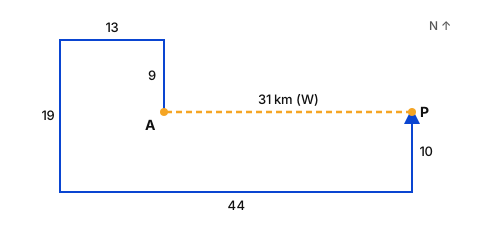
Mr. Yorly starts from Point A and drives 9 km towards North. He then takes a left turn, drives 13 km, turns left and drives 19 km. He then takes a left turn and drives 44 km. He takes a final left turn, drives 10 km and stops at Point P. How far (shortest distance) and towards which direction should he drive in order to reach Point A again?
(All turns are 90 degrees turns only unless specified.)
श्री योर्ली बिंदु A से चलना शुरू करते हैं और उत्तर की ओर 9 km गाड़ी चलाते हैं। फिर वे बाएँ मुड़ते हैं, 13 km गाड़ी चलाते हैं, बाएँ मुड़ते हैं और 19 km गाड़ी चलाते हैं। फिर वे बाएँ मुड़ते हैं और 44 km गाड़ी चलाते हैं। वे अंतिम बार बाएँ मुड़ते हैं, 10 km गाड़ी चलाते हैं और बिंदु P पर रुक जाते हैं। बिंदु A पर पुनः पहुँचने के लिए उन्हें कितनी दूर (न्यूनतम दूरी) और किस दिशा में गाड़ी चलानी चाहिए?
(जब तक अन्यथा निर्दिष्ट न हो, सभी मोड़ केवल 90 डिग्री के मोड़ हैं।)
  1. A35 km to the North35 km उत्तर की ओर
  2. B33 km to the South33 km दक्षिण की ओर
  3. C31 km to the West31 km पश्चिम की ओर
  4. D22 km to the East22 km पूर्व की ओर
Show answer

Concept: Track the position with coordinates, taking A as origin, North as +y and East as +x. A left turn rotates N → W → S → E → N.

  1. North 9: (0, 9). Left → West 13: (−13, 9). Left → South 19: (−13, −10).
  2. Left → East 44: (31, −10). Left → North 10: (31, 0) = P.
  3. P is 31 km due east of A, so he must drive 31 km towards the West to reach A.

Trick: Net N–S: 9−19+10=0; net E–W: −13+44=31 km east → go back 31 km west.

Answer: (C) 31 km to the West

अवधारणा: A को मूल बिंदु, उत्तर को +y और पूर्व को +x मानकर स्थिति निर्देशांकों से ट्रैक करें। बायाँ मोड़: N → W → S → E → N।

  1. उत्तर 9: (0, 9)। बाएँ → पश्चिम 13: (−13, 9)। बाएँ → दक्षिण 19: (−13, −10)।
  2. बाएँ → पूर्व 44: (31, −10)। बाएँ → उत्तर 10: (31, 0) = P।
  3. P, A से ठीक 31 km पूर्व में है, अतः A पहुँचने के लिए 31 km पश्चिम की ओर चलना होगा।

ट्रिक: शुद्ध N–S: 9−19+10=0; शुद्ध E–W: −13+44=31 km पूर्व → वापस 31 km पश्चिम।

उत्तर: (C) 31 km पश्चिम की ओर

RRB NTPC Undergraduate CBT 1General Intelligence and ReasoningDirection and DistanceRRB NTPC Undergraduate CBT 1 2025 · 9 May Shift 1 →
Q7890.
What should come in place of the ‘?’ in the given series?
43 ? 31 67 19 79
दी गई शृंखला में '?' के स्थान पर क्या आना चाहिए?
43 ? 31 67 19 79
  1. A50
  2. B52
  3. C60
  4. D55
Show answer

Concept: When neighbouring terms rise and fall alternately, split the series into two alternate sub-series.

  1. Odd places: 43, 31, 19 → each −12.
  2. Even places: ?, 67, 79 → each +12, so ? =67−12=55.
  3. Check: 43, 55, 31, 67, 19, 79 – alternate differences −12 and +12 hold.

Trick: Zig-zag series → read alternate terms; both chains here use the same step 12.

Answer: (D) 55

अवधारणा: जब पड़ोसी पद बारी-बारी से बढ़ें-घटें, तो श्रृंखला को दो एकांतर उप-श्रृंखलाओं में बाँटें।

  1. विषम स्थान: 43, 31, 19 → प्रत्येक −12।
  2. सम स्थान: ?, 67, 79 → प्रत्येक +12, अतः ? =67−12=55।
  3. जाँच: 43, 55, 31, 67, 19, 79 – एकांतर अंतर −12 और +12 सही बैठते हैं।

ट्रिक: ज़िग-ज़ैग श्रृंखला → एक छोड़कर पद पढ़ें; यहाँ दोनों शृंखलाओं में समान चरण 12 है।

उत्तर: (D) 55

RRB NTPC Undergraduate CBT 1General Intelligence and ReasoningNumber SeriesRRB NTPC Undergraduate CBT 1 2025 · 9 May Shift 1 →
Q7891.
Based on the English alphabetical order, three of the following four letter-cluster pairs are alike in a certain way and thus form a group. Which is the one that does not belong to that group?
(Note: The odd one out is not based on the number of consonants/vowels or their position in the letter-cluster.)
अंग्रेज़ी वर्णमाला क्रम के आधार पर, निम्नलिखित चार अक्षर-समूह युग्मों में से तीन एक निश्चित प्रकार से समान हैं और इस प्रकार एक समूह बनाते हैं। वह कौन-सा है जो उस समूह से संबंधित नहीं है?
(नोट: असंगत का निर्धारण व्यंजनों/स्वरों की संख्या या अक्षर-समूह में उनकी स्थिति के आधार पर नहीं किया गया है।)
  1. AHC - GB
  2. BJE - MK
  3. CNI - MH
  4. DLG - KF
Show answer

Concept: Compare the shift of each letter from the first cluster to the second.

  1. HC–GB: H→G −1, C→B −1. NI–MH: N→M −1, I→H −1. LG–KF: L→K −1, G→F −1.
  2. JE–MK: J→M +3, E→K +6 – different pattern.
  3. Also, within every first cluster the gap is 5 (H–C, J–E, N–I, L–G), but in MK it is only 2.

Trick: Three pairs are simply "each letter one step back"; the one that moves forward is the odd one.

Answer: (B) JE - MK

अवधारणा: पहले समूह से दूसरे समूह तक हर अक्षर के परिवर्तन की तुलना करें।

  1. HC–GB: H→G −1, C→B −1। NI–MH: N→M −1, I→H −1। LG–KF: L→K −1, G→F −1।
  2. JE–MK: J→M +3, E→K +6 – भिन्न पैटर्न।
  3. साथ ही, हर पहले समूह में अंतर 5 है (H–C, J–E, N–I, L–G), पर MK में केवल 2।

ट्रिक: तीन युग्मों में "हर अक्षर एक कदम पीछे"; जो आगे बढ़ता है वही विषम है।

उत्तर: (B) JE - MK

RRB NTPC Undergraduate CBT 1General Intelligence and ReasoningOdd One Out – Letter PairsRRB NTPC Undergraduate CBT 1 2025 · 9 May Shift 1 →
Q7892.
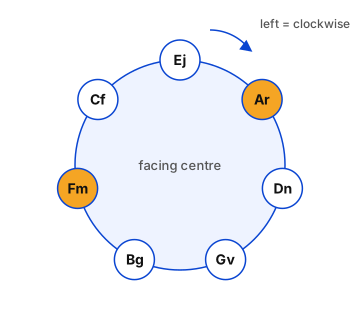
Ar, Bg, Cf, Dn, Ej, Fm and Gv are sitting around a circular table, facing the centre. Bg sits third to the right of Ej. Gv sits third to the left of Ej. Fm is the immediate neighbour of Cf and Bg. Dn is not an immediate neighbour of Ej.
How many people sit between Ar and Fm when counted from the left of Fm?
Ar, Bg, Cf, Dn, Ej, Fm और Gv एक वृत्ताकार मेज़ के चारों ओर केंद्र की ओर मुख करके बैठे हैं। Bg, Ej के दाएँ तीसरे स्थान पर बैठा है। Gv, Ej के बाएँ तीसरे स्थान पर बैठा है। Fm, Cf और Bg का निकटतम पड़ोसी है। Dn, Ej का निकटतम पड़ोसी नहीं है।
Fm के बाएँ से गिनने पर Ar और Fm के बीच कितने व्यक्ति बैठे हैं?
  1. AFourचार
  2. BOneएक
  3. CTwoदो
  4. DThreeतीन
Show answer

Concept: For people facing the centre, 'left' means clockwise and 'right' means anticlockwise. Fix one person and place the others.

  1. Fix Ej. Bg is third to the right (3 places anticlockwise); Gv is third to the left (3 places clockwise) – in a circle of 7 they sit next to each other opposite Ej.
  2. Fm is a neighbour of Bg (the seat not taken by Gv), and Cf is Fm's other neighbour → going clockwise from Ej: Ej, _, _, Gv, Bg, Fm, Cf.
  3. Dn is not Ej's neighbour → Dn takes the seat two places from Ej, Ar sits immediately left of Ej.
  4. From the left of Fm (clockwise) to Ar: Cf, Ej, then Ar → two people between.

Trick: Facing centre: left = clockwise. 'Third to right' and 'third to left' of the same person in a 7-seat circle are adjacent seats.

Answer: (C) Two

अवधारणा: केंद्र की ओर मुख होने पर 'बायाँ' = दक्षिणावर्त (clockwise) और 'दायाँ' = वामावर्त। एक व्यक्ति को स्थिर रखकर बाकी को बैठाएँ।

  1. Ej को स्थिर रखें। Bg, Ej के दाएँ तीसरा (3 स्थान वामावर्त); Gv बाएँ तीसरा (3 स्थान दक्षिणावर्त) – 7 के वृत्त में ये दोनों Ej के सामने पास-पास बैठते हैं।
  2. Fm, Bg का पड़ोसी (जो सीट Gv ने नहीं ली) और Cf, Fm का दूसरा पड़ोसी → Ej से दक्षिणावर्त: Ej, _, _, Gv, Bg, Fm, Cf।
  3. Dn, Ej का पड़ोसी नहीं → Dn, Ej से दो स्थान दूर; Ar, Ej के ठीक बाएँ।
  4. Fm के बाएँ से (दक्षिणावर्त) Ar तक: Cf, Ej, फिर Ar → बीच में दो लोग।

ट्रिक: केंद्र की ओर मुख: बायाँ = दक्षिणावर्त। 7 सीटों के वृत्त में एक ही व्यक्ति के 'दाएँ तीसरा' और 'बाएँ तीसरा' आपस में पड़ोसी होते हैं।

उत्तर: (C) दो (Two)

RRB NTPC Undergraduate CBT 1General Intelligence and ReasoningCircular Seating ArrangementRRB NTPC Undergraduate CBT 1 2025 · 9 May Shift 1 →
Q7893.
Select the option that represents the correct order of the given words as they would appear in an English dictionary.
1. Bright
2. Bring
3. Bread
4. Break
5. Brain
उस विकल्प का चयन कीजिए जो दिए गए शब्दों के उस सही क्रम को दर्शाता है जिस क्रम में वे अंग्रेज़ी शब्दकोश में आएँगे।
1. Bright
2. Bring
3. Bread
4. Break
5. Brain
  1. A5, 3, 4, 1, 2
  2. B5, 3, 1, 2, 4
  3. C2, 5, 1, 4, 3
  4. D1, 5, 4, 2, 3
Show answer

Concept: Compare words letter by letter from the left; the first differing letter decides the order.

  1. All start with 'Br'. Third letters: Brain (a), Bread (e), Break (e), Bright (i), Bring (i).
  2. a < e < i → Brain first; among Bread/Break the fourth letters match (a), fifth: d < k → Bread, Break.
  3. Bright vs Bring: fourth letter g = g, fifth: h < n → Bright, Bring.
  4. Order: Brain (5), Bread (3), Break (4), Bright (1), Bring (2).

Trick: Move to the next letter only when the current letters tie; vowels order a < e < i < o < u helps quick sorting.

Answer: (A) 5, 3, 4, 1, 2

अवधारणा: शब्दों की बाएँ से अक्षर-दर-अक्षर तुलना करें; पहला भिन्न अक्षर क्रम तय करता है।

  1. सभी 'Br' से शुरू। तीसरे अक्षर: Brain (a), Bread (e), Break (e), Bright (i), Bring (i)।
  2. a < e < i → Brain पहले; Bread/Break में चौथा अक्षर समान (a), पाँचवाँ: d < k → Bread, Break।
  3. Bright बनाम Bring: चौथा g = g, पाँचवाँ: h < n → Bright, Bring।
  4. क्रम: Brain (5), Bread (3), Break (4), Bright (1), Bring (2)।

ट्रिक: अगले अक्षर पर तभी जाएँ जब वर्तमान अक्षर समान हों; स्वर क्रम a < e < i < o < u से जल्दी छँटाई होती है।

उत्तर: (A) 5, 3, 4, 1, 2

RRB NTPC Undergraduate CBT 1General Intelligence and ReasoningDictionary OrderRRB NTPC Undergraduate CBT 1 2025 · 9 May Shift 1 →
Q7894.
LHLP is related to TPTX in a certain way based on the English alphabetical order. In the same way, DZDH is related to LHLP. To which of the following is JFJN related, following the same logic?
अंग्रेज़ी वर्णमाला क्रम के आधार पर LHLP, TPTX से एक निश्चित प्रकार से संबंधित है। उसी प्रकार, DZDH, LHLP से संबंधित है। समान तर्क का अनुसरण करते हुए, JFJN निम्नलिखित में से किससे संबंधित है?
  1. ARNQV
  2. BROQW
  3. CRMQV
  4. DRNRV
Show answer

Concept: Find the shift of each letter in the given pairs and apply it to the new cluster.

  1. LHLP → TPTX: L(12)+8 = T(20), H(8)+8 = P(16), L+8 = T, P(16)+8 = X(24) → every letter +8.
  2. Check DZDH → LHLP: D+8 = L, Z(26)+8 = 34−26 = 8 = H, D+8 = L, H+8 = P ✓.
  3. JFJN: J(10)+8 = R(18), F(6)+8 = N(14), J+8 = R, N(14)+8 = V(22) → RNRV.

Trick: The 1st and 3rd letters are identical in every cluster, so the answer must have identical 1st and 3rd letters – only RNRV does.

Answer: (D) RNRV

अवधारणा: दिए गए युग्मों में हर अक्षर का परिवर्तन खोजें और नए समूह पर लागू करें।

  1. LHLP → TPTX: L(12)+8 = T(20), H(8)+8 = P(16), L+8 = T, P(16)+8 = X(24) → हर अक्षर +8।
  2. जाँच DZDH → LHLP: D+8 = L, Z(26)+8 = 34−26 = 8 = H, D+8 = L, H+8 = P ✓।
  3. JFJN: J(10)+8 = R(18), F(6)+8 = N(14), J+8 = R, N(14)+8 = V(22) → RNRV।

ट्रिक: हर समूह में पहला और तीसरा अक्षर समान है, अतः उत्तर में भी पहला-तीसरा समान होना चाहिए – केवल RNRV में ऐसा है।

उत्तर: (D) RNRV

RRB NTPC Undergraduate CBT 1General Intelligence and ReasoningLetter Cluster AnalogyRRB NTPC Undergraduate CBT 1 2025 · 9 May Shift 1 →
Q7895.
Read the given statement(s) and conclusions carefully. Assuming that the information given in the statements is true, even if it appears to be at variance with commonly known facts, decide which of the given conclusions logically follow(s) from the statement(s).
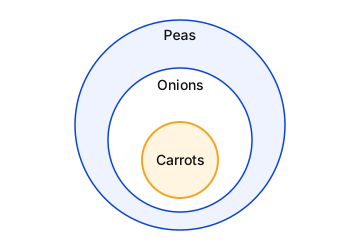
Statements: All carrots are onions. All onions are peas.
Conclusions (I) : All peas are carrots.
Conclusions (II) : Some onions are carrots.
दिए गए कथन(नों) और निष्कर्षों को ध्यानपूर्वक पढ़िए। यह मानते हुए कि कथनों में दी गई जानकारी सत्य है, भले ही वह सामान्यतः ज्ञात तथ्यों से भिन्न प्रतीत होती हो, निर्णय कीजिए कि दिए गए निष्कर्षों में से कौन-सा/से निष्कर्ष कथन(नों) का तार्किक रूप से अनुसरण करता/करते है/हैं।
कथन: सभी गाजर प्याज़ हैं। सभी प्याज़ मटर हैं।
निष्कर्ष (I): सभी मटर गाजर हैं।
निष्कर्ष (II): कुछ प्याज़ गाजर हैं।
  1. ABoth conclusions (I) and (II) followनिष्कर्ष (I) और (II) दोनों अनुसरण करते हैं
  2. BOnly conclusion (II) followsकेवल निष्कर्ष (II) अनुसरण करता है
  3. CNeither conclusion (I) nor (II) followsन तो निष्कर्ष (I) और न ही (II) अनुसरण करता है
  4. DOnly conclusion (I) followsकेवल निष्कर्ष (I) अनुसरण करता है
Show answer

Concept: 'All carrots are onions' and 'All onions are peas' give nested circles: carrots inside onions inside peas.

  1. Conclusion (I) 'All peas are carrots' reverses the inclusion – peas may exist that are not carrots, so it does not follow.
  2. Conclusion (II) 'Some onions are carrots': since all carrots are onions, the carrots are onions too, so some onions are definitely carrots – follows.

Trick: All A are B ⇒ Some B are A (always true); but All A are B never gives All B are A.

Answer: (B) Only conclusion (II) follows

अवधारणा: 'सभी गाजर प्याज़ हैं' और 'सभी प्याज़ मटर हैं' से एक के अंदर एक वृत्त बनते हैं: गाजर, प्याज़ के अंदर, प्याज़, मटर के अंदर।

  1. निष्कर्ष (I) 'सभी मटर गाजर हैं' समावेशन को उलट देता है – ऐसे मटर हो सकते हैं जो गाजर नहीं, अतः अनुसरण नहीं करता।
  2. निष्कर्ष (II) 'कुछ प्याज़ गाजर हैं': सभी गाजर प्याज़ हैं, तो वे गाजर प्याज़ भी हैं, अतः कुछ प्याज़ निश्चित रूप से गाजर हैं – अनुसरण करता है।

ट्रिक: सभी A, B हैं ⇒ कुछ B, A हैं (सदैव सत्य); पर सभी A, B हैं से कभी सभी B, A हैं नहीं निकलता।

उत्तर: (B) केवल निष्कर्ष (II) अनुसरण करता है

RRB NTPC Undergraduate CBT 1General Intelligence and ReasoningSyllogismRRB NTPC Undergraduate CBT 1 2025 · 9 May Shift 1 →
Q7896.
Why were tax incentives provided to foreign investors during the 1991 economic reform period in India?
भारत में 1991 के आर्थिक सुधार काल के दौरान विदेशी निवेशकों को कर प्रोत्साहन क्यों दिए गए थे?
  1. ATo promote domestic monopoliesघरेलू एकाधिकारों को बढ़ावा देने के लिए
  2. BTo discourage foreign investmentविदेशी निवेश को हतोत्साहित करने के लिए
  3. CTo attract foreign investmentविदेशी निवेश को आकर्षित करने के लिए
  4. DTo increase tax revenue for the governmentसरकार के कर राजस्व में वृद्धि करने के लिए
Show answer

Concept: The 1991 reforms (LPG – Liberalisation, Privatisation, Globalisation) opened the Indian economy to foreign capital.

  1. India faced a severe balance-of-payments crisis in 1991; foreign exchange reserves were enough for barely two weeks of imports.
  2. To bring in foreign capital and technology, the government offered tax incentives and concessions to foreign investors and raised FDI limits.
  3. Options A, B and D go against the very aim of liberalisation.

Yaad rakhein: 1991 reforms = LPG; tax holidays for foreign investors were part of "Globalisation".

Answer: (C) To attract foreign investment

अवधारणा: 1991 के सुधार (LPG – उदारीकरण, निजीकरण, वैश्वीकरण) ने भारतीय अर्थव्यवस्था को विदेशी पूँजी के लिए खोला।

  1. 1991 में भारत गंभीर भुगतान-संतुलन संकट में था; विदेशी मुद्रा भंडार मुश्किल से दो सप्ताह के आयात लायक था।
  2. विदेशी पूँजी और तकनीक लाने के लिए सरकार ने विदेशी निवेशकों को कर प्रोत्साहन (tax incentives) और रियायतें दीं तथा FDI सीमा बढ़ाई।
  3. विकल्प A, B और D उदारीकरण के उद्देश्य के ही विरुद्ध हैं।

याद रखें: 1991 सुधार = LPG; विदेशी निवेशकों को कर छूट "वैश्वीकरण" का हिस्सा थी।

उत्तर: (C) विदेशी निवेश आकर्षित करने के लिए

RRB NTPC Undergraduate CBT 1General AwarenessEconomy – 1991 ReformsRRB NTPC Undergraduate CBT 1 2025 · 8 May Shift 3 →
Q7897.
What does PCB stand for in a Computer System?
कंप्यूटर सिस्टम में PCB का पूर्ण रूप क्या है?
  1. APhysical Circuit Block
  2. BPrinted Circuit Board
  3. CPeripheral Circuit Board
  4. DProgrammed Control Board
Show answer

Concept: PCB = Printed Circuit Board – the board on which electronic components are mounted and connected by etched copper tracks.

  1. The motherboard, RAM modules and graphics cards are all PCBs.
  2. Copper "tracks" are printed/etched on an insulating board – hence "Printed".

Yaad rakhein: Motherboard = the main PCB of a computer.

Answer: (B) Printed Circuit Board

अवधारणा: PCB = Printed Circuit Board – वह बोर्ड जिस पर इलेक्ट्रॉनिक पुर्जे लगे होते हैं और ताँबे की ट्रैक से जुड़े होते हैं।

  1. मदरबोर्ड, RAM मॉड्यूल और ग्राफिक्स कार्ड सभी PCB हैं।
  2. ताँबे की "ट्रैक" इंसुलेटिंग बोर्ड पर छापी/उकेरी जाती हैं – इसलिए "Printed"।

याद रखें: मदरबोर्ड = कंप्यूटर का मुख्य PCB।

उत्तर: (B) Printed Circuit Board

RRB NTPC Undergraduate CBT 1General AwarenessComputer Awareness – HardwareRRB NTPC Undergraduate CBT 1 2025 · 8 May Shift 3 →
Q7898.
Which rules define the process of identification, determination, and remediation of contaminated sites?
कौन-से नियम संदूषित स्थलों (contaminated sites) की पहचान, निर्धारण और उपचार (remediation) की प्रक्रिया को परिभाषित करते हैं?
  1. AAir Quality Standards Rules, 2025वायु गुणवत्ता मानक नियम, 2025
  2. BUrban Wetland Restoration Rules, 2025शहरी आर्द्रभूमि पुनर्स्थापन नियम, 2025
  3. CEnvironment Protection (Management of Contaminated Sites) Rules, 2025पर्यावरण संरक्षण (संदूषित स्थलों का प्रबंधन) नियम, 2025
  4. DGreen Industrial Policy Rules, 2025हरित औद्योगिक नीति नियम, 2025
Show answer

Concept: The Environment Protection (Management of Contaminated Sites) Rules, 2025 were notified by the Ministry of Environment, Forest and Climate Change under the Environment (Protection) Act, 1986.

  1. They lay down a step-wise process: identification of probable contaminated sites, investigation/determination, and remediation with cost recovery under the "polluter pays" principle.
  2. State Pollution Control Boards and district authorities are made responsible for identification and remediation plans.
  3. The other options are not notified rules dealing with contaminated sites.

Yaad rakhein: "Contaminated sites" → Environment Protection (Management of Contaminated Sites) Rules, 2025.

Answer: (C) Environment Protection (Management of Contaminated Sites) Rules, 2025

अवधारणा: पर्यावरण संरक्षण (संदूषित स्थलों का प्रबंधन) नियम, 2025 को पर्यावरण, वन एवं जलवायु परिवर्तन मंत्रालय ने पर्यावरण (संरक्षण) अधिनियम, 1986 के तहत अधिसूचित किया।

  1. ये चरणबद्ध प्रक्रिया तय करते हैं: संभावित संदूषित स्थलों की पहचान, जाँच/निर्धारण और "प्रदूषक भुगतान करे" सिद्धांत पर उपचार (remediation)।
  2. राज्य प्रदूषण नियंत्रण बोर्ड और जिला प्रशासन को पहचान व उपचार योजना की जिम्मेदारी दी गई है।
  3. अन्य विकल्प संदूषित स्थलों से संबंधित अधिसूचित नियम नहीं हैं।

याद रखें: "Contaminated sites" → Environment Protection (Management of Contaminated Sites) Rules, 2025।

उत्तर: (C) Environment Protection (Management of Contaminated Sites) Rules, 2025

RRB NTPC Undergraduate CBT 1General AwarenessEnvironment – Rules 2025RRB NTPC Undergraduate CBT 1 2025 · 8 May Shift 3 →
Q7899.
What is the name of India’s first indigenous CRISPR-based gene therapy for Sickle Cell Disease, launched in November 2025?
नवंबर 2025 में शुरू की गई, सिकल सेल रोग के लिए भारत की पहली स्वदेशी CRISPR-आधारित जीन थेरेपी का नाम क्या है?
  1. AGENO-1
  2. BBIRSA 101
  3. CSickle Cure
  4. DCRISPR-X
Show answer

Concept: BIRSA 101 is India's first indigenous CRISPR-Cas9 based gene therapy for Sickle Cell Disease.

  1. It was launched in November 2025 on Janjatiya Gaurav Divas (15 November, birth anniversary of Birsa Munda) – hence the name BIRSA.
  2. Developed under CSIR (Institute of Genomics and Integrative Biology) with industry partners, it supports the National Sickle Cell Anaemia Elimination Mission (target 2047).

Yaad rakhein: BIRSA 101 → Birsa Munda → tribal-dominated areas where sickle cell disease is most common.

Answer: (B) BIRSA 101

अवधारणा: BIRSA 101 भारत की पहली स्वदेशी CRISPR-Cas9 आधारित जीन थेरेपी है, जो सिकल सेल रोग के लिए बनी है।

  1. इसे नवंबर 2025 में जनजातीय गौरव दिवस (15 नवंबर, बिरसा मुंडा जयंती) पर लॉन्च किया गया – इसलिए नाम BIRSA।
  2. CSIR (Institute of Genomics and Integrative Biology) ने उद्योग साझेदारों के साथ विकसित किया; यह राष्ट्रीय सिकल सेल एनीमिया उन्मूलन मिशन (लक्ष्य 2047) को सहारा देती है।

याद रखें: BIRSA 101 → बिरसा मुंडा → जनजातीय क्षेत्र, जहाँ सिकल सेल रोग सबसे अधिक है।

उत्तर: (B) BIRSA 101

RRB NTPC Undergraduate CBT 1General AwarenessScience & Tech – Gene TherapyRRB NTPC Undergraduate CBT 1 2025 · 8 May Shift 3 →
Q7900.
The inscriptions of Ashoka and Kharavela were primarily written in which of the following languages?
अशोक और खारवेल के अभिलेख मुख्य रूप से निम्नलिखित में से किस भाषा में लिखे गए थे?
  1. ASanskritसंस्कृत
  2. BPaliपालि
  3. CBengaliबांग्ला
  4. DPrakritप्राकृत
Show answer

Concept: Ashoka's edicts and Kharavela's Hathigumpha inscription are in Prakrit, the people's language of the time.

  1. Ashokan edicts: Prakrit language, mostly Brahmi script (Kharoshthi in the north-west; Greek/Aramaic at Kandahar).
  2. Kharavela (Kalinga, 1st century BCE): Hathigumpha inscription at Udayagiri, Odisha – Prakrit in Brahmi script.
  3. Sanskrit inscriptions become common later (e.g., Rudradaman's Junagadh inscription, 150 CE).

Yaad rakhein: Ashoka → Prakrit + Brahmi; first major Sanskrit inscription → Rudradaman (Junagadh).

Answer: (D) Prakrit

अवधारणा: अशोक के शिलालेख और खारवेल का हाथीगुम्फा अभिलेख प्राकृत में हैं – उस समय की जनभाषा।

  1. अशोक के अभिलेख: भाषा प्राकृत, लिपि प्रायः ब्राह्मी (उत्तर-पश्चिम में खरोष्ठी; कंधार में यूनानी/अरामाइक)।
  2. खारवेल (कलिंग, पहली शताब्दी ई.पू.): उदयगिरि, ओडिशा का हाथीगुम्फा अभिलेख – ब्राह्मी लिपि में प्राकृत।
  3. संस्कृत अभिलेख बाद में प्रचलित हुए (जैसे रुद्रदामन का जूनागढ़ अभिलेख, 150 ई.)।

याद रखें: अशोक → प्राकृत + ब्राह्मी; पहला प्रमुख संस्कृत अभिलेख → रुद्रदामन (जूनागढ़)।

उत्तर: (D) प्राकृत (Prakrit)

RRB NTPC Undergraduate CBT 1General AwarenessAncient History – InscriptionsRRB NTPC Undergraduate CBT 1 2025 · 8 May Shift 3 →