Question bank

Q&A: practice questions with answers

Search questions on any topic. Filter by exam category, exam, subject and topic, try the question, then open the answer and explanation.

Courses – airGurukul

2,900 questions found.

Q61.
A man sells a watch at a loss of 10%. Had he increased the selling price by ₹120, the transaction would have resulted in a gain of 5%. Determine the selling price of the watch.
एक व्यक्ति एक घड़ी को 10% की हानि पर बेचता है। यदि उसने विक्रय मूल्य में ₹120 की वृद्धि की होती, तो इस लेन-देन में 5% का लाभ होता। घड़ी का विक्रय मूल्य ज्ञात कीजिए।
  1. A₹840
  2. B₹720
  3. C₹760
  4. D₹800
Show answer

Concept: A change from loss to gain = change in SP as % of CP.

  1. From −10% to +5% is a change of 15% of CP.
  2. 15% of CP =120 ⇒ CP =800.
  3. SP =90% of 800 =720.

Trick: Rupee difference ÷ % difference gives 1% of CP: 12015=8.

Answer: (B) ₹720

अवधारणा: हानि से लाभ में बदलाव = SP का बदलाव, CP के % में।

  1. −10% से +5% = CP का 15% परिवर्तन।
  2. CP का 15%=120 ⇒ CP =800।
  3. SP = 800 का 90%=720।

ट्रिक: रुपये का अंतर ÷ प्रतिशत अंतर = CP का 1%: 12015=8।

उत्तर: (B) ₹720

RRB NTPC Undergraduate CBT 1MathematicsProfit and LossRRB NTPC Undergraduate CBT 1 2025 · 20 Jun Shift 3 →
Q62.
The simple interest on ₹55,000 at 5.5% per annum simple rate of interest is ₹______ in 5.5 years.
₹55,000 पर 5.5% वार्षिक साधारण ब्याज की दर से 5.5 वर्षों में साधारण ब्याज ₹______ होगा।
  1. A16,637.5
  2. B14,452.5
  3. C15,525.5
  4. D17,712.5
Show answer

Concept: SI=P×R×T100.

  1. SI=55000×5.5×5.5100.
  2. =550×30.25=16637.5.

Trick: 5.5×5.5=30.25 – multiply this by P100=550.

Answer: (A) 16,637.5

अवधारणा: SI=P×R×T100।

  1. SI=55000×5.5×5.5100।
  2. =550×30.25=16637.5।

ट्रिक: 5.5×5.5=30.25 – इसे P100=550 से गुणा करें।

उत्तर: (A) 16,637.5

RRB NTPC Undergraduate CBT 1MathematicsSimple InterestRRB NTPC Undergraduate CBT 1 2025 · 20 Jun Shift 3 →
Q63.
Simplify: 0.375+38−0.125
सरल कीजिए: 0.375+38−0.125
  1. A0.875
  2. B0.625
  3. C0.5
  4. D0.75
Show answer

Concept: Convert the fraction to a decimal: 38=0.375.

  1. Expression =0.375+0.375−0.125.
  2. =0.75−0.125=0.625.

Yaad rakhein: Eighths: 18=0.125, 38=0.375, 58=0.625.

Answer: (B) 0.625

अवधारणा: भिन्न को दशमलव में बदलें: 38=0.375।

  1. व्यंजक =0.375+0.375−0.125।
  2. =0.75−0.125=0.625।

याद रखें: आठवें भाग: 18=0.125, 38=0.375, 58=0.625।

उत्तर: (B) 0.625

RRB NTPC Undergraduate CBT 1MathematicsSimplification – Decimals and FractionsRRB NTPC Undergraduate CBT 1 2025 · 20 Jun Shift 3 →
Q64.
A sum becomes ₹9,075 after 2 years at 10% per annum compound interest,
compounded annually. What was the principal amount (in ₹)?
एक राशि 10% वार्षिक चक्रवृद्धि ब्याज की दर से, वार्षिक रूप से संयोजित होने पर,
2 वर्षों में ₹9,075 हो जाती है। मूलधन (₹ में) कितना था?
  1. A7,650
  2. B7,800
  3. C7,500
  4. D8,000
Show answer

Concept: A=P(1+R100)T.

  1. 9075=P×(1.1)2=1.21P.
  2. P=90751.21=7500.

Trick: 10% for 2 years ⇒ P:A=100:121; 9075121=75, so P=7500.

Answer: (C) 7,500

अवधारणा: A=P(1+R100)T।

  1. 9075=P×(1.1)2=1.21P।
  2. P=90751.21=7500।

ट्रिक: 2 वर्ष, 10% ⇒ P:A=100:121; 9075121=75, अतः P=7500।

उत्तर: (C) 7,500

RRB NTPC Undergraduate CBT 1MathematicsCompound InterestRRB NTPC Undergraduate CBT 1 2025 · 20 Jun Shift 3 →
Q65.
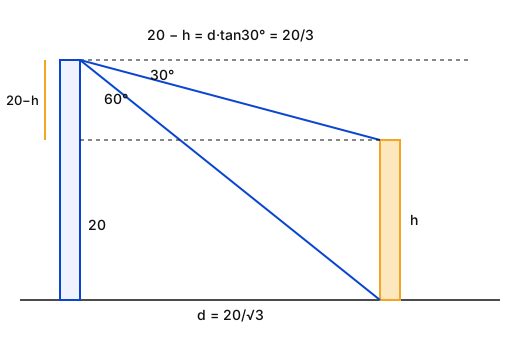
From the top of a building 20 m high, the angles of depression of the top and the bottom of a tower standing on the same horizontal ground are observed to be 30° and 60°, respectively. The height (in meter) of the tower is:
(Round off your answer to two decimal places.)
20 m ऊँचे एक भवन के शिखर से, उसी क्षैतिज तल पर खड़ी एक मीनार के शिखर और आधार के अवनमन कोण क्रमशः 30° और 60° देखे जाते हैं। मीनार की ऊँचाई (मीटर में) कितनी है?
(अपने उत्तर को दशमलव के दो स्थानों तक पूर्णांकित कीजिए।)
  1. A13.33 m
  2. B12.67 m
  3. C13.67 m
  4. D12.33 m
Show answer

Concept: Angle of depression = angle of elevation from the lower point (alternate angles).

  1. Bottom (60°): d=20tan60∘=203.
  2. Top (30°): drop =dtan30∘=203×13=203.
  3. Tower h=20−203=403≈13.33 m.

Trick: For 30° & 60° depressions, tower =23 of building height.

Answer: (A) 13.33 m

अवधारणा: अवनमन कोण = नीचे वाले बिंदु से उन्नयन कोण (एकांतर कोण)।

  1. नीचे (60°): d=20tan60∘=203।
  2. ऊपर (30°): अंतर =dtan30∘=203×13=203।
  3. मीनार h=20−203=403≈13.33 m।

ट्रिक: 30° और 60° अवनमन पर मीनार = भवन की ऊँचाई का 23।

उत्तर: (A) 13.33 m

RRB NTPC Undergraduate CBT 1MathematicsHeights and DistancesRRB NTPC Undergraduate CBT 1 2025 · 20 Jun Shift 3 →
Q66.
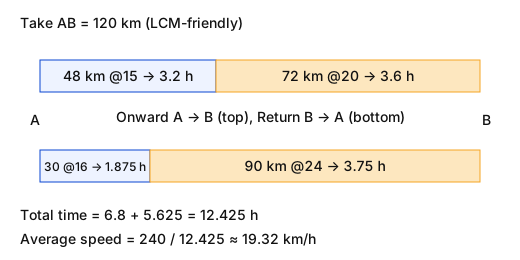
A cyclist travels from point A to B and then returns from B to A along the same route. On the onward journey, he covers two-fifths of the distance at 15 km/hr and the remaining distance at 20 km/hr. On the return journey, he covers one-fourth of the distance at 16 km/hr and the remaining distance at 24 km/hr. Find the average for the entire trip. (Round off your answer to two decimal places.)
एक साइकिल चालक बिंदु A से B तक जाता है और फिर उसी मार्ग से B से A तक लौटता है। जाते समय, वह दूरी का दो-पाँचवाँ भाग 15 km/hr की चाल से और शेष दूरी 20 km/hr की चाल से तय करता है। लौटते समय, वह दूरी का एक-चौथाई भाग 16 km/hr की चाल से और शेष दूरी 24 km/hr की चाल से तय करता है। पूरी यात्रा की औसत चाल ज्ञात कीजिए। (अपने उत्तर को दशमलव के दो स्थानों तक पूर्णांकित कीजिए।)
  1. A19.32 km/hr
  2. B20.56 km/hr
  3. C17.54 km/hr
  4. D23.34 km/hr
Show answer

Concept: Average speed=Total distanceTotal time.

  1. Take AB =120 km. Onward: 4815+7220=3.2+3.6=6.8 h.
  2. Return: 3016+9024=1.875+3.75=5.625 h.
  3. Average =24012.425≈19.32km/h.

Trick: Choose AB as LCM of 5 and 4 multiples (120) to keep pieces whole.

Answer: (A) 19.32 km/hr

अवधारणा: औसत चाल=कुल दूरीकुल समय।

  1. AB =120 km मानें। जाते समय: 4815+7220=3.2+3.6=6.8 घंटे।
  2. लौटते समय: 3016+9024=1.875+3.75=5.625 घंटे।
  3. औसत =24012.425≈19.32km/h।

ट्रिक: AB ऐसा लें (120) कि सभी भाग पूर्णांक बनें।

उत्तर: (A) 19.32 km/hr

RRB NTPC Undergraduate CBT 1MathematicsAverage SpeedRRB NTPC Undergraduate CBT 1 2025 · 20 Jun Shift 3 →
Q67.
The following data represents the weekly wages (in ₹) of the employees. Find the arithmetic mean of the weekly wages (in ₹).
Weekly wages (in ₹)900100011001200130014001500
Number of employees12121413141114
निम्नलिखित आँकड़े कर्मचारियों की साप्ताहिक मज़दूरी (₹ में) दर्शाते हैं। साप्ताहिक मज़दूरी (₹ में) का समांतर माध्य ज्ञात कीजिए।
साप्ताहिक मज़दूरी (₹ में)900100011001200130014001500
कर्मचारियों की संख्या12121413141114
  1. A₹1204.44
  2. B₹1186.25
  3. C₹1226.85
  4. D₹1056.35
Show answer

Concept: x¯=∑fx∑f.

  1. ∑f=12+12+14+13+14+11+14=90.
  2. ∑fx=10800+12000+15400+15600+18200+15400+21000=108400.
  3. x¯=10840090≈1204.44.

Trick: Assumed mean 1200: deviations sum =400 ⇒ 1200+40090=1204.44.

Answer: (A) ₹1204.44

अवधारणा: x¯=∑fx∑f।

  1. ∑f=12+12+14+13+14+11+14=90।
  2. ∑fx=10800+12000+15400+15600+18200+15400+21000=108400।
  3. x¯=10840090≈1204.44।

ट्रिक: कल्पित माध्य 1200: विचलनों का योग =400 ⇒ 1200+40090=1204.44।

उत्तर: (A) ₹1204.44

RRB NTPC Undergraduate CBT 1MathematicsStatistics – Arithmetic MeanRRB NTPC Undergraduate CBT 1 2025 · 20 Jun Shift 3 →
Q68.
Eight years ago, the age of Mr Gupta was four times that of his nephew, Rohit. After 6 years, Mr Gupta’s age will be twice that of Rohit. Find the present age of Mr Gupta.
आठ वर्ष पहले, श्री गुप्ता की आयु उनके भतीजे रोहित की आयु की चार गुनी थी। 6 वर्ष बाद, श्री गुप्ता की आयु रोहित की आयु की दोगुनी होगी। श्री गुप्ता की वर्तमान आयु ज्ञात कीजिए।
  1. A42 years42 वर्ष
  2. B36 years36 वर्ष
  3. C38 years38 वर्ष
  4. D40 years40 वर्ष
Show answer

Concept: Form two equations from past and future conditions.

  1. G−8=4(R−8) ⇒ G=4R−24.
  2. G+6=2(R+6) ⇒ 4R−18=2R+12 ⇒ R=15.
  3. G=60−24=36 years.

Trick: Check options: G=36 ⇒ 8 years ago 28, Rohit 7 ✓; after 6 years 42=2×21 ✓.

Answer: (B) 36 years

अवधारणा: भूत और भविष्य की शर्तों से दो समीकरण बनाएँ।

  1. G−8=4(R−8) ⇒ G=4R−24।
  2. G+6=2(R+6) ⇒ 4R−18=2R+12 ⇒ R=15।
  3. G=60−24=36 वर्ष।

ट्रिक: विकल्प जाँच: G=36 ⇒ 8 वर्ष पहले 28, रोहित 7 ✓; 6 वर्ष बाद 42=2×21 ✓।

उत्तर: (B) 36 years

RRB NTPC Undergraduate CBT 1MathematicsProblems on AgesRRB NTPC Undergraduate CBT 1 2025 · 20 Jun Shift 3 →
Q69.
What is the smallest natural number ‘x’ that needs to be subtracted from 13 and 25 so that the fourth proportional of the resulting numbers is 49?
वह सबसे छोटी प्राकृत संख्या ‘x’ कौन-सी है जिसे 13 और 25 में से घटाया जाए ताकि परिणामी संख्याओं का चतुर्थानुपाती 49 हो?
  1. A4
  2. B2
  3. C3
  4. D5
Show answer

Concept: With the two resulting numbers a,b in continued proportion a:b::b:c, the last term is c=b2a.

  1. Numbers: 13−x and 25−x; required (25−x)213−x=49.
  2. Try x=4: 2129=4419=49 ✓.
  3. x=2,3 give 52911, 48.4 – not 49; so smallest x=4.

Trick: 49=72, so look for 25−x=7k and 13−x=k2: k=3 gives x=4.

Answer: (A) 4

अवधारणा: दो परिणामी संख्याएँ a,b हों तो a:b::b:c में अंतिम पद c=b2a।

  1. संख्याएँ: 13−x और 25−x; आवश्यक (25−x)213−x=49।
  2. x=4: 2129=4419=49 ✓।
  3. x=2,3 पर 52911, 48.4 – 49 नहीं; अतः न्यूनतम x=4।

ट्रिक: 49=72; 25−x=7k, 13−x=k2 खोजें: k=3 पर x=4।

उत्तर: (A) 4

RRB NTPC Undergraduate CBT 1MathematicsProportionRRB NTPC Undergraduate CBT 1 2025 · 20 Jun Shift 3 →
Q70.
Three positive numbers are in the ratio 3:5:7. If the sum of their squares is 2075, then the middle number is:
तीन धनात्मक संख्याएँ 3:5:7 के अनुपात में हैं। यदि उनके वर्गों का योग 2075 है, तो बीच वाली संख्या कौन-सी है?
  1. A20
  2. B25
  3. C30
  4. D15
Show answer

Concept: Let the numbers be 3k,5k,7k.

  1. 9k2+25k2+49k2=83k2=2075.
  2. k2=25 ⇒ k=5.
  3. Middle number =5k=25.

Trick: 2075÷83=25 – a perfect square confirms the ratio method.

Answer: (B) 25

अवधारणा: संख्याएँ 3k,5k,7k मानें।

  1. 9k2+25k2+49k2=83k2=2075।
  2. k2=25 ⇒ k=5।
  3. मध्य संख्या =5k=25।

ट्रिक: 2075÷83=25 – पूर्ण वर्ग मिलना पुष्टि है।

उत्तर: (B) 25

RRB NTPC Undergraduate CBT 1MathematicsRatio – Sum of SquaresRRB NTPC Undergraduate CBT 1 2025 · 20 Jun Shift 3 →
Q71.
Read the given statements and conclusions carefully. You have to take the given statements to be true even if they seem to be at variance from commonly known facts. You have to decide which conclusions logically follow/s from the given statements. Statements: All vans are trailers. No trailer is a scooter.
Conclusion (I) : No van is a scooter
Conclusion (II) : Some scooters are trailers
दिए गए कथनों और निष्कर्षों को ध्यानपूर्वक पढ़िए। आपको दिए गए कथनों को सत्य मानना है, भले ही वे सामान्यतः ज्ञात तथ्यों से भिन्न प्रतीत होते हों। आपको निर्णय करना है कि कौन-सा/से निष्कर्ष दिए गए कथनों का तार्किक रूप से अनुसरण करता है/करते हैं। कथन: सभी वैन, ट्रेलर हैं। कोई ट्रेलर, स्कूटर नहीं है।
निष्कर्ष (I) : कोई वैन, स्कूटर नहीं है
निष्कर्ष (II) : कुछ स्कूटर, ट्रेलर हैं
  1. AOnly conclusion (II) followsकेवल निष्कर्ष (II) अनुसरण करता है
  2. BBoth conclusions (I) and (II) followनिष्कर्ष (I) और (II) दोनों अनुसरण करते हैं
  3. COnly conclusion (I) followsकेवल निष्कर्ष (I) अनुसरण करता है
  4. DNeither conclusion (I) nor (II) followsन तो निष्कर्ष (I) और न ही (II) अनुसरण करता है
Show answer

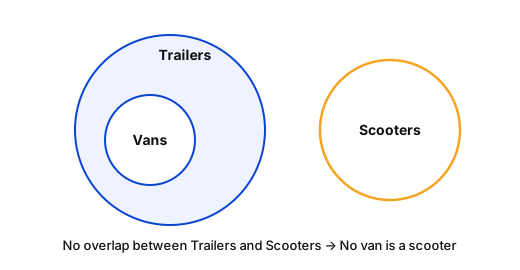
Concept: Draw the least-overlap Venn diagram for the statements and test each conclusion.

  1. All vans are trailers → Vans circle lies inside Trailers.
  2. No trailer is a scooter → Scooters circle is completely separate from Trailers.
  3. Since vans are inside trailers, no van can touch scooters → Conclusion I follows.
  4. Scooters and trailers never meet, so ‘Some scooters are trailers’ is false → II does not follow.

Trick: All A are B + No B is C ⇒ No A is C (always).

Answer: (C) Only conclusion (I) follows

अवधारणा: कथनों का न्यूनतम-संभव वेन आरेख बनाकर हर निष्कर्ष जाँचें।

  1. सभी वैन ट्रेलर हैं → वैन का वृत्त ट्रेलर के अंदर।
  2. कोई ट्रेलर स्कूटर नहीं → स्कूटर का वृत्त ट्रेलर से पूरी तरह अलग।
  3. वैन ट्रेलर के अंदर है, इसलिए कोई वैन स्कूटर नहीं → निष्कर्ष I सही।
  4. स्कूटर और ट्रेलर कभी नहीं मिलते, अतः ‘कुछ स्कूटर ट्रेलर हैं’ गलत → II अनुसरण नहीं करता।

ट्रिक: सभी A, B हैं + कोई B, C नहीं ⇒ कोई A, C नहीं।

उत्तर: (C) केवल निष्कर्ष (I) अनुसरण करता है

RRB NTPC Undergraduate CBT 1General Intelligence and ReasoningSyllogismRRB NTPC Undergraduate CBT 1 2025 · 20 Jun Shift 3 →
Q72.
In a certain code language,
A ← B means ‘A is the wife of B’,
A ≥ B means ‘A is the brother of B’,
A @ B means ‘A is the father of B’, and
A £ B means ‘A is the daughter of B’.
Based on the above, how is P related to U if 'P £ D ← M @ L ≥ U’?
एक निश्चित कूट भाषा में,
A ← B का अर्थ है ‘A, B की पत्नी है’,
A ≥ B का अर्थ है ‘A, B का भाई है’,
A @ B का अर्थ है ‘A, B का पिता है’, और
A £ B का अर्थ है ‘A, B की पुत्री है’।
उपरोक्त के आधार पर, यदि ‘P £ D ← M @ L ≥ U’ है, तो P का U से क्या संबंध है?
  1. AWifeपत्नी
  2. BSisterबहन
  3. CDaughterपुत्री
  4. DMotherमाता
Show answer

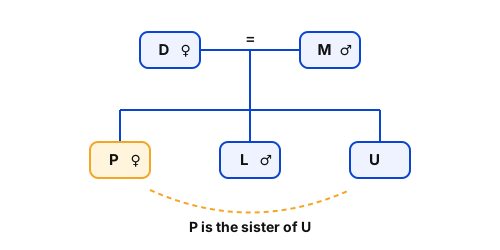
Concept: Decode each symbol from left to right and build the family tree.

  1. P £ D → P is the daughter of D (P is female).
  2. D ← M → D is the wife of M; so P is the daughter of M too.
  3. M @ L → M is the father of L; L ≥ U → L is the brother of U, so U is also M's child.
  4. P, L and U are children of M and D → P (female) is U's sister.

Trick: Children of the same parents: a female is ‘sister’, a male is ‘brother’.

Answer: (B) Sister

अवधारणा: हर चिह्न को बाएँ से दाएँ डिकोड करके वंश-वृक्ष बनाएँ।

  1. P £ D → P, D की बेटी है (P स्त्री)।
  2. D ← M → D, M की पत्नी है; अतः P, M की भी बेटी।
  3. M @ L → M, L का पिता; L ≥ U → L, U का भाई, यानी U भी M की संतान।
  4. P, L, U तीनों M और D की संतानें हैं → P (स्त्री) U की बहन है।

ट्रिक: एक ही माता-पिता की संतान: स्त्री = बहन, पुरुष = भाई।

उत्तर: (B) बहन

RRB NTPC Undergraduate CBT 1General Intelligence and ReasoningCoded Blood RelationsRRB NTPC Undergraduate CBT 1 2025 · 20 Jun Shift 3 →
Q73.
If 3 is added to each odd digit and 2 is subtracted from each even digit in the number 8254316, then how many digits will appear more than once in the new number thus formed?
यदि संख्या 8254316 में प्रत्येक विषम अंक में 3 जोड़ दिया जाए और प्रत्येक सम अंक में से 2 घटा दिया जाए, तो इस प्रकार बनी नई संख्या में कितने अंक एक से अधिक बार आएँगे?
  1. ATwoदो
  2. BOneएक
  3. CThreeतीन
  4. DNoneकोई नहीं
Show answer

Concept: Apply the rule digit by digit, then count repeated digits.

  1. Even digits (−2): 8→6,2→0,4→2,6→4.
  2. Odd digits (+3): 5→8,3→6,1→4.
  3. 8254316 → 6 0 8 2 6 4 4.
  4. 6 appears twice and 4 appears twice → two digits repeat.

Trick: Write the new number under the old one in a table – mistakes vanish.

Answer: (A) Two

अवधारणा: नियम को हर अंक पर लगाएँ, फिर दोहराए गए अंक गिनें।

  1. सम अंक (−2): 8→6,2→0,4→2,6→4।
  2. विषम अंक (+3): 5→8,3→6,1→4।
  3. 8254316 → 6 0 8 2 6 4 4।
  4. 6 दो बार और 4 दो बार आते हैं → दो अंक दोहराते हैं।

ट्रिक: नई संख्या को पुरानी के नीचे लिखें – गलती नहीं होगी।

उत्तर: (A) दो

RRB NTPC Undergraduate CBT 1General Intelligence and ReasoningNumber OperationsRRB NTPC Undergraduate CBT 1 2025 · 20 Jun Shift 3 →
Q74.
What should come in place of ‘?’ in the given series?
80 ? 89 98 110 125
दी गई श्रृंखला में ‘?’ के स्थान पर क्या आना चाहिए?
80 ? 89 98 110 125
  1. A85
  2. B84
  3. C83
  4. D82
Show answer

Concept: Check the differences between consecutive terms.

  1. Known differences: 98−89=9,110−98=12,125−110=15 → they rise by 3.
  2. So the differences are 3, 6, 9, 12, 15.
  3. 80+3=83 and 83+6=89 ✓.

Trick: Differences in steps of 3 → multiples of 3 series.

Answer: (C) 83

अवधारणा: क्रमागत पदों का अंतर देखें।

  1. ज्ञात अंतर: 98−89=9,110−98=12,125−110=15 → हर बार 3 बढ़ता है।
  2. अतः अंतर 3, 6, 9, 12, 15 हैं।
  3. 80+3=83 और 83+6=89 ✓।

ट्रिक: अंतर 3 के गुणज → 3, 6, 9, 12, 15।

उत्तर: (C) 83

RRB NTPC Undergraduate CBT 1General Intelligence and ReasoningNumber SeriesRRB NTPC Undergraduate CBT 1 2025 · 20 Jun Shift 3 →
Q75.
Refer to the given letter series and answer the question that follows.
(Left) S E S I B V V R R I Y S S P B T K S A P P (Right)
How many such consonants are there, each of which is immediately preceded by a vowel and also immediately followed by a vowel?
दी गई अक्षर श्रृंखला को देखिए और उसके बाद दिए गए प्रश्न का उत्तर दीजिए।
(बाएँ) S E S I B V V R R I Y S S P B T K S A P P (दाएँ)
ऐसे कितने व्यंजन हैं, जिनमें से प्रत्येक के ठीक पहले एक स्वर है और ठीक बाद भी एक स्वर है?
  1. AThreeतीन
  2. BNoneकोई नहीं
  3. CTwoदो
  4. DOneएक
Show answer

Concept: Mark the vowels first, then look only at the letters sitting between two vowels.

  1. Vowels in the series: E (2nd), I (4th), I (10th), A (19th).
  2. Only one consonant has a vowel on both sides: E S I (S is the 3rd letter).
  3. Around the other vowels the neighbours are consonants (e.g. R I Y, S A P), so no other case.

Trick: Search for the pattern ‘vowel–consonant–vowel’ – it needs two vowels just two places apart.

Answer: (D) One

अवधारणा: पहले स्वरों को चिह्नित करें, फिर केवल दो स्वरों के बीच वाले अक्षर देखें।

  1. श्रृंखला में स्वर: E (2रा), I (4था), I (10वाँ), A (19वाँ)।
  2. केवल एक व्यंजन के दोनों ओर स्वर है: E S I (S तीसरा अक्षर)।
  3. बाकी स्वरों के पड़ोस में व्यंजन ही हैं (जैसे R I Y, S A P), अतः और कोई नहीं।

ट्रिक: ‘स्वर–व्यंजन–स्वर’ पैटर्न खोजें – दो स्वर ठीक दो स्थान दूर होने चाहिए।

उत्तर: (D) एक

RRB NTPC Undergraduate CBT 1General Intelligence and ReasoningLetter Series – Position CountingRRB NTPC Undergraduate CBT 1 2025 · 20 Jun Shift 3 →
Q76.
Refer to the following letter series and answer the question that follows. Counting to be done from left to right only.
(Left) L R I D P E Q Y H D V Q U Y L X F H A U Z (Right)
How many such vowels are there, each of which is immediately preceded by a consonant and also immediately followed by a consonant?
निम्नलिखित अक्षर श्रृंखला को देखिए और उसके बाद दिए गए प्रश्न का उत्तर दीजिए। गिनती केवल बाएँ से दाएँ की जानी है।
(बाएँ) L R I D P E Q Y H D V Q U Y L X F H A U Z (दाएँ)
ऐसे कितने स्वर हैं, जिनमें से प्रत्येक के ठीक पहले एक व्यंजन है और ठीक बाद भी एक व्यंजन है?
  1. AOneएक
  2. BThreeतीन
  3. CNoneकोई नहीं
  4. DTwoदो
Show answer

Concept: Find each vowel and check its left and right neighbours.

  1. Vowels: I (3rd), E (6th), U (13th), A (19th), U (20th).
  2. R I D ✓, P E Q ✓, Q U Y ✓ – consonants on both sides.
  3. H A U ✗ (followed by a vowel) and A U Z ✗ (preceded by a vowel).
  4. Count = 3.

Trick: Two vowels side by side (AU) can never count – skip them quickly.

Answer: (B) Three

अवधारणा: हर स्वर के बाएँ और दाएँ पड़ोसी जाँचें।

  1. स्वर: I (3रा), E (6ठा), U (13वाँ), A (19वाँ), U (20वाँ)।
  2. R I D ✓, P E Q ✓, Q U Y ✓ – दोनों ओर व्यंजन।
  3. H A U ✗ (बाद में स्वर) और A U Z ✗ (पहले स्वर)।
  4. संख्या = 3।

ट्रिक: पास-पास के दो स्वर (AU) कभी नहीं गिने जाते – उन्हें तुरंत छोड़ें।

उत्तर: (B) तीन

RRB NTPC Undergraduate CBT 1General Intelligence and ReasoningLetter Series – Position CountingRRB NTPC Undergraduate CBT 1 2025 · 20 Jun Shift 3 →
Q77.
Based on the English alphabetical order, three of the following four letter-cluster pairs are alike in a certain way and thus form a group. Which is the one that does not belong to that group?
(Note: The odd man out is not based on the number of consonants/vowels or their position in the letter cluster.)
अंग्रेज़ी वर्णमाला क्रम के आधार पर, निम्नलिखित चार अक्षर-समूह युग्मों में से तीन किसी निश्चित प्रकार से एकसमान हैं और इस प्रकार एक समूह बनाते हैं। वह कौन-सा युग्म है जो उस समूह से संबंधित नहीं है?
(ध्यान दें: असंगत युग्म, व्यंजनों/स्वरों की संख्या या अक्षर-समूह में उनके स्थान पर आधारित नहीं है।)
  1. ADP – ZL
  2. BRM – IN
  3. CKS – GO
  4. DYH – UD
Show answer

Concept: Compare the shift from each letter of the first cluster to the matching letter of the second (A = 1 … Z = 26).

  1. DP – ZL: D−4=Z (looping back), P−4=L.
  2. KS – GO: K−4=G,S−4=O. YH – UD: Y−4=U,H−4=D.
  3. RM – IN: R−9=I but M+1=N → different rule.

Trick: Learn reverse jumps: D−4 = Z (wrap round the alphabet).

Answer: (B) RM – IN

अवधारणा: पहले समूह के हर अक्षर से दूसरे समूह के संगत अक्षर तक का अंतर देखें (A = 1 … Z = 26)।

  1. DP – ZL: D−4=Z (चक्र में पीछे), P−4=L।
  2. KS – GO: K−4=G,S−4=O। YH – UD: Y−4=U,H−4=D।
  3. RM – IN: R−9=I पर M+1=N → अलग नियम।

ट्रिक: उल्टी छलांग याद रखें: D−4 = Z (वर्णमाला का चक्र)।

उत्तर: (B) RM – IN

RRB NTPC Undergraduate CBT 1General Intelligence and ReasoningOdd One Out – Letter PairsRRB NTPC Undergraduate CBT 1 2025 · 20 Jun Shift 3 →
Q78.
In the following triads, each group of letters is related to the subsequent one following a certain logic. Select from the given options, the one which follows the same logic. FORT - RTFO - TROF
SIGN - GNSI - NGIS
निम्नलिखित त्रिकों में, अक्षरों का प्रत्येक समूह एक निश्चित तर्क का अनुसरण करते हुए अगले समूह से संबंधित है। दिए गए विकल्पों में से उस विकल्प का चयन कीजिए जो समान तर्क का अनुसरण करता है। FORT - RTFO - TROF
SIGN - GNSI - NGIS
  1. ARAFT - FTRA - TFAR
  2. BDIRT - TRID - IRTD
  3. CDOVE - OVED - EVOD
  4. DFILE - LEFI - ELFI
Show answer

Concept: Number the letters of the first word 1 2 3 4 and track their positions.

  1. FORT → RTFO = letters 3 4 1 2; third word TROF = FORT written backwards (4 3 2 1).
  2. SIGN → GNSI (3 4 1 2) → NGIS (reverse) ✓.
  3. RAFT → FTRA (3 4 1 2) → TFAR (reverse) ✓.
  4. DIRT would give RTDI; DOVE gives VEDO; FILE gives LEFI – but its reverse is ELIF, not ELFI.

Trick: Middle = swap the two halves; last = full reverse of the first word.

Answer: (A) RAFT - FTRA - TFAR

अवधारणा: पहले शब्द के अक्षरों को 1 2 3 4 क्रमांक दें और उनकी स्थिति देखें।

  1. FORT → RTFO = अक्षर 3 4 1 2; तीसरा TROF = FORT उल्टा (4 3 2 1)।
  2. SIGN → GNSI (3 4 1 2) → NGIS (उल्टा) ✓।
  3. RAFT → FTRA (3 4 1 2) → TFAR (उल्टा) ✓।
  4. DIRT से RTDI, DOVE से VEDO बनना चाहिए; FILE से LEFI सही पर उल्टा ELIF है, ELFI नहीं।

ट्रिक: बीच वाला = दोनों आधे भाग अदला-बदली; अंतिम = पहला शब्द उल्टा।

उत्तर: (A) RAFT - FTRA - TFAR

RRB NTPC Undergraduate CBT 1General Intelligence and ReasoningLetter Rearrangement AnalogyRRB NTPC Undergraduate CBT 1 2025 · 20 Jun Shift 3 →
Q79.
Based on the English alphabetical order, three of the following four are alike in a certain way and thus form a group. Which is the one that does not belong to that group? (Note: The odd man out is not based on the number of consonants/vowels or their position in the letter cluster.)
अंग्रेज़ी वर्णमाला क्रम के आधार पर, निम्नलिखित चार में से तीन किसी निश्चित प्रकार से एकसमान हैं और इस प्रकार एक समूह बनाते हैं। वह कौन-सा है जो उस समूह से संबंधित नहीं है? (ध्यान दें: असंगत, व्यंजनों/स्वरों की संख्या या अक्षर-समूह में उनके स्थान पर आधारित नहीं है।)
  1. AKMP
  2. BQSV
  3. CFHK
  4. DDFJ
Show answer

Concept: Find the gaps between consecutive letters using their positions.

  1. KMP: K→+2M→+3P; QSV: +2,+3; FHK: +2,+3.
  2. DFJ: D→+2F→+4J → the second gap is 4, not 3.

Trick: Write the gaps as a pair (+2, +3) – the different pair is the odd one.

Answer: (D) DFJ

अवधारणा: अक्षरों के स्थानीय मान से क्रमागत अक्षरों का अंतर निकालें।

  1. KMP: K→+2M→+3P; QSV: +2,+3; FHK: +2,+3।
  2. DFJ: D→+2F→+4J → दूसरा अंतर 4 है, 3 नहीं।

ट्रिक: अंतर को जोड़ी (+2, +3) के रूप में लिखें – अलग जोड़ी वाला विषम।

उत्तर: (D) DFJ

RRB NTPC Undergraduate CBT 1General Intelligence and ReasoningOdd One Out – Letter ClustersRRB NTPC Undergraduate CBT 1 2025 · 20 Jun Shift 3 →
Q80.
In the following triad, each group of letters is related to the subsequent one following a certain logic. Select, from the given options, the one which follows the same logic. WORD - RWOD - DROW
JAMS - MJAS - SMAJ
निम्नलिखित त्रिक में, अक्षरों का प्रत्येक समूह एक निश्चित तर्क का अनुसरण करते हुए अगले समूह से संबंधित है। दिए गए विकल्पों में से उस विकल्प का चयन कीजिए जो समान तर्क का अनुसरण करता है। WORD - RWOD - DROW
JAMS - MJAS - SMAJ
  1. AAGES - AEGS - SEGA
  2. BVAST - SVAT - ASTV
  3. CYEAR - AYER - RAEY
  4. DPOLE - OPLE - EOLP
Show answer

Concept: Number the letters 1 2 3 4 and see where each moves.

  1. WORD → RWOD = letters 3 1 2 4; DROW = WORD reversed (4 3 2 1).
  2. JAMS → MJAS (3 1 2 4) → SMAJ (reverse) ✓.
  3. YEAR → AYER (3 1 2 4) → RAEY (reverse) ✓.
  4. AGES should give EAGS; VAST gives SVAT but its reverse is TSAV; POLE gives LPOE.

Trick: Step 1: 3rd letter jumps to the front; Step 2: write the original word backwards.

Answer: (C) YEAR - AYER - RAEY

अवधारणा: अक्षरों को 1 2 3 4 क्रमांक देकर देखें कि कौन कहाँ गया।

  1. WORD → RWOD = अक्षर 3 1 2 4; DROW = WORD उल्टा (4 3 2 1)।
  2. JAMS → MJAS (3 1 2 4) → SMAJ (उल्टा) ✓।
  3. YEAR → AYER (3 1 2 4) → RAEY (उल्टा) ✓।
  4. AGES से EAGS बनना चाहिए; VAST से SVAT सही पर उल्टा TSAV है; POLE से LPOE।

ट्रिक: चरण 1: तीसरा अक्षर आगे; चरण 2: मूल शब्द उल्टा लिखें।

उत्तर: (C) YEAR - AYER - RAEY

RRB NTPC Undergraduate CBT 1General Intelligence and ReasoningLetter Rearrangement AnalogyRRB NTPC Undergraduate CBT 1 2025 · 20 Jun Shift 3 →