Question bank

Q&A: practice questions with answers

Search questions on any topic. Filter by exam category, exam, subject and topic, try the question, then open the answer and explanation.

Courses – airGurukul

8,495 questions found.

Q8041.
The difference between a discount of 35% and two successive discounts of 20% and 15% on a certain marked price is ₹70. Find the marked price (rounded off to the nearest integer).
किसी निश्चित अंकित मूल्य पर 35% की छूट और 20% तथा 15% की दो क्रमिक छूटों के बीच का अंतर ₹70 है। अंकित मूल्य ज्ञात कीजिए (निकटतम पूर्णांक तक पूर्णांकित)।
  1. A₹2,367
  2. B₹2,433
  3. C₹2,467
  4. D₹2,333
Show answer

Concept: Two successive discounts a% and b% equal a single discount of a+b−ab100.

  1. 20% and 15%: 20+15−3=32%.
  2. Difference from 35% =3% of MP =70.
  3. MP =70×1003=2333.33≈ ₹2,333.

Trick: Only the ab100=3% term differs between the two offers – work directly with it.

Answer: (D) ₹2,333

अवधारणा: a% और b% की दो क्रमिक छूटें =a+b−ab100 की एकल छूट।

  1. 20% और 15%: 20+15−3=32%.
  2. 35% से अंतर = MP का 3%=70.
  3. MP =70×1003=2333.33≈ ₹2,333.

ट्रिक: दोनों ऑफ़रों में केवल ab100=3% वाला पद अलग है – सीधे उसी से हल करें।

उत्तर: (D) ₹2,333
RRB NTPC Undergraduate CBT 1MathematicsSuccessive discountsRRB NTPC Undergraduate CBT 1 2025 · 8 May Shift 2 →
Q8042.
Find the value of m which satisfies
(1910)7×(1019)6×(1910)10=(1019)6m+18.
m का वह मान ज्ञात कीजिए जो
(1910)7×(1019)6×(1910)10=(1019)6m+18 को संतुष्ट करता है।
  1. A−296
  2. B−276
  3. C−386
  4. D−206
Show answer

Concept: (1019)n=(1910)−n; write everything with the same base and equate powers.

  1. LHS =(1910)7−6+10=(1910)11.
  2. RHS =(1019)6m+18=(1910)−(6m+18).
  3. −(6m+18)=11⇒6m=−29⇒m=−296.

Trick: Flipping a fraction flips the sign of its exponent.

Answer: (A) −296

अवधारणा: (1019)n=(1910)−n; सबको एक ही आधार में लिखकर घातें बराबर करें।

  1. LHS =(1910)7−6+10=(1910)11.
  2. RHS =(1019)6m+18=(1910)−(6m+18).
  3. −(6m+18)=11⇒6m=−29⇒m=−296.

ट्रिक: भिन्न उलटने पर घातांक का चिह्न उलट जाता है।

उत्तर: (A) −296

RRB NTPC Undergraduate CBT 1MathematicsLaws of indicesRRB NTPC Undergraduate CBT 1 2025 · 8 May Shift 2 →
Q8043.
Two taps can fill a cistern in 4 hours and 8 hours, respectively. A third tap can empty it in 4 hours. How long (in hours) will it take to fill one-fourth of the empty cistern if all the taps are opened together?
दो नल एक टंकी को क्रमशः 4 घंटे और 8 घंटे में भर सकते हैं। एक तीसरा नल इसे 4 घंटे में खाली कर सकता है। यदि सभी नल एक साथ खोल दिए जाएँ, तो खाली टंकी के एक-चौथाई भाग को भरने में कितना समय (घंटों में) लगेगा?
  1. A4
  2. B6
  3. C2
  4. D8
Show answer

Concept: Add the per-hour rates (emptying tap negative).

  1. Net rate =14+18−14=18 cistern/hour.
  2. Full cistern takes 8 h, so one-fourth takes 84=2 h.

Trick: The 4-h filler and 4-h emptier cancel; only the 8-h tap effectively works.

Answer: (C) 2

अवधारणा: प्रति घंटा दरें जोड़ें (खाली करने वाला नल ऋणात्मक)।

  1. कुल दर =14+18−14=18 टंकी/घंटा।
  2. पूरी टंकी 8 घंटे, अतः एक-चौथाई =84=2 घंटे।

ट्रिक: 4 घंटे वाला भरने और 4 घंटे वाला खाली करने वाला नल एक-दूसरे को काट देते हैं; असल में केवल 8 घंटे वाला नल काम करता है।

उत्तर: (C) 2

RRB NTPC Undergraduate CBT 1MathematicsPipes and cisternsRRB NTPC Undergraduate CBT 1 2025 · 8 May Shift 2 →
Q8044.
Evaluate 203 + (-9)3 + (-11)3
203 + (-9)3 + (-11)3 का मान ज्ञात कीजिए।
  1. A5940
  2. B6015
  3. C5992
  4. D5934
Show answer

Concept: If a+b+c=0 then a3+b3+c3=3abc.

  1. 20+(−9)+(−11)=0.
  2. So the sum =3×20×(−9)×(−11)=3×20×99=5940.

Trick: Always check whether the three numbers add to zero before cubing anything.

Answer: (A) 5940

अवधारणा: यदि a+b+c=0 तो a3+b3+c3=3abc.

  1. 20+(−9)+(−11)=0.
  2. अतः योग =3×20×(−9)×(−11)=3×20×99=5940.

ट्रिक: घन निकालने से पहले हमेशा जाँचें कि तीनों संख्याओं का योग शून्य है या नहीं।

उत्तर: (A) 5940

RRB NTPC Undergraduate CBT 1MathematicsAlgebraic identity (sum of cubes)RRB NTPC Undergraduate CBT 1 2025 · 8 May Shift 2 →
Q8045.
Yogesh invested a certain sum of money at 10% per annum. After 2 years, he received ₹147 as compound interest, compounded annually. Find the corresponding simple interest (in ₹) for 2 years at the same rate.
योगेश ने एक निश्चित धनराशि 10% वार्षिक दर पर निवेश की। 2 वर्ष बाद, उसे वार्षिक रूप से संयोजित चक्रवृद्धि ब्याज के रूप में ₹147 प्राप्त हुए। समान दर पर 2 वर्ष के लिए संगत साधारण ब्याज (₹ में) ज्ञात कीजिए।
  1. A135
  2. B130
  3. C140
  4. D125
Show answer

Concept: For 2 years, CI at r% =P[(1+r100)2−1] and SI =2Pr100.

  1. P×(1.21−1)=147⇒0.21P=147⇒P=700.
  2. SI =700×10×2100=140.

Trick: For 2 years, SICI=2r2r+r2100=2021; 147×2021=140.

Answer: (C) 140

अवधारणा: 2 वर्ष के लिए r% पर CI =P[(1+r100)2−1] और SI =2Pr100.

  1. P×(1.21−1)=147⇒0.21P=147⇒P=700.
  2. SI =700×10×2100=140.

ट्रिक: 2 वर्ष के लिए SICI=2021 (10% पर); 147×2021=140.

उत्तर: (C) 140

RRB NTPC Undergraduate CBT 1MathematicsCompound vs simple interestRRB NTPC Undergraduate CBT 1 2025 · 8 May Shift 2 →
Q8046.
A sum of ₹25,000 is invested at 2% per annum compounded annually. Find the compound interest after 2 years.
₹25,000 की एक धनराशि 2% वार्षिक दर पर वार्षिक रूप से संयोजित चक्रवृद्धि ब्याज पर निवेश की जाती है। 2 वर्ष बाद चक्रवृद्धि ब्याज ज्ञात कीजिए।
  1. A₹1,010
  2. B₹1,050
  3. C₹1,130
  4. D₹1,230
Show answer

Concept: CI=P[(1+r100)n−1].

  1. (1.02)2=1.0404.
  2. CI =25000×0.0404=1010.

Trick: 2-year effective rate =2r+r2100=4+0.04=4.04% of 25,000 =1010.

Answer: (A) ₹1,010

अवधारणा: CI=P[(1+r100)n−1].

  1. (1.02)2=1.0404.
  2. CI =25000×0.0404=1010.

ट्रिक: 2 वर्ष की प्रभावी दर =2r+r2100=4.04%; 25,000 का 4.04%=1010.

उत्तर: (A) ₹1,010

RRB NTPC Undergraduate CBT 1MathematicsCompound interestRRB NTPC Undergraduate CBT 1 2025 · 8 May Shift 2 →
Q8047.
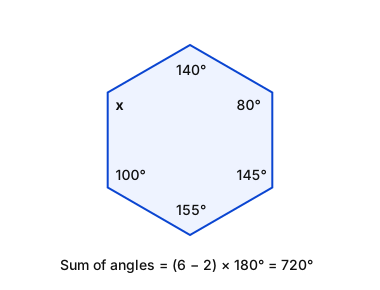
Find the measure of the unknown interior angle in an irregular hexagon with angles 140°, 80°, 145°, 155°, and 100°.
एक अनियमित षट्भुज के अज्ञात आंतरिक कोण का माप ज्ञात कीजिए, जिसके कोण 140°, 80°, 145°, 155° और 100° हैं।
  1. A105°
  2. B100°
  3. C110°
  4. D120°
Show answer

Concept: Sum of interior angles of an n-gon =(n−2)×180∘; for a hexagon =720∘.

  1. Known angles: 140+80+145+155+100=620∘.
  2. Unknown =720∘−620∘=100∘.

Yaad rakhein: Hexagon 720∘, pentagon 540∘, quadrilateral 360∘.

Answer: (B) 100∘

अवधारणा: n-भुज के अंतः कोणों का योग =(n−2)×180∘; षट्भुज के लिए =720∘.

  1. ज्ञात कोण: 140+80+145+155+100=620∘.
  2. अज्ञात =720∘−620∘=100∘.

याद रखें: षट्भुज 720∘, पंचभुज 540∘, चतुर्भुज 360∘.

उत्तर: (B) 100∘

RRB NTPC Undergraduate CBT 1MathematicsAngle sum of polygonRRB NTPC Undergraduate CBT 1 2025 · 8 May Shift 2 →
Q8048.
The enrolment of students in an institution increased by 10% in April compared to the number of students in March and then decreased by 5%, resulting in 1045 students in June. Find the number of students in March.
एक संस्थान में विद्यार्थियों का नामांकन मार्च के विद्यार्थियों की संख्या की तुलना में अप्रैल में 10% बढ़ा और फिर 5% घट गया, जिसके परिणामस्वरूप जून में 1045 विद्यार्थी हुए। मार्च में विद्यार्थियों की संख्या ज्ञात कीजिए।
  1. A1050
  2. B1085
  3. C1000
  4. D900
Show answer

Concept: Apply the changes as multipliers on the March figure x.

  1. x×1.10×0.95=1.045x.
  2. 1.045x=1045⇒x=1000.

Trick: +10% then −5% = net +4.5% (10−5−0.5); 1045 is 104.5% ⇒ base 1000.

Answer: (C) 1000

अवधारणा: मार्च की संख्या x पर परिवर्तनों को गुणक की तरह लगाएँ।

  1. x×1.10×0.95=1.045x.
  2. 1.045x=1045⇒x=1000.

ट्रिक: +10% फिर −5% = कुल +4.5% (10−5−0.5); 1045 = 104.5% ⇒ आधार 1000.

उत्तर: (C) 1000

RRB NTPC Undergraduate CBT 1MathematicsSuccessive percentage changeRRB NTPC Undergraduate CBT 1 2025 · 8 May Shift 2 →
Q8049.
If 9 workers can build a wall in 12 days, how many days will 6 workers take to build the same wall, assuming they work at the same rate?
यदि 9 श्रमिक एक दीवार 12 दिनों में बना सकते हैं, तो 6 श्रमिक उसी दीवार को बनाने में कितने दिन लेंगे, यह मानते हुए कि वे समान दर से कार्य करते हैं?
  1. A16
  2. B18
  3. C17
  4. D15
Show answer

Concept: Same work ⇒ M1D1=M2D2.

  1. 9×12=6×D2.
  2. D2=1086=18 days.

Trick: Workers reduced to 23 ⇒ days increase to 32 of 12 = 18.

Answer: (B) 18

अवधारणा: समान कार्य ⇒ M1D1=M2D2.

  1. 9×12=6×D2.
  2. D2=1086=18 दिन।

ट्रिक: मज़दूर 23 रह गए ⇒ दिन 12 के 32 = 18 हो जाएँगे।

उत्तर: (B) 18

RRB NTPC Undergraduate CBT 1MathematicsInverse proportion (work)RRB NTPC Undergraduate CBT 1 2025 · 8 May Shift 2 →
Q8050.
The value of (2.3)3+(1.5)3+(1.2)3−3×2.3×1.5×1.2(2.3)2+(1.5)2+(1.2)2−2.3×1.5−1.5×1.2−1.2×2.3 is equal to:
(2.3)3+(1.5)3+(1.2)3−3×2.3×1.5×1.2(2.3)2+(1.5)2+(1.2)2−2.3×1.5−1.5×1.2−1.2×2.3 का मान बराबर है:
  1. A5
  2. B1
  3. C4
  4. D2
Show answer

Concept: a3+b3+c3−3abca2+b2+c2−ab−bc−ca=a+b+c.

  1. Here a=2.3, b=1.5, c=1.2.
  2. Value =2.3+1.5+1.2=5.

Trick: Recognise the identity – no decimal cubes needed.

Answer: (A) 5

अवधारणा: a3+b3+c3−3abca2+b2+c2−ab−bc−ca=a+b+c.

  1. यहाँ a=2.3, b=1.5, c=1.2.
  2. मान =2.3+1.5+1.2=5.

ट्रिक: सर्वसमिका पहचानें – दशमलव के घन निकालने की ज़रूरत नहीं।

उत्तर: (A) 5

RRB NTPC Undergraduate CBT 1MathematicsAlgebraic identityRRB NTPC Undergraduate CBT 1 2025 · 8 May Shift 2 →
Q8051.
If the third proportional to 4 and 6 is used as the base of a rectangle, and the first number (4) is its height, what is the area of the rectangle?
यदि 4 और 6 के तृतीयानुपाती (third proportional) को एक आयत के आधार के रूप में प्रयोग किया जाए, और पहली संख्या (4) उसकी ऊँचाई हो, तो आयत का क्षेत्रफल क्या है?
  1. A30 unit2
  2. B48 unit2
  3. C24 unit2
  4. D36 unit2
Show answer

Concept: Third proportional to a and b is b2a.

  1. Third proportional to 4, 6 =364=9 (base).
  2. Height =4 ⇒ area =9×4=36unit2.

Yaad rakhein: a:b::b:c⇒c=b2a; mean proportional is ab.

Answer: (D) 36unit2

अवधारणा: a और b का तृतीयानुपाती (third proportional) =b2a.

  1. 4, 6 का तृतीयानुपाती =364=9 (आधार)।
  2. ऊँचाई =4 ⇒ क्षेत्रफल =9×4=36unit2.

याद रखें: a:b::b:c⇒c=b2a; मध्यानुपाती =ab.

उत्तर: (D) 36unit2

RRB NTPC Undergraduate CBT 1MathematicsThird proportionalRRB NTPC Undergraduate CBT 1 2025 · 8 May Shift 2 →
Q8052.
Three numbers are in the ratio 17 : 13 : 8, and their LCM is 7072. Their HCF is:
तीन संख्याएँ 17 : 13 : 8 के अनुपात में हैं, और उनका LCM 7072 है। उनका HCF है:
  1. A12
  2. B3
  3. C4
  4. D23
Show answer

Concept: Numbers 17k,13k,8k (co-prime ratio terms) have HCF =k and LCM =17×13×8×k.

  1. 1768k=7072⇒k=4.
  2. HCF =k=4.

Trick: When ratio terms are pairwise co-prime, HCF =LCMproduct of ratio terms.

Answer: (C) 4

अवधारणा: संख्याएँ 17k,13k,8k (अनुपात के पद सह-अभाज्य) ⇒ HCF =k, LCM =17×13×8×k.

  1. 1768k=7072⇒k=4.
  2. HCF =k=4.

ट्रिक: अनुपात के पद सह-अभाज्य हों तो HCF =LCMअनुपात पदों का गुणनफल.

उत्तर: (C) 4

RRB NTPC Undergraduate CBT 1MathematicsLCM and HCF with ratioRRB NTPC Undergraduate CBT 1 2025 · 8 May Shift 2 →
Q8053.
In a science experiment, chemicals X, Y, and Z are mixed in the ratio 5:2:3. If the total weight of the mixture is 100 grams, how much of chemical Y is present?
एक विज्ञान प्रयोग में, रसायन X, Y और Z को 5:2:3 के अनुपात में मिलाया जाता है। यदि मिश्रण का कुल भार 100 ग्राम है, तो रसायन Y की कितनी मात्रा उपस्थित है?
  1. A20 grams20 ग्राम
  2. B30 grams30 ग्राम
  3. C50 grams50 ग्राम
  4. D10 grams10 ग्राम
Show answer

Concept: Each share =ratio partsum of parts×total.

  1. Sum of parts =5+2+3=10.
  2. Y =210×100=20 grams.

Trick: Total 100 with sum 10 ⇒ each part is 10 g; Y has 2 parts.

Answer: (A) 20 grams

अवधारणा: प्रत्येक हिस्सा =अनुपात का भागभागों का योग×कुल.

  1. भागों का योग =5+2+3=10.
  2. Y =210×100=20 ग्राम।

ट्रिक: कुल 100 और योग 10 ⇒ हर भाग 10 g; Y के 2 भाग।

उत्तर: (A) 20 ग्राम

RRB NTPC Undergraduate CBT 1MathematicsRatioRRB NTPC Undergraduate CBT 1 2025 · 8 May Shift 2 →
Q8054.
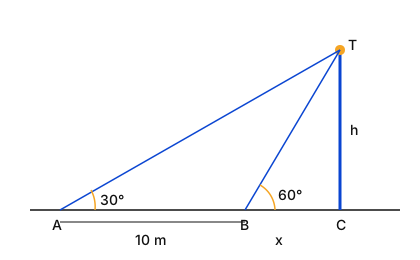
The angle of elevation of the top of a tree from a point on the ground is 30°. After moving 10 m towards the tree, the angle of elevation becomes 60°. Find the height of the tree.
ज़मीन पर स्थित एक बिंदु से एक पेड़ के शीर्ष का उन्नयन कोण 30° है। पेड़ की ओर 10 m चलने के बाद, उन्नयन कोण 60° हो जाता है। पेड़ की ऊँचाई ज्ञात कीजिए।
  1. A63m
  2. B43m
  3. C33m
  4. D53m
Show answer

Concept: Use tan in the two right triangles; with angles 30∘ and 60∘, h=d23 where d is the distance walked.

  1. From B: tan60∘=hx⇒x=h3.
  2. From A: tan30∘=hx+10⇒x+10=h3.
  3. h3−h3=10⇒2h3=10⇒h=53m.

Trick: For 30∘→60∘, height =32× distance moved =32×10.

Answer: (D) 53m

अवधारणा: दोनों समकोण त्रिभुजों में tan लगाएँ; 30∘ व 60∘ के लिए h=d23, जहाँ d चली गई दूरी है।

  1. B से: tan60∘=hx⇒x=h3.
  2. A से: tan30∘=hx+10⇒x+10=h3.
  3. h3−h3=10⇒2h3=10⇒h=53m.

ट्रिक: 30∘→60∘ के लिए ऊँचाई =32× चली दूरी =32×10.

उत्तर: (D) 53m

RRB NTPC Undergraduate CBT 1MathematicsHeights and distancesRRB NTPC Undergraduate CBT 1 2025 · 8 May Shift 2 →
Q8055.
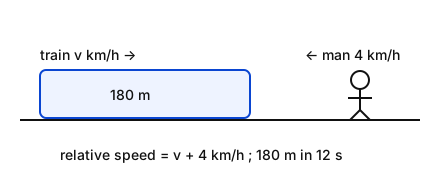
A man is walking at 4 km/hr. A 180 m long train crosses him in 12 seconds while coming from the opposite direction. What is the speed of the train (in km/hr)?
एक व्यक्ति 4 km/hr की चाल से चल रहा है। विपरीत दिशा से आती हुई 180 m लंबी एक रेलगाड़ी उसे 12 सेकंड में पार करती है। रेलगाड़ी की चाल (km/hr में) क्या है?
  1. A61
  2. B50
  3. C32
  4. D45
Show answer

Concept: Opposite directions ⇒ relative speed =v+4; the train covers its own length in the crossing time.

  1. Relative speed =18012=15m/s=15×185=54km/h.
  2. v+4=54⇒v=50km/h.

Trick: m/s → km/h: multiply by 185. Opposite ⇒ add, same direction ⇒ subtract.

Answer: (B) 50

अवधारणा: विपरीत दिशा ⇒ सापेक्ष चाल =v+4; पार करने के समय में ट्रेन अपनी लंबाई तय करती है।

  1. सापेक्ष चाल =18012=15m/s=15×185=54km/h.
  2. v+4=54⇒v=50km/h.

ट्रिक: m/s → km/h: 185 से गुणा। विपरीत ⇒ जोड़ें, समान दिशा ⇒ घटाएँ।

उत्तर: (B) 50

RRB NTPC Undergraduate CBT 1MathematicsTrains (relative speed)RRB NTPC Undergraduate CBT 1 2025 · 8 May Shift 2 →
Q8056.
A keg is fitted with three taps A, B and C. If opened together, all the three taps will drain the full keg in 112 minutes. Taps A and B together take 3 minutes to drain the keg while taps B and C together take 412 minutes to drain it. How long (in minutes) taps A and C together take to drain the keg?
एक पीपे (keg) में तीन नल A, B और C लगे हैं। यदि एक साथ खोले जाएँ, तो तीनों नल भरे हुए पीपे को 112 मिनट में खाली कर देंगे। नल A और B एक साथ पीपे को खाली करने में 3 मिनट लेते हैं जबकि नल B और C एक साथ इसे खाली करने में 412 मिनट लेते हैं। नल A और C एक साथ पीपे को खाली करने में कितना समय (मिनट में) लेंगे?
  1. A49
  2. B57
  3. C97
  4. D47
Show answer

Concept: (A+C)=2(A+B+C)−(A+B)−(B+C) in terms of per-minute rates.

  1. A+B+C=11.5=23, A+B=13, B+C=14.5=29.
  2. A+C=43−13−29=1−29=79 keg/min.
  3. Time =97 minutes.

Trick: Take LCM 9 units: all three drain 6/min, A+B 3/min, B+C 2/min ⇒ A+C =12−3−2=7/min ⇒ 97 min.

Answer: (C) 97

अवधारणा: प्रति मिनट दरों में (A+C)=2(A+B+C)−(A+B)−(B+C).

  1. A+B+C=11.5=23, A+B=13, B+C=14.5=29.
  2. A+C=43−13−29=1−29=79 केग/मिनट।
  3. समय =97 मिनट।

ट्रिक: LCM 9 इकाई लें: तीनों 6/मिनट, A+B 3/मिनट, B+C 2/मिनट ⇒ A+C =12−3−2=7/मिनट ⇒ 97 मिनट।

उत्तर: (C) 97

RRB NTPC Undergraduate CBT 1MathematicsPipes and cisterns (pair rates)RRB NTPC Undergraduate CBT 1 2025 · 8 May Shift 2 →
Q8057.
What is the arithmetic mean of the dataset {12, 25, 37, 48, 56, 61, 73, 85, 92, 104}?
डेटासेट {12, 25, 37, 48, 56, 61, 73, 85, 92, 104} का समांतर माध्य क्या है?
  1. A59.3
  2. B56.3
  3. C57.3
  4. D58.3
Show answer

Concept: Mean =sum of observationsn.

  1. Sum =12+25+37+48+56+61+73+85+92+104=593.
  2. Mean =59310=59.3.

Trick: Pair for quick adding: (12+85)+(25+73)+(37+61)+(48+56)+92+104=97+98+98+104+196=593.

Answer: (A) 59.3

अवधारणा: माध्य =प्रेक्षणों का योगn.

  1. योग =12+25+37+48+56+61+73+85+92+104=593.
  2. माध्य =59310=59.3.

ट्रिक: जोड़ी बनाकर जोड़ें: (12+85)+(25+73)+(37+61)+(48+56)+92+104=593.

उत्तर: (A) 59.3

RRB NTPC Undergraduate CBT 1MathematicsArithmetic meanRRB NTPC Undergraduate CBT 1 2025 · 8 May Shift 2 →
Q8058.
A shopkeeper offers the following schemes on toys of the same marked price. (A) Successive discounts of 35% and 4% on any number of toys bought.
(B) Successive discounts of 45%, 46% and 50% on any number of toys bought. (C) 15% discount on the first 3 toys and 5% discount on each toy thereon.
(D) 2 toys free of cost on buying 9 toys.
A customer wants to buy 9 toys. Which of the above schemes is the least beneficial to her?
एक दुकानदार समान अंकित मूल्य वाले खिलौनों पर निम्नलिखित योजनाएँ प्रस्तुत करता है। (A) खरीदे गए किसी भी संख्या के खिलौनों पर 35% और 4% की क्रमिक छूट।
(B) खरीदे गए किसी भी संख्या के खिलौनों पर 45%, 46% और 50% की क्रमिक छूट। (C) पहले 3 खिलौनों पर 15% छूट और उसके बाद प्रत्येक खिलौने पर 5% छूट।
(D) 9 खिलौने खरीदने पर 2 खिलौने निःशुल्क।
एक ग्राहक 9 खिलौने खरीदना चाहती है। उपरोक्त योजनाओं में से कौन-सी उसके लिए सबसे कम लाभदायक है?
  1. AC
  2. BD
  3. CA
  4. DB
Show answer

Concept: Take MP = ₹100 per toy (₹900 for 9) and compute the amount paid under each scheme; the least beneficial is the one costing the most.

  1. (A) 900×0.65×0.96=561.6.
  2. (B) 900×0.55×0.54×0.50=133.65.
  3. (C) 3×85+6×95=255+570=825.
  4. (D) pay for 7 only =700.
  5. Highest payment is scheme C ⇒ least beneficial.

Trick: "2 free on 9" =29≈22% off; scheme C is barely 8.3% off overall.

Answer: (A) C

अवधारणा: प्रति खिलौना MP = ₹100 (9 के ₹900) मानकर हर योजना में भुगतान निकालें; सबसे कम लाभकारी वह है जिसमें भुगतान सबसे अधिक हो।

  1. (A) 900×0.65×0.96=561.6.
  2. (B) 900×0.55×0.54×0.50=133.65.
  3. (C) 3×85+6×95=255+570=825.
  4. (D) केवल 7 का भुगतान =700.
  5. सबसे अधिक भुगतान योजना C में ⇒ सबसे कम लाभकारी।

ट्रिक: "9 पर 2 मुफ़्त" =29≈22% छूट; योजना C में कुल छूट मात्र 8.3% है।

उत्तर: (A) C

RRB NTPC Undergraduate CBT 1MathematicsComparing discount schemesRRB NTPC Undergraduate CBT 1 2025 · 8 May Shift 2 →
Q8059.
Two solid hemispheres are joined together to make a sphere. The total surface area of solids reduced by approximately ___%.
दो ठोस अर्धगोलों को जोड़कर एक गोला बनाया जाता है। ठोसों का कुल पृष्ठीय क्षेत्रफल लगभग ___% कम हो जाता है।
  1. A33.33
  2. B66.67
  3. C50
  4. D25
Show answer

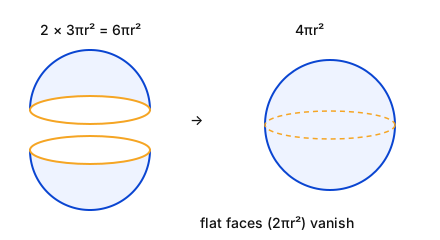
Concept: TSA of a solid hemisphere =3πr2; surface area of sphere =4πr2.

  1. Two hemispheres: 2×3πr2=6πr2.
  2. Sphere formed: 4πr2; reduction =2πr2 (the two flat faces).
  3. Percentage =2πr26πr2×100=33.33%.

Trick: Joining hides 2 of the 6 units of area ⇒ 13 reduction.

Answer: (A) 33.33

अवधारणा: ठोस अर्धगोले का TSA =3πr2; गोले का पृष्ठीय क्षेत्रफल =4πr2.

  1. दो अर्धगोले: 2×3πr2=6πr2.
  2. बना गोला: 4πr2; कमी =2πr2 (दोनों समतल फलक)।
  3. प्रतिशत =2πr26πr2×100=33.33%.

ट्रिक: जोड़ने पर 6 में से 2 इकाई क्षेत्रफल छिप जाता है ⇒ 13 कमी।

उत्तर: (A) 33.33

RRB NTPC Undergraduate CBT 1MathematicsSurface area (hemisphere, sphere)RRB NTPC Undergraduate CBT 1 2025 · 8 May Shift 2 →
Q8060.
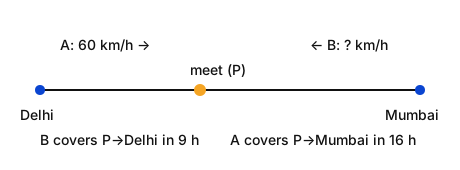
Two trains, A and B, start simultaneously from stations Delhi and Mumbai respectively towards each other on parallel tracks. After meeting, train A takes 16 hours to reach Mumbai, and train B takes 9 hours to reach Delhi. If train A’s speed is 60 km/h, what is the length of train B (in meters), given that it crosses a pole in 18 seconds?
दो रेलगाड़ियाँ, A और B, क्रमशः दिल्ली और मुंबई स्टेशनों से एक साथ समांतर पटरियों पर एक-दूसरे की ओर चलना शुरू करती हैं। मिलने के बाद, रेलगाड़ी A को मुंबई पहुँचने में 16 घंटे और रेलगाड़ी B को दिल्ली पहुँचने में 9 घंटे लगते हैं। यदि रेलगाड़ी A की चाल 60 km/h है, तो रेलगाड़ी B की लंबाई (मीटर में) क्या है, यदि यह एक खंभे को 18 सेकंड में पार करती है?
  1. A420
  2. B400
  3. C300
  4. D280
Show answer

Concept: If after meeting the trains take t1 and t2 hours to finish, SASB=t2t1.

  1. SASB=916=34⇒SB=43×60=80km/h.
  2. 80km/h=80×518=2009m/s.
  3. Length =2009×18=400m.

Yaad rakhein: Speed ratio is the inverse square root of the post-meeting times: 16:9→3:4.

Answer: (B) 400

अवधारणा: मिलने के बाद यदि ट्रेनें t1 और t2 घंटे लें, तो SASB=t2t1.

  1. SASB=916=34⇒SB=43×60=80km/h.
  2. 80km/h=80×518=2009m/s.
  3. लंबाई =2009×18=400m.

याद रखें: चाल का अनुपात = मिलने के बाद के समयों का व्युत्क्रम वर्गमूल: 16:9→3:4.

उत्तर: (B) 400

RRB NTPC Undergraduate CBT 1MathematicsTrains meeting (speed ratio)RRB NTPC Undergraduate CBT 1 2025 · 8 May Shift 2 →